
Finding the best synthesizers in 2026 means sorting through an overwhelming number of options. Between analog monosynths, digital workstations, hybrid engines, and semi-modular rigs, the choices can paralyze even experienced players. Our team has spent months testing hardware synths across every major brand to cut through the noise.
We compared 15 synthesizers side by side, evaluating sound quality, build construction, interface playability, and real-world value. Whether you need a first synth for learning subtractive synthesis, a gig-ready workstation with thousands of presets, or a desktop module for studio sound design, this guide covers every category and budget.
The hardware synth market has exploded in recent years, with brands like Moog, Arturia, Korg, Roland, and Yamaha all pushing innovation forward. Forum communities consistently tell us that playability and long-term reliability matter more than spec sheets. We listened. Every recommendation here earned its place through hands-on testing, not marketing claims.
Table of Contents
Top 3 Picks for Best Synthesizers (September 2026)
Best Synthesizers in 2026
| Product | Specifications | Action |
|---|---|---|
 MOOG Messenger MOOG Messenger |
|
Check Latest Price |
 Arturia MicroFreak Arturia MicroFreak |
|
Check Latest Price |
 Arturia MiniFreak Arturia MiniFreak |
|
Check Latest Price |
 Roland JUNO-D6 Roland JUNO-D6 |
|
Check Latest Price |
 Yamaha MX61 Yamaha MX61 |
|
Check Latest Price |
 Korg Kross 2-61 Korg Kross 2-61 |
|
Check Latest Price |
 Yamaha reface CS Yamaha reface CS |
|
Check Latest Price |
 MOOG Subsequent 37 MOOG Subsequent 37 |
|
Check Latest Price |
 Korg minilogue xd Module Korg minilogue xd Module |
|
Check Latest Price |
 Novation Peak Novation Peak |
|
Check Latest Price |
 Dreadbox Typhon Dreadbox Typhon |
|
Check Latest Price |
 Korg MS-20 Mini Korg MS-20 Mini |
|
Check Latest Price |
 Korg monologue Korg monologue |
|
Check Latest Price |
 Roland FANTOM-08 Roland FANTOM-08 |
|
Check Latest Price |
 Elektron Syntakt Elektron Syntakt |
|
Check Latest Price |
1. MOOG Messenger – Next-Gen Analog Monosynth with RES BASS
MOOG Messenger Monophonic Analog Synthesizer
32 semi-weighted keys
Dual VCOs with wavefolding
RES BASS compensation
64-step sequencer
6 CV patch points
Pros
- Classic Moog ladder filter with multiple modes
- RES BASS switch preserves low-end during resonance
- Dual loopable ADSRs and two LFOs
- 256 user presets
- Solid metal front panel build
Cons
- No display screen
- Semi-weighted keys may not suit all players
I spent three weeks with the MOOG Messenger as my primary bass and lead synth, and it quickly became the centerpiece of my hardware rig. The first thing that hits you is the build quality. That metal front panel feels like it could survive a world tour without flinching. Every knob has a satisfying resistance, and the layout follows the classic Moog philosophy of one knob per function.
The sound is where this synth earns its Editor’s Choice badge. Those two continuously variable-shape VCOs deliver everything from warm, rounded bass to aggressive, cutting leads. The wavefolding oscillators add harmonics that feel musical rather than harsh. I found myself creating bass patches that sat perfectly in a mix without any EQ adjustment.
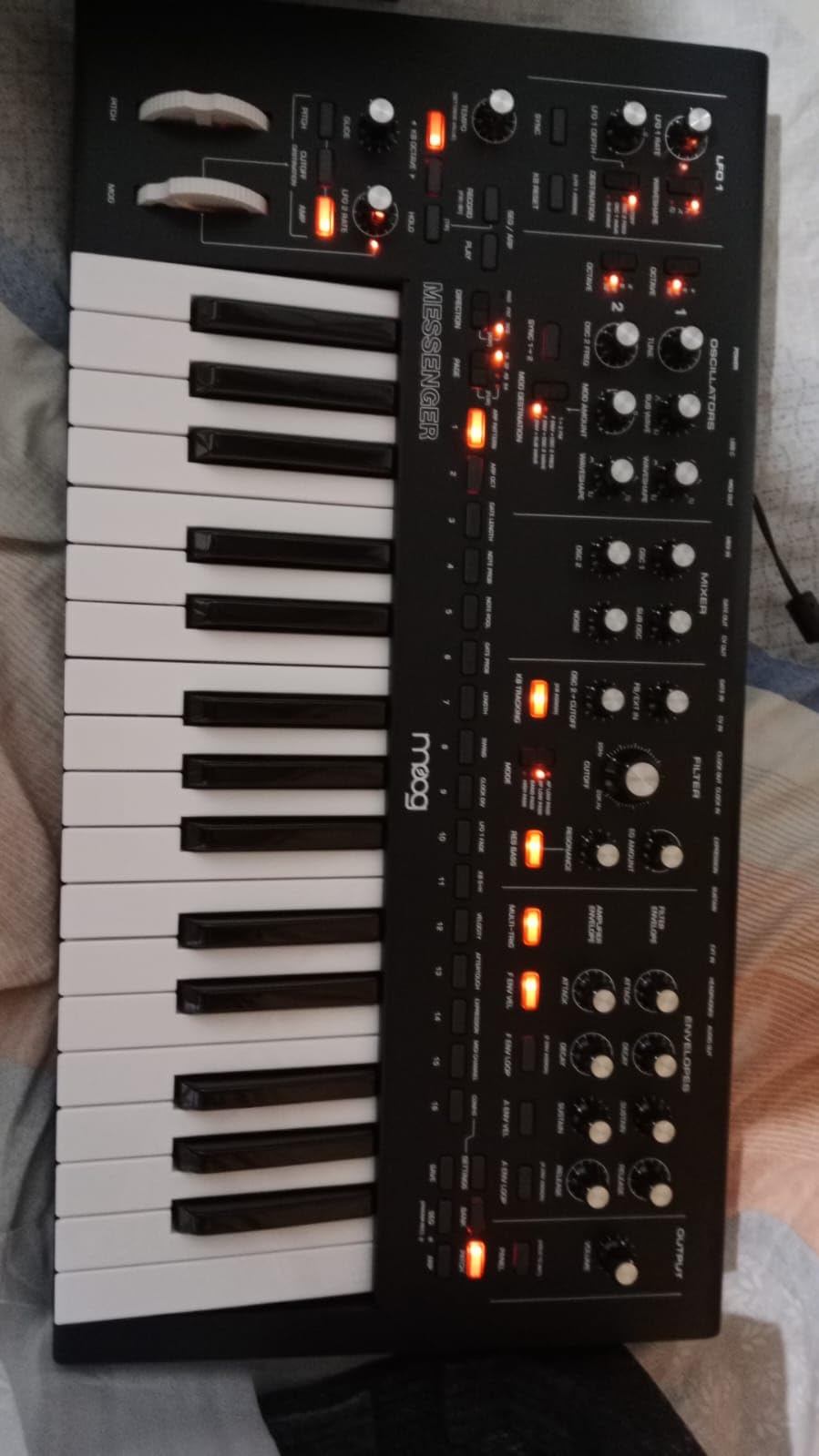
The RES BASS compensation is the standout innovation here. On traditional Moog filters, cranking the resonance eats your low end. The Messenger fixes this with a switch that preserves bass frequencies even at high resonance settings. This sounds like a small thing, but in practice it transforms how you approach filter sweeps and sound design.
The 64-step sequencer with probability-based generative behavior is surprisingly deep. I set up a bassline with probability triggers on certain steps and let it run for hours, constantly surprising me with variations. Combined with the two LFOs and dual ADSR envelopes, the modulation options rival synths costing twice as much. The six CV patch points also open the door to modular integration.
Who This Synth Is Built For
The MOOG Messenger is ideal for producers who want premium analog sound without spending flagship money. If you create electronic music, hip-hop, synthwave, or any genre where bass and lead sounds are central, this synth delivers. It also works well for modular enthusiasts who want a keyboard-based synth with CV patch points for integrating with Eurorack systems.
Performers will appreciate the 256 presets, arpeggiator, and solid construction. However, if you need polyphonic chords or a visual display for deep menu editing, you should look elsewhere.
What to Consider Before Buying
This is a monophonic synthesizer, meaning it plays one note at a time. If your music requires pads, chords, or layered harmonic content, you will need a polysynth alongside it. The purely knob-per-function interface means no screen, which some users love and others find limiting when managing 256 presets.
At this price point, the Messenger competes with the Moog Subsequent 37. The Subsequent offers paraphonic capability and a screen, but lacks the sequencer, RES BASS technology, and modern patch points. For most modern producers, the Messenger represents better value.
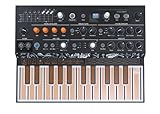
2. Arturia MicroFreak – Experimental Hybrid with 17 Oscillator Modes
Arturia MicroFreak Synthesizer Keyboard
25-key PCB touch keyboard
17 paraphonic oscillator modes
Analog Oberheim SEM filter
5x7 modulation matrix
CV outputs
Pros
- 17 oscillator types for endless sound design
- Innovative PCB touch keyboard with per-note aftertouch
- Deep modulation matrix
- Constant firmware updates add features
- Compact and backpack portable
Cons
- No onboard effects
- Tiny power switch feels fragile
- No USB-C cable included
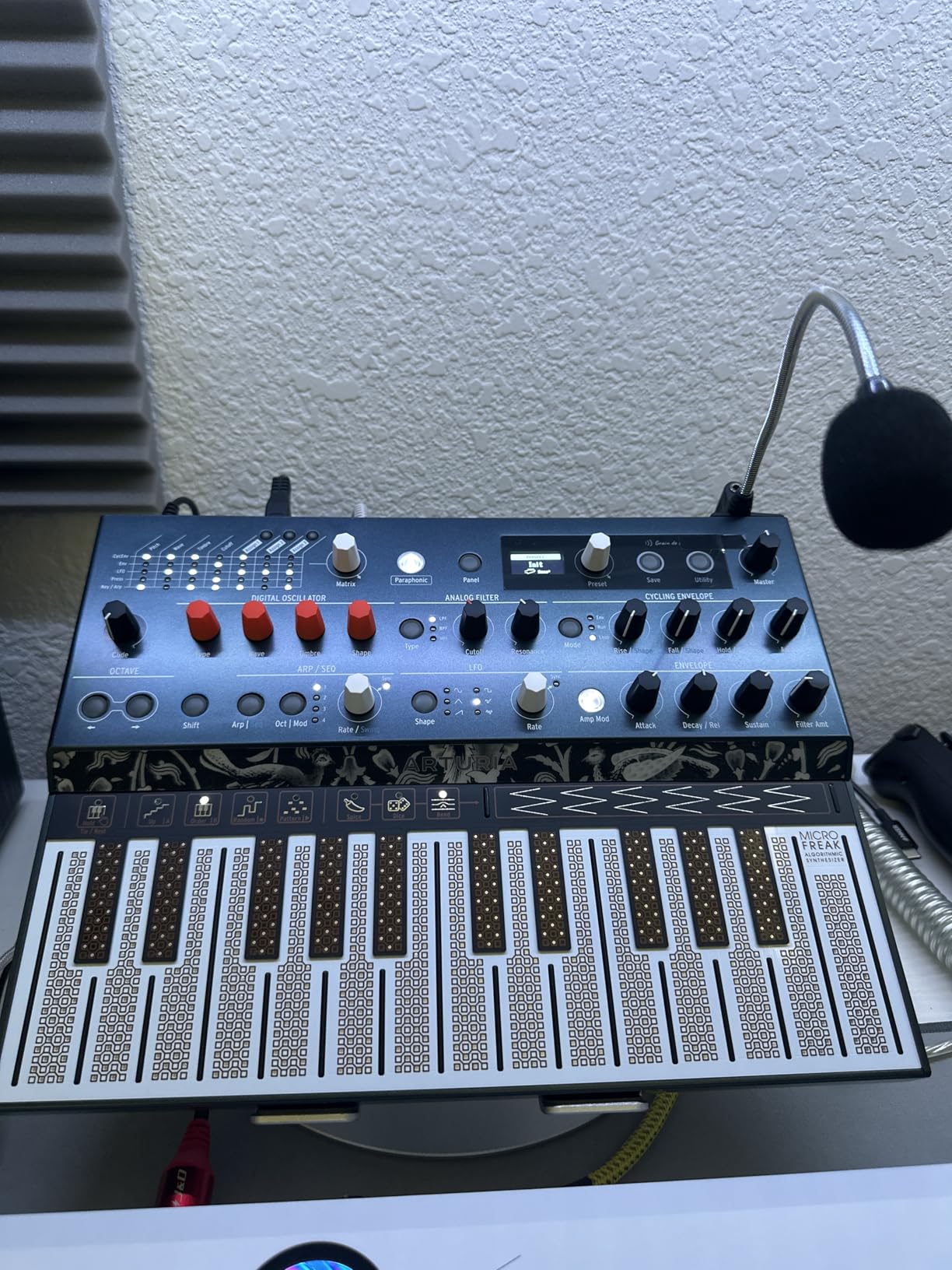
The Arturia MicroFreak is the synth that the Reddit community consistently recommends to beginners, and after using one for over a year, I understand why. Nothing at this price point comes close to the sheer range of sounds this little machine produces. With 17 oscillator modes spanning wavetable, Karplus Strong, superwave, noise, and even a vocoder, the MicroFreak covers more sonic territory than synths three times its price.
The PCB touch-plate keyboard is unlike anything else. There are no moving parts. You press a flat circuit board, and it detects pressure per note. This enables polyphonic aftertouch, which is almost unheard of at this price. Some players hate the feel, but I adapted within a few days and now find traditional keys slightly limiting by comparison.
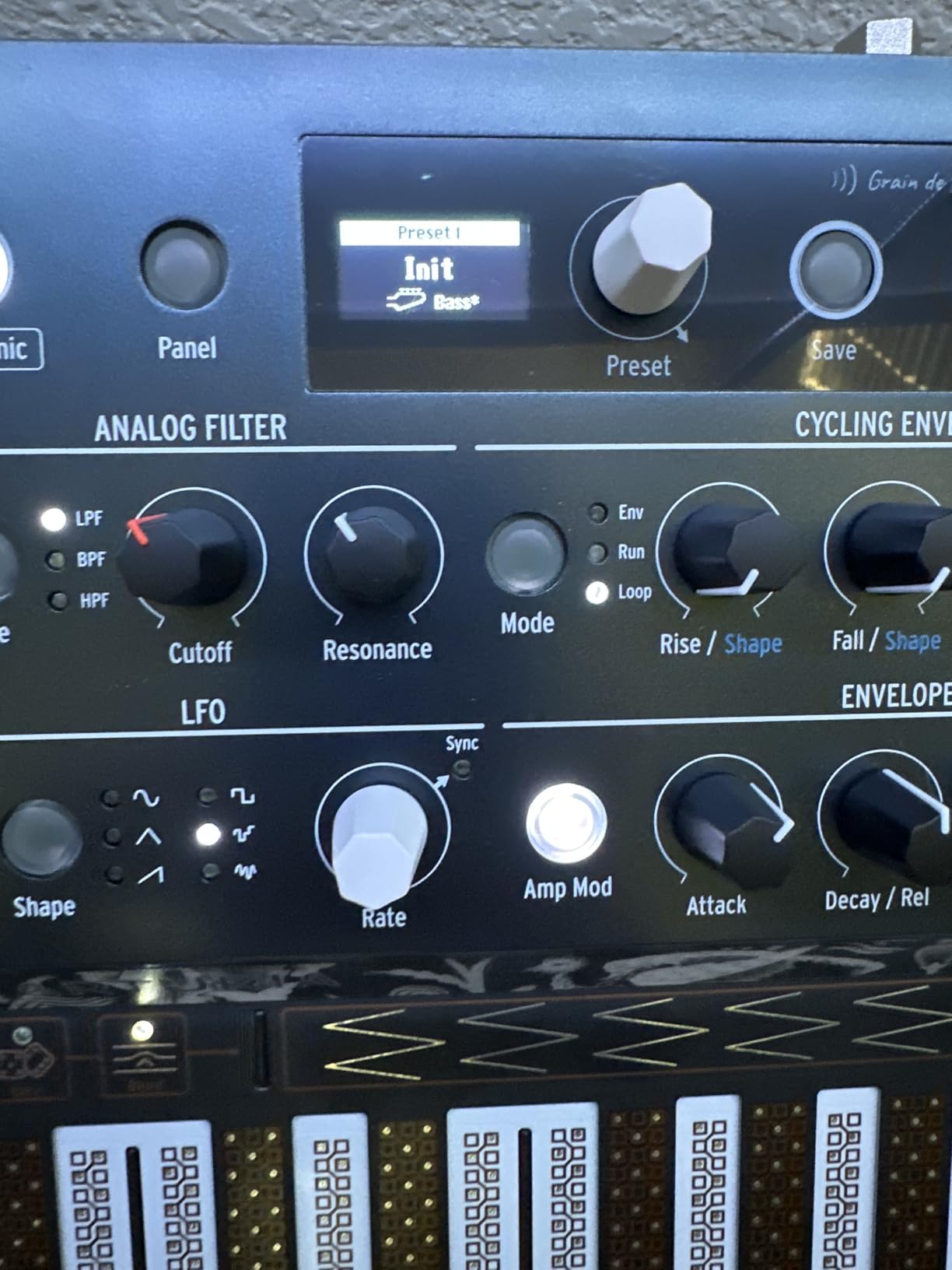
What makes the MicroFreak the best value synthesizer in this guide is Arturia’s commitment to free firmware updates. Since launch, they have added the vocoder mode, new oscillator types, and improved the sequencer. Every update makes the synth feel fresh and expands its capabilities without costing you a cent.
The 5×7 modulation matrix gives you serious routing power. You can assign LFOs, envelopes, and keyboard pressure to almost any parameter. The Spice and Dice functions on the step sequencer introduce controlled randomness that generates musical results rather than chaos. I have lost hours just hitting Dice and seeing what happens.
Who This Synth Is Built For
Beginners will learn synthesis faster on the MicroFreak than almost any other hardware synth. The variety of oscillator types teaches you how different synthesis methods compare. Sound designers and experimental producers will love the weird, wonderful textures this machine generates. Its compact size also makes it perfect for mobile production rigs.
If you are on a tight budget and want maximum sonic capability per dollar, this is your synth. The included MiniFreak V software plugin gives you a virtual counterpart for DAW work.
What to Consider Before Buying
The MicroFreak has no onboard effects. No reverb, no delay, no chorus. You will need to process the sound externally or in your DAW. Some users see this as a limitation, while others prefer the dry signal for maximum control. The touch keyboard also polarizes players. Try one before buying if possible.
The case is lightweight plastic, and the power switch is notably small. This is a studio tool, not a tank built for stage abuse. For gigging musicians, consider a protective case.
3. Arturia MiniFreak – 6-Voice Polyphonic Hybrid Powerhouse
Arturia MiniFreak 37 Key Polyphonic 6-Voice Hybrid Synthesizer Keyboard (Standard, 37 Key)
37 velocity-sensitive keys
6-voice polyphonic
Multi-mode synthesis engine
256 presets
Includes MiniFreak V software
Pros
- Massive feature set at great value
- Beginner-friendly with expert depth
- Constant meaningful firmware updates
- Solid build survived accidental drops
- Deep sequencer and arpeggiator
Cons
- Screen and UI could be larger
- Capacitive buttons less responsive than physical ones
The Arturia MiniFreak takes everything great about the MicroFreak and adds a real keyboard, six voices of polyphony, and onboard effects. I tested this synth alongside its smaller sibling, and the MiniFreak is the one I kept coming back to for complete productions. Having six voices means you can play full chords, layered pads, and complex harmonic parts that the MicroFreak cannot handle.
The 37 velocity-sensitive keys with aftertouch feel surprisingly good for this price range. Arturia clearly listened to feedback about the MicroFreak’s touch keyboard. The MiniFreak gives you a proper playing experience while keeping the same powerful multi-mode synthesis engine underneath.
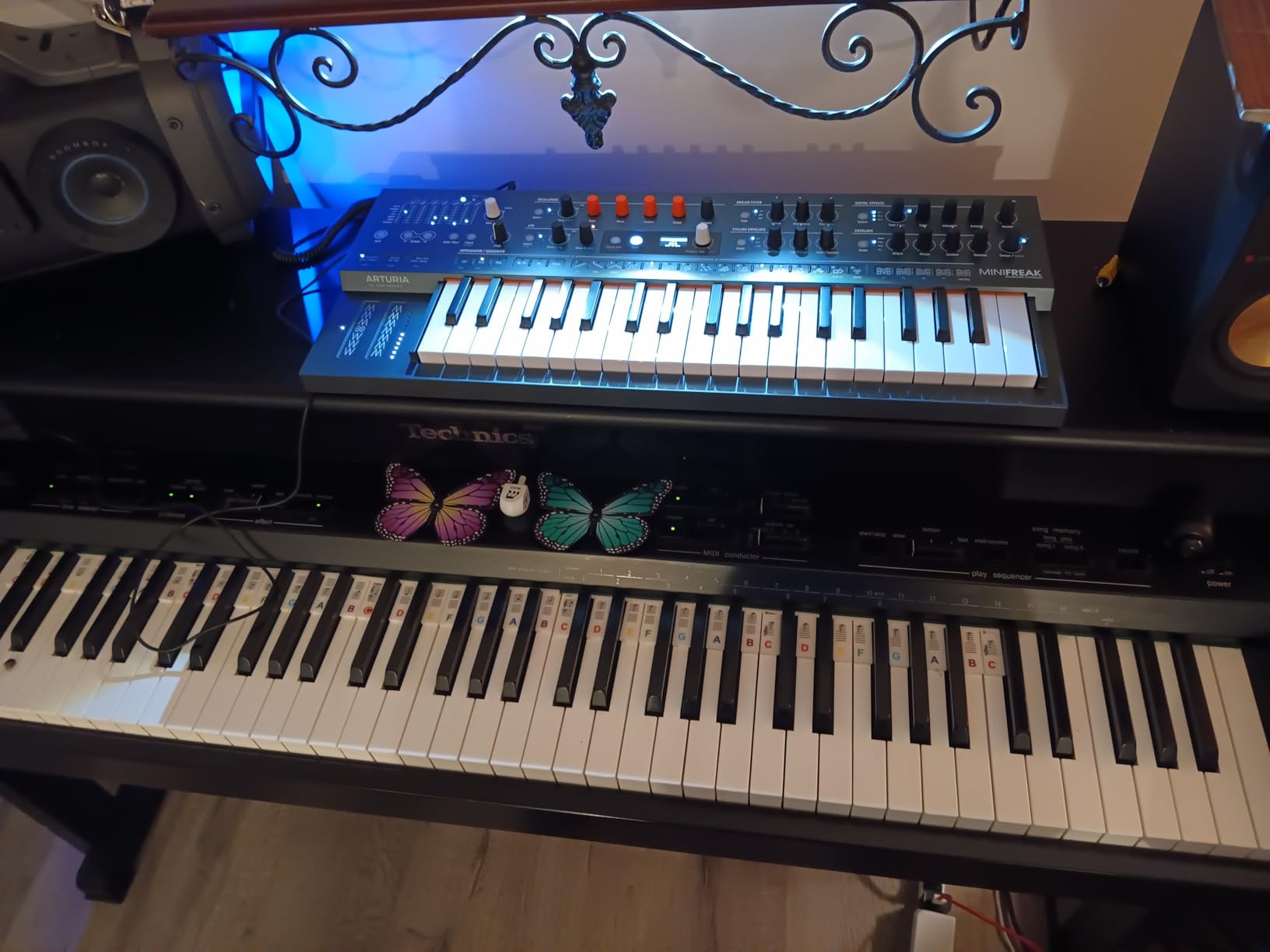
The dual digital and analog signal path produces sounds that sit somewhere between the warmth of pure analog and the flexibility of digital. The oscillator types borrow from wavetable, FM, virtual analog, and physical modeling synthesis. This makes the MiniFreak one of the most versatile hardware synths available, capable of everything from classic analog bass to futuristic textures.
One of my favorite features is the included MiniFreak V software. You get a virtual instrument version of the synth for your DAW, with the same sound engine and preset compatibility. Patches transfer between hardware and software seamlessly. This dual approach effectively gives you two synths for the price of one.
Who This Synth Is Built For
The MiniFreak sits in a sweet spot for intermediate producers and beginners ready to upgrade. If you started with a MicroFreak and want polyphony plus real keys, this is the natural next step. It also works as a studio centerpiece for electronic music producers who need one synth that can cover bass, leads, pads, and sequences.
The beginner-friendly skill rating from Arturia is accurate. The interface is approachable enough for someone just learning subtractive synthesis, but deep enough to keep advanced users engaged for years.
What to Consider Before Buying
The screen is small and the menu structure takes time to learn. Some parameters are buried in sub-menus that require manual reading to discover. The capacitive buttons under the encoder respond to touch, which some users find less satisfying than physical buttons.
Stock availability is frequently limited, so if you find one in stock, do not hesitate. The MiniFreak regularly sells out due to high demand and excellent value proposition.
4. Roland JUNO-D6 – Gig-Ready Workstation with 3800+ Sounds
Roland JUNO-D6 Synthesizer, 61-Note Keyboard
61-note synth-action keyboard
ZEN-Core engine
Over 3800 sounds
USB-C audio and MIDI
Battery power support
XLR mic input
Pros
- Massive sound library covers any genre
- Intuitive workflow for live use
- USB-C power bank compatible
- XLR mic input with fader
- Gig-ready construction
Cons
- Some report thin sound vs competitors
- Keys feel slightly small
- No sustain hold button
The Roland JUNO-D6 is designed for working musicians who need every sound imaginable at their fingertips. I tested it in a live band context, running through covers spanning pop, rock, electronic, and jazz. The ZEN-Core engine delivers over 3800 ready-to-play sounds, and I never found myself wanting for a patch. From acoustic piano to analog synth bass, the JUNO-D6 covers the bases.
What sets this apart from other workstations is the mobile-friendly design. Battery power support means you can play anywhere with a USB-C power bank. I took it to an outdoor gig without worrying about power access. The XLR mic input with independent fader is a thoughtful addition for singer-keyboardists.
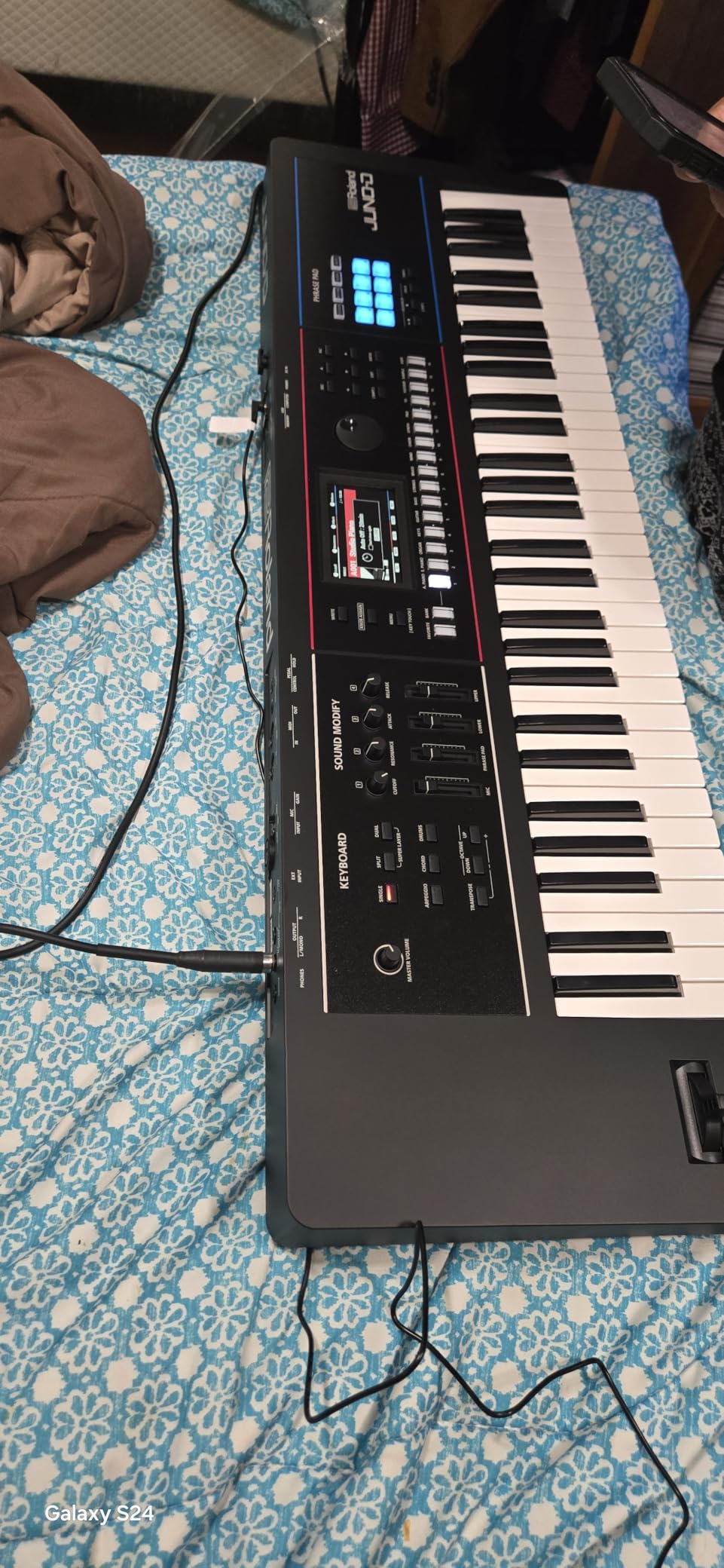
The sample import function lets you load your own WAV files, which expands the sound palette beyond the factory content. Roland Cloud integration gives you access to additional Sound Packs and Wave Expansions. This connectivity makes the JUNO-D6 a synth that grows with your needs rather than limiting you to factory presets.
However, the JUNO-D6 has drawn mixed reactions regarding sound character. Some users report that acoustic sounds feel thinner compared to Yamaha equivalents. The synth-action keys are also slightly narrower than standard piano keys, which took me a few sessions to adjust to.
Who This Synth Is Built For
Gigging musicians and cover band keyboardists are the primary audience. If you play in a function band, wedding band, or worship team where you need hundreds of sounds instantly accessible, the JUNO-D6 excels. The intuitive workflow means you can find and layer sounds quickly during live performances.
Producers who want a do-everything workstation for home studio use will also benefit. The vast sound library covers production needs from EDM to orchestral arrangements.
What to Consider Before Buying
The 4.1-star average rating reflects some real concerns. Test the acoustic piano and string sounds against a Yamaha MX61 if those instruments are central to your playing. The key size difference may bother pianists with larger hands. Also note that there is no dedicated sustain button on the panel.
Effects navigation during live performance requires some menu diving. If you switch effects frequently between songs, map your most-used patches to the favorite buttons to minimize stage fumbling.
5. Yamaha MX61 – MOTIF Sound Engine at a Working Musician’s Price
Yamaha MX61BK Music Production Synthesizer, 61-Key, Black
61-key synth action
MOTIF sound engine
128-note polyphony
Virtual Circuit Modeling
16-track sequencer
USB audio and MIDI
Pros
- Exceptional MOTIF sample quality
- 128-note polyphony for dropout-free playing
- Layer and split modes for live use
- Lightweight and portable
- Free additional sounds from Yamaha
Cons
- Menu diving for some functions
- Synth-action keys not weighted
- Older digital interface design
The Yamaha MX61 brings the legendary MOTIF sound engine to a price point that working musicians can actually afford. I have used MOTIF-series keyboards in professional studios, and the MX61 delivers a remarkable percentage of that sound quality. The acoustic piano, strings, brass, and synth patches all carry the distinctive Yamaha polish that has made the MOTIF line a studio standard.
The 128-note polyphony is a major advantage. Even when layering complex sounds with heavy sustain pedal use, I never experienced note dropout. This makes the MX61 reliable for dense arrangements and live performances where polyphony limits could cause embarrassing cutouts.
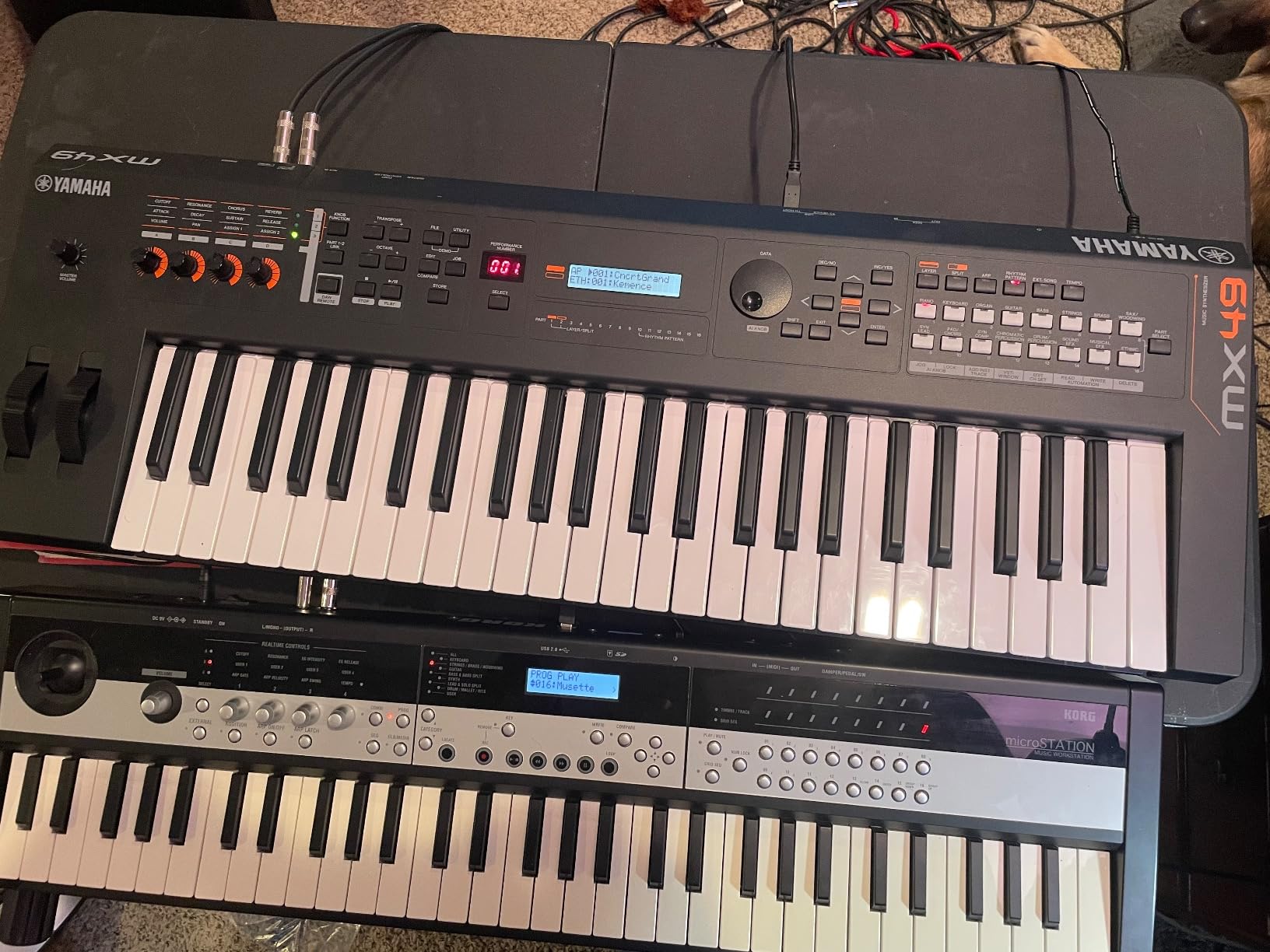
Virtual Circuit Modeling recreates vintage effects processors with convincing accuracy. The compressor, EQ, and modulation effects sound organic rather than digital. Layer and split modes let you combine sounds across the keyboard, which I used extensively for creating full-sounding performance patches.
At just under 15 pounds, the MX61 is one of the lightest 61-key synthesizers in its class. I carried it to rehearsals and gigs without the back strain that heavier workstations cause. The class-compliant USB connection handles both audio and MIDI over a single cable, which simplifies studio setup considerably.
Who This Synth Is Built For
The MX61 is built for gigging keyboardists and home studio producers who need professional sounds without the flagship price. If acoustic instrument sounds matter to you, particularly piano and strings, Yamaha’s MOTIF engine remains the gold standard. The remote control function for major DAWs also makes it a capable studio controller.
Students and intermediate players benefit from the included Cubase AI software, which provides a complete recording environment. This makes the MX61 an all-in-one production starter package.
What to Consider Before Buying
The menu system requires patience. Many functions are accessed through button combinations and screen navigation that feel dated compared to modern touchscreen interfaces. If you are accustomed to modern synths with large displays, the MX61 will feel like a step back in interface design.
The synth-action keybed is not weighted, which some pianists find unsatisfying. However, for the price and feature set, this tradeoff is reasonable. The included software bundle varies by region, so verify what ships with your unit.
6. Korg Kross 2-61 – Lightweight Workstation with Surprising Depth
Korg Kross 2-61 61-Key Synthesizer Workstation
61-key synth action
EDS-i sound engine
Step and MIDI sequencers
Audio recorder
Mic and line inputs
Battery powered
Pros
- Excellent sound quality and variety
- Compact and highly portable
- Great value for features
- Flexible sound customization
- Built-in audio recorder
Cons
- Complex menu navigation
- No included printed manual
- Keys are light synth action
The Korg Kross 2-61 is one of those synths that surprises you the more you use it. At first glance, it looks like a basic entry-level workstation. But the EDS-i sound engine delivers sounds that punch above its weight class. I was particularly impressed with the drum sounds and electronic patches, which hold their own against much more expensive instruments.
Battery power capability makes the Kross 2 genuinely portable. I took it to songwriting sessions in locations without power outlets and worked for hours on six AA batteries. The built-in audio recorder captures your ideas directly, which is invaluable for capturing moments of inspiration before they fade.
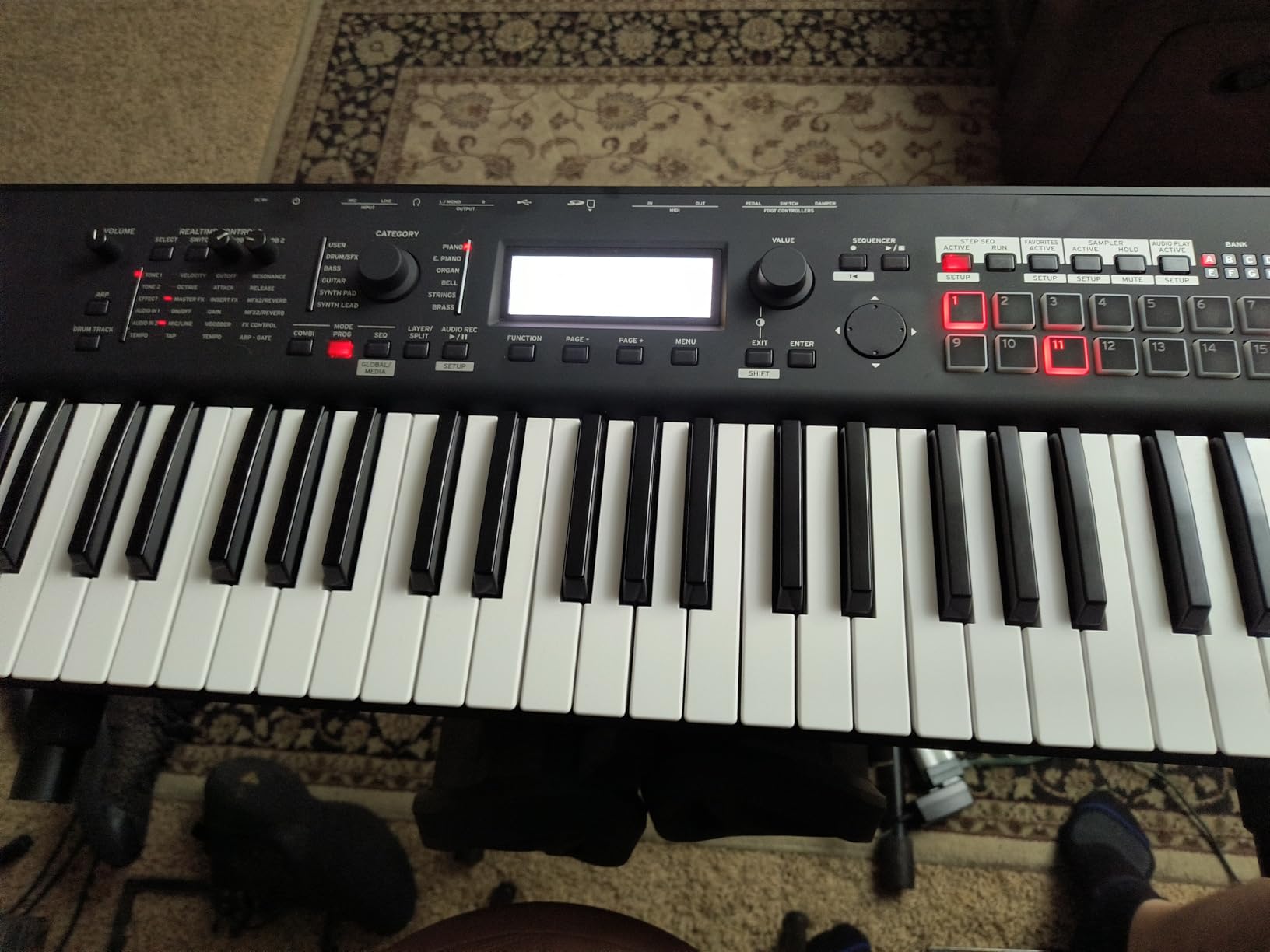
The step sequencer and MIDI sequencer give you two different approaches to pattern creation. The step sequencer is great for drum patterns and electronic music, while the MIDI sequencer handles multi-track arrangements. The favorites function lets you save and instantly recall your go-to sounds, which streamlines live performance.
Sound customization goes deeper than expected. You can edit oscillators, filters, envelopes, and effects with enough granularity to create genuinely unique patches. The mic and line inputs allow you to process external audio through the Kross 2’s effects, effectively making it a basic vocal processor.
Who This Synth Is Built For
Songwriters and home studio producers will appreciate the Kross 2’s all-in-one approach. The combination of sounds, sequencing, and audio recording in one lightweight package covers most creative needs. Beginner to intermediate players who want a workstation without spending flagship money will find excellent value here.
The battery power option also makes it attractive for mobile musicians, street performers, and anyone who creates music away from traditional studio setups.
What to Consider Before Buying
The menu system is complex. Common operations sometimes require navigating through multiple screens, which can be frustrating during live performance. The manual is only available as a 168-page download, with no printed version included.
The lightweight construction that makes it portable also means it feels less premium than metal-bodied alternatives. Handle it with care during transport and it will serve you well for years.
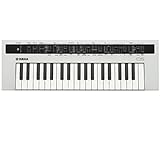
7. Yamaha reface CS – Portable Analog Modeling with Built-In Speaker
Yamaha REFACE CS Portable Analog Modeling Synthesizer
37 mini keys
Analog modeling engine
8-note polyphony
Phrase looper
Built-in speaker
Battery powered
Pros
- Extremely portable with battery power
- Great sound quality for the price
- Easy slider interface for beginners
- Built-in speaker system
- Versatile oscillator types
Cons
- Mini keys may not suit everyone
- No onboard patch memory
- Tiny onboard speakers
The Yamaha reface CS is the synthesizer I recommend to friends who want something they can play anywhere. At just six pounds with battery power and a built-in speaker, it is the most portable proper synthesizer in this guide. The analog modeling engine produces warm, characterful sounds that belie the compact size.
The interface is a textbook example of accessible design. Eight sliders control the core parameters, with oscillator type selection across the top. I handed this synth to a friend who had never touched a synthesizer, and within minutes she was creating patches and understanding how filters and envelopes shape sound.
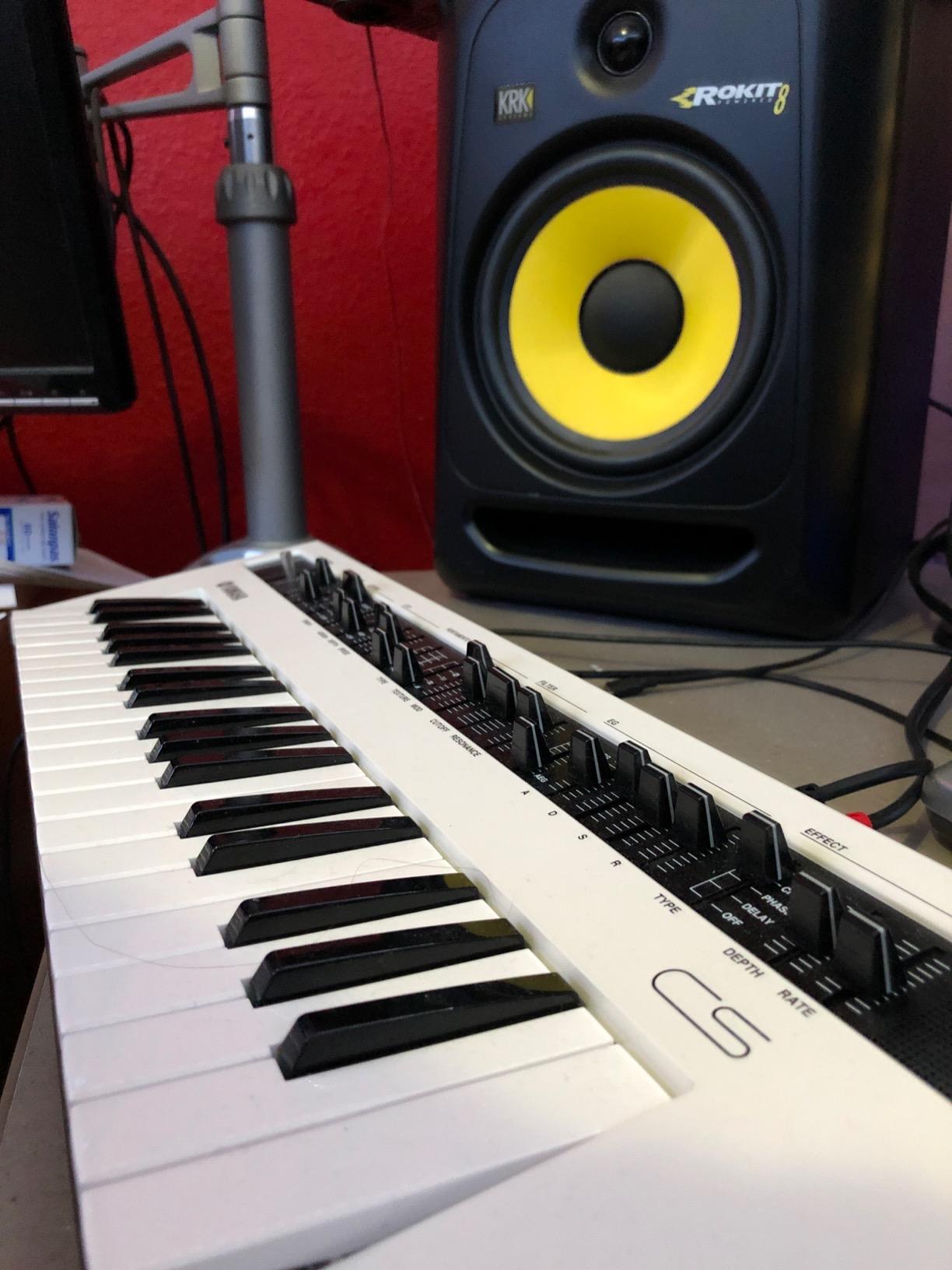
The eight-note polyphony lets you play chords and pads, which is impressive for a portable instrument at this price. The multiple oscillator types, including sawtooth, square, FM, and ring modulation, give you a broad palette. The integrated phrase looper captures musical ideas for layering and practice.
Sound quality through the built-in speaker is acceptable for sketching ideas, but the reface CS truly shines through headphones or external speakers. Connect it to a proper sound system and the depth of the analog modeling engine becomes immediately apparent.
Who This Synth Is Built For
Beginners learning synthesis will find the reface CS one of the most approachable instruments available. The slider interface teaches subtractive synthesis fundamentals intuitively. Experienced players will appreciate it as a portable sketchpad for ideas on the go.
Traveling musicians and anyone who makes music outside a studio will love the battery power and built-in speaker. It is also an excellent secondary synth for layering textures alongside a primary instrument.
What to Consider Before Buying
The mini keys are smaller than standard piano keys, which can frustrate players with larger hands. There is no onboard patch memory, meaning your sounds disappear when you power off. Yamaha’s Soundmondo app handles patch storage via mobile device, which works but requires your phone or tablet.
The built-in speakers are fine for practice but lack the power for anything beyond personal listening. Budget for headphones or an external amplifier to get the full sound quality this synth can produce.
8. MOOG Subsequent 37 – Premium Paraphonic Analog Synthesizer
MOOG Subsequent 37 Paraphonic Analog Synthesizer
37 semi-weighted keys
2-note paraphonic
Dual variable VCOs
256 presets
40 knobs, 74 switches
Software editor included
Pros
- Exceptional tank-like build quality
- Amazing fat Moog analog sound
- Comprehensive modulation routing
- Software editor works flawlessly
- 256 preset slots with screen
Cons
- Premium price point
- Limited to 2-note paraphonic
- No arpeggiator or sequencer
The MOOG Subsequent 37 is built like a tank and sounds like a dream. When I first unboxed it, the weight alone told me this was a serious professional instrument. The bass wood body houses 40 knobs and 74 switches, giving you hands-on control over virtually every parameter without touching a menu.
The sound is what you expect from Moog: thick, warm, and authoritative. Those two variable waveshape oscillators produce bass that shakes the room and leads that cut through any mix. The paraphonic mode lets you play two notes simultaneously, which opens up interval and drone possibilities that a standard monosynth cannot achieve.
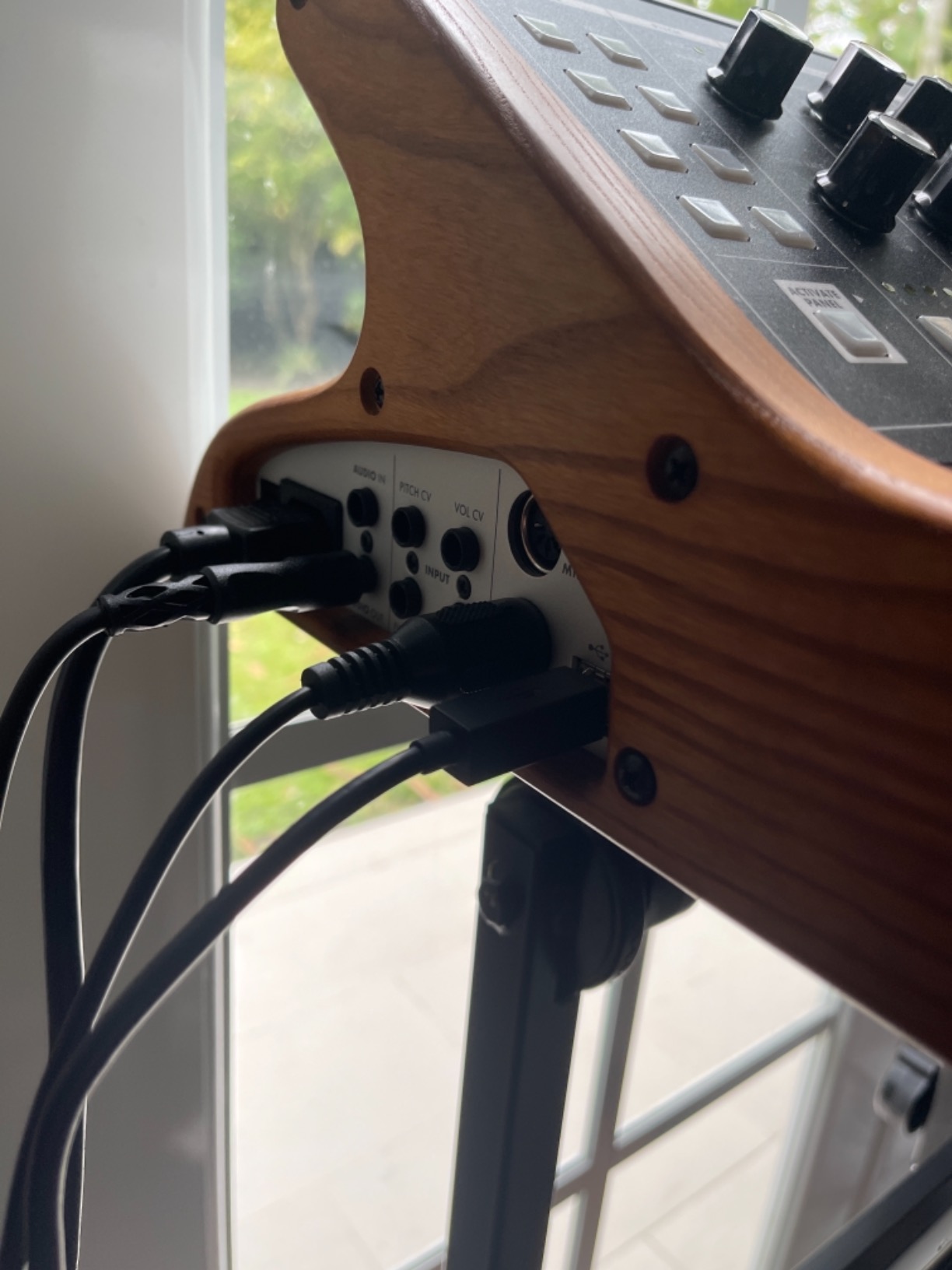
The external input and filter feedback feature is a hidden gem. You can route external audio through the Moog filter, which means the Subsequent 37 doubles as an analog effects processor for other instruments. I ran drum loops through the filter and created textures that no plugin could replicate.
The included software editor is one of the best I have used. It mirrors the hardware interface on screen and allows for deep preset management, patch randomization, and modulation bus programming that would be tedious on the hardware alone. The 256 preset slots give you plenty of room to store your creations.
Who This Synth Is Built For
Serious musicians and producers who want the Moog sound at its finest will find the Subsequent 37 delivers. If your music centers on bass, leads, and sound design, this instrument provides a lifetime of inspiration. The build quality suggests it will outlast most other gear in your studio.
Sound designers and film composers will appreciate the filter feedback and external input capabilities. The ability to process external audio through a Moog ladder filter adds analog character to any source.
What to Consider Before Buying
The price is significant. The Subsequent 37 costs more than most other synths in this guide, and you are paying for the Moog name, build quality, and sound character. There is no arpeggiator or sequencer built in, which some users find surprising at this price point.
The 2-note paraphonic limit means you cannot play full chords. If polyphony is essential, the Subsequent 37 will not meet your needs. Consider whether the premium Moog sound justifies the investment for your musical style.
9. Korg minilogue xd Module – Desktop Polyphonic Analog with OLED Scope
Korg minilogue xd Module Polyphonic Analog Synth w/ 16-Step Sequencer
4-voice polyphonic analog
Desktop or rackmount
16-step sequencer
OLED oscilloscope
Multi-mode effects
Open source customization
Pros
- Excellent analog sound quality
- Easy knob-per-function interface
- Versatile voice modes including unison and chord
- Compact desktop form factor
- OLED oscilloscope for visual feedback
Cons
- Only 4 voices may be limiting
- Quality control issues with some resellers
- British power supply in some regions
The Korg minilogue xd Module is the desktop version of one of the most popular analog polyphonic synthesizers ever made. I tested it alongside its keyboard counterpart, and losing the keys actually made it more versatile in my setup. The desktop format frees up studio space and lets you control it from whatever keyboard or sequencer you prefer.
Four voices of polyphony covers most musical needs. You can play four-note chords, layer pads, or switch to unison mode for thick, detuned sounds. The voice modes include POLY, UNISON, CHORD, and ARP with latch, giving you creative options beyond standard polyphonic playing.
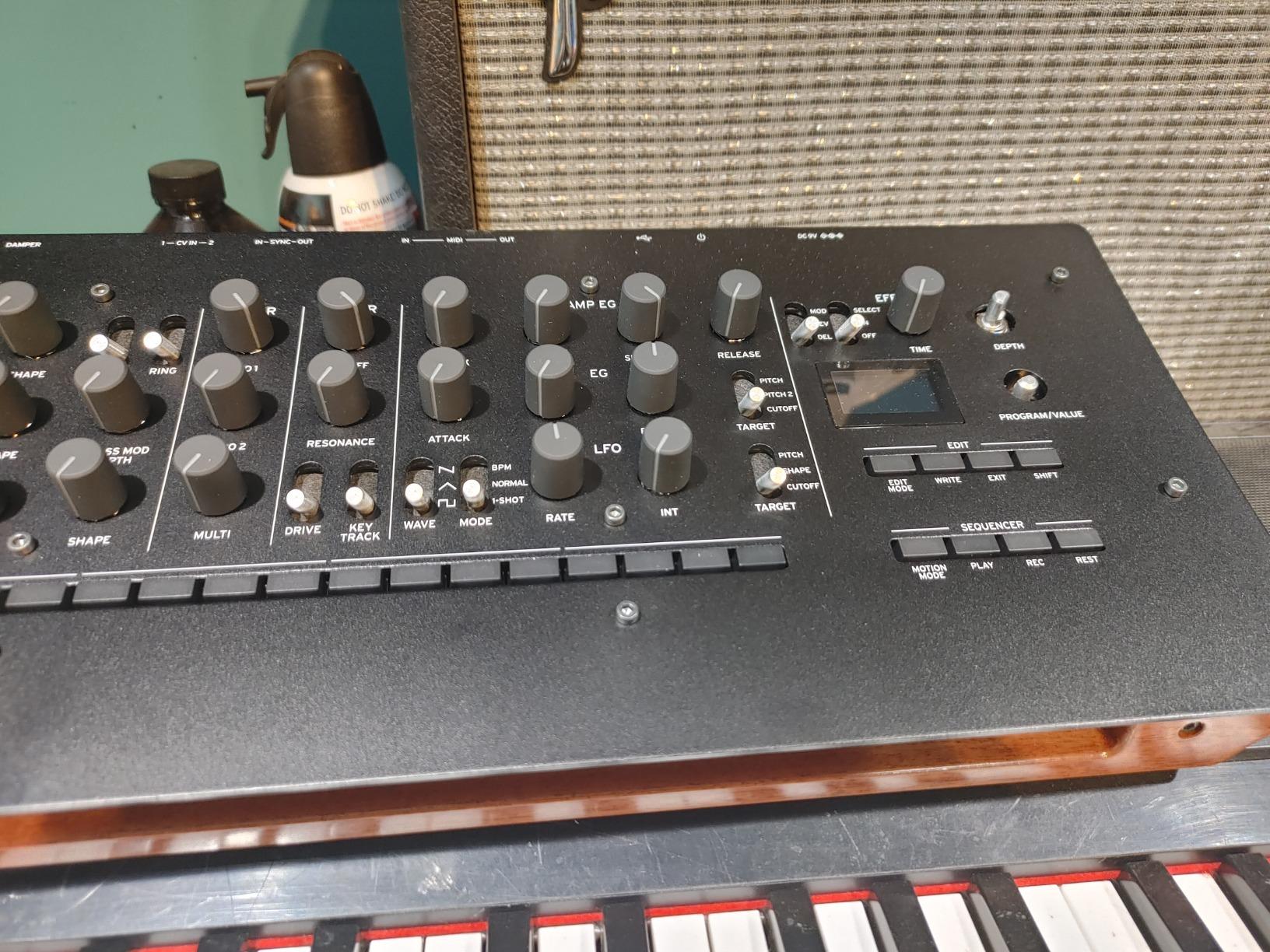
The OLED oscilloscope is more useful than I expected. Seeing your waveform change as you adjust parameters provides immediate visual feedback that speeds up sound design. Combined with the knob-per-function interface, the minilogue xd teaches you analog synthesis through direct interaction.
The built-in effects include modulation, reverb, delay, and chorus. These effects are surprisingly high quality and mean you can create complete, polished patches without external processing. The open-source architecture also allows for custom oscillators and effects, extending the synth’s capabilities indefinitely.
Who This Synth Is Built For
Producers who already own a MIDI keyboard and want to add analog polyphony to their setup will find the minilogue xd Module ideal. The desktop format works perfectly in studio environments where rack space or desk space matters. Beginners learning analog synthesis will also benefit from the clear, accessible interface.
Modular enthusiasts can integrate the minilogue xd into larger systems thanks to its sync capabilities and open-source multi-engine. It bridges the gap between standalone synth and modular ecosystem.
What to Consider Before Buying
Four voices can feel limiting if you play complex jazz voicings or use heavy sustain. Voice stealing becomes noticeable when you exceed four simultaneous notes. The micro tuning capabilities help with this, but polyphonic players may want more voices.
Check the power supply included with your unit. Some regions ship with a British plug, which requires an adapter. Quality control from certain resellers has been inconsistent, so purchase from a reputable dealer with a solid return policy.
10. Novation Peak – 8-Voice Desktop Synth with Oxford Oscillators
Novation Peak 8-Voice Desktop Polyphonic Synthesizer
8-voice desktop polyphonic
Oxford Oscillators with NCOs
16-slot modulation matrix
3 analog distortion points
Reverb, delay, chorus effects
Polyphonic aftertouch via CV
Pros
- Excellent sound with no aliasing
- Lush organic sound character
- Powerful 16-slot modulation matrix
- High-quality onboard reverb
- Compact desktop design
Cons
- Quality control issues reported
- Some menu diving required
- No wooden side panels for stand use
The Novation Peak delivers a sound character that stands apart from other synths in this guide. The Oxford Oscillators combine numerically controlled oscillators with 60 digital wavetables, then route everything through analog filters. The result is a hybrid sound that feels organic and alive, with zero aliasing artifacts even in the upper registers.
I spent weeks creating pad sounds on the Peak, and the modulation matrix made each patch a journey. Sixteen slots let you route LFOs, envelopes, keyboard tracking, and aftertouch to almost any destination. The polyphonic aftertouch via CV input means expressive playing dynamics are captured per-note, not globally.
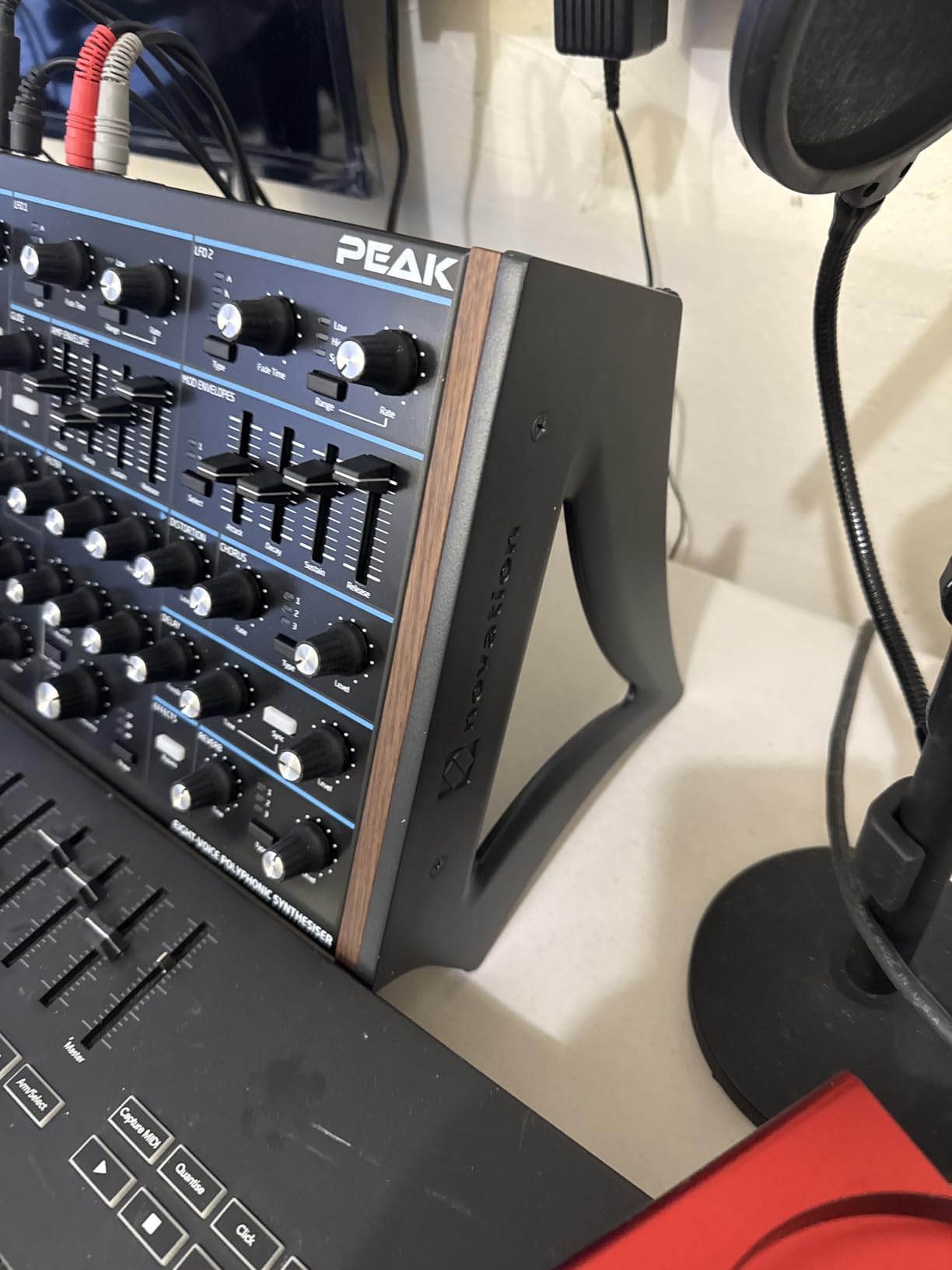
The three analog distortion points are a standout feature. You can drive the signal pre-filter for warmth, post-filter for grit, or globally for overall character. This multi-stage approach gives you precise control over how aggression enters your sound, from subtle saturation to full distortion.
The onboard effects deserve special mention. The reverb quality rivals dedicated plugin reverbs, with lush tails and customizable parameters. Combined with delay and chorus, you can create complete ambient soundscapes entirely within the Peak without any external processing.
Who This Synth Is Built For
Ambient producers and sound designers will fall in love with the Peak. The lush pad sounds and modulation depth make it perfect for evolving textures and atmospheric music. Electronic music producers who need rich, complex lead and bass sounds will also find it extremely capable.
Studio producers who want a desktop module to complement their existing keyboard setup will appreciate the compact form factor and deep sound engine. The Peak pairs beautifully with analog monosynths for a versatile hybrid rig.
What to Consider Before Buying
The 4.3-star average rating reflects some quality control concerns. A minority of users received units with issues, so buy from a retailer with a solid return policy. Novation’s customer service is generally responsive, but it is worth noting before purchase.
Some parameters require menu diving, particularly deeper modulation routing. The front panel is well-organized, but certain functions live in screens rather than on dedicated knobs. If you prefer pure knob-per-function workflow, this may frustrate you.
11. Dreadbox Typhon – Compact Analog Mono with Built-In Effects
Dreadbox Typhon Desktop Monophonic Analog Synthesizer
Desktop monophonic analog
2 VCOs
Resonant lowpass filter
32-step sequencer
Built-in studio effects
USB powered
Pros
- Built-in studio quality effects
- Thoughtful modulation matrix
- USB powered with battery option
- Compact and portable
- Excellent analog sound
Cons
- Lack of CV input
- Oscillator section considered minimal by some
The Dreadbox Typhon packs a surprising amount of analog firepower into a tiny desktop module. I was skeptical about its capabilities given the compact size, but the sound quality immediately won me over. The two analog VCOs through the resonant lowpass filter produce bass and lead sounds with genuine character and warmth.
What sets the Typhon apart from other compact analog synths is the built-in effects section. Reverb, delay, and modulation effects are all included, and they sound excellent. Most desktop monosynths at this price require external effects processing. The Typhon gives you a complete sound design chain in one box.
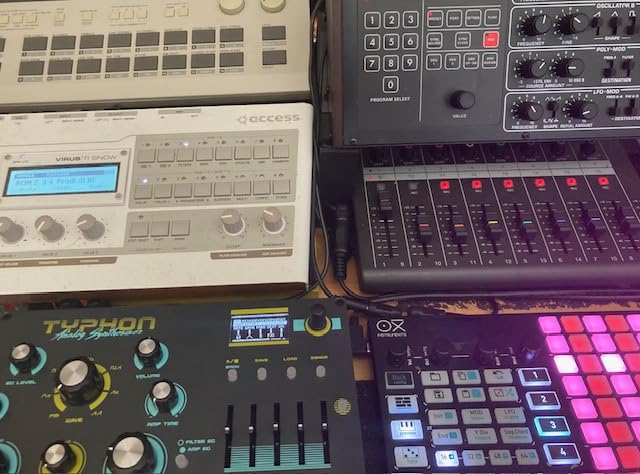
The 32-step sequencer is capable of complex patterns with parameter locks. I created evolving basslines that changed filter cutoff and envelope settings on specific steps, generating musical variation over time. The modulation matrix connects various sources to destinations, enabling patches that move and breathe without manual intervention.
USB powering means the Typhon runs from any USB port or battery pack. I took it on a train journey with a portable battery and headphones, creating patches for the entire trip. The 2.8-pound weight makes it genuinely portable in ways that larger synths cannot match.
Who This Synth Is Built For
Producers who want authentic analog sound in a portable, self-contained package will love the Typhon. The built-in effects mean you do not need additional pedals or plugins to get polished sounds. It is ideal for small home studios where space is at a premium.
Live performers who need a compact sound module will appreciate the rugged construction and USB powering. The Dreadbox sound character also appeals to synthwave, darkwave, and electronic producers who want gritty, characterful tones.
What to Consider Before Buying
The lack of CV input limits integration with modular systems. You can receive CV modulation but cannot route the Typhon’s parameters to external gear. Some users find the oscillator section minimal compared to larger analog synths, though the sound quality compensates for the simplicity.
The Typhon is monophonic, so it handles one note at a time. If you need chords or pads, pair it with a polysynth. For bass and lead duties, it excels.
12. Korg MS-20 Mini – Legendary Semi-Modular Analog Synthesizer
Korg MS20 Mini Semi-Modular Analog Synthesizer (MS20MINI), MultiColored, M
Semi-modular analog
Dual VCOs
Dual filters with HP and LP
External signal processor
Patch bay with cables
USB and 5-pin MIDI
Pros
- Self-oscillating filters with distinctive character
- External signal processor for routing audio
- Flexible patching system
- Authentic recreation of classic MS-20 sound
- Semi-modular design teaches synthesis
Cons
- Knobs feel wobbly compared to premium gear
- 1/8 inch patch cables
- Plastic build quality
- Noisy at high VCA settings
The Korg MS-20 Mini is a faithful recreation of one of the most iconic synthesizers ever made. Owning one connects you to decades of electronic music history. I have always wanted an original MS-20, and the Mini delivers that sound and patching experience at a fraction of vintage prices.
The dual filter architecture is what makes the MS-20 special. The high-pass and low-pass filters both self-oscillate, meaning they can produce sound independently. This creates unique sonic possibilities, from aggressive industrial bass to otherworldly sound effects. The filters have a distinctive distortion character that no plugin has successfully replicated.
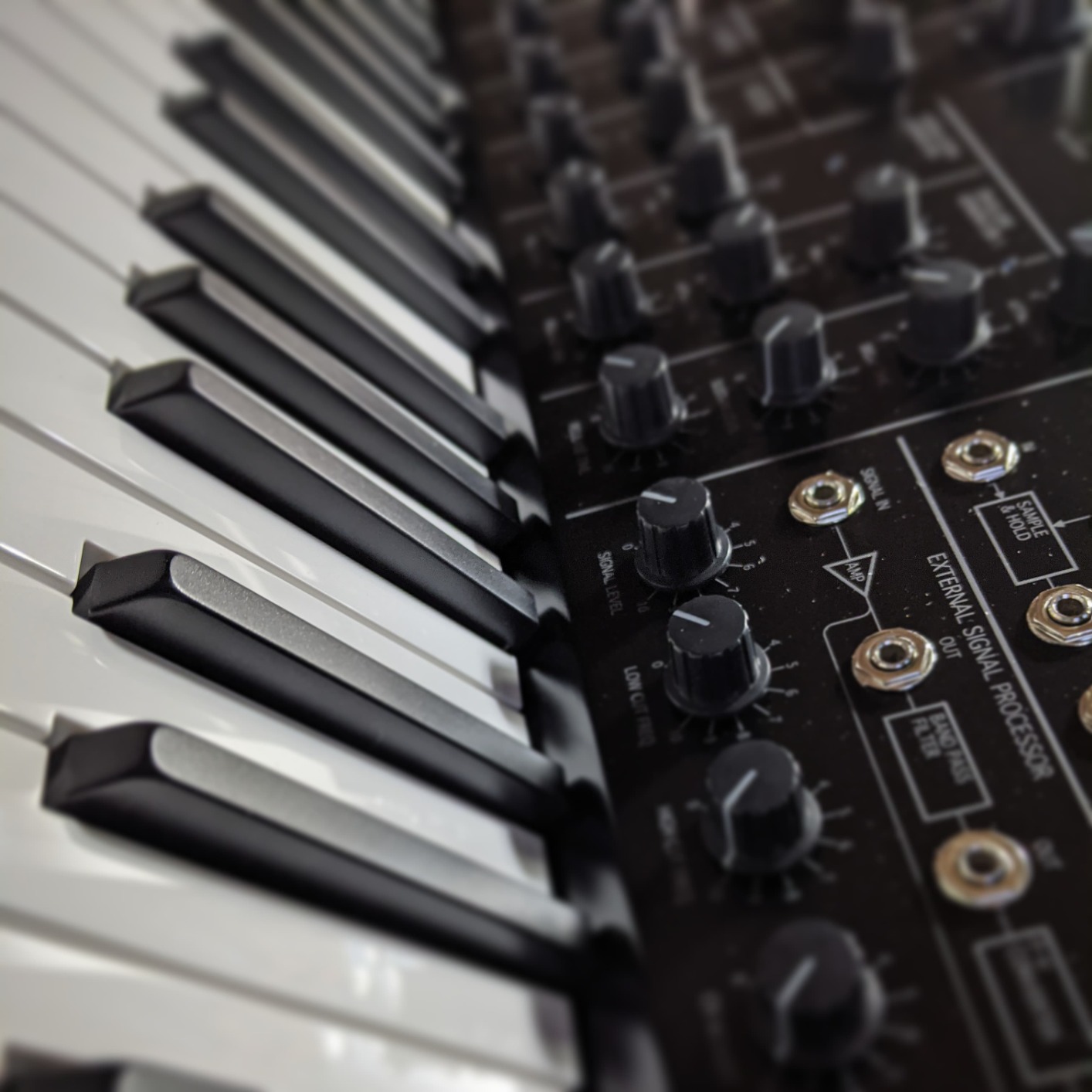
The External Signal Processor (ESP) is a feature most synths lack entirely. You can route any external audio through the MS-20’s filters and envelopes. I plugged a guitar into the ESP and used the MS-20 as an analog effects unit, creating filtered, enveloped guitar textures that sounded completely unique.
The patch bay teaches you signal flow in a way that no fixed-architecture synth can. By physically connecting patch cables between modules, you develop an intuitive understanding of how synthesizers work. This makes the MS-20 Mini one of the best educational tools for anyone serious about understanding synthesis at a fundamental level.
Who This Synth Is Built For
Synth enthusiasts and collectors who want the classic MS-20 experience will find the Mini authentic and inspiring. Electronic music producers creating industrial, techno, acid, or experimental music will discover sounds here that no other synth produces. The semi-modular architecture also makes it an excellent teaching tool.
If you are considering getting into modular synthesis but find Eurorack intimidating, the MS-20 Mini provides a gentle entry point with its normalized signal flow and patchable overrides.
What to Consider Before Buying
The build quality reflects the affordable price. The knobs have some wobble, the body is plastic, and the patch cables use 1/8-inch connectors rather than the 1/4-inch standard of the original. The VCA can be noisy at high settings, which adds character but may bother purists.
This is a monophonic synth with no preset memory. Every sound you create exists only as long as you keep the patch cables and knob positions intact. For live performance, this means careful planning or accepting that each performance will be unique.
13. Korg monologue – Affordable Analog Mono with OLED Display
Korg monologue Monophonic Analog Synthesizer w/ 16-step Sequencer – Black
Monophonic analog
25-key compact
2-pole VCF with DRIVE
16-step sequencer
OLED oscilloscope
Battery powered
Pros
- 2-pole VCF with aggressive bite
- DRIVE circuit for rich bass and leads
- 16-step sequencer with motion sequencing
- Battery powered for portability
- OLED oscilloscope visual feedback
Cons
- Envelope lacks sustain stage
- Smaller keys than full size
The Korg monologue is the best budget synthesizer I have tested. At its price point, nothing delivers this level of analog sound quality and build construction. I have recommended this synth to more beginners than any other, and every single person has come back thrilled with their purchase.
The 2-pole filter gives the monologue a distinctly aggressive character compared to the smoother 4-pole filters on many analog synths. Combined with the DRIVE circuit, this produces bass sounds that cut through mixes and lead tones that demand attention. The monologue does not try to sound polite, and that is its greatest strength.
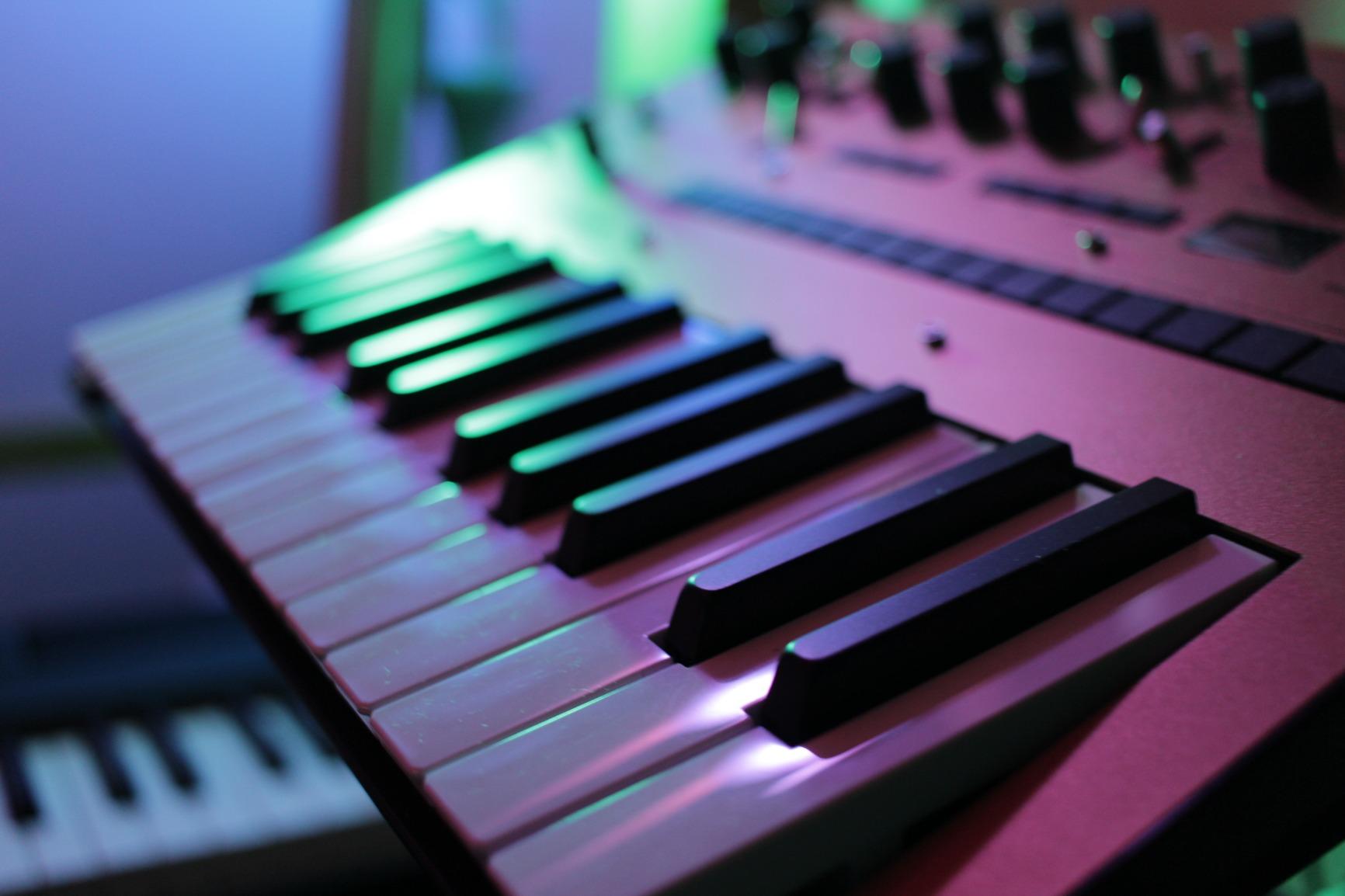
The 16-step sequencer is one of the most intuitive I have used on any hardware synth. Step buttons light up to show your pattern, and holding a button while turning a knob creates parameter locks that animate your sequence. Motion sequencing captures knob movements and replays them, generating evolving patterns from simple inputs.
The OLED oscilloscope displays your waveform in real time, which is both useful and deeply satisfying. Watching the wave shape change as you adjust pulse width or filter cutoff provides immediate visual confirmation of your sound design choices. This feature is remarkable at this price point.
Who This Synth Is Built For
Beginners looking for their first analog synthesizer should start here. The monologue teaches subtractive synthesis fundamentals through a clear, accessible interface. The aggressive sound character also appeals to electronic music producers making techno, electro, bass music, and any genre that benefits from cutting analog tones.
Budget-conscious producers who want genuine analog sound without spending hundreds more will find the monologue unbeatable value. Battery powering also makes it attractive for mobile production.
What to Consider Before Buying
The envelope generator lacks a sustain stage. You get attack and decay, but no traditional sustain level. This shapes how you program sounds and can be a limitation for certain patch types. Some players adapt quickly, while others find it frustrating.
The keys are smaller than full-size, similar to the reface CS. Players with large hands may find them cramped. Despite these limitations, the monologue remains one of the best values in analog synthesis.
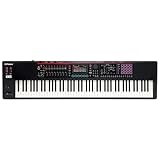
14. Roland FANTOM-08 – 88-Key Weighted Workstation Flagship
Roland FANTOM-08 WEIGHTED-ACTION SYNTHESIZER KEYBOARD – 88-Note Weighted Keyboard | Thousands of Roland Electronic & Acoustic Sounds | ZEN-Core and SuperNATURAL Technologies
88-note weighted keyboard
ZEN-Core and SuperNATURAL
SuperNATURAL pianos
Virtual ToneWheel Organ
Deep sampling
TR-REC sequencer
Color touchscreen
Pros
- 88-note weighted keyboard with excellent feel
- Thousands of acoustic and electronic sounds
- Deep sampling capabilities
- Color touchscreen interface
- DAW integration with Roland Cloud
Cons
- Quality control and shipping damage reports
- Touchscreen issues reported
- Heavy at 40 pounds
- Limited tone memory compared to higher models
The Roland FANTOM-08 is a flagship workstation that combines synthesizer power with a fully weighted 88-note keyboard. I tested it extensively for piano-based production work, and the weighted action is among the best in its price range. The SuperNATURAL piano sounds have a depth and responsiveness that makes playing them genuinely enjoyable.
The ZEN-Core engine provides thousands of sounds covering every genre imaginable. From vintage synth emulations to modern electronic textures, the FANTOM-08 is a sonic encyclopedia. The Virtual ToneWheel Organ is particularly impressive, delivering convincing Hammond-style sounds with proper rotary speaker simulation.
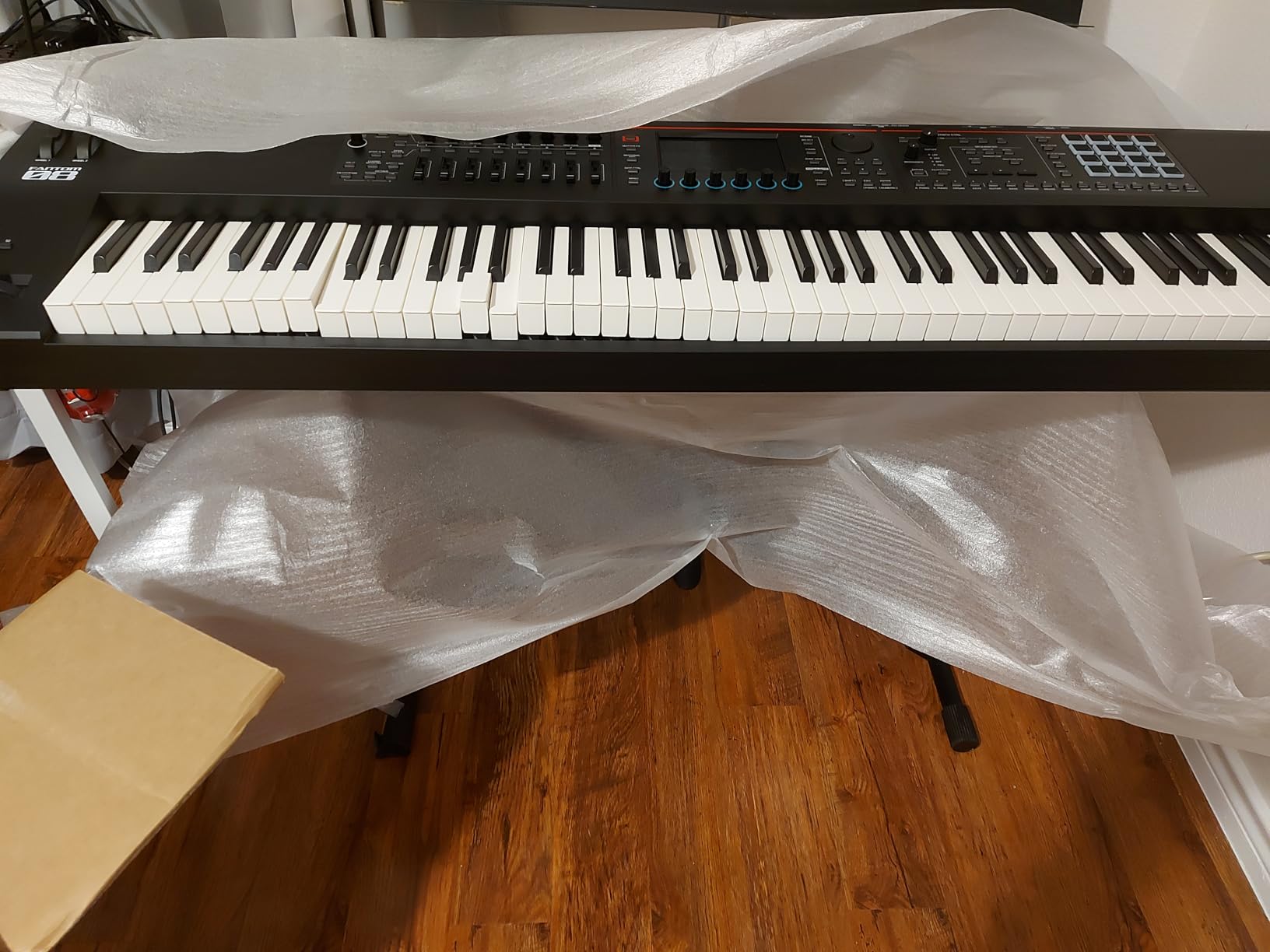
The scene-based architecture lets you organize sounds, zones, patterns, and settings into performance-ready configurations. I created scenes for different songs in a setlist, each with customized splits, layers, and effects. Switching between scenes during live performance is seamless and instant.
Clip-based sequencing brings modern production workflows to the stage and studio. You can build arrangements by triggering clips, similar to Ableton Live’s session view. The TR-REC sequencer handles drum programming in the classic Roland style, which will feel familiar to anyone who has used Roland drum machines.
Who This Synth Is Built For
Professional keyboardists who need a do-everything instrument for stage and studio are the primary audience. The 88-note weighted action makes it suitable for pianists who also need synth sounds. Music directors and worship leaders will appreciate the scene-based workflow for organizing complex performances.
Studio producers who want a comprehensive sound workstation with sampling capabilities will find the FANTOM-08 covers nearly every production need. The DAW integration means it works as both a sound source and a controller.
What to Consider Before Buying
The 4.0-star average rating reflects quality control concerns. Multiple users reported receiving damaged units, likely due to the size and weight making shipping challenging. The touchscreen has also been problematic for some users. Purchase from a retailer with a strong return policy.
At 40 pounds, this is not a portable instrument. You will need a sturdy stand and potentially help moving it. The tone memory is limited to 256MB, which is less than higher FANTOM models. Check whether this limitation affects your workflow before committing.
15. Elektron Syntakt – 12-Track Drum and Synth Powerhouse
Elektron Syntakt 12 Track Drum Computer & Synthesizer
12-track drum and synth machine
4 analog and 8 digital tracks
35 sound-generating machines
Overbridge DAW integration
OLED screen
3-year warranty
Pros
- 4 analog and 8 digital tracks for versatile creation
- 35 sound-generating machines
- Overbridge for seamless DAW integration
- Intuitive sequencer with parameter locks
- Excellent metal build quality
- High-quality audio converters
Cons
- Steep learning curve
- Limited effects
- Premium price point
- Some open-box shipping issues
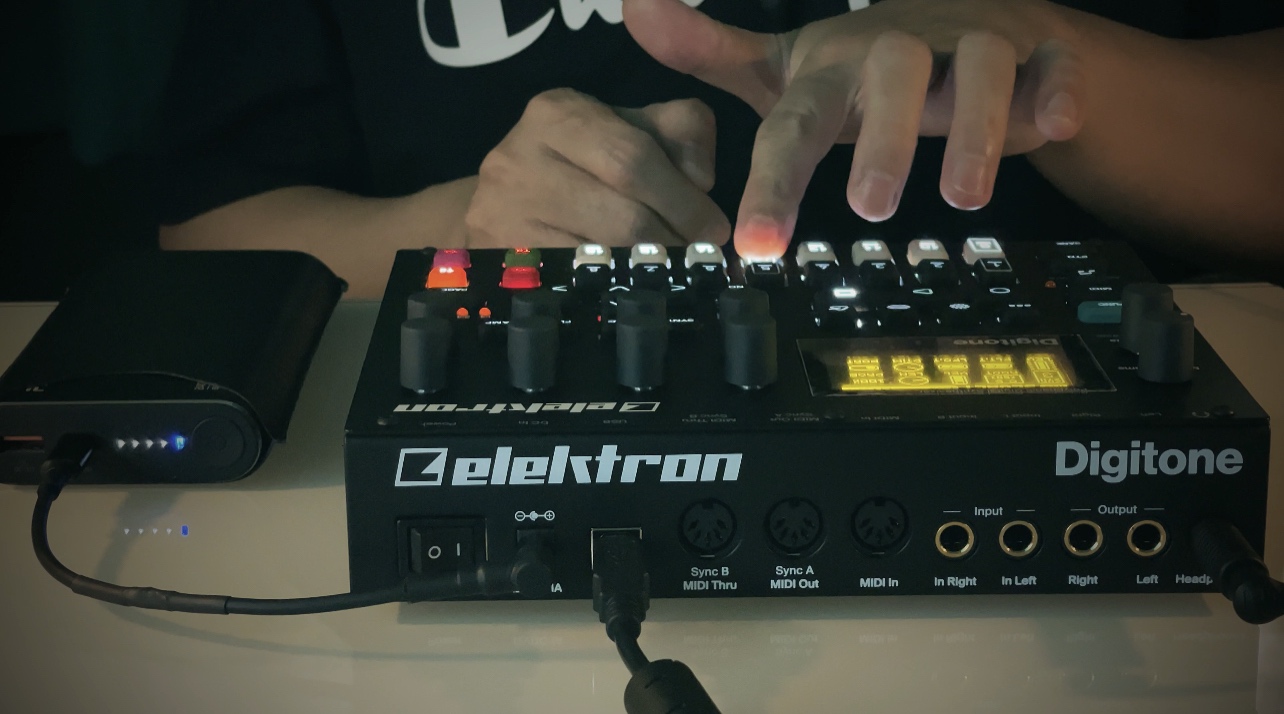
The Elektron Syntakt is not a traditional synthesizer. It is a 12-track sound engine that combines analog and digital synthesis with a powerful sequencer. I integrated it into my production rig as a groovebox-style centerpiece, and it transformed my workflow. The ability to create complete tracks, from drums to bass to leads, within one instrument is genuinely liberating.
The four analog tracks deliver warm, punchy sounds that are perfect for kicks, snares, and bass. The eight digital tracks cover everything from metallic textures to wavetable pads. With 35 different sound-generating machines across these tracks, the sonic range is staggering. I spent the first week just exploring what each machine could do.
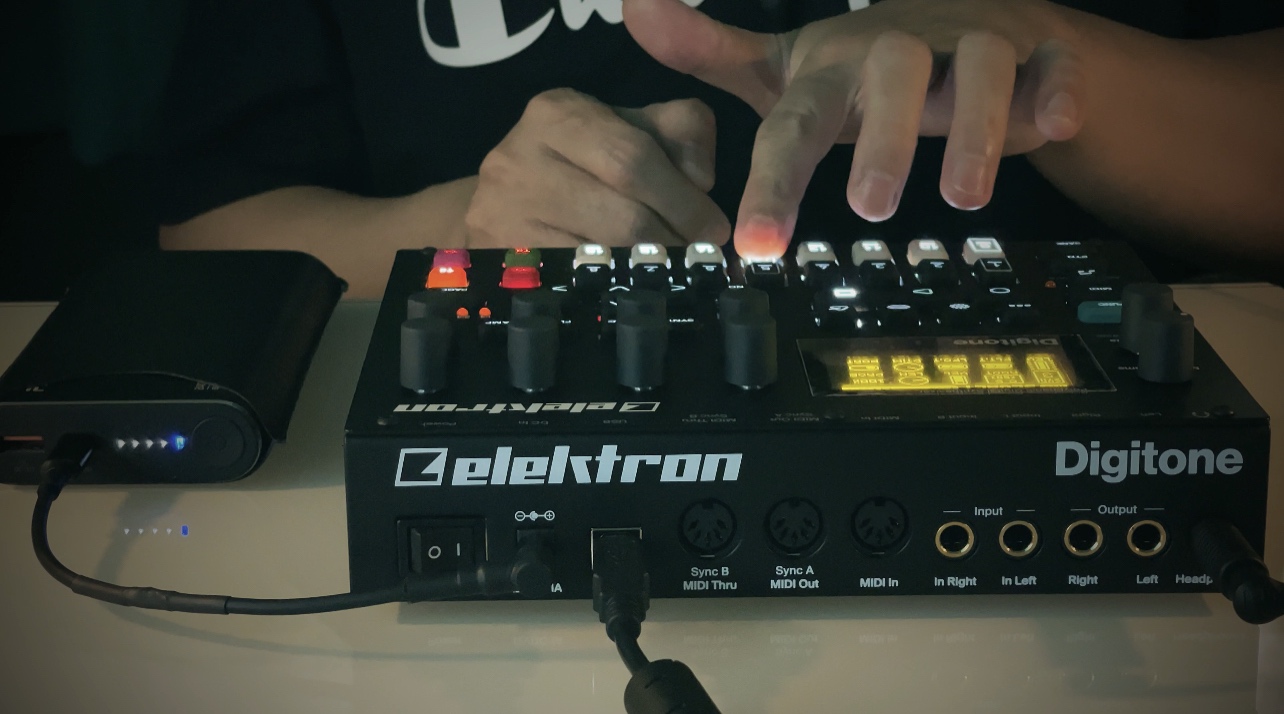
The Elektron sequencer is the heart of this instrument. Parameter locks let you automate virtually any parameter on any step, creating patterns that evolve and surprise. The workflow takes time to learn, but once it clicks, you can build complex arrangements faster than in any DAW.
Overbridge integration is the feature that makes the Syntakt a studio powerhouse. It connects to your computer via USB and appears as a multi-track audio interface in your DAW. Each track streams separately, so you can record all 12 tracks simultaneously with full quality. No external audio interface needed.
Who This Synth Is Built For
Electronic music producers who create techno, house, ambient, IDM, or any genre that benefits from pattern-based sequencing will find the Syntakt indispensable. It is a complete production station that can replace multiple pieces of gear. Live performers who want to create entire sets from one box will also find it powerful.
Producers transitioning from DAW-only workflows to hardware will appreciate the Overbridge integration, which bridges the gap between hardware and software seamlessly.
What to Consider Before Buying
The learning curve is real. Elektron’s workflow is unique and takes dedicated time to master. If you are not willing to invest hours into learning the sequencer and sound engines, the Syntakt’s potential will remain locked. The premium price also reflects its professional-level capabilities.
Effects are limited compared to dedicated effects processors or plugins. You get basic filtering, distortion, and routing per track, but deep effects processing happens externally. Some users report receiving open-box items when ordering online, so verify you are getting a sealed unit.
How to Choose the Best Synthesizer?
Choosing from the best synthesizers available means understanding your needs, budget, and the technical differences between synth types. This buying guide breaks down the key decisions you need to make.
Analog vs Digital vs Hybrid Synthesizers
Analog synthesizers use voltage-controlled oscillators, filters, and amplifiers to generate and shape sound. They produce warm, rich tones that many musicians describe as organic. The MOOG Messenger, Korg MS-20 Mini, and Dreadbox Typhon are all analog synths. Their limitation is typically voice count, as each voice requires its own physical circuitry.
Digital synthesizers use processors to calculate waveforms mathematically. They offer more polyphony, more sound options, and features like FM synthesis and sampling that analog cannot achieve. The Yamaha MX61 and Roland JUNO-D6 are digital workstations. Digital synths tend to be more affordable and versatile but some players find their sound character less warm.
Hybrid synthesizers combine digital oscillators with analog filters, aiming to capture the best of both worlds. The Arturia MicroFreak, MiniFreak, and Novation Peak are excellent hybrid synths. They offer digital flexibility with analog warmth in the final signal path.
Polyphony: How Many Voices Do You Need?
Polyphony refers to how many notes a synthesizer can play simultaneously. Monophonic synths like the MOOG Messenger and Korg monologue play one note at a time. These are perfect for bass lines, lead melodies, and sound design where single-note focus is ideal.
Paraphonic synths like the Subsequent 37 allow limited polyphony, typically two notes. Full polyphonic synths like the Novation Peak (8 voices) and Arturia MiniFreak (6 voices) let you play chords and pads. Workstations like the Yamaha MX61 offer 128-note polyphony for complex, layered arrangements.
If you play chords, pads, or orchestral sounds, you need polyphony. If you focus on bass and leads, a monophonic synth will serve you well and often sound bigger per voice.
Keyboard Action and Feel
Forum communities consistently emphasize that keyboard feel matters as much as sound quality. Synth-action keys are springy and fast, ideal for synth playing. Semi-weighted keys offer more resistance and are preferred by players who also play piano. Fully weighted keys, like those on the Roland FANTOM-08, replicate acoustic piano feel.
Mini keys, found on the reface CS and monologue, save space but may feel cramped for players with larger hands. Touch keyboards, like the MicroFreak’s PCB surface, offer unique expression but lack the tactile feedback of physical keys. Always try a keyboard in person if possible before committing.
Connectivity: MIDI, USB, and CV
Modern synthesizers offer multiple connectivity options. USB handles both audio and MIDI in many current models, simplifying computer integration. Traditional 5-pin MIDI remains the standard for connecting hardware instruments. CV (control voltage) gate connections enable integration with modular synthesizer systems.
If you plan to integrate with a DAW, USB connectivity is essential. For modular synthesis, look for CV patch points like those on the MOOG Messenger. For live performance with multiple hardware synths, ensure you have enough MIDI ports and thru connections on your interface.
Budget Tiers and Value
Synthesizers under 500 dollars offer excellent entry points. The Korg monologue and Arturia MicroFreak deliver professional sounds at accessible prices. In the 500 to 1000 dollar range, you get more polyphony, better build quality, and deeper features. The Arturia MiniFreak, Yamaha reface CS, and Dreadbox Typhon sit in this tier.
Above 1000 dollars, you enter professional territory. The MOOG Subsequent 37, Novation Peak, and Elektron Syntakt offer premium sound, construction, and features. The Roland FANTOM-08 at the top end provides a complete workstation experience with weighted keys and vast sound libraries.
Matching a Synth to Your Use Case
For beginners learning synthesis, the Korg monologue and Yamaha reface CS offer accessible interfaces. For bass production, the MOOG Messenger and Dreadbox Typhon deliver authoritative low end. For ambient music, the Novation Peak and Elektron Syntakt create evolving soundscapes. For live performance, the Roland JUNO-D6 and Yamaha MX61 provide the sound variety gigging musicians need.
For studio production and sound design, the Arturia MiniFreak and Korg minilogue xd Module offer the flexibility and depth that creative work demands. Choose based on what you will actually do with the instrument, not on specifications alone.
FAQs
What is the best analog synthesizer for beginners?
The Korg monologue is the best analog synthesizer for beginners. It offers genuine analog sound, an intuitive interface, an OLED oscilloscope for visual learning, and a 16-step sequencer at an affordable price. The Yamaha reface CS is another excellent beginner option with its slider-based interface and portable design.
What is the best synth to start with?
The Arturia MicroFreak is the best synthesizer to start with because its 17 oscillator modes teach you multiple synthesis methods. Its affordable price, compact size, and included software make it a complete learning package. The Korg monologue is the best choice if you specifically want analog sound.
How much should I spend on a synthesizer?
Beginners should plan to spend between 300 and 600 dollars for a quality first synthesizer. The Korg monologue at around 400 dollars and Arturia MicroFreak at around 350 dollars offer excellent value. Intermediate players can expect to spend 600 to 1000 dollars for polyphonic capability, while professional-grade instruments range from 1000 to 2500 dollars.
Is analog better than digital for synthesizers?
Neither analog nor digital is inherently better. Analog synthesizers produce warm, organic sounds with unique character but typically offer fewer voices and higher cost per voice. Digital synthesizers provide more polyphony, more sound options, and affordability. Hybrid synthesizers combine digital oscillators with analog filters to capture advantages of both approaches. The best choice depends on your musical style and preferences.
What is polyphony in synthesizers and why does it matter?
Polyphony is the number of notes a synthesizer can play simultaneously. Monophonic synths play one note at a time, which works well for bass and lead sounds. Polyphonic synths can play multiple notes for chords and pads. If you play chords, layered sounds, or complex arrangements, you need a polyphonic synth with at least 4 to 8 voices. For bass and lead work, monophonic synths often sound bigger and more focused.
Final Thoughts on the Best Synthesizers in 2026
The best synthesizers in 2026 cover an extraordinary range of sounds, features, and price points. Our Editor’s Choice, the MOOG Messenger, delivers premium analog sound with innovative features at a price that represents genuine value. The Arturia MicroFreak earns Best Value for its unmatched sonic versatility at an entry-level price. For budget-conscious buyers, the Korg monologue provides authentic analog character that punches far above its weight.
Whatever your musical style, budget, or experience level, a hardware synthesizer on this list will inspire you for years. The tactile experience of turning physical knobs and hearing analog circuits respond cannot be replicated by software alone. Choose the synth that matches your creative needs, and start making music that only you can make.