
Music is a language that speaks directly to the soul, unraveling a unique blend of harmonies and melodies that never cease to amaze.
An integral part of this musical magnificence lies in understanding basic concepts like scales.
One of the most fundamental scales in Western music that every musician often begins their learning journey with is the C Major Scale.
From piano lessons at home to college-level music theory courses, you’re likely to come across the C Major scale regularly.
It’s the backbone of countless pieces of music spanning centuries, genres, and artists.
By gaining a clear comprehension of the C Major scale, you are setting foot on a broader pathway laden with musical knowledge and creativity.
Table of Contents
What is the C Major Scale?
The C Major scale is an essential and basic musical scale in Western music.
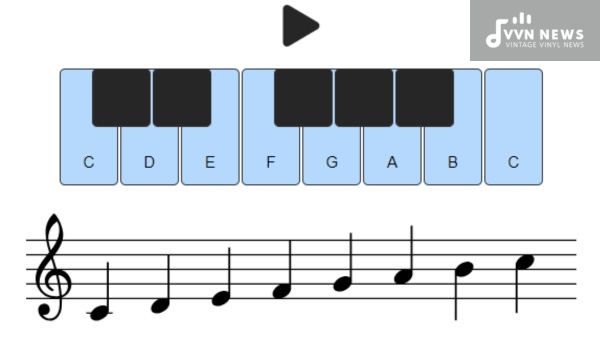
It is composed of seven distinct notes, each having a specific pitch: C, D, E, F, G, A, and B.
The eighth tone, also known as the octave, returns to ‘C’ but at a higher pitch, completing the cycle.
A unique characteristic of this scale is that it doesn’t contain any sharps or flats – black keys on a keyboard.
Sounds originating from these seven notes in sequence form the recognizable, ‘happy’ sound attributed to the C Major scale.
The structure of this sequence can be depicted as:
- C – D – E – F – G – A – B – C
This universally used collection not only underpins learning fundamental music theory but acts as a guide for budding musicians keen on crafting their melodies.
Role of C Major Scale in Music Theory

The C Major Scale holds significance in music theory due to several reasons. Here are some essential points that highlight its importance:
- Gateway to the Language of Music: This scale is the most straightforward, with it involving no sharps or flats. Consequently, it’s often the first scale introduced to students learning music theory or a new instrument.
- Standard Reference Point: Since its structure is easy to comprehend, the C Major Scale sometimes functions as a primary reference for exploring other scales and concepts. It’s the musical equivalent of ‘ground zero’ – helping to build familiarity before transitioning into more complex scales.
- Fundamental Harmonic Relationships: The understanding of harmonic relationships and chord progressions often commence using the C Major Scale as a foundation. The chords derived from this scale (C, D minor, E minor, F, G, A minor, B diminished) facilitate this insight.
- Understanding Key Signatures: Being devoid of any sharps or flats simplifies comprehension of key signatures for beginners. Once you’re familiar with how key signatures work in C Major you can transfer that knowledge over to different keys.
Utilizing its unique characteristics initially eases your transition into understanding more nuanced facets of music theory.
Also Read: G Sharp Diminished Triad [Explore Unique Guitar Chords]
The Composition of the C Major Scale
To fully appreciate the melody, nuance, and style that a C Major scale can bring to your hymns, you first need to get acquainted with its components.
Essentially, it is a sequence of notes and diatonic chords that follow a specific pattern.
The Notes
For starters, the C Major scale encompasses seven unique notes starting from ‘C’ and ending on another ‘C.’ It follows this progression: C – D – E – F – G – A – B – C.
These are all natural notes (there are no sharps or flats), making it the only major key with this characteristic.
The Chords
Now shifting gears to chords within this scale, let’s unwrap this musical present.
You’ll see that each note in the sequence can act as a root for both major and minor chords, giving you a total of seven basic diatonic chords: C Major (I), D minor (ii), E minor (iii), F major (IV), G major (V), A minor (vi), B diminished (vii°).
It’s not difficult to see why many musicians tend to lean towards these progressions while creating music.
Whether you’re composing a song or practicing your skills on an instrument like guitar or piano, knowing how to form and play the notes and chords of the C Major scale can significantly enhance your abilities.
How to Play the C Major Scale on Various Instruments?

Whether you’re a novice or just brushing up on your music theory, mastering the C Major scale opens up a world of possibilities in understanding other musical concepts.
Here’s a practical approach to playing this quintessential scale on two commonly played instruments: the piano and the guitar.
On The Piano
An effortless instrument for visualizing scales, including the C Major scale, is the piano.
With its clear layout of black and white keys, it becomes simple to identify notes and play scales.
- Start from middle C (this sits directly left of two black keys).
- Proceed to play white keys—D, E, F, G, A, B.
- Understandably maintain that fingers should follow numeric pointer—thumb (1), index finger (2), middle finger (3), ring finger (4), little finger (5).
- Returns must restart with your thumb by passing it under your middle finger after three notes.
This simple pattern – noted in numerics (C-1,D-2,E-3,F-1,G-2,A-3,B-4,C-5) – is easy to memorize.
Also Read: A Flat Diminished Triad [Delve Into Rare Guitar Chords]
On The Guitar
To navigate across frets and strings correctly:
- Initiate from the 3rd fret of the 5th(A) string which determines ‘C’.
- Shift to the 2nd fret of the 4th(D) string that marks ‘D’.
- Maintain following up in the same string by moving to open(E) string’.
- Remember this unique pattern (A string/ 3rd fret – D string/ second fret – D string / third fret – G string / open – G string / second fret – B String / first fret – High E string / open)
Essentially the structure of numbers (C-3, D-2, E, G, A, B) helps memorize readily.
Although each instrument has its nuances, the C Major scale’s fundamental hue remains consistent—you just have to allow your familiarity and dexterity with the instrument to guide you in expressing that color in your unique style.
Also Read: G Minor Triad [Demystify This Common Guitar Chord]
Key Characteristics and Uses of the C Major Scale
As the simplest scale in the diatonic series, the C Major scale comprises seven distinct notes, excluding the repeat of the tonic (C) at the octave.
These notes are pure and simple, without any flats or sharps.
No Flats or Sharps
Primarily, what sets this scale apart from others is its purity. In other words, all seven notes (C, D, E, F, G, A, B) in a C Major scale use their natural forms.
These are utilized in their ‘white key’ state on a keyboard instrument such as a piano with no need for sharps or flats.
Root Note
Another characteristic aspect is its anchor note: the C. This serves as both the starting and ending point of one complete run-through of the scale.
Thus it provides each octave’s foundation to sustain different musical tones.
Vital Uses

The C Major scale finds widespread usage across various musical domains due to its easy grasp and application.
Melodies and Harmonies
Many melodies and harmonies in Western music are composed predominantly with this simple scale due to its straightforwardness.
Pieces written in this key express a certain kind of impressive luminosity owing to clear tonal shifts between its seven core notes.
Chords
Chord work especially benefits from understanding this crucial scale as it forms basic chord patterns like major triads (e.g., C-E-G).
Learning how to incorporate this fundamental building block effectively can pave the way for you to explore a more profound understanding of different song structures and melodic concepts minus complicacies.
What Are Some Famous Compositions That Utilize the C Major Scale?
Over the centuries, numerous compositions across diverse genres have utilized the C Major scale, taking advantage of its pure, uplifting, and emotive qualities.
Some famous classical music pieces and contemporary songs written in this key include:
- Beethoven’s Symphony No. 1 – This melodic symphony showcases the full-bodied form of C Major with unparalleled creativity.
- Pachelbel’s “Canon in D” (Transposed) – While originally in D major, this piece is often transposed to C major due to its simplicity on keyboards.
- Mozart’s Sonata No. 16 – This sonata is a great example of Mozart’s genius in exploring the tonal qualities of this key.
- The Beatles’ “Let It Be” – This iconic pop song deploys the timeless charm of the C major scale beautifully.
- Coldplay’s “Viva La Vida” – This contemporary hit features a rich tapestry woven with sounds from the same key.
These compositions reflect how versatile and universally loved the C Major scale is, spanning different periods and styles of music.
Thus, as you embark on your musical journey to master this fundamental scale, remember that practice coupled with exposure to these classical and contemporary melodies will enrich your experience.
The sound knowledge of basics like C Major scale plays a prominent role in shaping one’s musical journey by opening realms filled with endless possibilities for composing new masterpieces.
Also Read: B Major: The Scale And Chords [Guide To This Bold & Beautiful Key]
FAQs About C Major scale
Why is the C Major scale so important for beginners?
The C Major scale is the simplest to understand as it involves no black keys on the piano or sharps and flats for other instruments. It forms a strong foundation for beginners to grasp musical theory.
What notes are used in the C Major scale?
The C Major scale comprises seven natural notes: C, D, E, F, G, A, B; with C as the starting and ending note.
How does understanding of C Major scale help in progressing music skills?
Having a solid understanding of the C Major scale aids in learning other major scales, understanding chord structures, and promotes easier comprehension of complex music theory concepts.
What is unique about the tonality of the C Major Scale?
C Major scale is often associated with characteristics like joyous and triumphant due to its clear and harmonious sound which isn’t affected by any sharps or flats.
Can you suggest some famous pieces composed in the key of C major?
Many iconic pieces are written in this key including Beethoven’s Symphony No. 1 and Mozart’s Sonata No. 16.
Conclusion
The journey through the world of music starts with a single step. The understanding and mastery of the C Major Scale is the first significant stride that paves the way for endless musical possibilities.
Grasping this basic concept in music theory makes traveling through more complex scales, harmonies, and compositions less daunting.
Whether you aspire to play some tuneful melodies on your guitar or create your symphony, a deep dive into the C Major scale will be your compass guiding you through this beautifully intricate realm of tunes and harmonies.