
In the world of music, versatility, and expression are key, and there’s no better example of this than the C sharp major blues scale.
This particular scale is a powerhouse for crafting soulful tunes that resonate with emotion and character.
Whether you’re a seasoned guitarist or just starting out on the keyboard, understanding the nuances of the C sharp major blues scale can elevate your playing and give your melodies that much-desired bluesy edge.
Now, if you’re curious about jazz improvisation or looking to add some depth to your rock solos, this scale is your ticket to a richer musical vocabulary.
It blends the sweet sounds of major tonality with the gritty, heartfelt expressions found in blues music.
Stick around as we break down its structure and share tips on how to integrate it into your own compositions.
By mastering the C sharp major blues scale, you’ll be well on your way to unlocking new dimensions in your music-making journey.
Table of Contents
What is the C Sharp Major Blues Scale?
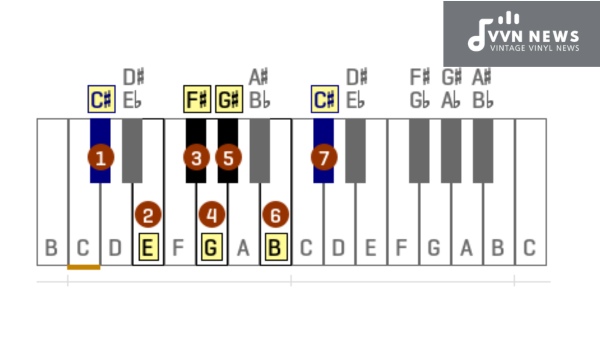
The C sharp major blues scale is an intriguing hybrid musical scale, combining elements of the traditional major scale with the soulful nuances of the blues.
At its core, this hexatonic (six-note) scale is built upon the C sharp major pentatonic framework with the addition of a bluesy chromatic passing note—the flattened third, known as the blue note.
This melodic twist injects a dose of richness into the sound. Here’s a quick breakdown:
- Root Note (C#): The tonal center and starting point of your musical journey.
- Major Second (D#): Supports melody while maintaining a bright tonality.
- Flattened Third/Blue Note (E): The defining characteristic that brings the bluesy feel to life.
- Major Third (F#): Adds contrast and reinforces the major quality.
- Perfect Fifth (G#): A stable pitch that anchors melodies.
- Major Sixth (A#): Completes this fusion scale with a harmonious touch.
Embrace these tones to infuse your compositions with an evocative blend of cheer and melancholy unique to blues music.
Also Read: G Major Scales And Chords [Expand Your Musical Understandings]
C Sharp Major Blues Scale Patterns

When exploring the C sharp major blues scale, it’s essential to familiarize yourself with its shape patterns on the fretboard or keyboard.
These patterns are your roadmap to navigating the scale across your instrument.
Here, we’ll break down five distinct shapes that will help you master this evocative scale.
Shape 1: The Root Position
- Starting Point: Locate the root note, C#, on your instrument.
- Pattern Layout: Begin with the root note and follow this sequence of intervals: whole step, half step, half step (blue note), whole step, whole step.
- Key Tones: C#, E, F#, G (blue note), G#, and B locate this pattern on various octaves across your instrument for fluidity.
Shape 2: Extend to Higher Octaves
- Maximizing Reach: Build upon Shape 1 by continuing the same interval pattern into higher octaves.
- Visual Aid: Think in terms of boxes or clusters of notes that repeat as you ascend in pitch.
- Use visual markers on your fretboard or keys as reference points to switch octaves seamlessly.
Shape 3: The Box Pattern
- Guitarist’s Favorite: Commonly used by guitarists for its comfortable hand positioning.
- Fingering Mastery: Place your fingers so that each one is responsible for a fret within a four-fret span.
- Learning this “box” allows easy movement and fluid bluesy licks.
Shape 4: Two-Octave Stretch
- Broadening Horizons: Connect two shapes to play the scale over two full octaves without repositioning your hand.
- Effective for longer runs and when you need to make a musical statement that lasts more than a fleeting moment.
Shape 5: Diagonal Approach
- Across The Strings Or Keys: Instead of playing laterally along the strings or keys, move diagonally up across them integrating more variety in tone dynamics.
Try practicing each shape slowly at first. As always, remember quiet introspection about these shapes will lead to mastery.
And soon enough, these patterns will not only enhance your technique but pave avenues for creative expression when improvising or composing.
Also Read: D Major: The Scales And Chords [Broaden Your Musical Vocabulary]
Major and Minor Scales in C Sharp Major Blues
When examining the C sharp major blues scale, it’s essential to understand its relationship with both major and minor scales.
Known for its unique texture, the C sharp major blues scale is a fusion that derives its complexity from interweaving elements of the conventional C sharp major and the blues scale.
- Major Scale Reference: The base of this blues scale lies firmly on the foundation of the C sharp major scale, which consists of seven notes: C#, D#, E#, F#, G#, A#, and B#. This diatonic sequence is known for its bright, unambiguous sound—a staple in Western music.
- Minor-Flavored Addition: On the contrary, a traditional minor blues scale adds a soulful twist with flatter pitches. However, in the major blues scenario, we inject a dash of this minor essence into our existing major structure.
The critical note responsible for this effect is known as the “blue note.” In our case—the magic happens with an added F (natural note), sandwiching perfectly between E# (the third degree) and F# (the perfect fourth).
Understanding how these scales relate is crucial in crafting melodies that resonate emotionally.
The power of the blue note transforms the clean sound of C sharp major into something more complex—an alluring blend that can captivate any listener’s ear.
Why Train Your Ears for C Sharp Major Blues Scale?

Ear training for the C Sharp Major Blues scale is an essential skill that bears numerous musical benefits:
- Enhanced Improvisation: By familiarizing your ears with this scale, you gain the flexibility to improvise with confidence and creativity in live settings or recording sessions.
- Musical Vocabulary: It expands your musical vocabulary, allowing you to recognize and employ distinctive bluesy phrases that can add character to your solos.
- Tonal Accuracy: Ear training helps in achieving accurate pitch recognition, which is crucial for playing the C sharp major blues scale in tune and with good intonation.
- Emotional Connection: The blues is all about conveying emotion. Recognizing the scale by ear means you can emote more effectively through your instrument.
Like any skill, ear training takes time and patience, but the payoff is a deeper connection with the language of music. Embrace the process, and your ears will soon lead you down a path of richer musical expression.
Also Read: C Music Note [Master The Essentials Of Musical Notation]
Major Blues Scale in Famous Songs?
When it comes to the Major Blues Scale, many iconic songs have utilized this scale to create memorable melodies and solos that stand the test of time.
These tunes span across various genres, showcasing the scale’s versatility and its power to convey deep emotion and groove.
The major blues scale, often with that added blue note, brings a unique flavor to compositions, striking a balance between major sweetness and bluesy tension.
Here are a few notable tracks that have made exemplary use of the C sharp Major Blues Scale:
- “Sweet Home Chicago” by Robert Johnson
In this classic blues anthem, you can hear elements of the major blues scale throughout. It’s one of those tracks where the bittersweet tang of the blue note is used expertly to complement traditional chord progressions. - “Crossroads” by Cream
The rendition of Robert Johnson’s original piece by Cream offers an electrified example of how the major blues scale can rock out. Eric Clapton’s fiery licks involve swift runs up and down this very scale. - “The Thrill Is Gone” by B.B. King
This song demonstrates how the C sharp Major Blues Scale can elegantly support soulful storytelling and create a haunting atmosphere.
Each song listed above is a testament to how a simple scale can be transformed into remarkable musical expressions when placed in the hands of creative artists.
By dissecting these pieces, you gain not just appreciation but also inspiration for your own musical endeavors. Listen closely to how these legends navigate through their solos—it may just spark your next melodic masterpiece.
Also Read: A Major Scale [The Key To Bright, Cheerful Musical Pieces]
C Sharp Major Blues’ Impact on Genres

The C sharp major blues scale has had a profound influence on numerous musical genres, effortlessly permeating the sonic landscapes of blues, rock, jazz, and even pop music.
Its essence carries a unique blend of emotional depth and brightness that imbues songs with character and soul.
Blues & Rock
In blues music, where the scale arguably takes center stage, it adds a certain raw emotion to the melodies.
Guitar legends like B.B. King and Eric Clapton have utilized this scale to craft unforgettable licks that resonate with listeners on an almost spiritual level.
The same can be said for rock music, where the use of the C sharp major blues scale injects a measure of rebellious spirit into powerhouse anthems.
Think of Jimi Hendrix’s fiery solos or Led Zeppelin’s bold riffing—these icons revolutionized rock with their masterful command of blues scales.
Jazz Fusion
When it comes to jazz, the C sharp major blues scale is often used in fusion and modal jazz compositions.
It offers musicians like Miles Davis or John Coltrane an alternative palette for improvisation—one that traverses beyond traditional major modes and toward more adventurous harmonic expressions.
Pop Music
Even in pop music, understanding this scale can unlock sophisticated sonic layers within seemingly simple tunes.
Artists such as Adele leverage its tones to add weighty textures to their ballads, hence creating deeper connections with their audience.
Utilizing the C sharp major blues scale is not just about adding notes; it’s about conveying feelings and constructing narratives within the framework of diverse genres.
By embracing its potential, you contribute to a rich musical tradition while carving out your own distinct sound.
Also Read: F Sharp Major Chords [Boost Your Guitar Skills Today]
FAQs about the C Sharp Major Blues Scale
What notes make up the C sharp major blues scale?
The C sharp major blues scale consists of the notes C#, E, F#, G#, A, and B.
How is the C sharp major blues scale different from the C sharp minor blues scale?
The major blues scale has a brighter, happier sound due to its major third (E), whereas the minor version has a more somber tone with a minor third (E flat).
Can I use the C sharp major blues scale over any chord progression?
This scale works best over blues progressions, dominant 7th chords, or major chords in the key of C sharp.
Why should I learn the C sharp major blues scale for guitar solos?
Learning this scale will add emotional depth and expressiveness to your solos, especially in blues, rock, and jazz contexts.
How can I practice improvising with the C sharp major blues scale?
Start by playing along with backing tracks or metronomes, emphasizing chord tones, and experimenting with phrasing.
Conclusion
In the realm of musical exploration, the C sharp major blues scale represents a bridge between emotion and technique.
By harnessing its unique sound, you empower yourself to infuse songs with depth that resonates with audiences.
Remember, the journey of mastering this scale not only expands your musical toolkit but also enriches your personal artistry. Keep practicing, listen intently, and allow the nuanced flavors of the C sharp major blues to color your musical canvas.