
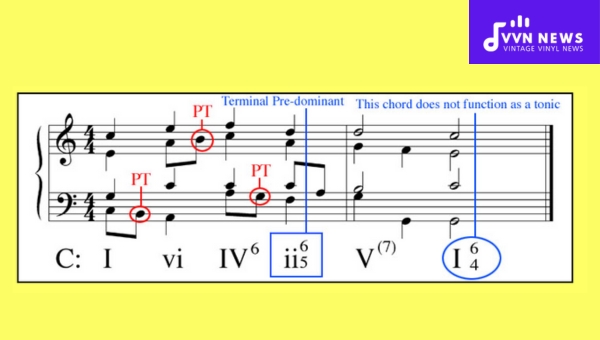
Music, an art form that is universally appreciated, shares a common language. Yet the nuances of this language are varied and complex, such as cadential 6/4.
At first glance, this phrase might feel like mystical jargon to many of you, but it is a stepping stone to appreciating how music is structured profoundly.
Asking what cadential 6/4 is akin to asking how we conclude a philosophical argument or tie together loose ends in a gripping detective novel.
It’s about finality and transition; moving from tension to resolution in harmonic progression. But don’t worry if that sounds complex—today, I’ll be your guide through this fascinating musical concept.
Table of Contents
What Is a Cadential 6/4 Chord?
The Cadential 6/4 chord, also known as the “cadential second inversion chord”, plays a pivotal role in Western music. Typically found near the end of phrases, this chord signals an imminent return to stability.
It possesses a specific configuration: the tonic or keynote is spotted at the top and bottom of the chord, while the dominant rests in the middle.
It’s dubbed “6/4” due to the intervals above the bass note – a sixth and a fourth – which create its distinctive sound. Its primary usage is not just any common chord but as an embellishment, preparing listeners for an emphatic harmonic resolution.
Also Read: E Minor Pentatonic Scale [How To Use In Your Music Composition]
How Do You Construct a Cadential 6/4 Chord?
To construct a cadential 6/4 chord, you need to know its fundamental structure. A cadential 6/4 chord typically consists of the V chord (the dominant) in the first inversion, immediately followed by the V triad in the root position.

Step 1: Identify the key of your piece. The dominant will be the fifth note (or degree) of that scale.
Step 2: Form a IV chord by stacking a major third and then a minor third on top of this dominant note in your chosen key.
Step 3: Invert this IV chord. Inversion places the third note at the bottom, creating what we call a first inversion. This results in our initial ‘6’ in cadential 6/4.
Step 4: Progress from this inverted IV to your root V triad (the ‘4’ part). You should keep the bass note (the original fifth degree) unchanged between these chords for added effect.
When seen on paper or heard in practice, this change is quite dramatic and satisfying, offering both tension and resolution within its harmonic structure.
What Are Some Examples of Cadential 6/4 in a Minor Key?
Musicians love working with tonal music because the resolution it offers holds immense power.
One way to amplify this is by employing a cadential 6/4 chord in a minor key, heightening the pull towards the tonic.
Other than theoretical knowledge, practical examples can bring clarity to its application.
Think about A minor. Here’s a step-by-step guide on preparing a cadential 6/4 in this specific context:
- Identify your dominant: The dominant of A minor is its fifth note— E.
- Construct the chord above the dominant: The notes forming a triad above E are E, G, and B.
- Raise the third: To provide your music with heightened tension and subsequent resolution, you’ll need to raise G, which serves as the third in your E-major triad, by a half step or semitone transforming it into G sharp.
- Displace harmony tones to afford them lesser emphasis: This entails shifting both the third (your shiny new G sharp) and fifth (B) of your triad onto beats that don’t typically receive emphasis.
- Place upper neighboring tones on emphasized beats: Finish off by allocating notes exactly one step higher (A and C respectively) on stronger beats for added harmonic complexity.
With practice and attentive listening, effectively crafting beautiful cadential 6/4 progressions -such as these- in A minor will become second nature.
Also Read: Mastering Chords In A Minor [Improve Your Composition Skills]
How Can Ear Training Play a Vital Role in Identifying Cadential 6/4 Chords?
The process of identifying the cadential 6/4 chord isn’t only about reading musical sheets; one’s ear also plays a noteworthy role.

Ear training is particularly useful in attuning oneself to distinguish the nuances among various types of chords, including our topic of interest.
Practicing Chord Recognition
Ear training sheds light on identifying music intervals, chords, scales, and more.
A golden rule is to practice chord recognition exercises regularly. With time, your ears will become adept at pinpointing the distinct sound patterns that signify a cadential 6/4 within a harmonic progression.
Utilizing Apps
In this digital era, countless ear training apps are readily available at your fingertips, ranging from free to premium tiers.
These interactive platforms transform tedious theory into engaging lessons so that you can hone your musical perception wherever you may be.
Incorporating Cadences in the Training
Often, music pieces culminate or transition with cadences — rhythmic patterns that come in various forms like perfect, imperfect, and more importantly for our discussion, cadential 6/4.
Incorporating these cadences into your ear training routine with focused attention on their unique characteristics will greatly elevate your auditory skills.
What Contexts Is the Cadential 6/4 Typically Used?
The cadential 6/4 chord is often utilized in music as a harmonic device to represent the resolution of tension. It provides a sense of fullness and closure at specific points in musical composition, especially at the end of phrases or sections.
Most commonly seen in classical music, you’ll find this progression in various motifs in the works of baroque, classical, and early romantic composers such as Johann Sebastian Bach, Ludwig van Beethoven, and Franz Schubert.
For instance, Beethoven’s 5th Symphony uses cadential 6/4 chords effectively to provide dramatic moments during its progression. Interestingly enough, this chord doesn’t exclusively belong to classical music; it finds its place in modern pop and rock genres too.
Musicians today utilize this formulaic chord progression to create harmonic interest or a solid conclusion. Cadential 6/4 serves as the gateway towards musical resolution across genres providing structure and cohesiveness within a composition.
This underscores its significance – from Baroque sonatas to contemporary pop ballads.
Also Read: How To Transpose Treble To Bass Clef [Music Guide]
How Is the Cadential 6/4 Chord Properly Labeled?
When we discuss the proper labeling of a cadential 6/4 chord, we’re diving into the specifics of musical analysis.

This chord, often found just before the dominant harmony, serves as a powerful set-up for the concluding phrase in a progression.
Traditionally, to denote this chord’s inversion and function, we use figured bass notation—a system from Baroque music that indicates intervals above the bass note.
A cadential 6/4 consists of a root position V (dominant) chord with two non-chord tones: 1) the fourth above the bass, and 2) the sixth above the bass.
In sheet music or theoretical analysis, this is labeled as V6/4 before resolving to V. Here’s how it breaks down:
- The “V” symbolizes its connection with the dominant chord.
- The “6” indicates a sixth interval from the bass note.
- The “4” represents a fourth interval from the same reference point.
Remember, despite these numerals suggesting inversion—confusingly—they do not alter our interpretation here. They simply signify an embellished tonic (I) chord within this specific context.
Once mastered, both notation and practical application will come naturally in your compositions or analyses.
The Passing Six-Four Progression
The passing six-four progression is a harmonic movement that typically functions as a bridge between two stable chords.
It consists of an intermediary chord where the bass note descends by step.
The numeral “6/4” signifies intervals of a sixth and fourth above the bass.
This configuration briefly suggests an inversion before settling into the next chord.
Imagine you’re moving from a C major chord (C-E-G) to an F major chord (F-A-C). In a progression, you could insert a passing six-four chord here:
- C major: C-E-G
- D minor 6/4: D-F-A (where D is the bass)
- F major: F-A-C
In this case, D minor 6/4 acts as the “passage,” smoothly connecting what would otherwise be an abrupt leap from C to F.
Observing voice-leading principles, composers often utilize this kind of progression to achieve fluid transitions and maintain melodic continuity within their pieces.
Adept listeners might recognize these progressions as fleeting, yet they’re pivotal in reinforcing the overarching harmony.
How Does the Pedal 6/4 Function Differently?
A Pedal 6/4 is distinct from its cadential cousin. This chord arises over a sustained bass note, usually the tonic or dominant of the key.

Think of the bass as the steadfast ‘pedal point’ around which other harmonies revolve.
- Static Bass: The pedal 6/4 maintains a fixed bass note, often providing an anchor in shifting harmonic landscapes.
- Prolonging Tension: Unlike the revolving nature of a cadential 6/4, this chord prolongs tension before resolution.
- Pervasive Use: It appears not just at cadences but can be utilized throughout a piece to create stability or suspense.
When you encounter a non-resolving six-four chord that hovers over a repeated note in the bass, you’re likely hearing a Pedal 6/4.
Recognizing this allows composers and performers to shape musical phrases with nuanced anticipation.
Also Read: Mastering Chords In A Minor [Improve Your Composition Skills]
FAQs
What is a simple way to recognize a cadential 6/4?
A cadential 6/4 typically precedes the V chord and features the tonic note in the bass over which you’ll hear a fourth and a sixth degree, creating a sense of anticipation.
Can cadential 6/4 chords be found in pop music?
You might find them as dramatic build-ups before a chorus or during key song transitions.
Is there a difference between authentic and plagal cadences when using 6/4 chords?
The cadential 6/4 is part of an authentic cadence, moving to the dominant, whereas plagal cadences move from subdominant to tonic without this particular progression.
What’s the main function of the cadential 6/4 in harmony?
Its main function is to heighten tension before resolving into the dominant chord for musical closure.
Do I need formal music education to understand Cadential 6/4 chords?
While formal education can help, with attentive listening and practice, anyone can learn to recognize Cadential 6/4 progressions.
Conclusion
In a nutshell, the cadential 6/4 is one of the most mesmerizing pieces in the musical lexicon. It’s an exquisite tool that allows musicians to create palpable suspense before resorting to satisfying harmonic resolution.
Thus, it is integral to know and apply it to enrich musical composition and enhance our knowledge of music as listeners. As you continue to delve into music theory, always remember – the journey is rich, complex, yet eternally rewarding.