
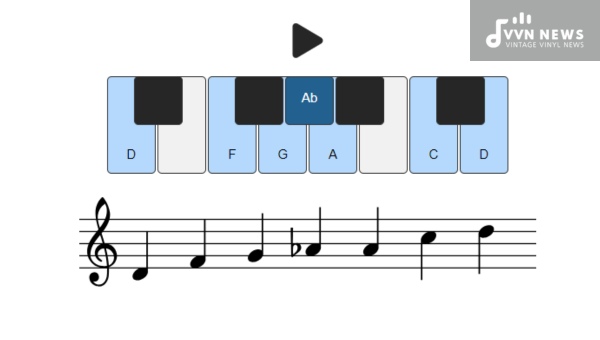
The D minor blues scale, a captivating and moody sequence of notes, holds a special place in the heart of many musicians.
With its deep roots in American music traditions, this scale is not just a series of pitches; it’s the backbone for countless classic rock, jazz, and blues compositions.
Its sultry intervals and emotional depth give guitarists and other instrumentalists the ability to express feelings that sometimes words alone cannot convey.
It is an essential tool in your repertoire whether you’re a budding guitarist or seasoned pianist.
This scale isn’t simply about memorizing notes—it’s about exploring spaces between traditional sounds, where creativity and personal style thrive.
Let me guide you through its nuances and how you can make it your own for truly soul-stirring performances.
Table of Contents
What is the D Minor Blues Scale?

The D Minor Blues Scale is a musical scale that comprises six notes: D, F, G, G#, A, and C.
It’s essentially the D minor pentatonic scale with an added flat fifth, the G#. This note, also called the “blue note,” injects a dose of soulfulness and tension, distinguishing the blues scale from more conventional scales.
When played over chords in various progressions, it can elicit a powerful emotional response due to its deep tonal quality and versatility.
This scale serves as a foundation for improvisation in genres like blues, jazz, and rock.
Instructions for Making the D Minor Blues Scale
The D minor blues scale is a variation of the D natural minor scale with an added chromatic passing note—the flat 5, also known as the blue note.
Craft this evocative scale with the following steps, ensuring your musical endeavors are steeped in bluesy depth:
- Start with the Root: Begin on ‘D,’ which is your tonic or starting note.
- Minor Third Interval: Move to ‘F,’ a minor third above your root.
- Perfect Fourth Leap: Ascend to ‘G,’ completing a perfect fourth interval from ‘D.’
- Blue Note Addition: Introduce that characteristic blues sound with ‘G#,’ the blue note that adds tension.
- Perfect Fifth Solidity: Stabilize with ‘A,’ creating a perfect fifth interval from your root.
- Minor Seventh Touch: Proceed to ‘C,’ achieving a minor seventh leap from ‘D.’
- Octave Completion: Return to ‘D’ an octave above your starting point to round off the scale.
By incorporating these intervals, you craft the compelling sequence: D, F, G, G#, A, C, (and back to) D. Use this formula to infuse your melodies with that quintessential blues sound.
Also Read: B Minor Pentatonic Scale [Inject Your Music With Dramatic Flair]
Major and Minor Blues Scales in D Minor Blues Scale

Taking a closer look at the D minor blues scale, we notice it’s a variation of the D minor pentatonic scale with an added chromatic note, often referred to as the “blue note.”
This additional pitch introduces a distinctive tension, giving the scale its characteristic bluesy feel.
The D Minor Blues Scale Notes:
- D (Root)
- F (Minor third)
- G (Perfect fourth)
- G# (Sharp fourth or “blue note”)
- A (Perfect fifth)
- C (Minor seventh)
In Contrast: The D Major Blues Scale
Conversely, the D major blues scale imparts a different emotion. It consists of:
- D (Root)
- E (Major second)
- F# (Major third)
- G (Minor third or “blue note”)
- A (Perfect fifth)
- C (Minor seventh)
Comparing the two scales illuminates their unique characters. The minor blues scale leans toward a melancholic or gritty aesthetic, while the major blues scale tends to sound more upbeat and bouncy.
Significance of Ear Training in D Minor Blues Scale
Ear training is a critical facet of mastering any musical scale, including the D minor blues scale.
It equips you with the ability to discern pitch relationships and communicate emotional intent through music. Here’s why it is so crucial:
Enhanced Pitch Recognition
- Developing your ear allows for immediate recognition of the notes within the D minor blues scale.
- You’ll be able to identify the tonal center and how other notes relate to it.
Improvisation Skills
- A well-trained ear facilitates improvisation, allowing you to play fluidly over various chords and progressions.
- It empowers musicians to create spontaneous melodies that are coherent with the underlying harmony.
Better Musical Expression
- The aural subtleties of the blues scale lets you convey emotions effectively.
- You will be able to emphasize certain notes and nuances like bends and vibratos that define the bluesy sound.
Also Read: B Flat Minor Pentatonic Scale [Create Emotive Music In Minutes]
Mistake Identification
- Acute listening skills help in catching and correcting errors swiftly during practice sessions or performances.
- You gain insight into your own playing, promoting consistent improvement.
Refined Tuning Skills
- Ear training teaches you to tune your instrument by ear—a valuable skill when electronic tuners aren’t within reach.
Connectivity with Other Musicians
- Strong aural abilities ensure better ensemble playing, as you respond intuitively to what you hear from fellow musicians.
By integrating these points into your practice regimen, expect not just technical proficiency in playing the D minor blues scale but also an elevated level of musicality that resonates with listeners on a deeper level.
Songs that use the D Minor Blues Scale

The D minor blues scale has subtly woven its way into numerous iconic songs across various genres.
This hauntingly beautiful scale imparts a sense of depth and emotion, serving as the backbone for many memorable melodies and solos.
Here’s a look at some standout tracks that have effectively harnessed the evocative power of the D minor blues scale:
- “Shine On You Crazy Diamond” by Pink Floyd – This masterpiece showcases David Gilmour’s virtuosic use of the D minor blues scale, especially in his soulful guitar solos.
- “Since I’ve Been Loving You” by Led Zeppelin – Jimmy Page’s bluesy licks are drenched in the essence of the D minor blues, underpinning this track’s heartache and passion.
- “Comfortably Numb” by Pink Floyd – Gilmour again crafts an otherworldly atmosphere, with his solos being prime examples of how the D minor blues scale can convey deep emotion.
These selections underscore just how versatile and expressive the D minor blues scale can be.
Whether through slow-burning ballads or intense rock anthems, this set of notes has allowed artists to channel their innermost feelings into timeless pieces.
Also Read: A Sharp Minor Pentatonic Scale [Unique Harmonic Possibilities]
FAQs on the D Minor Blues Scale
What notes make up the D minor blues scale?
The D minor blues scale consists of the notes D, F, G, G#, A, and C.
Can I use the D minor blues scale over major chords?
Yes, you can play the D minor blues scale over a D7 chord to add a bluesy feel to your improvisation.
How does the D minor blues scale differ from the natural minor scale?
The addition of the sharp fourth or flat fifth (G# in this case), known as the “blue note,” distinguishes it from the natural minor scale.
Is ear training important for mastering the D minor blues scale?
Absolutely, ear training improves your ability to recognize intervals and apply the blue notes expressively in your playing.
Are there any well-known songs that feature the D minor blues scale prominently?
Yes, many famous tracks like BB King’s “The Thrill is Gone” utilize variations of the minor blues scales, including D minor.
Conclusion
In wrapping up, the D minor blues scale is a versatile and expressive tool for musicians.
By internalizing its unique sound and practicing diligently, you can infuse your music with the raw emotion that the blues embodies.
Remember, it’s not just about playing notes; it’s about feeling them. So take time to explore this scale, experiment with phrasing, and listen to the greats who have paved the way.
Armed with this knowledge, you’re ready to carry the torch of blues tradition forward in your own creative expression.