
A profound appreciation of music can deepen our understanding of life and the emotions we experience.
One element that resonates particularly with our emotional side is the D minor pentatonic scale.
This unique musical configuration, adored by countless musicians and listeners alike, serves as an essential tool in crafting melodies that evoke varied feelings and moods.
When embarking on a journey into the realm of melody creation or guitar improvisation, understanding the nuances of the D minor pentatonic scale can significantly enhance your capabilities.
The scale, consisting of five distinctive notes, bears a melancholic yet beautiful aura, allowing you to touch hearts or create tunes that linger long after they are played.
Table of Contents
What is the D Minor Pentatonic Scale?
The superb D Minor Pentatonic Scale is a formidable tool in the world of music, emanating an aura of mystery and depth that is instinctively attractive.
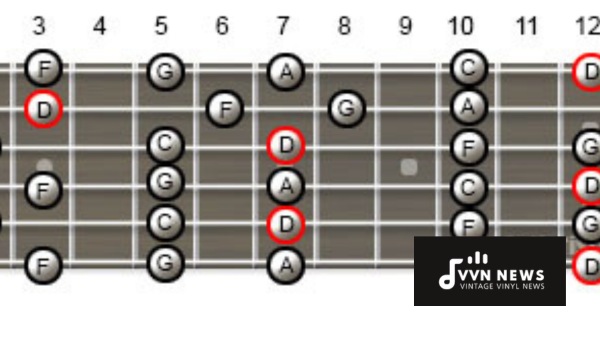
This scale contains five unique notes – D (root), F (minor third), G (perfect fourth), A (perfect fifth), and C (minor seventh). The absence of the second and sixth scale degrees about the diatonic scale sets it apart, infusing an intriguing vibe into your music.
Not only does it offer simplicity, but it also opens up an expansive musical landscape for you to embark upon further creation.
How to create the D Minor Pentatonic Scale?

For those aspiring to delve into music, here’s a concise direction toward creating the D minor pentatonic scale.
Let’s initiate from the very soul of this scale; ‘pentatonic’ which gets its name from the Greek word ‘pente’, meaning five, signifying that our scale consists of five primary notes.
- Identify the Key Note: This is your starting and ending point. For the D minor pentatonic, this is naturally, a D note.
- Second and Third Notes: After landing on D, it’s time to count up to the minor third – three whole steps or three frets on your guitar. Here we land on F. Hitting another one and a half steps (or 3 frets), takes you to G.
- Fourth and Fifth Notes: Dive an additional whole step forward to meet A, then after another minor third (three whole steps), capture C.
- Return Home: To close out your pentatonic journey, you’ve got another step and a half or three frets back to D.
So there you have it! D – F – G – A – C feels like running a musical marathon, but with practice and patience, perfect results are envisaged.
Also Read: C Sharp Minor Pentatonic Scale [Add Color To Your Solos & Riffs]
The Five Shapes of the D Minor Pentatonic Scale
The concept of guitar scale shapes, or patterns, offers a powerful pathway to navigate across your instrument’s fretboard.
The D Minor Pentatonic Scale consists of five distinct shapes. Let’s delve into these forms, enhancing our proficiency on this beautiful scale.
1. First Shape
The first shape starts at the root note or tonic, which in this case is ‘D.’
Place your index finger on the tenth fret of the low E string (which is D), and let your fingers follow this pattern from low E to high E – 10-13, 10-12, 10-12, 10-12, 10-13, 10-13.
2. Second Shape
Starting from the E string (low), place your index finger on the 13th fret.
The pattern to follow for this second shape is Frets – 13-15, 12-15, 12-14, 12-14,13-15, and again 13-15 going from thick E string to thin E string.
3. Third Shape
The third shape commences at a higher octave ‘D’ starting at the throat of your guitar’s body i.e., an octave higher than that initial ‘D.’ The sequence proceeds like Frets – starting from low E string are -15 -17,14 -17,14 -17,14 -16,15 -17 and finally, again it’s 15 –17.
4. Fourth Shape
Launch with your index finger on the ‘F’ note present at the first fret (position) of fat E i.e., 1st position of big fat ‘E’ string, and then proceed like:
1st position to it goes to 3rd,
additionally, it ranges from 1st position on A string up to 3rd again,
from 1st position on the D string to 3rd,
from the 2nd fret on the G brass string, it ranges up to the 3rd, and finally, from the 1st position on B and high E strings, it advances up to the 4th.
5. Fifth Shape
The fifth shape commences from ‘G.’ Initiating from a low E string the pattern follows 3-5, 3-5, 2-5, 3-5,3-6, and finally ends at 3-5.
Mastering these diverse patterns provides a roadmap to navigate the fretboard seamlessly while playing. It’s pivotal in learning all musical keys while also fine-tuning motor skills and enhancing precision.
Moving fluidly between the forms can create a luscious auditory feast for listeners and give an added layer of enjoyment to your strumming escapades.
Also Read: A Minor Pentatonic Scale [Create Powerful Solos With This Key]
What are the Advantages of acquiring the D Minor Pentatonic Scale?

The D minor pentatonic scale comes with copious benefits that can shape your music journey, allowing you to craft melodies with diverse emotions and depth.
Broadsens Spectrum of Emotional Tones
Firstly, the scale’s tone unravels a broad spectrum of emotions, due to its minor key nature.
Unlike major keys depicting happiness or liveliness, minor keys like D minor offer a more melancholic or sentimental undertone.
This enables you to create or etch out compositions that strike a chord with listeners on a deeper level.
Versatility
Second in line is the sheer versatility of the D minor pentatonic scale – it is aesthetic magic everyone should at least dabble in once.
From blues and rock to pop and jazz, this five-note treasure trove can integrate seamlessly into multiple genres.
This adaptability gives you wings to explore different musical styles without worrying about sounding out of tune or off-beat.
Simplicity Means Productivity
When it comes to ease of learning and remembering, the D minor pentatonic scale shines bright.
Its simpler structure – comprised of five critical notes – is easier to internalize than other complex scales featuring more notes.
Enhances Creativity
Lastly, mastering this scale could sprout your creativity by leaps and bounds.
Thinking within this defined structure challenges you to invent melodic patterns and phrases that can excite your listeners while keeping them hooked – an essential skill for any budding or professional musician.
To put it succinctly, acquiring knowledge and proficiency in playing the D minor pentatonic scale can open up a whole new world for you – one teeming with opportunities filled with emotional depth, creativity enhancement, as well as diverse music genre exploration.
What is the Relation to Relative Minor and Major Scales?
Our emphasis now shifts to understanding the relationship between the D minor pentatonic scale and its relative minor and major scales.
Minor Pentatonic and Natural Minor Scale
The natural minor scale or “relative minor” of D consists of seven notes: D, E, F, G, A, Bb, and C.
The D minor pentatonic scale is fundamentally a subset of this group with two fewer notes—specifically Bb and C.
Your five notes in this pentatonic are D (root), F (minor third), G (perfect fourth), A (perfect fifth), and C (minor seventh).
Pentatonic Major Scale
The corresponding major pentatonic puts a twist on things. Interestingly enough, each minor pentatonic scale couples with a major pentatonic scale, generating a different melodic interpretation.
The ‘relative major’ for the D minor pentatonic is F major pentatonic—built as follows: F (root), G (second), A (third), C (fifth), D(sixth).
This blend offering of relatable scales has an immense impact on how the music feels overall.
To further grow in your musical journey, try experimenting with these related scales alongside your exploration of the core D minor pentatonic.
Also Read: F Minor Blues Scale [Experiment With This Dark & Moody Key]
The Role of Ear Training in Mastering the D Minor Pentatonic Scale

Effectively incorporating the D minor pentatonic scale into your repertoire requires more than just manual dexterity on your instrument.
Ear training is a crucial exercise every musician should adopt. This practice can significantly augment your ability to identify and distinguish key components of this distinctive scale.
Develop Your Listening Skills
Firstly, ear training nurtures your capacity to comprehend the implications of each note on an auditory level.
With continuous training, you’ll become adept at recognizing the unique tone and sonority of the D minor pentatonic scale that distinguishes it from other scales.
Recognition of Intervals
Secondly, a well-tuned ear greatly assists in discerning intervals within the scale.
Each interval contributes exclusive emotional color to a melody, so being able to identify these gaps allows you to incorporate them effectively in your compositions.
Identifying Melodic Patterns
Lastly, honing your listening skills aids in spotting characteristic melodic patterns within this scale’s configuration.
Over time, you can start anticipating these patterns and understand how they’re constructed within various genres and styles.
Hone Your Abilities with Auditory Exercises!
Consider investing some time every day devoted to practicing auditory exercises specifically built for this objective.
These can be straightforward interval recognition tasks or more complex melodic dictation challenges. Several free resources are available online that provide these exercises.
Comprehensive knowledge about the D minor pentatonic scale isn’t confined solely to theoretical understanding or practical proficiency on an instrument.
Equally essential is developing an intimately attuned ear that recognizes this fascinating scale’s nuanced expressions and melodious potential.
Songs Incorporating the D Minor Pentatonic Scale

The D minor pentatonic scale does not just serve theoretical or practical purposes; it also significantly impacts the broader world of music.
Many successful and widely recognized songs make extensive use of this scale, employing its unique attributes in melody creation and guitar solos.
“Sunshine Of Your Love” by Cream
One bold example is the famous track “Sunshine Of Your Love” by Cream. In the introductory riff of this iconic song, Eric Clapton brilliantly exploits the D minor pentatonic spectrum, showcasing its potent sonic capacities.
“Another Brick in The Wall (Part 2)-Pink Floyd”
Another instance drawing from the well of this scale is Pink Floyd’s legendary staple, “Another Brick in The Wall (Part 2)”.
This anthem for generation after generation captures audiences with its compelling musical notes artfully curated from our dear D minor pentatonic scale.
These are merely two examples shining a spotlight on the constellation of songs illuminated by the versatility of the D minor pentatonic scale.
Notably, many other legendary tracks across genres employ this adventurous yet familiar series of notes.
Also Read: B Flat Major Scale [Exploring This Warm & Mellow Key]
FAQs About D minor pentatonic scale
What is the D Minor Pentatonic Scale?
The D Minor Pentatonic Scale is a five-note scale used primarily in music theory and composition. It consists of the notes D, F, G, A, and C.
Why should musicians learn the D Minor Pentatonic Scale?
The D Minor Pentatonic Scale is an excellent tool for creating melodious tunes. It contributes significantly to crafting captivating melodies and impactful guitar improvisations.
Does the D Minor Pentatonic Scale have a unique emotional attribute?
Yes, the D Minor Pentatonic Scale exudes a characteristic melancholic vibe. It can invoke profound emotions and create memorable tunes.
In terms of music theory, how does the D Minor Pentatonic relate to other scales?
The relative major of the D minor pentatonic is F major. Its understanding aids transitions between other scales and modes for more complex pieces.
Can practicing with backing tracks benefit my use of the D Minor Pentatonic Scale?
Absolutely! Practicing with backing tracks helps develop an understanding of how these scales work in a musical context. This practice will enhance your improvisation skills significantly.
Conclusion
The D minor pentatonic scale broadens your horizons in the world of melody construction and solo improvisation.
Its five distinct notes, D, F, G, A, and C, allow unique expressions of various moods and emotions.
Implement ear training, practice with backing tracks, and familiarize yourself with its relative major scale for skill enhancement.
Notably, numerous popular songs feature this melancholic scale.
Therefore, exploring this versatile scale indeed opens doors to unexplored dimensions in creating memorable melodies that resonate deeply with your listeners! Happy exploring!