
Today, I am excited to present to you A Guide on the E Flat Diminished Triad. I will delve into the intricacies of this musical concept, providing an informative and easy-to-understand guide for all music enthusiasts.
Whether you are a seasoned musician or someone looking to expand your knowledge of music theory, this guide will provide you with valuable insights into the E Flat Diminished Triad.
The E Flat Diminished Triad is a three-note chord that is widely used in various genres of music. Understanding its structure and how to utilize it can greatly enhance your musical compositions and improvisations.
We will explore the notes that make up the E Flat Diminished Triad, its distinct sound characteristics, and practical applications in different musical contexts.
Stay tuned as we uncover the fascinating world of the E Flat Diminished Triad. Whether you are looking to analyze classical compositions or experiment with chord progressions in modern styles, this comprehensive guide will equip you with the knowledge needed to incorporate this unique chord into your musical repertoire confidently.
Table of Contents
The Basics of E Flat (Eb) Note
The E Flat (Eb) note is an essential element of the music theory world. It is one of the 12 unique pitches in the Western musical system, situated between the D and E notes on the keyboard. Here are some key points to help you understand this note:
- Pitch and Sound: E Flat is a lower pitch compared to the natural E note. It has a rich, warm, and slightly dark tone.
- Musical Notation: In sheet music, the E Flat note is represented by a lowercase “e” with a flat symbol (♭) placed on its left side.
- Relative Major Key: E Flat is closely related to the key of C minor, as it is the 6th scale degree in that key.
- Keyboard Placement: On a piano keyboard, Eb appears as a black key between D and E. It repeats at regular intervals throughout the keyboard.
- Scales and Chords: The E Flat note serves as an important component in numerous scales and chords, such as the Eb major scale or Eb major chord.
Mastering your understanding of the basics of the E Flat note will greatly assist you in identifying its role within the context of chord progressions and musical compositions.
Also Read: Musical Key Characteristics & Emotions [Understand Their Impact]
Diminished Triads

A diminished triad is a three-note chord consisting of two minor thirds stacked on top of each other. It is known for its tense and dissonant sound, adding color and complexity to musical compositions.
To better understand diminished triads, consider the following key points:
- Structure: A diminished triad is composed of a root note, a minor third above the root, and a diminished fifth above the root.
- Chord Formula: The formula for building a diminished triad is R-b3-b5.
- Symmetry: Diminished triads are symmetrical because each interval between the notes is a minor third.
- Chord Symbol: In chord notation, a diminished triad is denoted with “dim” or the degree symbol followed by “o”.
- Tonal Instability: The dissonant quality of diminished triads makes them naturally want to resolve to more stable chords.
- Inversions: Like other chords, diminished triads can be inverted by rearranging their notes.
- Common Uses: Diminished triads are commonly found in jazz, classical music, and other genres where tension and resolution play important roles.
By understanding the structure and characteristics of a diminished triad, you can effectively incorporate this unique chord into your musical creations and arrangements.
Formation of the E Flat Diminished Triad
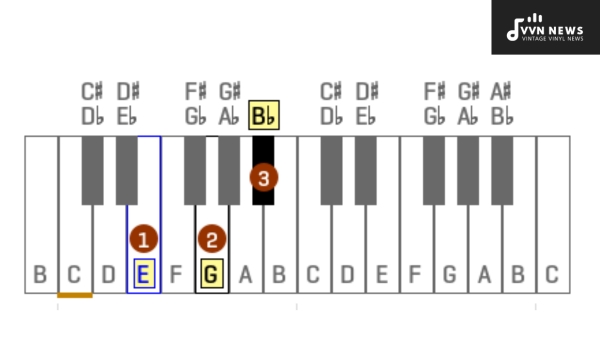
The E Flat Diminished Triad is a chord consisting of three notes – the root note (E♭), the flat third (G♭), and the diminished fifth (B♭♭). Let’s dive into the details to understand how this triad is formed.
- Root Note (E♭): The triad gets its name from its root note, which is E Flat. This serves as the foundation upon which the other two notes are built.
- Flat Third (G♭): The second note in the triad is a flattened third interval, resulting in G♭. It is important to note that a half step below G would be written as G♯, but for consistency and standardization purposes, we use flats when constructing diminished chords.
- Diminished Fifth (B♭♭): The final note of this triad is a diminished fifth interval, denoted here as B Double-Flat. It consists of two flats below B natural.
When these three notes are played together, they create a unique and dissonant sound that adds tension and suspense to your musical compositions.
The formation of the E Flat Diminished Triad is as follows: Root Note (E♭) + Flattened Third Interval (G♭) + Diminished Fifth Interval (B Double-Flat). Understanding this formation will help you identify and utilize this chord in your musical endeavors effectively.
Notation and Symbolism of E Flat Diminished Triad

The E Flat Diminished Triad is a unique three-note chord that consists of the notes E♭, G♭, and B♭♭. Understanding its notation and symbolism will enable you to identify and use it effectively in your musical compositions. Here are some key details to help you easily grasp this concept:
- Notation: In sheet music, the E Flat Diminished Triad is represented using the chord symbol “Eb(dim)” or “Eb°”. It consists of the root note Eb followed by two minor third intervals: Eb-Gb and Gb-Bbb.
- Symbolism: The symbol “dim” or “°” signifies that the triad is diminished, indicating its specific musical quality. It distinguishes it from other triads like major or minor.
- Quality Indicator: The double flat symbol (♭♭) in Bbb indicates that the B note is lowered by two half steps from its natural position (B). This enharmonic equivalence means Bbb is technically A, but notated as Bbb for clarity within the context of E Flat.
- Compact Structure: The diminished triad’s specific structure creates a compact sound due to multiple minor third intervals stacking upon one another.
By understanding the notation and symbolism of the E Flat Diminished Triad, you can confidently analyze and incorporate this unique chord into your musical arrangements with ease.
Also Read: B Flat Minor Triad Guide [Improve Your Music Theory]
Inversions of the E Flat Diminished Triad
The E Flat Diminished Triad can be inversed in various ways to create unique and interesting chord voicings. An inversion occurs when a different note of the chord is played as the lowest note, while maintaining the original intervals between the other notes. Let’s explore the inversions of the E Flat Diminished Triad:
- Root Position: The root position of the E Flat Diminished Triad consists of three notes in ascending order – Eb, Gb, and A. In this position, the root note (Eb) is played as the lowest note.
- First Inversion: To create the first inversion, move the root note (Eb) up an octave. This results in Gb being played as the lowest note, followed by A and then Eb.
- Second Inversion: Moving up another octave, we bring Gb up to its second position as the highest note in this inversion. The order of notes from lowest to highest becomes A, Eb, and then Gb.
By experimenting with these inversions on different instruments or within a musical composition, you can add depth and variation to your chord progressions.
It’s important to remember that each inversion maintains the same relationships between notes within the triad but offers a distinct sonic quality due to different voicings.
Practicing all three inversions in different musical contexts will help you become more comfortable with utilizing them effectively.
Understanding and practicing these inversions will allow you to expand your harmonic possibilities and bring new textures to your musical compositions or improvisations involving E Flat Diminished Triads.
Comparison of E Flat Diminished Triad with Other Triads

The E Flat Diminished Triad is a unique chord that possesses its own distinct sound characteristics. Understanding its differences and similarities with other triads can provide valuable insights into its musical applications. Let’s compare the E Flat Diminished Triad with two commonly used triads: the Major and Minor triads.
1. Structure and Notes
- The E Flat Diminished Triad consists of three notes: Eb, Gb, and B double flat (Bbb).
- The Major Triad is composed of three notes as well: Eb, G, and Bb.
- The Minor Triad is also made up of three notes: Eb, Gb, and Bb.
2. Sound Characteristics
- The E Flat Diminished Triad has an overall tense and unstable sound due to its diminished quality.
- The Major Triad has a stable and consonant sound, evoking a brighter and more uplifting mood.
- The Minor Triad carries a more cynical or darker tone than the Major Triad but still maintains some stability.
3. Chord Spacing
- In the E Flat Diminished Triad, the distance between the root note (Eb) and the third (Gb) is a minor third interval.
- In the Major Triad, the distance between the root note (Eb) and the third (G) is a major third interval.
- In the Minor Triad, like in the E Flat Diminished Triad, there is a minor third interval between the root note (Eb) and the third (Gb).
4. Notation
- E♭dim or Eb° denotes an E Flat Diminished chord.
- Eb denotes an Eb Major chord.
- Ebm signifies an Eb Minor chord.
5. Functionality in Chord Progressions
- The E Flat Diminished Triad often functions as a transitional chord, leading to a more stable harmonic destination.
- The Major Triad is frequently employed as a tonic or dominant chord in many musical compositions.
- The Minor Triad is commonly used to create a melancholic or sad atmosphere in music.
Also Read: B Minor Triad [Master Chord Progression In Just Minutes]
Usage of E Flat Diminished Triad in Music Composition
The E Flat Diminished Triad is a versatile chord that finds its place in various forms of music composition. Its distinct sound adds a touch of tension and intrigue to musical passages. Here are some key details to help you understand its usage:
1. Creating Tension and Excitement
The E Flat Diminished Triad is often used to create tension and excitement in music. Its unique structure, consisting of two minor thirds stacked on top of each other, gives it an inherently dissonant and unstable quality.
2. Substituting Dominant Chords
One common usage of the E Flat Diminished Triad is as a substitute for dominant chords. By substituting a dominant chord with the E Flat Diminished Triad, you can add an unexpected twist to your compositions or create chromatic voice leading.
3. Modulation Tool
The E Flat Diminished Triad can also be utilized as a modulation tool. By using this triad in various inversions, you can smoothly transition from one key to another by creating shared tones between chords.
4. Voice Leading Techniques
In voice leading, the movement of individual melodic lines plays a crucial role in creating harmonic progressions and smooth transitions between chords.
The E Flat Diminished Triad provides interesting voice-leading opportunities due to its symmetrical nature.
5. Dramatic Effect
Due to its inherent instability, the E Flat Diminished Triad is frequently employed in compositions when a sense of drama or suspense is desired. Its dissonant qualities can heighten emotional intensity or accentuate climactic moments.
It’s worth noting that although diminished triads are sometimes found in isolation within compositions, they are often used as passing tones or transitional chords between other harmonies.
By understanding these applications, you can confidently incorporate the E Flat Diminished Triad into your compositions to add complexity, tension, and interest.
Experiment with different progressions, inversions, and voicings to discover the unique possibilities that this chord offers.
Common Chord Progressions with E Flat Diminished

Chord progressions involving the E Flat Diminished Triad can add a unique flavor and tension to your musical compositions. Here are some common chord progressions where the E Flat Diminished Triad can be used effectively:
i – IV – vii° – iii
In the key of C minor, this progression utilizes the Eb diminished triad as the vii° chord. It creates a sense of suspense and provides a smooth transition from the IV chord (F minor) to the iii chord (E♭ major).
ii – V – i
This classic progression is commonly found in jazz and blues music. Incorporating the Eb diminished triad as a substitution for the V7 chord (G7) adds a chromatic descending effect. For example, in the key of C minor, the progression would be Dm7b5 (ii) – G7b9 (V) – Cm (i).
I – bVIIdim7 – IIm7 – V7
In major keys, using the E♭ diminished triad as a substitute for bVIIdim7 adds harmonic interest. This progression can be found in various musical genres, including rock and pop.
E♭ Diminished Passing Chords
The E♭ diminished triad can also be used as a passing chord to create smooth transitions between other chords or keys. It adds an element of tension and movement to your compositions.
By incorporating these common progressions into your music, you can harness the unique qualities of the E Flat Diminished Triad and enhance your musical arrangements with added depth and complexity.
Also Read: E Flat Minor Triad [How To Crack The Code Of Music Notation]
E Flat Diminished in Different Music Genres
The E Flat Diminished Triad finds its place in various music genres, adding a distinct flavor and unique harmonic tension. Let’s explore how this chord is utilized in different musical styles:
Classical Music
In classical music, the E Flat Diminished Triad often appears as a passing chord or a chromatic modulation tool. Composers frequently use it to transition between different keys and create suspenseful moments within their compositions.
Jazz
Jazz musicians value the E Flat Diminished Triad for its versatility and ability to provide a sense of harmonic movement. It is commonly used as an approach chord, leading into the next chord in a progression. Jazz improvisers often incorporate this diminished triad in their soloing, adding chromaticism and tension.
Blues
In blues music, the E Flat Diminished Triad can be employed for diminished passing chords or as a substitution for dominant chords. This adds a touch of sophistication and unexpected harmonic twists to traditional blues progressions.
Pop/Rock
Although less commonly used, the E Flat Diminished Triad can be found in pop and rock music as a way to introduce harmonic tension or create interesting chord progressions.
To fully understand the uses of any chord, it is important to listen to examples from various genres, study the compositions of influential musicians, and experiment with incorporating them into your own musical creations.
Each genre brings its unique perspective on using chords and harmonies. Don’t limit yourself creatively—explore different genres to find inspiration for incorporating the E Flat Diminished Triad into your compositions or improvisations.
Playing the E Flat Diminished on Various Instruments

The E Flat Diminished Triad can be played on a variety of instruments, each with its own unique characteristics and techniques. Here’s a breakdown of how to play this chord on piano, guitar, and violin:
Piano
When playing the E Flat Diminished Triad on the piano, locate the notes E♭, G♭, and B????. Here’s a step-by-step guide:
- Hand Position: Start with your right hand in the “C” position – place your thumb (1) on E♭, your middle finger (3) on G♭, and your pinky finger (5) on B????.
- Physical Placement: Position your fingers above the respective keys without pressing them down yet.
- Playing the Chord: Simultaneously press down E♭, G♭, and B???? using your thumb (1), middle finger (3), and pinky finger (5), respectively.
- Sustain and Release: Hold down the keys for as long as needed to achieve the desired sound before releasing them.
Guitar
To play the E Flat Diminished Triad on guitar, you’ll need to know where to place your fingers on the fretboard. Follow these steps:
- Fret Positioning: Place your index finger across all strings at the 6th fret.
- Enlist Your Other Fingers: Use your middle finger to press down the 7th fret of the A string, and use your ring finger to press down both the 8th frets of D and G strings.
- Strumming or Picking: Strum all six strings from D string downwards or pick individual strings from lowest pitch to highest pitch for an arpeggiated sound.
Violin
Playing the E Flat Diminished Triad on the violin involves finger placement and bowing technique. Here’s how to do it:
- Finger Placement: Position your first finger (index finger) on the A string, just before the first tape marker.
- Note Positions: Press down the string firmly to produce an accurate pitch for each note. The notes are E♭ (first finger), G♭ (fourth finger), and B???? (second finger).
- Bow Technique: Draw the bow across the strings while applying steady pressure to create a smooth and sustained sound.
Remember to practice each instrument technique slowly and gradually increase your speed as you become more familiar with playing the E Flat Diminished Triad on each respective instrument.
Also Read: D Sharp Minor Blues Scale [Master The Moods Of Music Theory]
Tips for Recognizing the E Flat Diminished by Ear
Recognizing the E Flat Diminished Triad by ear can be a valuable skill for musicians and composers. Here are some tips to help you quickly identify this unique chord:
1. Familiarize Yourself with the Sound:
- Listen to examples of E Flat Diminished Triads in different musical contexts.
- Pay attention to the distinctive “tense” or “dissonant” sound created by this chord.
2. Identify the Quality of the Chord:
- Isolate the three notes of the chord and listen closely to their relationship.
- Note that a diminished triad consists of two minor thirds stacked on top of each other.
3. Listen for the Root Note:
- Focus on identifying the E Flat (Eb) note as the lowest pitch in the chord.
- This establishes the tonal center and helps you recognize its diminished quality.
4. Recognize the Intervals:
- Determine if there is a minor third interval between each adjacent note.
- The interval between Eb and Gb, as well as Gb and Bbb (or A), should be a minor third.
5. Compare with Other Chords:
- Differentiate between diminished triads, minor chords, and major chords.
- Please pay attention to how diminished triads differ from minor triads by their unique intervals.
6. Practice Interval Training:
- Train your ears to identify various intervals, including minor thirds.
- This will help you quickly recognize the sound of a diminished triad when it arises.
Developing an ear for recognizing diminished triads takes time and practice.
By actively listening to different musical examples, focusing on intervals, and comparing with other chords, you will gradually become more skilled at identifying this intriguing musical element by ear.
With dedication and perseverance, you will soon be able to confidently identify the E Flat Diminished Triad in any musical setting.
E Flat Diminished in Popular Songs

The E Flat Diminished Triad is a versatile chord that has been utilized in numerous popular songs across various genres. Let’s explore some notable examples where this chord adds a distinct flavor to the music:
- “Blue Moon” by Richard Rodgers and Lorenz Hart: This timeless classic features the E Flat Diminished Triad in its iconic opening phrase: “Blue moon, you saw me standing alone.” The chord adds a touch of melancholy and mystery to the song’s romantic atmosphere.
- “White Rabbit” by Jefferson Airplane: In this psychedelic rock hit from the 1960s, the E Flat Diminished Triad is heard in the line “Remember what the dormouse said.” Its dissonant and suspenseful sound perfectly complements the song’s trippy atmosphere.
- “Lucy in the Sky with Diamonds” by The Beatles: The Beatles were known for their groundbreaking chord progressions, and this song is no exception. The chorus of “Lucy in the Sky with Diamonds” features an E Flat Diminished Triad, adding an otherworldly and surreal quality to the composition.
- “Snake Eyes” by Mumford & Sons: This folk-rock song incorporates interesting harmonies throughout, including an E Flat Diminished chord that adds tension and suspense during certain sections of the track.
- “It Had To Be You” by Isham Jones and Gus Kahn: This jazz standard, popularized by various artists over the years, includes tasteful diminished chords to create a sense of longing and nostalgia. The verse “It had to be you, it had to be you, I wandered around and finally found…” showcases an E Flat Diminished Triad that enriches the emotional depth of the song.
These are just a few examples that highlight how musicians have used the E Flat Diminished Triad creatively to evoke specific moods and enhance musical arrangements.
By listening and analyzing these songs, you can gain inspiration for your own compositions and learn how to incorporate the E Flat Diminished Triad effectively in different musical genres.
Also Read: E Flat Music Note [Master The Symbols Of Musical Notation]
FAQ About E Flat Diminished Triad
How is the E Flat Diminished Triad different from a regular triad?
The E Flat Diminished Triad is unique because it is formed by stacking two minor thirds on top of each other. In contrast, a regular triad consists of a major third and a minor third.
What are the notes in an E Flat Diminished Triad?
The notes in an E Flat Diminished Triad are Eb, Gb, and Bbb (which can also be written as A). These three notes combine to create the distinct sound of the diminished chord.
Can I use the E Flat Diminished Triad in any genre of music?
Yes, absolutely! The E Flat Diminished Triad can be utilized in various genres, including classical, jazz, rock, and pop. It adds tension and richness to compositions.
How do I form inversions of the E Flat Diminished Triad?
Inversions of the E Flat Diminished Triad are created by rearranging the order of the three notes. For example, the first inversion would have Gb as its lowest note, followed by Bbb and Eb.
Are there any famous songs that use the E Flat Diminished Triad?
Yes! The classic song “I Will Survive” by Gloria Gaynor features an iconic chord progression that includes the E Flat Diminished Triad. It demonstrates its versatility across different musical styles.
Conclusion
The E Flat Diminished Triad is a versatile and intriguing chord that adds depth and complexity to musical compositions.
Understanding its structure, formation, and inversions is crucial for musicians looking to incorporate this unique chord into their compositions.
With its distinctive sound characteristics, the E Flat Diminished Triad can evoke a range of emotions and elevate the musical experience.
Whether you are a pianist, guitarist, or violinist, exploring the applications of this chord on different instruments can help you enhance your musical prowess.