
The E major blues scale is a captivating symphony of notes that resonates deeply with the soulful expressions found in many genres of music.
It’s a musical tool that can elevate your playing whether you’re a seasoned guitarist, a budding pianist, or any musician looking to infuse a touch of blues into their work.
This particular scale offers a unique blend of emotions, combining the classic bluesy feel with the bright and uplifting sound of the major tonality.
The twist it gives to conventional melodies can breathe new life into old tunes or inspire original creations.
Stick around as I dive into what makes the E major blues scale a must-know for musicians and how you can start incorporating its distinctive sound into your own music-making journey.
Table of Contents
Structure of E Major Blues Scale
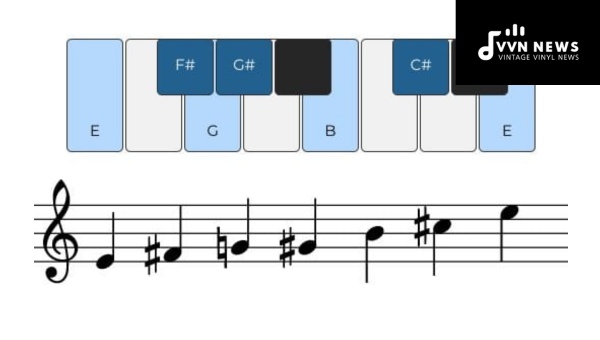
The E Major Blues Scale is a six-note scale that incorporates a flattened third, often referred to as the “blue note,” into the E Major pentatonic scale.
This addition creates a unique fusion of major brightness and plaintive bluesy tones.
To quickly grasp its structure consider the following intervals: Root (E), Major second (F#), Flattened third (G), Major third (G#), Perfect fifth (B), and Major sixth (C#).
Here’s how you can visualize the notes on a scale:
- E (Root)
- F# (Major Second)
- G (Blue Note)
- G# (Major Third)
- B (Perfect Fifth)
- C# (Major Sixth)
These intervals give the E Major Blues Scale its characteristically uplifting yet soulful sound. Musicians often emphasize the G note for that quintessential ‘bluesy’ feel within this predominantly major backdrop.
The presence of both G and G# notes allows for expressive tension and release, which is central to the blues style.
Also Read: Delay & Echo: A Guide To Using Time-based Audio Effects
Positions for E Major Blues Scale

When mastering the E Major Blues Scale, it is crucial to learn its various positions on the fretboard.
These positions allow guitarists to navigate the scale across the entire range of their instrument, giving them access to a variety of licks and riffs that are fundamental to blues music.
The Five Key Positions
- Open Position: In this position, you will utilize open strings. It starts at the open E string and typically spans up to the third fret.
- Position I (The Root Position): This position centers around the root note located on the fifth string, the second fret. Your fingers will cover frets two through five.
- Position II: Move up the neck to where your index finger is now on the fifth fret, commonly known as the A shape in bar chord terminology.
- Position III: Shifting further, start with your index finger on the seventh fret; this area is pivotal for soulful bends and vibrato.
- Position V: The final position puts your index finger around the twelfth fret where full-octave patterns are accessible.
Understanding these positions involves recognizing patterns that repeat themselves octave after octave.
Each position unlocks new melodic possibilities and offers fresh takes on traditional blues phrasing.
Also Read: Sharp Sign In Music [What It Means And How To Play It]
Utilizing Positions for Fluid Play
The beauty of learning these positions lies in their potential for fluid movement up and down the neck.
Blending these positions seamlessly can give you an edge in improvisation and soloing.
To truly master these positions:
- Practice each pattern till it feels natural.
- Work on transitioning smoothly between different areas of the fretboard.
- Listen to your favorite blues tracks and try identifying which position is being used for certain licks or solos.
Familiarizing yourself with these five key positions will provide a solid foundation upon which you can expand your creative expression within E Major Blues repertoire.
Major and Minor in Blues Scales
The color and mood of blues music heavily rely on the interplay between major and minor scales.
The E major blues scale incorporates a unique blend of the major third with the minor third and the minor seventh, contributing to its characteristic sound.
The intriguing aspect here is how these intervals, commonly found in minor scales, inject a bittersweet quality into the bright backdrop of a major scale.
Understanding Intervals
- Major Third: A distance encompassing four half steps.
- Minor Third: A distance encompassing three half steps.
- Minor Seventh: A distance encompassing ten half steps.
These intervals interact within the E major blues scale to create a sonic fusion that is at once familiar and distinctive.
Utilizing Both Major and Minor Tones
When you play this scale, your approach matters. By emphasizing the minor third or seventh, you inject a deeper sense of traditional blues feeling.
- Start with traditional E Major scale notes: E – F# – G# – A – B – C#
- Add a “blue note” (D) creating that bluesy feel.
- Blend it with minor-scale tones to form the E Major Blues Scale: E – G# (major third) and D (blue note).
Artists employing this mix can elicit various emotional responses from their listeners, bridging gaps between genres, styles, and moods seamlessly.
Also Read: C Minor Pentatonic Scale [Essential Tool For Improvisation]
Why Learn Ear Training for Blues Scales?

Ear training is a pivotal aspect of comprehending and utilizing blues scales, especially when it comes to the E Major Blues Scale.
By fine-tuning your listening skills, you enable yourself to distinguish subtle nuances and intervals that make up the soulful characteristics of blues music.
Recognizing Patterns
Firstly, ear training aids in recognizing patterns within the blues scale. This recognition allows you to foresee the direction of a melody or accompaniment, thus anticipating chord changes and improvisational opportunities.
Improvisation Skills
Secondly, it boosts your improvisation skills. Blues is all about expression and feeling.
When you can hear which notes will complement the underlying chords best, you naturally become more adept at crafting impromptu solos that feel right at home within the scale.
Communication with Other Musicians
Moreover, ear training is crucial for effective communication with other musicians.
If you understand what you’re hearing, articulating musical ideas or suggestions becomes more straightforward during jams or performances.
Developing Relative Pitch
- Recognize relationships between notes.
- Enhance tuning and intonation.
- Predict melodic and harmonic movements.
By honing your ears, you become more attuned to the emotional weight each note carries in the E Major Blues Scale—transforming your music into an expressive conversation rather than just a series of notes.
Also Read: D Flat Major Scale [The Tools Of Music Theory]
Well-known E Major Blues Scale Songs
When you begin to delve into songs that utilize the E major blues scale, you’ll quickly realize why it’s such a cherished palette in music.
Many great tracks have harnessed the soul-stirring quality of this scale to create iconic sounds. Here are a few examples that stand out:
“Pride and Joy” by Stevie Ray Vaughan
Stevie Ray Vaughan’s Pride and Joy is a quintessential blues number that deftly showcases the E major blues scale in action.
The song combines a Texas shuffle rhythm with piercing lead lines, offering a clear display of how flexible and expressive the E major blues can be.
“Crossroads” by Cream
Although originally composed by Robert Johnson as a Delta blues song, Cream’s rendition of Crossroads takes it to another level.
Eric Clapton’s fiery guitar solos are riddled with E major blues phrases, blending seamlessly with the song’s rocking tempo to create an unforgettable musical experience.
“Sweet Home Chicago” (Blues Brothers version)
The Blues Brothers reimagined this classic blues standard adding their own upbeat spin.
While the song walks through various blues progressions, the unmistakable influence of the E major blues scale is present throughout, providing a jubilant energy that can invigorate any listener.
Discovering well-known songs that feature the E major blues scale can also serve as excellent practice material.
Not only do you get familiar with how different artists apply it within their compositions, but you also gain insights into creating your own improvisations or borrowing elements for your work.
How did E Major Blues Change Music?

The E Major Blues Scale has left an indelible mark on the landscape of modern music.
This scale is a mosaic of sound, merging the bright cheerfulness of E major with the soul-stirring depths of blues notes to create something truly transcendent.
Its impact can be heard across numerous genres, bending rules and blurring lines.
One significant change catalyzed by this scale is its allowance for emotional expression.
It gave musicians a broader aural palette to work with, permitting them to express shades of joy and sorrow in a single phrase.
This emotional versatility changed how artists composed and performed, leading to more nuanced and impactful pieces.
Fusion of Genres
The scale facilitated a seamless blend between traditional major melodies and the earthier tones typical of blues music.
Such hybrids brought forth new subgenres like blues-rock and jazz-blues, where the quintessential shuffle rhythms meet harmonious major melodic lines.
Innovation in Guitar Solos
In particular, for guitarists, the E Major Blues Scale became an essential part of the soloist’s toolkit.
Iconic riffs and solos born from this scale have etched their way into music’s DNA; think legendary tracks like “Sweet Child O’ Mine” by Guns N’ Roses or “Pride and Joy” by Stevie Ray Vaughan.
Music was never quite the same after its colorings began appearing in everything from solemn hymns to rock ‘n’ roll anthems.
The E Major Blues Scale did not just change music; it added a layer of emotional complexity, turning ordinary tunes into timeless expressions of humanity’s vast emotional tapestry.
Also Read: Haas Effect [The Powerful Tool To Upgrade Your Audio Mix]
FAQ about the E Major Blues Scale
What are the core notes of the E Major Blues Scale?
The core notes are E, G#, A, Bb (which is the “blue” note), B, and D.
How does the E Major Blues Scale differ from a regular major scale?
The key difference is the addition of a “blue” note, or flat fifth (Bb), which gives the scale its bluesy sound.
Can I use the E Major Blues Scale for genres other than blues?
Absolutely! It’s great for jazz, rock, and even pop to add some soulfulness to your melodies.
What’s an easy way to start practicing this scale on guitar?
Start by learning one octave of the scale in an open position, slowly at first, then increasing speed as you grow comfortable.
Where can I listen to examples of the E Major Blues Scale in action?
Listen to blues legends like B.B. King and Eric Clapton, or search for songs in E major on music streaming platforms with blues influences.
Conclusion
The E Major Blues Scale serves as a bridge between the worlds of raw blues emotion and the sophistication of major harmony.
From its unique note composition to its versatile application across various fretboard positions, mastering this scale enriches your musical expression.
Whether you’re crafting soul-stirring solos or infusing bluesy undertones into melodies, the E Major Blues Scale is a valuable tool that can transform your music, imbuing it with depth and feeling that resonates with listeners.