
Music is an expansive and beautiful language, rich in nuances, with its own alphabet and grammar.
At the heart of this language lies a fundamental element known as a triad, a set of three notes that creates a particular harmony.
This article introduces you specifically to the F minor triad, an evocative little sequence that carries its own unique mood and texture.
Getting acquainted with musical constructs like the F minor triad is an essential step in enriching your musical vocabulary.
The understanding of triads opens up a new perspective when you are playing an instrument or composing music.
It’s akin to discovering different shades while painting or finding a unique seasoning for your favorite dish: it enhances your ability to express emotions and ideas within this complex and dynamic language of sound.
With this knowledge tucked into your toolkit, even if music isn’t your profession or passion, it can transform the way you listen to, appreciate, and engage with music.
Table of Contents
What is a Triad in Music Theory?
In music theory, a triad refers to a chord consisting of three notes stacked on top of each other. These three notes are typically chosen from the scale of the key in which the chord is being used. Triads form the foundation of most chords and harmonies in music and provide structure and depth to compositions.
A triad is composed of three intervals: the root, third, and fifth. The root note is the foundation upon which the chord is built. The third interval determines whether a chord is major or minor. In our case, we will focus on the F minor triad, where “F” serves as our root note.
The fifth interval adds stability and support to the chord’s tonality. When these intervals are combined, they create a harmonious and coherent sound that can be felt throughout a piece of music.
Understanding triads allows musicians to identify different chords’ qualities and function within a musical context. Whether you’re strumming away on a guitar, tickling the ivories on a piano, or manipulating synth patches digitally, an understanding of triads opens up endless possibilities for creative exploration in your musical journey.
How is the F Minor Triad Constructed?

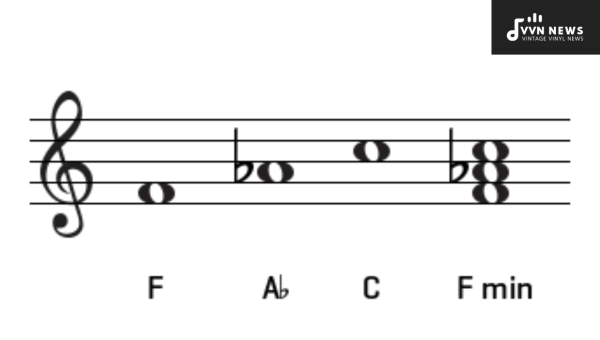
The F minor triad is a chord that consists of three notes: F, Ab, and C. Let’s break down how this triad is constructed:
- Start with the Root Note: The root note of the F minor triad is F. It serves as the foundation and determines the chord’s name.
- Identify the Third Interval: To determine whether the triad is major or minor, we need to find the third interval from the root note. In the case of an F minor chord, we take A as our starting point and count three half steps downwards (F#, F). This leads us to Ab, which becomes the second note in our triad.
- Add the Fifth Interval: The final note in our F minor triad is determined by counting three and a half steps upwards from Ab. This brings us to C, completing our triad.
An F minor triad consists of the notes F (root), Ab (third), and C (fifth). These three notes combined create a melancholic and introspective sound that can evoke various emotions in music.
Also Read: 20 Best Phaser Pedals [Top Picks For Epic Sound Effects]
Why is the F Minor Triad Important in Music?
The F minor triad holds great significance in the world of music. It adds depth, emotion, and complexity to compositions across various genres. Here are several reasons why the F minor triad is important:
1. Emotional Expression:
The F minor triad has a melancholic and somber quality due to its minor third interval. Its dark and moody nature makes it an ideal choice for expressing sadness, introspection, or longing in music. The F minor triad can evoke a sense of yearning or nostalgia, creating a powerful emotional impact on listeners.
2. Chord Progressions:
The F minor triad frequently appears in chord progressions, contributing to the overall harmony and structure of a piece. It often acts as the vi (minor) chord in the key of A-flat major or as the ii (minor) chord in the key of D-flat major. Understanding how to use and resolve the F minor triad within these progressions provides musicians with diverse harmonic possibilities.
3. Songwriting and Composition:
When writing music, exploring different chords and their variations is essential to create engaging melodies and harmonies. Incorporating the F minor triad into your compositions can elevate them by adding intensity or contrasting moments of tranquility against major chords.
4. Musical Versatility:
The F minor triad can be used across various music genres such as classical, jazz, pop, rock, and blues. Its adaptable nature allows it to seamlessly integrate into different styles, offering musicians endless opportunities for creative expression.
5. Transposition and Key Modulation:
Understanding how chords function within different keys is essential for musicians looking to explore new tonalities or modulate between different keys while performing or composing. The knowledge gained from grasping the importance of an F minor triad translates beyond just this particular chord but extends to understanding harmonic relationships more broadly.
The F minor triad adds emotional depth, chord progressions, and versatility to music.
Its melancholic nature and role within different keys contribute to its importance in creating impactful compositions and eliciting powerful emotional responses from listeners.
By harnessing the potential of the F minor triad, musicians can expand their creative horizons and immerse themselves in a world of musical possibilities.
Which Notes Make Up the F Minor Triad?

The F minor triad is composed of three notes: F, Ab, and C. Let’s break down each note and understand its role within the triad:
- F (Root Note): The F note serves as the foundation of the triad. It establishes the tonal center and gives the chord its name.
- Ab (Minor Third): The Ab note is what classifies this chord as a minor triad. The interval between F and Ab is a minor third, which gives it a slightly melancholic or somber quality.
- C (Perfect Fifth): The C note acts as the fifth interval in the F minor triad. This interval adds strength and stability to the chord, balancing out the tension created by the minor third.
When played together, these three notes create an emotionally rich and expressive sound characteristic of the F minor triad.
It is important to remember that music theory provides a framework for understanding chords, but innovation and creativity often involve breaking these rules and experimenting with different combinations of notes to create unique musical expressions.
Also Read: 17 Best Delay Pedals For Heavenly Echo Tones
How Can You Recognize the F Minor Triad by Ear?
Recognizing chords by ear is an important skill for musicians, as it enables them to play and understand music more instinctively. Here are some key pointers to help you identify the F minor triad by ear:
- Listen for the Root Note: The first step in identifying any triad is to listen for the root note. In this case, we are looking for the note “F.” Pay attention to the lowest sounding note in the chord.
- Identify the Quality: The quality of a triad refers to whether it is major or minor. In the case of an F minor triad, it has a “minor” quality.
- Listen for the Intervals: To identify a minor triad, pay attention to the specific intervals between notes. In an F minor triad, you will hear a minor third interval between the root note (F) and its accompanying third note (Ab). Additionally, there will be a perfect fifth interval between the root note (F) and its fifth note (C).
- Familiarize Yourself with Examples: By listening to songs, melodies, or pieces that prominently feature F minor chords or progressions, you can train your ear to become more attuned to their sound characteristics.
- Practice Chord Recognition Exercises: Train your ear further through dedicated chord recognition exercises using software tools or practice books that provide musical examples for you to identify and analyze.
By actively engaging with music and focusing on these techniques, you can gradually develop your ability to recognize F minor triads by ear. Remember that consistent practice and exposure are key in honing this skill.
Also Read: 20 Best Volume Pedals [Top Picks For Controlling Your Sound]
How to Play the F Minor Triad on Various Instruments?

Playing the F minor triad on different instruments requires understanding the instrument’s layout, finger positioning, and overall technique. Let’s explore how to play this chord on some popular instruments.
Guitar
To play the F minor triad on a guitar:
- Start with your index finger barring all strings at the first fret.
- Press down your ring finger on the 3rd fret of the A string (5th string).
- Place your pinky finger on the 3rd fret of the D string (4th string).
- Strum from the A string (5th string) downward.
This standard open position allows for an easy transition to other chords and variations within the F minor family.
Piano
On a piano:
- Position your right hand with fingers 1, 2, and 5 (thumb, middle finger, and pinky) over three adjacent white keys: F, Ab, and C.
- Play all three notes simultaneously.
- For a fuller sound, add in your left hand by playing a single F note one octave below with your pinky.
While this is one common fingering for playing Fm triads on piano, you can experiment with different inversions and hand positions to find what works best for you.
Bass
On a bass guitar:
- Place your index finger of your fretting hand barring across all strings at the first fret.
- Press down with your middle or pinky finger on the third fret of the A string (4th string).
- Strike all four strings together using either fingers or a pick.
By pressing down at different positions along the neck, you can create various voicings and positions for playing Fm triads on bass.
Ukulele
On a ukulele:
- Use your index finger to bar the first fret on all four strings.
- Press down with your middle finger on the third fret of the G string (4th string).
- Strum from the G string (4th string) downward.
Adapting this triad to a compact instrument like a ukulele can bring a unique character to your arrangement.
Learning to play the F minor triad on various instruments opens up a world of musical possibilities. Experiment with different voicings, inversions, and chord progressions to find your own unique sound. Practice regularly and have fun exploring this versatile chord!
What are the Different Triads in the F Minor Triad?
The F minor triad is a versatile chord, and it can take on several different forms or inversions. Each inversion provides a unique sound and can be used to create distinct musical effects. Let’s break down the different variations of the F minor triad:
- Root Position: The root position of the F minor triad has F as the lowest note. The notes in this triad are F, Ab, and C.
- First Inversion: In the first inversion of the F minor triad, we move the root note (F) up one octave. This means that Ab becomes the lowest note of the chord. The notes in this inversion are Ab, C, and F.
- Second Inversion: For the second inversion, we move both the root note (F) and first inversion (Ab) up one octave each. This places C as our lowest note in this position. The notes in this inversion are C, F, and Ab.
By utilizing these inversions within your compositions and arrangements, you can add depth and variety to your music effortlessly.
Also Read: 20 Best Boost Pedals In 2026 [Pump Up Your Guitar Performance]
How Does the F Minor Triad Relate to Other Chords?

Understanding how the F minor triad relates to other chords is crucial for creating smooth transitions and harmonies in music. Let’s explore the various ways this triad interacts with other chords.
1. Relative Major and Minor Chords
Every minor key has a relative major key, which shares the same key signature. In the case of F minor, its relative major is Ab major. The F minor triad contains the same notes as Ab major, but with F as the root note. This relationship allows for seamless modulations between these chords within a composition.
2. Chord Progressions
The F minor triad can be part of numerous chord progressions in various musical genres. One common progression is i-iv-V, where the F minor chord (i) is followed by a Bb minor chord (iv) and a C dominant seventh chord (V). This progression adds depth and tension to a piece while providing a sense of resolution when returning back to the F minor chord.
3. Secondary Dominant Chords
The dominant seventh chords built off notes that are not in the original key can add harmonic interest and tension to a composition. In the key of F minor, one frequently utilized secondary dominant is C7 (the dominant seventh chord based on G), which leads naturally back to an F minor triad.
4. Extended Chords
With additional notes added on top of the basic triad structure, extended chords can be created. For example, adding an A-flat note results in an Fm7 chord—a more complex version of the simple triad that brings further richness and color to musical arrangements.
Understanding how different chords relate helps musicians create captivating melodic progressions and harmonies when composing or improvising music. It allows for greater flexibility in expression and opens up countless possibilities for constructing unique and emotive musical landscapes.
FAQ About F Minor Triad
1. What notes make up the F minor triad?
The F minor triad is comprised of the notes F, Ab, and C.
2. How can I recognize the F minor triad by ear?
By listening for the distinctive interval between the root note (F) and the third (Ab), you can identify the F minor triad by its characteristic minor quality.
3. How do I play the F minor triad on a piano?
To play the F minor triad on a piano, place your thumb on F, your middle finger on Ab, and your pinky finger on C.
4. Are there different inversions of the F minor triad?
Yes, there are three inversions of the F minor triad: root position (F Ab C), first inversion (Ab C F), and second inversion (C F Ab).
5. How does the F minor triad relate to other chords?
The F minor triad is an essential component in various chord progressions and harmonies in music, forming a foundation upon which many compositions are built.
Conclusion
The F minor triad is a fundamental chord in music theory that adds depth and emotion to compositions. Understanding how it is constructed and its relationship to other chords allows musicians to create more complex harmonies and melodies. By recognizing the F minor triad by ear and learning to play it on various instruments, you can incorporate its unique sound into your own musical creations. So go ahead, dive into the world of the F minor triad, and unlock new possibilities for musical expression.