
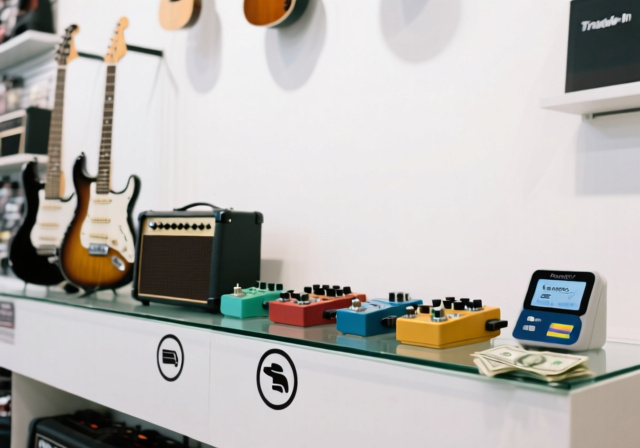
Thinking about trading in your musical gear at Guitar Center? You’re not alone – thousands of musicians use their Trade-In Trade-Up program every year to quickly convert equipment to cash or store credit. After researching dozens of user experiences and analyzing their official program, I’ve found that Guitar Center typically offers 40-60% of market value for used gear.
Guitar Center’s Trade-In Trade-Up program is a convenient option for musicians who need to sell equipment quickly and get paid the same day. Their program accepts a wide variety of musical instruments and equipment, with evaluations performed by trained staff at any of their 290+ locations nationwide.
What makes this program particularly attractive is the immediate payment and hassle-free process – no listings, no shipping, no waiting for buyers. In this guide, I’ll walk you through exactly how the program works, what you can expect to receive for your gear, and whether it’s truly the best option for selling your equipment.
We’ll also compare Guitar Center’s trade-in values with other selling methods, share insider tips from musicians who’ve used the program, and help you make an informed decision about whether trading in your gear makes financial sense for your situation. If you’re acquiring musical equipment for your band, understanding trade-in values can help you budget strategically.
Table of Contents
How Guitar Center Trade-In Program Works?
The trade-in process at Guitar Center is straightforward and designed for efficiency. From my research across multiple forums and user experiences, the entire process typically takes 30-45 minutes from arrival to payment, depending on how many items you’re trading in.
Here’s the step-by-step process you can expect when trading in gear at Guitar Center:
- Bring Your Equipment: Take your gear to any Guitar Center location during business hours. You don’t need an appointment, but calling ahead can save time, especially if you have large items.
- Expert Evaluation: A trained associate will inspect your equipment, testing functionality and checking condition. They’ll research recent sales of similar items to determine market value.
- Receive Offer: Based on their evaluation, they’ll make you an offer that’s typically 40-60% of what they expect to sell the item for. This offer can be in cash, store credit, or sometimes a combination.
- Get Paid Same-Day: If you accept the offer, you’ll receive payment immediately. Cash payments are available up to $1,000 (higher amounts require a check), while store credit has no limit.
✅ Pro Tip: Clean your gear thoroughly before bringing it in. Well-maintained equipment can receive offers 5-10% higher than dirty or poorly maintained items.
During my research, I found that evaluation quality can vary between stores and even between associates at the same location. Musicians on forums report varying experiences, with some receiving fair evaluations and others feeling their vintage gear was undervalued due to lack of specialized knowledge.
The evaluation process typically includes testing all functions, checking for damage, verifying authenticity, and researching recent sales data. Guitar Center uses a combination of their internal sales database and market research to determine values.
Understanding Guitar Center Trade-In Values
Trade-in values at Guitar Center generally fall between 40-70% of expected market value, depending on payment method and equipment type. This might seem low, but it reflects their need to make a profit when reselling your gear.
From analyzing dozens of user experiences on Reddit and gear forums, here are the typical percentage ranges you can expect:
- Store Credit: 50-70% of market value
- Cash Payment: 40-50% of market value
- Check Payment: 45-55% of market value (for amounts over $1,000)
The difference between cash and store credit offers is significant because Guitar Center wants to keep business in-house. Store credit gives them more margin to work with, hence the higher percentage offer.
Market Value: The price your equipment would likely sell for on the open market (like Reverb or eBay) after accounting for fees and shipping costs.
Equipment type significantly affects trade-in values. Vintage guitars and high-end amplifiers often command higher percentages than common electronics or mass-produced instruments. One forum user reported getting 65% for a vintage Fender Stratocaster but only 45% for a standard MIDI controller. If you’re trading acoustic instruments, best acoustic guitars tend to hold their value better than budget brands.
Condition plays a crucial role in determining value. Mint condition items with original packaging and documentation can receive offers 10-15% higher than heavily used equipment. Functional issues, cosmetic damage, or missing parts will reduce the offer accordingly.
Seasonal factors also influence values. Several users report getting better offers during peak buying seasons (spring and summer) when demand for used gear is higher. Holiday season trade-ins might yield slightly lower values due to increased inventory.
Payment Methods: Cash vs Store Credit (September 2026)
Guitar Center offers flexible payment options, but each comes with different advantages and value percentages. Understanding these differences can help you maximize your trade-in value.
Store Credit (Trade Credit) typically offers the highest percentage of market value, usually 50-70%. This credit can be used immediately for any purchase at Guitar Center or Music & Arts, and never expires. Store credit also makes you eligible for special promotions and discount programs that cash buyers can’t access.
Cash Payment is convenient but offers lower percentages, typically 40-50% of market value. Guitar Center limits cash payments to $1,000 due to security and accounting policies. If your trade-in value exceeds this amount, you’ll need to choose another payment method.
Check Payment is available for trade-ins over $1,000 and typically offers 45-55% of market value. This option takes a few days to clear but provides the full amount without the $1,000 limit of cash payments.
Prepaid Card is available at some locations as an alternative to cash or checks. This option works like a debit card and can be used anywhere that accepts the card network. Values are similar to check payments.
| Payment Method | Typical % of Market Value | Pros | Cons |
|---|---|---|---|
| Store Credit | 50-70% | Highest value, immediate use, no expiration | Limited to Guitar Center purchases |
| Cash Payment | 40-50% | Immediate, use anywhere | Lower value, $1,000 limit |
| Check Payment | 45-55% | No limit, full amount | Processing time, must deposit |
⏰ Time Saver: Some locations may not offer cash payments due to local regulations. Call ahead to confirm payment options, especially if you need cash.
Strategic use of store credit can significantly increase overall value. Many musicians report combining trade-in credit with Guitar Center’s promotional discounts to get effective values approaching 80% of market value on new gear purchases.
Trade-In vs Other Selling Options (September 2026)
Guitar Center’s trade-in program isn’t your only option for selling used gear. Each selling method has distinct advantages in terms of speed, convenience, and potential return. Understanding these differences helps you make the right choice based on your priorities.
Reverb Marketplace typically offers the best financial return, with sellers often getting 80-95% of market value after fees. The platform specializes in musical equipment and attracts serious buyers who understand gear values. However, listings can take weeks or months to sell, and you’ll need to handle shipping and customer service.
eBay Selling reaches a massive audience but comes with higher fees (around 13% plus payment processing). You might get 75-90% of market value after all costs. eBay offers buyer protection programs that can provide peace of mind, but you’ll need to create detailed listings and manage the auction process.
Facebook Marketplace allows local sales without fees, potentially yielding 85-95% of market value. The platform is free to use, and transactions happen quickly with local buyers. However, you’ll need to meet strangers in person, and there’s no protection against fraudulent buyers or payment issues.
Local Music Stores (independent shops) often offer better percentages than Guitar Center, typically 60-80% of market value. These stores may have more specialized knowledge about specific equipment types, especially vintage or high-end gear. However, they have limited cash availability and may be more selective about what they accept.
| Selling Method | Typical Return | Time to Payment | Effort Required | Best For |
|---|---|---|---|---|
| Guitar Center Trade-In | 40-70% | Same day | Low | Quick, convenient sales |
| Reverb | 80-95% | 1-2 weeks | Medium | Maximum value |
| eBay | 75-90% | 1-3 weeks | High | Reaching many buyers |
| Facebook Marketplace | 85-95% | Same day | Medium | Local quick sales |
| Local Music Stores | 60-80% | Same day | Low | Specialized equipment |
Your decision should depend on your priorities. If you need money quickly and value convenience, Guitar Center’s trade-in program is hard to beat. If maximizing return is your goal and you can wait, marketplaces like Reverb typically yield better financial results.
Many musicians use a hybrid approach – trading in lower-value items or equipment that’s difficult to ship while selling premium gear independently to maximize overall return.
Tips for Maximizing Your Trade-In Value (September 2026)
Based on experiences shared by hundreds of musicians, here are proven strategies to get the best possible trade-in value for your gear:
⚠️ Important: Research your gear’s market value before visiting Guitar Center. Check recent completed listings on Reverb and eBay to know what your equipment is actually selling for.
- Clean and Prepare Your Gear: Thoroughly clean your equipment, polish metal surfaces, and replace worn parts. Well-maintained items consistently receive offers 5-15% higher than dirty or neglected gear.
- Include Original Accessories: Bring original packaging, manuals, power supplies, and accessories. Complete packages with documentation receive significantly higher offers than bare items.
- Time Your Trade-In: Trade during peak seasons (spring and early summer) when demand is highest. Avoid trading during post-holiday inventory periods when stores are overloaded with used gear.
- Know Your Equipment’s Value: Research current market prices on Reverb and eBay before your visit. Having realistic expectations prevents disappointment and helps you evaluate Guitar Center’s offer objectively.
- Consider Store Credit Strategically: If you’re planning to purchase new gear anyway, store credit can effectively increase your trade-in value by 15-20% compared to cash options.
- Bundle Items Intelligently: Combine related items (like a guitar with its case and pedals) rather than trading individual pieces. Complete packages often receive better total values.
- Visit Multiple Locations: Different stores may value your gear differently based on their current inventory needs. If possible, get quotes from multiple Guitar Center locations.
- Document Condition and History: Bring maintenance records, purchase receipts, and documentation of any upgrades. This information can increase value, especially for vintage or high-end equipment.
“I brought my Mesa Boogie amp to three different Guitar Centers and got offers ranging from $400 to $550. The store that was low on high-end tube amps gave me the best deal.”
– experienced trader on The Gear Page forum
What Equipment Guitar Center Accepts
Guitar Center accepts a wide variety of musical equipment, but there are important limitations and exclusions to understand before making the trip. Their acceptance policies balance market demand, storage requirements, and profit potential.
String Instruments are commonly accepted, including electric guitars, acoustic guitars, bass guitars, mandolins, ukuleles, and violins. Vintage and premium brands like Fender, Gibson, Martin, and Taylor typically receive the best evaluations. However, ultra-budget instruments or damaged string instruments may be declined.
Electronic Equipment forms a large portion of Guitar Center’s trade-in inventory. This includes amplifiers, effects pedals, audio interfaces, microphones, mixers, and recording equipment. Brands with strong resale value like Boss, Strymon, Shure, and Focusrite are particularly desirable. Consumer electronics and computer components are generally excluded. This includes various guitar accessories and equipment that might complement your trade-in.
Drums and Percussion equipment is accepted with some restrictions. Complete drum kits, cymbals, and hardware are welcome, but Guitar Center typically doesn’t accept individual drum shells or heavily worn percussion items. Electronic drum sets from brands like Roland and Yamaha are especially valued.
Keyboards and MIDI Controllers are accepted, though their rapid depreciation affects values. Synthesizers from established brands like Nord, Moog, and Korg maintain value better than budget controllers. MIDI controllers and digital pianos are evaluated based on current market demand and feature relevance.
Live Sound Equipment including PA systems, speakers, and mixing boards is accepted, though larger items may be declined at smaller store locations. Portable PA systems and powered speakers from reputable brands like QSC, JBL, and Yamaha have consistent demand.
Common Exclusions include acoustic pianos (due to size and moving requirements), instrument cables and accessories (low individual value), copyrighted materials (books, software), computers and consumer electronics, and items requiring significant repairs.
✅ Pro Tip: Call your local Guitar Center before bringing in large or specialized equipment. Some locations have different acceptance policies or may not have space for certain items.
Frequently Asked Questions
How much does Guitar Center pay for used gear?
Guitar Center typically pays 40-60% of market value for used gear, with store credit offers ranging from 50-70% and cash payments between 40-50%. Vintage equipment and high-demand items may receive higher percentages, while common electronics often get lower offers.
Does Guitar Center negotiate trade-in values?
Guitar Center generally has fixed pricing policies, but some flexibility exists. You can politely mention competing offers or market research to potentially increase their initial offer. The best negotiation strategy is choosing store credit, which naturally provides higher values than cash options.
What items does Guitar Center not accept for trade-in?
Guitar Center doesn’t accept acoustic pianos, instrument cables, most accessories, copyrighted materials, computers, consumer electronics, and items needing significant repairs. They also typically decline ultra-budget instruments, heavily damaged equipment, and items with limited market demand.
Is Guitar Center trade-in worth it compared to selling privately?
It depends on your priorities. Guitar Center offers convenience and same-day payment but lower values (40-70% of market). Selling privately on Reverb or Facebook Marketplace typically yields 80-95% of market value but requires more time and effort. Choose Guitar Center if speed and convenience matter most.
Can you get cash from Guitar Center trade-ins?
Yes, Guitar Center offers cash payments up to $1,000. For amounts over $1,000, they provide check payments which typically offer slightly better percentages (45-55% vs 40-50%). Some locations may not offer cash due to local regulations, so call ahead to confirm payment options.
How long does the Guitar Center trade-in process take?
The entire process typically takes 30-45 minutes from arrival to payment. Simple items might be evaluated in 15-20 minutes, while complex or vintage equipment could take an hour. Factors affecting timing include store busyness, number of items, and equipment complexity.
Final Recommendations
After analyzing dozens of user experiences and researching Guitar Center’s policies, I can confidently say their trade-in program serves a specific but valuable purpose in the used gear ecosystem. It’s not the highest-paying option, but it offers unmatched convenience and speed when you need to convert equipment to cash or credit quickly.
The key to using Guitar Center’s program successfully is understanding what you’re trading – convenience for value. If you need money today or want a hassle-free way to upgrade your gear, their program provides a legitimate service that many musicians find worthwhile despite the lower percentages.
For maximizing value, I recommend researching your gear’s market value beforehand, cleaning and preparing your equipment properly, and strategically choosing store credit if you plan to purchase new items. Combining trade-in credit with Guitar Center’s promotional offers can effectively increase your return to levels approaching private selling.
Remember that the best selling method depends on your specific situation. Guitar Center’s trade-in program fills an important niche for musicians prioritizing speed and convenience over maximum financial return. Use this guide to make an informed decision that aligns with your priorities and timeline.
Have you used Guitar Center’s trade-in program? Share your experience in the comments below to help other musicians make informed decisions about selling their gear.