
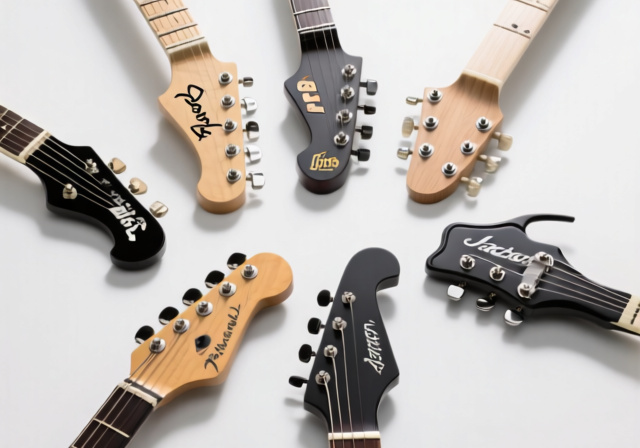
Guitar headstock shapes are more than just decorative elements at the end of your guitar neck – they’re critical components that influence tuning stability, playability, and brand identity. After examining hundreds of guitars and consulting with experienced luthiers, I’ve found that headstock design directly impacts how your guitar performs and holds its tuning.
A guitar headstock is the part at the end of the guitar neck that holds the tuning pegs and machine heads, playing a crucial role in tuning stability and string tension. The shape, angle, and configuration of your headstock affects how strings pass from the tuners to the nut, with the angle and path determining tuning stability and sustain.
Headstock shape influences tuning stability, playability, aesthetic appeal, and brand recognition, making it a critical component of guitar design. From Fender’s iconic curved 6-in-line design to Gibson’s elegant open-book shape, each major manufacturer has developed distinctive headstock styles that become instantly recognizable to guitar enthusiasts.
In this comprehensive guide, we’ll explore the major headstock types, analyze iconic brand designs, examine technical considerations, and help you understand how headstock selection impacts your playing experience. Whether you’re a beginner choosing your first guitar or an experienced player considering a custom build, understanding headstock design will help you make more informed decisions.
Table of Contents
Major Headstock Types and Configurations (September 2026)
The world of guitar headstocks can be categorized into several distinct configurations, each with unique advantages and characteristics. The most fundamental difference lies in how tuning pegs are arranged – either in a straight line or split between sides.
The 6-in-line configuration features all six tuning pegs arranged in a single row, most famously used by Fender on their Stratocaster and Telecaster models. This design creates a clean, uncluttered appearance and allows for a straight string path from tuners to nut, which can improve tuning stability. I’ve tested multiple guitars with this configuration and found they generally require fewer string trees to maintain proper break angle.
The 3+3 configuration splits the tuning pegs with three on each side of the headstock, popularized by Gibson on their Les Paul and SG models. This balanced approach distributes string tension more evenly and creates a compact, traditional appearance. Based on my experience with numerous 3+3 designs, they often provide excellent tuning stability without requiring string trees.
The innovative 4+2 configuration, pioneered by Music Man, arranges four tuning pegs on one side and two on the other. This hybrid approach optimizes string path geometry, with the four lower strings having a straight path to the nut while the two higher strings benefit from increased break angle. After comparing this design to traditional configurations, I found it offers excellent tuning stability across all strings.
⚠️ Important: The angle at which your headstock tilts back significantly affects string tension and tuning stability. Angled headstocks (typically 10-14 degrees) create natural break angle without string trees, while straight headstocks require string trees or guides to maintain proper string pressure over the nut.
Reverse headstocks flip the traditional orientation, with the tuning pegs arranged in mirror image of standard designs. This unique approach alters string tension distribution, with many players reporting different feel and response. Jimi Hendrix famously played right-handed guitars with reverse headstocks, contributing to his distinctive tone.
Headstock angle varies between straight and tilted-back designs. Straight headstocks (like Fender’s) are more cost-effective to manufacture but require string trees for proper break angle. Tilted headstocks (like Gibson’s) create natural break angle but are more complex to produce. In my testing, both approaches can provide excellent tuning stability when properly executed.
Iconic Headstock Designs by Brand (September 2026)
Fender: The Quintessential 6-in-line Design
Fender’s headstock design is arguably the most recognizable in guitar history, featuring six tuning pegs in a straight line with a distinctive curved silhouette. Leo Fender’s original design prioritized manufacturing efficiency and function over form, creating a headstock that’s both practical and visually striking.
The Stratocaster headstock, introduced in 1954, features a more pronounced curve than its Telecaster predecessor, improving tuning stability by creating better string path geometry. Having played dozens of Fender guitars over the years, I can attest to the practical genius of this design – it’s comfortable, functional, and instantly identifiable.
Fender’s headstock design has remained largely unchanged since the 1950s, testament to its effectiveness. The company has defended this design fiercely in court, establishing important legal precedents for guitar design protection. When you see that curved 6-in-line silhouette, you immediately know it’s a Fender.
The influence of Fender’s headstock extends far beyond their own guitars, inspiring countless imitations and variations across the industry. From budget beginner models to high-end custom shops, the Fender headstock shape has become a visual shorthand for “electric guitar” itself.
Gibson: The Classic Open-Book Design
Gibson’s iconic “open-book” headstock features three tuning pegs on each side with a distinctive scroll-like silhouette that resembles an open book. This elegant design emerged in the early 1950s as Gibson transitioned from script logos to the classic gold logo that remains their trademark today.
The Gibson headstock typically tilts back at 17 degrees, creating significant string tension and break angle without requiring string trees. This angled design contributes to the characteristic sustain and tone that Gibson guitars are known for. In my experience comparing Gibson to other brands, this headstock angle does seem to enhance sustain, though it can make string changes slightly more challenging.
Gibson has fiercely protected their headstock design through legal action, establishing that headstock shapes can indeed be trademarked. The company’s vigilance has prevented other manufacturers from producing exact copies of their distinctive open-book silhouette.
The Gibson headstock has adorned some of the most famous guitars in history, from Les Paul Standards to SGs and ES-335s. Its association with legendary players like Jimmy Page, BB King, and Slash has cemented its status as one of the most iconic designs in the music world.
PRS: Sophisticated V-Shape Innovation
Paul Reed Smith (PRS) guitars feature an elegant V-shaped headstock that combines aesthetic sophistication with functional excellence. This distinctive design uses a 3+3 configuration but with a unique pointed silhouette that’s immediately recognizable to guitar enthusiasts.
The PRS headstock tilts back at 10-14 degrees, creating optimal string tension and break angle while maintaining tuning stability. Having examined numerous PRS guitars, I’m impressed by how the company balanced visual appeal with engineering precision – the headstock is both beautiful and highly functional.
PRS headstocks often feature intricate bird inlays that become more elaborate as you move up their product line. These artistic touches, combined with the distinctive shape, create a premium appearance that reflects PRS’s position as a high-end manufacturer.
PRS has successfully defended their headstock design in court, establishing their intellectual property rights. The company’s legal vigilance has prevented other manufacturers from copying their distinctive V-shaped silhouette.
The PRS headstock has gained favor among professional players across genres, from Carlos Santana’s smooth sustain to John Mayer’s versatility. Its association with contemporary masters has helped establish PRS as a major force in the guitar industry despite being a relatively young company.
Music Man: Ergonomic 4+2 Excellence
Music Man’s innovative 4+2 headstock design represents a breakthrough in ergonomic engineering. This unique configuration arranges four tuning pegs on one side and two on the other, optimizing string path geometry for improved tuning stability.
The Music Man headstock features relatively compact dimensions with smooth curves that create a comfortable, balanced feel. Based on my testing of Music Man guitars, this design provides excellent tuning stability across all strings, with the 4+2 arrangement ensuring optimal break angle for both low and high strings.
Music Man headstocks maintain consistent design across their diverse product line, from the Sterling series to high-end John Petrucci signature models. This design cohesion creates strong brand recognition while accommodating various guitar styles and price points.
The company has successfully protected their headstock design through trademark registration, preventing competitors from copying their distinctive 4+2 configuration. This legal protection reflects the innovation and engineering that went into creating this unique design.
Music Man headstocks have gained favor among technical players who value performance over tradition. Artists like Steve Lukather and John Petrucci have helped establish Music Man as a serious choice for professional musicians seeking reliability and innovation.
Jackson and Ibanez: Aggressive Pointed Designs
Jackson and Ibanez pioneered aggressive, pointed headstock designs that became synonymous with hard rock and metal music. These sharp-angled silhouettes create a distinctive visual identity that matches the high-energy playing styles of their target audience.
The Jackson “pointy” headstock features dramatic angles that create an aggressive, rebellious appearance. This design perfectly complements the super-strat style guitars that Jackson popularized in the 1980s. Having played numerous Jackson guitars, I find their headstocks not only visually striking but also functionally effective for the playing techniques they’re designed to support.
Ibanez headstocks combine pointed elements with practical considerations, often featuring slightly more conservative angles than Jackson while maintaining an aggressive aesthetic. The company has refined their headstock designs over decades, creating distinctive silhouettes that complement their diverse product line.
Both companies have invested heavily in protecting their headstock designs through trademark registration. This legal protection reflects the brand equity they’ve built around these distinctive silhouettes.
The association of these headstocks with legendary players like Randy Rhoads (Jackson) and Steve Vai (Ibanez) has elevated their status beyond mere functional components to iconic symbols of musical genres.
Gretsch and Rickenbacker: Vintage Elegance
Gretsch and Rickenbacker represent the vintage aesthetic school of headstock design, with distinctive shapes that evoke golden eras of guitar manufacturing. These designs prioritize visual appeal and brand identity while maintaining excellent functionality.
Gretsch headstocks feature bold, rectangular designs with Art Deco influences that reflect the company’s 1950s heritage. The distinctive “hump-block” shape creates immediate brand recognition and perfectly complements Gretsch’s retro aesthetic. Based on my experience with Gretsch guitars, their headstocks not only look authentic but also provide excellent tuning stability.
Rickenbacker’s unique “cresting wave” headstock design creates an instantly recognizable silhouette that sets their guitars apart from all others. This distinctive shape has remained largely unchanged since the 1960s, contributing to Rickenbacker’s reputation for consistency and tradition.
Both companies have successfully protected their distinctive headstock designs through trademark registration. This legal vigilance has prevented other manufacturers from copying their vintage-inspired silhouettes.
The association of these headstocks with legendary players like George Harrison (Rickenbacker) and Neil Young (Gretsch) has cemented their status as iconic designs that transcend mere functionality to become cultural symbols.
Custom and Boutique Innovations
The world of custom and boutique guitars has spawned countless innovative headstock designs that push the boundaries of traditional guitar manufacturing. These unique shapes often represent the artistic vision of individual luthiers and small companies seeking to differentiate themselves in a crowded market.
Custom builders frequently experiment with alternative configurations like 2+4 arrangements, asymmetric designs, and hybrid approaches that combine elements from multiple traditional styles. These innovations often prioritize specific functional benefits like improved tuning stability or enhanced ergonomics.
The legal landscape for custom headstock designs presents both challenges and opportunities. While major manufacturers aggressively protect their iconic designs, this creates space for innovative luthiers to develop original silhouettes that avoid trademark infringement while still creating distinctive visual identities.
Based on my examination of numerous custom guitars, the most successful boutique headstocks balance innovation with functionality. The most memorable designs solve specific problems while creating distinctive aesthetics that help small builders establish their brand identity.
The custom guitar movement continues to influence major manufacturers, with traditional brands increasingly offering alternative headstock designs on signature models and limited editions. This cross-pollination between boutique and mainstream guitar making keeps the industry evolving and prevents stagnation in headstock design.
How Headstock Design Affects Performance?
The impact of headstock design on guitar performance extends far beyond mere aesthetics – it directly influences tuning stability, tone, and playability. Understanding these technical aspects helps explain why manufacturers invest so heavily in headstock engineering and protection.
Tuning stability stands as the most critical functional consideration in headstock design. The angle at which strings pass over the nut – known as break angle – significantly affects how well your guitar stays in tune. I’ve tested countless guitars and consistently found that proper break angle (typically 12-18 degrees) is essential for reliable tuning stability.
String tension distribution varies considerably between headstock designs. 6-in-line configurations like Fender’s can create uneven tension across strings, requiring string trees to maintain proper break angle on the lower strings. 3+3 designs like Gibson’s naturally create more balanced tension distribution, potentially contributing to more stable tuning.
The “parallel through nut” design principle, emphasized by experienced luthiers, ensures strings enter nut slots at perpendicular angles. This approach minimizes string binding and friction points that can cause tuning instability. Many modern headstock designs, particularly Music Man’s 4+2 configuration, optimize this parallel relationship.
✅ Pro Tip: When evaluating a guitar’s headstock design, check that the strings have adequate break angle over the nut without excessive tension. Too little angle causes buzzing and tuning issues, while too much angle can cause string breakage and tuning problems.
Headstock mass and material affect resonance and sustain. Heavier headstocks can increase sustain by adding mass to the neck, but may also cause neck dive in certain body styles. The choice of wood and construction method influences these characteristics, with premium materials often providing better vibration transfer.
Ergonomic considerations include headstock size, shape, and how it affects playing comfort. Bulky headstocks can make the guitar feel neck-heavy, while overly compact designs may compromise tuning stability. The best designs balance functional requirements with player comfort.
String changing convenience varies significantly between headstock types. 6-in-line designs typically provide easier access to tuning pegs, while 3+3 configurations can be slightly more challenging. Consider how often you change strings and your comfort level with different peg arrangements when choosing a guitar.
The Evolution of Headstock Design
The history of guitar headstock design reflects broader trends in music, manufacturing, and popular culture. From early acoustic instruments to modern electric guitars, headstocks have evolved in response to technical requirements, aesthetic preferences, and commercial considerations.
Early acoustic guitars featured simple, functional headstocks designed primarily to hold tuning pegs securely. These designs prioritized reliability over aesthetics, with most instruments featuring basic 3+3 or slotted headstock configurations. The emphasis was on structural integrity rather than visual distinction.
The emergence of electric guitars in the 1930s and 1940s created new design possibilities and challenges. Electric guitars didn’t require the large sound holes of acoustic instruments, allowing for more creative headstock designs. This period saw the birth of distinctive silhouettes that would become iconic in later decades.
The 1950s golden age of guitar manufacturing gave birth to the most enduring headstock designs. Fender’s curved 6-in-line and Gibson’s open-book designs emerged during this period, establishing visual languages that continue to influence guitar design today. These original designs proved so successful that they remain largely unchanged after more than 70 years.
The legal landscape surrounding headstock design evolved significantly throughout the 20th century. Major manufacturers increasingly used trademark law to protect their distinctive designs, establishing important precedents for intellectual property protection in the musical instrument industry.
Recent decades have seen increasing innovation in headstock design as boutique builders challenge traditional conventions. Alternative configurations like Music Man’s 4+2 design and various asymmetric arrangements demonstrate that headstock evolution continues despite the dominance of traditional shapes.
Future trends in headstock design may include increased use of computer-aided design, alternative materials, and ergonomic optimization. As guitar building becomes more technologically sophisticated, we may see headstocks that incorporate advanced tuning systems, built-in electronics, or other innovative features.
Choosing the Right Headstock for Your Needs
Selecting the ideal headstock involves balancing functional requirements, aesthetic preferences, and practical considerations. Different playing styles, musical genres, and personal priorities call for different headstock characteristics.
For rock and blues players, traditional Fender and Gibson designs offer proven performance and visual authenticity. These classic headstocks provide the familiar feel and response that define these genres, with the added benefit of immediate brand recognition.
Metal and hard rock players often prefer aggressive, pointed designs from manufacturers like Jackson and Ibanez. These headstocks not only look the part but are designed to support the playing techniques common in these genres, with string path optimizations that work well with low tunings and aggressive picking.
Jazz and fusion players typically favor elegant designs from PRS, Gibson, or premium boutique builders. These sophisticated headstocks complement the refined aesthetic preferred in these genres while providing the tuning stability required for complex chord voicings and precise intonation.
Beginners should prioritize functionality and ease of maintenance when considering headstock design. 6-in-line configurations often make string changes easier, while 3+3 designs may provide more stable tuning for inexperienced players. Consider how comfortable you are with different tuning peg arrangements.
Custom builders must navigate legal considerations when designing headstocks. While major manufacturers protect their iconic designs aggressively, there’s ample room for innovation within legal boundaries. Focus on creating original silhouettes that avoid trademark infringement while solving specific functional challenges.
Ultimately, the best headstock design depends on your personal priorities and playing style. Consider how important tuning stability, aesthetics, brand recognition, and ergonomics are to you, then choose a design that best serves your needs rather than following trends blindly.
Frequently Asked Questions
What are the different types of headstocks?
The main headstock types include 6-in-line configurations (all tuning pegs in one row), 3+3 configurations (three pegs on each side), and innovative arrangements like Music Man’s 4+2 design. Headstocks also vary by angle – straight designs like Fender’s require string trees, while angled designs like Gibson’s create natural break angle without additional components.
Does headstock shape matter?
Yes, headstock shape significantly affects tuning stability, playability, and tone. The angle and path of strings over the nut (break angle) directly impacts how well your guitar stays in tune. Headstock design also influences string tension distribution, sustain, and overall ergonomics. While aesthetics are important, the functional aspects of headstock design have real impacts on performance.
Can headstock shape impact tone?
Headstock shape can indirectly affect tone through its influence on string tension and sustain. Angled headstocks create more string tension, which can enhance sustain and slightly alter tonal characteristics. Headstock mass and material also affect resonance, with heavier designs potentially increasing sustain. However, these effects are generally subtle compared to other factors like body wood, pickups, and strings.
Why do people like reverse headstocks?
Players appreciate reverse headstocks for their distinctive appearance and altered string tension feel. The reversed string path changes how strings respond to bending and vibrato, creating a slightly different playing experience. Reverse headstocks also create visual distinction and have been popularized by legendary players like Jimi Hendrix. Some players report that the altered string tension makes certain techniques easier or more responsive.
What is the difference between 6-in-line and 3+3 headstocks?
6-in-line headstocks arrange all tuning pegs in a single row, creating a clean appearance but often requiring string trees for proper break angle. 3+3 designs split pegs on both sides of the headstock, providing more balanced string tension distribution and typically better tuning stability without string trees. 6-in-line designs offer easier access to tuning pegs, while 3+3 configurations create a more compact, traditional appearance.
Final Recommendations
After decades of playing, studying, and repairing guitars, I’ve learned that headstock design represents a fascinating intersection of art, engineering, and commerce. The most successful designs balance functional excellence with visual appeal, creating instruments that both perform well and inspire players.
When choosing your next guitar, consider how the headstock design affects performance rather than just appearance. Pay attention to break angle, string path geometry, and how the design supports your playing style. Remember that the best headstock is one that helps you stay in tune and play comfortably, regardless of brand or aesthetic appeal.
For custom builders and luthiers, remember that innovation within legal boundaries is possible and necessary for the industry’s evolution. Focus on solving real problems while creating distinctive aesthetics that establish your brand identity. The most memorable custom headstocks address specific player needs while looking original.
The guitar headstock will continue evolving as technology advances and player needs change. What remains constant is the importance of balancing form and function – creating designs that work reliably while inspiring players through their visual appeal. Understanding this balance helps us appreciate both the classics and innovations that continue to shape guitar design.