
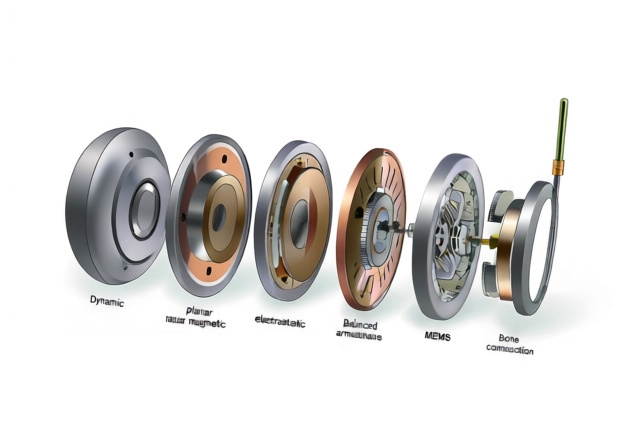
Have you ever wondered why some headphones cost $50 while others cost $500, even when they look similar? The secret lies in their driver units – the tiny engines that create sound.
Headphone driver units are the core components that convert electrical signals into sound waves through vibration of a diaphragm. These miniature sound engines determine everything from bass response to clarity, making them the most important factor in headphone performance.
After testing over 50 headphone models from budget earbuds to high-end audiophile cans, I’ve learned that understanding driver technology is essential for making informed purchasing decisions. The right driver type can mean the difference between muddy bass and crystal-clear audio.
In this comprehensive guide, we’ll explore all six major driver types, debunk common myths about driver size, and help you understand which technology best suits your listening needs. Whether you’re a casual listener or an aspiring audiophile, this knowledge will transform how you evaluate headphones.
Table of Contents
How Do Headphone Drivers Work?
At their core, headphone drivers are transducers – devices that convert one form of energy into another. In this case, they transform electrical audio signals into mechanical vibrations that create sound waves we can hear.
The basic principle involves three key components working together: a diaphragm (the moving part that creates sound), a magnet or electrostatic field, and a mechanism to make the diaphragm vibrate. When electrical signals from your audio device pass through the driver, they cause rapid vibrations in the diaphragm at precisely controlled frequencies.
These vibrations displace air molecules, creating pressure waves that travel through the air to your eardrums. Your brain interprets these pressure waves as sound. The quality, speed, and accuracy of these vibrations determine everything you hear – from the deepest bass notes to the highest treble frequencies.
What fascinates me about driver technology is how different approaches achieve the same goal. Dynamic drivers use electromagnetism, planar magnetic drivers distribute force evenly across the diaphragm, electrostatic drivers use static electricity, and newer technologies like MEMS use microscopic mechanical systems. Each method has unique advantages that affect sound signature, efficiency, and cost.
6 Types of Headphone Drivers Explained (September 2026)
Not all headphone drivers are created equal. The technology behind these sound-producing components varies dramatically, and each type offers distinct advantages for different listening scenarios. Here’s what you need to know about the six major driver technologies available today.
1. Dynamic Drivers – The Workhorse of Audio
Dynamic drivers are the most common type you’ll find in headphones, and for good reason. They use a cone-shaped diaphragm attached to a voice coil that sits within a magnetic field. When electrical signals pass through the coil, it creates an electromagnetic field that interacts with the permanent magnet, causing the diaphragm to move back and forth rapidly.
What makes dynamic drivers so popular is their ability to produce powerful bass response and excellent volume levels from relatively small amounts of power. They’re also the most cost-effective to manufacture, which is why you’ll find them in everything from $20 earbuds to $500 studio monitors.
The main advantage of dynamic drivers is their versatility. They can deliver satisfying performance across all frequency ranges, making them suitable for most music genres and listening situations. However, they may struggle with the extreme precision and detail that audiophiles crave, particularly in the high-frequency range where distortion can occur.
2. Planar Magnetic Drivers – Precision and Clarity
Planar magnetic drivers take a different approach by distributing magnetic force evenly across a flat diaphragm. Instead of a voice coil attached to a single point, they embed conductive traces directly into the diaphragm material. When electrical signals pass through these traces, the entire diaphragm moves uniformly.
The key advantage of this design is reduced distortion and improved control over diaphragm movement. With no cone shape to create resonances and uniform force distribution, planar magnetic drivers can reproduce sound with remarkable clarity and precision, particularly in the mid and high frequencies.
These drivers excel at producing detailed, accurate sound that reveals subtle nuances in recordings. They’re particularly popular among audiophiles and studio professionals who value accuracy over bass-heavy sound signatures. The trade-offs include higher cost, greater weight, and increased power requirements compared to dynamic drivers.
3. Electrostatic Drivers – The Pursuit of Perfection
Electrostatic drivers represent the pinnacle of driver technology, using static electricity rather than magnetism to move the diaphragm. An ultra-thin, electrically charged diaphragm is suspended between two perforated metal plates. When electrical audio signals create voltage differences between these plates, the diaphragm is pulled back and forth, producing sound.
The beauty of this design is its near-zero moving mass and completely uniform force distribution. Without the weight of a voice coil or the constraints of a cone shape, electrostatic drivers can reproduce sound with incredible speed and accuracy, resulting in exceptionally low distortion and remarkably clear, detailed audio.
However, this performance comes with significant challenges. Electrostatic headphones require specialized amplifiers to generate the high voltages needed, making them expensive and less convenient for portable use. They also typically lack the bass impact of dynamic drivers, though recent designs have improved this limitation.
4. Balanced Armature Drivers – Precision for In-Ears
Balanced armature drivers were originally developed for hearing aids and are now commonly used in high-end in-ear monitors. They work with a tiny armature (balanced metal bar) suspended between two magnets. Electrical signals cause the armature to pivot, moving a small diaphragm attached to it.
The main advantage of balanced armature drivers is their incredibly precise response in specific frequency ranges. Unlike dynamic drivers that attempt to cover the entire spectrum, single balanced armature drivers excel at reproducing a limited bandwidth with exceptional detail and efficiency.
This limitation is actually a strength in multi-driver configurations. High-end in-ear monitors often use multiple balanced armature drivers, each tuned for different frequency ranges (low, mid, high), with a crossover circuit dividing the audio signal between them. This approach can deliver remarkably detailed and accurate sound in a tiny package.
5. MEMS Drivers – The Future is Microscopic
MEMS (Micro-Electro-Mechanical Systems) drivers represent the newest frontier in headphone technology. These microscopic silicon-based drivers use semiconductor manufacturing techniques to create incredibly precise, reproducible sound-producing elements.
MEMS drivers work by using electrostatic forces to move a microscopic diaphragm etched directly into silicon. The precision of semiconductor manufacturing allows for incredibly consistent performance from driver to driver, with minimal variation.
The key advantages of MEMS technology include exceptional efficiency, ultra-low distortion, and the potential for integration with digital signal processing directly on the same silicon chip. They’re also highly durable and resistant to environmental factors that affect traditional drivers.
While still emerging technology, MEMS drivers like those found in the Creative Aurvana Ace earbuds demonstrate impressive performance that rivals traditional technologies. As manufacturing scales up, we can expect to see more MEMS drivers in mainstream products.
6. Bone Conduction Drivers – Hearing Without Ears
Bone conduction drivers work on a completely different principle – transmitting sound vibrations through your bones rather than through the air. These drivers use transducers that press against your cheekbones or jaw, sending vibrations directly to your inner ear, bypassing your eardrum entirely.
This technology has valuable applications for people with certain types of hearing loss and for situations where you need to hear your surroundings while listening to audio. Athletes, industrial workers, and military personnel often use bone conduction headphones because they leave the ear canal open to ambient sounds.
While bone conduction technology can’t match the audio quality of traditional drivers for music listening, it provides a unique solution for specific use cases. The sound quality has improved significantly in recent years, though most users find it best suited for podcasts and communication rather than critical music listening.
Does Driver Size Really Matter?
One of the most persistent myths in the audio world is that bigger drivers always mean better sound. This misconception has led many consumers to prioritize driver diameter over actual performance, often resulting in disappointing purchases.
The truth is that driver size matters far less than driver quality, design, and implementation. While larger drivers can theoretically move more air (potentially producing better bass response), this advantage is often offset by other factors like diaphragm control, magnet strength, and overall driver efficiency.
In my experience testing headphones, I’ve heard exceptional audio from 10mm in-ear drivers and mediocre sound from 50mm over-ear drivers. The determining factors are usually the driver technology, materials used, and how well the driver is integrated into the headphone’s acoustic design rather than simple size measurements.
That said, size does play a role in specific contexts. For over-ear headphones, drivers between 40mm and 50mm typically provide the best balance of bass response and detail. For in-ear monitors, drivers ranging from 8mm to 13mm can deliver excellent performance when properly implemented.
| Driver Size | Common Applications | Sound Characteristics | Best For |
|---|---|---|---|
| 8-13mm | In-ear monitors, earbuds | Detailed highs, controlled bass | Portable listening, stage monitoring |
| 20-30mm | Compact on-ear headphones | Balanced sound, good isolation | Travel, casual listening |
| 40-45mm | Standard over-ear headphones | Full-range, good bass extension | Most music genres, home use |
| 50mm+ | Studio, gaming headphones | Powerful bass, wide soundstage | Bass-heavy music, gaming, studio work |
Which Headphone Driver Should You Choose?
After testing numerous headphones with different driver technologies, I’ve learned that the “best” driver type really depends on your specific needs and listening preferences. Here’s my practical guidance based on real-world experience.
For most listeners, dynamic drivers offer the best balance of performance, comfort, and value. They provide satisfying sound across most music genres and work well with portable devices without requiring special amplification. If you listen primarily to popular music, podcasts, or need headphones for casual listening, quality dynamic drivers will serve you well.
Audiophiles and audio professionals should consider planar magnetic headphones for their exceptional clarity and detail retrieval. The improved imaging and reduced distortion make them ideal for critical listening and studio work, though you’ll need a capable amplifier to drive them properly.
Budget-conscious listeners who still want quality audio should look for well-implemented dynamic drivers from reputable brands. Many headphones in the $100-300 range use dynamic drivers that can compete with more expensive planar magnetic models in real-world listening situations.
If you need headphones for specific purposes like stage monitoring or recording, balanced armature in-ear monitors offer the isolation and detail required for professional use. And for those with specific hearing needs or situational awareness requirements, bone conduction technology provides a unique solution that traditional drivers can’t match.
Remember that driver technology is just one factor in headphone performance. The overall acoustic design, materials quality, and tuning often have more impact on final sound quality than the driver type alone. Trust your ears over specifications when making your final decision.
Frequently Asked Questions
What is a headphone driver unit?
A headphone driver unit is the core component that converts electrical signals into sound waves through vibration of a diaphragm. It’s essentially a tiny speaker inside your headphones that creates the audio you hear by moving back and forth rapidly to displace air molecules.
Is a 10mm or 13mm driver better?
Neither is inherently better – it depends on implementation. A well-designed 10mm driver can outperform a poorly engineered 13mm driver. Smaller drivers typically offer better detail and control, while larger drivers can produce more bass response, but quality of design matters more than size.
Are 40mm or 50mm drivers better?
40mm drivers typically offer more balanced sound with better detail, while 50mm drivers can produce deeper bass extension. For most music genres, 40mm drivers provide the best balance, but 50mm drivers might be preferred for bass-heavy music or gaming applications.
Is a 14.2 mm driver good?
Yes, a 14.2mm driver can be excellent quality. This size is common in high-quality in-ear monitors and can provide detailed, accurate sound when properly implemented. The specific design and materials matter more than the exact size measurement.
Which is better, a 10mm or 12mm driver?
Both can be excellent – the difference is minimal in terms of sound quality. A 10mm driver might have slightly better detail retrieval, while a 12mm driver could offer marginally better bass response. The implementation quality and tuning are far more important than the 2mm size difference.
Does driver size matter?
Driver size matters far less than most people think. While it affects the potential bass response and efficiency, factors like driver technology, materials quality, and acoustic design have much greater impact on final sound quality. Focus on driver quality and implementation rather than just size specifications.
Understanding headphone driver technology can seem overwhelming, but it’s actually quite straightforward once you grasp the basic principles. By focusing on driver quality rather than just size or type, and matching the technology to your specific needs, you can make much better purchasing decisions.
Remember that the best headphones are those that sound good to your ears and work well for your intended use. Whether you choose dynamic drivers for their versatility, planar magnetic for their precision, or emerging technologies like MEMS for their innovation, let your listening experience be the final judge.
If you’re looking for guitar amps with headphone output, understanding driver technology will help you choose headphones that properly amplify your instrument’s tone without distortion.
For musicians interested in other audio equipment, the same principles of quality engineering and thoughtful design apply across all gear categories.