
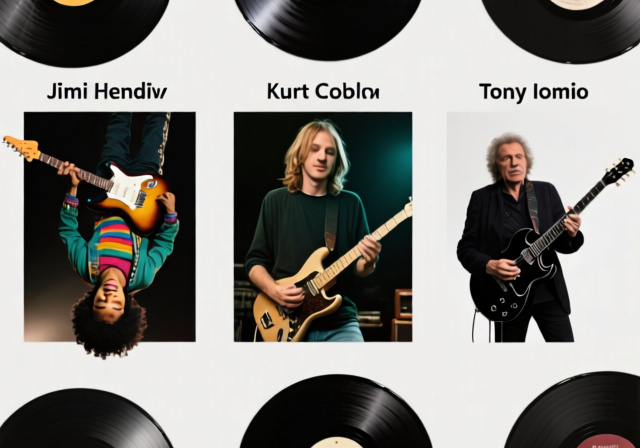
Being a left-handed musician in a right-handed world has shaped some of the most innovative and influential guitar players in history. These southpaw pioneers didn’t just adapt—they revolutionized how we think about guitar playing, creating unique techniques and sounds that continue to inspire musicians today.
Left-handed guitarists are musicians who play guitar with their left hand as their dominant hand, either using specially made left-handed instruments or adapting right-handed guitars to suit their playing style.
While only about 10% of the population is left-handed, these players have contributed disproportionately to music history. From Jimi Hendrix’s upside-down Stratocaster to Tony Iommi’s adapted heavy metal techniques, left-handed guitarists represent some of the most creative minds in modern music.
In this guide, we’ll explore 18 legendary left-handed guitarists who changed music, examine their unique playing approaches, and provide practical insights for aspiring southpaw players. You’ll discover how these innovators turned their natural handedness into a musical advantage.
Table of Contents
18 Legendary Left-Handed Guitarists Who Changed Music (September 2026)
1. Jimi Hendrix – The Upside-Down Stratocaster Innovator
Jimi Hendrix remains the most influential left-handed guitarist of all time, transforming rock music with his revolutionary approach to the instrument. What made Hendrix truly unique was his decision to play a right-handed Fender Stratocaster flipped upside down without reversing the strings.
This unconventional setup gave Hendrix his signature tone—the thicker bass strings were now on the bottom, creating a deeper, richer sound when he played his famous chord voicings. His thumb-over fretting technique, made easier by the reversed neck angle, allowed him to create bass lines while simultaneously playing rhythm and lead parts.
“Sometimes you want to give up the guitar, you’ll hate the guitar. But if you stick with it, you’re gonna be rewarded.”
– Jimi Hendrix
From his groundbreaking performance at Woodstock to his innovative studio techniques like backward recording and feedback manipulation, Hendrix’s left-handed approach became synonymous with musical experimentation. His influence extends beyond guitar technique—he redefined what was possible on the instrument and opened doors for countless left-handed players who followed.
Hendrix’s playing style incorporated elements of blues, rock, R&B, and jazz, creating a unique fusion that still sounds fresh decades later. His use of the wah-wah pedal, feedback control, and explosive stage presence were all enhanced by his southpaw orientation, giving him a physical advantage in creating his signature sounds.
2. Kurt Cobain – Grunge Pioneer with Unconventional Approach
Kurt Cobain brought left-handed guitar playing to the forefront of 1990s alternative rock as the frontman of Nirvana. Unlike Hendrix, Cobain primarily played left-handed guitars, most famously his Fender Mustang and Jaguar models, which contributed significantly to grunge’s raw, abrasive sound.
Cobain’s playing style was characterized by its simplicity and emotional intensity. He often used power chords and simple melodic lines, but his left-handed approach gave his rhythm playing a distinctive quality that helped define the grunge aesthetic. His songwriting balanced quiet verses with explosive choruses—a dynamic that became the template for countless alternative rock bands.
“I’d rather be hated for who I am, than loved for who I am not.”
– Kurt Cobain
Despite being naturally left-handed, Cobain was somewhat ambidextrous and could play basic right-handed guitar parts. This flexibility occasionally appeared in Nirvana’s music and videos, though he primarily performed left-handed live. His accidental guitar smashing at the end of Nirvana’s 1992 Reading Festival performance became legendary, symbolizing the raw energy that defined both Cobain and the grunge movement.
Cobain’s influence extended beyond his guitar technique—he demonstrated that technical virtuosity wasn’t necessary for emotional impact. His authenticity and willingness to embrace imperfection inspired a generation of musicians who felt disconnected from the guitar hero era of the 1970s and 1980s.
3. Tony Iommi – Heavy Metal Architect with Adapted Technique
Tony Iommi, the godfather of heavy metal and guitarist for Black Sabbath, developed his unique playing style out of necessity. After losing the tips of his middle and ring fingers in an industrial accident at age 17, Iommi had to completely relearn how to play guitar left-handed with homemade plastic and leather thimbles.
This life-altering injury forced Iommi to detune his strings to make them easier to press down, inadvertently creating the dark, heavy sound that would define heavy metal music. His simplified chord structures and use of the tritone interval (the “devil’s interval”) gave Black Sabbath their ominous, foreboding sound that contrasted sharply with the optimistic rock music of the late 1960s.
“The accident changed my whole style of playing. I had to adapt, and that adaptation created the Black Sabbath sound.”
– Tony Iommi
Iommi’s left-handed SG playing, combined with his modified technique, created some of metal’s most iconic riffs, including “Iron Man,” “Paranoid,” and “Black Sabbath.” His use of down-picking rather than alternate picking gave his riffs their powerful, driving quality, while his slow, deliberate solos emphasized melody and emotion over speed.
Beyond his technical innovations, Iommi’s dark, lyrical themes about war, death, and social commentary established heavy metal as a serious artistic genre capable of addressing complex issues. His perseverance through physical injury demonstrates how constraints can sometimes lead to greater creativity—a lesson that resonates with left-handed players facing their own challenges.
4. Paul McCartney – Beatle Bassist Who Switched from Guitar
Before becoming one of history’s most famous bassists, Paul McCartney was a left-handed guitar player who struggled to find instruments that suited his natural orientation. This difficulty led him to switch to bass guitar when he joined The Beatles in 1962, a decision that would shape popular music for decades.
McCartney’s left-handed Hofner 500/1 bass, known as the “violin bass” for its distinctive shape, became one of the most recognizable instruments in music history. His melodic approach to bass playing, influenced by his guitar background, transformed the instrument from a rhythmic foundation to a lead voice in popular music.
“I was a guitar player first, but when I switched to bass, I approached it like a melody instrument.”
– Paul McCartney
McCartney’s innovative bass lines on songs like “Come Together,” “Something,” and “Paperback Writer” demonstrated how the bass could drive a song’s harmonic and melodic direction. His left-handed playing style, combined with his songwriting sensibilities, created parts that were both technically sophisticated and accessible to listeners.
While McCartney occasionally played left-handed guitar on Beatles recordings and in his solo work, his primary contribution as a left-handed musician came through his revolutionary bass playing. His influence extended beyond technique—his willingness to experiment with different bass sounds and recording techniques helped establish the studio as an instrument in itself.
5. Albert King – Blues Master Who Played Upside Down
Albert King, one of the “Three Kings of the Blues” alongside B.B. and Freddie King, developed a completely unique playing style by turning a right-handed guitar upside down without reversing the strings. This unorthodox approach, combined with his massive physical size and powerful bending technique, created one of the most distinctive sounds in blues history.
King’s signature instrument was a Gibson Flying V, which he nicknamed “Lucy.” By playing the guitar upside down, the low E string was positioned where the high E string would normally be, allowing him to execute massive string bends that were impossible for conventional players. These exaggerated bends became his signature sound and influenced countless guitarists, including Jimi Hendrix and Stevie Ray Vaughan.
“I can’t read music, but I can read people’s hearts when I play.”
– Albert King
King’s playing was characterized by its economy—every note served a purpose, and his solos told stories with dramatic tension and release. Songs like “Born Under a Bad Sign,” “Crosscut Saw,” and “Oh Pretty Woman” showcased his ability to blend powerful blues phrasing with memorable melodic hooks.
Despite being left-handed, King never used a left-handed guitar, instead adapting his technique to fit standard instruments. This limitation became his greatest strength, forcing him to develop innovative approaches to soloing and phrasing that right-handed players couldn’t easily replicate. His influence extends beyond blues to rock, soul, and jazz musicians who studied his unique approach to the instrument.
6. Dick Dale – Surf Guitar Inventor
Dick Dale pioneered surf rock music in the early 1960s with his aggressive, percussive left-handed guitar playing. Known as the “King of the Surf Guitar,” Dale developed a unique playing style that emulated the sound of crashing waves through rapid alternate picking, heavy reverb, and Middle Eastern musical scales.
Dale played left-handed guitars but strung them in reverse order, creating a setup that allowed his powerful picking hand to execute the rapid, repetitive patterns that defined surf music. His single-note runs on songs like “Misirlou” and “Let’s Go Trippin'” were played at speeds previously unheard of in popular music, establishing new technical possibilities for electric guitar.
“I don’t play music—I play danger. That’s what surf music is all about.”
– Dick Dale
Dale’s relationship with Fender led to the development of the first 100-watt guitar amplifier, designed to handle his powerful playing style. He experimented with different guitar setups and recording techniques to achieve his signature sound, pushing both instrument and equipment to their limits.
Beyond his technical innovations, Dale’s left-handed approach gave surf music its distinctive character. His aggressive right-hand technique (the fretting hand for left-handed players) created the driving, percussive rhythms that defined the genre. Dale’s influence extends beyond surf rock to punk, metal, and experimental guitarists who appreciate his boundary-pushing approach to the instrument.
7. Elizabeth Cotten – Folk Pioneer Who Invented Cotten Picking
Elizabeth Cotten developed one of the most distinctive fingerpicking styles in American folk music entirely self-taught. As a left-handed player, Cotten played a right-handed guitar upside down without changing the strings, leading to the creation of “Cotten picking”—a unique approach that influenced generations of folk and blues musicians.
Cotten’s technique involved using her fingers to play melody lines on the bass strings while her thumb maintained a constant alternating bass pattern on the treble strings—the reverse of conventional fingerpicking. This unorthodox approach created a rich, textured sound that sounded like two guitarists playing simultaneously.
“I never had a lesson in my life. I just picked up the guitar and played what I heard in my head.”
– Elizabeth Cotten
Cotten’s most famous composition, “Freight Train,” written when she was just 12 years old, became a folk standard recorded by numerous artists. Her unique approach to the guitar, developed out of necessity rather than choice, demonstrates how left-handed players can turn perceived limitations into innovative techniques.
Despite stopping her musical career for decades to work as a domestic servant, Cotten was “rediscovered” in her 60s and went on to influence the 1960s folk revival. Her recordings and performances inspired artists like Bob Dylan, Joan Baez, and the Grateful Dead, proving that innovation has no age limit and that unconventional approaches can create timeless music.
8. Otis Rush – Chicago Blues Innovator
Otis Rush brought intense emotional depth to Chicago blues through his aggressive left-handed guitar playing and powerful vocals. Known for his piercing, high-pitched sound and dramatic stage presence, Rush developed a unique style that influenced both blues and rock musicians.
Rush played left-handed guitars with standard string orientation, allowing him to combine powerful rhythm playing with stinging lead lines. His use of dramatic dynamic shifts—from quiet, introspective passages to explosive, high-volume attacks—created emotional tension that became his signature approach.
“I play with my feelings, not my fingers. The guitar is just an extension of my heart.”
– Otis Rush
Songs like “I Can’t Quit You Baby” (later covered by Led Zeppelin), “All Your Love” (covered by John Mayall’s Bluesbreakers with Eric Clapton), and “Double Trouble” (named after Stevie Ray Vaughan’s band) showcased Rush’s ability to blend sophisticated harmony with raw emotional power.
Rush’s left-handed approach gave his playing a distinctive quality that set him apart from other Chicago blues players. His aggressive attack on the strings, combined with his mastery of dynamics and tone, created a sound that was both technically impressive and deeply moving. Rush’s influence can be heard in the playing of countless blues and rock guitarists who studied his recordings and live performances.
9. Courtney Barnett – Modern Indie Rock Star
Courtney Barnett represents a new generation of left-handed guitarists who combine indie rock sensibilities with sophisticated songwriting. Her conversational lyrical style and lo-fi guitar work have earned her critical acclaim and a dedicated international following.
Barnett’s left-handed playing style emphasizes tone and texture over technical virtuosity. Her use of fuzzy, overdriven sounds combined with angular, unconventional chord progressions creates a sound that’s both familiar and innovative. Songs like “Avant Gardener” and “Nobody Really Cares If You Don’t Go to the Party” showcase her ability to blend witty, observational lyrics with compelling guitar work.
“I’m not a guitar hero. I’m just someone who writes songs and happens to play guitar left-handed.”
– Courtney Barnett
Barnett’s approach to guitar playing reflects her broader artistic philosophy—authenticity over perfection. Her willingness to embrace imperfection and explore unconventional sounds has made her a role model for left-handed players who don’t fit into traditional guitar hero molds.
Barnett’s success in the 2010s and 2020s demonstrates that left-handed guitarists continue to innovate and shape contemporary music. Her influence extends beyond her left-handed playing to her entire approach to music-making, which prioritizes personal expression over technical display.
10. Mdou Moctar – Tuareg Guitar Virtuoso
Mdou Moctar brings a unique cultural perspective to left-handed guitar playing, blending traditional Tuareg music with rock and blues influences. From Niger, Moctar has gained international recognition for his hypnotic, psychedelic guitar work that transcends cultural and musical boundaries.
Moctar’s left-handed technique combines rapid, repetitive patterns with melodic improvisation, creating trance-inducing music that honors traditional Tuareg sounds while incorporating modern electric guitar approaches. His album “Ilana (The Creator)” and the film “Rain the Color Blue with a Little Red in It” (a Tuareg remake of “Purple Rain”) introduced his innovative playing to global audiences.
“Music is universal. Whether you play left-handed or right-handed, the feeling comes through the same way.”
– Mdou Moctar
Moctar’s success demonstrates how left-handed guitarists continue to evolve and expand the instrument’s possibilities across different cultures and genres. His ability to blend traditional African musical elements with Western rock influences shows how guitar playing transcends handedness and cultural boundaries.
Moctar’s approach to the guitar, developed independently of Western guitar traditions, offers fresh perspectives on what’s possible with the instrument. His international success has inspired a new generation of African guitarists and demonstrated the global appeal of innovative left-handed playing.
11. Tim Armstrong – Punk Rock Revivalist
Tim Armstrong, guitarist for Rancid and Operation Ivy, has been a driving force in punk rock for over three decades. His aggressive, energetic left-handed playing style combines punk’s raw energy with ska’s rhythmic sophistication, creating a sound that has influenced countless bands.
Armstrong’s guitar work emphasizes power and simplicity over technical complexity. His use of rapid down-picking, barre chords, and ska-inspired upstrokes creates a distinctive sound that’s both aggressive and danceable. Songs like “Time Bomb” and “Ruby Soho” showcase his ability to write memorable hooks with minimal but effective guitar parts.
“Punk rock isn’t about being the best guitar player. It’s about having something to say and saying it with passion.”
– Tim Armstrong
Armstrong’s left-handed approach gives his rhythm playing a distinctive quality that sets him apart from other punk guitarists. His use of Gretsch guitars, traditionally associated with rockabilly and jazz rather than punk, further distinguishes his sound within the genre.
Beyond his guitar playing, Armstrong’s influence extends to his work as a producer and label owner (Hellcat Records), where he has helped launch the careers of numerous punk and ska bands. His longevity in punk rock demonstrates how left-handed players can maintain relevance and continue innovating across decades.
12. Malina Moye – Rock/Blues Fusion Artist
Malina Moye represents a new generation of left-handed guitarists who blend rock, blues, and funk into a distinctive style. Known for her energetic live performances and technical prowess, Moye has gained recognition as one of the most exciting contemporary guitarists regardless of handedness.
Moye’s playing combines virtuosic technique with soulful phrasing, creating a sound that honors blues traditions while pushing into new territory. Her use of the “flip” technique—holding the guitar left-handed but using right-handed stringing—gives her playing a unique character that sets her apart from other contemporary players.
“Being left-handed gave me a different perspective on the guitar. It forced me to find my own way of doing things.”
– Malina Moye
Moye’s albums like “Rock & Roll Baby” and “Bad As I Wanna Be” showcase her ability to blend technical proficiency with emotional depth. Her success as a left-handed African American woman in a genre dominated by white men makes her an important role model for underrepresented musicians.
Moye’s international touring and media appearances have helped raise awareness of left-handed guitar playing while demonstrating that technical virtuosity and commercial success are achievable regardless of natural handedness. Her influence extends to her work as an advocate for music education and women’s representation in rock music.
13. Bob Geldof – Musician Turned Activist
Bob Geldof, while better known for his humanitarian work than his guitar playing, was the frontman and left-handed guitarist for The Boomtown Rats, one of the most successful Irish punk/new wave bands of the late 1970s and early 1980s.
Geldof’s guitar playing was straightforward and energetic, perfectly suited to the band’s punk-influenced rock sound. His left-handed approach added visual interest to live performances while his distinctive vocal delivery and charismatic stage presence helped define the band’s identity.
“Music can change the world because it can change people.”
– Bob Geldof
Songs like “I Don’t Like Mondays” and “Rat Trap” showcased Geldof’s ability to blend punk energy with pop sensibility, creating music that was both socially conscious and commercially successful. His left-handed guitar playing, while not technically revolutionary, was effective in supporting the band’s musical vision.
Geldof’s later work organizing Band Aid and Live Aid demonstrated how musicians can use their platform for social change. While his guitar playing wasn’t his primary contribution to music, his success as a left-handed frontman helped pave the way for other southpaw performers in punk and new wave music.
14. Gary Moore – Blues Rock Virtuoso
Gary Moore was one of the most technically accomplished left-handed guitarists in rock history, capable of breathtaking speed and emotional depth. His career spanned multiple genres—from hard rock with Thin Lizzy to blues-rock solo work—showcasing remarkable versatility throughout his decades-long career.
Moore’s playing combined technical precision with passionate phrasing, creating a sound that was both impressive and emotionally resonant. His use of legato techniques, rapid alternate picking, and expressive vibrato influenced countless guitarists across multiple genres.
“The blues isn’t about technique. It’s about feeling—getting that emotion across to the listener.”
– Gary Moore
Albums like “Still Got the Blues” and “Corridors of Power” demonstrated Moore’s ability to move seamlessly between hard rock and traditional blues. His left-handed approach gave his playing a distinctive quality that set him apart from other technically-oriented rock guitarists.
Moore’s influence extends to his work as a session musician and collaborator with artists like George Harrison, Phil Lynott, and B.B. King. His dedication to his craft and willingness to explore different musical directions made him one of the most respected left-handed guitarists of his generation.
15. Seasick Steve – Blues Revivalist
Seasick Steve represents the raw, authentic side of left-handed guitar playing, combining traditional blues techniques with punk energy. His DIY approach to music and homemade instruments has earned him a cult following and mainstream success later in his career.
Steve’s left-handed playing emphasizes feel over technique, using slide guitar, unconventional tunings, and homemade instruments like the “three-string trance wonder.” His energetic live performances and storytelling ability have made him a beloved figure in contemporary blues.
“I’m not a technical player. I just play what I feel, and sometimes it works out.”
– Seasick Steve
Songs like “Dog House Boogie” and “Cut My Wings” showcase Steve’s ability to create compelling music with minimal equipment. His success demonstrates that technical proficiency isn’t necessary for emotional impact—authenticity and passion can connect with audiences regardless of technical ability.
Steve’s late-career success provides inspiration for left-handed players who may feel they don’t fit traditional guitar hero molds. His willingness to embrace unconventional instruments and techniques shows that innovation often comes from working within limitations rather than having unlimited options.
16. Iggy Pop – Punk Icon with Guitar
While primarily known as a vocalist and performer, Iggy Pop’s contributions to left-handed guitar playing shouldn’t be overlooked. His primitive, aggressive approach to the instrument helped define punk rock’s raw energy and DIY aesthetic.
Pop’s guitar playing with The Stooges emphasized power and simplicity over technical complexity. His left-handed approach added to the band’s chaotic, unpredictable sound that influenced countless punk and alternative rock bands.
“I’m not a musician. I’m an entertainer who happens to play guitar sometimes.”
– Iggy Pop
The Stooges’ albums like “Fun House” and “Raw Power” featured Pop’s abrasive guitar work alongside his distinctive vocals. His willingness to embrace imperfection and prioritize emotional impact over technical precision aligned with punk’s anti-establishment ethos.
Pop’s influence extends beyond his guitar playing to his entire approach to performance, which shattered conventions about how rock musicians should behave on stage. His success as a left-handed performer who prioritized energy over technique inspired generations of punk and alternative musicians.
17. Zakk Wylde – Left-Handed Who Plays Right-Handed
Zakk Wylde presents an interesting case in the left-handed guitarist discussion—he’s naturally left-handed but plays guitar right-handed. This ambidextrous approach has given him a unique perspective on the instrument and contributed to his distinctive playing style.
Wylde’s technical prowess and aggressive playing style have made him one of the most influential metal guitarists of his generation. His work with Ozzy Osbourne and Black Label Society showcases his ability to combine lightning-fast alternate picking with powerful, memorable riffs.
“I’m left-handed but I learned to play right-handed because that’s what was available. It worked out fine in the end.”
– Zakk Wylde
Wylde’s signature “bulls-eye” Gibson Les Paul guitars have become iconic in metal music. His playing combines elements of classic rock, blues, and heavy metal, creating a sound that’s both technically impressive and emotionally powerful.
Wylde’s success demonstrates that natural handedness doesn’t have to determine how you play guitar. His decision to learn right-handed playing out of necessity rather than choice shows how adaptability can lead to success—though he often mentions that certain tasks, like picking, come more naturally to his left hand.
18. Mark Knopfler – Right-Handed Playing Lefty
Mark Knopfler, leader of Dire Straits, is another guitarist who plays right-handed despite being naturally left-handed. His distinctive fingerpicking technique—playing without a pick—has created one of the most recognizable guitar sounds in popular music.
Knopfler’s left-handed orientation may contribute to his unique fingerpicking approach, which combines elements of fingerstyle guitar with rock and blues phrasing. His playing on songs like “Sultans of Swing” and “Money for Nothing” showcases his ability to blend technical sophistication with memorable melodic hooks.
“I never thought about being left-handed or right-handed. I just picked up the guitar and found a way to make the sounds I heard in my head.”
– Mark Knopfler
Knopfler’s fingerstyle technique, developed out of necessity rather than choice, creates a distinctive tone that sets him apart from other rock guitarists. His ability to simultaneously play bass lines, harmony, and melody gives Dire Straits’ music its characteristic depth and complexity.
Knopfler’s success as a left-handed person playing right-handed guitar demonstrates how natural handedness doesn’t have to limit musical development. His unique approach to the instrument has influenced countless fingerstyle players across multiple genres, from country to jazz to rock.
How Left-Handed Guitarists Play: 4 Different Approaches
Left-handed guitarists have developed several approaches to playing the instrument, each with distinct advantages and challenges. Understanding these different methods can help aspiring players determine which approach might work best for their individual needs and goals.
Southpaw Playing: The general term for left-handed guitar playing, encompassing various approaches to adapting the instrument for left-handed players.
- Standard Left-Handed Guitar
Using guitars specifically manufactured for left-handed players, with all components (bridge, nut, pickups, controls) reversed. This provides the most ergonomic playing experience but limits instrument selection and often increases costs. - Upside-Down Right-Handed Guitar (No String Reversal)
Playing a standard right-handed guitar flipped upside down without changing the string order. This approach, used by Albert King and Jimi Hendrix, creates unique bending possibilities but requires adaptation to the reversed string arrangement. - Upside-Down Right-Handed Guitar (With String Reversal)
Flipping a right-handed guitar and restringing it for left-handed playing. This provides proper string orientation but may affect intonation and requires careful setup adjustment. - Playing Right-Handed Despite Being Left-Handed
Learning to play standard right-handed guitars despite natural left-handedness. This approach maximizes instrument availability but may initially feel less intuitive.
Each approach has produced legendary players, proving there’s no single “correct” way to play guitar left-handed. The best method depends on individual comfort, musical goals, and available resources.
Challenges Faced by Left-Handed Guitarists and How to Overcome Them?
Left-handed guitarists face unique challenges that right-handed players rarely consider. These obstacles range from equipment limitations to learning resources, but with proper strategies, they can be overcome or even turned into advantages.
✅ Limited Equipment Selection: Most music stores stock significantly fewer left-handed guitars, often at higher prices. Solution: Research online retailers specializing in left-handed instruments, consider custom orders, or learn to adapt right-handed guitars.
⏰ Scarce Learning Resources: Most instructional materials assume right-handed playing. Solution: Use mirror-image videos, find left-handed specific tutorials online, or work with teachers experienced in teaching southpaw players.
⚠️ Higher Costs: Left-handed guitars typically cost 10-20% more than right-handed equivalents. Solution: Consider quality used instruments, explore direct-to-consumer brands offering left-handed options, or learn basic guitar setup skills to maintain instruments longer.
Isolation: Feeling like the “only left-handed player” can be discouraging. Solution: Join online left-handed guitar communities, attend workshops for left-handed players, or connect with other southpaw musicians through social media.
These challenges, while significant, haven’t stopped countless left-handed players from achieving greatness. In fact, overcoming these obstacles often builds resilience and creativity that translates directly to musical innovation.
The New Generation: Left-Handed Guitarists Making Waves Today
The tradition of left-handed guitar innovation continues with a new generation of players who are expanding the instrument’s possibilities across genres and platforms. Social media and online communities have created unprecedented opportunities for southpaw players to connect and showcase their talents.
Contemporary left-handed guitarists benefit from increased equipment options, with more manufacturers offering left-handed versions of popular models. Direct-to-consumer brands like Chapman Guitars and Schecter have made quality left-handed instruments more accessible than ever before.
Online platforms like YouTube, Instagram, and TikTok have given left-handed players global reach, allowing them to build audiences without traditional industry gatekeepers. This democratization of music creation has opened doors for innovative southpaw players who might have struggled to find recognition in previous eras.
The growing community of left-handed guitarists online provides support, resources, and inspiration for players at all levels. This connectivity helps overcome the isolation that many left-handed players experienced in the past, creating a supportive ecosystem for southpaw innovation.
Frequently Asked Questions
Who is the most famous left-handed guitarist?
Jimi Hendrix is widely considered the most famous and influential left-handed guitarist of all time. His revolutionary approach to playing a right-handed Stratocaster upside down created some of the most iconic sounds in rock music history.
Is it rare to be a left-handed guitarist?
Yes, approximately only 10% of guitarists are left-handed, matching the general population’s left-handed percentage. This makes left-handed guitarists relatively rare, though their impact on music history has been disproportionately significant.
Do lefties play guitar differently?
Left-handed guitarists play using several approaches: some use left-handed guitars, others flip right-handed guitars upside down (with or without restringing), and some learn to play right-handed despite being left-handed. Each approach creates unique technical characteristics and tonal qualities.
Was Kurt Cobain really left-handed?
Yes, Kurt Cobain was naturally left-handed and primarily played left-handed guitars, most famously his Fender Mustang and Jaguar models. His left-handed playing contributed to Nirvana’s distinctive sound and aesthetic.
Should left-handed people play left-handed guitar?
Left-handed people should try both approaches to determine what feels most natural. While many find left-handed playing more intuitive, others (like Mark Knopfler and Zakk Wylde) have achieved great success playing right-handed despite being left-handed.
Are left-handed guitars more expensive?
Yes, left-handed guitars typically cost 10-20% more than right-handed equivalents due to smaller production runs and additional manufacturing setup requirements. However, increased demand has led to more affordable options in recent years.
Final Recommendations
The history of left-handed guitarists demonstrates how constraints can spark innovation. From Jimi Hendrix’s upside-down Stratocaster to Elizabeth Cotten’s self-taught fingerpicking, these players turned their natural handedness into a source of creativity rather than limitation.
For aspiring left-handed guitarists, the message is clear: your orientation isn’t a disadvantage—it’s an opportunity to develop a unique voice on the instrument. Whether you choose to play left-handed guitars, adapt right-handed instruments, or learn to play right-handed, the most important factor is finding an approach that feels natural and allows you to express yourself musically.
The legacy of these southpaw pioneers proves that innovation often comes from working within limitations rather than having unlimited options. Their contributions continue to inspire new generations of players, ensuring that left-handed guitarists will keep pushing musical boundaries for years to come.