
Music, like language, has wonderful intricacies that give it depth and dimension. If you’re aspiring to play an instrument, write a song, or simply deepen your appreciation of music, major, minor, and perfect intervals can elevate your experience.
So let’s open up this treasure trove of knowledge that many great musicians have used to create enchanting melodies and harmonies.
Deciphering music is akin to cracking a secret code – at first glance complex but immensely rewarding once understood!
Major, minor, and perfect intervals form the basic building blocks of this code. Each one of these interval types holds unique characteristics that influence the melody’s flow and the emotions it triggers.
Welcome to this enriching journey where we parse through the details and discover how these intervals truly shape music.
Table of Contents
What is an Interval in Music?
An interval in music refers to the difference between two pitches or notes. Consider this, when you strike a chord on the piano or pluck a string on the guitar, that musical note you hear is characterized by a specific pitch.
Now, when you play two different notes either together (simultaneously) or one after another (one plays, then stops before the other starts), measured from one note to another, that distance is what we refer to as an ‘interval’.
These intervals form the building blocks of melody and harmony in music. Essentially, they’re key contributors to the mood and feel of a piece of music.
Also Read: Phrygian Mode [Adding Exotic Flair To Your Musical Compositions]
What are the different types of intervals?
Before delving into the exquisite world of intervals, we need a basis for comparison.

Think of middle C on your piano or keyboard as our starting point – the tone against which we’ll contrast other tones.
Now, let’s unpack these tonal relationships that add a mystical charm to every melody.
Major Intervals
The universe of major intervals reveals itself in two forms – major seconds and major thirds.
Bearing their distinct sound quality, they set a particular stage for the energy of musical compositions.
- Major seconds – Spanning two half-steps (or semitones), major seconds are commonly found in various scales and chord structures. On a piano keyboard, this interval would be the distance between any two adjacent white or black keys.
- Major thirds – Jumping over four half-steps, or two whole steps, major thirds form an integral part of both major and minor chords. These intervals tend to exude happiness or positivity when played.
Minor Intervals
On the flip side, we have minor intervals. Like their major counterparts, minor intervals come in second and third forms, each bringing a different tonality to the mix.
- Minor seconds – These are synonymous with tension and dissonance. As the smallest measurable interval in Western music, it includes only one-half step.
- Minor thirds – Count up three half-steps from your starting note (or one whole step plus one half-step), and voila! You’ve reached a minor third. This interval is usually associated with sad or melancholic emotions.
Perfect Intervals
Then we arrive at the intriguing realm of perfect intervals. Why perfect? Mainly because they remain constant in both major and minor scales.
Four types exist: perfect unison, fourths, fifths, and octaves.
- Perfect Unison – When you play two identical notes simultaneously or one after another.
- Perfect Fourth – Leap five half-steps (or two and a half steps) and there you land on a perfect fourth!
- Perfect Fifth – Seven half-steps yonder resides what’s known as a perfect fifth.
- Perfect Octave – Jump twelve half-steps (equivalent to six whole steps or an entire octave), and there you find a perfect octave.
These concepts form the crux of how melodies and harmonies are made!
They’re the tools through which musicians deliver intense emotive experiences, illustrating the eloquent phrases and dramatic shifts that make music a universal language.
Also Read: F Sharp Minor Pentatonic Scale [How To Use In Your Compositions]
How do Intervals Relate to Scales?
Scales act like an artist’s color palette in the realm of music, and intervals are the building blocks that create them.
They are the spaces between the notes, which lend uniqueness to each scale. Moreover, specific sequences of intervals define different types of scales.
Take for instance, the major scale follows a pattern of intervals that reads like this: whole, whole, half, whole, whole, whole, half.
This formula denotes the “steps” between one note to another on a piano or any musical instrument.
On the other hand, a minor scale varies slightly with a distinct interval pattern ie. whole, half, whole, whole, half, whole, and again a last step as a whole.
The ‘whole’ refers to two steps (Major Second) in music terminology and ‘half’ refers to one step (Minor Second).
By mastering these interval patterns within scales and varied combinations thereof you unravel endless opportunities for intriguing melodies and harmonies!
How is Ear Training Leveraged in Intervals?
Ear training is an elemental skill in recognizing intervals, which in turn, enhances your ability to play by ear and compose your music.

Let’s uncover five crucial points on how this remarkable training aids in comprehending intervals.
- Enables Recognition of Sounds: Ear training empowers you to identify the different intervals within a piece of music simply by hearing it. With sufficient practice, you’ll be able to recognize a perfect fifth or minor third instantly without needing musical notation.
- Enhances Musical Dictation Skills: Through ear training, you get acclimated to the musical tonality associated with each interval. These skills aid in transcribing songs or melodies effortlessly, thereby improving your musical dictation skills.
- Makes Improvisation Easier: Once you are familiar with the sound of individual intervals, improvising becomes much easier. You’ll know instinctively what note to play next based on its interval from the previous note.
- Facilitates Transposition: A critical aspect of ear training involves identifying similar sounding patterns across different keys. A deep knowledge of intervals allows musicians to transpose music with ease – changing the key of a piece while maintaining its harmony and melodic relationships intact.
- Refines Musical Perception: Interval identification becomes second nature through ear training and enriches your overall experience as a musician or listener by refining how you perceive music.
The beauty of ear training lies in its simplicity – you don’t need any extensive setup, specialized equipment, or even an instrument!
All that it requires is dedicated listening and keen attention to sounds around us—be it rhythms from nature or hums from our daily lives—and intentional structuring of these experiences into meaningful learning sessions to enhance our recognition and perception recognition skills effectively.
Also Read: E Minor Pentatonic Scale [How To Use In Your Music Composition]
Songs that employ Major Intervals, Minor Intervals, and Perfect Intervals
Interwoven into the fabric of our favorite songs are major, minor, and perfect intervals.

These elements add depth to the melody and balance to the harmony.
Reflecting on the role of these musical intervals in songs we know and love can be a fascinating exploration.
Major Intervals
Major intervals contribute heavily to Western music’s character and often signal a song’s key.
The backbone of happy or upbeat songs frequently consists of these intervals due to the positive emotions they evoke.
For example, “Here Comes the Sun” by The Beatles starts with a major third interval from G to B.
A popular song that beautifully exhibits a major second interval is “Happy Birthday”. Right from when you sing ‘Happy’ to ‘Birth-‘, it spans a major second interval.
Minor Intervals
On the other hand, minor intervals are often associated with a darker or melancholic mood.
Songs addressing themes like sadness or longing usually utilize minor intervals.
Take “Hallelujah” by Leonard Cohen for instance. The song is heavily marked by minor third intervals which evoke its mournful tone.
Similarly, Gary Jules’ “Mad World” employs a repeated pattern of minor third intervals giving it an unmistakably somber mood.
Perfect Intervals
Perfect intervals hold down the fort as constant companions if you’re playing in a Major or Minor key and lend stability to melodies.
In “Twinkle Twinkle Little Star”, you will notice that regardless of what key you play (it be G Major or C Major), all perfect fourths will sound very consonant – resolute and stable.
Simon & Garfunkel’s timeless hit “The Sound of Silence” also opens with repeated perfect fifth leaps that captivate listeners right off the bat.
Major, minor, and perfect intervals form the heart of any melody’s structure. They establish a song’s emotional overtones while animating its overall narrative.
These magnificent techniques used by music makers across generations continue to captivate us, tugging at our heartstrings.
Also Read: C Minor Triad [Simplify Music Composition With This Guide]
FAQs
What exactly is an interval in music?
An interval refers to the distance in pitch between two notes, measured by the number of steps from one note to another on a scale.
How do I identify if an interval is major or minor?
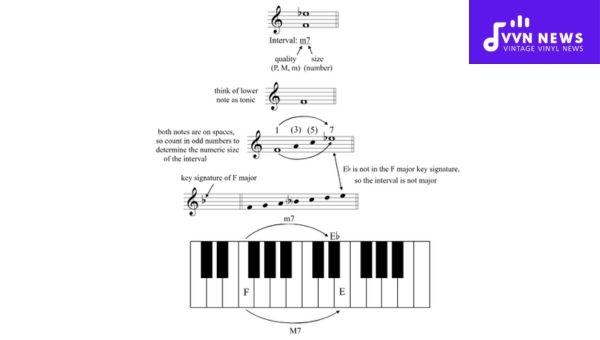
To identify, compare the interval to the major scale starting on the lower note; if it’s the same, it’s major; if the higher note is one half-step lower, it’s minor.
Can intervals be larger than an octave?
Yes, intervals that span more than an octave are called compound intervals.
Why are some intervals called ‘perfect’?
Some intervals are labeled ‘perfect’ because of their consonant sound that has remained consistent in Western music throughout history.
How can I practice recognizing different intervals?
You can use ear training apps, play intervals on an instrument, or sing them using solfège to practice and improve your interval recognition skills.
Also Read: How To Transpose Music? [Simplifying Key Changes In Songs]
Conclusion
Learning major, minor, and perfect intervals is pivotal to grasping the essence of music. These intervals are the stepping stones towards identifying scales, constructing chords, and even developing your ear training.
By recognizing the nuanced differences in these intervals, you can begin to decipher key elements within songs.
Embrace this knowledge, for it will not only enhance your listening skills but also empower your musical expression.
Whether composing or performing, these core concepts are your allies in the beautiful language of music.