
Music is a universal language that transcends borders and cultures. One crucial facet of music that often bewilders inexperienced musicians is mastering the difference between simple and compound time.
As the name suggests, simple time is straightforward to count, while compound time yields a unique rhythmic structure that gives music its distinctive flavor.
Recognizing simple and compound time is a journey into the heart of musical theory. This blog post will guide you through these core principles while keeping it as uncomplicated as possible.
By the end of this article, you’ll have a keen interest in not only timing in music but also how to distinguish the difference between simple and complex rhythms.
Table of Contents
What Defines a Time Signature in Music?
A time signature in music is essentially a mathematical symbol placed at the beginning of a piece. It has two numbers, one stacked over the other. The top number informs how many beats there are in a measure, while the bottom number denotes what sort of note gets the beat.
These symbols provide critical information that lays down the rhythmic foundation and pulse for each piece of music. You wouldn’t be far off if you considered time signatures as the blueprint that anticipates how music unfolds over a series of beats.
Also Read: How To Transpose Into The Tenor Clef? [Mastering In Notation]
How Does Simple Time Differ from Compound Time?
Without delving into too many technical terms, the primary difference between simple and compound time lies in the way beats are subdivided within a measure.

But what does that mean and why does it matter? Let’s break it down!
Simple Time
A simple time signature can be boiled down to its most basic beat division, which includes 2, 3, or 4 main beats per measure.
Moreover, each of these beats can be subdivided into two equal parts. In a nutshell, the top number of the time signature in simple time tells you the total count of major beats per bar.
The bottom figure specifies the note that represents one beat.
For instance,
- The meter
2/4signifies Simple Duple, meaning there are two beats per measure (bar), and each beat can be divided into two (hence “duple”). - The meter
3/4denotes Simple Triple. There are three major beats in each bar, and every beat is divided evenly into two. - The meter
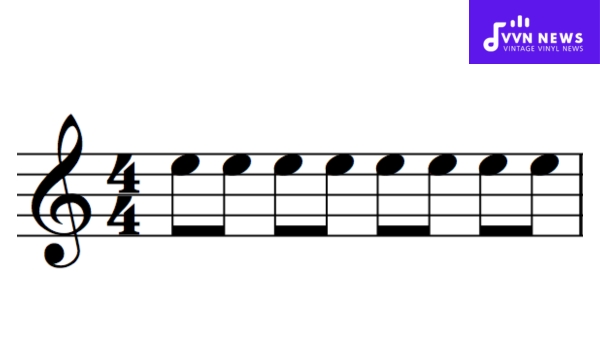
4/4, known colloquially as Common Time, is a Simple Quadruple, with four significant notes in a bar that divides neatly into halves.
Compound Time
On the flip side stands compound time, distinguished by compound rhythms.
Each measure maintains a fixed amount of strong primary beats divisible by three rather than two as seen in simple time.
To illustrate compound time,
- Consider the metric
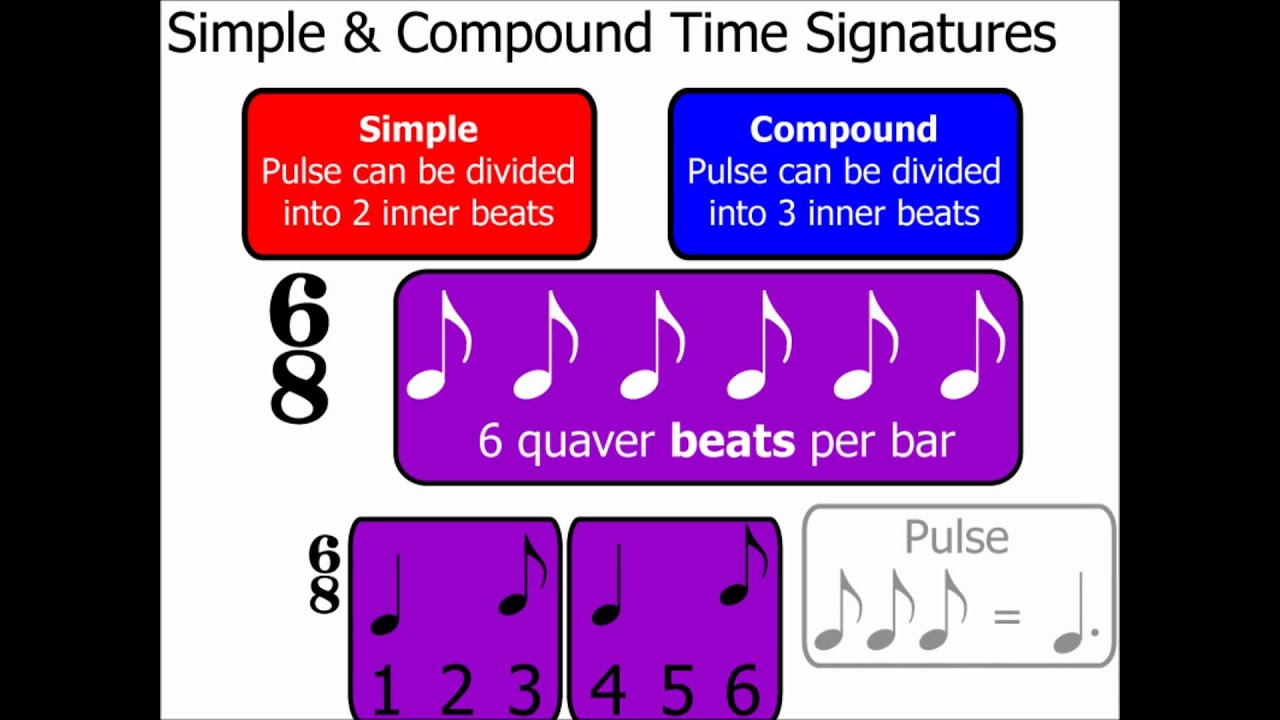
6/8. Classified as a Compound Duple – it holds six eighth notes per measure, but these can compile into two groups of three eighth notes forming two major beats. - The rhythm
9/8constitutes Compound Triple. As strange as this may seem initially, this rhythm imparts nine eighth notes per measure split further into three larger groups of three each. - And finally,
12/8, dubbed “Compound Quadruple.” In this tone meter, every bar offers a robust dozen eighth notes that group themselves handily into four trios.
Discerning between simple and compound time encompasses glimpsing at how many main pulses are in one measure and how they further break down.
As you cultivate your musical instincts, this recognition process will become intuitive rather than intellectual.
What Are the Components of a Time Signature?
A time signature in music is paramount to deciphering the rhythm and pace of a piece. It’s much like the heartbeat of a song. Now, let’s break down the two main components found in every time signature.
- Top Number: Known as the beat count, this digit unveils how many beats are in each measure. In other words, this value dictates how often you tap your foot to the rhythm per measure.
- Bottom Number: This figure, known as the note value, points out which note will be counted as one beat in the piece. A common example is “4,” representing a quarter note.
Imagine looking at a typical 4/4 time signature; the ‘4’ on top reveals four beats per measure while the ‘4’ beneath implies that quarter notes account for those beats.
Also Read: How To Transpose Treble To Bass Clef [Music Guide]
How Do Duple, Triple, and Quadruple Times Work?
Time signatures are key to reading and interpreting a piece of music correctly.

Duple, triple, and quadruple are three primary categories of meter that each carry different rhythmic feels.
Duple Times
A time signature with a 2 at the top or a multiple thereof falls into the duple meter category, such as 2/4 or 6/8.
Within a single measure of duple-meter music, you’ll find two beats. These beats can be divided into two (simple duple) or three (compound duple).
Triple Times
In contrast with the more grounded feel of duple meter music, triple time, like 3/4 or 9/8, brings a more waltz-like feel to the music.
Here, there’s an emphasis on every third beat which adds a dreamy rhythm that feels like swaying or being carried aloft.
Quadruple Times
Quadruple times, such as 4/4 (also known as common time), consist of four beats per measure.
This rhythmic structure allows for strong downbeats and softer upbeats creating an overall steady feel.
Whether it’s the spirited rhythm of simple duple times in pop songs or the majestic sway of triple times in Waltzes – these meters influence everything from symphonies to rock anthems.
As you delve deeper into your exploration of musical theory and practice playing different pieces on your instrument, noticing these underlying structures will shape your interpretation significantly.
Recognizing whether a piece observes triple or quadruple times can change not only how you play it but also how you perceive its emotion and character.
Also Read: Mastering Chords In A Minor [Improve Your Composition Skills]
What Earmarks a Simple Time Signature?
To begin with, a simple time signature identifies music where each beat can naturally be divided into two equal parts.
The term ‘simple’ doesn’t mean it’s easier to understand, it merely denotes the nature of beats subdivision.
The primary figures you’ll encounter under this category are 2/4, 3/4, and 4/4. Let me demystify this for you:
- 2/4 Time: Herein, there are two beats in a measure, and the quarter note equals one beat.
- 3/4 Time: This signature has been famously employed in waltzes. It conveys three beats per bar where the quarter note is one beat.
- 4/4 Time: This highly popular ‘common time’ carries four beats in each measure with a quarter note symbolizing one beat.
When counting these time signatures, you can experience an easy rhythmic flow that doesn’t entail complex subdivisions.
What Constitutes Compound Time in Music?
In music, compound time refers to the rhythmic structure where each beat is divided into three equal parts or subdivisions.

Unlike simple time, which has a binary structure (each pulse divided into two), compound time offers a ternary structure that alters the behavior of the music ‘pulse’ and its flow.
Compound meters usually bear signatures such as 6/8, 9/8, or 12/8. It’s worth noting that in such meters, the upper digit can be divided evenly by three. This gives us insight into the ‘tertiary’ beat divisions intrinsic to compound timing.
For instance, let’s consider a bar in a 6/8 meter – it encompasses six quavers (eighth notes), but we perceive it essentially as two beats made of triplet quavers.
- Step 1: When you see a gauge like 6/8, don’t fret; remember we aren’t counting six beats per bar but two! Each beat is made of three ‘eighth notes’, creating an inherent ‘triplet feel’ to the rhythm.
- Step 2: Discard thinking about music merely in terms of one-two pulse instead adopt the one-two-three pulse mindset. Practice clapping patterns based on accumulation by threes.
Interpreting and applying musical timing requires practice and familiarity with various time signatures.
Also Read: 19 Best-selling Albums Of All Time [Music’s Greatest Hits]
Why Are Time Signatures Important in Music Composition?
Time signatures are like the heartbeat of a musical composition. They provide structure and can drastically affect the song’s vibes or emotions that it exudes.
It provides a rhythmic framework within which your music unfolds.
- Set The Pace: Time signatures relay to musicians at what pace or speed they should play the piece. Musicians count beats in their heads or tap their feet to stay on track. Without time signatures, imagine the chaos!
- Uniqueness: Different types of time signatures, simple or compound, give diversity to music genres. Every music style will have its unique signature times. For instance, waltzes are always written in 3/4 time, while most pop songs are in 4/4.
- Feeling and Mood: By providing a rhythm pattern, time signatures add to the feeling and mood of a piece. Simple time is more straightforward and steady, while compound time brings complexity musically and emotionally.
- Musical Variety: Time signatures allow for changes in rhythm patterns throughout a piece contributing greatly to musical variety.
So as you navigate your musical journey it’s essential not only to learn about these elements but also to experiment with them!
It is through this experimentation that you’ll be able to create compositions that are uniquely yours – music that reflects not just your skill but also your personality and emotional depth.
Also Read: E Major: Scale And Chords [Exciting Sounds For Your Compositions]
FAQs
What is the difference between simple and compound time?
Simple time has a basic beat that can be divided into equal parts, while compound time features beats divided into three equal parts.
How can I quickly identify a compound time signature?
A compound time signature will have a beat that naturally divides into three smaller parts—look for the top number in the signature to be 6, 9, or 12.
Can a piece of music switch between simple and compound time?
Yes, composers often switch between simple and compound time within a piece to create contrast or emphasize certain sections.
What is an example of a simple time signature?
A common example of a simple time signature is 4/4, where there are four beats per measure and each beat is a quarter note.
Does playing in compound time require different skills than playing in simple time?
Indeed, compound time may require more nuanced rhythmical skills due to its triplet feel, as opposed to the straight feel of simple time.
Conclusion
Grasping the concepts of simple and compound time significantly enhances your musical literacy. Simple time, divided into equal segments like 2/4 or 4/4, is intuitive to count.
Compound time, such as 6/8 or 12/8, adds a layer of complexity with beats divisible into threes. Recognizing these allows for a deeper knowledge of rhythm and refines your musical ear.