
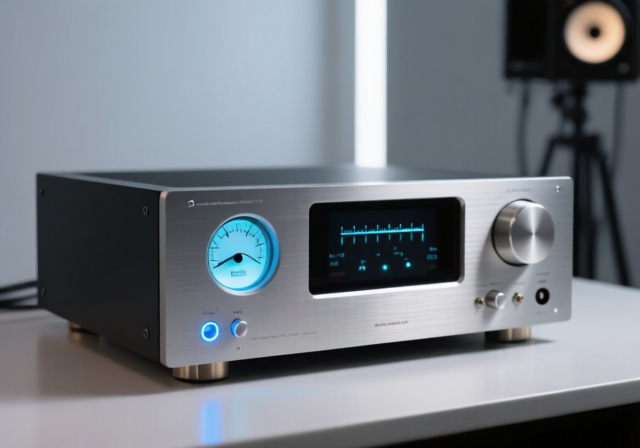
Ever wondered why your expensive speakers sound silent without that mysterious box in your audio setup? You’re not alone – I see this confusion daily among audio enthusiasts who invest thousands in speakers but overlook the heart of their system. The reality is that without proper amplification, even the world’s best speakers would produce nothing more than faint whispers.
What are stereo amplifiers? A stereo amplifier is an electronic device that boosts low-level audio signals from sources like music players or turntables to a level powerful enough to drive speakers, creating a two-channel soundscape with separate left and right audio channels.
After building numerous audio systems over the past 15 years, I’ve learned that understanding amplification is the key to unlocking your system’s true potential. The right amplifier doesn’t just make things louder – it preserves the subtle details, dynamics, and emotional impact that make music feel alive.
In this comprehensive guide, I’ll explain everything you need to know about stereo amplifiers, from basic concepts to technical specifications, and help you understand how these essential components shape your listening experience.
Table of Contents
What Is a Stereo Amplifier?
A stereo amplifier is the powerhouse of your audio system, taking weak electrical signals from your music sources and making them strong enough to move your speaker cones and create sound waves you can hear. Think of it as the muscle between your delicate audio sources and your demanding speakers.
Unlike mono amplifiers that handle a single channel, stereo amplifiers manage two independent audio channels – left and right – creating the spatial separation and imaging that makes music feel three-dimensional. This dual-channel design is fundamental to how we experience recorded music, allowing instruments and voices to occupy specific positions in the soundstage.
From a technical perspective, stereo amplifiers perform one critical function: power amplification. They take line-level signals (typically around 1-2 volts) and amplify them to speaker-level signals (20-50 volts or more), providing the electrical current needed to drive speaker voice coils. This process involves carefully managing both voltage and current while maintaining the original signal’s integrity.
What makes stereo amplifiers indispensable is the fundamental mismatch between audio sources and speakers. Your phone, turntable, or CD player produces signals measured in milliwatts, while your speakers need several watts (often 50-200 watts) to produce room-filling sound. Without an amplifier to bridge this gap, your expensive speakers would remain essentially silent.
The importance of quality amplification becomes clear when you understand what happens during amplification. A good amplifier adds power while preserving the signal’s waveform, maintaining the delicate balance of frequencies, dynamics, and timing that make music engaging. Poor amplification can introduce distortion, frequency response errors, or timing issues that compromise the musical experience.
Stereo Amplifier: An electronic device that increases the power of two-channel audio signals to drive speakers, creating left and right audio channels for spatial sound reproduction.
How Do Stereo Amplifiers Work?
Understanding how amplifiers work reveals why quality matters so much in audio reproduction. The process begins when your audio source sends a weak electrical signal representing sound waves. This signal carries all the musical information – frequencies, dynamics, timing – but lacks the power to move speaker cones.
The amplifier’s first job is to receive this signal without degrading it. Quality amplifiers have input stages that carefully buffer and protect the incoming signal, ensuring it remains clean and intact throughout the amplification process. This is where many budget amplifiers fall short, introducing noise or distortion even before the main amplification begins.
Next comes the critical amplification stage, where the signal’s power is dramatically increased. This happens through a carefully designed circuit that uses the amplifier’s power supply to add energy to the signal. The process involves splitting the signal into positive and negative halves, amplifying each separately, then recombining them – a technique that allows for more efficient power delivery.
Modern amplifiers use various classes of operation (which we’ll cover later), but they all share the same fundamental challenge: adding power without adding distortion. This requires precise control over the amplification process, with sophisticated circuitry that monitors and adjusts the signal thousands of times per second.
Finally, the amplified signal reaches the output stage, where it’s prepared for delivery to your speakers. This stage includes protection circuits to prevent damage from short circuits or impedance mismatches, and output filters that smooth the signal and remove any high-frequency artifacts from the amplification process.
Throughout this entire process, timing is critical. The amplifier must preserve the original signal’s timing relationships – the subtle differences between when different frequencies arrive at your ears. This timing integrity is what gives music its sense of pace, rhythm, and emotional impact. Even tiny timing errors can make music sound confused or lifeless.
Quick Summary: Amplifiers take weak audio signals, add power from their internal power supply, and deliver the amplified signal to speakers while preserving the original musical information.
- Signal Reception: The amplifier receives a line-level audio signal from your source device
- Input Buffering: The signal is protected and conditioned to prevent degradation
- Power Amplification: The signal’s power is increased using energy from the power supply
- Output Processing: The amplified signal is filtered and protected before reaching speakers
- Speaker Drive: The powerful signal drives speaker cones to create sound waves
Types of Stereo Amplifiers (September 2026)
The world of stereo amplifiers offers several distinct categories, each designed for specific applications and user needs. Understanding these types helps you choose the right solution for your audio system and listening preferences.
Integrated amplifiers represent the most popular choice for most music lovers. These all-in-one units combine a preamplifier (which handles source selection and volume control) with a power amplifier (which provides the actual speaker-driving power) in a single chassis. I’ve found integrated amplifiers particularly appealing for their simplicity and value – you get everything needed for a complete system in one box, typically costing less than separate components while maintaining excellent performance.
Power amplifiers are the workhorses of high-end audio systems. These dedicated amplifiers focus solely on the power amplification stage, assuming you already have a separate preamplifier or processor to handle source selection and volume control. Power amplifiers range from modest 50-watt-per-channel models to massive thousand-watt monoblocks used in professional installations. The advantage of separate power amplifiers is the ability to dedicate all resources and space to the critical power amplification circuitry, often resulting in better performance.
Preamplifiers, while not technically amplifiers in the power-delivery sense, are essential components in high-end systems. These devices handle source switching, volume control, and often include phono preamplification for turntables. Preamplifiers prepare and amplify line-level signals to the level required by power amplifiers, ensuring clean signal transmission and precise control over your system.
⚠️ Important: Don’t confuse preamplifiers with power amplifiers – preamps prepare signals, while power amps provide the actual speaker-driving power.
Receivers combine an amplifier with a radio tuner and often additional features like digital-to-analog converters, streaming capabilities, and video switching. While receivers offer convenience and value, they typically compromise on pure audio performance compared to dedicated amplifiers. However, for home theater systems or users who want maximum functionality in one box, receivers remain a popular choice.
| Amplifier Type | Best For | Pros | Cons | Price Range |
|---|---|---|---|---|
| Integrated Amplifier | Most users seeking simplicity | Space-saving, cost-effective, good performance | Limited upgrade flexibility | $300-$3000 |
| Power Amplifier | High-end systems with separate preamps | Best performance, dedicated power delivery | Requires separate preamp, more complex | $500-$10000 |
| Receiver | Home theater, all-in-one solutions | Maximum features, convenient | Compromised audio quality | $400-$2500 |
Amplifier Classes Explained (September 2026)
Amplifier classes represent different approaches to the amplification process, each with unique characteristics affecting efficiency, heat generation, and sound quality. Understanding these classes helps you choose the right technology for your needs.
Class A amplifiers represent the purist’s approach to amplification. These amplifiers use a single transistor (or tube) that conducts for the entire audio signal cycle, resulting in theoretically perfect linearity and no crossover distortion. The downside is terrible efficiency – Class A amplifiers typically waste 75-80% of their energy as heat. I’ve owned several Class A amplifiers over the years, and while they sound exquisite, they run hot enough to warm a small room and consume significant electricity even at idle.
Class B amplifiers solve the efficiency problem by using two transistors – one for the positive half of the signal, one for the negative. Each transistor conducts for only half the signal cycle, dramatically improving efficiency to 70-80%. However, there’s a catch: at the point where the signal transitions between positive and negative halves, both transistors are briefly off, creating a gap called crossover distortion. This distortion, while often subtle, can make music sound harsh or edgy, especially at low volumes.
Class AB amplifiers represent the best of both worlds and dominate the market for good reason. They use a small bias current to keep both transistors slightly conducting even when no signal is present, eliminating the crossover gap of Class B designs. This results in smooth transitions and much lower distortion while maintaining good efficiency of 50-70%. Most quality amplifiers on the market use Class AB designs, offering an excellent balance of performance, efficiency, and cost.
Class D amplifiers have revolutionized the industry in recent years. Rather than continuously varying the output like analog classes, Class D amplifiers use high-frequency switching (pulse-width modulation) to create the output signal. This makes them incredibly efficient – often 90% or more – meaning they run cool and can be made very small and lightweight. Early Class D designs had issues with high-frequency noise and sound quality, but modern designs have largely solved these problems. I’ve been impressed with recent Class D amplifiers that offer performance rivaling traditional Class AB designs while using a fraction of the power.
Amplifier Classes: Technical classifications based on how the amplifier circuit handles the audio signal. Different classes offer trade-offs between efficiency, heat generation, and sound quality.
| Class | Efficiency | Heat | Sound Quality | Best Use |
|---|---|---|---|---|
| Class A | 20-25% | Very High | Excellent | Purist systems |
| Class B | 70-80% | Low | Poor (crossover distortion) | Obsolete |
| Class AB | 50-70% | Moderate | Very Good | Most applications |
| Class D | 90%+ | Very Low | Good to Excellent | Modern systems |
Amplifier vs Receiver: Key Differences
The confusion between amplifiers and receivers represents one of the most common questions I encounter from audio newcomers. While both can drive speakers, they serve different purposes and excel in different applications.
At its core, a receiver is simply an integrated amplifier with added features – primarily a radio tuner, but usually also digital-to-analog conversion, video switching, and often streaming capabilities. This all-in-one approach makes receivers attractive for home theater systems and users who want maximum functionality in a single box. The convenience factor is undeniable – one remote, one set of cables, one box to place in your equipment rack.
However, this convenience comes with compromises. Receivers must allocate space, power, and budget to multiple functions, often at the expense of pure audio performance. The amplifier sections in receivers are typically less robust than dedicated amplifiers, with lower-quality power supplies and less sophisticated circuitry. For critical music listening, separate amplifiers almost always outperform receivers at similar price points.
From my experience building both types of systems, I’ve found that dedicated amplifiers offer better sound quality, more power delivery, and greater reliability. The simplicity of focusing on one function allows manufacturers to invest in better components, more robust power supplies, and more sophisticated circuitry. This focus translates to better dynamics, lower distortion, and the ability to drive demanding speakers without strain.
That said, receivers excel in home theater applications where multiple video and audio sources, surround sound processing, and remote control convenience are priorities. For movie watching and casual music listening, a quality receiver provides more than adequate performance while simplifying system setup and operation.
✅ Pro Tip: Choose a dedicated amplifier for critical music listening systems, opt for a receiver for home theater or maximum convenience needs.
| Feature | Dedicated Amplifier | Receiver |
|---|---|---|
| Primary Focus | Audio quality | Feature integration |
| Sound Quality | Superior | Good to Very Good |
| Power Delivery | Robust | Adequate |
| Features | Basic audio functions | Comprehensive |
| Complexity | Simple operation | Feature-rich interface |
| Best For | Music-focused systems | Home theater, convenience |
Understanding Amplifier Specifications
Navigating amplifier specifications can feel like reading a foreign language, but understanding key metrics helps you make informed decisions and match components properly. Let me demystify the most important specifications you’ll encounter.
Power output, measured in watts per channel, is perhaps the most misunderstood specification. Contrary to popular belief, more watts don’t always mean better sound or louder music. What matters more than the peak power rating is how cleanly the amplifier delivers that power across the frequency range. I’ve heard 50-watt amplifiers that outperform 200-watt models because they deliver cleaner, more controlled power. Most quality speakers sound their best with 50-150 clean watts per channel – anything more is typically overkill for home use.
Total Harmonic Distortion (THD) measures how much the amplifier alters the original signal. Lower THD numbers indicate cleaner amplification, with anything under 0.1% considered excellent for music reproduction. However, don’t get obsessed with ultra-low THD numbers – the difference between 0.01% and 0.001% is essentially inaudible, while other factors like damping factor and frequency response have much more impact on sound quality.
Frequency response indicates the range of frequencies the amplifier can reproduce. Look for a specification that lists both the frequency range and the deviation (usually expressed in dB). A good amplifier should reproduce from at least 20Hz to 20kHz with less than ±0.5dB deviation. Beyond these numbers, what matters more is how linear the response is across the range – a flat response ensures all frequencies are reproduced at their proper levels.
Impedance compatibility is crucial for proper system operation. Amplifiers are designed to work with speakers of specific impedance ratings (typically 4, 6, or 8 ohms). Mismatching impedance can cause performance problems or even damage equipment. Most modern amplifiers can handle 4-8 ohm speakers, but always check your specifications to ensure compatibility.
Impedance: The electrical resistance that affects how power flows between amplifier and speakers. Measured in ohms, it’s crucial for matching components properly.
Signal-to-noise ratio (SNR) measures how much background noise the amplifier introduces. Higher numbers are better, with anything over 100dB considered excellent for music listening. This specification becomes important during quiet passages of music – a low SNR can result in audible hiss that masks subtle musical details.
⏰ Time Saver: Don’t get caught up in specification wars. Focus on clean power delivery, proper impedance matching, and low distortion rather than chasing extreme numbers.
Practical Applications and Setup
Setting up an amplifier correctly is essential for achieving optimal performance. Over the years, I’ve learned that proper setup can make a bigger difference than spending more money on equipment. Let me share some practical guidance based on real-world experience.
Speaker placement and connection is your first priority. Use quality speaker cables that are appropriately gauged for your distances – generally 16-gauge for runs under 50 feet, 14-gauge for longer distances. Ensure proper polarity by connecting positive terminals on both amplifier and speakers, and negative terminals to negative. This seems basic, but reversed polarity is a common mistake that can severely impact sound quality.
Source connections matter more than many people realize. Use quality interconnects between your sources and amplifier, keeping cable runs as short as practical to minimize signal degradation. For digital sources, consider using the amplifier’s built-in DAC if available – modern DACs in quality amplifiers often outperform those in source devices.
Ventilation is crucial for amplifier longevity and performance. Most amplifiers generate significant heat, especially Class A and Class AB designs. Ensure at least 2-3 inches of clearance above and around your amplifier for air circulation. I’ve seen too many amplifiers fail prematurely because they were crammed into tight entertainment centers with no airflow.
Proper gain staging is an often-overlooked aspect of setup. Set your source devices to output a strong, clean signal, then use the amplifier’s volume control for final level adjustment. Avoid turning source volume too low and compensating with high amplifier volume – this can introduce noise and reduce dynamic range. Similarly, avoid driving sources into clipping (distortion) as this damaged sound will be amplified along with the music.
Break-in time is real for most amplifiers. New components need time to settle into their optimal operating parameters. Plan for at least 50-100 hours of use before making final judgments about sound quality. During this period, you might notice the sound becoming smoother and more coherent as components settle.
Common troubleshooting issues often have simple solutions. If your amplifier runs excessively hot, check ventilation and speaker impedance. If there’s no sound, verify all connections and check if the amplifier is in mute mode. If you hear distortion, reduce volume levels and check for clipping in your source components. Most amplifier problems are user-fixable with a bit of systematic troubleshooting.
Final Recommendations
Understanding stereo amplifiers is essential for anyone serious about audio quality. These components form the heart of any good sound system, bridging the gap between your music sources and speakers with the power needed to bring music to life.
Remember that the best amplifier is one that matches your needs, speakers, and listening preferences. Don’t get caught up in specification wars or brand prestige – focus on clean power delivery, proper impedance matching, and real-world performance with your specific equipment. A well-chosen amplifier will provide years of musical enjoyment and serve as the foundation for system upgrades down the road.
Whether you’re building your first serious audio system or upgrading an existing setup, take the time to understand amplification fundamentals. The knowledge will help you make better purchasing decisions, optimize your system’s performance, and ultimately enjoy your music more fully.