
The resonating sound of the whole tone scale in music might be familiar to some of you, but have you ever wondered about its unique structure and representation in a variety of musical genres?
This blog post centers around the whole tone scale, a fascinating aspect of music theory that continues to intrigue both musicians and listeners alike.
If you’ve touched a piano or strummed a guitar, chances are, you’ve encountered scales – major, minor, and perhaps even chromatic.
The whole tone scale often flies under the radar for most amateur musicians despite its interesting features and versatile range of expression.
Time to change that; let’s uncover the magic of the whole tone scale together.
Table of Contents
How to construct a whole-tone scale?
Constructing a whole-tone scale is similar to forming any other scale, but there’s an interesting twist: each note is exactly one whole step (whole tone) away from the next.
- Choose a Root Note: The first step in building your whole tone scale is selecting a root note or tonic. This could be any note – A, B, C#, F, Gb, it all depends on you.
- Step Up: Add the next note by moving up a whole step from your root note. In music lingo, whole steps are also known as ‘tones’. Thus if your root is C, moving up by a full step brings us to D.
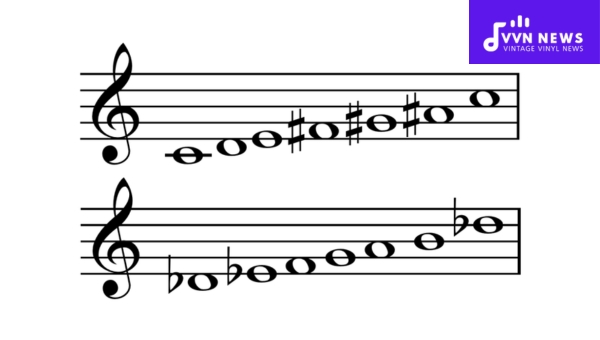
- Repeat: Continue this process to add six unique notes to the scale (including the root). Each new addition is always a full step above the previous one. So if you start with C as your root note, your C Whole Tone Scale becomes C-D-E-F#-G#-A#.
Every recitation of this process will produce two types of whole-tone scales depending on the initial root note selected.
These two ‘hexatonic‘ scales consist of six different pitches spaced equidistantly – making them symmetrical and offering an intriguing sound profile distinct from traditional major and minor scales.
Also Read: A Minor Scale [Unlock The Mysteries Of Musical Composition]
What are the different types of whole-tone scales?
Believe it or not, when we delve into the world of whole-tone scales, simplicity reigns.

Uniquely, there are only two distinct whole-tone scales that encompass all the notes that can be utilized within this system. These two are:
- The C Whole Tone Scale:
C-D-E-F#-G#-A#-C - The Db Whole Tone Scale:
Db-Eb-F-G-A-B-Db
What sets these two scales apart from the more common major and minor ones is their limitation to just these pairs.
While you encounter 24 variations in major and minor scales, here you’re provided with a compact toolkit.
Each scale is symmetric and can be transposed a whole step up or down to yield the other one, creating an elegant duo of equidistant patterns across the keyboard or fretboard.
Both beginning on C and Db respectively, they give musicians a lush tapestry of sound, spaced in whole steps only.
By familiarizing yourself with these patterns, you unlock access to a vast plane of tonal possibilities reserved typically for impressionist or jazz compositions.
These configurations serve as stepping stones for aspiring musicians eager to explore musical textures beyond conventional harmony.
What are the different Uses of whole-tone scales in music?
The whole tone scale holds a noteworthy position within the world of music because of its unique applications.
Below, discover five enduring uses of the whole tone scale in various musical scenarios.
- Creating an ethereal/Surreal Atmosphere: The whole tone scale’s lack of tonal center creates an otherworldly or surreal atmosphere when used in compositions. Engulfing listeners in a dream-like state, this has been used effectively in works such as Debussy’s prelude, Voiles.
- Jazz Improvisation: Jazz music utilizes whole-tone scales to deliver a distinct flavor into improvisations and solos, imparting flair to music by artists like Thelonious Monk and Stevie Wonder.
- Disguising Resolutions: Since there’s no leading tone present in a whole tone scale, it proves to be exceptional at obscuring tonal resolution – found mostly within classical compositions.
- Dominant 7th Chord Extensions: Whole tone scales are widely employed on dominant 7th chord extensions, allowing musicians to incorporate specific tensions into their chords easily.
- Soundscapes for Films/Plays: Composers often turn to whole-tone scales for creating eerie or unsettling soundscapes particularly relevant to film grades and plays.
These diverse uses lend the whole tone scales profound relevance and versatility across multiple musical genres.
If you’re keen to expand your musical palate further, exploring this intriguing asset in music is the way forward!
Also Read: E Minor Pentatonic Scale [How To Use In Your Music Composition]
Chords within whole-tone scales
Diving into the realm of the whole tone scale, you’ll notice that typical triads cannot be constructed.

This uniqueness presents itself in the form of augmented triads, a deviation from the ordinary major and minor chords we’re accustomed to.
With whole tone scales, there are two such triads possible. Let’s explore this concept using a C Whole Tone Scale, for instance.
One whole-tone scale
To create an augmented triad in a whole tone scale, you use every second note or the 1st, 3rd, and 5th notes from the scale. In our C example, these would be:
- C (our root)
- E (the third)
- G# (the augmented fifth)
A notable aspect is that these stacked thirds result in an augmented chord, given the raised fifth.
This makes their sound quite dissonant, ideal for those tension-filled music moments.
The second whole-tone scale
Look to the 2nd, 4th, and 6th notes of your whole-tone scale for another series of tones perfect for supplementing your melody with an unexpected twist:
- D
- F#
- A#
These notes come together to form another unique vibe within your composition.
Hence, it can be inferred that chords within whole-tone scales are quirky conundrums waiting to be arranged into stunning sounds.
These constructs open up a world of exploration that enhances your musical journey with its fascinating elements.
Importance of Learning the Whole Tone Scale
When we begin our journey in the world of music, appreciating disparate forms of scales and how they influence the mood and tone of a piece is crucial.
In particular, grasping the concept of a whole tone scale is significant for various reasons.
Influencing Timbre and Emotion
The most exhilarating feature about whole tone scales lies in their ability to add eccentricity and mystique to a music piece.
Known for its dream-like, ethereal quality, it’s frequently used in impressionist music, jazz, and cinematic soundtracks to evoke nuanced emotional responses.
Expanding Musical Knowledge
Whole-tone scales break away from traditional diatonic scales as there are no semitones involved.
Each note is an exact whole step away from its preceding and succeeding note.
Sieving out scalar patterns prefixed by semitones will cultivate musical acumen significantly.
Boosting Creativity
Utilizing whole-tone scales opens up new horizons for creativity. Their non-functioning tonality means they don’t produce standard major or minor chords, offering composers abundant room for experimentation.
They can yield unexpected harmonic progressions that spur inventive thinking.
Aiding Improvisation
For jazz artists especially, whole-tone scales can be a valuable tool in their improvisation arsenal.
Due to their symmetrical nature, they allow musicians to shift freely up and down the piano whilst creating continuous flowing phrases.
Equipping oneself with mastery over the whole tone scale broadens musical prowess significantly.
It fosters deeper engagement with musical theory while inspiring creativity through non-traditional harmonious constructions.
Also Read: Mastering Chords In A Minor [Improve Your Composition Skills]
FAQs
What is a whole-tone scale?
A whole-tone scale is a linear sequence of notes where each note is separated by an interval of a whole step (two semitones).
Can whole-tone scales be transposed?
Yes, there are only two unique whole-tone scales, which means that transposing them will result in the same notes, just starting from a different pitch.
Do whole-tone scales contain half steps?
No, the defining characteristic of a whole-tone scale is that it consists entirely of whole steps without any half steps.
How does the whole tone scale affect the mood of a piece?
The use of a whole-tone scale often creates an ambiguous or dreamy atmosphere due to the lack of resolution typically provided by half steps in more common scales.
Are there any well-known pieces that utilize the whole tone scale?
Certainly! Claude Debussy’s “Voiles” and “L’Isle Joyeuse” are prime examples where you can hear the ethereal texture that whole-tone scales bring to music.
Conclusion
The whole tone scale offers a distinctive soundscape for composers and players to explore.
Its uniform step structure enriches harmonic textures, creating a dreamlike sequence that transcends traditional tonality.
As you delve into this symmetrical sound world, you’ll discover its limitless potential for innovation in your compositions and improvisations.
Every musical journey expands your expressive vocabulary; make sure the whole tone scale is part of yours.