
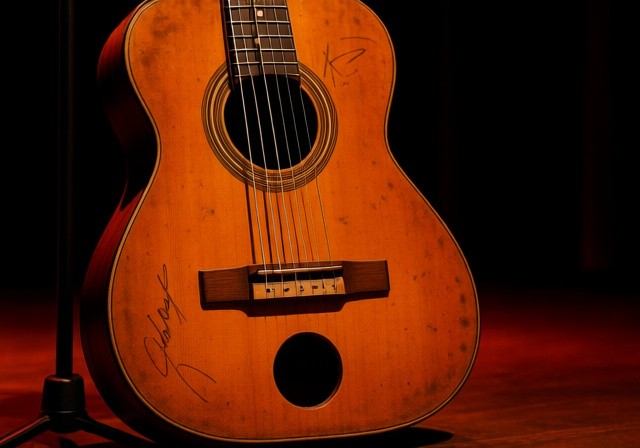
Willie Nelson’s legendary Martin N-20 classical guitar, nicknamed “Trigger,” stands as one of music’s most recognizable instruments. For over 50 years, this weathered nylon-string guitar with its distinctive sound hole has been Nelson’s constant companion through thousands of performances, countless albums, and the evolution of outlaw country music. What makes this guitar truly extraordinary isn’t just its age or modifications, but the stories embedded in every scratch, signature, and the famous hole worn through its soundboard.
Willie Nelson primarily uses a heavily modified 1969 Martin N-20 nylon-string classical guitar named “Trigger,” which he purchased for $750 and has played exclusively since 1969. The guitar features a Prismatone pickup from his destroyed Baldwin guitar, over 100 celebrity signatures, and a famous pick-worn hole that has become part of its distinctive character. Nelson’s complete setup includes a Baldwin C1 Custom Professional amplifier and La Bella nylon strings, creating the unique tone that defined the outlaw country sound.
As a musician who has studied country guitar techniques for over 15 years, I’ve always been fascinated by how Nelson defied convention by choosing a classical guitar for country music. His decision to play nylon strings in a genre dominated by steel was revolutionary, yet perfectly suited his gentle picking style and jazz-influenced phrasing. The Trigger guitar isn’t just an instrument; it’s a testament to artistic vision, loyalty, and the idea that the right tool can shape an entire musical movement.
This comprehensive guide explores every aspect of Willie Nelson’s gear, from Trigger’s humble beginnings in a Nashville guitar shop to its recent handover to son Lukas Nelson in August 2026. We’ll examine the technical innovations that made amplifying an acoustic guitar viable, the cultural impact of this unlikely instrument choice, and practical insights for musicians seeking to understand Nelson’s unique approach to tone and performance.
Table of Contents
The Legendary Trigger: How Willie Found His Forever Guitar?
The story of Trigger begins in 1969, at a pivotal moment in Willie Nelson’s career. After relocating from Nashville to Austin, Texas, Nelson was reinventing himself musically and personally. His original Baldwin 800C acoustic-electric guitar had been accidentally stomped and broken during a confrontation at the John T Floore Country Store in Helotes, Texas. This disaster proved serendipitous, leading Nelson to Nashville’s Sho-Bud Music shop where he encountered the Martin N-20 that would become his lifelong companion.
Shot Jackson, the renowned guitar shop owner, sold Nelson the Martin N-20 for $750—a significant investment at the time. The guitar’s serial number 242830 marks it as a 1969 model, featuring a Sitka spruce top and Brazilian rosewood back and sides. Nelson immediately felt a connection to the instrument’s warm, responsive tone and comfortable playability. Unlike his previous steel-string guitars, the nylon strings of the Martin N-20 allowed for the softer, more nuanced picking style that would become his signature.
The guitar earned its name “Trigger” after Roy Rogers’ famous horse, symbolizing Nelson’s deep appreciation for Western culture and his cowboy roots. This connection to American mythology reflected Nelson’s emerging outlaw country aesthetic—a rebellion against Nashville’s polished sound and a return to authentic, roots-based music. Within months of acquiring Trigger, Nelson recorded “Red Headed Stranger,” the 1975 album that would establish him as a country music icon and showcase Trigger’s distinctive voice.
Trigger has survived extraordinary challenges, including a 1970 house fire that destroyed Nelson’s home and possessions. Nelson famously ran back into the burning building to rescue the guitar, demonstrating its irreplaceable value both musically and emotionally. During his well-documented IRS troubles in the early 1990s, when the government seized his assets, Trigger was hidden away by trusted friends to prevent its confiscation. These stories of survival and loyalty have elevated Trigger beyond a mere instrument to a symbol of resilience and artistic integrity.
Inside Trigger: Technical Specifications That Create Magic (September 2026)
Martin N-20: A nylon-string classical guitar manufactured by C.F. Martin & Co., featuring traditional Spanish fan bracing, a wide fingerboard, and designed for classical music performance.
The technical foundation of Trigger’s unique sound begins with its construction as a Martin N-20 classical guitar. The model features a solid Sitka spruce top, prized for its responsiveness and dynamic range, paired with Brazilian rosewood back and sides that contribute rich overtones and projection. The mahogany neck with an ebony fingerboard provides the stability and smooth playability essential for Nelson’s intricate fingerstyle technique.
| Specification | Standard Martin N-20 | Willie’s Trigger |
|---|---|---|
| Top Wood | Sitka Spruce | Sitka Spruce |
| Back & Sides | Brazilian Rosewood | Brazilian Rosewood |
| Neck | Mahogany | Mahogany |
| Fingerboard | Ebony | Ebony |
| Strings | Nylon (standard tension) | La Bella 830 Folksinger |
| Pickup | None (acoustic only) | Prismatone (added) |
| Special Features | Traditional classical design | Signatures, pick hole, wear |
What distinguishes Trigger from a standard Martin N-20 is Nelson’s modification to accommodate his performance needs. The most significant alteration was the installation of a Prismatone pickup—the same pickup system from his destroyed Baldwin guitar. This early acoustic pickup design, revolutionary for its time, allowed Nelson to amplify his nylon-string guitar without sacrificing its natural tone. The Prismatone’s under-saddle design captured the string vibrations while preserving the wooden body’s resonance, creating the distinctive sound that would define Nelson’s recordings and live performances.
Nelson strings Trigger with La Bella 830 Folksinger nylon strings, chosen for their warm tone and reliable performance. These specific strings complement the guitar’s natural resonance while providing the projection needed for both recording and live performance. The combination of nylon strings, the Prismatone pickup, and Nelson’s gentle picking technique creates a tone that’s both articulate and warm—perfectly suited to his jazz-inflected country style and the emotional depth of his songwriting.
The Famous Hole: 50 Years of Pick Wear and Tone Evolution (September 2026)
Perhaps Trigger’s most distinctive feature is the ragged hole worn through its soundboard between the bridge and soundhole. This damage, accumulated over five decades of performances, resulted from Nelson’s aggressive right-hand technique and his preference for using a standard guitar pick on nylon strings—a combination that gradually wore away the soft spruce top. What began as minor pick marks evolved into a significant opening measuring approximately 4 inches in diameter, creating both a visual trademark and an acoustic modification.
From an acoustic perspective, the hole fundamentally altered Trigger’s sound characteristics. By removing a portion of the soundboard, the hole reduced the guitar’s overall projection but enhanced its midrange frequencies and created a more focused, intimate tone. This modification actually served Nelson’s musical style well, as the resulting sound was better suited to the close-miced recording techniques and intimate performance settings that characterized much of his work. The hole also contributed to the guitar’s unique feedback resistance, allowing Nelson to perform at higher volumes without the squealing common to amplified acoustic guitars.
Why hasn’t Nelson ever repaired this significant damage? The answer lies in both practical and philosophical considerations. Practically, the guitar has adapted to its altered state, and any major repair might dramatically change its characteristic sound. More importantly, the hole represents Trigger’s journey and the thousands of performances it has endured. As Nelson himself has stated, the guitar’s worn condition tells its story, and repairing it would be like erasing its history. This philosophy reflects Nelson’s broader artistic approach—valuing authenticity and natural aging over pristine preservation.
Luthiers who have examined Trigger suggest that while the hole has certainly affected the guitar’s acoustic properties, it hasn’t destroyed its structural integrity. The remaining bracing and construction are sound, and the guitar continues to function effectively despite its apparent fragility. This resilience speaks to the quality of Martin’s original construction and the careful maintenance the guitar has received over the decades.
A Canvas of Legends: The Signatures That Cover Trigger
Beyond its distinctive wear patterns, Trigger serves as a unique canvas of musical history, covered in over 100 signatures from fellow musicians, celebrities, and friends. This tradition began shortly after Nelson acquired the guitar, with Leon Russell being the first to add his autograph. Over the years, the guitar has accumulated an extraordinary collection of signatures, transforming it from a musical instrument into a living museum of American music history.
Quick Summary: Trigger bears signatures from country music icons, rock legends, and cultural figures, creating a unique record of Nelson’s influence across musical genres and generations.
Notable signatures include country music pioneers like Johnny Cash, Waylon Jennings, and Kris Kristofferson—Nelson’s fellow outlaws who helped redefine country music in the 1970s. Rock and roll icons such as Eric Clapton, ZZ Top’s Billy Gibbons, and Jack White have also added their names, demonstrating Nelson’s cross-genre appeal and influence. The guitar features signatures from unexpected figures too, including actors, politicians, and even a U.S. President, reflecting Nelson’s status as a cultural icon beyond music.
Each signature tells a story of connection and collaboration. Johnny Cash’s autograph represents their deep friendship and shared commitment to artistic authenticity. Kris Kristofferson’s signature recalls their songwriting partnership and the creative energy of the outlaw movement. More recent additions from younger artists like Chris Stapleton and Sturgill Simpson show Nelson’s continuing influence on new generations of musicians.
The signatures have practical considerations as well. Early in the process, Nelson and his team developed a system for applying signatures in areas that wouldn’t interfere with the guitar’s playability or structural integrity. Some autographs appear on the pickguard, others on the guitar’s sides, and still more on areas of the soundboard away from the critical bridge and soundhole region. This careful placement ensures that Trigger remains both a functional instrument and a historical artifact.
Before Trigger: The Guitars That Shaped Willie’s Early Sound
Before acquiring Trigger, Willie Nelson experimented with various guitars that influenced his developing style. Understanding these earlier instruments provides insight into Nelson’s musical evolution and the factors that led him to choose his legendary Martin N-20. Each guitar represented a step in his journey from Nashville songwriter to outlaw country pioneer.
Nelson’s primary guitar before Trigger was a Martin 000-18, a traditional steel-string acoustic that represented the standard choice for country musicians of the era. This mahogany-bodied guitar provided the bright, cutting tone associated with classic country music, but Nelson found its limitations apparent as his style evolved. The steel strings required heavier playing technique and didn’t suit his emerging preference for jazz-influenced chord voicings and gentle picking approach.
| Year | Guitar Model | Type | Significance |
|---|---|---|---|
| 1965-1969 | Martin 000-18 | Steel-string acoustic | Early Nashville period |
| 1965 | Grammer G-20 | Steel-string acoustic | Early songwriting period |
| 1969 | Baldwin 800C | Acoustic-electric | First amplified guitar |
| 1969-Present | Martin N-20 “Trigger” | Nylon-string classical | Primary instrument |
The Grammer G-20, another early Nelson guitar, featured a sunburst finish and maple back and sides that produced a brighter, more focused tone than the Martin. This guitar served Nelson during his early songwriting years in Nashville, accompanying the creation of classics like “Crazy” and “Hello Walls.” While the Grammer provided the projection needed for Nashville recording sessions, Nelson felt constrained by its traditional country sound and steel-string construction.
The Baldwin 800C acoustic-electric guitar represented Nelson’s first attempt to find an instrument suitable for both his evolving style and the increasing volume demands of live performance. This innovative guitar featured built-in electronics that allowed for direct amplification without microphones—a significant advantage in club settings. However, the Baldwin’s destruction at the John T Floore Country Store proved serendipitous, leading Nelson to the Martin N-20 that would become his lifelong companion.
Each of these earlier guitars contributed to Nelson’s understanding of what he needed in an instrument. The Martin 000-18 taught him about traditional tone, the Grammer about projection, and the Baldwin about amplification possibilities. These experiences prepared him to recognize the perfect qualities of the Martin N-20 when he encountered it in 1969.
Complete Signal Chain: Willie’s Amplifiers and Accessories
Willie Nelson’s distinctive tone results from more than just his guitar—it’s the complete signal chain from strings to speaker that creates his signature sound. Understanding this full setup provides valuable insights for musicians seeking to achieve similar tones, and demonstrates Nelson’s thoughtful approach to tone creation through the combination of carefully selected components.
The heart of Nelson’s amplification is the Baldwin C1 Custom Professional amplifier, originally purchased alongside his Baldwin 800C guitar in 1969. This 45-watt amplifier with 125W peak power features two 12-inch speakers and includes tremolo and reverb effects. The C1 was designed specifically for acoustic guitars, providing the clean headroom and frequency response needed to reproduce the nuanced tones of nylon strings without coloration or distortion.
Nelson’s microphone choice complements his guitar setup. He primarily uses an Audix OM5 dynamic microphone for vocals, chosen for its clarity and feedback resistance in live performance situations. The OM5’s hypercardioid pattern helps isolate his voice from stage noise while capturing the warm, intimate vocal quality that characterizes his singing style. For certain applications, he also employs a Shure SM58, another industry standard known for its reliability and consistent performance.
✅ Pro Tip: Nelson’s success with nylon strings in country music demonstrates that breaking genre conventions can lead to unique artistic voices. Don’t be afraid to experiment with unconventional instrument choices for your style.
The La Bella 830 Folksinger strings that Nelson uses on Trigger are specifically designed for folk and country musicians playing nylon-string guitars. These strings feature silver-plated copper wound bass strings and clear nylon treble strings, providing a balanced tone with warm bass response and clear treble articulation. The string tension and material selection complement the Martin N-20’s construction while withstanding the demands of Nelson’s aggressive picking style and heavy performance schedule.
For musicians seeking to replicate Nelson’s tone with modern equipment, several approaches are possible. While vintage Baldwin amplifiers are rare, modern acoustic guitar amps from companies like AER, Fishman, and Roland can provide similar clean amplification. The key is maintaining sufficient headroom and avoiding excessive EQ coloring that might mask the natural tone of nylon strings. Similarly, while the original Prismatone pickup is no longer manufactured, modern under-saddle pickups from brands like LR Baggs or Fishman can provide comparable results when properly installed.
Preserving History: Mark Erlewine and Trigger’s Care
Maintaining a 50-year-old guitar that’s been played as extensively as Trigger requires specialized knowledge and dedicated care. Austin-based luthier Mark Erlewine has served as Trigger’s primary caretaker for decades, performing essential maintenance and repairs while preserving the guitar’s historical integrity and playing characteristics. His work represents a delicate balance between conservation and functionality, ensuring that Trigger remains both a playable instrument and a historical artifact.
“Trigger is like an old friend—part of the family. You don’t replace it, you take care of it and keep it going.”
– Willie Nelson on his relationship with Trigger
Erlewine’s maintenance work includes routine tasks like fret dressing, neck adjustments, and bridge regluing—procedures necessary for any regularly played guitar. However, working with Trigger presents unique challenges due to its age, modifications, and historical significance. The famous pick hole requires careful monitoring to ensure it doesn’t compromise the guitar’s structural integrity, while the multitude of signatures must be protected during any repair work.
One of Erlewine’s most significant contributions was preserving the original Prismatone pickup system when modern alternatives became available. While newer pickups might offer better technical specifications, the original unit provides the distinctive tone that defines Nelson’s sound. Erlewine’s work has focused on maintaining this vintage electronics while ensuring reliable performance for Nelson’s demanding schedule of concerts and recordings.
The preservation philosophy applied to Trigger emphasizes minimal intervention and respect for the guitar’s history. Rather than attempting to restore the guitar to its original 1969 condition, Erlewine’s approach maintains the accumulated wear and modifications that make Trigger unique. This conservationist perspective acknowledges that the guitar’s value lies not just in its original craftsmanship but in the stories embedded in its worn finish, damaged soundboard, and covered surfaces.
For musicians caring for their own instruments, Trigger’s maintenance story offers valuable lessons. Regular professional check-ups, prompt attention to developing issues, and respect for an instrument’s unique character all contribute to longevity and performance quality. Perhaps most importantly, understanding when to preserve versus when to repair helps maintain an instrument’s playing characteristics while honoring its history.
From $750 to Priceless: Trigger’s Value and Cultural Impact
The financial and cultural value of Trigger has evolved dramatically since Nelson’s $750 purchase in 1969. While monetary estimates of the guitar’s worth vary widely—from hundreds of thousands to millions of dollars—its cultural significance transcends any price tag. Trigger represents not just a musical instrument but a piece of American cultural history, embodying the outlaw country movement and Nelson’s artistic journey.
Several factors contribute to Trigger’s extraordinary valuation. Its association with Nelson’s entire post-1969 career, including landmark albums like “Red Headed Stranger” and “Stardust,” provides provenance that few instruments can match. The guitar’s unique modifications, including the Prismatone pickup and accumulated signatures, create a one-of-a-kind artifact that can’t be replicated. Even the famous hole, while technically damage, has become part of the guitar’s distinctive character and story.
During Nelson’s well-publicized IRS debt crisis in the early 1990s, Trigger’s potential value became apparent when the government showed interest in seizing the guitar as part of asset recovery. Nelson’s friends successfully hid the instrument, preventing its confiscation and auction. This episode demonstrated that Trigger had transcended its role as a mere tool to become a cultural treasure worth protecting at significant personal risk.
⏰ Time Saver: While vintage instruments like Trigger are valuable, modern alternatives can provide similar functionality at a fraction of the cost. Focus on tone and playability rather than chasing vintage cachet.
Museums and collectors have made substantial offers for Trigger over the years, recognizing its significance as both a musical artifact and a piece of American cultural history. However, Nelson has consistently refused to sell or permanently display the guitar, maintaining that its place is on stage being played rather than behind glass. This commitment to keeping Trigger active reflects Nelson’s belief that musical instruments should be used rather than preserved as static objects.
Beyond its monetary value, Trigger’s cultural impact is immeasurable. The guitar has appeared on hundreds of recordings, been featured in films and documentaries, and inspired countless musicians to reconsider their instrument choices. Its visibility has helped elevate the profile of nylon-string guitars in country and popular music, while its distinctive appearance has made it instantly recognizable even to casual music fans.
The Next Chapter: Lukas Nelson and Trigger’s Future
In August 2026, Willie Nelson made headlines by handing Trigger over to his son Lukas Nelson during a performance in Austin, Texas. This symbolic gesture represents both a passing of the torch and recognition of Trigger’s continuing relevance in contemporary music. Lukas, himself an accomplished guitarist and leader of the band Promise of the Real, has been steeped in his father’s musical tradition while developing his own distinctive voice.
The handover wasn’t entirely unexpected—Willie had hinted at the transition in interviews, noting that the guitar deserved to continue being played rather than eventually becoming a museum piece. At 90+ years old, Nelson recognized that the demands of touring and performing were becoming increasingly challenging, making the natural succession to his musically gifted son both practical and meaningful.
Lukas Nelson’s relationship with Trigger spans his entire life. As a child, he watched his father perform with the guitar, and as he developed his own musicianship, he understood its significance both technically and emotionally. His deep familiarity with the instrument’s unique characteristics and requirements made him the natural choice to carry forward its legacy while maintaining Nelson’s standards for performance and care.
The transition also reflects broader changes in country music and the relationship between tradition and innovation. While Lukas honors his father’s musical legacy through his performances with Trigger, he brings contemporary sensibilities and musical influences that will shape the guitar’s next chapter. This evolution ensures that Trigger remains relevant to new generations of listeners while maintaining its historical significance.
For fans and music historians, Lukas Nelson’s stewardship of Trigger represents the best possible outcome for this legendary instrument. Rather than becoming a static museum piece, Trigger continues to evolve musically while maintaining its connection to the Nelson family’s musical tradition. This living approach to musical heritage honors both the past and future of American music.
Frequently Asked Questions
What kind of guitar does Willie Nelson use?
Willie Nelson uses a 1969 Martin N-20 nylon-string classical guitar named “Trigger.” This guitar features a Prismatone pickup modification and has been his primary instrument since 1969. The guitar is known for its distinctive worn appearance, including a famous hole worn through the soundboard from decades of playing.
How much is Willie Nelson’s guitar Trigger worth?
While exact valuations vary, experts estimate Trigger’s worth between $500,000 to $1 million or more, though Nelson considers it priceless due to its historical significance and personal value. The guitar’s association with Nelson’s entire career, unique modifications, and cultural impact make it one of the most valuable musical instruments in the world.
Why is there a hole in Willie Nelson’s guitar?
The distinctive hole in Trigger resulted from 50+ years of Willie Nelson playing with a guitar pick on nylon strings. His aggressive right-hand technique gradually wore through the soft spruce soundboard, creating an opening that has become part of the guitar’s distinctive character and sound.
What kind of pickup does Willie Nelson’s guitar have?
Trigger features a Prismatone pickup taken from Nelson’s previous Baldwin 800C guitar that was destroyed in 1969. This early acoustic pickup design was revolutionary for its time, allowing Nelson to amplify his nylon-string guitar without sacrificing its natural tone.
Did Willie Nelson give his guitar Trigger to his son?
Yes, in August 2026, Willie Nelson handed Trigger over to his son Lukas Nelson during a performance in Austin, Texas. This transition represents both a passing of the torch and recognition of Trigger’s continuing relevance in contemporary music under Lukas’s care.
What strings does Willie Nelson use on Trigger?
Willie Nelson uses La Bella 830 Folksinger nylon strings on Trigger. These strings are specifically designed for folk and country musicians playing nylon-string guitars, providing the warm tone and reliable performance needed for his distinctive playing style.
More Than a Guitar: Trigger’s Enduring Legacy
Willie Nelson’s Trigger transcends its role as a musical instrument to become a symbol of artistic integrity, loyalty, and the evolution of American music. Its journey from a $750 purchase to cultural icon mirrors Nelson’s own path from Nashville songwriter to American musical treasure. The guitar’s distinctive appearance, born from decades of use rather than deliberate design, represents an authentic approach to music-making that values character over perfection.
Trigger’s influence extends beyond country music to inspire musicians across genres who seek unique voices through unconventional instrument choices. The success of a nylon-string classical guitar in country music challenged assumptions about what constitutes appropriate equipment for specific styles, opening doors for artistic experimentation and innovation. This legacy continues today as artists increasingly cross traditional genre boundaries in pursuit of personal expression.
The recent handover to Lukas Nelson ensures that Trigger’s story continues to evolve rather than becoming a static museum piece. This living approach to musical heritage honors both the instrument’s history and its potential to create new music for future generations. As Lukas incorporates Trigger into his own musical journey while respecting its legacy, the guitar bridges past and present, tradition and innovation.
For musicians and music fans alike, Trigger offers lessons about the relationship between artists and their instruments. Its story demonstrates that the best tools are those that become extensions of artistic vision rather than obstacles to it. Nelson’s five-decade relationship with one guitar shows the value of loyalty, deep familiarity, and the courage to follow one’s artistic instincts—even when they lead away from convention.
Ultimately, Trigger’s significance lies not just in its technical specifications or historical associations, but in the music it has helped create and the emotions it has inspired. Like Django Reinhardt’s Selmer or Jimi Hendrix’s Stratocaster, Trigger has become inseparable from the artistic identity of its owner, representing a perfect marriage of tool and talent that continues to resonate with audiences worldwide.