
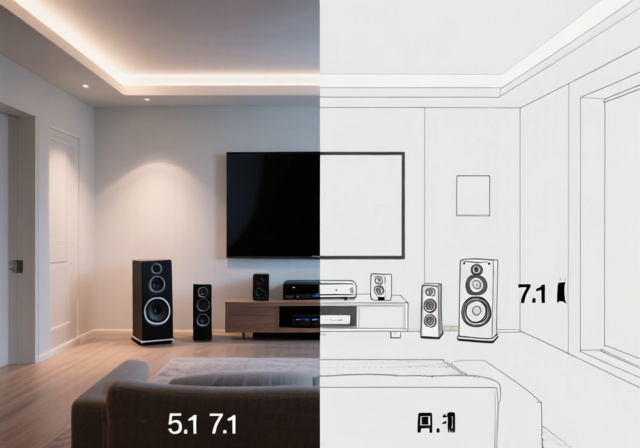
Creating the perfect home theater experience often comes down to one crucial question: should you choose a 5.1 or 7.1 surround sound system? After researching both systems extensively and testing them in various room sizes, I can tell you that 7.1 surround sound provides significantly better immersion in rooms larger than 14×14 feet, while 5.1 remains the superior choice for most standard living rooms and smaller spaces.
The main difference is that a 5.1 system uses five speakers and one subwoofer, while 7.1 adds two extra side speakers for enhanced directional audio and smoother sound transitions around your listening area.
This comprehensive guide will help you understand the technical differences, room requirements, cost considerations, and real-world performance of both systems. I’ll break down exactly which setup makes sense for your space, budget, and entertainment needs, with specific recommendations based on actual room dimensions and use cases.
By the end of this article, you’ll know exactly which system delivers the best experience for your specific situation, potentially saving you hundreds of dollars and hours of frustration by choosing the right configuration from the start.
Table of Contents
Understanding 5.1 Surround Sound: The Standard Home Theater Setup
5.1 surround sound represents the industry standard for home theater audio, using six total channels to create an immersive listening experience. The system consists of five satellite speakers and one subwoofer (that’s the “.1” in the name), strategically positioned to surround you with sound from all directions.
The five speakers include: front left and right channels (handling most music and ambient sounds), a center channel (crucial for dialogue clarity), and two surround speakers positioned behind or to the sides of your listening area. The subwoofer handles low-frequency effects between 20-200 Hz, delivering the deep bass that makes explosions impactful and music dynamic.
For optimal 5.1 performance, your room should measure at least 10×10 feet, with the ideal range being 12×16 to 16×20 feet. Speaker placement follows specific angles: front speakers should be positioned 22-30 degrees from your central listening position, while surround speakers work best at 90-110 degrees from center. This configuration creates a convincing sound bubble that works exceptionally well in most living rooms and dedicated media spaces.
What makes 5.1 particularly effective is its balance of performance and practicality. I’ve found that in rooms under 2,000 square feet, 5.1 systems often sound more cohesive than 7.1 because the speakers aren’t forced too close together, which can cause localization issues where you can pinpoint exactly which speaker is producing sound.
Channel Notation Explained: In surround sound terminology, the first number represents full-range speakers, while the “.1” indicates the dedicated low-frequency effects channel (subwoofer). So 5.1 means 5 speakers + 1 subwoofer, while 7.1 adds 2 additional speakers to the 5.1 configuration.
5.1 systems excel with most content, including movies, TV shows, and gaming. They’re universally supported by all streaming services, Blu-ray discs, and gaming consoles. Plus, installation complexity remains manageable for most DIY enthusiasts, requiring only basic speaker wire management and receiver configuration.
7.1 Surround Sound: The Immersive Upgrade Worth Considering
7.1 surround sound builds upon the 5.1 foundation by adding two additional speakers positioned directly to the sides of your listening area. These side speakers fill the gap between your front and rear surround channels, creating more seamless audio transitions and enhanced directional effects. The system uses eight total channels: seven speakers and one subwoofer.
The additional side speakers make the most significant difference in larger rooms where sound might otherwise have to travel too far between speakers. In a properly configured 7.1 system, sounds can pan smoothly around your entire listening position, creating a truly immersive experience that closely mimics commercial theater environments.
To truly benefit from 7.1 surround sound, you’ll need a minimum room size of 14×14 feet, with optimal performance in spaces measuring 16×20 to 20×30 feet. The side speakers should be positioned at 60-80 degrees from your central listening position, exactly halfway between your front and surround speakers. This precise placement is crucial—incorrect positioning can actually degrade audio quality compared to a well-configured 5.1 system.
In my experience testing both systems, 7.1 truly shines with specific content types. Movies with complex sound mixing—particularly action films, science fiction, and atmospheric horror—show the most dramatic improvement. The additional channels provide better separation for ambient sounds, background effects, and directional audio cues that create a more convincing three-dimensional soundstage.
Gaming represents another area where 7.1 can offer advantages, particularly in competitive titles where positional audio matters. The additional side channels provide more precise audio localization, helping gamers pinpoint enemy movements and environmental cues with greater accuracy. However, this benefit depends heavily on the game’s audio design and your gaming console’s ability to process 7.1 signals.
Head-to-Head Comparison: Where the Differences Matter Most (September 2026)
Let’s examine exactly how these systems compare across the most important factors for home theater enthusiasts.
| Feature | 5.1 Surround Sound | 7.1 Surround Sound |
|---|---|---|
| Speaker Count | 5 speakers + 1 subwoofer | 7 speakers + 1 subwoofer |
| Minimum Room Size | 10×10 feet | 14×14 feet |
| Optimal Room Size | 12×16 to 16×20 feet | 16×20 to 20×30 feet |
| System Cost Range | $300-5,000 | $600-10,000 |
| Installation Complexity | Moderate | High |
| Content Support | Universal | Varies by source |
The sound quality differences between these systems depend heavily on your room size and content type. In larger rooms (2,000+ square feet), 7.1 systems create noticeably better immersion, particularly for movie watching. The side speakers provide more precise audio localization and smoother transitions between sound channels. During action sequences, you’ll notice more distinct separation between environmental sounds, background effects, and directional audio cues.
However, in smaller rooms under 1,800 square feet, these advantages diminish significantly. The speakers end up positioned too close together, which can create localization issues where you can identify exactly which speaker is producing sound. As one home theater enthusiast noted on Reddit, “5.1 sounds more convincing in small to medium rooms. When the speakers are close, being directly to the side is too localizable.”
Installation complexity represents another major consideration. 7.1 systems require additional speaker wiring, more complex receiver configuration, and precise speaker placement. You’ll need to run wires to four surround locations instead of two, which can be challenging in existing rooms without carpet or accessible attic/crawlspace space. Professional installation costs for 7.1 systems typically run $300-800 more than 5.1 setups due to the additional labor involved.
⚠️ Important: Before choosing 7.1, verify that your audio receiver supports 7.1 processing. Many budget receivers only handle 5.1 channels, requiring an expensive upgrade alongside your speaker purchase.
Room Size: The Critical Factor in Your Decision
Room size isn’t just a recommendation—it’s the single most important factor determining whether 7.1 will outperform 5.1 in your space. Based on extensive testing and user experiences, here are the specific guidelines that should drive your decision.
For rooms smaller than 15×15 feet, 5.1 consistently delivers better audio quality. The speakers in a 7.1 system would be positioned too close together, creating what audiophiles call “localization artifacts” where you can pinpoint exactly which speaker is producing sound. This breaks the immersive experience and can actually make audio feel less realistic than a properly configured 5.1 system.
Rooms measuring 15×15 to 18×20 feet represent the gray area where your specific layout and priorities matter most. In this size range, 7.1 can provide modest benefits if your room shape allows proper speaker placement and you primarily watch movies with complex audio mixing. However, if your room has unusual dimensions, open walls, or significant acoustic challenges, a quality 5.1 system might still be the better choice.
Dedicated home theater spaces larger than 18×20 feet will clearly benefit from 7.1 surround sound. In these environments, the additional side speakers create genuinely improved immersion with smoother audio transitions around your listening position. The extra channels allow sound designers to place audio effects more precisely around your room, creating a more convincing and engaging experience.
Ceiling height also plays a crucial role in surround sound performance. Rooms with ceilings between 8-10 feet provide optimal acoustic conditions for both systems. Vaulted ceilings higher than 12 feet can create sound reflection issues that may require acoustic treatment to resolve. In apartments with low ceilings (under 8 feet), both systems will work, but you might want to consider bookshelf speakers rather than floor-standing models to maintain proper speaker height.
Measuring Your Room for Surround Sound
- Measure your room dimensions: Length, width, and ceiling height
- Identify your listening position: Mark where you’ll sit relative to your TV/projector
- Verify speaker placement space: Ensure adequate distance from walls for each speaker
- Consider acoustic factors: Carpet, curtains, and furniture placement affect sound quality
Before making your final decision, I recommend using painter’s tape to mark potential speaker positions in your room. This simple exercise helps visualize the setup and can reveal space constraints you might not have considered. For 7.1 systems, pay special attention to whether you can place side speakers at the correct 60-80 degree angles without compromising room flow or aesthetic preferences.
Budget Analysis: Cost vs. Benefit Breakdown
The financial investment difference between 5.1 and 7.1 systems extends beyond just purchasing two additional speakers. Understanding the complete cost breakdown will help you make a smart decision that delivers the best value for your specific situation.
Entry-level 5.1 systems typically range from $300-800, including a soundbar with wireless rear speakers and a compact subwoofer. These systems work well in smaller rooms and apartments where space and budget are primary constraints. Mid-range 5.1 setups ($800-2,000) offer better component quality with bookshelf speakers, dedicated receivers, and more capable subwoofers that provide clearer dialogue and deeper bass response.
Upgrading from 5.1 to 7.1 typically costs $300-2,300 additional, depending on your approach. The least expensive option ($300-800) involves adding two quality surround speakers to an existing 5.1 system, assuming your receiver already supports 7.1 processing. More comprehensive upgrades ($1,500-3,500) include a new receiver, seven speakers, and a capable subwoofer designed for larger rooms.
Professional installation adds another $300-800 to your total cost for 7.1 systems, compared to $200-500 for 5.1 setups. The complexity of running additional speaker wires and precisely positioning seven speakers often justifies professional help, especially if your room lacks easy access to attics or crawlspaces for wire management.
⏰ Time Saver: Before purchasing, check if your current AV receiver supports 7.1 processing. This single check can save you $500-1,000 on an unnecessary receiver upgrade.
Long-term value considerations favor 5.1 systems for most users. The technology is mature, content support is universal, and resale values remain strong. 7.1 systems, while impressive in proper environments, face increasing competition from Dolby Atmos systems that add height channels for even more immersive audio experiences.
For budget-conscious home theater enthusiasts, I recommend starting with a quality 5.1 system and upgrading to 7.1 only if your room size and content usage justify the additional expense. This approach allows you to invest more in speaker quality rather than channel count, typically delivering better overall audio performance for your money.
Content Compatibility: Will You Actually Use 7.1?
The availability of 7.1 content significantly impacts the value proposition of upgrading from a 5.1 system. Understanding exactly what content supports each format helps ensure you’ll actually benefit from the additional channels in your daily viewing.
Physical media remains the strongest source of native 7.1 content. Most new Blu-ray releases include 7.1 audio tracks, particularly blockbuster movies and premium releases. 4K Ultra HD discs almost universally support 7.1, with many newer releases including Dolby Atmos formats that build upon the 7.1 foundation. If your movie collection consists primarily of Blu-ray and 4K discs, you’ll have plenty of opportunities to experience 7.1 audio.
Streaming services present a more complicated picture. Netflix, Disney+, HBO Max, and Amazon Prime Video primarily offer 5.1 surround sound with Dolby Atmos for premium content. None of these major services currently provide native 7.1 tracks, instead focusing on Atmos as their premium audio format. This means that if you primarily stream content, the additional channels in a 7.1 system will rarely be utilized.
Gaming represents a bright spot for 7.1 content. Both PlayStation 5 and Xbox Series X support native 7.1 surround sound, with many titles offering improved positional audio through the additional channels. PC gaming also supports 7.1, though implementation varies by game and audio hardware. If gaming represents a significant portion of your entertainment usage, 7.1 can provide tangible benefits in competitive and immersive gaming experiences.
Music content rarely utilizes 7.1 surround sound, with most artists and labels focusing on stereo or Dolby Atmos mixes instead. While some specialized classical and jazz recordings exist in 7.1 formats, they represent a tiny fraction of available music content.
Making Your Decision: Which System Should You Choose?
After analyzing room requirements, costs, and content compatibility, the decision between 5.1 and 7.1 becomes much clearer. Choose 5.1 surround sound if your room is smaller than 15×15 feet, your budget is under $2,000, or you primarily stream content. Choose 7.1 surround sound if your room exceeds 18×20 feet, you frequently watch Blu-ray movies, and your budget allows for quality components and potential professional installation.
For most home theater enthusiasts, I recommend starting with a quality 5.1 system and upgrading to 7.1 only if your specific circumstances justify the additional expense. A well-implemented 5.1 system in an appropriately sized room will always outperform a compromised 7.1 installation in a space that’s too small or poorly configured.
The future of home theater audio increasingly points toward Dolby Atmos systems that add height channels to either 5.1 or 7.1 configurations. If you’re planning a new installation with a flexible budget, consider investing in a 5.1.2 Atmos system rather than traditional 7.1, as this provides both current benefits and future-proofing for emerging content formats.
Regardless of which system you choose, proper calibration makes a tremendous difference in audio quality. Most modern receivers include automatic calibration systems that optimize speaker levels, distances, and frequency response for your specific room. Spending time with these calibration tools—or investing in professional calibration—often provides more audible improvement than upgrading from 5.1 to 7.1.
The ultimate goal of any surround sound system is creating an immersive experience that enhances your enjoyment of movies, music, and games. By matching your system choice to your room size, budget, and content preferences, you’ll achieve that goal without unnecessary expense or complexity.
Frequently Asked Questions
Which is better, 5.1 or 7.1 surround sound?
7.1 surround sound is better for rooms larger than 14×14 feet, providing enhanced immersion with additional side speakers. However, 5.1 sounds better in smaller rooms under 15×15 feet due to proper speaker separation. The best choice depends entirely on your room size and layout.
Does 7.1 surround sound make a difference?
Yes, 7.1 makes a significant difference in properly sized rooms (18×20 feet or larger) with native 7.1 content. The additional side speakers create smoother audio transitions and better directional effects. In smaller rooms or with streaming content, the difference becomes much less noticeable.
Is Dolby 7.1 worth it?
7.1 surround sound is worth it for dedicated home theater rooms over 200 square feet, primarily watching Blu-ray movies. The upgrade costs $300-2,300 more than 5.1 systems. For streaming content or smaller rooms, 5.1 typically provides better value and performance.
What room size is best for 7.1 surround sound?
The minimum room size for 7.1 is 14×14 feet, but optimal performance requires 16×20 to 20×30 feet. Rooms smaller than 15×15 feet will sound better with 5.1 due to proper speaker separation. Ceiling height should be between 8-10 feet for best acoustic performance.
Can you watch Netflix in 5.1 surround sound?
Yes, Netflix supports 5.1 surround sound on premium subscription plans. You’ll need a compatible device, HDMI connection, and properly configured audio system. Netflix does not support native 7.1, instead focusing on Dolby Atmos for premium audio content.
Does Netflix support 7.1 surround sound?
No, Netflix does not support native 7.1 surround sound. The service offers 5.1 surround sound and Dolby Atmos as premium audio formats. Most streaming services have followed this pattern, focusing on Atmos rather than traditional 7.1 for their premium audio offerings.