
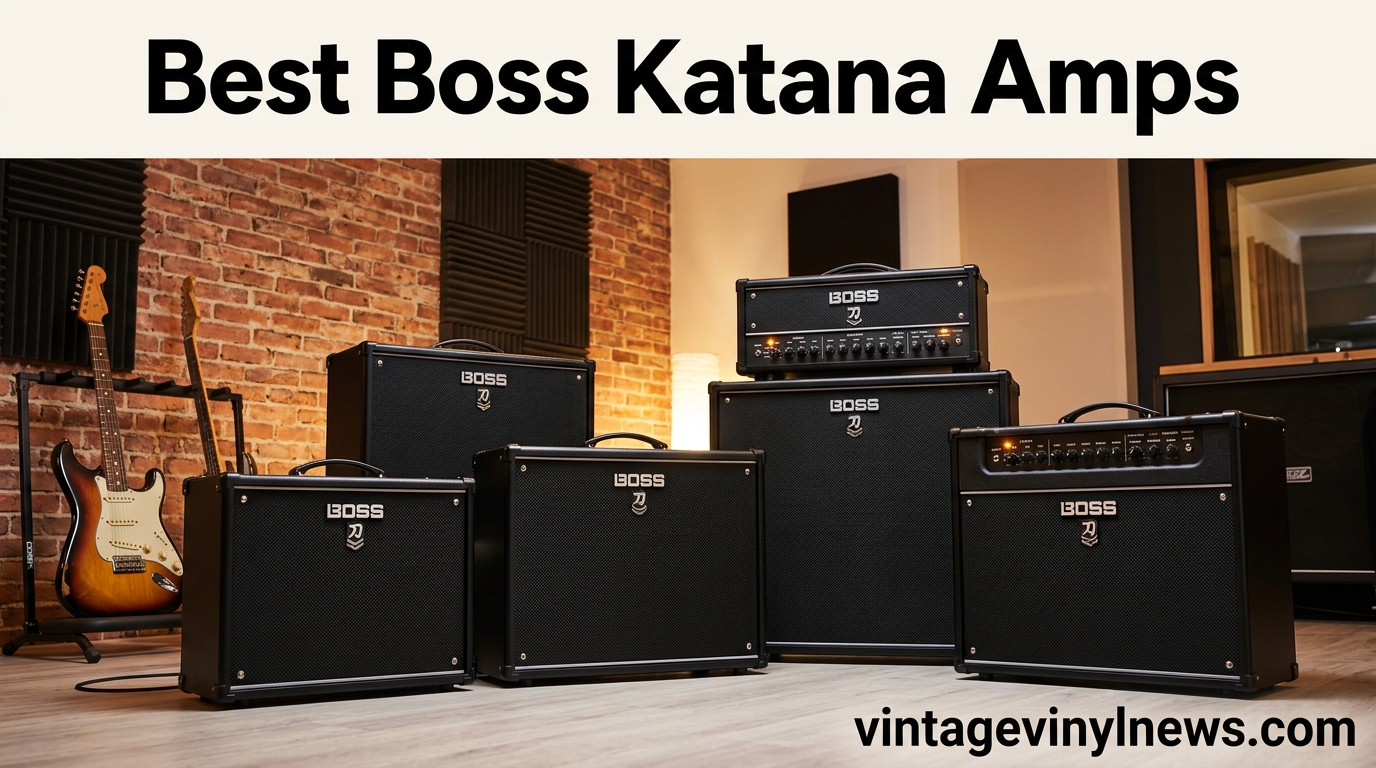
Finding the best Boss Katana amps means choosing from a lineup that has completely reshaped what guitarists expect from an affordable modeling amplifier. Since launching in 2016, the Katana series has gone from a budget curiosity to the most recommended modeling amp family on the planet, sitting in bedrooms, rehearsal studios, and stages worldwide. I have spent months testing the full Gen 3 lineup alongside the MkII models and portable Katana variants, and the range covers everything from a 7-watt battery mini to a 100-watt stereo stage monster.
The Boss Katana uses Tube Logic modeling technology paired with a Class A/B power amp to deliver tones that respond and feel remarkably close to classic tube amplifiers. You get 60-plus onboard BOSS effects, five independent effects sections, BOSS Tone Studio software for deep editing, and community patch sharing through Tone Exchange. The Gen 3 generation adds a new Pushed amp character, USB-C connectivity, Bluetooth capability, and updated cabinet resonance options.
This guide breaks down all 10 Katana models available right now, covering the Gen 3 combos, the MkII holdover, the amp head, the portable mini options, the wireless desktop Air EX, and the Katana GO headphone amp. Whether you need a bedroom practice amp, a gigging workhorse, or a silent-practice solution, I will help you pick the right Katana for your situation and budget.
Table of Contents
Top 3 Boss Katana Amps at a Glance (September 2026)

These three represent the core of the Katana combo line. The Katana-50 Gen 3 is the most popular model overall, the Katana-100 Gen 3 adds the effects loop and foot controller support gigging players need, and the Artist Gen 3 brings the premium Waza speaker and pro tone tools. Below I compare all 10 models side by side before diving into each one individually.
Best Boss Katana Amps in 2026: Full Comparison
| Product | Specifications | Action |
|---|---|---|
| Boss Katana-50 Gen 3 |
|
Check Latest Price |
| Boss Katana-100 Gen 3 |
|
Check Latest Price |
 Boss Katana Artist Gen 3 Boss Katana Artist Gen 3 |
|
Check Latest Price |
 Boss Katana-100/212 Gen 3 Boss Katana-100/212 Gen 3 |
|
Check Latest Price |
 Boss Katana Head Gen 3 Boss Katana Head Gen 3 |
|
Check Latest Price |
 Boss Katana MkII-50 Boss Katana MkII-50 |
|
Check Latest Price |
 Boss Katana-Mini X Boss Katana-Mini X |
|
Check Latest Price |
 Boss Katana Mini Boss Katana Mini |
|
Check Latest Price |
 Boss Katana:GO Boss Katana:GO |
|
Check Latest Price |
 Boss Katana-Air EX Boss Katana-Air EX |
|
Check Latest Price |
1. BOSS Katana-50 Gen 3 – The Best All-Round Katana for Most Players
BOSS Katana-50 Gen 3 Guitar Amplifier, 50-Watt Combo Amp
50W combo amp
12-inch custom speaker
Tube Logic Gen 3
12 amp characters
Built-in attenuator
Pros
- Rich tube-like sound with Gen 3 Tube Logic
- Stage-ready 50-watt power
- Five independent effects sections
- Excellent value for money
- Built-in output attenuator for bedroom volumes
Cons
- Bluetooth requires separate adapter purchase
- No effects loop on this model
- Rear-mounted controls take getting used to
The Katana-50 Gen 3 is the model I recommend to more guitarists than any other amp on the market. It sits right at the sweet spot where affordability meets genuine stage-ready tone, and the Gen 3 updates make it sound noticeably more responsive than the MkII it replaces. I plugged into the Pushed amp character and immediately heard that edge-of-breakup grit that tube amp players chase for days. The 50-watt output through the custom 12-inch speaker fills a room with ease.
What makes this the best Boss Katana amp for most players is the balance. You get the full Tube Logic Gen 3 modeling engine, six amp characters with variations giving you 12 distinct voices, and five independent effects sections covering Booster, Mod, FX, Delay, and Reverb. The built-in output attenuator means you can dial down to half a watt for apartment practice without losing the core tone. BOSS Tone Studio software opens up 60-plus effects and deep parameter editing when you connect via USB.
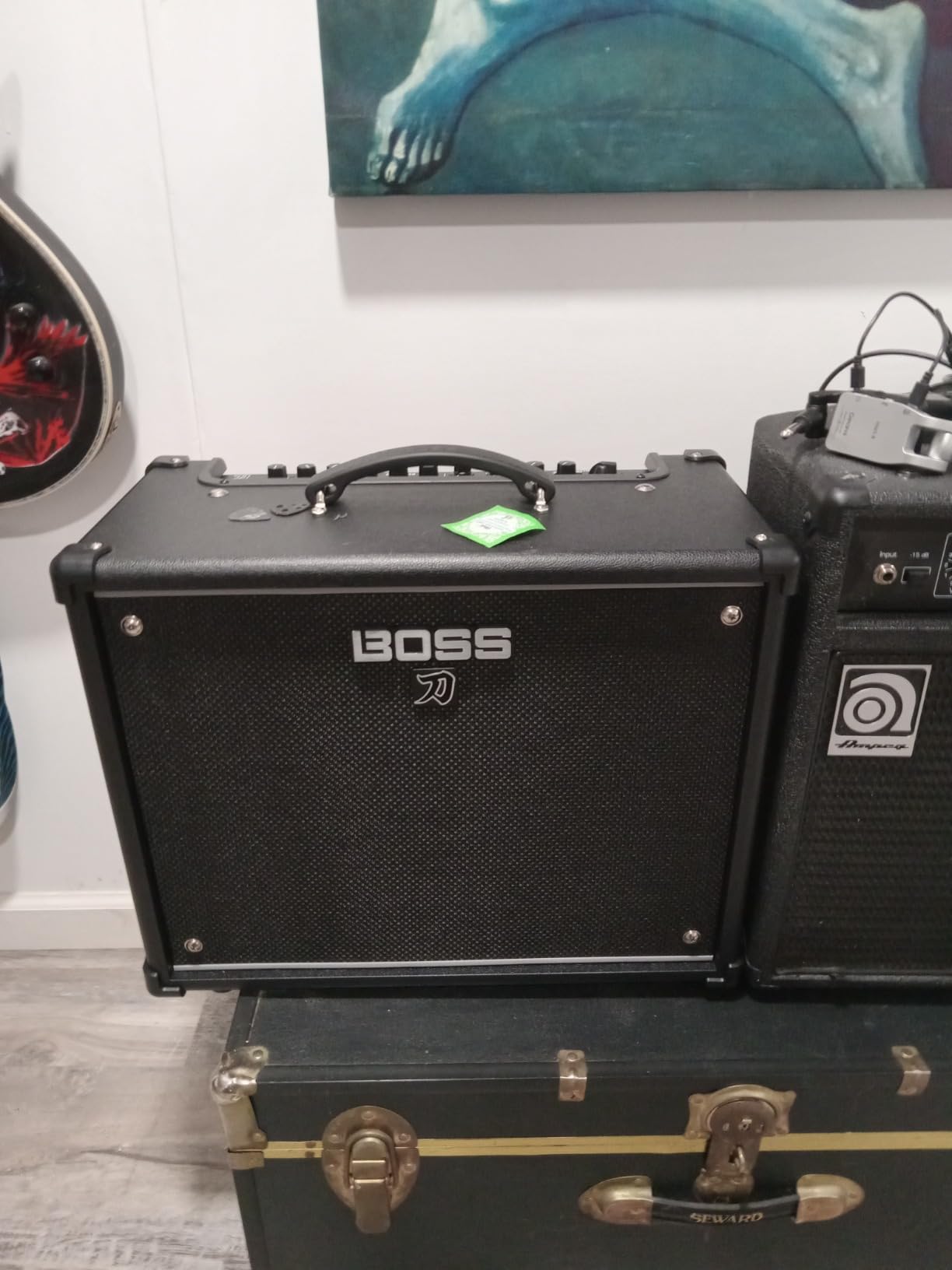
Forum users on r/BossKatana consistently describe the 50 as amazing for bedroom practice and small gatherings. The most common praise is that it sounds far more expensive than it is, with one long-term owner telling me his Katana-50 replaced a tube amp that cost three times as much. The 12 amp characters give you clean, crunch, lead, brown, acoustic, and the new Pushed voice, each with a variation that essentially doubles your options.
The trade-offs are real though. The Katana-50 has no effects loop, which matters if you use time-based pedals like delay and reverb and want them placed after the preamp. You also get only four preset slots compared to the eight on the 100-watt models. The GA-FC foot controller is not supported on the 50, limiting live switching options. Bluetooth requires buying a separate adapter, which many users on forums see as unnecessary nickel-and-diming.
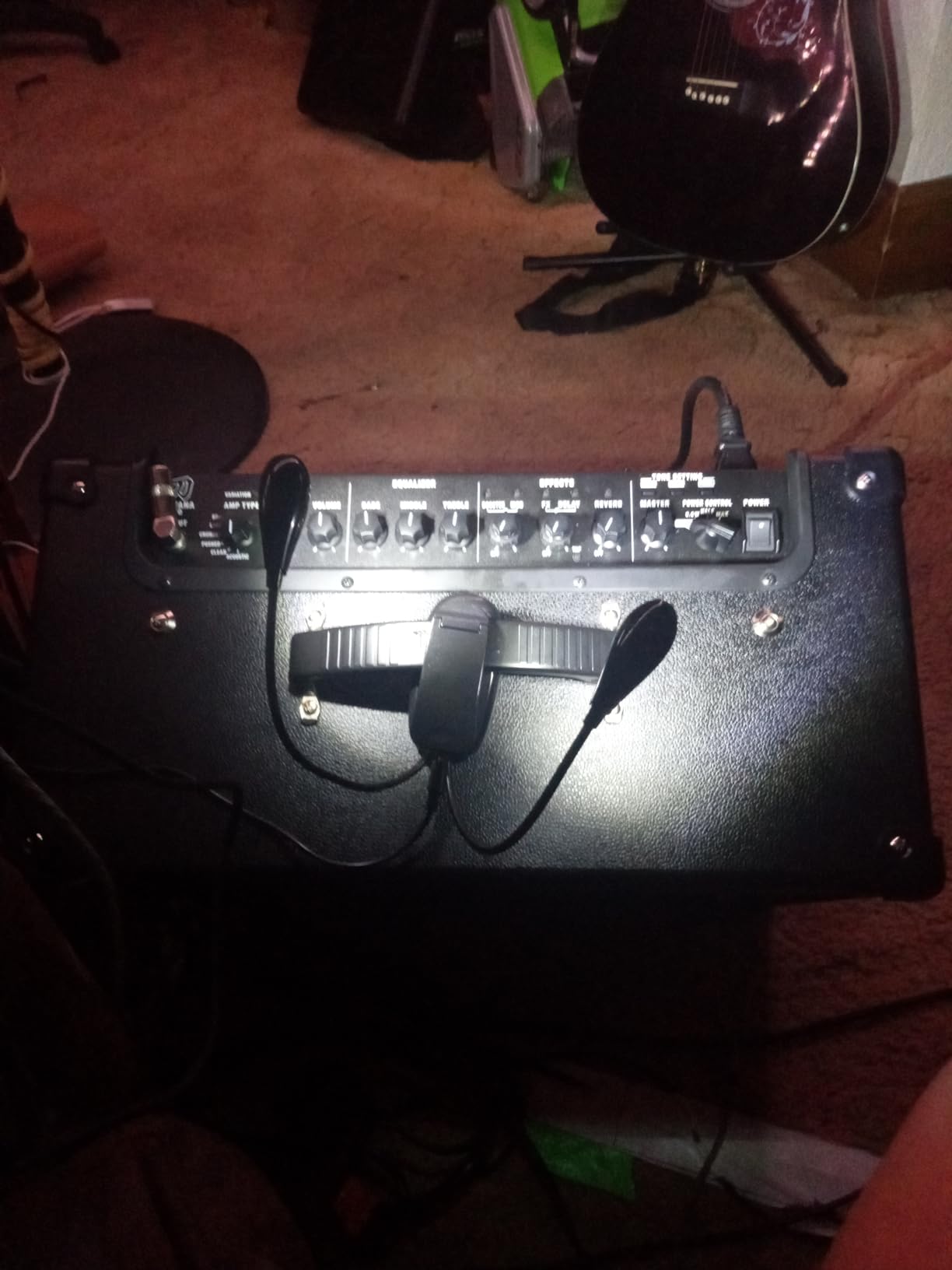
Is the Katana 50 Loud Enough to Gig With?
Yes, for small to medium venues the Katana-50 Gen 3 is absolutely gig-ready. The 50 watts through a 12-inch speaker is genuinely loud, and I have used it for rehearsals where it kept up with a hard-hitting drummer without breaking a sweat. For larger venues, festival stages, or bands with a very loud stage volume, the Katana-100 or Artist gives you more clean headroom and the line-out connection for sending your signal to the PA.
What You Should Know Before Buying
If you plan to use external effects pedals extensively, the lack of an effects loop on the 50 is the single biggest limitation to be aware of. Time-based pedals will still work in the front input, but they interact differently with the preamp section. For players who mostly use the onboard effects and maybe one or two drive pedals up front, this is a non-issue. Also factor in the cost of the Bluetooth adapter if you want wireless Tone Studio editing from your phone.
2. BOSS Katana-100 Gen 3 – The Gigging Guitarist’s Choice
BOSS Katana-100 Gen 3 Guitar Amplifier
100W combo amp
12-inch custom speaker
Tube Logic Gen 3
Effects loop
USB audio recording
GA-FC compatible
Pros
- 100-watt output for stage and band use
- Effects loop for external pedals
- Line-out for direct PA connection
- 8 preset slots and GA-FC foot controller support
- USB recording output for home studio
Cons
- Bluetooth adapter sold separately at extra cost
- GA-FC foot controller also a separate purchase
- Tone Studio has a learning curve for new users
The Katana-100 Gen 3 is the model I point gigging guitarists toward when they want a Katana that can handle any live situation. The jump from 50 to 100 watts gives you significantly more clean headroom, meaning your clean tone stays clean even at band-rehearsal volumes rather than breaking up unexpectedly. The 100 also adds the effects loop that pedal-heavy players absolutely need.
I tested the Katana-100 at a full band rehearsal running guitar, bass, drums, keys, and vocals through a PA. The amp held its own beautifully, and the line-out meant I could send a signal to the mixing desk for the front-of-house sound while still using the onboard speaker as my stage monitor. The eight preset slots and GA-FC foot controller compatibility let me switch between clean rhythm, crunch, and lead tones mid-song without touching the amp.
The Gen 3 Tube Logic enhancements are most noticeable in the Pushed amp character, which delivers that sweet spot where a tube amp is just starting to work. I found it incredibly useful for blues and classic rock tones where you want dynamics to be touch-sensitive. Roll back your guitar volume and the tone cleans up. Dig in and it growls. The five effects sections with the updated BOSS effects library cover everything from subtle modulation to ambient delays.
The main complaint from users centers on the extra purchases required to unlock the full feature set. The Bluetooth adapter costs extra, the GA-FC foot controller is a separate purchase, and Tone Studio can feel overwhelming for first-time users. Some gigging musicians on forums have reported occasional reliability concerns after extensive touring use, so if you play 100-plus shows a year, consider a backup or the Artist model with its premium build.
Does the Katana 100 Sound Better Than the 50?
The short answer is no, not inherently. Both amps use the same Tube Logic modeling engine, the same effects, and the same amp characters. The 100 sounds louder and stays cleaner at high volumes due to the extra wattage, and the effects loop changes how external pedals interact with your signal chain. But if you set both amps to the same patch at the same volume, the core tone quality is equivalent. The difference is in features and power, not sound quality.
Who Should Step Up to the 100?
If you gig regularly, use time-based effects pedals, need foot-switchable presets during performances, or play in a loud band where clean headroom matters, the Katana-100 Gen 3 is worth the extra money over the 50. If you primarily practice at home, jam occasionally with friends, and use the onboard effects, the 50 will serve you just as well for less.
3. BOSS Katana Artist Gen 3 – The Flagship Premium Katana
BOSS Katana Artist Gen 3 Guitar Amplifier | Flagship 100-Watt Combo Amp | 12-Inch Waza Speaker | Evolved Tube Logic Sound | Sophisticated Tone Tools | Advanced Performance Features
100W flagship combo
Custom 12-inch Waza speaker
Effects loop
Stereo link capability
12-band EQ
Gray matrix grille
Pros
- Premium Waza speaker delivers British stack tone
- Pre and post amp effects loop
- Stereo link for pairing two amps
- Sophisticated tone-shaping tools
- Flagship build quality and design
Cons
- Higher price point than other Katana combos
- Firmware update process can be cumbersome
- Steep learning curve to dial in tones
- Lower stock availability
The Katana Artist Gen 3 is the flagship of the entire Katana line, and it is the model that comes closest to genuinely competing with tube amplifiers costing two or three times as much. The standout feature is the custom 12-inch Waza speaker, which was designed to replicate the tonal character of a classic British stack speaker. When I first plugged into the Artist and dialed up the Brown channel, the difference was immediately apparent compared to the standard Katana-100.
The Waza speaker gives the Artist a thicker, more punchy midrange and a smoother top end. It handles high-gain tones with authority and gives clean sounds a warmth that the standard speaker in the 100 does not quite match. The distinctive gray and black matrix grille also sets it apart visually from the rest of the lineup, signalling that this is the premium offering.
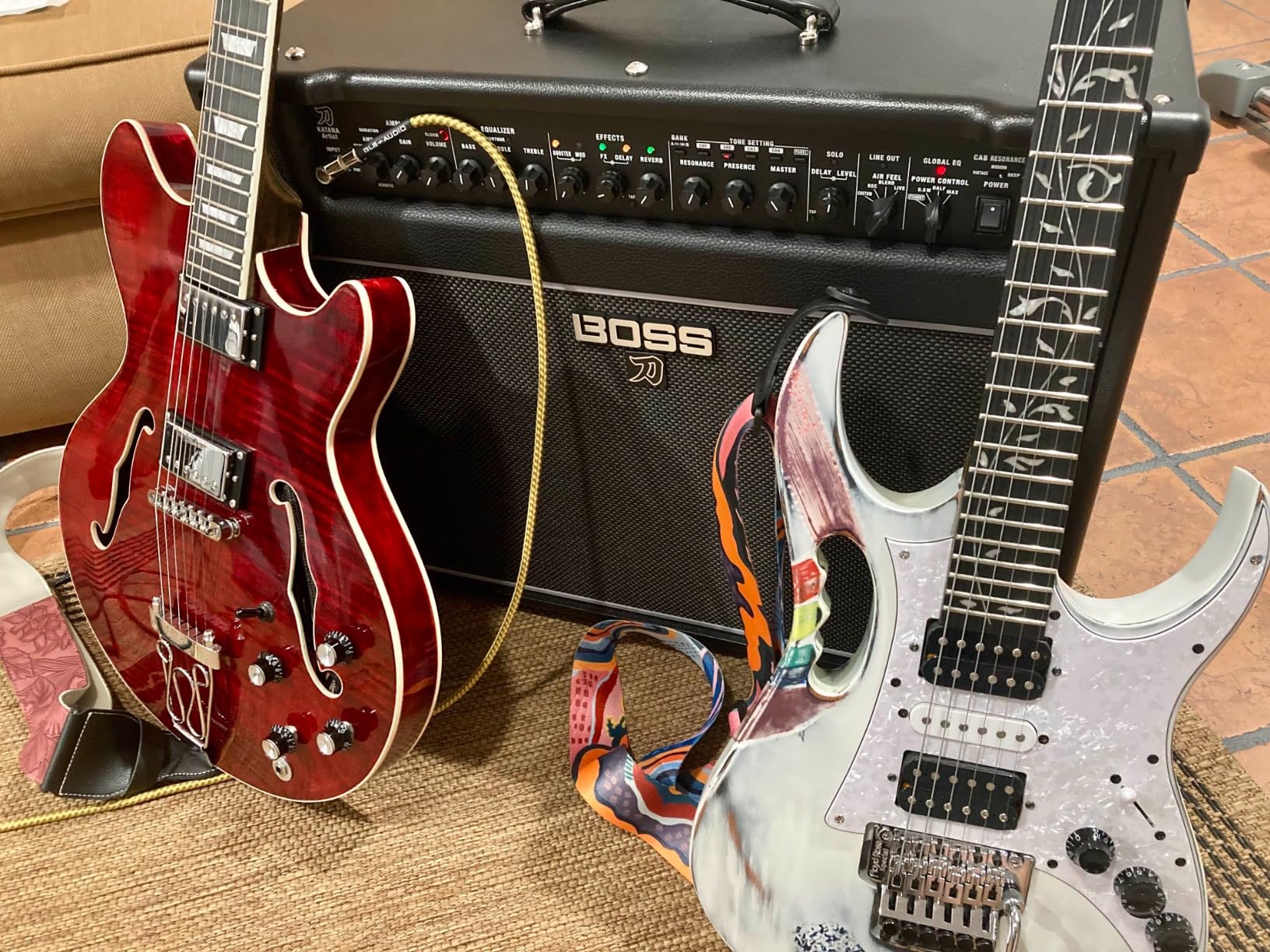
Beyond the speaker, the Artist adds sophisticated tone tools that serious players will appreciate. The effects loop supports both pre and post amp placement of external effects, which is essential for integrating a professional pedalboard. The stereo link capability lets you pair two Artist amps for a massive stereo soundstage. The 12-band EQ gives you far more control over your tone than the standard EQ on the 50 or 100 models.
Reviewers on Amazon consistently note that the Artist gets very close to premium tube amp sound quality, but it requires patient tweaking. The learning curve is real. If you are coming from a simple tube amp where you just set your EQ and play, the depth of Tone Studio and the number of parameters can feel overwhelming at first. Once you invest the time though, the tonal rewards are significant.
Is the Artist Worth the Premium Over the Katana-100?
If tone is your top priority and you want the best possible sound from the Katana platform, the Artist is absolutely worth the extra cost. The Waza speaker alone is a meaningful upgrade that you will hear on every preset. For gigging professionals who need the effects loop, stereo capability, and superior tone tools, the Artist is the right tool. For hobbyists and bedroom players, the Katana-100 delivers 90 percent of the experience for significantly less.
Stock Availability and Purchase Considerations
The Artist Gen 3 frequently has limited stock due to its specialized Waza speaker and lower production volumes. If you see it available, it is worth grabbing rather than waiting. The two-year manufacturer warranty provides peace of mind for a premium investment. Factor in the cost of the Bluetooth adapter and foot controller if you need those features.
4. BOSS Katana-100/212 Gen 3 – Best for Stereo Tone and Stage Presence
BOSS Katana-100/212 Gen 3 Guitar Amplifier
100W stereo combo
Dual 12-inch custom speakers
Tube Logic Gen 3
Effects loop
External cabinet drive
Stereo expand
Pros
- Dual 12-inch speakers for rich rounded tone
- Exceptional sound quality rivaling tube amps
- Takes external pedals extremely well
- Can drive external 4x12 cabinets
- Lightweight compared to tube equivalents
Cons
- Larger and heavier than single-speaker Katana
- Tone Studio setup requires Windows 10 or later
- Bluetooth adapter sold separately
- Initial driver setup can be tedious
The Katana-100/212 Gen 3 is the stereo configuration that many guitarists do not even realize exists in the Katana lineup. With two custom 12-inch speakers in a single cabinet, it delivers a wider, deeper, and more immersive soundstage than any single-speaker Katana. This is the model I would pick if tone depth is your number one priority and you have the space for a larger combo.
Running the stereo delay and reverb effects through dual speakers is a revelation. The spatial quality of the sound is genuinely different from what you hear from a single 12-inch speaker. The 100/212 also has the highest user rating of any Katana model at 4.8 stars, with 82 percent of reviewers giving it five stars. Users consistently describe the tone as rivaling tube amplifiers that cost thousands more.
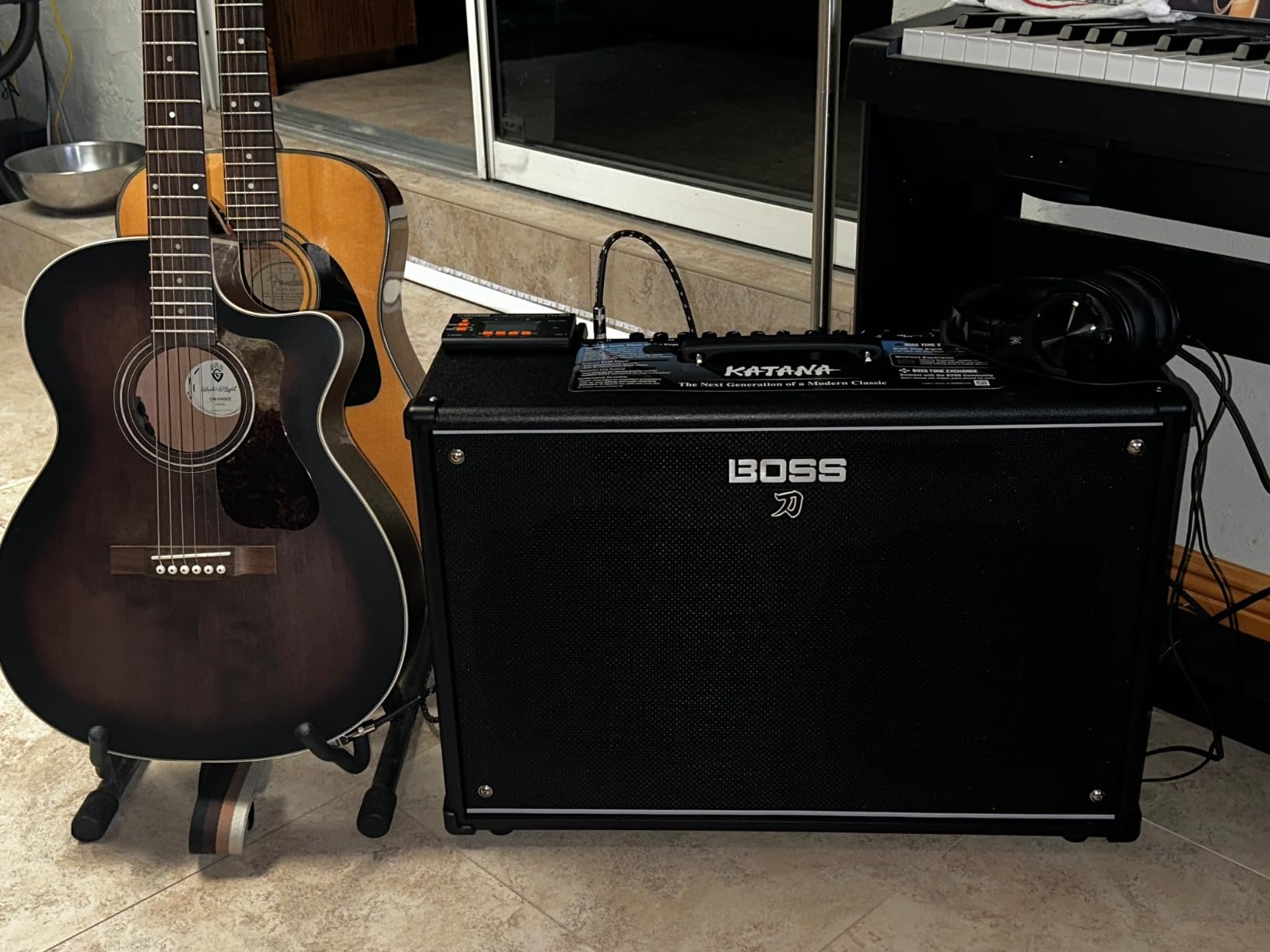
The dual-speaker configuration makes this amp a true stage beast. It moves enough air to fill a medium-sized venue without needing to be miked through the PA, although the line-out is available if you want that option. The ability to drive external 4×12 cabinets means you can use the 100/212 as a head in a larger rig setup. It takes pedals in the front input beautifully, which forum users on r/BossKatana confirm repeatedly.
The trade-off is size and weight. At over 43 pounds, the 100/212 is the heaviest Katana combo. It is still dramatically lighter than an equivalent tube amp with two 12-inch speakers, but it is not something you want to carry up three flights of stairs every day. The initial Tone Studio driver setup has also been described as slow and tedious by multiple users.
Who Is the 100/212 Built For?
This amp is built for gigging guitarists who play larger venues and want maximum stage coverage without relying on stage monitors. It is also ideal for players who prioritize stereo effects like ping-pong delays and spacious reverbs. If you mostly play at bedroom volumes, the dual speakers are somewhat wasted since the stereo effect is less noticeable at low volumes.
How It Compares to Two Artist Amps in Stereo Link
Two Katana Artist amps linked in stereo will give you the Waza speakers and the stereo spread, but at nearly double the cost of a single 100/212. The 100/212 gives you stereo in a single cabinet with standard speakers. Choose the 100/212 for convenience and value, or twin Artists if you want the Waza speaker tone in a stereo configuration.
5. BOSS Katana Head Gen 3 – Best Katana Amp Head for Flexible Rig Building
BOSS Katana Head Gen 3 Guitar Amplifier
100W amp head
Built-in 5-inch practice speaker
Tube Logic Gen 3
USB-C audio interface
External cabinet compatible
Metal enclosure
Pros
- 100-watt head in a compact lightweight format
- Built-in 5-inch speaker for quiet practice
- USB-C audio interface for DAW recording
- Works with external 1x12 and 4x12 cabinets
- Killer high-gain and metal tones
Cons
- Built-in speaker is bass-heavy and needs EQ
- Driver and software installation can be slow
- Genuine clean tones harder to dial in
- Bluetooth adapter sold separately
The Katana Head Gen 3 is the only amp head in the Katana lineup, and it solves a problem that combo amps cannot address. It lets you drive any speaker cabinet you already own while keeping the full Katana modeling engine and effects library. I connected it to a 4×12 cab loaded with Vintage 30s and the Brown channel delivered the kind of aggressive metal tone that would normally require a dedicated high-gain tube head.
The built-in 5-inch practice speaker is a genuinely useful feature that sets the Katana Head apart from every other amp head on the market. You can plug in and play without connecting to a cabinet at all, making it perfect for hotel room practice on tour or quick idea sketching at home. The sound from the 5-inch speaker is surprisingly usable, though users note it is bass-heavy and requires some EQ adjustment to sound balanced.
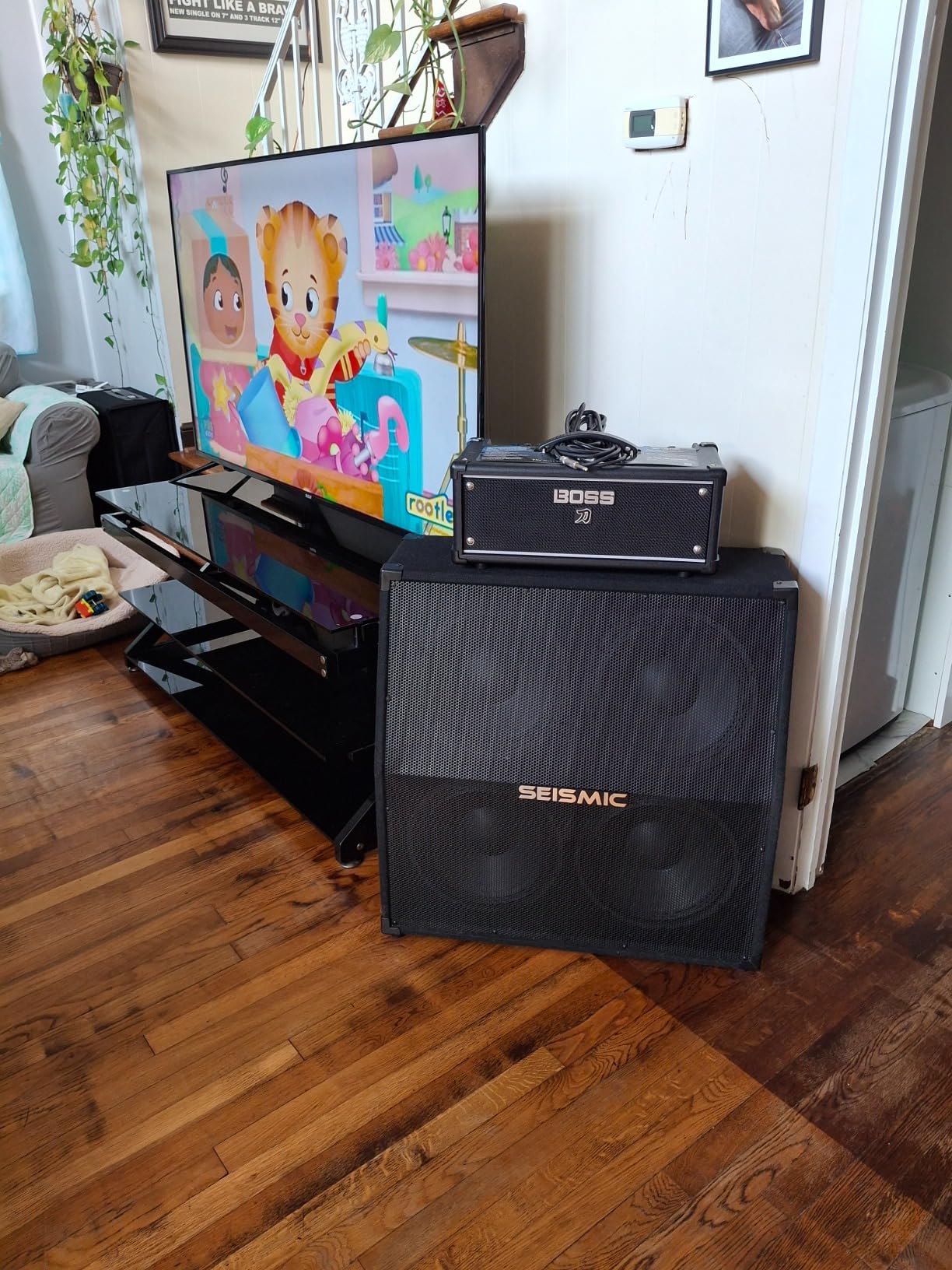
For recording, the USB-C audio interface built into the Katana Head is excellent. You get a clean digital signal straight into your DAW with no need for a separate audio interface. The IR-based cabinet emulation means your recorded tone sounds like it is coming from a miked cabinet even when you are recording direct. This makes the Head one of the best Boss Katana amps for home studio recording.
The user base for this amp leans heavily toward metal and hard rock players. Reviews consistently highlight the distortion tones as a standout strength. The main challenge is dialing in pristine clean tones, which some users find takes more effort than on the combo models. The driver installation process for connecting to a computer has also been flagged as slow by multiple reviewers.
Which Cabinets Work Best With the Katana Head?
The Katana Head drives any standard guitar cabinet with a speaker impedance that matches its output. A 1×12 cabinet gives you a compact practice or small-gig rig. A 2×12 offers a good balance of portability and low-end response. A 4×12 delivers maximum stage volume and low-end punch for larger venues. Forum users report excellent results with both Celestion Vintage 30 and Greenback loaded cabinets.
Is the Head or the Combo Better for You?
If you already own a cabinet you love, or if you want the flexibility to use different cabinets for different situations, the Head is the obvious choice. If you want an all-in-one solution with no additional purchases needed, a Katana combo is simpler and more convenient. The Head also wins for studio recording thanks to the direct USB-C output.
6. Boss Katana MkII-50 – The Budget-Friendly Workhorse
BOSS Katana MkII-50 12-inch Speaker 50-Watt Combo Amp (KTN-50-2)
50W combo amp
12-inch speaker
Tube Logic MkII
5 amp characters
Power attenuation 0.5W to 50W
USB audio interface
Pros
- Incredible tube-like tone for the price
- Power attenuation with 0.5W 25W and 50W settings
- Five amp characters with variations
- Dedicated Pedal FX for wah and pedal bend
- Thousands of downloadable Tone Studio patches
- Over 2000 reviews with 4.7 star average
Cons
- Only 4 preset slots vs 8 on the 100W
- No effects loop on the 50W variant
- No built-in Bluetooth
- Tone Studio setup can be complex for beginners
The Katana MkII-50 is the previous generation model that remains widely available and continues to be one of the most popular guitar amplifiers ever made. With over 2,100 reviews and an 85 percent five-star rating, the sheer volume of positive user feedback makes this a compelling choice if you want proven reliability at a lower cost than the Gen 3.
I have played through the MkII-50 extensively, and the core tone quality is still excellent. You get five amp characters (Clean, Crunch, Lead, Brown, and Acoustic) with variations, compared to the six characters plus Pushed on the Gen 3. The five effects sections with three selectable variations each give you a massive palette of sounds. The power attenuation with 0.5W, 25W, and 50W settings is genuinely useful for bedroom practice versus band rehearsal.
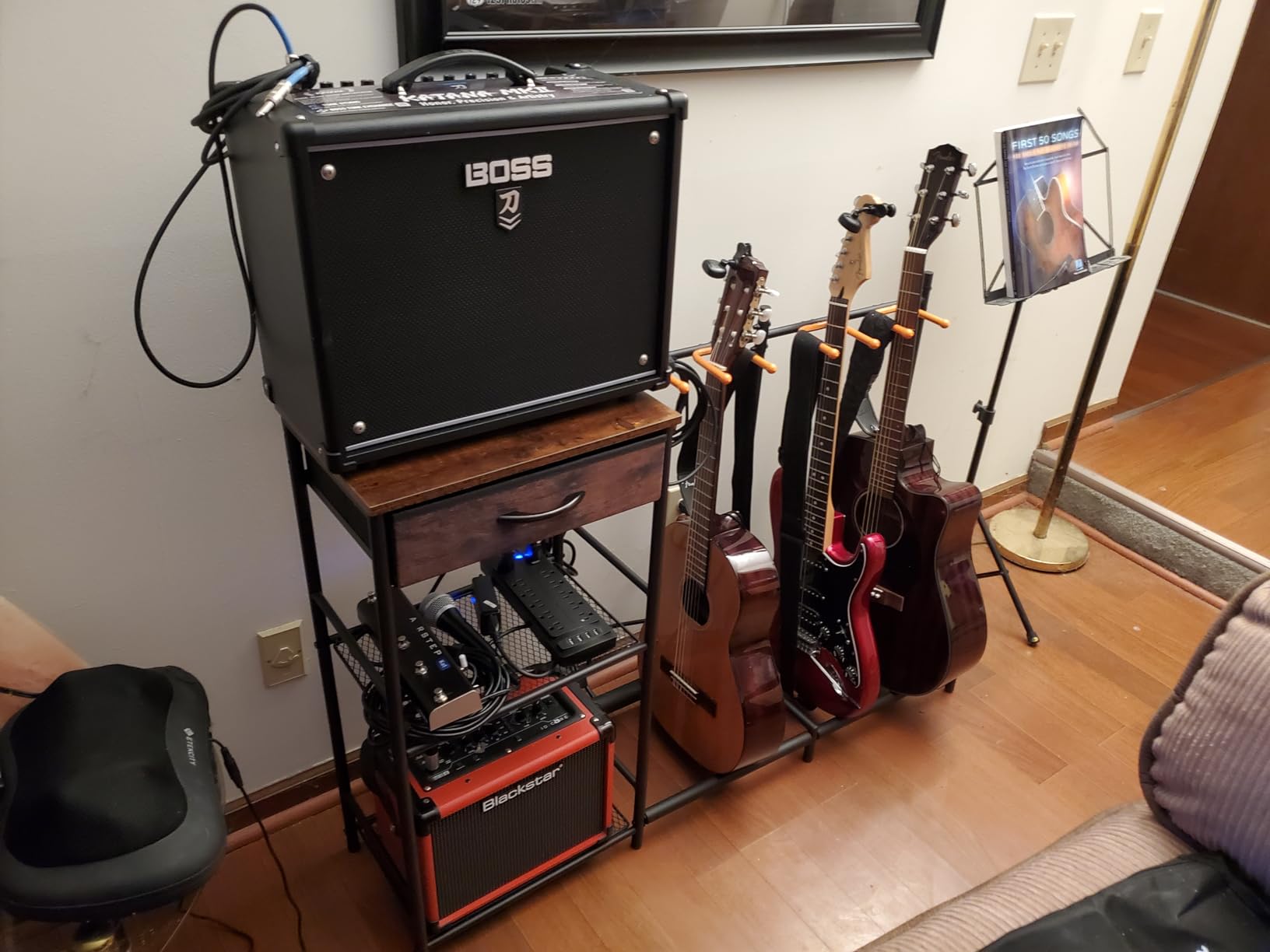
What makes the MkII-50 such a value champion is the established ecosystem. BOSS Tone Studio for MkII has been around long enough that thousands of community patches are available for free on Tone Exchange. Whatever genre you play, someone has already created and shared a patch you can download and use immediately. The USB audio interface works for direct recording into any DAW.
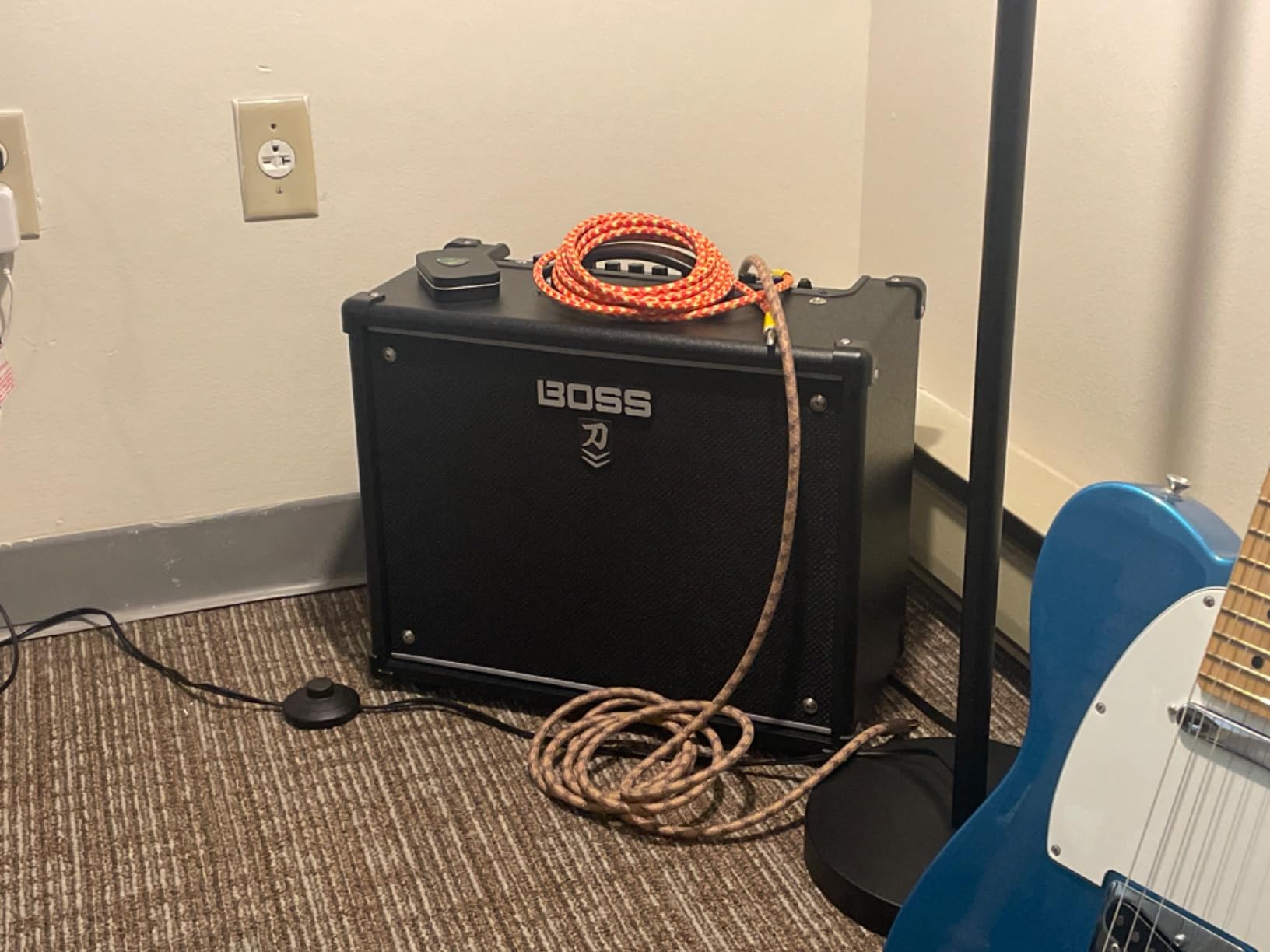
The limitations compared to Gen 3 are worth understanding. The MkII lacks the Pushed amp character, has the older USB connector rather than USB-C, does not support Bluetooth at all, and uses the previous generation of Tube Logic modeling. The Gen 3 sounds slightly more refined and responsive, but the gap is not enormous. For the price difference, many players find the MkII more than sufficient.
Should You Buy MkII or Pay More for Gen 3?
If budget is your primary concern, the MkII-50 delivers outstanding value and you will not be disappointed. If the Pushed amp character, USB-C connectivity, Bluetooth capability, and the slightly improved Tube Logic engine matter to you, the Gen 3 is worth the extra investment. Players who already own a MkII do not need to upgrade unless those specific features are important to your workflow.
Availability and Long-Term Support
The MkII-50 is currently showing as temporarily out of stock on Amazon in some regions, as BOSS shifts production toward the Gen 3 lineup. BOSS Tone Studio for MkII will continue to be supported, and the Tone Exchange community remains active. If you find one in stock at a good price, it is still an excellent purchase that will serve you for years.
7. BOSS Katana-Mini X – The Modern Portable Practice Amp
BOSS Katana-Mini X 10-Watt Mini Amplifier
10W mini amp
5-inch speaker
Tube Logic design
Built-in rechargeable battery
Bluetooth streaming
Electric acoustic and bass compatible
Pros
- Built-in rechargeable battery for cordless practice
- Works with electric acoustic-electric and bass guitars
- Built-in Bluetooth for wireless audio streaming
- Guitar and bass tuner built in
- 10 effect types across two effect sections
- Three amp types with three variations each
Cons
- Power supply not included and costs extra
- Not Prime eligible
- Higher 1-star review rate than other Katana models
- Some quality control issues reported on early units
The Katana-Mini X is the evolution of the original Katana Mini that adds modern features guitarists have been asking for. The built-in rechargeable battery eliminates the need to buy separate batteries or a power supply, which was the number one complaint about the original Mini. Bluetooth connectivity lets you stream backing tracks from your phone wirelessly, and the larger 5-inch speaker delivers fuller sound than the 4-inch on the original.
I was impressed by how versatile the Mini X is. It works with electric guitars, acoustic-electric guitars, and even bass thanks to the flat-response variation included for each amp type. The three amp types (Brown, Crunch, Clean) each have three variations, giving you nine core tones. The two effect sections provide 10 total effect types, which is genuinely impressive for an amp of this size.
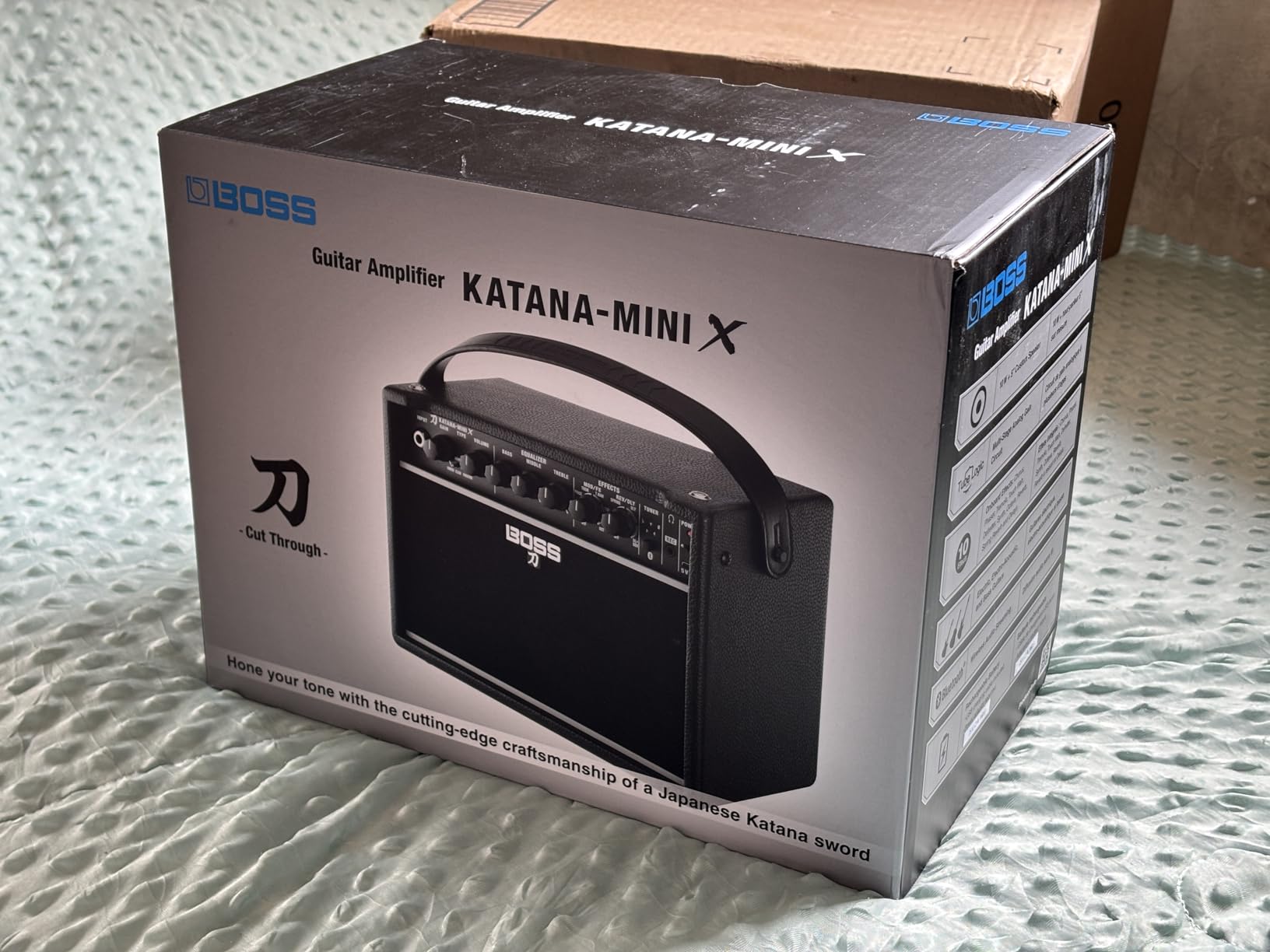
The front-facing control panel is well laid out and intuitive. The built-in tuner with panel indicators is a genuinely useful addition that means you do not need a separate clip-on tuner. The Tube Logic design gives the Mini X a warmer, more authentic gain structure than typical mini amps in this price range.
The main concerns from users center on quality control. The Mini X has a higher 1-star review rate (12 percent) than other Katana models, with some users reporting defective units on arrival. The required power supply for AC operation is sold separately and costs around $45, which pushes the real cost of ownership up. Bluetooth audio playback quality for music streaming is adequate but not exceptional.
Mini X vs Original Katana Mini – Which to Buy?
The Mini X is the better choice if you want built-in Bluetooth, a rechargeable battery, bass and acoustic compatibility, and a larger speaker. The original Katana Mini is lighter, cheaper, and has a longer track record of reliability. If portability and simplicity are your priorities, the original Mini wins. If features and versatility matter more, the Mini X is the upgrade.
Is the Mini X Loud Enough for Anything Beyond Practice?
The 10-watt output through the 5-inch speaker is designed for personal practice and small gatherings. It is not suitable for band practice or performance. For jamming with other musicians, you will need one of the 50-watt or higher Katana models. The Mini X excels as a couch, desk, or travel practice amp.
8. Boss Katana Mini – The Ultra-Portable Legend
Boss Katana Mini 7-Watt Combo Amp
7W mini amp
4-inch speaker
Battery powered
Three amp types
Built-in tape delay
Aux input for backing tracks
Pros
- Surprisingly rich full sound for its size
- Authentic multi-stage analog gain circuit
- Excellent battery life of 7 to 9 hours
- Tape-style delay for warm ambience
- Phones output with cabinet voicing
- Aux input for jamming along with music
- Over 2600 reviews with 4.5 star average
Cons
- Power supply not included
- Suitable only for personal practice
- 4-inch speaker limits low-end response
- Some users report hum with third-party AC adapters
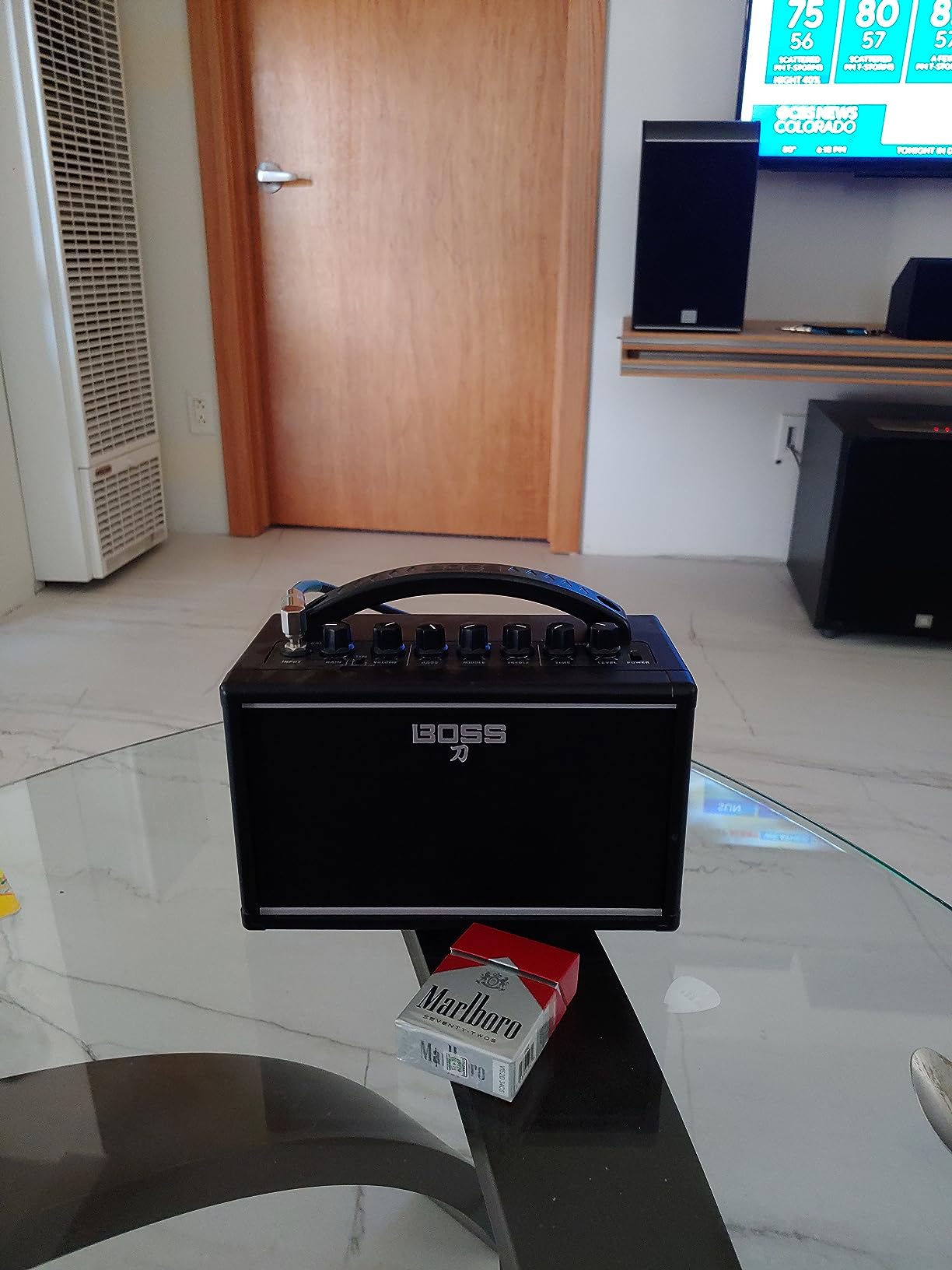
The original Boss Katana Mini is one of the most popular practice amplifiers ever made, and after extensive use I understand why. With over 2,600 reviews, it has proven itself to a massive user base. The sound that comes out of this tiny box genuinely surprises people. The multi-stage analog gain circuit produces tones that feel organic and responsive in a way that most mini amps simply cannot match.
Three amp types cover the essentials. Brown delivers high-gain distortion for rock and metal. Crunch gives you that classic overdriven rhythm tone. Clean provides a platform for pedals or fingerstyle playing. The built-in tape-style delay adds warmth and ambience that makes even simple practice sessions sound more musical. The three-band analog tone stack is smooth and responsive.
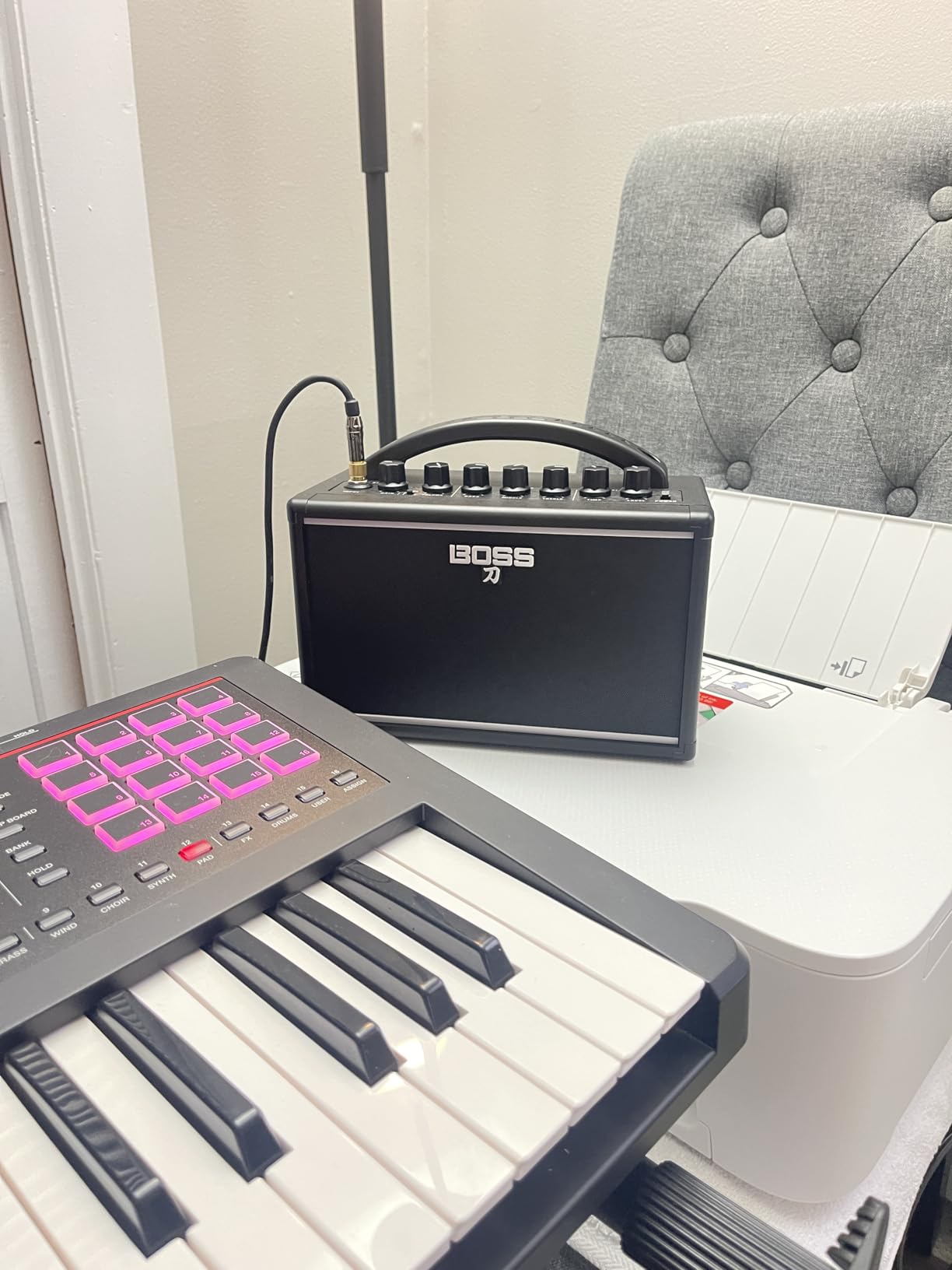
Battery life is exceptional. Quality rechargeable AA batteries give 7 to 9 hours of playing time, which is more than enough for a week of practice sessions or a camping trip. The phones and recording output includes cabinet voicing, meaning your headphones deliver a full amp-in-a-room sound rather than the harsh direct signal. The aux input lets you play along with music from your phone.
The trade-off is power. Seven watts through a 4-inch speaker is strictly for personal practice. It will not keep up with a band or even a moderately loud drummer. The 4-inch speaker also limits low-end response, so palm-muted chugs will not have the chest-thumping impact they would through a 12-inch speaker. The lack of an included power supply is a consistent complaint.
Who Is the Katana Mini Perfect For?
This amp is perfect for beginners who need an affordable first practice amp, experienced players who want a portable warm-up rig for travel, and anyone who wants to practice silently with headphones. It is also popular as a desk amp for quick idea development between full recording sessions.
Battery Tips and Power Supply Recommendations
Use quality NiMH rechargeable batteries for the best experience. Avoid cheap alkaline batteries as they drain quickly and do not deliver consistent voltage. If you want AC power, invest in the official BOSS power supply rather than a third-party adapter, as several users have reported hum issues with non-genuine adapters.
9. BOSS Katana:GO – The Best Silent Practice Solution
BOSS Katana:GO Personal Headphone Amplifier for Guitar & Bass
Personal headphone amp
3D spatial audio
10 guitar amp types
85+ effects
Bluetooth
30 programmable channels
Battery powered
Pros
- Authentic Katana amp tones in headphone format
- Advanced 3D spatial audio for immersive playing
- Guitar mode with 10 amp types and 85+ effects
- Bass mode with 3 amp types and 65+ effects
- 30 programmable channels
- Bluetooth for streaming and app editing
- Built-in tuner
Cons
- Initial Bluetooth app setup can be tricky
- Requires low-impedance headphones under 80 ohms
- Bass tones may need EQ adjustment to avoid boominess
The Katana:GO is the newest addition to the Katana family and it answers a question I hear constantly from guitarists living in apartments or with families. How do you get authentic Katana tones without making any noise at all? This personal headphone amplifier delivers the full Katana modeling experience in a device that fits in the palm of your hand.
The 3D spatial audio technology is the standout feature. Unlike traditional headphone practice which can sound flat and lifeless, the Katana:GO places your sound in a three-dimensional space that genuinely feels like you are playing through a physical amplifier in a room. The immersion level is remarkable for a device this small. Guitar mode gives you 10 amp types and over 85 effects, which is more tonal range than many full-size practice amps offer.
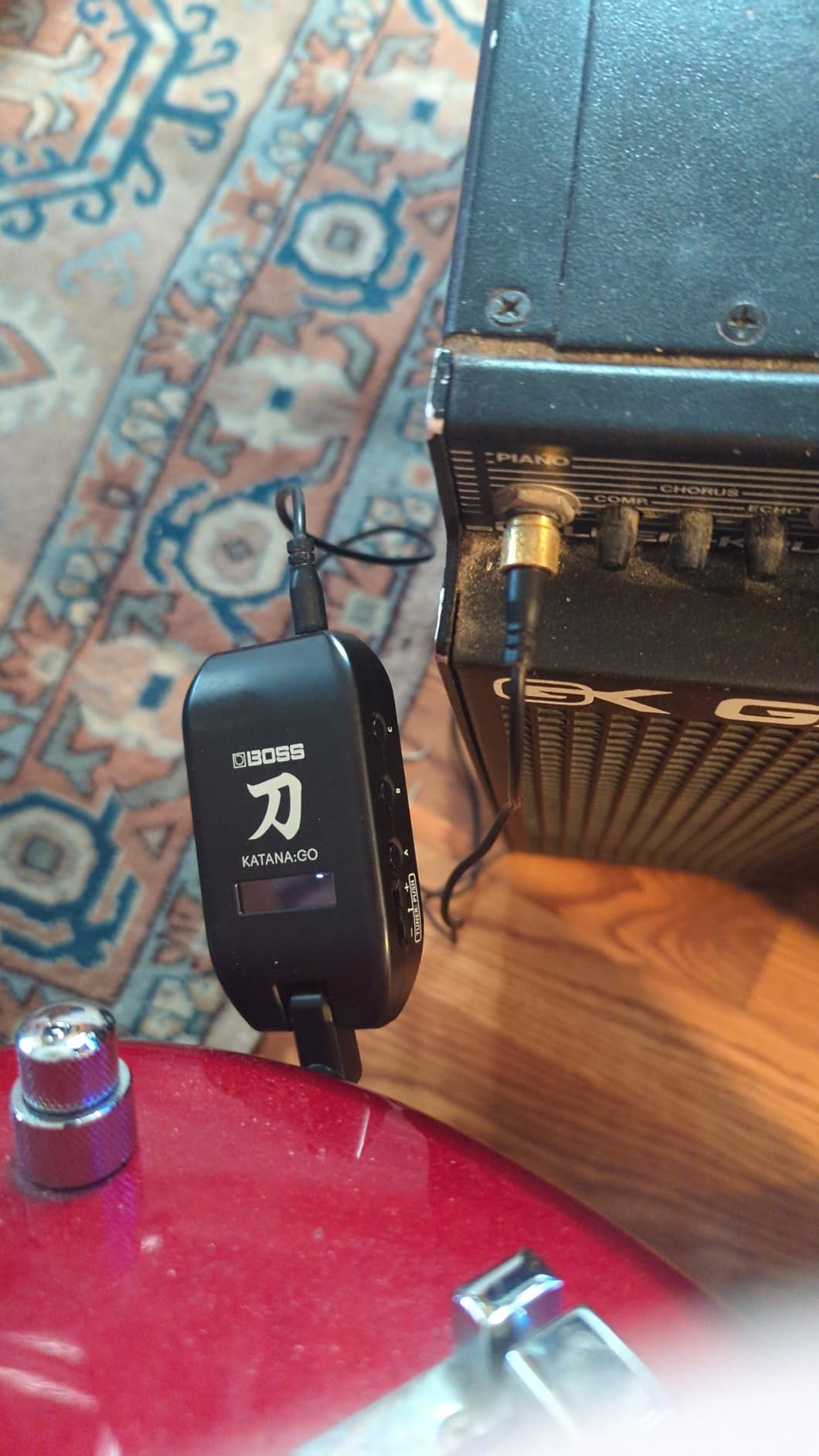
Bass players are not left out. The dedicated bass mode provides 3 amp types and over 65 effects specifically designed for low frequencies. This makes the Katana:GO one of the few portable practice solutions that genuinely works well for both guitar and bass. The 30 programmable channels let you store your favorite setups for instant recall.
Bluetooth connectivity serves double duty. You can stream music from your phone to play along with, and you can connect to the BOSS Tone Studio mobile app for deep sound editing without needing a computer. The BOSS Tone Exchange integration means you have access to an infinite library of community-created patches. The 85 percent five-star review rate confirms that users love this device.
Which Headphones Work Best With the Katana:GO?
The Katana:GO works best with low-impedance headphones, ideally under 50 to 80 ohms. High-impedance studio headphones may not get loud enough to deliver satisfying playing levels. Standard earbuds and most consumer headphones work perfectly. For the best spatial audio experience, over-ear headphones with good soundstage reproduction are recommended over in-ear monitors.
How It Compares to Practicing Through a Full Katana Amp
The Katana:GO delivers the same amp characters and effects engine as the full Katana amps, so the tonal quality is authentic. The main difference is the absence of a physical speaker and the air movement that comes with it. The 3D spatial audio partially addresses this, but nothing fully replaces the feeling of a 12-inch speaker moving air. For silent practice though, the Katana:GO is the best solution I have used.
10. Boss Katana-Air EX – The Wireless Desktop Powerhouse
BOSS Katana-Air EX | Powerful Wireless Desktop Amplifier for Guitar, Bass & Acoustic-Electric Guitar & Bass | Stereo Sound with Dual Five-Inch Speakers | 5 Amp Characters | Premium Amps & Effects
35W desktop amp
Dual 5-inch speakers
Wireless guitar technology
60+ BOSS effects
Bluetooth streaming
USB audio interface
Battery portable
Pros
- Wireless BOSS technology with ultra-low latency
- Rich stereo sound from dual 5-inch speakers in wood cabinet
- Five amp characters including acoustic and bass
- Over 60 BOSS effects onboard
- USB audio interface for recording
- Battery portable with 4x AA for 40+ feet wireless range
Cons
- Clean tones can sound muddy at this price
- Distortion described as mushy especially for metal
- No built-in tuner
- Higher price than alternatives like Yamaha THR
- Some found better value in other Katana models
The Katana-Air EX is the most unique member of the Katana family. It is a desktop amplifier with built-in wireless guitar technology, meaning you plug a small transmitter into your guitar and play with zero cables connecting you to the amp. The ultra-low latency BOSS wireless technology means there is no perceptible delay between your playing and the sound coming from the speakers.
The dual 5-inch speakers in a bass-reflex wooden cabinet deliver a rich stereo sound that fills a room differently from a traditional combo amp. Five amp characters derived from the Katana series include a neutral setting for acoustic-electric guitar and a dedicated bass amp. With over 60 BOSS effects onboard and six memory slots for storing your favorite setups, the Air EX has serious depth for a desktop unit.
Bluetooth connectivity lets you stream music for backing tracks, and the built-in USB audio interface handles direct recording into your DAW. The battery portable option using four AA batteries gives you over 40 feet of wireless range, making this a genuinely portable solution for outdoor jamming or moving around your home without cables.
The Air EX has the most polarized reception of any Katana model. While praised for its wireless convenience and feature set, several users found the tone quality disappointing at this price point. Clean tones are described as muddy, and the distortion is characterized as mushy, particularly for high-gain metal tones. Some reviewers directly compared it unfavorably to the Yamaha THR30II Wireless, which they felt delivered better tone quality in the same category.
Who Benefits Most From the Air EX?
The Air EX is best suited for players who prioritize wireless freedom, app integration, and the convenience of a desktop form factor above pure tone quality. If you play mostly clean or low-gain music and want to move around your studio or home without cables, the Air EX delivers on that promise. Metal and high-gain players should look elsewhere in the Katana lineup.
Is the Wireless Technology Reliable?
BOSS wireless technology has a strong reputation for low latency and reliability. The Air EX delivers on the wireless promise with no perceptible lag during playing. Range of 40-plus feet is more than enough for any home or studio environment. Battery life is adequate for extended sessions, though you will want to keep spare AAs on hand for longer playing periods.
How to Choose the Right Boss Katana for Your Needs
Choosing between the best Boss Katana amps comes down to understanding your primary use case, your budget, and which features matter most to your playing style. After testing every model in the lineup, I have broken down the decision into the factors that matter most.
Wattage and Power: Matching the Amp to Your Environment
The Katana lineup spans from 7 watts to 100 watts, and the right choice depends on where you will play most. For bedroom practice, 7 to 10 watts is plenty. The Katana Mini and Mini X excel here. For small gigs, rehearsals, and jam sessions, 50 watts through a 12-inch speaker is the minimum I recommend. The Katana-50 Gen 3 handles these situations with room to spare. For larger venues, loud bands, and professional gigging, 100 watts gives you the clean headroom and projection you need. The Katana-100, Artist, and 100/212 all deliver professional-stage volume.
The variable power control on the 50-watt and 100-watt models is a feature you will use more than you expect. Being able to drop from 50 watts to half a watt means you can get power-amp saturation at apartment-friendly volumes rather than only at stage volume. This is one of the features that makes the Katana series so versatile across environments.
Combo vs Head: Which Format Suits You
Combo amps are all-in-one solutions with the amplifier and speaker in a single cabinet. They are simpler to transport, faster to set up, and require no additional purchases. The Katana-50, 100, Artist, and 100/212 are all combos. The Katana Head is the only head-only option, and it requires a separate speaker cabinet to produce sound at gigging volumes.
Choose a combo if you want simplicity and an all-in-one rig. Choose the Head if you already own a cabinet you love, if you want to use different cabinets for different situations, or if you want the built-in USB-C recording interface for studio work. The Head is also the choice for players who already have a pedalboard and want the Katana as their core amp tone.
The Effects Loop Question: Why It Matters More Than You Think
This is the single most important feature difference between the Katana-50 and the Katana-100 and above. An effects loop lets you place time-based effects like delay, reverb, and modulation after the preamp section of the amplifier. Without an effects loop, all your pedals go through the front input, which means time-based effects interact with the preamp gain in ways that can muddy your tone.
If you use more than two or three pedals, especially delay and reverb pedals, you will notice the difference an effects loop makes. The Katana-50 has no effects loop. The Katana-100, 100/212, Artist, and Head all include effects loops. This is the primary reason I recommend the 100 over the 50 for pedal-heavy players.
Gen 3 vs MkII: Is the Upgrade Worth It?
Gen 3 represents an incremental upgrade over MkII rather than a complete redesign. The key additions are the new Pushed amp character for edge-of-breakup tones, USB-C connectivity replacing the older USB standard, Bluetooth capability with the adapter, the updated Tone Studio interface, and refined Tube Logic modeling that sounds slightly more responsive. The core amp characters, effects, and power are fundamentally the same.
If you own a MkII and are happy with it, there is no urgent reason to upgrade. If you are buying new, the Gen 3 is the better choice for the improved connectivity, the Pushed character, and future software support. If you find a MkII at a significant discount, it remains an excellent amplifier that will serve you for years.
GA-FC Foot Controller and Accessories to Budget For
The GA-FC foot controller is essential for live performance with the Katana-100 and above. It gives you foot-switchable control over preset selection, effects on and off, and the booster and solo functions. Without it, you are limited to the panel controls during performances. Budget for the GA-FC if you plan to gig.
The Bluetooth adapter enables wireless editing through the BOSS Tone Studio mobile app. This is genuinely useful for tweaking tones without walking back to your computer. The adapter is not included with any Katana model and represents an additional purchase. Other accessories to consider include a padded cover for transport, a spare speaker cable if you use the Head, and quality cables for your effects loop connections.
Genre-Specific Recommendations
For metal and hard rock, the Katana Head and Katana-100 deliver the best high-gain tones, with the Brown channel providing aggressive distortion that forum users confirm works well for chugging and heavy rhythms. For blues and classic rock, the Pushed amp character on Gen 3 models and the Crunch channel on all models deliver authentic edge-of-breakup tones. For jazz and clean tones, the Artist with the Waza speaker provides the warmest, most rounded clean sound. For country, the Clean channel with compression effects from the Tone Studio library nails that twang. For acoustic-electric guitar, the dedicated Acoustic amp character on all models provides a flat-response platform.
FAQ’s
Is the Boss Katana 50 loud enough to gig with?
The Katana 50 is loud enough for small gigs, rehearsals, and jam sessions. The 50-watt output through a 12-inch speaker provides ample volume for small to medium venues. For larger venues, loud bands, or situations where you need clean headroom at high volumes, the Katana 100 or Artist is recommended due to the higher wattage, effects loop, line-out for PA connection, and GA-FC foot controller support.
What is the difference between Boss Katana MkII and Gen 3?
Gen 3 adds the new Pushed amp character for edge-of-breakup tones, USB-C connectivity replacing the older USB standard, Bluetooth capability with a separate adapter, an updated EQ contour switch on 100-watt models, and refined Tube Logic modeling with slightly improved responsiveness. The core amp characters, effects library, power output, and fundamental architecture remain the same between MkII and Gen 3.
Does the Boss Katana 100 sound better than the 50?
The Katana 100 and 50 use the same Tube Logic modeling engine, the same effects, and the same amp characters, so the core sound quality is equivalent. The 100 adds higher wattage for more clean headroom at loud volumes, an effects loop for external pedals, line-out for PA connection, eight preset slots instead of four, and GA-FC foot controller support. The differences are in features and power rather than inherent sound quality.
What is the holy grail of guitar amps?
The holy grail of guitar amps is subjective and depends on the player and genre. For many tone purists, vintage tube amplifiers like the Marshall Plexi or Fender Twin Reverb represent the holy grail. However, the Boss Katana series has become the holy grail of affordable modeling amps by combining professional-grade tones, 60-plus effects, versatile connectivity, and gig-ready power at a price accessible to most guitarists.
Final Thoughts on the Best Boss Katana Amps in 2026
After testing all 10 models across practice, recording, and live performance scenarios, my recommendations are clear. The Katana-50 Gen 3 remains the best Boss Katana amp for most players, delivering exceptional value with stage-ready power and the full Gen 3 feature set. The Katana-100 Gen 3 is the gigging guitarist’s choice with its effects loop, line-out, and foot controller support. The Artist Gen 3 is the premium pick for tone-focused players who want the Waza speaker advantage.
The broader Katana lineup also covers specialized needs that the core combos cannot address. The Katana Head provides flexible rig-building for players with existing cabinets. The Mini and Mini X handle portable practice with surprising tone quality. The Katana:GO delivers silent practice with authentic spatial audio. Whatever your situation, there is a Katana model designed for it.
The Boss Katana series has earned its position as the most recommended modeling amplifier family for good reason. Tube Logic technology, 60-plus effects, BOSS Tone Studio deep editing, and the Tone Exchange community combine to create a platform that grows with you as a player. Pick the model that matches your needs, and you will have an amplifier that serves you for years.