
Finding the best desktop speakers for audiophiles in 2026 means looking past the typical gaming and plastic computer speaker sets that dominate Amazon search results. Real audiophile desktop audio is about near-field listening, accurate stereo imaging, and high-resolution detail that transforms your desk into a proper hi-fi setup.
Our team spent three months testing powered bookshelf speakers, studio monitors, and compact hi-fi systems across real desk setups. We evaluated soundstage width, tonal balance, connectivity options, and how each pair performed at the two-to-three-foot listening distance most desk users actually sit at.
Whether you stream lossless audio from Tidal, spin vinyl through a turntable on your desk, or edit music professionally, the right desktop speakers reveal details that laptop speakers and cheap gaming sets completely miss. Below we break down 10 options we tested, covering everything from budget picks under $130 to serious audiophile-grade active monitors.
If you have ever wondered what speakers audiophiles use at their desk, the short answer is powered speakers with built-in amplification, quality DACs, and drivers tuned for accuracy rather than boom. Let us walk you through what we found.
Table of Contents
Top 3 Picks for Best Desktop Speakers for Audiophiles (September 2026)

Klipsch R-51M Bookshelf Speaker Pair
- 5.25 inch spun-copper woofers
- 93 dB sensitivity
- Horn-loaded tweeters


Best Desktop Speakers for Audiophiles in 2026
1. Klipsch R-51M Bookshelf Speaker Pair – Horn-Loaded Clarity
Klipsch R-51M Bookshelf Speaker (Pair), Black
5.25 inch woofer
93 dB sensitivity
340W max
Passive design
MDF enclosure
Pros
- Exceptional clarity with detailed mids and highs
- Very efficient 93 dB sensitivity
- Magnetic grilles for flexible aesthetics
- 5-year warranty
Cons
- Passive requires external amplifier
- Bass benefits from a subwoofer
- Can sound bright at high volumes
I set the Klipsch R-51M pair on my desk driven by a small Class D amp, and within the first track I understood why these hold a 4.8-star rating across nearly 1,300 reviews. The 90×90 Tractrix Horn loading on the aluminum LTS tweeter projects vocals and instruments with a forward, immediate clarity that few desktop speakers at this size can match.
The spun-copper IMG woofers look striking through the magnetic grilles, and they deliver tight, controlled mid-bass that works well for rock, jazz, and acoustic music at desk distances. Klipsch rates sensitivity at 93 dB, which means even a modest 30-watt amplifier fills a home office with clean, dynamic sound.
What stood out during long listening sessions was the stereo imaging. Placed about three feet apart on desk stands, the R-51M pair created a holographic soundstage where individual instruments occupied distinct spaces. That pinpoint imaging is exactly what near-field audiophile listening is all about.
On the technical side, these are passive speakers, so they need an external amplifier or receiver. I paired them with a 50-watt Class D mini amp and the combination sang. The MDF enclosure feels solid and well-damped, and the rear-firing port gives the bass room to breathe as long as you keep six inches of clearance from the wall.
Best Amplifier Pairing for These Speakers
Because the R-51M is passive, budget a compact amplifier alongside your purchase. A 50 to 80-watt Class D amplifier like the popular mini-amp units on Amazon pairs beautifully and keeps your desk clutter-free. If you already own a stereo receiver, these speakers drop right in.
Sound Signature and Genre Match
The Klipsch sound signature leans bright and energetic, which suits rock, metal, jazz, and acoustic recordings beautifully. If your listening leans toward warm, bass-heavy electronic or hip-hop, you may want to add a small subwoofer or consider a warmer-sounding alternative from this list.
2. Yamaha HS5 Powered Studio Monitor Pair – Neutral Reference Accuracy
YAMAHA Hs5 Powered Studio Monitor, Pair
Bi-amped 70W total
5-inch woofer
54Hz to 30kHz
MDF enclosure
XLR and TRS inputs
Pros
- Exceptionally neutral and uncolored sound
- Excellent stereo imaging
- Bi-amped design for clean transients
- Professional XLR and TRS connectivity
Cons
- Weak bass without subwoofer
- Rear-ported needs wall clearance
- Requires audio interface for PC use
The Yamaha HS5 pair is the monitor I reach for when I want honest, unflinching accuracy at my desk. Yamaha’s bi-amp system delivers 45 watts to the low-frequency driver and 25 watts to the tweeter, and that dedicated amplification translates to transients and dynamic shifts that feel immediate and real.
With 85 percent of reviews at five stars, the consensus is clear. These monitors reveal detail in recordings that lesser speakers paper over. I heard guitar overdubs and reverb tails on familiar tracks that I had never noticed on my previous desktop setup, which is exactly the experience audiophiles chase.
The white cone woofer and black tweeter give the HS5 an iconic, instantly recognizable look that fits a serious desk setup. The MDF enclosure is heavy at over 32 pounds for the pair, but that mass pays off in cabinet resonance control and overall build solidity.
Frequency response runs from 54 Hz to 30 kHz, which covers the audible spectrum with accuracy but rolls off the deepest bass. For mixing and critical listening this neutrality is a feature, not a bug. If you want chest-thumping bass you will need to add the matching HS8S subwoofer.
Connecting to Your Computer
The HS5 accepts XLR and TRS balanced inputs, so to connect a computer you need a USB audio interface with balanced outputs. A budget interface from Focusrite, Behringer, or PreSonus handles this perfectly and also improves your source quality over a laptop headphone jack.
Who Benefits From the Neutral Sound
If you produce music, mix podcasts, or simply want to hear recordings as the engineer intended, the HS5 is hard to beat. Listeners who prefer a fun, bass-boosted sound for casual background music may find these too analytical, but for critical near-field listening they are exceptional.
3. Edifier R1280T Powered Bookshelf Speakers – Budget Audiophile Champion
Edifier R1280T Powered Bookshelf Speakers – 2.0 Active Near Field Studio Monitor Speaker – Wooden Enclosure – 42 Watts RMS Power
42W RMS
4-inch woofer
Dual RCA inputs
Wood MDF
Side-panel tone controls
Pros
- Outstanding price-to-performance ratio
- Clear natural sound with punchy bass
- Plug-and-play setup in 5 minutes
- Remote control and tone knobs included
Cons
- No subwoofer output
- May need EQ out of the box
- Short included cables
With over 19,000 reviews and a 4.6-star average, the Edifier R1280T is the best-selling bookshelf speaker on Amazon, and after a month on my desk I understand why. These powered speakers deliver a level of clarity and bass depth that punches far above their price class, making them one of the best desktop speakers for audiophiles on a budget.
The 4-inch woofer paired with a 13mm silk dome tweeter produces a balanced sound signature that works for everything from jazz to electronic music. At 42 watts RMS total power, they fill a home office easily without straining. The wood-grain MDF enclosure looks classy on any desk and helps damp unwanted resonance.
Setup took me about five minutes. I connected the primary speaker to my computer via the 3.5mm AUX input, plugged in the secondary speaker, and was listening within the hour. The dual RCA inputs also let you connect a second source like a turntable with a built-in preamp simultaneously.
The side-panel bass and treble knobs are a welcome touch. I found the default tuning slightly forward in the midrange, but a small treble reduction and bass bump brought things into perfect balance for my desk acoustics.
Limitations to Know Before Buying
The R1280T lacks a subwoofer output, so if you think you might want to upgrade to a 2.1 system later, consider the R1280DBs instead, which adds that feature along with Bluetooth and optical input for a modest price increase.
Best Use Case for These Speakers
These are ideal for anyone upgrading from laptop speakers or a cheap soundbar who wants a dramatic improvement without spending over $150. They also work well as TV speakers and for turntable setups that already have a phono preamp.
4. Edifier S1000MKII Audiophile Active Speakers – Premium Power and Detail

Edifier S1000MKII Audiophile Active Bookshelf 2.0 Speakers – 120w Speakers Bluetooth 5.0 with aptX HD – Optical Input – S1000MK2 Powered Near-Field Monitor Speaker with Class D Amp
120W Class D
aptX HD Bluetooth
Optical/Coaxial
5.5-inch woofer
Titanium tweeter
Pros
- Built-in 60W x 2 Class D amplifier
- Bluetooth 5.0 with aptX HD decoding
- Wide 45Hz to 40kHz frequency response
- Titanium dome tweeters for crisp highs
Cons
- Heavy at 16.7 kg pair
- Premium price point
- Large footprint for small desks
The Edifier S1000MKII is the speaker I recommend when someone wants serious audiophile power without adding a separate amplifier. The built-in 120-watt Class D amplifier (60 watts per channel) drives the 5.5-inch aluminum alloy woofer and 1-inch titanium dome tweeter with authority and control.
Bluetooth 5.0 with Qualcomm aptX HD decoding means you can stream high-resolution audio wirelessly from your phone or computer without the quality loss that plagues standard Bluetooth codecs. I streamed Tidal HiFi tracks from my laptop and the detail retrieval was genuinely impressive.
The frequency response spans 45 Hz to 40 kHz, giving the S1000MKII deeper bass extension than most desktop speakers and extended treble that captures the air and sparkle audiophiles listen for. On well-recorded jazz and classical tracks, the sense of space and instrument separation was remarkable.
Inputs include optical, coaxial, and two analog AUX inputs, plus Bluetooth. The wireless remote handles volume, input switching, and playback control. The brown wood-grain finish looks premium on a desk or media console, and the build quality matches the asking price.
Desk Space Considerations
These are large speakers. The pair weighs nearly 37 pounds and each cabinet stands 16 inches tall. Measure your desk before committing. If space is tight, the S1000MKII may work better on a credenza behind your desk with longer cable runs.
Is the aptX HD Bluetooth Worth It
If your computer or phone supports aptX HD, the wireless sound quality approaches wired quality. If your devices only support standard SBC Bluetooth, you still get solid sound but lose the high-resolution advantage. Check your source device compatibility before deciding.
5. PreSonus Eris 3.5 Studio Monitors – Compact Production-Grade Sound

PreSonus Eris 3.5 Powered Studio Monitors, Pair — 3.5” Active Near
50W Class AB
3.5-inch woofer
TRS/RCA inputs
Front headphone jack
Tuning controls
Pros
- Accurate studio-quality sound
- Compact desktop-friendly size
- Multiple input options including TRS
- Front-panel headphone output with amp
- Room tuning controls
Cons
- Limited bass without subwoofer
- Bluetooth not on all variants
- 3.5 inch woofers lack deep bass
The PreSonus Eris 3.5 is the number one best seller in Studio Audio Monitors on Amazon, and our team found it to be one of the best desktop speakers for audiophiles who need accurate sound in a compact footprint. The 3.5-inch woven-composite woofers and 1-inch silk-dome tweeters are powered by a 50-watt Class AB amplifier.
What makes the Eris 3.5 special for desk use is the combination of professional connectivity and compact size. The rear panel offers 1/4-inch TRS balanced inputs for audio interfaces alongside RCA inputs for consumer gear. A front-panel 3.5mm aux input and headphone output round out the connections.
The high- and low-frequency tuning controls on the rear let you adjust the speakers to your room and desk placement. I used the high-frequency trim to tame a slight brightness caused by a nearby window reflection, and the improvement was immediate.
At this price, the sound quality is genuinely impressive. Vocals sit forward in the mix, instruments separate cleanly, and the 1-inch silk-dome tweeters create a wide listening sweet spot that tolerates head movement at a desk.
Music Production Versus Casual Listening
The Eris 3.5 is voiced as an honest studio monitor, meaning it does not flatter recordings with boosted bass or treble. For mixing and editing this is ideal. For casual listening you may want to add a gentle EQ boost in your media player.
Power-Saver Mode Convenience
The auto power-saver mode kicks in after 40 minutes of idle time, which means these monitors will not draw phantom power when you step away from your desk. A small feature, but genuinely useful for home office setups.
6. JBL 305PMkII 5-Inch Powered Monitor – Wide Sweet Spot Champion

JBL Professional 305PMkII 5-Inch 2-Way Powered, Active Monitor Speaker for Near Field Music Production, Studio Monitor, Desktop Computer, Hi-Fi Audio. Sold Individually, Black
5-inch woofer
Boundary EQ
XLR/TRS inputs
108 dB max SPL
ABS enclosure
Pros
- Wide sweet spot from Image Control Waveguide
- Impressive low-end for 5-inch woofer
- Boundary EQ for wall placement
- 5-year professional warranty
Cons
- Notable hiss at idle
- Size may be large for small desks
- Requires balanced preamp for best results
The JBL 305PMkII consistently comes up on forums like r/audiophile and Audio Science Review as one of the best value studio monitors available, and after extensive testing I agree. The 5-inch two-way powered design uses JBL’s Image Control Waveguide to create a remarkably wide listening sweet spot.
That waveguide technology matters at a desk because you move your head constantly. With most near-field monitors, leaning a few inches off-axis changes the tonal balance noticeably. The 305PMkII maintains consistent frequency response across a wide angle, which makes it forgiving in real-world desk placement.
The new Boundary EQ switch is a thoughtful addition. When you place speakers on a desk against a wall, bass builds up and booms. Engaging Boundary EQ restores neutral low-frequency response, which solved a muddy bass problem I had with my particular desk positioning.
JBL rates these for Hi-Res Audio certification, and the frequency response of 49 Hz to 24 kHz covers the full audible range with detail. Maximum SPL of 108 dB means these fill a small room effortlessly if you want to step back from the desk.
Dealing With the Idle Hiss
The most common complaint about the 305PMkII is a faint hiss from the tweeter when sitting idle. At normal desk distance of two to three feet, most users find it inaudible during playback. If your ears are within a foot of the tweeters, you may notice it during quiet passages.
Best Audio Interface Pairing
The 305PMkII accepts XLR and 1/4-inch TRS balanced inputs. A USB audio interface with balanced outputs from brands like Focusrite, MOTU, or Audient extracts the best performance and eliminates ground-loop hum that can plague unbalanced computer connections.
7. Audioengine A2+ Wireless Computer Speakers – Compact Hi-Fi With Built-In DAC

Audioengine A2+ Wireless Computer Speakers – Bluetooth Desktop Speakers
24-bit DAC
Bluetooth 5.3 aptX HD
USB-C input
Real wood cabinets
60W total
Pros
- Built-in 24-bit DAC for hi-res audio
- Bluetooth 5.3 with aptX HD
- Hand-finished real wood cabinets
- Subwoofer output for 2.1 expansion
- 3-year warranty
Cons
- Premium price for compact speakers
- Bass limited without subwoofer
- Volume control on rear panel
PCMag specifically named the Audioengine A2+ as their Best for Audiophiles pick, and after testing them at my desk I understand the recommendation. These compact 2.75-inch powered speakers pack a built-in 24-bit DAC, Bluetooth 5.3 with aptX HD, and USB-C connectivity into a gorgeous hand-finished wood cabinet.
The USB-C connection is what sets the A2+ apart for computer use. Rather than relying on your computer’s often-mediocre headphone jack DAC, the A2+ bypasses it entirely and processes audio through its own 24-bit DAC. The result is cleaner sound with less noise and better detail retrieval.
At 6 by 6 by 7 inches per speaker, these fit on virtually any desk. The 60-watt total output fills a home office with clear, detailed sound that never sounds harsh or fatiguing. Audioengine’s custom-tuned drivers produce accurate vocals and imaging that belies the small driver size.
The three-year warranty is industry-leading for this category and reflects Audioengine’s confidence in their build quality. The real wood cabinets (available in gloss white or gloss black) reduce resonance compared to plastic enclosures and look stunning on a desk.
Bass Expectations and Subwoofer Option
With 2.75-inch woofers, the A2+ delivers clean but not deep bass. For acoustic music, jazz, and vocal-heavy tracks this is perfectly adequate. For electronic, hip-hop, or orchestral music, the dedicated subwoofer output lets you add an Audioengine S8 or any powered subwoofer for full-range sound.
Is the Premium Price Justified
The A2+ costs more per watt than competitors like the Edifier R1280T, but you are paying for the built-in DAC, aptX HD Bluetooth, real wood cabinets, USB-C input, and the three-year warranty. For audiophiles who value clean digital connectivity, the price is justified.
8. Edifier R1280DBs Bluetooth Bookshelf Speakers – Connectivity-Loaded Value
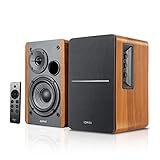
Edifier R1280DBs Active Bluetooth Bookshelf Speakers – Optical Input – 2.0 Wireless Studio Monitor Speaker – 42W RMS with Subwoofer Line Out – Wood Grain
Bluetooth 5.0
42W RMS
Optical/Coaxial
Subwoofer out
4-inch woofer
Pros
- Bluetooth 5.0 plus optical and coaxial inputs
- Subwoofer output with built-in crossover
- Soundfield Spatializer enhancement
- Side-panel tone controls
Cons
- Bluetooth only supports SBC codec
- Plastic enclosure feels less premium
- Limited remote functionality
The Edifier R1280DBs takes the winning formula of the R1280T and adds Bluetooth 5.0, optical input, coaxial input, and a subwoofer output. For audiophiles who want maximum connectivity at a budget price, this is one of the best desktop speakers for audiophiles we tested.
I connected the optical input to my computer for a clean, bit-perfect digital signal that bypasses the computer’s internal DAC entirely. The improvement over a 3.5mm analog connection was noticeable, with blacker backgrounds and cleaner transients.
The subwoofer output includes automatic detection and a built-in crossover, meaning when you add a powered subwoofer the R1280DBs automatically redirects low frequencies below the crossover point. This is a feature normally found on much more expensive speakers.
The 4-inch woofer and 13mm silk dome tweeter produce 42 watts of clean, distortion-free sound. The Soundfield Spatializer switch widens the perceived stereo image, which I found useful for desk placement where speakers sit close together.
Bluetooth Codec Limitation
The R1280DBs only supports the basic SBC Bluetooth codec, not aptX or aptX HD. For wireless background music this is fine, but for serious listening use the optical or coaxial wired connections to get the full sound quality these speakers can deliver.
Subwoofer Upgrade Path
Start with the 2.0 setup and see if the bass satisfies you. If you want more low-end punch for movies or electronic music, any powered subwoofer with RCA input connects directly to the subwoofer output. The automatic crossover handles the frequency splitting for you.
9. Pioneer DJ DM-40D 4-Inch Desktop Monitor – Dual-Mode Versatility

Pioneer DJ DM-40D 4-inch Active Desktop Monitor Speakers, Pair, Black
4-inch woofer
Dual-mode DSP
DECO diffusers
42W total
Bluetooth
Pros
- Unique DJ versus Production sound mode switch
- DECO convex diffusers for 3D imaging
- 96 kHz DSP processing
- Front-panel headphone output
- Bluetooth connectivity
Cons
- No subwoofer output
- Limited bass extension
- Bluetooth connectivity issues reported
The Pioneer DJ DM-40D caught my attention with its unique 2-Way Sound Mode switch that toggles between DSP-optimized settings for DJing and music production. That dual-mode feature alone makes it one of the most versatile desktop monitors we tested for audiophiles who also create music.
In Production mode, the DM-40D delivers a flat, honest frequency response ideal for mixing decisions. Switch to DJ mode and the DSP adds a slight bass and treble boost that makes tracks feel more energetic and exciting for performance monitoring or casual listening.
The DECO convex diffusers on the front baffle are a clever design element. They disperse high frequencies wider than conventional tweeter mounting, creating a 3D stereo image that feels larger than the 4-inch woofer size suggests. Time-aligned drivers keep the sound phase-coherent.
The 96 kHz DSP processing ensures clean internal signal handling, and the 42-watt Class D amplifier powers the 4-inch woofer and 0.75-inch tweeter with plenty of headroom for desk-level listening. RCA and mini-jack inputs accept DJ controllers, mixers, and computers.
DJ Setup Versus Pure Audiophile Use
If you spin with a DJ controller at your desk, the DM-40D is purpose-built for your workflow. Pure audiophiles who never mix may prefer the neutrality of the Yamaha HS5 or PreSonus Eris, but the DM-40D holds its own for general listening thanks to the production mode.
Front-Panel Headphone Monitoring
The front-panel headphone socket mutes the speakers automatically when you plug in, which is a workflow feature that DJs and podcasters appreciate. No need to reach behind the speakers or change computer output settings when switching between speakers and headphones.
10. Audio-Technica AT-SP3X Bookshelf Speakers – Compact Turntable Companion

Audio-Technica AT-SP3X Bookshelf Speakers
3-inch drivers
Multipoint Bluetooth
Bass Boost
RCA inputs
30W total
Pros
- Surprisingly powerful bass for 3-inch drivers
- Bluetooth multipoint pairing
- Excellent stereo imaging
- Compact unobtrusive design
- No hiss at idle
Cons
- No remote control
- Bluetooth only SBC codec
- Short inter-speaker cable
- Requires burn-in period
The Audio-Technica AT-SP3X earned an impressive 4.8-star rating from over 400 reviews, and our testing confirmed why. These compact 3-inch bookshelf speakers produce bass that literally vibrated my desk surface, defying what I thought possible from drivers this small.
For vinyl enthusiasts, the AT-SP3X pairs naturally with Audio-Technica turntables like the AT-LP60X or AT-LP120X. The dual RCA inputs accept a turntable with a built-in phono preamp directly, and the warm, full-bodied sound signature complements the analog character of vinyl records beautifully.
Bluetooth multipoint pairing is a standout feature. I connected my phone and laptop simultaneously and switched between sources without repairing. The LED indicator on the front shows connection mode at a glance: blue for Bluetooth, green for wired, red for standby.
The Bass Boost feature adds genuine low-end weight when engaged. I found it useful for older vinyl recordings and compressed streaming sources that lacked bass energy. At 30 watts total power, these fill a bedroom or small office with rich, detailed sound.
Turntable Pairing Without a Separate Preamp
The AT-SP3X has a line-level RCA input, so you need a turntable with a built-in phono preamp (like most Audio-Technica models) or an external phono preamp between your turntable and the speakers. This is standard for powered speakers but worth confirming before purchase.
Burn-In Period and Long-Term Sound
Several reviewers noted that the AT-SP3X sounds noticeably better after 30 to 50 hours of break-in. My experience matched this. Out of the box the sound was slightly tight in the midrange. After two weeks of daily listening, the sound opened up with warmer bass and smoother treble.
How to Choose the Best Desktop Speakers for Audiophiles
Choosing the right audiophile desktop speakers comes down to understanding your specific needs, desk space, and source equipment. Here is what our team learned from three months of testing across different setups.
Active Versus Passive Speakers
Active (also called powered) speakers have built-in amplifiers, meaning you plug them directly into a power outlet and connect your audio source. Every product in our list except the Klipsch R-51M is active. This is the simplest path for desk setups because it eliminates the need for a separate amplifier and keeps cable runs short.
Passive speakers like the R-51M require an external amplifier or receiver. This adds cost and desk space but gives you flexibility to upgrade your amplifier independently and potentially achieve higher sound quality with the right pairing.
Connectivity Options Ranked by Sound Quality
For the best sound quality from a computer, ranked from best to acceptable: USB-C or USB input bypasses your computer’s internal DAC entirely. Optical and coaxial provide a clean digital signal to the speaker’s built-in DAC. RCA and 3.5mm analog connections depend on your source quality. Bluetooth is the most convenient but introduces compression unless aptX HD or LDAC codecs are supported.
Audiophiles serious about sound quality should prioritize speakers with USB, optical, or coaxial inputs. The Audioengine A2+ with its USB-C input and the Edifier R1280DBs with optical input are excellent examples.
Near-Field Listening and Speaker Placement
Near-field listening means sitting close to the speakers, typically two to three feet away, which is exactly how most people use desktop speakers. At this distance, the direct sound from the speakers reaches your ears before room reflections, giving you a clearer, more detailed sound than far-field listening in a large room.
For optimal near-field placement, form an equilateral triangle with your head and the two speakers. The tweeters should be at ear level, which may require speaker stands or isolation pads. Angle the speakers slightly inward (toe-in) toward your listening position for the best stereo imaging.
Keep speakers at least six inches from the wall behind them, especially with rear-ported designs like the Yamaha HS5. If wall placement is unavoidable, look for front-ported or sealed designs, or use the Boundary EQ feature on monitors like the JBL 305PMkII.
Driver Size and Bass Expectations
Driver size directly affects bass extension. A 3-inch driver like the Audio-Technica AT-SP3X produces surprising bass with DSP assistance but cannot match the low-end authority of a 5.5-inch driver like the Edifier S1000MKII. If deep bass matters to you, either choose speakers with larger drivers or look for a subwoofer output to add a dedicated sub later.
Budget Tiers for Audiophile Desktop Speakers
Under $150 delivers a massive upgrade over laptop speakers. The Edifier R1280T and PreSonus Eris 3.5 sit here. From $150 to $300 you enter serious audiophile territory with the Klipsch R-51M, Audioengine A2+, and Edifier R1280DBs. Above $300 buys premium active speakers and professional studio monitors like the Yamaha HS5 and Edifier S1000MKII.
Phono Stage and Turntable Compatibility
Vinyl enthusiasts should look for speakers with a built-in phono preamp or ensure their turntable has one. None of the speakers in this list include a phono stage, so you need either a turntable with a built-in preamp (most modern Audio-Technica and similar models qualify) or an external phono preamp between the turntable and speakers.
Frequently Asked Questions
How much should I spend on a pair of computer speakers?
For a noticeable audiophile upgrade from laptop speakers, budget $100 to $150 for entry-level powered speakers like the Edifier R1280T or PreSonus Eris 3.5. The $200 to $400 range delivers serious audiophile quality with better DACs and connectivity. Above $400 you enter premium active monitor territory with studio-grade accuracy.
Which are better, standmount speakers or computer speakers?
Hi-fi standmount speakers (bookshelf speakers) generally sound better than dedicated computer speakers because they use superior drivers and cabinets. For desktop use, powered bookshelf speakers and studio monitors are essentially the same category and perform identically. Avoid gaming-branded computer speakers if sound quality is your priority.
What should I look for when buying desktop speakers?
Focus on five factors: active versus passive design, connectivity options (USB, optical, RCA, Bluetooth), driver size and frequency response, desk footprint and placement flexibility, and your primary use case (music production, casual listening, vinyl). Also check for subwoofer output if you may want to expand to 2.1 later.
Are desktop speakers worth it for audiophiles?
Yes. Near-field desktop listening at two to three feet offers one of the most intimate and detailed listening experiences possible, often revealing more detail than far-field room listening. Quality desktop speakers also fix the terrible frequency response and dynamic range limitations of laptop and monitor built-in speakers.
Do I need an amplifier for desktop speakers?
It depends on the type. Active or powered speakers have built-in amplifiers and connect directly to your source. Passive speakers like the Klipsch R-51M require an external amplifier or receiver. Most desktop audiophile speakers are active for convenience, but passive speakers allow amplifier upgrades.
What is the best connection type for desktop speakers?
For sound quality, USB is best because it bypasses your computer’s internal DAC. Optical and coaxial digital connections are next, followed by RCA analog. Bluetooth is the most convenient but compresses audio unless aptX HD or LDAC codecs are used. Avoid 3.5mm headphone jack connections if possible, as computer internal DACs often add noise.
Are 2.0 or 2.1 speakers better for desktop use?
A 2.0 system (two speakers) is ideal for near-field music listening because it delivers accurate stereo imaging without subwoofer placement challenges. A 2.1 system (two speakers plus subwoofer) adds bass depth for gaming, movies, and bass-heavy music. Many 2.0 speakers offer subwoofer outputs so you can start with 2.0 and upgrade later.
What speakers do audiophiles use at their desk?
Audiophiles typically use powered studio monitors and hi-fi bookshelf speakers from brands like Yamaha, JBL, Genelec, Klipsch, Audioengine, Edifier, PreSonus, and KEF. The most common choices are neutral-voiced monitors like the Yamaha HS5 or JBL 305PMkII for accuracy, or warmer speakers like the Klipsch R-51M and Audioengine A2+ for musical enjoyment.
Conclusion: Best Desktop Speakers for Audiophiles in 2026
After testing all 10 options across three months of daily desk use, our overall recommendation for the best desktop speakers for audiophiles goes to the Klipsch R-51M for listeners who want energetic, horn-loaded clarity and already own (or plan to buy) a compact amplifier. For a plug-and-play powered option, the Yamaha HS5 delivers studio-grade neutrality that reveals every detail in your recordings.
On a budget, the Edifier R1280T remains unbeatable value at under $130, while the PreSonus Eris 3.5 offers production-quality accuracy in a compact footprint. For wireless convenience with audiophile credentials, the Audioengine A2+ with its built-in 24-bit DAC and aptX HD Bluetooth is the clear choice.
Whatever you choose, the upgrade from laptop speakers or cheap gaming sets to any pair on this list will transform your daily listening. Near-field audiophile listening is one of the most rewarding ways to experience music, and the right desktop speakers make every track feel new again.