
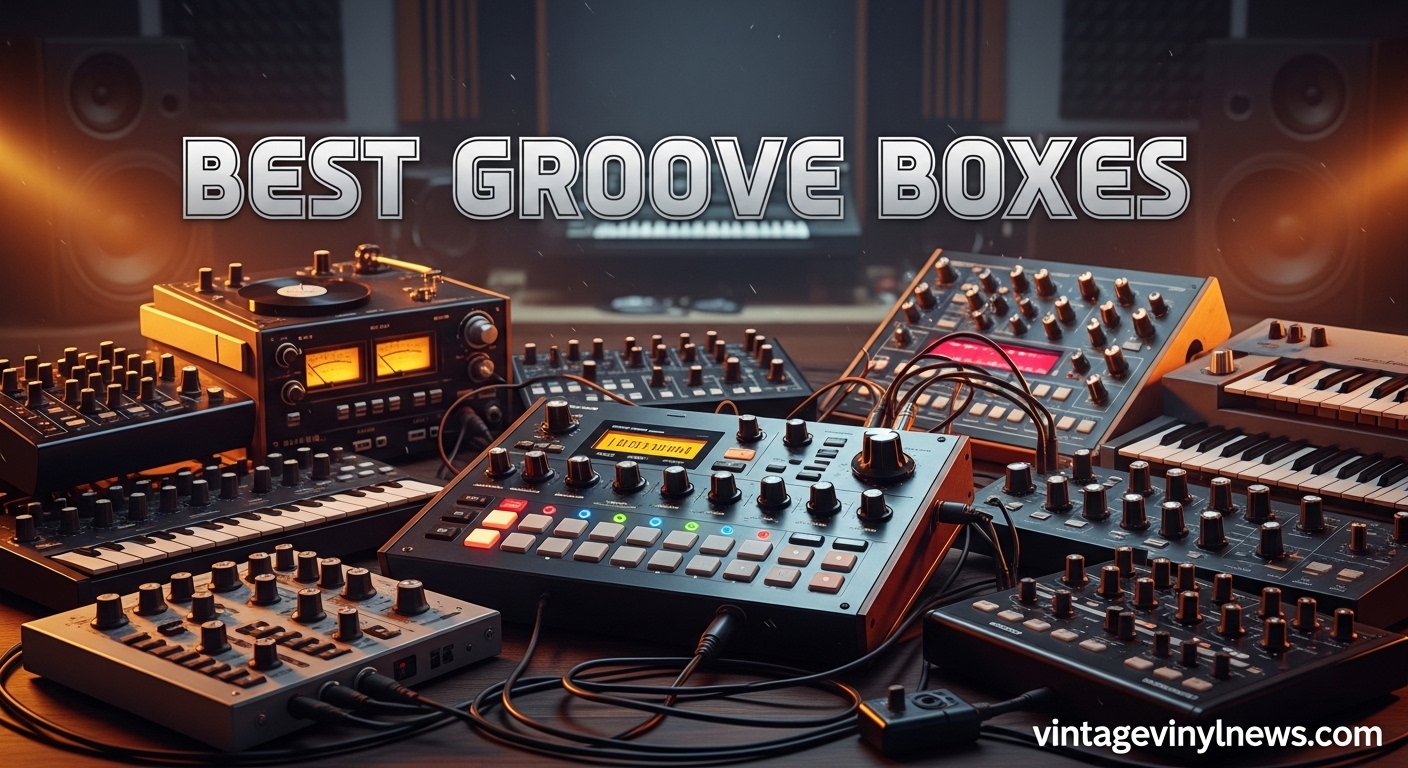
If you have ever wanted to make music without staring at a computer screen, a groovebox is exactly what you need. A groovebox is a standalone music production device that combines a drum machine, synthesizer, and sequencer into one portable unit, letting you create beats, melodies, and full tracks without opening a DAW. Our team spent over three months comparing the best groove boxes on the market, testing everything from pocket-sized samplers to professional workstations, to find out which ones actually deliver on their promises.
Whether you are a complete beginner looking for your first hardware music maker or an experienced producer wanting a portable sketch pad for live performance ideas, this guide covers the top options available in 2026. We tested 13 different grooveboxes across multiple genres, from techno and hip-hop to ambient and experimental sound design. Each device was evaluated on sound quality, workflow, portability, connectivity, and overall value.
In this roundup, you will find detailed reviews of every groovebox we tested, a quick comparison table to help you scan the specs, and a buying guide that breaks down exactly what to look for based on your experience level and musical goals. I made sure to include options across every budget, from ultra-affordable pocket units to full professional workstations.
Table of Contents
Top 3 Picks for Best Groove Boxes

Best Groove Boxes in 2026
| Product | Specifications | Action |
|---|---|---|
| Akai Professional MPC Sample |
|
Check Latest Price |
 Roland MC-707 Groovebox Roland MC-707 Groovebox |
|
Check Latest Price |
 Roland AIRA Compact T-8 Roland AIRA Compact T-8 |
|
Check Latest Price |
 Novation Circuit Rhythm Novation Circuit Rhythm |
|
Check Latest Price |
 Novation Circuit Groove Box Novation Circuit Groove Box |
|
Check Latest Price |
 Roland MC-101 Groovebox Roland MC-101 Groovebox |
|
Check Latest Price |
 Sonicware Liven XFM Sonicware Liven XFM |
|
Check Latest Price |
 Sonicware Liven 8bit Warps Sonicware Liven 8bit Warps |
|
Check Latest Price |
 Korg Volca Sample Korg Volca Sample |
|
Check Latest Price |
 1010music Bluebox 1010music Bluebox |
|
Check Latest Price |
 Donner Essential B1 Donner Essential B1 |
|
Check Latest Price |
| Donner MEDO |
|
Check Latest Price |
 Teenage Engineering PO-33 KO Teenage Engineering PO-33 KO |
|
Check Latest Price |
1. Akai Professional MPC Sample – Best Overall Groove Box
Akai Professional MPC Sample Portable Sampler
Portable sampler and sequencer
Battery powered with built-in mic
16 MPC pads with poly aftertouch
2.4 inch color display
4-6 hours battery life
60+ effect types
Pros
- Iconic MPC workflow in portable format
- Standalone operation no computer needed
- Excellent pads with velocity and poly aftertouch
- Great sampling via built-in mic or line input
- 4-6 hours battery life
Cons
- Step sequencer can feel cumbersome for complex arrangements
- Built-in speaker is just adequate
- Limited arrangement depth by design
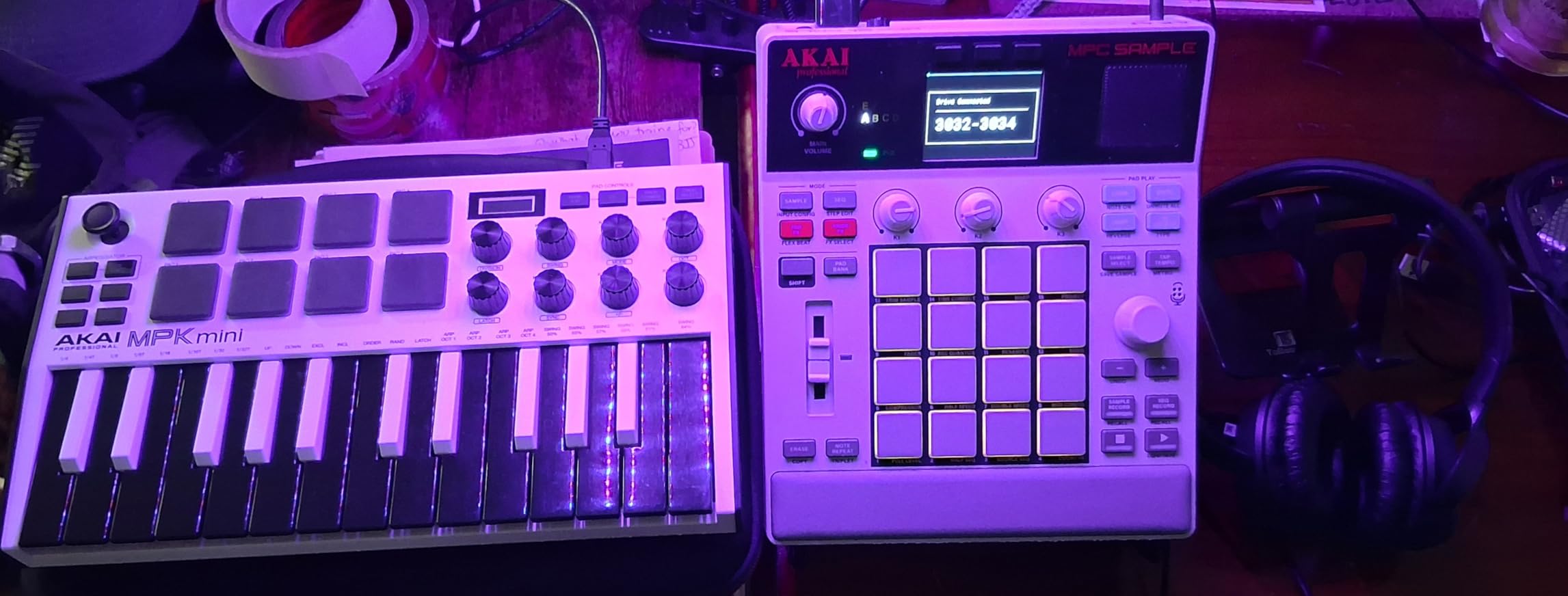
The Akai Professional MPC Sample is the groove box I keep coming back to when I want to make music without thinking too hard about the process. It captures the iconic MPC workflow that producers have relied on for decades, but shrinks it down into a battery-powered unit that fits in a backpack. From the moment I powered it on, the 16 responsive MPC pads felt familiar and precise, and I was chopping samples within minutes.
What sets this apart from other groove boxes in its range is the true standalone operation. You get a built-in microphone for capturing sounds on the go, an internal speaker for sketching ideas without headphones, and a rechargeable lithium-ion battery that lasts 4 to 6 hours in my testing. The microSD card handles all your storage needs, and file transfers are straightforward. I loaded up several custom sample packs and was pleasantly surprised by how quickly the device handled them.
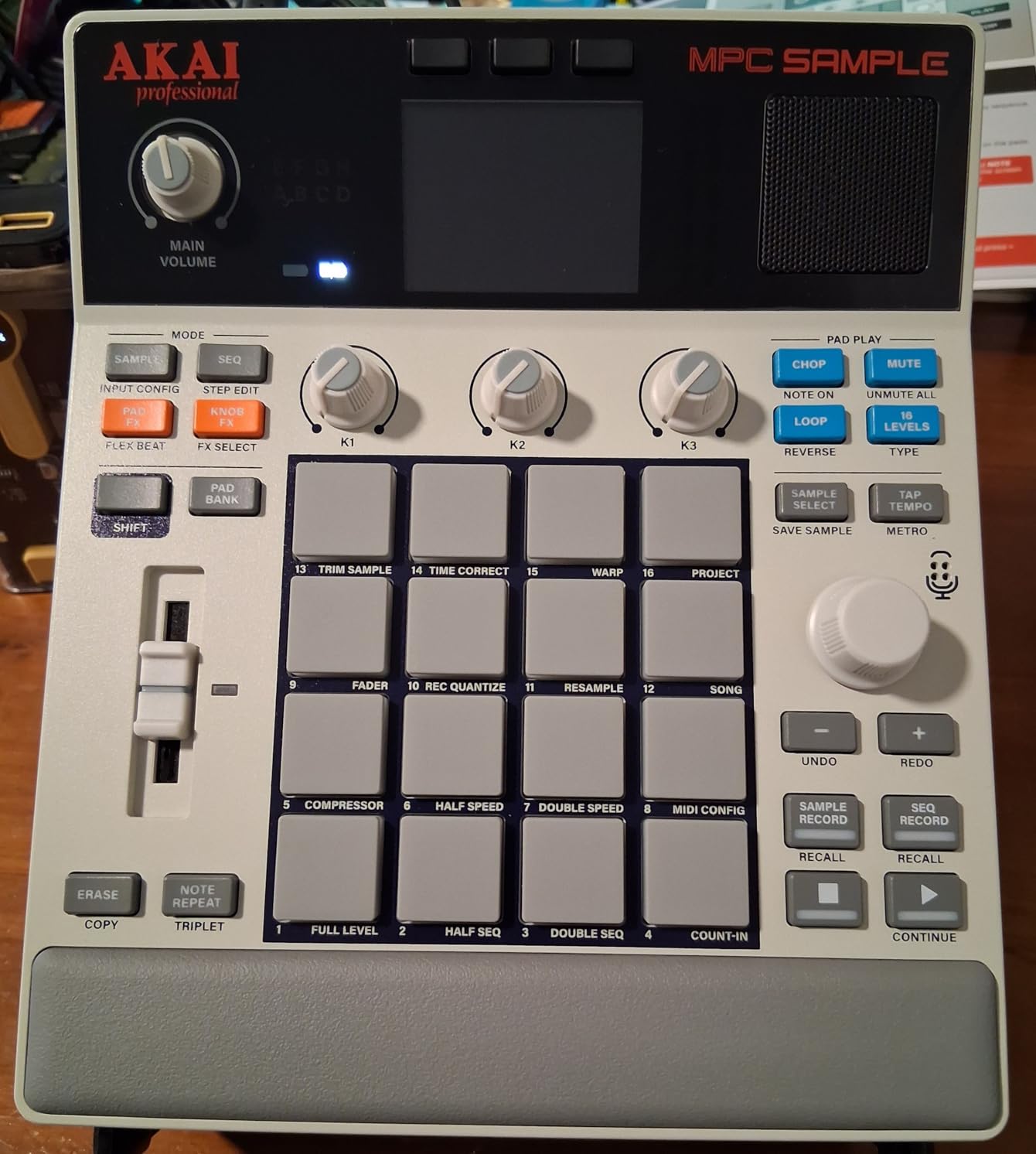
The 2.4-inch full-color display is bright and clear, making sample editing and navigation genuinely usable rather than a chore. Akai packed over 100 factory kits into this thing, plus four internal FX processors with 60 effect types including Flex Beat and Color Compressor. I found the instant sample chop mode particularly addictive. You can record a breakbeat from vinyl, chop it on the device, and have a new pattern running in under two minutes.
Who Should Buy the MPC Sample
This is the ideal groove box for anyone who wants the classic Akai sampling workflow in a portable format. Producers coming from the MPC Live or MPC One will feel right at home, and beginners get an accessible entry point that teaches the fundamentals of chopping, sequencing, and sampling. The included Melodics lessons are a nice bonus for anyone just starting out with beat-making.
If you are into hip-hop production, sample-based electronic music, or just want a dedicated hardware sampler for your DAWless setup, the MPC Sample delivers exceptional value. It ranks number one in Audio Samplers on Amazon for good reason.
Who Should Look Elsewhere
If you need deep arrangement capabilities for full song production, the MPC Sample keeps things focused on loops and patterns by design. You might find the step sequencer limiting for complex multi-section tracks. Producers who need extensive resampling options or multi-track recording should also consider the Roland MC-707 instead.
Also, while the built-in speaker is useful for quick ideas, it is not something you would want to rely on for serious listening or mixing decisions.
2. Roland MC-707 – Best Professional Workstation
Roland MC-707 Groovebox Professional Music Production Workstation (MC-707), Standard
Professional music workstation
8 tracks and 128 clips
90 track multi-effects types
128-step step sequencer
SD card storage
Classic Roland sound engine
Pros
- Complete song creation without a DAW
- Excellent preset library with classic Roland sounds
- 8 tracks and 128 clips provide ample workflow
- Comprehensive effects with 90 types per track
Cons
- Expensive compared to similar devices
- Documentation refers to long video tutorials
- Limited looper functionality
- Small LCD for the amount of features
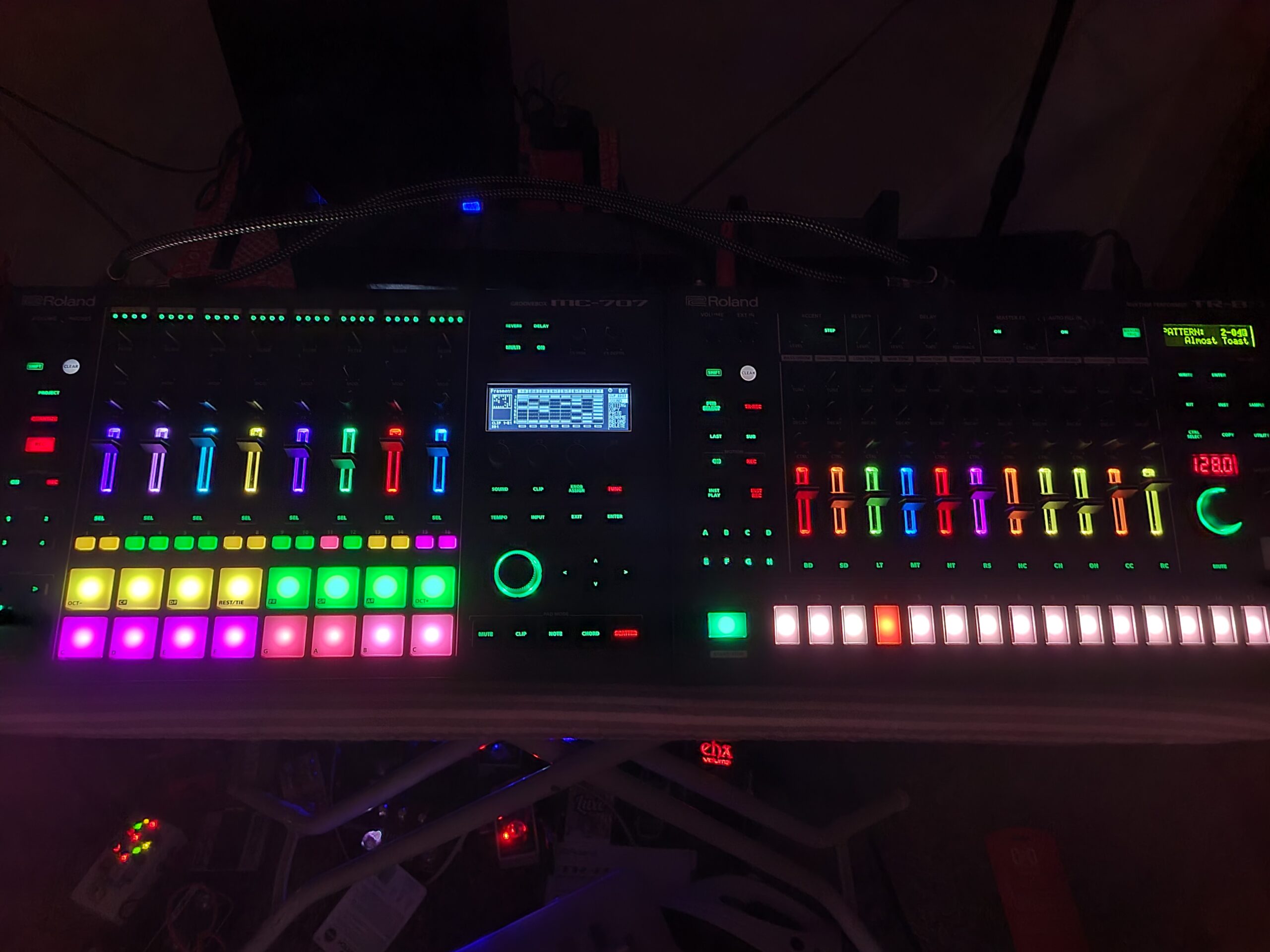
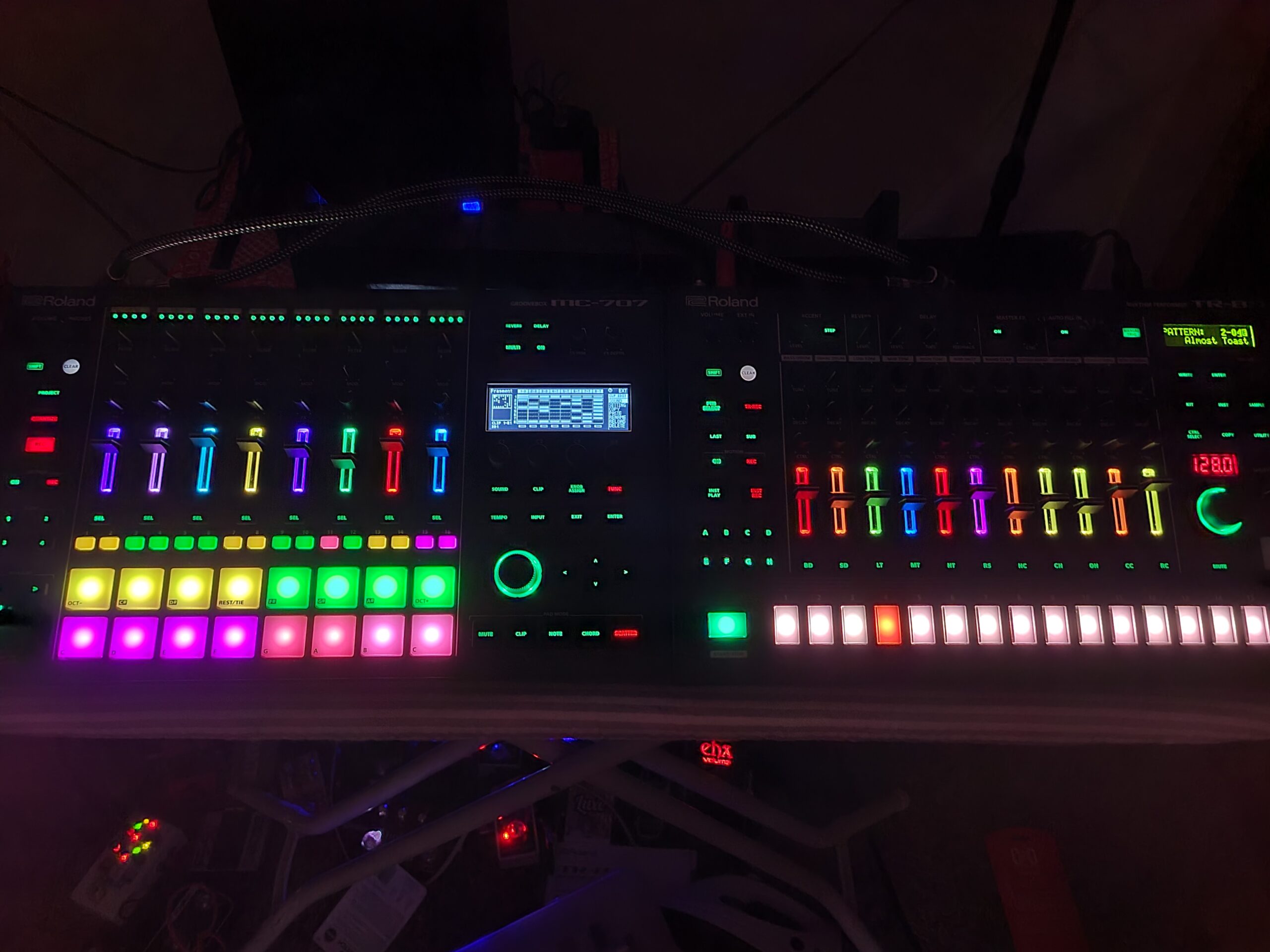
The Roland MC-707 is what happens when a company with decades of electronic music history builds a no-compromise production workstation. With 8 tracks and 128 clips, this is the groovebox I reach for when I want to create a complete song from start to finish without touching a computer. The sound engine is packed with classic Roland tones, and the preset library is massive enough that you can spend weeks just exploring what is already built in.
In my testing, the MC-707 handled everything I threw at it: techno, ambient, hip-hop beats, and even experimental stuff. The Tone, Drum Kit, and Looper track types give you flexibility in how you approach each part of your composition. With five 1/4-inch phone jacks plus MIDI and USB, connectivity is solid for integrating into any studio or live rig. The 128-step sequencer gives you plenty of room to build complex patterns.
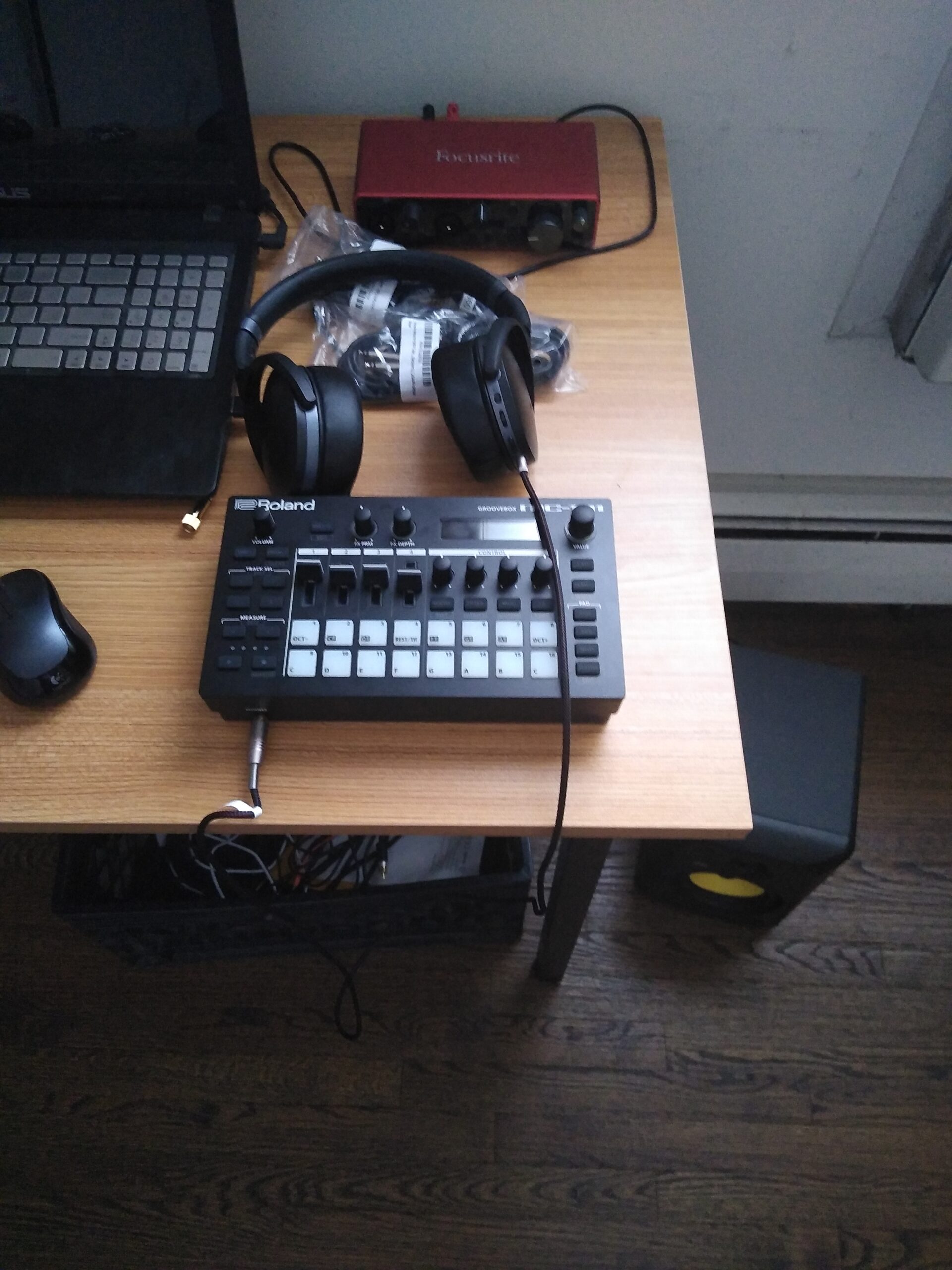
The effects section is where the MC-707 really shines. You get 90 types of Track Multi-Effects, plus Chorus/Delay, Reverb, Master Effects, Master Compressor, and Master EQ. That is a ridiculous amount of processing power in a single unit. I was able to shape sounds entirely on the device without reaching for external plugins or pedals. The SD card handles all project and audio data storage reliably.
Who Should Buy the MC-707
This is the best groove box for experienced producers who want a complete DAWless production suite. If you are building a home studio around a single hardware centerpiece, or you need a reliable workstation for live performances that covers everything from sequencing to mixing, the MC-707 is hard to beat. It is widely praised on forums like Reddit and Gearspace as one of the greatest standalone devices available.
Who Should Look Elsewhere
Beginners might find the MC-707 overwhelming. The interface involves a fair amount of menu diving, and the documentation is thin for a device this complex. If you do not need 8 tracks or professional-grade effects, the Roland MC-101 offers a similar sound engine in a much simpler, portable format at a lower price point.
3. Roland AIRA Compact T-8 – Best Value Drum and Bass Machine
Roland AIRA Compact T-8 Beat Machine
Ultra-portable rhythm and bass machine
TR-808/909/606 drums and TB-303 bass
16-step sequencer with 64 patterns
Rechargeable battery
USB-C audio and MIDI interface
1.3 pounds
Pros
- Pristine classic Roland sounds including 303 bass
- Extremely portable and affordable
- Intuitive 16-step sequencer
- Long rechargeable battery life
Cons
- Limited drum sound selection compared to full machines
- No complete 808 or 909 kit
- Buttons can feel too soft for punch-in beats
- Learning curve for beginners
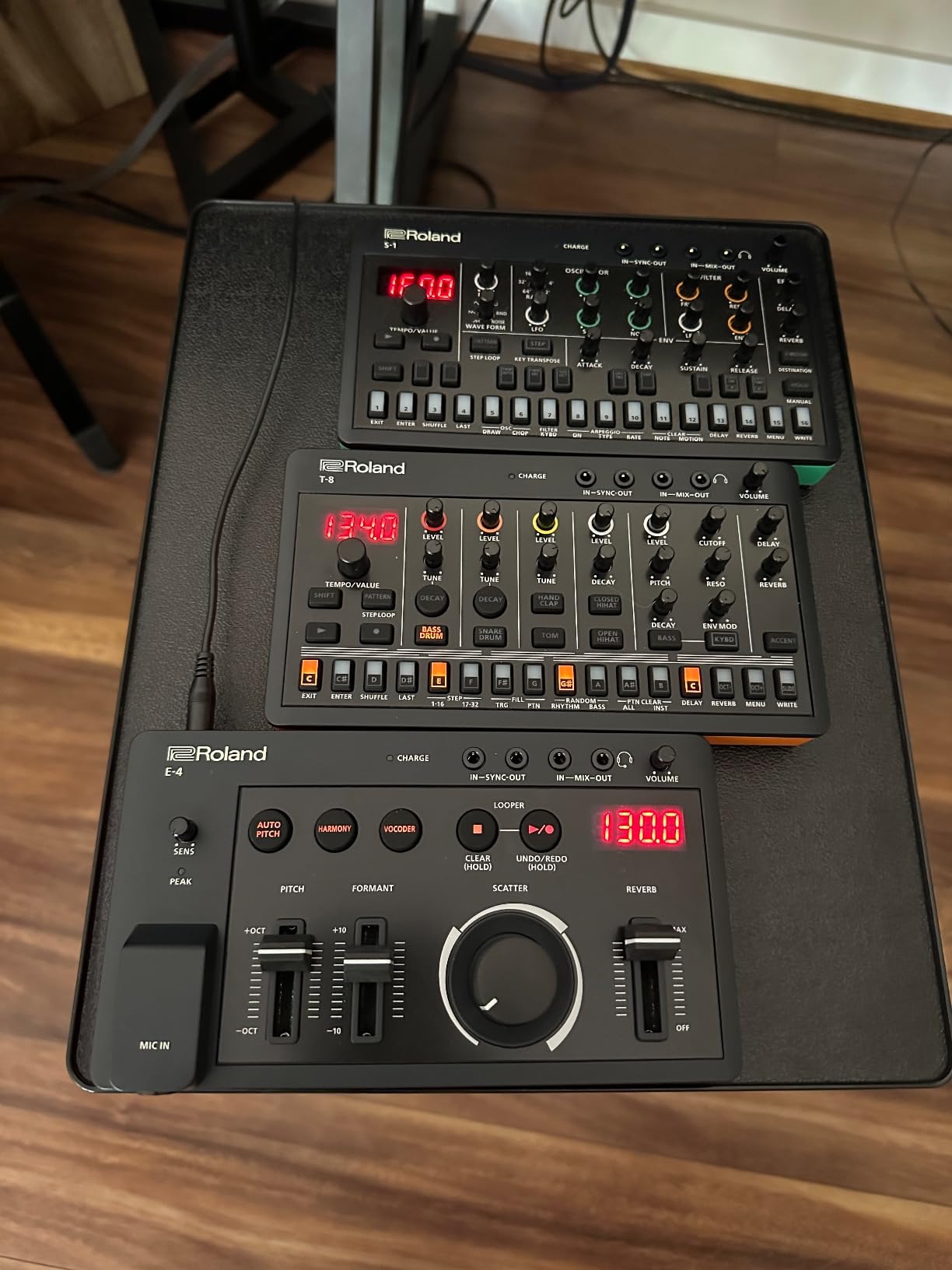
The Roland T-8 packs the legendary sounds of the TR-808, TR-909, TR-606, and TB-303 into a unit that weighs just 1.3 pounds and fits in a guitar case. I brought this to a friend’s studio session and within minutes we had a solid acid house track going, no setup required. The Analog Circuit Behavior technology genuinely recreates the tonality and behavior of those vintage Roland instruments, and you can hear it.
The 16-step sequencer is intuitive and quick. I was programming patterns within the first ten minutes of unboxing. The advanced rhythm programming features like probability, sub step, last step, and velocity add genuine depth once you start exploring them. With 64 user patterns and up to 32 steps each, there is plenty of room to build out your ideas. The real-time recording features including step loop, mute, fill, reload, and pattern shift make live performance genuinely fun.
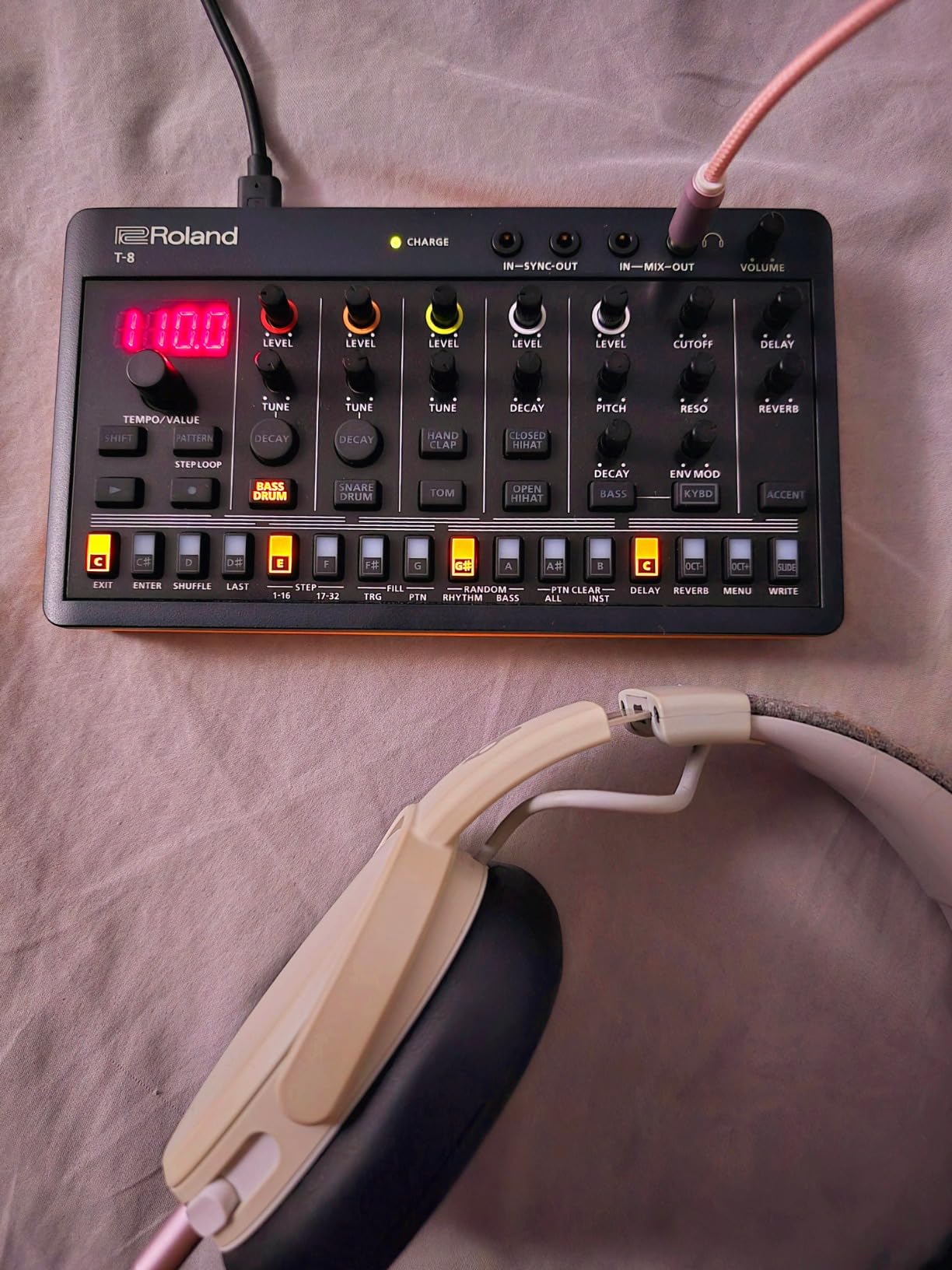
Effects include delay, reverb, overdrive, and sidechain compression, which is impressive for a device this small. The rechargeable battery lasts for long sessions, and the USB-C connection doubles as both a power source and a class-compliant audio and MIDI interface. No drivers needed, which is refreshing.
Who Should Buy the T-8
If you want classic Roland drum and bass sounds in a portable, affordable package, the T-8 is unbeatable. It is perfect for producers making techno, house, acid, or any electronic genre that relies on those iconic 808/909/303 sounds. The portability makes it great for travel, jam sessions, and live performance. Forum users on Reddit consistently recommend this as one of the best starter grooveboxes.
Who Should Look Elsewhere
The T-8 is focused on rhythm and bass, so if you need melodic synthesis, sampling, or a full production workstation, you will want something like the Akai MPC Sample or Roland MC-101 instead. The limited drum selection also means you will not get a complete 808 or 909 kit, but rather a curated blend of sounds from multiple classic machines.
4. Novation Circuit Rhythm – Best Sampler for Beginners
Novation Circuit Rhythm Sampler and Groovebox
8-track sampler and groovebox
Internal battery portable
32-step patterns chainable to 256
Slice mode and performance FX
MIDI USB-C microSD
1.9 pounds
Pros
- Fast and intuitive interface
- Excellent slice mode
- Portable with internal battery and sturdy build
- Great feeling pads with useful features like Mutate and Probability
Cons
- Slow sample transfer over USB-C
- No LCD screen makes slicing difficult
- Limited effects with no reverb or delay
- Poor MIDI implementation
The Novation Circuit Rhythm is the sampler I wish existed when I first started making beats. It strips away the complexity and gives you eight sample tracks, a powerful hands-on sequencer, and a workflow that just makes sense. Within an hour of unboxing, I had recorded sounds from my phone, chopped them up, and built a complete beat without opening a manual.
The slice mode is genuinely excellent. You load a sample, slice it into hits, and assign them to the pads for immediate play. The eight sample tracks each support 32-step patterns that can be chained up to 256 steps, giving you room to build evolving arrangements. Performance effects like lo-fi tape and beat repeat add character during live jams. The internal battery gives you over 4 hours of portable use.
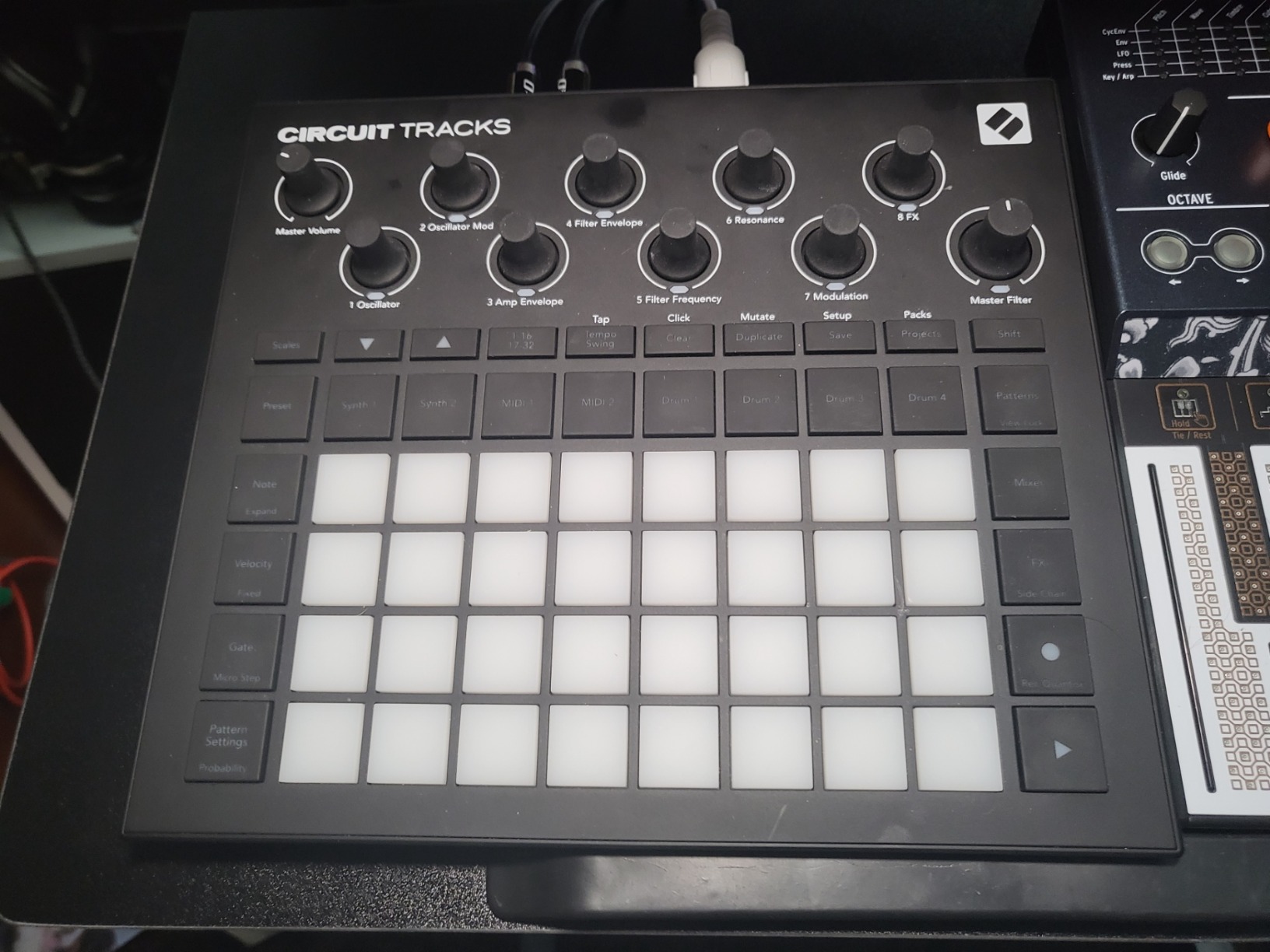
Build quality surprised me. The matte texture feels premium and does not collect dust, the pads are responsive, and the overall unit feels solid at 1.9 pounds. Features like Mutate, Probability, and random note generation keep patterns interesting and evolving. It is a genuinely fun device to use, which is something I cannot say about every sampler at this price.
Who Should Buy the Circuit Rhythm
Beginners and intermediate producers who want a straightforward sampler groovebox without a steep learning curve. If your workflow revolves around sampling, chopping, and layering drums and loops, the Circuit Rhythm handles it with minimal friction. It is also great for DAWless setups where you need a dedicated sampler alongside synths and drum machines.
Who Should Look Elsewhere
The lack of an LCD screen is a real limitation for precise sample editing and slicing. If you need built-in reverb or delay effects, or deep MIDI implementation for controlling external gear, the Circuit Rhythm falls short. Advanced producers might find the limited effects and slow USB transfer speeds frustrating. Consider the Akai MPC Sample for a more complete standalone experience.
5. Novation Circuit – Best Portable Synth Groove Box
Novation Circuit Groove Box with Sample Import: 2-Part Synth, 4-Part Drum Machine and Sequencer, Black (NOVSYNTH04)
2-part Nova analog-modeled synth
4-part drum machine
6-voice polyphony per synth
4x8 RGB velocity pads
Battery powered with speaker
MIDI I/O
Pros
- Intuitive workflow that is easy to grasp
- Great build quality with premium feel
- Excellent firmware updates adding new features
- Sample upload via Components software
- RGB pads are super responsive
Cons
- Built-in speaker has very low output volume
- No labels on rotary encoders
- Requires firmware updates for full features
- Pattern triggering can be limiting
The original Novation Circuit remains one of the most fun groove boxes I have ever used. It pairs a 2-part Nova-heritage analog-modeled synthesizer with a 4-part drum machine, all controlled through an intuitive grid of RGB velocity-sensitive pads. The learning curve is practically flat. I was making music within five minutes of turning it on, which is rare for any hardware synthesizer.
Each synth part offers 6-voice polyphony, which is generous for a unit this compact. The 128-step sequencer handles patterns up to 32 steps across 8 patterns per session, with 32 sessions total. That is a lot of creative headroom. The 8 macro encoder knobs let you tweak sounds in real-time, though I do wish they had labels. The 4×8 pad grid is bright, responsive, and makes pattern programming feel natural.
Battery power and a built-in speaker make this a truly portable music-making machine. I have brought it on flights, to parks, and to friends’ houses. The firmware updates from Novation have consistently added new features over the years, which speaks to the company’s commitment to the platform. The Components software lets you upload custom samples and manage patches from your computer.
Who Should Buy the Novation Circuit
Anyone who wants a fun, portable synth and drum machine combo for sketching musical ideas on the go. The Circuit is perfect for beginners who want to learn synthesis and sequencing without being overwhelmed. It is also great for experienced producers who want a quick scratch pad that sounds good right out of the box. Live performers appreciate its immediacy and portability.
Who Should Look Elsewhere
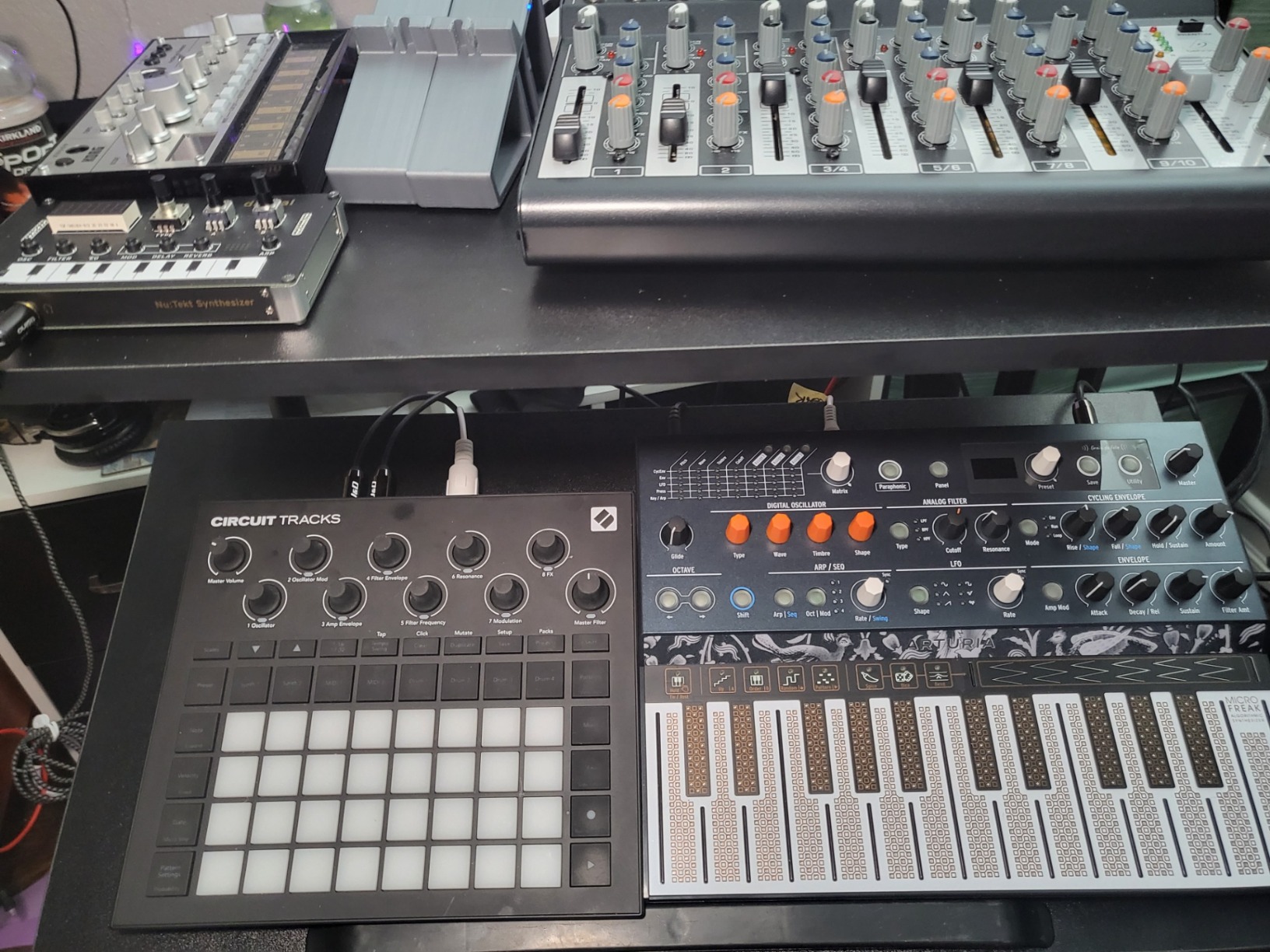
If sampling is your primary workflow, the Circuit Rhythm or Akai MPC Sample would serve you better. The lack of a display and unlabeled knobs can be frustrating for precise sound design. Also note that this model is currently difficult to find new, as stock availability is limited. The Circuit Tracks (not covered here) is the newer replacement with additional features.
6. Roland MC-101 – Best Compact Music Workstation
Roland MC-101 Groovebox Compact Music Production Workstation (MC-101)
4-track music production workstation
64 clips total
90 multi-effects types
128-step sequencer
AA battery or USB powered
454 grams
Pros
- Tons of quality presets and classic Roland sounds
- Totally portable and well designed
- Excellent sound quality
- Battery and USB powered
- Full-size MIDI in/out
Cons
- No arpeggiator
- Lots of menu diving required
- Pads are not velocity sensitive
- No direct sampling
- Scatter effects not practical for live use
The Roland MC-101 is essentially the MC-707’s smaller sibling, packing a legitimate professional music production workstation into a device that weighs just 454 grams. It runs on 4 AA batteries or USB power, making it one of the most portable full-featured groove boxes available. The preset library is massive, filled with classic Roland sounds that span decades of electronic music history.
With 4 tracks and 64 clips, the MC-101 gives you enough room to build complete tracks. Each track can be set to Tone, Drum Kit, or Looper type, providing flexibility in how you construct your songs. The effects section is comprehensive: 90 types of Track Multi-Effects, plus Chorus/Delay, Reverb, Master Effects, Master Compressor, and Master EQ. The 128-step sequencer handles complex patterns easily.
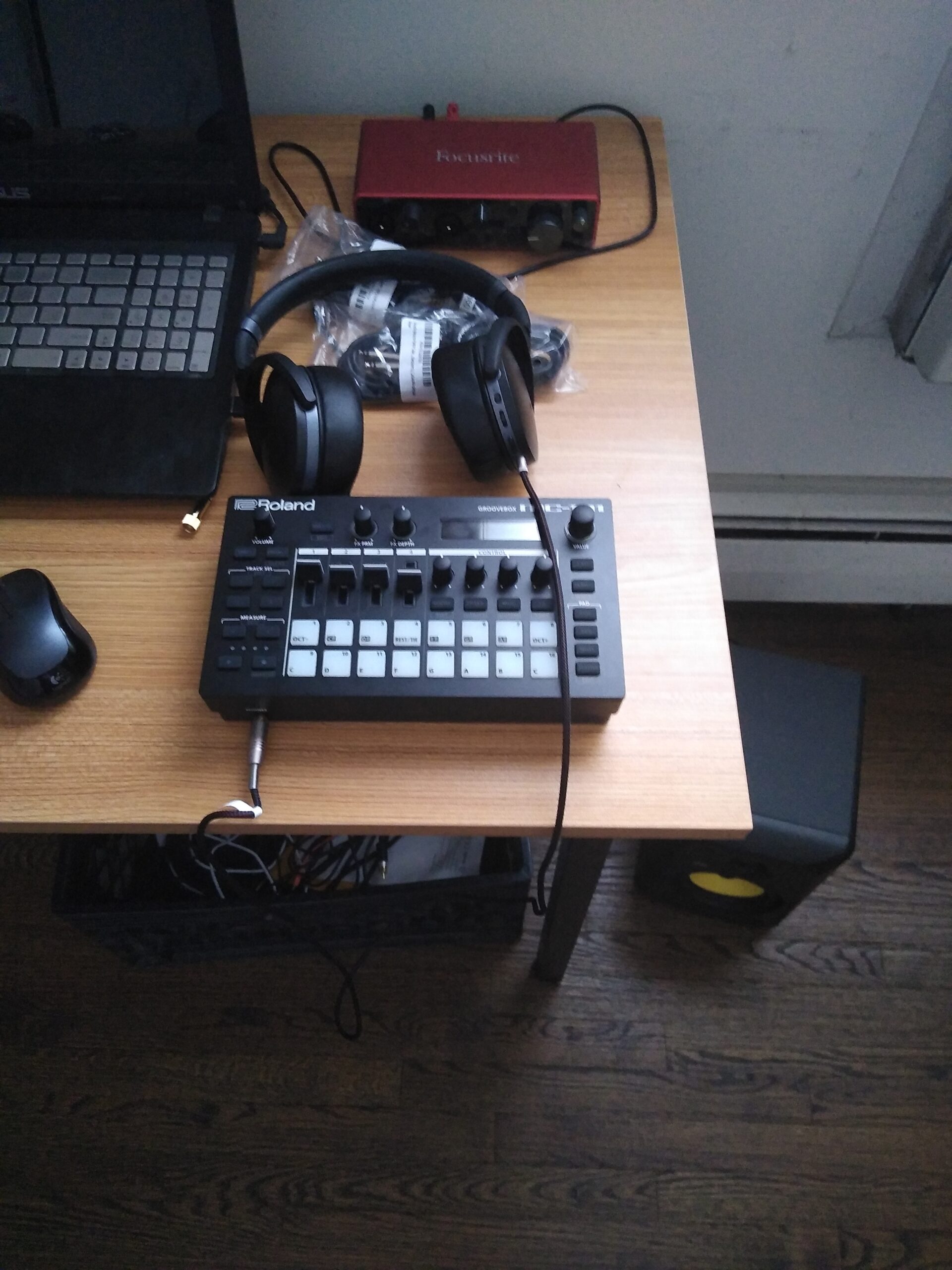
Where the MC-101 struggles is workflow friction. There is a lot of menu diving and sub-menu diving to access deeper parameters. The pads are not velocity sensitive, which limits expressive playing. There is no arpeggiator, no direct sampling capability, and no program change support. These limitations feel intentional, keeping the device focused on preset-based production rather than deep sound design.
Who Should Buy the MC-101
Producers who want a highly portable, battery-powered workstation loaded with great Roland sounds. If you primarily work with presets and want to sketch ideas on the go without carrying heavy gear, the MC-101 is excellent. The full-size MIDI in/out makes it a solid centerpiece for a small portable rig. The quantize-off option also lets you create more human-sounding grooves.
Who Should Look Elsewhere
If sound design and synthesis are your main interests, the lack of deep editing and no sampling will frustrate you. The menu-heavy interface slows down workflow compared to more hands-on devices. For a similar price, the Akai MPC Sample offers more creative flexibility with sampling and pad performance. If you need more tracks and a bigger screen, step up to the MC-707.
7. Sonicware Liven XFM – Best FM Synth Groove Box
Sonicware Liven XFM [FM Synthesizer Groove Box] 3 new FM engines with 4-track sequencer
4 FM synth engines
6-note polyphonic
4-track sequencer with 64 steps
128 patterns storage
MIDI IN/OUT
Battery operated with speaker
Pros
- Excellent FM synthesis capabilities
- Great value for money
- Intuitive and easy to use
- Portable with battery power
- 4-track sequencer is powerful
Cons
- Buttons feel flimsy
- Limited voices available
- Documentation is poor
- Some parameter linking limitations
The Sonicware Liven XFM brings FM synthesis to the groovebox format at a price that feels almost too good to be true. With 4 different FM synth engines and 6-note polyphony, this device creates sounds that range from bell-like clarity to gritty, metallic textures that are hard to get from standard subtractive synths. I spent an entire afternoon just exploring the preset library and was consistently surprised by the sonic range.
The 4-track sequencer with 64 steps per track provides enough room for layered compositions. You get 128 pattern storage slots, full MIDI in and out, sync in and out, and line in and out. Battery operation with a built-in speaker means you can make music anywhere, and at 790 grams it is easy to toss in a bag. The interface is surprisingly intuitive for an FM synth, which are notoriously complex to program.
Who Should Buy the Liven XFM
Producers who want to explore FM synthesis without investing in expensive Yamaha or digital FM instruments. The Liven XFM is perfect for ambient, experimental, and electronic music where FM textures shine. It is also a great learning tool for understanding FM synthesis fundamentals. The price-to-feature ratio is outstanding.
Who Should Look Elsewhere
The build quality is the main concern here. The buttons feel flimsy compared to Roland or Akai products, and the documentation is poor. If you need a tank-tough groovebox for gigging, the Liven XFM might not survive the road. Also, voice count is limited, so complex arrangements with lots of sustained notes may cause note-stealing issues.
8. Sonicware Liven 8bit Warps – Best Retro Sound Groove Box
Sonicware Liven 8bit Warps [8-bit Synthesizer with 4-track Looper] – Portable, Battery-Powered & Built-in Speaker for On-the-Go Sound Creation, Covering Chiptune, Game Music, and Ambient Music
8-bit waveform memory synth
4-track looper for internal and external audio
128-step sequencer
10 effects and 6 reverbs
Cassette tape simulator
Battery powered
Pros
- Excellent authentic 8-bit sounds
- Versatile sound design possibilities
- 4-track looper is a standout feature
- Full-size MIDI and audio connections
- Battery powered with built-in speaker
Cons
- Effects quality is mediocre
- Not a full groovebox in traditional sense
- Looper limited by sequencer length
- Many buttons can overwhelm initially
The Sonicware Liven 8bit Warps is unlike anything else in this roundup. It is an 8-bit waveform synthesizer that produces authentic NES and SNES-era sounds, complete with an aliasing noise toggle for extra retro character. But what makes it special is the 4-track looper, which handles both internal audio and external sources. This combination of retro synthesis and looping capability creates a workflow that feels genuinely unique.
The synth engine offers detune and sweep functions that push the 8-bit aesthetic into interesting territory. The 128-step sequencer supports parameter locking, so you can automate changes across your patterns. Effects include 10 processors and 6 reverbs, plus a cassette tape simulator that adds lo-fi warmth. Full-size MIDI in and out, plus 3.5mm sync connections, make it easy to integrate with other hardware.
Who Should Buy the 8bit Warps
Chiptune enthusiasts, retro game music composers, and anyone who loves lo-fi 8-bit aesthetics. The 4-track looper makes it useful beyond just retro sounds, and producers working in lo-fi hip-hop, ambient, or experimental genres will find plenty to love. At this price point, it is an easy creative impulse purchase that delivers real musical value.
Who Should Look Elsewhere
If you need modern, high-fidelity sounds, the 8-bit character is fundamental to this device and cannot be turned off entirely. The effects are not the best quality, and the looper is constrained by the sequencer length. This is more of a creative toy than a professional production tool, though that is part of its charm.
9. Korg Volca Sample – Best Budget Sample Player
Korg VOLCASAMPLE Playback Rhythm Machine
Sample-based rhythm machine
100 sample slots
8-note polyphony
16-step sequencer
Motion sequencer for automation
Battery powered at 1 pound
Pros
- Extremely versatile and flexible
- Easy to use interface
- Great sound quality through monitors
- Can load custom samples via iOS app
- Outstanding value for the price
Cons
- Limited to 16-step patterns
- Small internal storage of 4MB
- MIDI uses channels per sample not traditional note routing
- Built-in speaker is poor quality
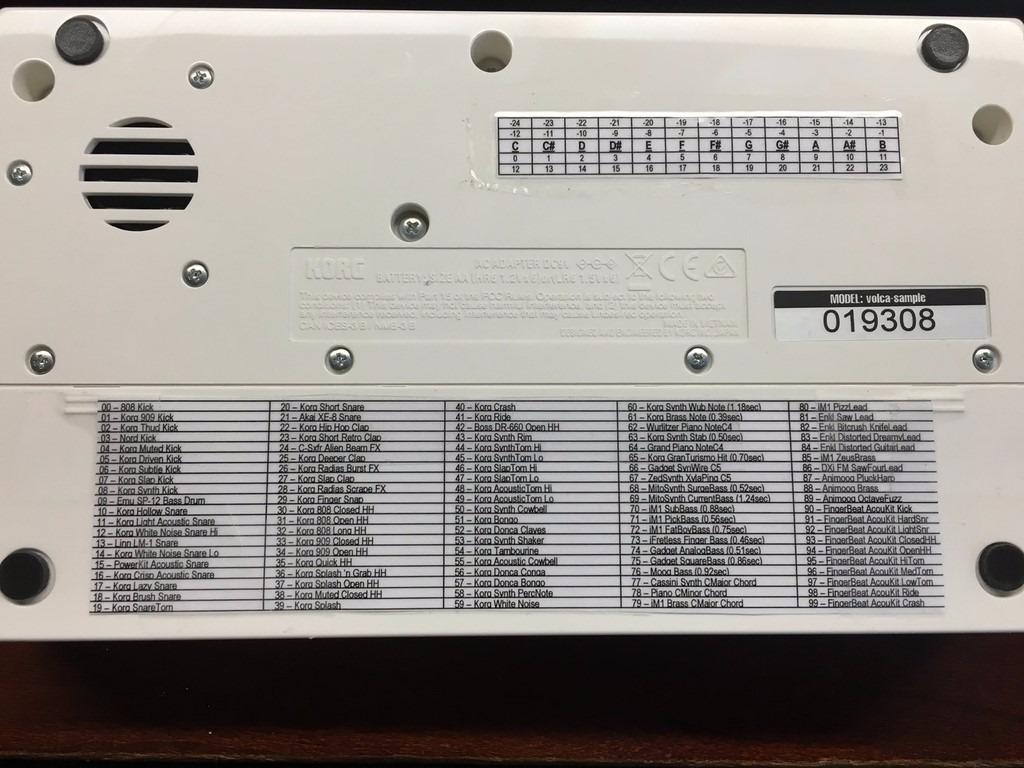
The Korg Volca Sample has been a staple in electronic music setups for years, and for good reason. At just 1 pound and running on batteries, it delivers sample-based rhythm programming that punches well above its weight class. The 100 sample slots give you plenty of sonic variety, and the iOS app integration makes loading custom samples straightforward, even if the process is not the most intuitive.
The 16-step sequencer with motion recording is where the Volca Sample becomes genuinely expressive. You can record knob movements to create evolving, animated patterns that sound far more complex than a simple step sequence. Active Step and Step Jump functions let you break out of predictable loops, and the Swing function adds groove effortlessly. Through decent monitors or headphones, the sound quality is surprisingly good.
Who Should Buy the Volca Sample
Anyone on a budget who wants a reliable, fun sample-based groove box. The Volca Sample is perfect for beginners who want to learn the basics of sequencing and sampling without a big investment. It is also popular with experienced producers who use multiple Volcas together for full DAWless setups. The price-to-fun ratio is hard to beat.
Who Should Look Elsewhere
The 16-step pattern limitation means each pattern is only one bar long, which requires chaining for longer arrangements. The 4MB storage is tiny by modern standards, so you need to be selective about what you load. MIDI implementation is unconventional, routing samples across channels rather than using traditional note mapping. For more modern sampling power, consider the Akai MPC Sample or Novation Circuit Rhythm.
10. 1010music Bluebox – Best Digital Mixer and Recorder
1010music Bluebox Compact Digital Mixer & Recorder
Compact digital mixer and recorder
6 stereo line inputs
3 stereo line outputs
Touch screen interface
microSD multitrack recording
MIDI I/O and USB audio
Pros
- Excellent audio quality with pristine sound
- Versatile internal audio routing
- Beautiful built-in reverb and delay
- Compact footprint with touch screen
- Multitrack recording to microSD
Cons
- Uses 3.5mm jacks requiring adapters for 1/4 inch gear
- Plugs are close together causing compatibility issues
- File management UI is clunky
- Does not act as multi-channel audio interface
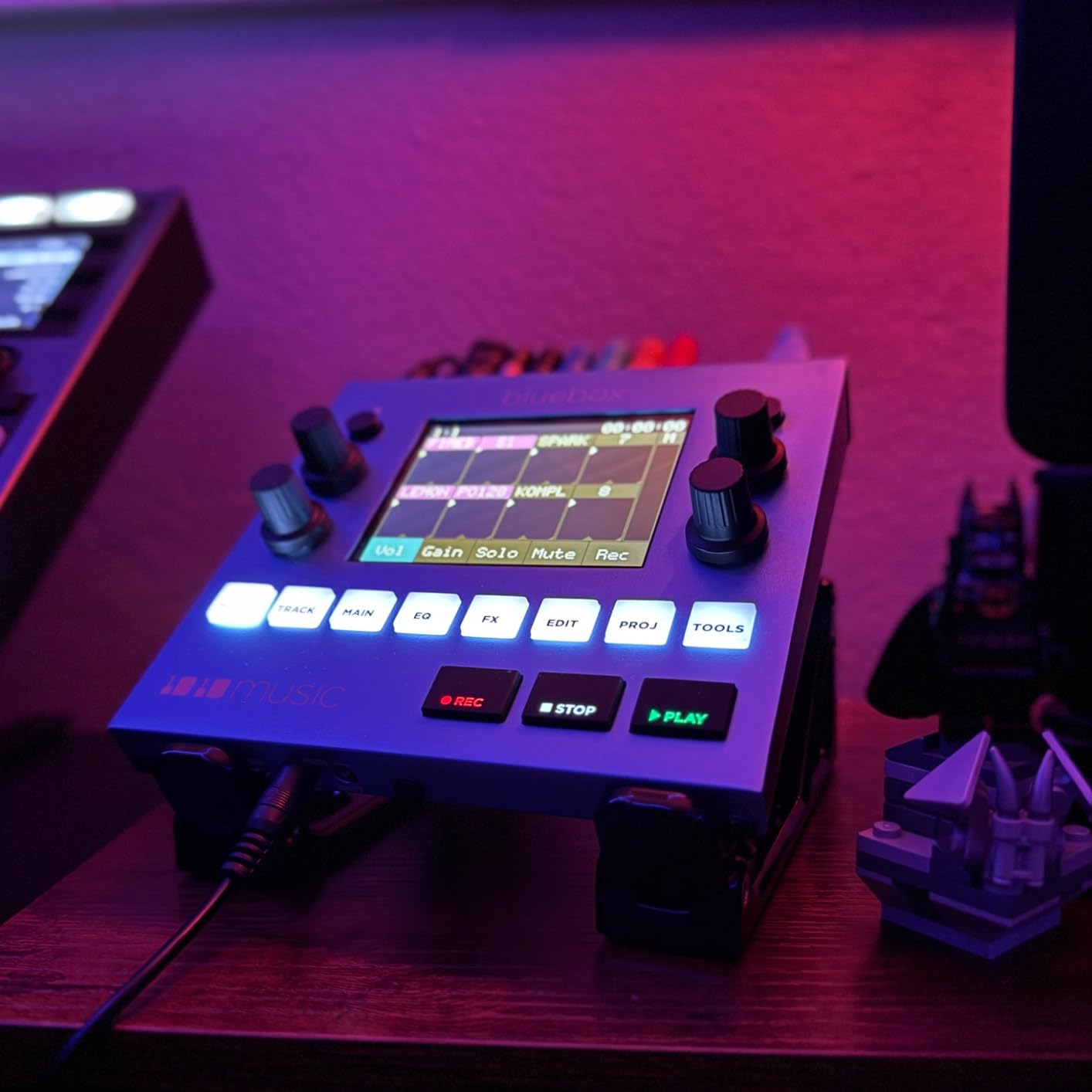
The 1010music Bluebox is not a traditional groovebox, but it serves as the central hub that many DAWless setups desperately need. It is a compact digital mixer and recorder with 6 stereo inputs, 3 stereo outputs, and a responsive touch screen interface. If you are running multiple grooveboxes, synths, and drum machines, the Bluebox lets you mix, route, and record everything in one place without a computer.
The audio quality is genuinely pristine. The built-in reverb and delay effects sound beautiful, adding professional polish to live mixes. Internal audio routing is flexible enough to handle complex signal chains. Multitrack recording to microSD card means you can capture every input separately for later mixing in your DAW. The touch screen and knobs are responsive and make real-time mixing intuitive.
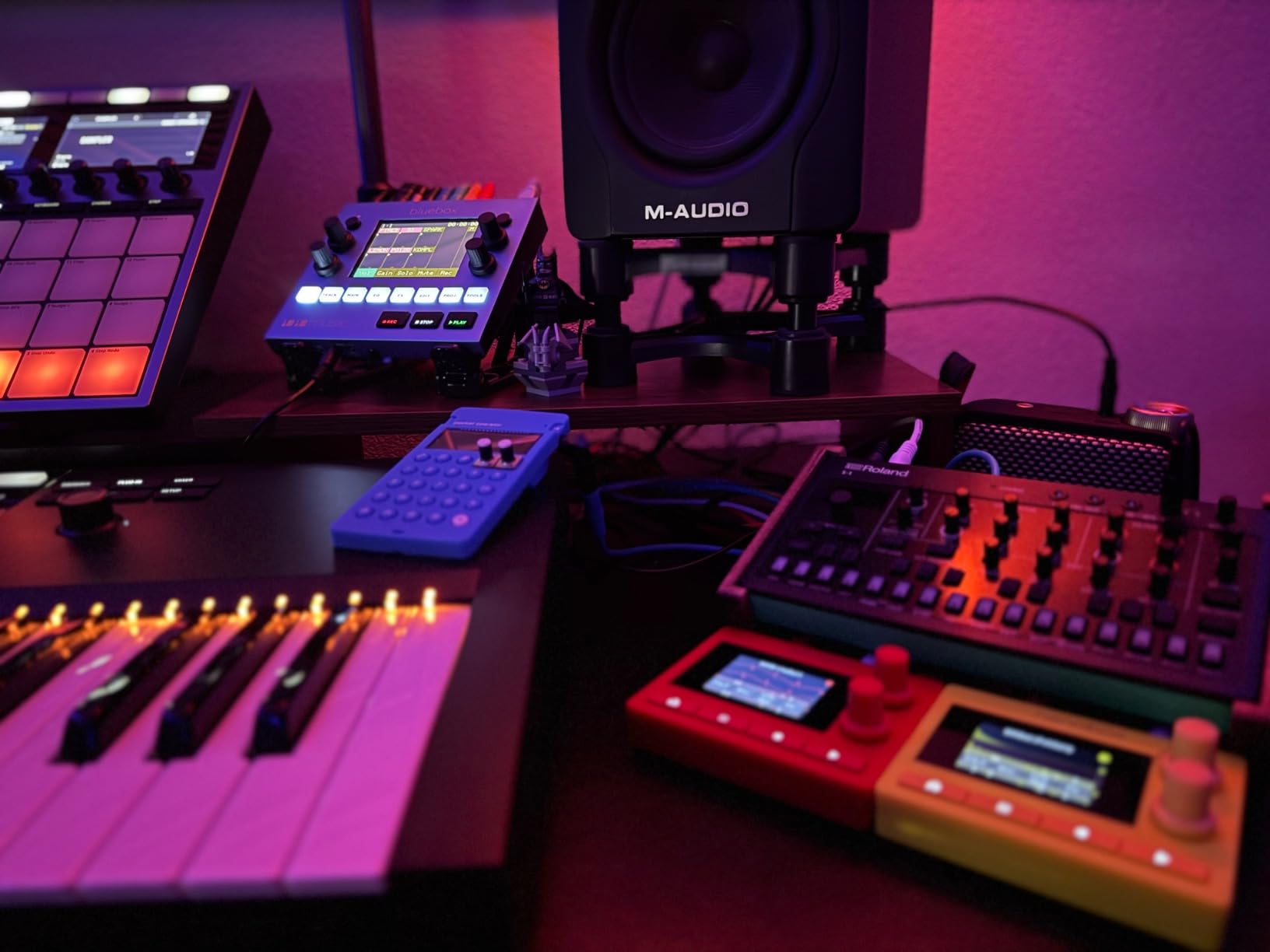
The main drawback is the 3.5mm (1/8-inch) jack connectors. Most studio gear uses 1/4-inch plugs, so you will need adapters for nearly everything, which creates a nest of cables and adapters. The file management interface is also clunky, and some firmware features are still being developed. The Bluebox does not function as a multi-channel audio interface for your computer, limiting its studio utility.
Who Should Buy the Bluebox
Producers with multi-device DAWless setups who need a central mixer and recorder. If you have several grooveboxes, drum machines, and synths that need to be mixed and recorded together, the Bluebox is purpose-built for this. Live performers who need a compact mixing solution with recording capability will also appreciate its portability and feature set.
Who Should Look Elsewhere
If you only have one or two devices, a traditional groovebox with built-in sequencing will serve you better. The adapter situation with 3.5mm jacks is frustrating for studio use. If you need a full audio interface for computer recording, the Bluebox does not serve that purpose. Consider it a specialized tool rather than a primary creative instrument.
11. Donner Essential B1 – Best Budget Analog Bass Synth
Analog Bass Synthesizer and Sequencer, Donner Essential B1 with Intuitive User Interface, 128 Patterns Memory, Saturation & Delay Effects, Make for Classic Acid Sound
Analog bass synth and sequencer
1 VCO 1 VCF 1 VCA signal path
128 presets
8-mode arpeggiator
Song Mode
MIDI I/O and Sync I/O
Pros
- High quality analog sound for the price
- Intuitive and easy to program
- Premium build quality for budget price
- Great sound through amps and headphones
- Easy MIDI connectivity with DAW and hardware
Cons
- Faint hiss when not playing
- Effects are average
- Limited compared to original TB-303
- Very lightweight body
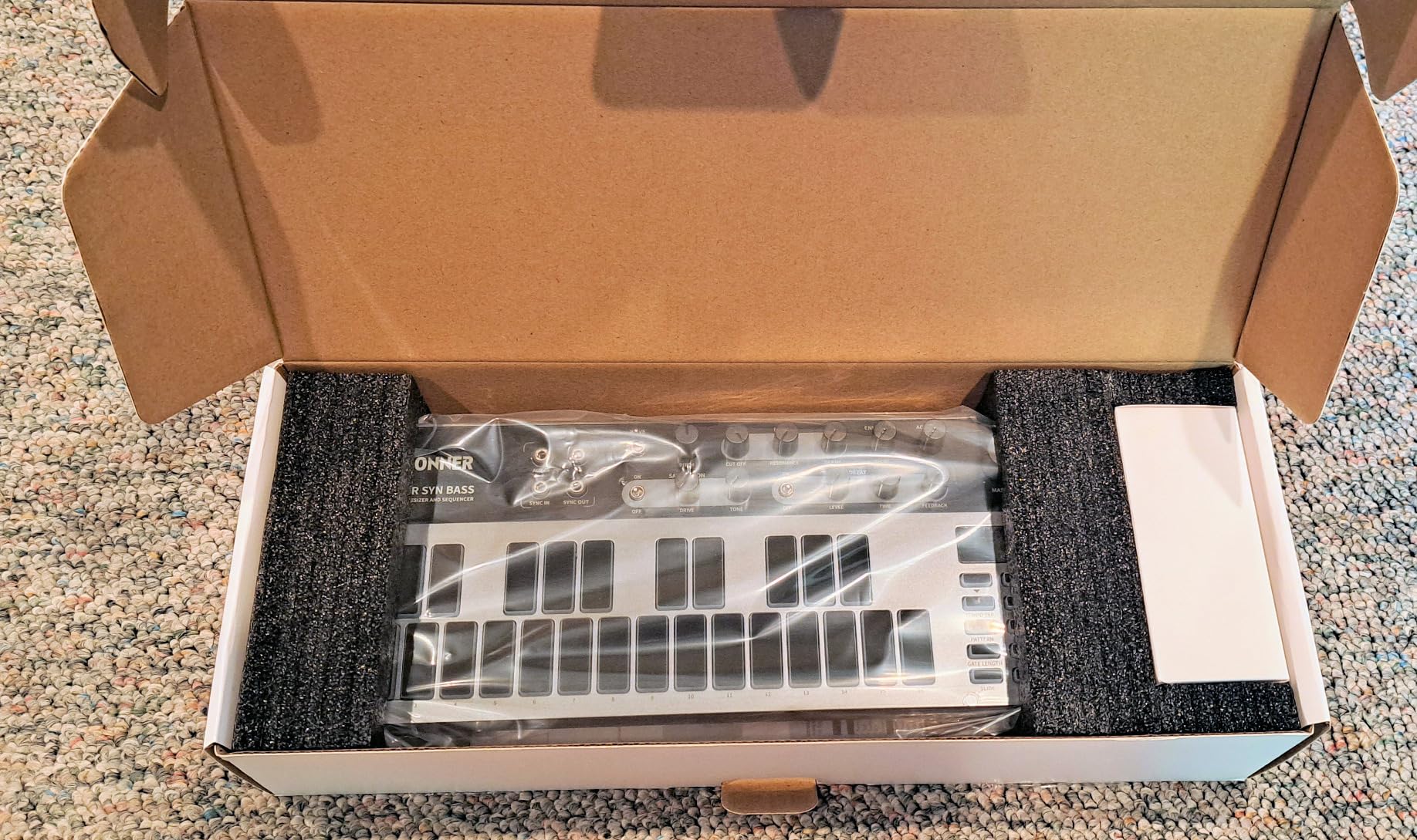
The Donner Essential B1 is proof that analog synthesis does not have to cost a fortune. This compact bass synthesizer delivers a genuine 1 VCO, 1 VCF, 1 VCA analog signal path that produces warm, organic bass tones reminiscent of the legendary Roland TB-303. At under $100, I was not expecting much, but the sound that came out of my monitors was genuinely impressive for the price.
The 128 preset slots give you plenty of room to store your creations, and the 8-mode arpeggiator adds movement and interest to sequences. The Haptic Pads with color-changing backlights are a nice touch, making pattern programming visual and intuitive. Song Mode, added via firmware update, lets you chain patterns together for longer compositions. Connectivity includes USB Type-C for DAW integration, 5-pin MIDI in and out, and Sync in and out.
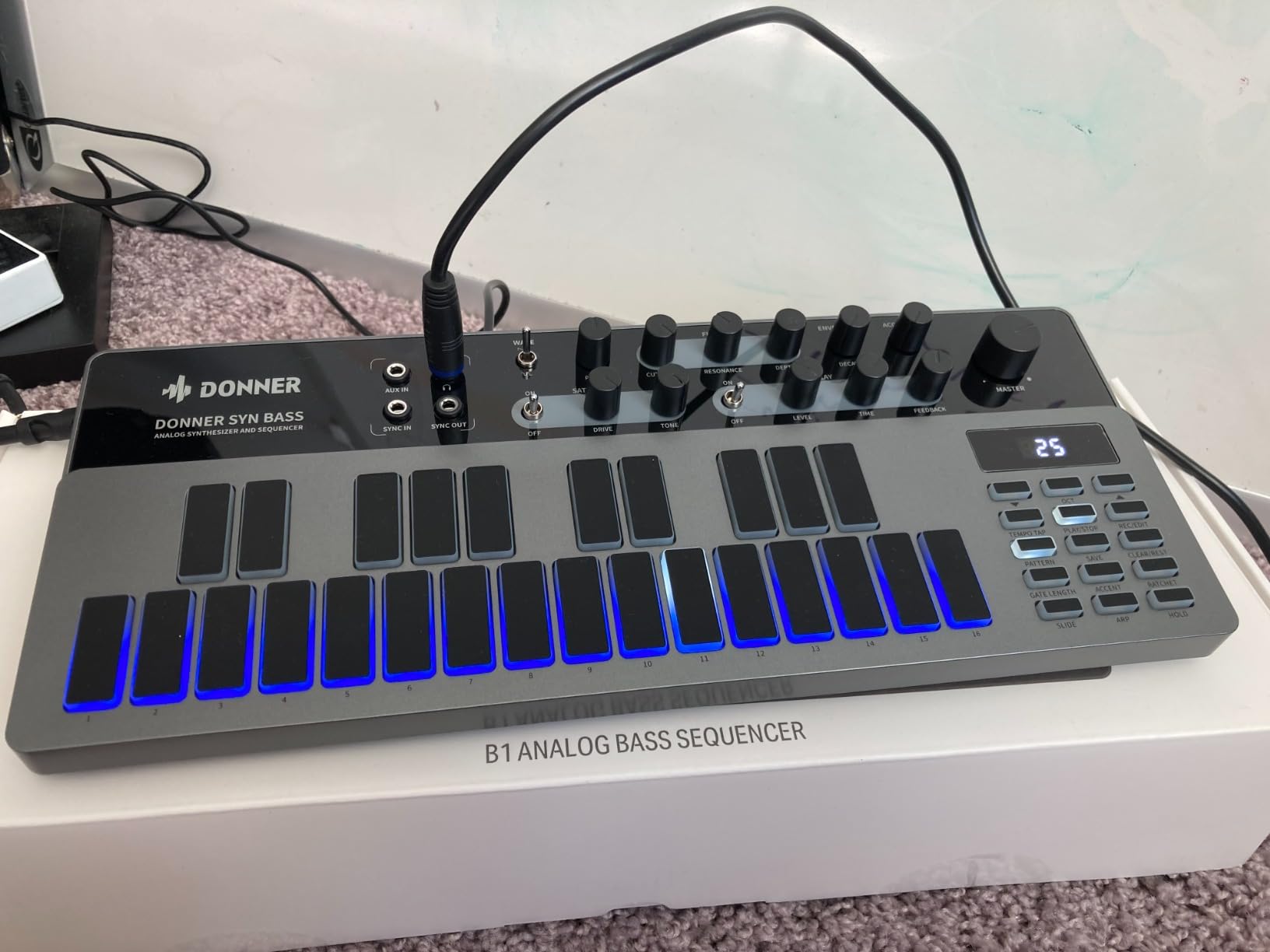
Where the B1 shows its budget nature is in the details. There is a faint but audible hiss when no notes are playing, which you will need to gate or noise-remove for clean recordings. The analog saturation and delay effects are serviceable but not outstanding. It is also physically very light at 9.6 ounces, which feels a bit insubstantial on a desk. But the sound through amplifiers, headphones, and speakers is genuinely satisfying.
Who Should Buy the Essential B1
Anyone who wants to explore analog bass synthesis without spending hundreds. The B1 is perfect for acid house, techno basslines, and experimental electronic music. It is an excellent first hardware synth for beginners and a fun addition to any DAWless setup. The intuitive step sequencer and easy MIDI integration make it accessible even if you have never used a hardware synth before.
Who Should Look Elsewhere
If you need pristine, noise-free audio for studio recording, the hiss might bother you. Sound design purists who want the authentic TB-303 experience should look at the Behringer TD-3 instead. The B1 is also limited to bass sounds, so it cannot serve as your only groove box for full productions. Pair it with a drum machine or sampler for a complete setup.
12. Donner MEDO – Best Ultra-Portable Bluetooth Groove Box
Bluetooth MIDI controller and groovebox
5 modes: Bass Chord Lead Drum Sample
100+ presets
128-bar looper
8 gesture controls
170 grams
Pros
- Extremely lightweight and compact
- Buttons are super responsive
- Excellent Bluetooth MIDI connectivity
- Good sound quality for the price
- Works as a pocket MPC with loop recording
Cons
- App does not always auto-reconnect
- Limited chord combinations
- No external controller input
- Bluetooth audio does not work on Mac
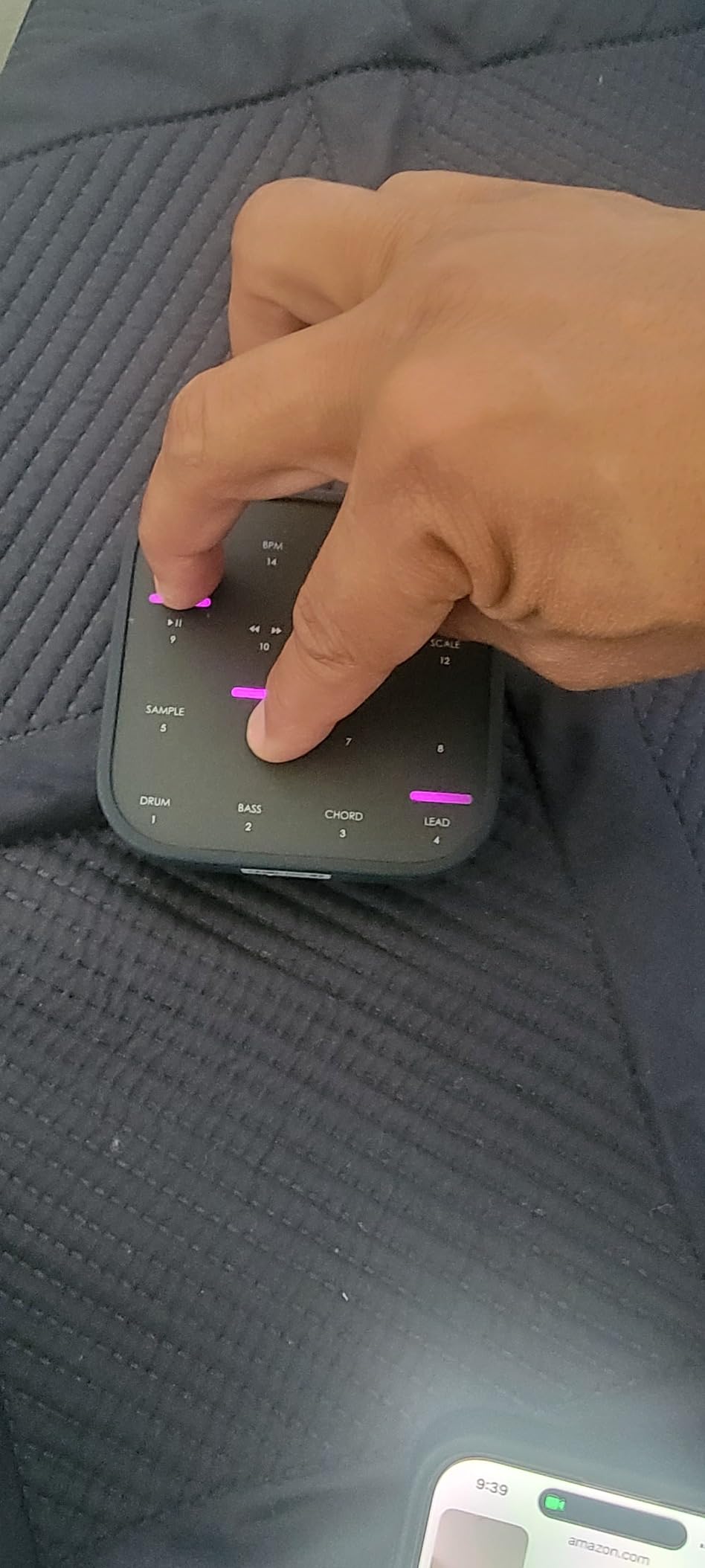
The Donner MEDO is one of the smallest and lightest groove boxes I have ever used, weighing just 170 grams and measuring 3.4 inches square. Despite its tiny footprint, it packs five sound modes: Bass, Chord, Lead, Drum, and Sample, plus over 100 presets built from real instrument samples and subtractive synthesis. The 16 touch-sensitive keys are surprisingly responsive, and note bending works really well for expressive playing.
What makes the MEDO unique is its gesture control system. You can interact with the device through 8 different gestures including click, press, slide, slap, tilt, shake, wiggle, and move. It sounds gimmicky, but in practice it adds genuine expressiveness to performances. The 128-bar built-in looper with 3 auto-quantization modes lets you build layered compositions on the go, and Bluetooth MIDI connectivity means no cables needed when pairing with your phone or tablet.
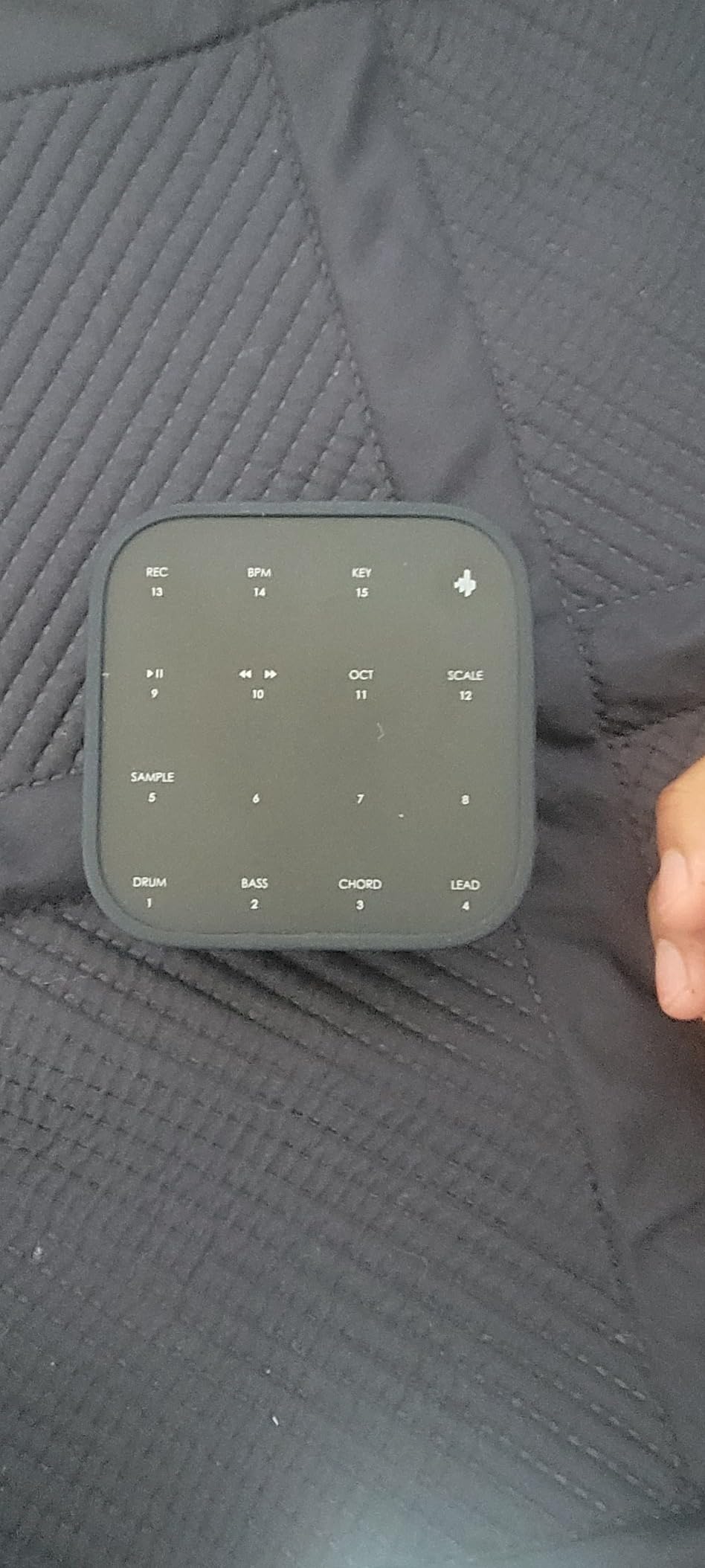
The 2000mAh lithium-ion battery gives you about 3 hours of use, which is adequate for a pocket device. The 3.5mm headphone jack provides private listening, and the Donner Play plus MEDO SYNTH companion apps offer parameter editing and additional sound management. The silicone sleeve included in the box adds protection and grip, which is a thoughtful touch for a device you are meant to carry around.
Who Should Buy the MEDO
Anyone who wants an ultra-portable music-making device that fits in a pocket. The MEDO is great for capturing quick musical ideas during commutes, travel, or whenever inspiration strikes. It is also a fun gift for teens and young musicians who want to experiment with electronic music production. The Bluetooth connectivity and app integration make it accessible even for complete beginners.
Who Should Look Elsewhere
The MEDO is more of a creative sketch pad than a production tool. Limited chord options, no external controller input, and the fact that Bluetooth audio does not work on Mac computers restrict its usefulness for serious production. If you need a standalone groovebox that can produce full tracks, look at the Akai MPC Sample or Roland MC-101 instead.
13. Teenage Engineering PO-33 KO – Best Pocket Sampler
Teenage Engineering Pocket Operator PO-33 KO
Pocket-sized sampler and groovebox
40 seconds sample memory
4 voices polyphony
16 patterns chainable to 128
16 effects
Built-in speaker
0.05 kg
Pros
- Unique workflow unlike other samplers
- Incredible battery life
- Pure fun to use
- Compact and truly pocket-sized
- Easy sampling workflow
Cons
- Only 40 seconds total sample memory
- Only 16 pattern slots
- Tiny fiddly knobs and buttons
- Learning curve with minimal documentation
The Teenage Engineering PO-33 KO is the most portable groovebox in this entire roundup, and arguably the most fun. It weighs just 50 grams, runs on two AAA batteries for what feels like forever, and has a built-in speaker that lets you make beats literally anywhere. The sampling workflow is dead simple: plug any audio source into the 3.5mm input, hold record, and capture sounds directly into the device.
With 40 seconds of total sample memory and 16 pattern slots that can be chained up to 128 patterns, the PO-33 KO is obviously limited. But that is part of the charm. Constraints breed creativity, and I found myself making more interesting music with 40 seconds of sample memory than I do with unlimited storage on my computer. The 16 built-in effects add character, and the mono 8-bit sampling gives everything a lo-fi, gritty quality that sounds fantastic for beat-making.
Who Should Buy the PO-33 KO
Anyone who wants the most portable sampler in existence. The PO-33 KO is perfect for commuting, traveling, or just having in your pocket for whenever inspiration strikes. It is also an excellent gift for anyone curious about hardware music production. The price point and simplicity make it nearly risk-free to try. Many producers on Reddit and Gearspace describe it as pure fun in pocket form.
Who Should Look Elsewhere
The limitations are real: 40 seconds of sample memory goes fast, 16 patterns fill up quickly, and the tiny knobs and buttons require patience. There is no MIDI output, no USB connectivity for transferring samples, and the screen is minimal. This is not a production tool. It is a creative toy that happens to make genuinely usable beats. For a more capable pocket device, consider the Donner MEDO.
How to Choose the Best Groove Box for Your Needs
Finding the right groovebox comes down to understanding your workflow, your experience level, and what kind of music you want to make. After testing all 13 devices in this guide, I can tell you that no single groovebox does everything perfectly. The key is matching the device to how you actually make music, not how you think you should make music.
What Is a Groove Box?
A groovebox is a self-contained electronic music instrument that combines at least two of these three core elements: a drum machine, a synthesizer, and a sequencer. Some add sampling, effects processing, and mixing capabilities. Unlike a standalone synthesizer or drum machine, a groovebox is designed to create complete musical ideas, beats, or even full tracks without needing a computer or additional hardware. Think of it as a portable music studio in a single box.
Sequencer Type and Workflow
The sequencer is the heart of any groovebox, and the workflow it provides determines how quickly you can translate ideas into music. Step sequencers like those on the Roland MC-101 and MC-707 let you program notes one step at a time on a grid, which is precise but methodical. Real-time recorders like the Akai MPC Sample let you play parts in live with the pads, capturing your natural timing and feel. Some devices, like the Novation Circuit, combine both approaches.
Consider whether you prefer a visual, grid-based approach or a more performative, pad-based workflow. If you like building patterns methodically, a step sequencer will serve you well. If you prefer jamming live and capturing performances, look for devices with good real-time recording and quantization options.
Sound Engine: Sampling vs Synthesis
Some grooveboxes focus on sampling, letting you record and manipulate audio from external sources. The Akai MPC Sample, Novation Circuit Rhythm, and Teenage Engineering PO-33 KO are sampling-focused devices. Others prioritize synthesis, generating sounds from oscillators and filters. The Sonicware Liven XFM, Donner Essential B1, and Novation Circuit are synthesis-first. Devices like the Roland MC-707 and MC-101 offer both approaches through different track types.
If you love chopping breaks, manipulating found sounds, and working with audio recordings, a sampler groovebox is your best bet. If you prefer designing sounds from scratch using oscillators, filters, and envelopes, look for synthesis-focused devices. Many producers end up with both types in their setup.
Portability and Power Options
Battery power matters more than you might think. The ability to make music on the couch, at a park, or during travel changes how often you actually use the device. The Teenage Engineering PO-33 KO, Donner MEDO, and Roland T-8 are the most portable options here, all running on batteries and weighing under 2 pounds. The Roland MC-101 runs on AA batteries, and the Akai MPC Sample has a rechargeable lithium-ion battery. The Roland MC-707 and 1010music Bluebox require AC power, keeping them studio-bound.
If portability is a priority, also consider built-in speakers. Having a speaker means you can sketch ideas without headphones, which makes a big difference for casual, on-the-go music making.
Connectivity and DAW Integration
Even if you want a DAWless workflow, connectivity matters for integrating with other hardware and for when you do need to transfer projects to your computer. MIDI in and out is essential for controlling or being controlled by other gear. USB audio and MIDI connectivity lets you use the groovebox as an audio interface with your DAW. Sync in and out keeps multiple devices playing in time together.
The Roland T-8 and MC-707 offer comprehensive connectivity. The Akai MPC Sample supports MPC OS 3.8 which expands workflow across standalone and desktop systems. The Donner MEDO uses Bluetooth MIDI for wireless control. Consider what other gear you own or plan to own, and make sure your groovebox can connect to it.
Beginner vs Advanced Considerations
If you are buying your first groovebox, prioritize devices with intuitive workflows, good documentation, and room to grow. The Novation Circuit series, Roland T-8, and Akai MPC Sample are all excellent beginner choices that offer enough depth to keep you engaged as your skills improve. The included Melodics lessons with the MPC Sample are particularly helpful for new producers.
Advanced producers should look at devices like the Roland MC-707 for complete production capability, or the 1010music Bluebox for managing complex multi-device setups. The Sonicware Liven XFM and 8bit Warps offer unique sound engines that can add character to any production, regardless of experience level.
Genre-Specific Recommendations
For techno and house production, the Roland MC-707 and Roland T-8 deliver those classic drum sounds and bass lines that define the genre. For hip-hop and beat-making, the Akai MPC Sample provides the sampling workflow that has been central to hip-hop production for decades. For ambient and experimental music, the Sonicware Liven XFM with its FM textures and the Sonicware 8bit Warps with lo-fi character offer unique sonic palettes. For lo-fi hip-hop and chill beats, the Teenage Engineering PO-33 KO adds an 8-bit warmth that works perfectly.
Frequently Asked Questions About Groove Boxes
Which is the best groovebox?
The Akai Professional MPC Sample is the best overall groovebox for most people. It delivers the iconic MPC sampling workflow in a portable, battery-powered format with responsive pads, a built-in microphone, and over 60 effect types. For professional use, the Roland MC-707 offers the most complete production workstation with 8 tracks and comprehensive effects.
How does a groovebox differ from a synth?
A groovebox combines multiple music production tools into one unit: typically a drum machine, synthesizer, and sequencer at minimum. A standalone synthesizer only generates and shapes sound. Grooveboxes are designed for creating complete beats and patterns, while synths focus on individual sound design. Many grooveboxes include synthesizers as one of their components, but a groovebox does much more than any single synth.
Is the Roland SP-404 a groovebox?
Yes, the Roland SP-404 is considered a groovebox by many producers. It combines a sampler, sequencer, and effects processor in a portable unit. While Roland markets it as a sampler, its ability to create complete beats and perform live sets without a computer places it firmly in the groovebox category. The SP-404 MKII is particularly popular for its ease of use and distinctive sample-based workflow.
Are grooveboxes good for sound design?
Grooveboxes can be good for sound design, but it depends on the model. Synthesis-focused grooveboxes like the Sonicware Liven XFM and Roland MC-707 offer deep sound design capabilities with multiple synth engines and extensive modulation. Sampling-focused grooveboxes like the Akai MPC Sample excel at manipulating and transforming recorded audio. However, dedicated synthesizers generally offer more detailed sound design control than grooveboxes.
Can a groovebox replace a DAW?
A groovebox can replace a DAW for certain types of music production, particularly beat-making, electronic music, and live performance. Devices like the Roland MC-707 with 8 tracks, extensive effects, and song mode can produce complete tracks without any computer. However, for complex mixing, detailed editing, film scoring, or multi-track recording, a DAW still offers more power and flexibility. Many producers use grooveboxes alongside their DAW rather than as a complete replacement.
Final Thoughts on the Best Groove Boxes in 2026
After testing all 13 devices in this guide, the Akai Professional MPC Sample stands out as the best groove box for most people. It combines the legendary MPC workflow with true standalone portability, excellent pads, and enough effects and sampling power to keep you creating for months. For professionals who need a complete workstation, the Roland MC-707 is the top choice with its 8-track production capabilities and extensive sound library.
For budget-conscious producers, the Roland T-8 delivers incredible value with classic Roland drum and bass sounds, and the Donner Essential B1 offers genuine analog synthesis at a price that makes it easy to take a chance on hardware. Whatever your budget or experience level, there is a groovebox in this guide that will get you making music without a computer. Pick the one that matches your workflow, and start creating.