
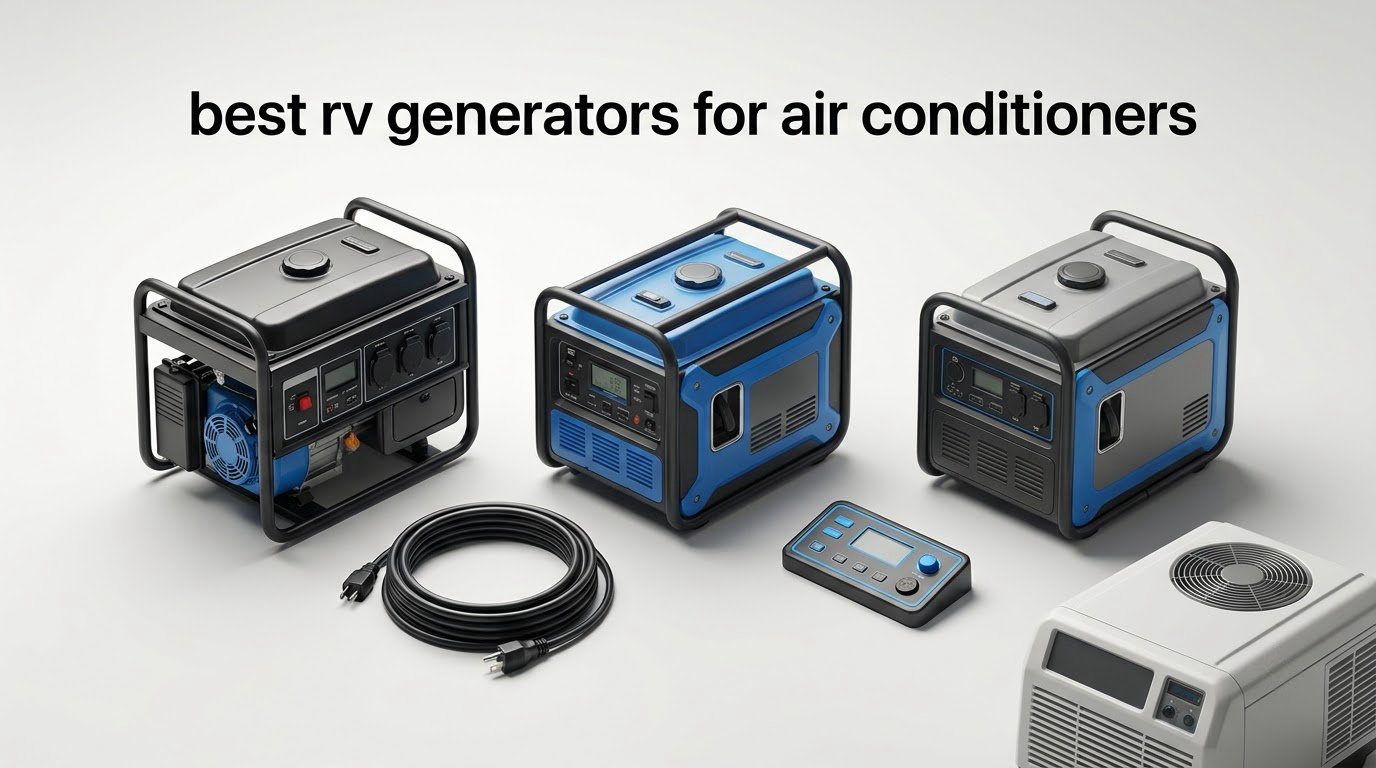
A rooftop air conditioner is the single hardest load in an RV. A 13,500 BTU unit settles around 1,300 to 1,600 running watts, but when the compressor kicks on it asks for roughly 2,800 to 3,500 watts in a burst that lasts a few seconds. That is why so many owners buy a “4000 watt” generator and still watch the lights flicker every time the AC cycles.
The best RV generators for air conditioners are the ones whose starting watt rating clears your compressor spike with room to spare, whose running watts cover the AC plus anything else you switch on, and whose noise level survives campground quiet hours. Those three filters narrow a crowded field of dual fuel and inverter units down to a short list. We compared twelve of them, weighing published specifications against what owners actually report after running them in summer heat.
Nobody should be guessing at the math. If you want the wider background on generator categories first, our RV generator guide covers inverter versus open frame, and our dual fuel guide breaks down the propane-versus-gasoline tradeoff in detail.
Table of Contents
How Big a Generator Do You Need for an RV AC?
Most RV rooftop units need 3,500 to 4,500 starting watts, and a 4,000 watt inverter with a 3,000 watt running rating is the practical sweet spot for a single 13,500 or 15,000 BTU air conditioner. Here is the reference by cooling capacity:
8,000 BTU rooftop unit: about 900 to 1,000 running watts, roughly 2,000 to 2,400 starting watts. A 2,500 to 3,000 watt generator handles it.
10,000 BTU rooftop unit: about 1,100 to 1,200 running watts, roughly 2,300 to 2,700 starting watts. A 3,000 watt unit is enough.
13,500 BTU rooftop unit: about 1,300 to 1,600 running watts, roughly 2,800 to 3,500 starting watts. Target a 3,500 to 4,000 starting watt generator.
15,000 BTU rooftop unit: about 1,500 to 1,800 running watts, roughly 3,000 to 3,900 starting watts. Target 4,000 to 4,500 starting watts.
18,000 BTU or dual AC setup: about 1,800 to 2,200 running watts per unit and 3,800 to 4,500 starting watts each. Budget 7,000 to 8,000 starting watts, or a built-in unit.
Yes, you can run an RV air conditioner from a generator. The compressor draws a short high-current burst and then settles to a much lower continuous load, so a generator rated above the AC’s starting requirement will hold steady once the compressor is up to speed.
Our RV air conditioner roundup covers the rooftop units themselves if you are still choosing what will be running on the roof.
Starting Watts vs. Running Watts (and What Reduces Your Power)
Running watts are the number you use for budgeting hours of runtime. Starting watts, sometimes listed as peak or surge, are the number that decides whether the compressor will ever turn over.
Retailer pages mix these constantly, and that confusion drives most purchase regret. A listing advertising “4500 watts” may mean 4,500 peak with only 3,500 running underneath. The peak figure is the one that has to clear your AC compressor, and the running figure is the one that has to cover everything else switched on at the same time.
Three real conditions quietly cut into a rated number:
Altitude. Air thins roughly 3 percent per 1,000 feet of elevation, and so does available output. A 4,000 watt unit becomes closer to 3,280 watts at 8,000 feet, which is not enough margin for a 15,000 BTU compressor in the Rockies.
Propane. Dual fuel machines publish a lower output on propane than on gasoline. Several units in our list lose 300 to 400 running watts when you switch tanks.
Heat and coil condition. A compressor working against a dirty condenser coil or a hundred-degree afternoon draws closer to its surge than its nameplate suggests. Stagger your startups and give the AC a minute before adding other loads.
Top 3 Picks for Running an RV Air Conditioner (October 2026)

Champion 4000W Dual Fuel RV Ready
- 4000 starting watts and 3000 running watts
- 25A TT-30R RV outlet
- Dual fuel capability
- 51.8 pounds
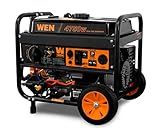
WEN DF475T 4750W Dual Fuel
- 3800 running watts on gasoline
- Switchable 120V and 240V output
- 11 hours at half load
- Electric start and wheel kit
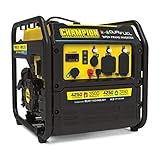
Champion 4250W Dual Fuel Open Frame
- 4250 starting watts and 3500 running watts
- 22 hours on a 4-gallon tank
- 30A RV outlet
- Parallel ready
Best RV Generators for Air Conditioners in 2026 at a Glance
Every generator below clears the starting requirement for at least a 13,500 BTU rooftop unit on gasoline. Read each row for the surge margin it gives you, since that margin is what decides whether your compressor ever turns over.
| Product | Specifications | Action |
|---|---|---|
| Champion 4000W Dual Fuel RV Ready |
|
Check Latest Price |
 Champion 4500W Electric Start Dual Fuel Champion 4500W Electric Start Dual Fuel |
|
Check Latest Price |
| Champion 4250W Dual Fuel Open Frame |
|
Check Latest Price |
 PowerSmart 3800W Dual Fuel Inverter PowerSmart 3800W Dual Fuel Inverter |
|
Check Latest Price |
| WEN DF475T 4750W Dual Fuel |
|
Check Latest Price |
 WEN DF451i 4500W Dual Fuel Inverter WEN DF451i 4500W Dual Fuel Inverter |
|
Check Latest Price |
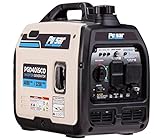 Pulsar PGD40ISCO 4000W Inverter Pulsar PGD40ISCO 4000W Inverter |
|
Check Latest Price |
 Oxseryn 4400W Inverter with 30A Outlet Oxseryn 4400W Inverter with 30A Outlet |
|
Check Latest Price |
 maXpeedingrods 4000W Inverter maXpeedingrods 4000W Inverter |
|
Check Latest Price |
 BILT HARD 4500W Dual Fuel BILT HARD 4500W Dual Fuel |
|
Check Latest Price |
 AIVOLT 4300W Dual Fuel Inverter AIVOLT 4300W Dual Fuel Inverter |
|
Check Latest Price |
 WEN 56455i 4500W RV Ready Inverter WEN 56455i 4500W RV Ready Inverter |
|
Check Latest Price |
1. Champion 4000-Watt Dual Fuel RV Ready Inverter – The Best Overall Pick for an RV AC
Champion 4000-Watt Dual Fuel RV Ready Portable Inverter Generator
4000 starting watts
3000 running watts
25A TT-30R outlet
1.54 gal tank
51.8 lb
Pros
- Starts a 12000 to 15000 BTU rooftop AC
- Built-in 25A TT-30R RV outlet
- Eco mode holds the AC without dropping out
- Dual fuel on gasoline or propane
- Light enough for one person at about 52 pounds
Cons
- Louder than sub-55 dBA inverter units at 64 dBA
- AC plus microwave exceeds 3000 running watts
- Some units needed a gasoline break-in before propane
This is the unit we keep coming back to for a reason: it is the only machine in the group under 55 pounds that still ships with a genuine 25A TT-30R RV outlet. Plugging straight into a 30 amp trailer receptacle is the whole game for most owners, and most competitors in this output class force you to bring your own adapter.
The 4000 starting watt figure sits comfortably above the 2,800 to 3,500 watt burst a 13,500 or 15,000 BTU compressor demands, and the 3000 running watt rating means you can run the AC, the refrigerator, and a battery converter together without the overload reset. On gasoline the tank holds 1.54 gallons and owners report roughly 8 to 10 hours under a typical nighttime load. Switched to propane, output drops to 2700 running watts and the runtime stretches toward 25 hours on a standard tank.
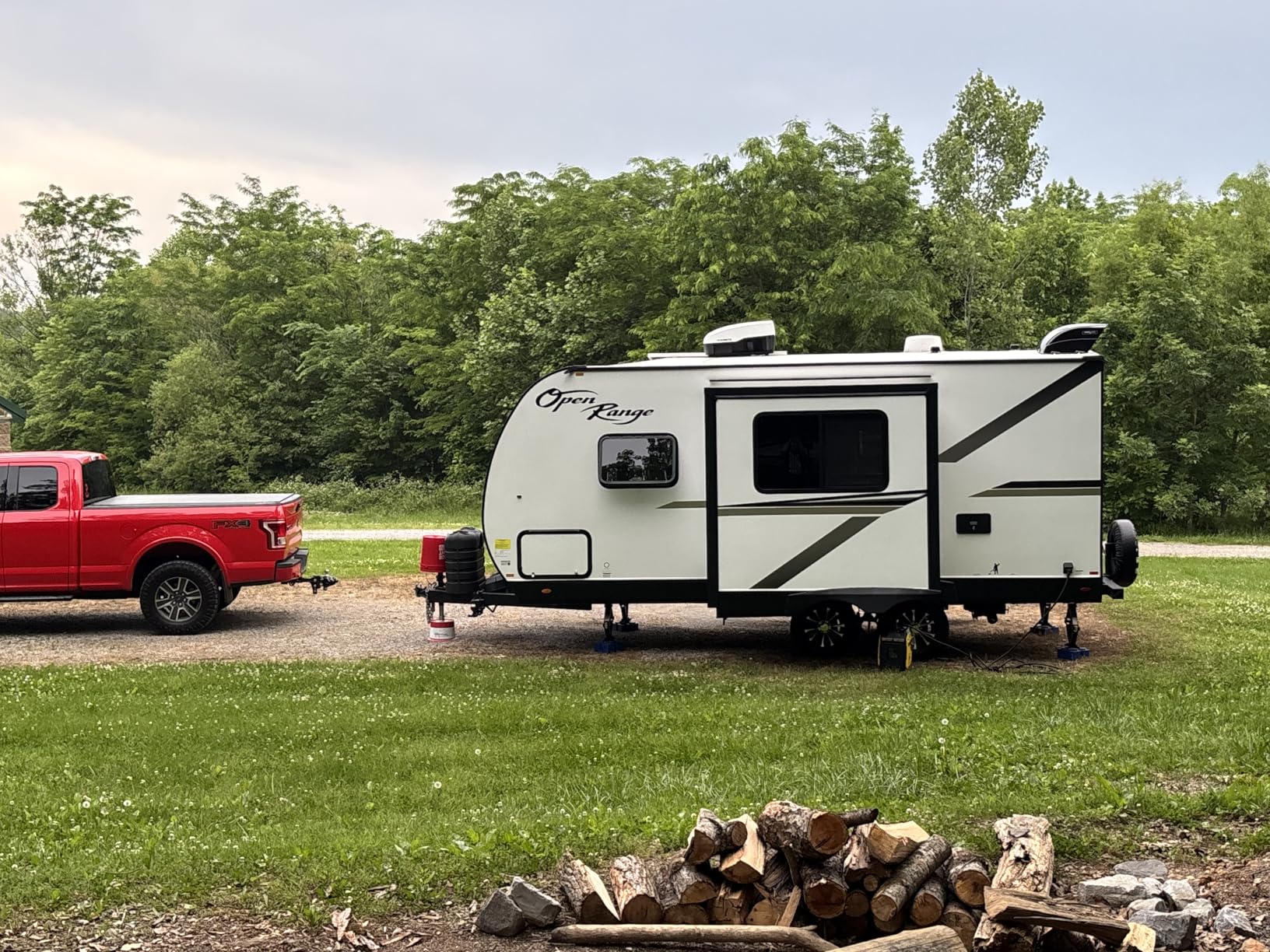
Total harmonic distortion under 3 percent means the output is clean enough for laptops, phones, and inverter-sensitive electronics, and a three-year limited warranty is longer than most of the field. The parallel ports let you double output later with a sold-separately kit if you upgrade to a 15,000 BTU unit or add a second AC.
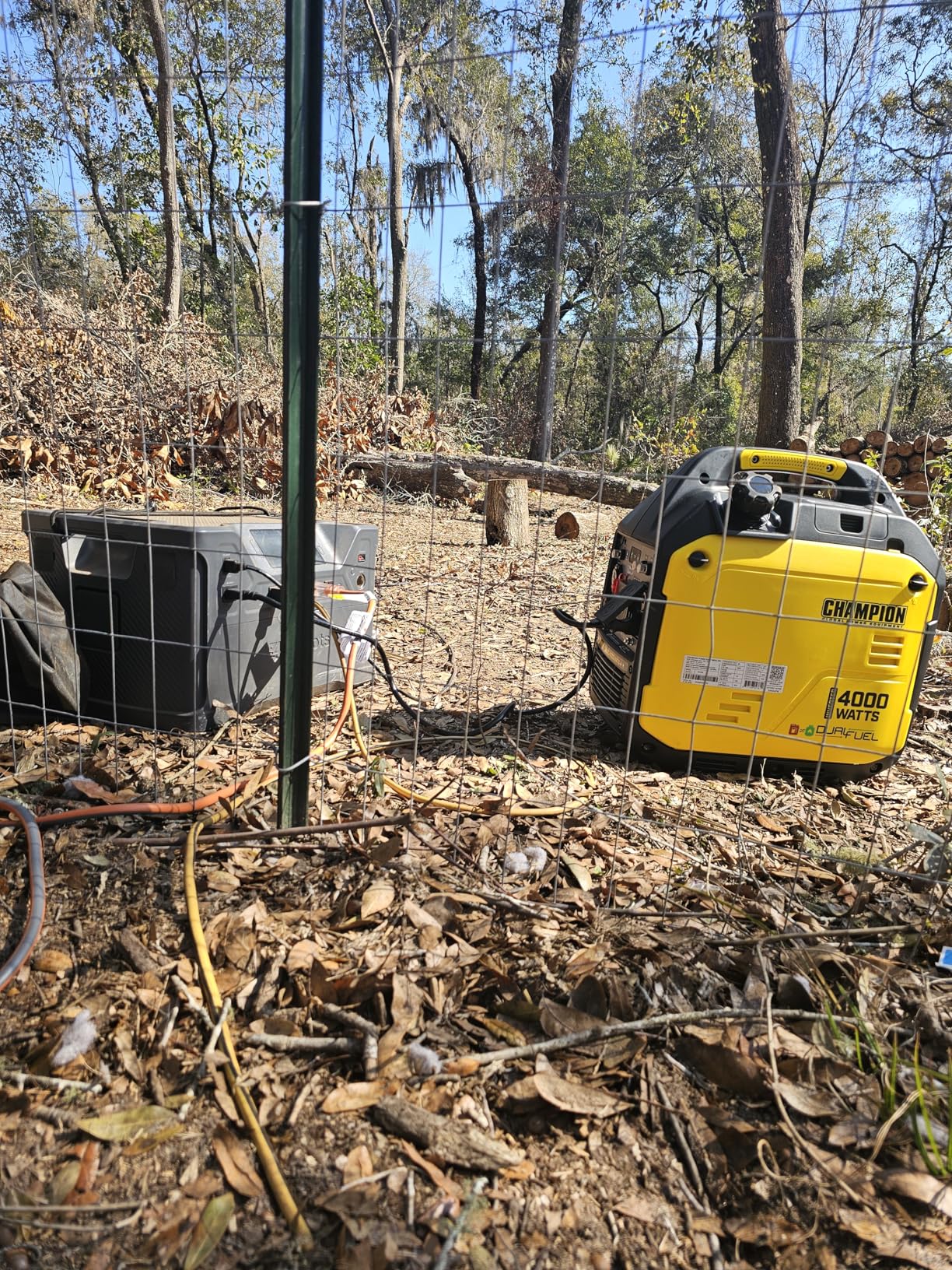
Will it actually start a 15,000 BTU rooftop AC?
Yes, on gasoline. The compressor’s roughly 3,000 to 3,900 watt startup burst lands well inside the 4000 starting watt ceiling, and 3000 running watts leaves genuine headroom once the compressor is loaded. A minority of owners note that a very small number of units would not fire on propane until they had been broken in on gasoline, so run it on gas first if you buy it.
The one real limit is pairing. Running the AC and a full-power microwave together will push past 3000 running watts and trip the overload protection. Sequence it, or use the propane runtime for the overnight stretch and gasoline for the microwave window.
Is it quiet enough for campground rules?
Not the quietest unit here, at 64 dBA measured at 23 feet, and the figure climbs at full load. That is inside the range most campgrounds and national parks accept during normal daytime hours, and many owners run it on eco mode overnight where the AC load keeps the engine in a low state.
If you are camping somewhere with strict quiet hours from dusk onward and the AC is your only reason for the generator, the smaller 53 to 59 dBA inverters later in this list are the better fit. Weight matters too, and at roughly 52 pounds this is one of the few high-output machines a single person can lift into a truck bed.
2. Champion 4500-Watt Electric Start Dual Fuel Inverter – Best for Overnight Runs
Champion 4500-Watt Electric Start Dual Fuel Portable Inverter Generator
4500 starting watts
3500 running watts
61 dBA
2.25 gal tank
99.2 lb
Pros
- Runs a camper AC plus appliances without strain
- Up to 14 hours on gasoline
- Single-pull electric start with a dial control
- Parallel ready for doubled output
- Quiet enough for campground use
Cons
- About 99 pounds takes two people to load
- CO sensor can shut down in a closed truck bed
- Warranty work may require an authorized shop
This is the one to buy if you plan to leave the AC running all night without refilling anything. The 2.25 gallon tank delivers up to 14 hours on gasoline, which comfortably covers a long boondocking stretch, and the 3500 running watt rating means the compressor plus your household loads are not fighting for headroom.
The 4500 starting watt ceiling clears both 13,500 and 15,000 BTU units, and the electric start with an EZ Start dial means you are not hauling a recoil cord in the dark. Owners running a travel trailer report it carrying the air conditioner and camper appliances together, and pairs of these share load well through a parallel kit.
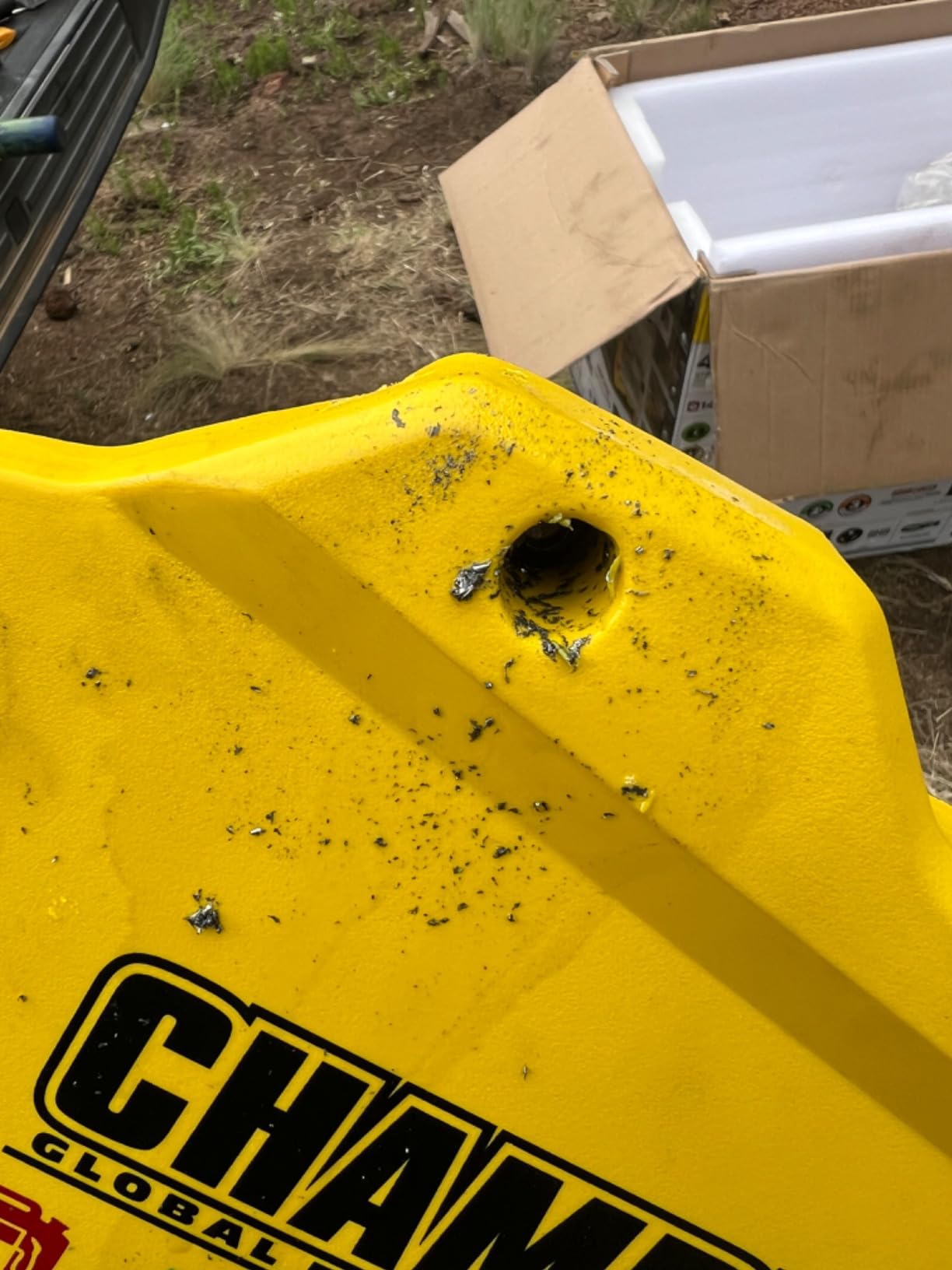
At 61 dBA it sits in the middle of the inverter pack, which is a fair trade for the runtime. Propane output drops to 3150 running watts and stretches runtime to about 21 hours, so switching tanks is a good move when you settle in for a long stretch with no other draw.
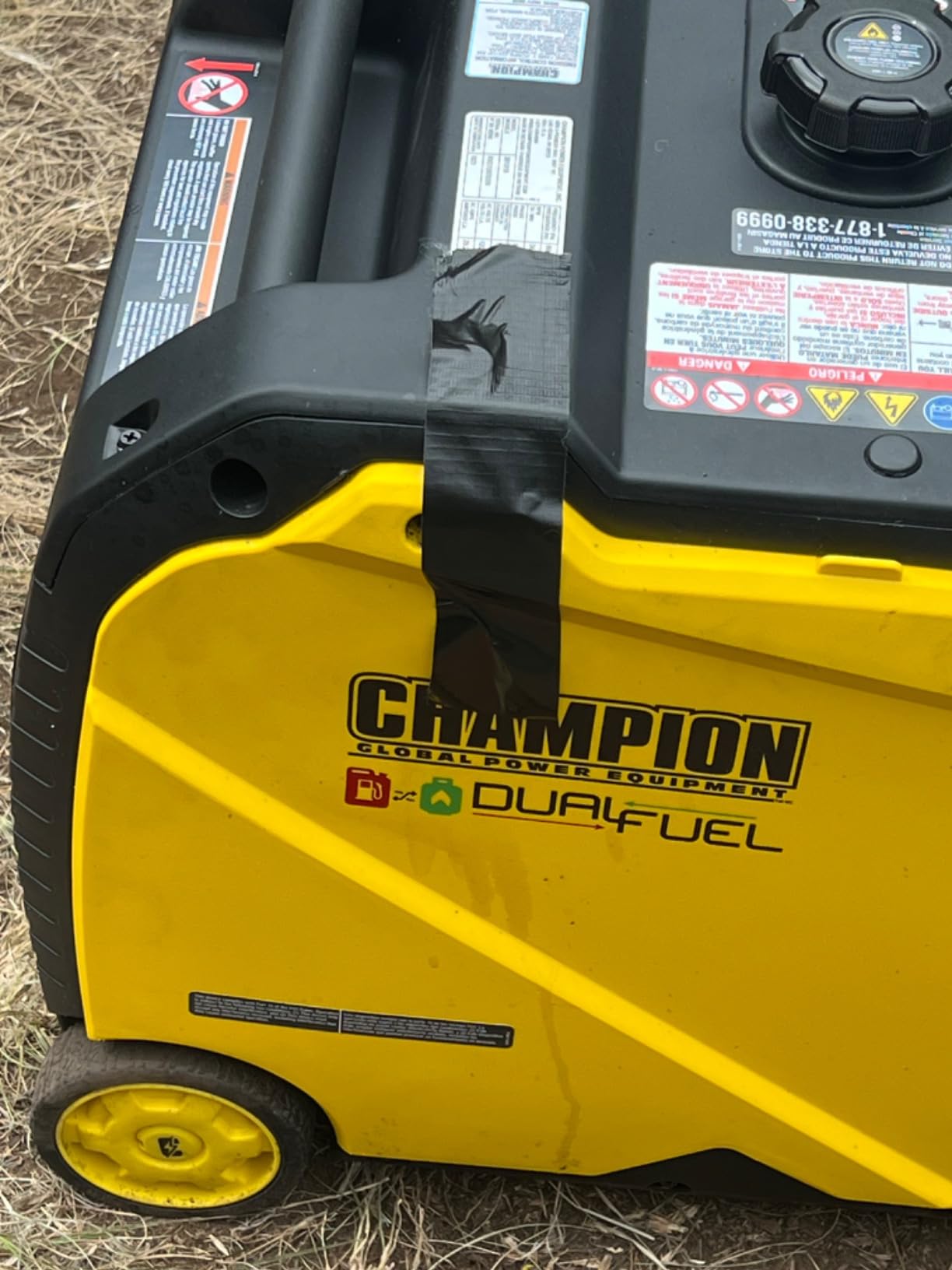
Who should buy this over a smaller unit?
Full-time boondockers, and anyone who runs a 15,000 BTU unit with a microwave, a water pump, or a CPAP machine. The 3500 running watt figure leaves roughly 1,500 to 2,000 watts of continuous room after the AC settles, which is the difference between a comfortable night and a night of cycling breakers.
Travel trailer owners on partial hookup probably do not need it, since the runtime only pays off past a full day off-grid.
What should you watch out for?
The carbon monoxide sensor has been reported tripping in enclosed spaces such as a truck bed with the tailgate closed. That is the sensor working as designed, but it means you cannot run it in a vehicle compartment, and it is a real annoyance for anyone stowing it alongside the trailer.
There is also a small number of quality complaints about oil leaks and hard starting straight out of the box. Service runs through an authorized shop rather than a local shop in most regions, so factor in travel time if you live far from one.
3. Champion 4250-Watt Dual Fuel Open Frame Inverter – Longest Runtime in the Group
Champion 4250-Watt Dual Fuel Portable Open Frame Inverter Generator, CARB
4250 starting watts
3500 running watts
22 hours on gasoline
4 gal tank
79 lb
Pros
- 22 hours from the 4-gallon tank
- 30A RV outlet plus two household outlets
- Parallel ready for a second unit
- Quiet for an open-frame design
- Three-year warranty
Cons
- Open frame is louder than enclosed inverters
- Bulky for small storage compartments
- Heavier than compact 30 amp options
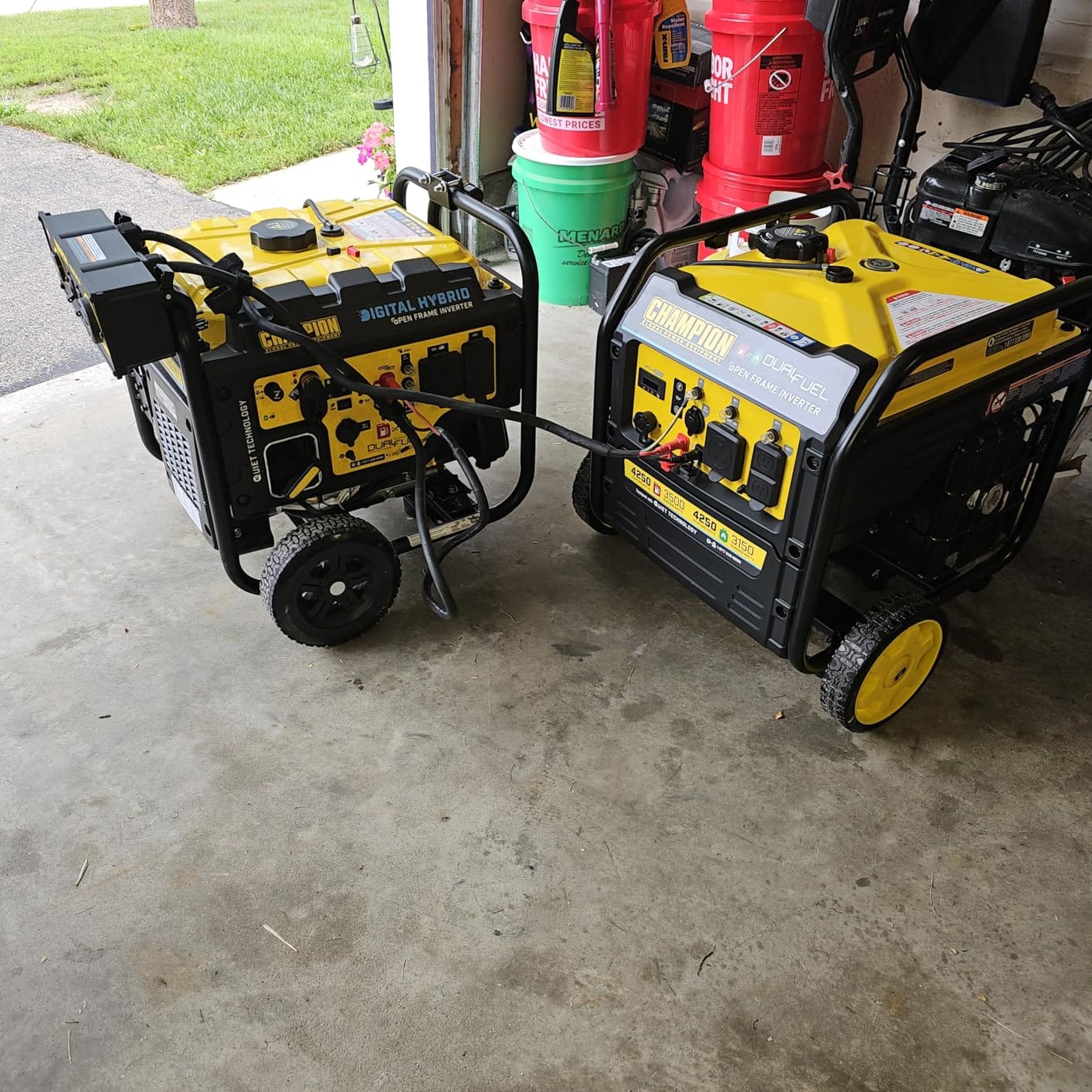
Runtime is the whole argument here. A 4-gallon tank and up to 22 hours of gasoline operation means a full tank of gas covers multiple nights of air conditioner operation without a single refill, and there is a dedicated 120V 30A RV outlet on the panel for direct hookup.
The 4250 starting and 3500 running watt split handles either 13,500 or 15,000 BTU rooftop units with headroom for a refrigerator and converter. The digital hybrid design is claimed to be 50 percent quieter and 20 percent lighter than a traditional 3500 watt Champion, and the economy mode extends both runtime and engine life when the AC is the only thing drawing.
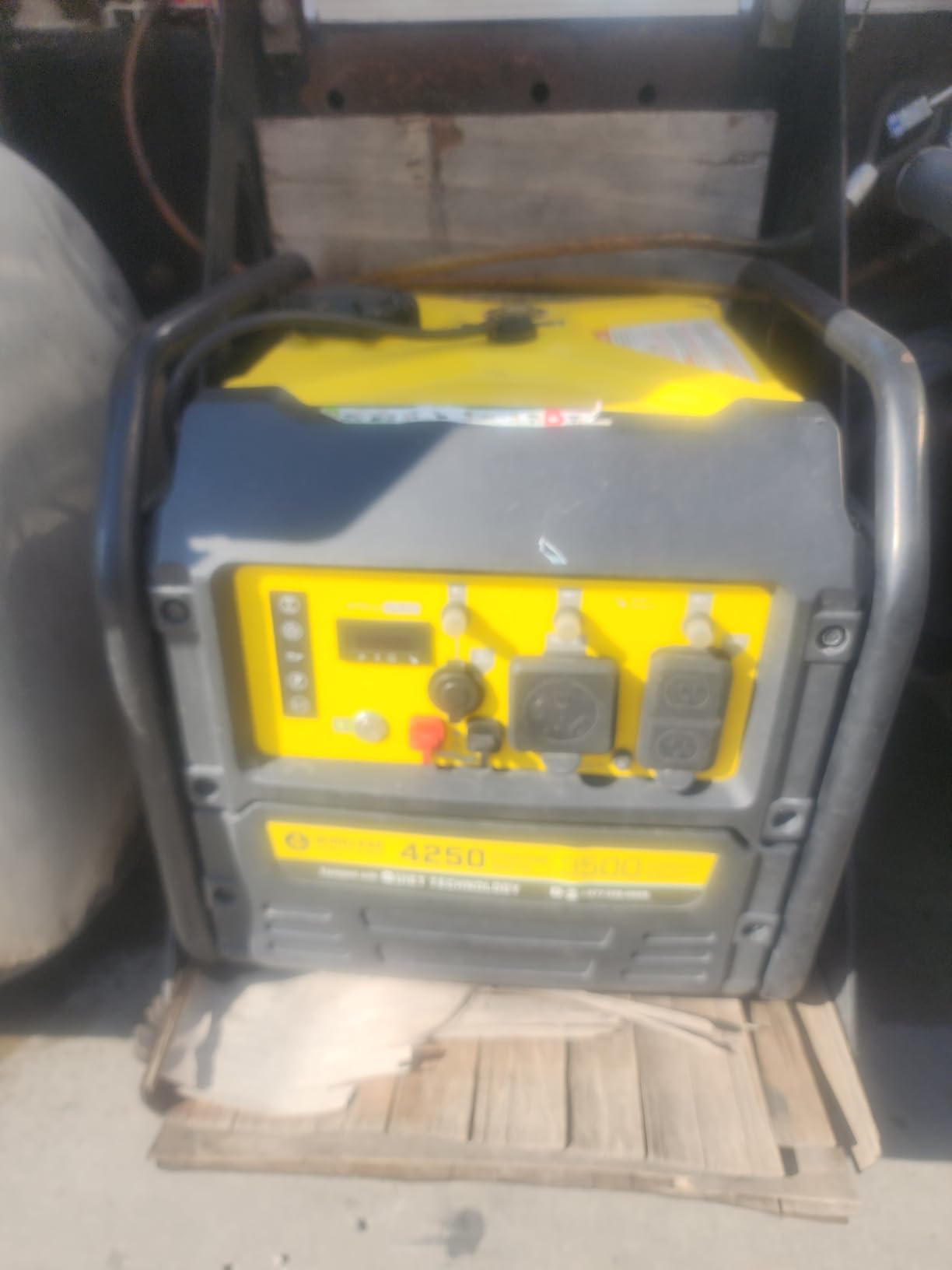
It is CARB compliant, which matters if you camp in California, and it is parallel ready so you can pair it with a second compatible inverter later. The 12V DC outlet with a dual USB adapter covers the small electronics that make up a working campsite.
Does it fit a 30 amp travel trailer AC?
Yes, and it is the one unit in this list with a true 30A twist-lock rather than the smaller TT-30R. That wider outlet also means you can run a 30 amp cord without an adapter, which removes the most common source of tripped breakers on a generator hookup.
With 3500 running watts, a 15,000 BTU AC plus a microwave is still tight. Sequence the microwave rather than switching it on mid-compressor-startup.
What is the catch with an open frame?
Noise and bulk. An open frame trades enclosure quietness for output and price, and at 64 dBA it is louder than the fully enclosed inverters in this list. It also measures 27.9 by 23.4 by 21.7 inches, which is a large object in a generator compartment that was designed for a suitcase-style unit.
At 79 pounds you are moving it with one hand on the frame or a wheel kit, not lifting it solo into a high bed. If storage space is your binding constraint, the smaller enclosed units later in this list fit where this one will not.
4. PowerSmart 3800-Watt Dual Fuel Inverter – Best Value Inverter for a 13,500 BTU AC
PowerSmart 3800 Watt Dual Fuel Inverter Generator for Camping or Home Use
3800 starting watts
3300 running watts
59 dBA eco mode
1.3 gal tank
50.7 lb
Pros
- 30A L5-30R outlet accepts standard RV hookups
- 59 dBA in Eco Mode
- Up to 24 hours on a propane tank
- Digital display shows live wattage
- Low oil and overload shutdown
Cons
- 1.3 gallon tank means frequent gasoline refills
- Access panels need a Phillips screwdriver
- Heavier in practice than the listed weight
With more than a thousand reviews averaging 4.5, this is a well-proven value pick in the pack. It puts out 3800 starting watts and 3300 running watts on gasoline, which is exactly what a 13,500 BTU compressor wants, and 3100 running watts on propane still clears most 13,500 BTU units.
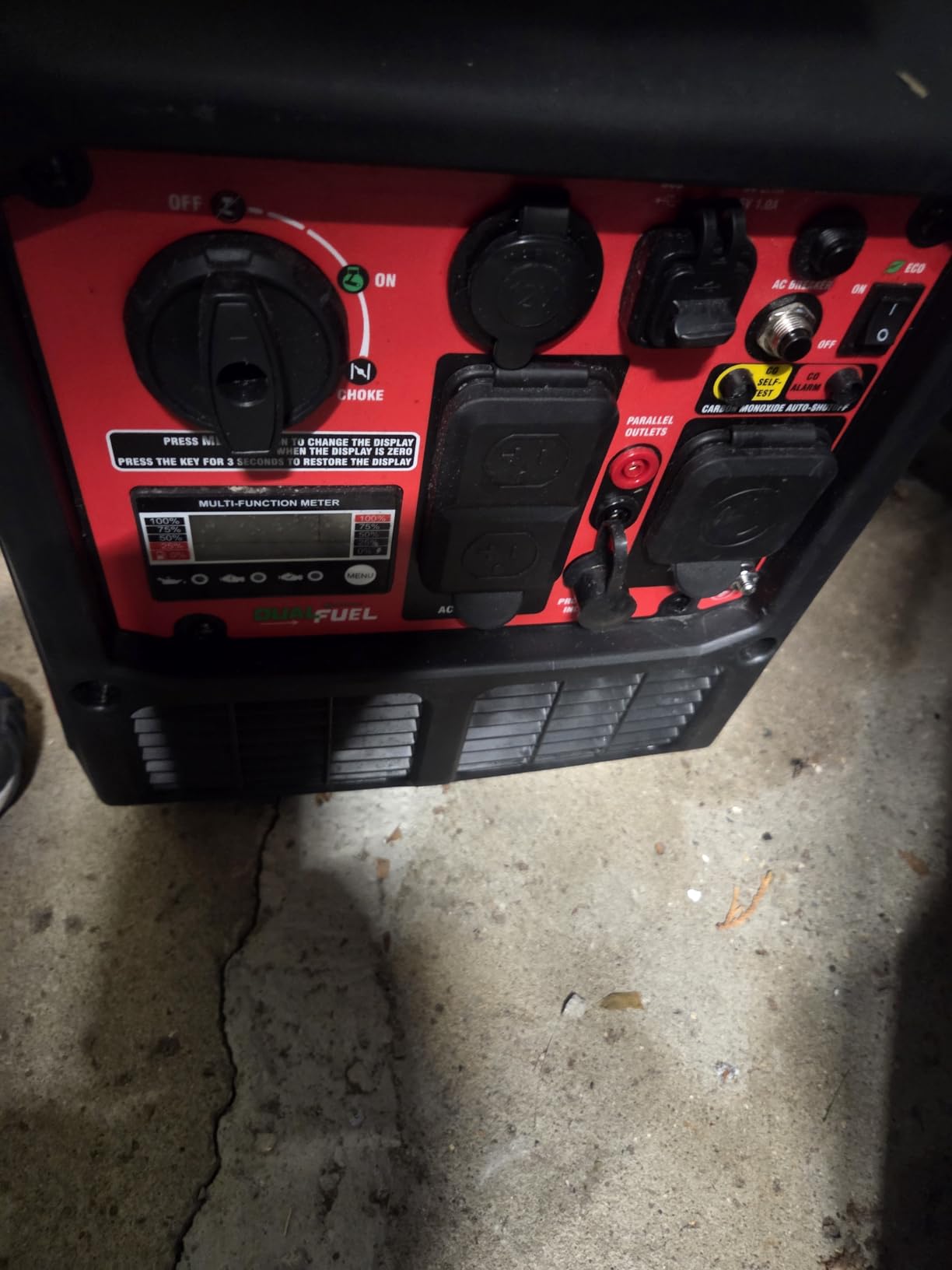
The 59 dBA Eco Mode figure is among the lowest measured numbers among the dual fuel machines here, and the L5-30R twist-lock outlet is the correct connector for a 30 amp RV. Owners point to a real-time wattage readout on the control panel, which makes it easy to watch the compressor start and see exactly how much headroom you have left.
Runtime is 8 hours at 25% load on gasoline from a 1.3 gallon tank, or up to 24 hours on a 20 pound propane cylinder. If you already carry a propane bottle for the stove, running the generator on the same fuel removes one more thing to restock. The unit is ANSI/PGMA G300, ANSI/UL2201, and EPA certified with CO sensor, low oil, overload, and short circuit protection.
Is it quiet enough for campground quiet hours?
Yes, with a caveat. 59 dBA is measured in Eco Mode at 25% load, and owners report noise climbing noticeably once the load rises out of Eco. Running a rooftop AC is an ideal Eco Mode workload, so a night with the AC on is exactly the case where that number holds.
Add a microwave or a hair dryer and the engine works harder and gets louder. For a quiet-hours campground, this is a good match; for a campground where you also need to run heavy appliances, the open frame units give you more output for the noise.
What annoys owners most?
The 1.3 gallon tank is small for gasoline, which means a refill roughly every eight hours under light duty. Propane is the better long-run choice here. The control panel also sits low on the frame and is awkward to read, and the access panels plus the oil door need a Phillips screwdriver, which is annoying for routine service.
The two-year warranty is shorter than the three years on the Champion units, so factor that into the ownership calculation if you keep gear for a decade.
5. WEN DF475T 4750-Watt Dual Fuel – Best Value for Maximum Headroom
WEN 4,750-Watt 120V/240V Dual Fuel Portable Generator with Wheel Kit and Electric Start (DF475T)
4750 starting watts
3800 running watts
Switchable 120V and 240V
4 gal tank
105.8 lb
Pros
- Highest running wattage here at 3800W
- Switchable 120V and 240V output
- Key electric start on a 224cc engine
- About 11 hours at half load
- Wheel kit included
Cons
- Open frame is louder than enclosed inverters
- About 106 pounds even with the wheel kit
- Not an inverter so output is less clean
- No dedicated RV TT-30R receptacle
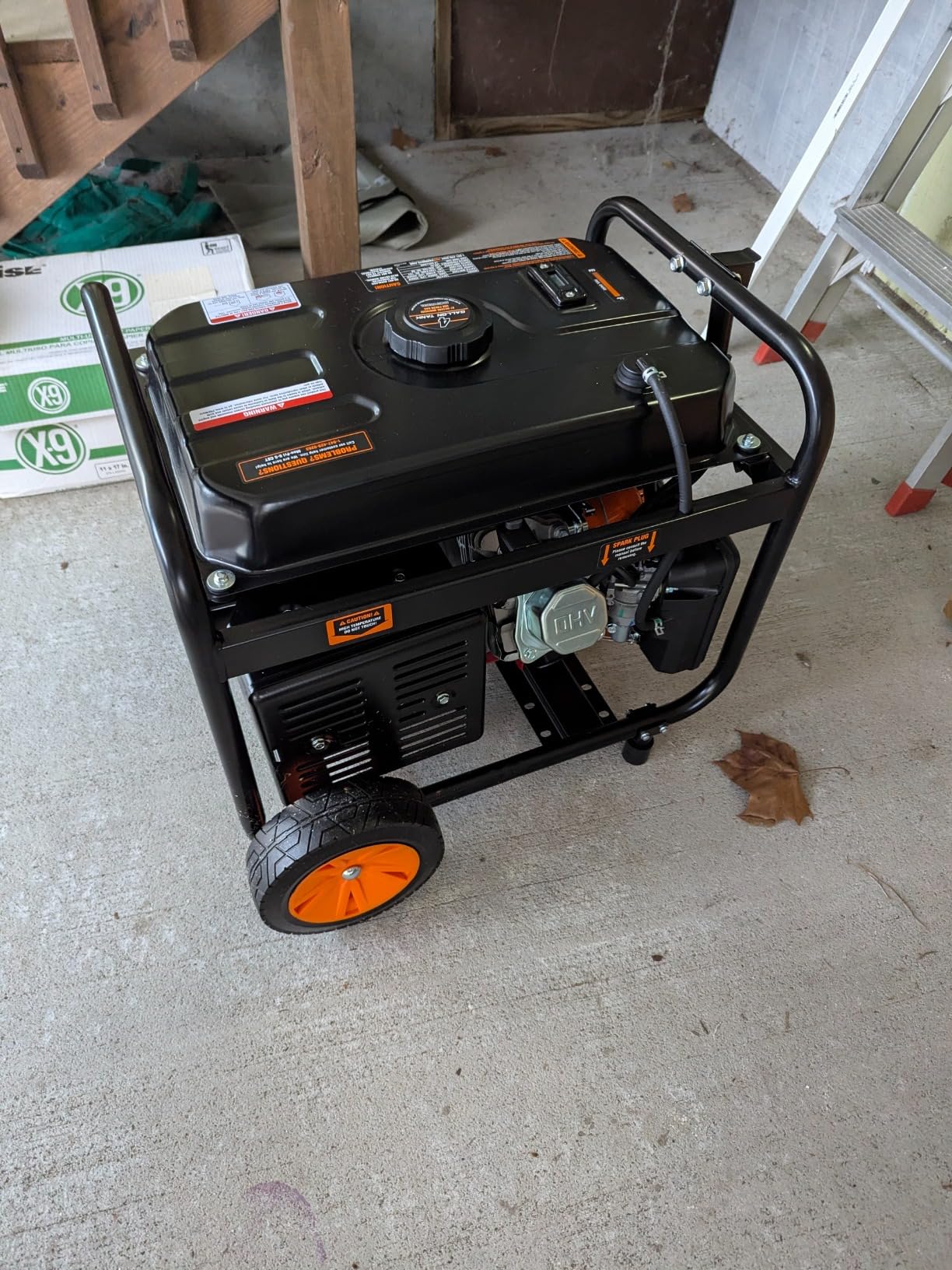
With close to 3,000 reviews, this is the most widely owned generator in the group, and for a reason: 3800 running watts on gasoline is more continuous capacity than anything else here. That headroom is what lets you run a 15,000 BTU rooftop AC alongside a microwave, a refrigerator, and a converter without gambling on the overload reset.
On gasoline it produces 4750 starting and 3800 running watts; on propane, 4350 starting and 3500 running. The output switches from 120V to 240V, so the same machine can back up a transfer switch at home during an outage, which is a genuine two-use proposition rather than a camping-only purchase.
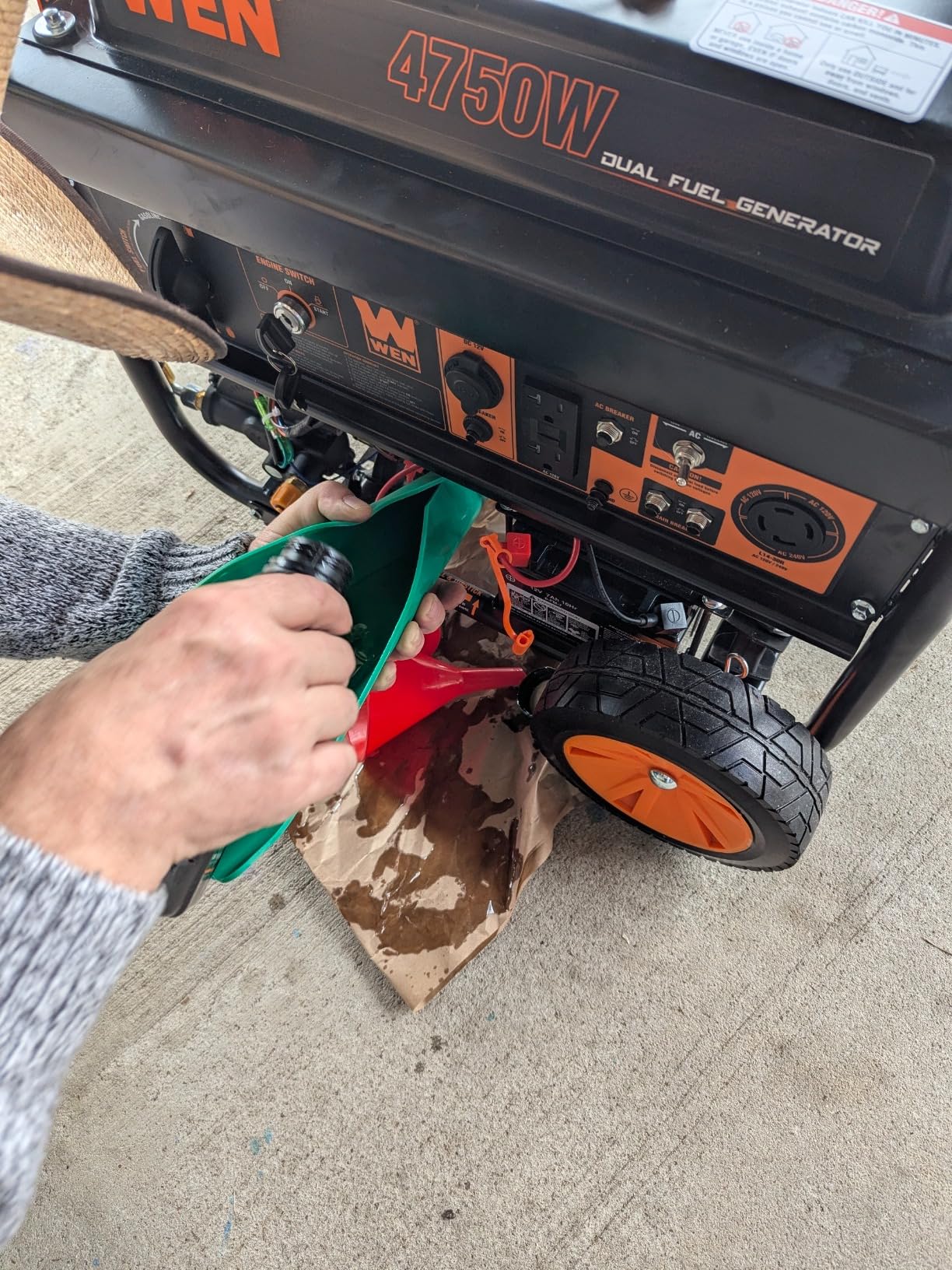
The electric start fires the 224cc four-stroke OHV engine with a key, and a 4-gallon tank gives up to 11 hours at half load. A wheel kit and handle are included, plus a 47-inch LPG hose, two GFCI household outlets, an NEMA L14-30R twist lock, and a 12V DC plug.
Is it the right size for a 15,000 BTU AC?
Yes, comfortably. 4750 starting watts clears the startup burst of a 15,000 BTU compressor, and the 3800 running watt rating leaves roughly 2,000 watts for everything else. It is also the only unit here with enough surplus to consider a second, smaller rooftop unit if your rig ever gets one.
Size it to the altimeter, though. If you camp above 8,000 feet, the 3 percent per 1,000 feet derate pulls 4750 starting watts down to roughly 3,800, which is adequate but no longer generous. Add a soft start kit and the margin returns.
What are you giving up for that headroom?
Two real things. First, it is not an inverter, so the output waveform is less clean than the enclosed inverter units and some sensitive electronics object. Second, there is no dedicated RV TT-30R receptacle, so you need an adapter to reach a 30 amp trailer receptacle.
At roughly 106 pounds it is the heaviest machine in the list even with the wheel kit, and the open frame is louder than anything below 60 dBA. If you are shopping strictly for campsite comfort, you are paying for capacity you may not use.
6. WEN DF451i Super Quiet 4500-Watt Dual Fuel RV Ready – Best Balanced Inverter
WEN DF451i Super Quiet 4500-Watt Electric Start Dual Fuel RV-Ready Portable Inverter Generator with Fuel Shut-Off
4500 starting watts
3500 running watts
58 dBA at quarter load
2.2 gal tank
100 lb
Pros
- RV TT-30R outlet and enough output for one or two rooftop ACs
- 58 dBA at quarter load
- Keyless electric start with recoil backup
- Drain hose and funnel simplify oil changes
- Unusually long propane runtime
Cons
- About 100 pounds needs two people
- Low and awkward oil fill port
- Can show a fault light after a cold start
- Wheels work on pavement only
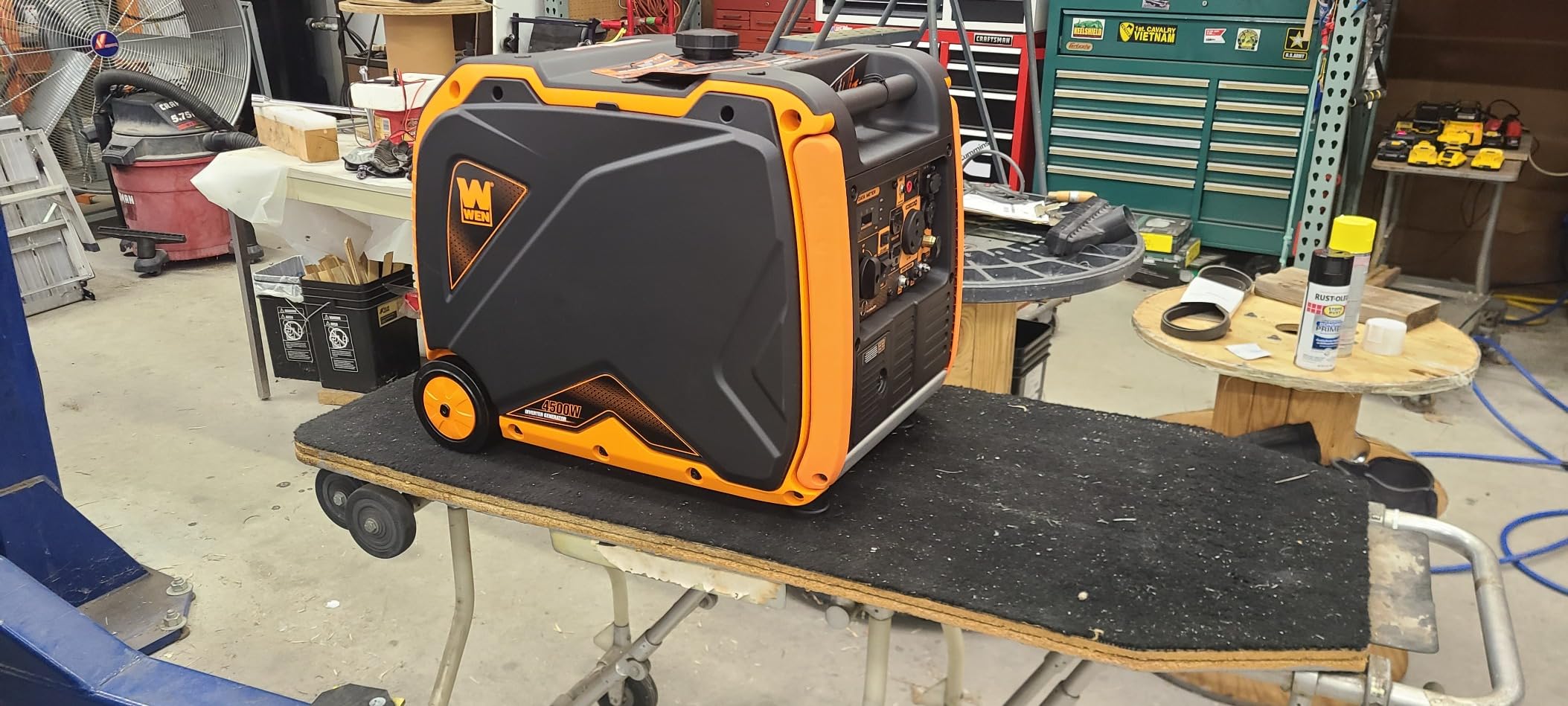
This is the most complete all-round package here: a 4500 starting watt inverter with a proper RV TT-30R receptacle, dual fuel capability, and a 58 dBA measured figure at quarter load that sits at the quiet end of the high-output class.
Owners running it daily report it starting rooftop air conditioner compressors in Eco Mode at about half load, which is the behavior you want from a generator that has to do this every night. Gasoline output is 4500 starting and 3500 running watts; propane drops to 3150 rated with runtime that is unusually long for the class. Auto Fuel Selection switches from propane to gasoline to stretch the range when the tank runs low.
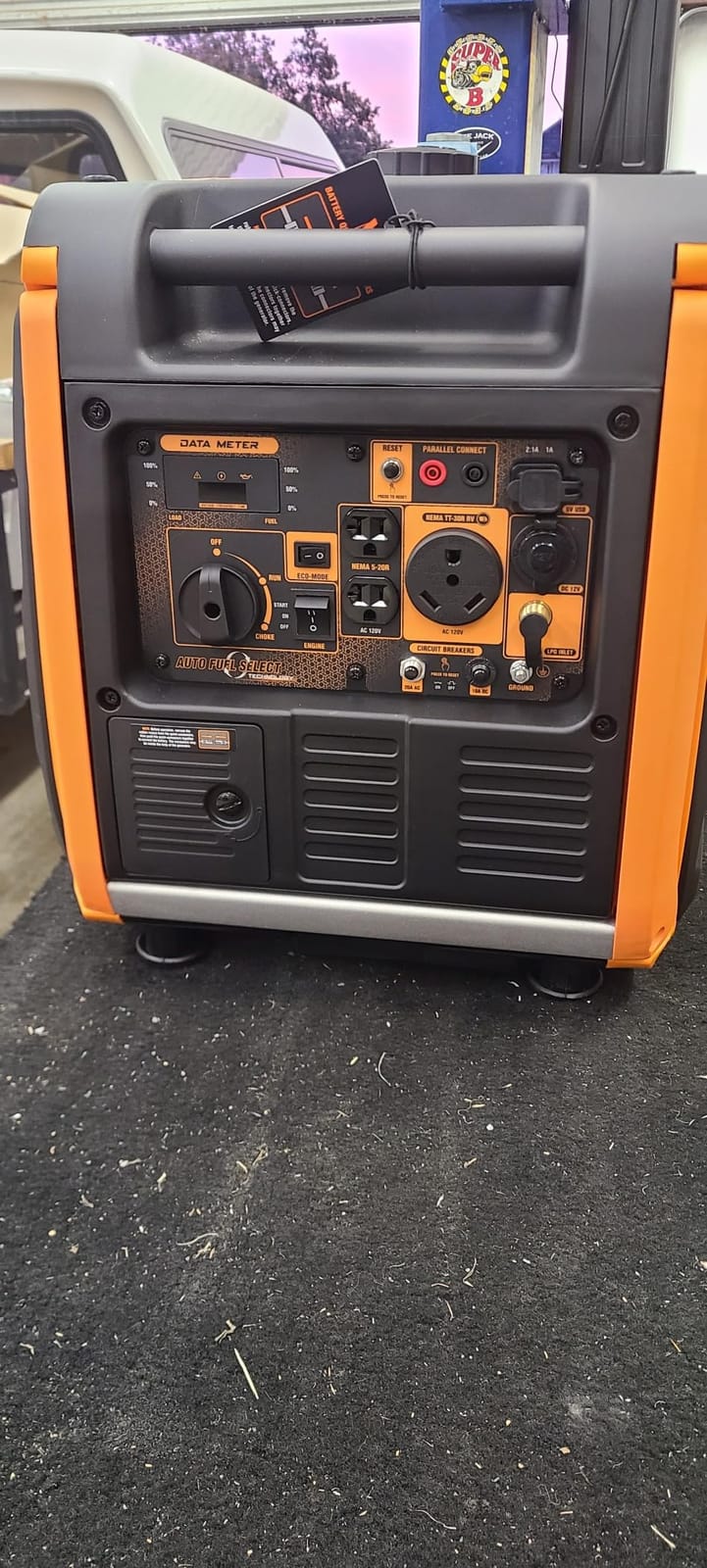
Maintenance touches are thoughtful for a portable unit. A built-in drain hose and funnel reach into the cabinet so an oil change does not require wrestling with a drain pan, and a keyless electric start is backed by a recoil starter in case the battery is flat. Onboard wheels and a carrying handle take some of the sting out of the weight.
Does it run one or two rooftop air conditioners?
One comfortably, two is not realistic on a single unit. Owners cite enough output to start one or two compressor startups in sequence, but two 15,000 BTU units running simultaneously would draw well past 3500 running watts. Stagger the startups and the second unit will usually come up, but the steady-state load is over capacity.
If you are planning dual AC, your realistic options are a 7,000 watt portable or a built-in generator. See the load planning section below.
What is annoying about daily use?
At about 100 pounds, loading it into a truck bed takes two people. The oil fill port sits low on one side and is awkward to reach, and the manual is described as inaccurate about the battery terminal connections, which slows first-time setup.
Some owners also report a red fault light after a cold start that clears on a restart cycle before it will take load. Worth knowing about if your first use is at 6am on a cold morning.
7. Pulsar PGD40ISCO 4000W Gas Inverter – Lightest Unit That Still Starts a 13,500 BTU AC
Pulsar PGD40ISCO Ultra Light Quiet 4000W Portable Gas Inverter Generator, white
4000 peak watts
3200 rated watts
59 dB
1 gal tank
47.3 lb
Pros
- Under 48 pounds with a compact footprint
- 59 dB operation
- Manufacturer rated for AC units to 13500 BTU
- Parallel ready
- Clean inverter output
Cons
- One gallon tank limits runtime to about 4 hours
- Gasoline only with no propane option
- 3200 rated watts is tight with extra loads
- No electric start
At 47.3 pounds this is the lightest machine in the group, and small enough to handle into a tall truck bed by yourself. That matters more than any spec for owners who move generators alone or are lifting into a Class B storage bay.
The manufacturer rates it for air conditioning units up to 13,500 BTU, and 4000 peak watts with 3200 rated watts gives the compressor enough of a cushion to start. Output is clean inverter power, so it is safe for laptops, phones, and other sensitive electronics in the camper.
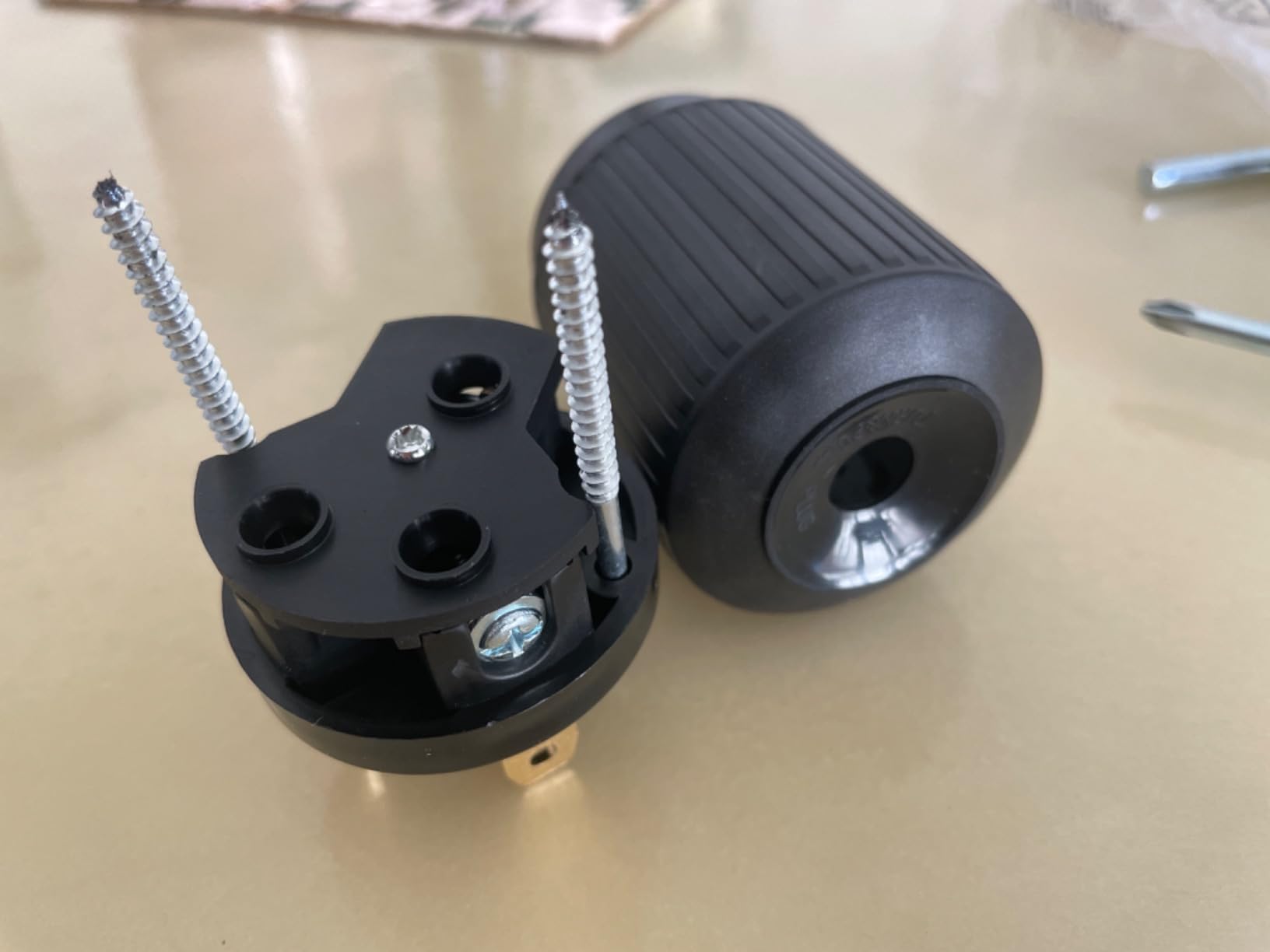
At 59 dB it is quiet enough to sit beside a trailer without dominating the campsite, and it is parallel ready so a second identical unit can double the output through a matched cable. The body measures 18.9 by 11.4 by 17.3 inches, one of the smallest footprints here.
Will it run a 15,000 BTU air conditioner?
Probably, but with almost no margin. A 15,000 BTU compressor can pull a 3,000 to 3,900 watt startup burst, and at 3200 rated watts with 4000 peak you have a narrow band. If anything else draws power at the moment the compressor starts, you risk a bog or a breaker trip.
For a 13,500 BTU unit with the fridge and a battery converter as the only other loads, it works well. For a 15,000 BTU unit in a fifth wheel, we would step up to one of the 4500 watt units.
What are the compromises?
Runtime is the big one. A single gallon tank gives about 4 hours at half load, which covers an evening and not much more. There is no propane option, so you cannot stretch a night by switching to a bottle you already carry.
There is also no electric start, so you are pulling a cord every time. For a weekend of boondocking in cool weather that is a fine trade for the weight; for a full week of summer AC use it is not.
8. Oxseryn 4400-Watt Inverter with 30A RV Outlet – Lowest Cost Route to a Rooftop AC
Oxseryn 4400-Watts Inverter Generator, Open Frame Generator Gas Powered, Emergency Home Backup, RV Ready 30A Outlet, EPA Compliment
4400 peak watts
3400 running watts
30A RV port
2 gal tank
57 lb
Pros
- Lowest entry cost with a genuine 30A RV outlet
- 3400 running watts suits a mid-size rooftop AC
- Up to 14 hours at 25% load
- Light at 57 pounds
- Overload and low oil protection
Cons
- Gasoline only with no propane capability
- Open frame is louder than enclosed inverters
- Only a one-year warranty
- Starting watts listed below the 4400 peak rating
That is the cheapest path we found to a genuine RV air conditioner on a generator, and the 4.6 average across more than 400 reviews says owners are rarely disappointed. A 30A RV port is unusual at this level; most competitors ship household outlets only.
The numbers read as 4400 peak watts and 3400 running watts from a 2-gallon tank, with up to 14 hours at 25% load. Inverter technology with Eco mode keeps the engine at a lower RPM when the AC is the only load, and low oil shutdown plus overload protection cover the basics.
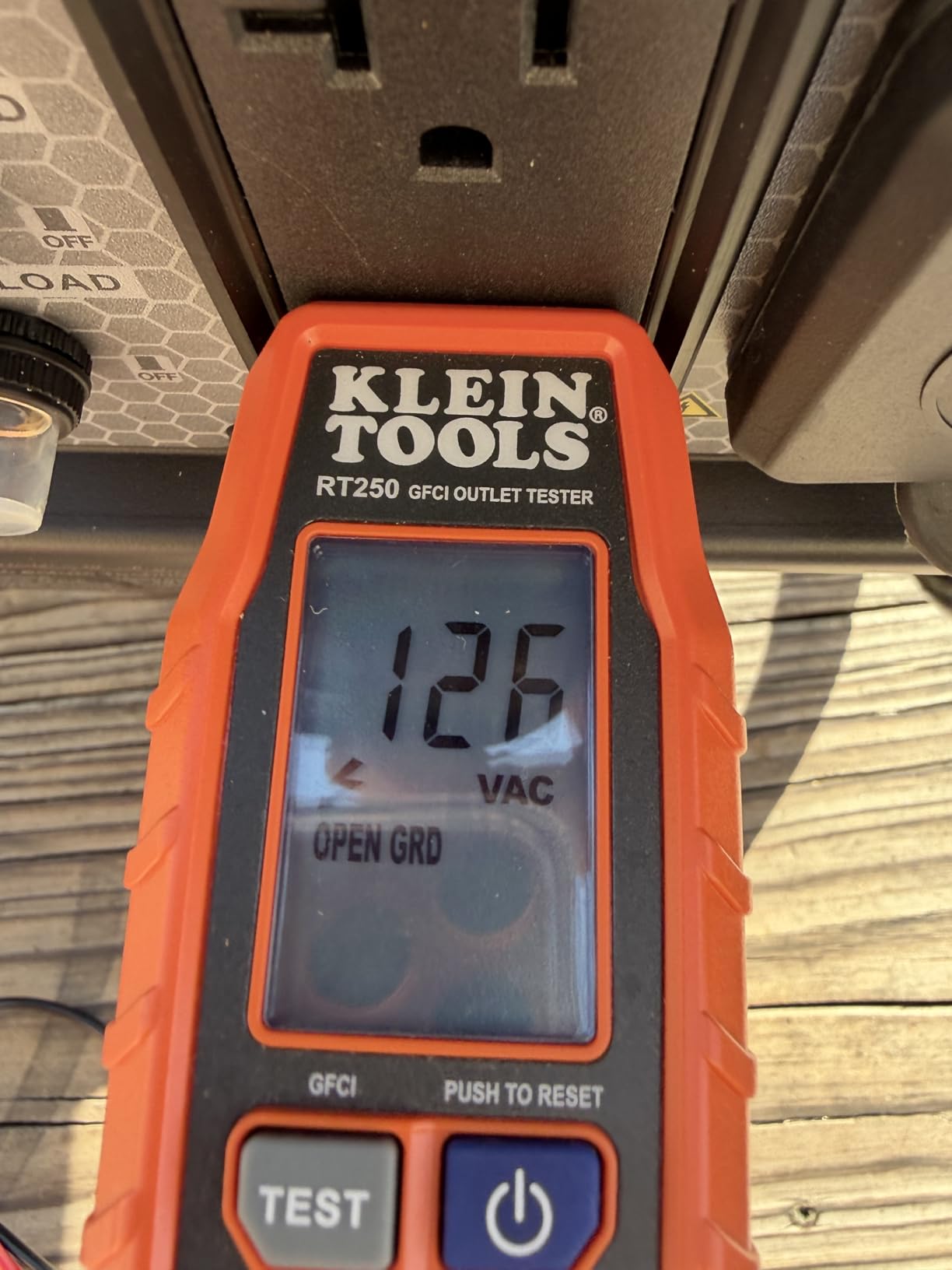
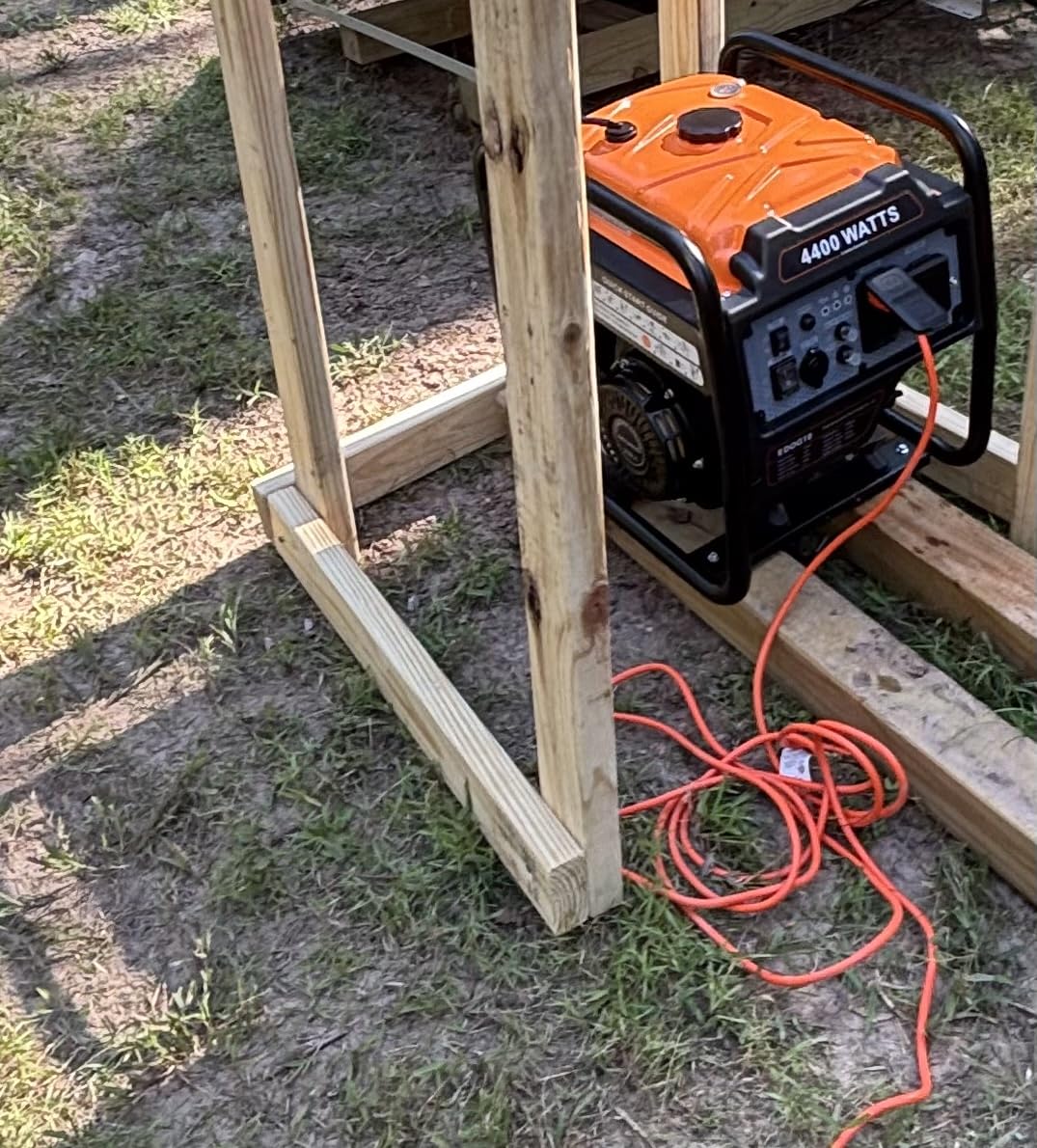
Two 120V AC ports, the 30A RV port, and a 12V DC port are all on the panel, which is enough to run the rooftop AC and charge devices. At 57 pounds and 19.4 by 15.2 by 19.2 inches, it fits most generator compartments without a fight.
Is 3400 running watts enough for a rooftop AC?
For a 13,500 BTU unit, yes. The compressor settles around 1,300 to 1,600 watts, so 3400 running watts leaves roughly 1,800 watts for a refrigerator, a battery converter, and chargers. The peak figure of 4400 watts clears startup with a real cushion, which is exactly what you want on a machine at this price.
The listing quirk to know is that starting wattage is printed as 3400 while output wattage is listed at 4400 peak. Treat the 4400 figure as the surge capacity and the 3400 as continuous.
Where the low cost shows up
The one-year manufacturer warranty is one of the shortest in this list, and there is no propane capability, so your runtime is capped by a single gasoline tank. The open frame also makes it louder than the enclosed inverters, which is the trade for the price and the weight.
The manufacturer notes a slight fuel smell from factory testing, which some owners find off-putting for the first few runs. It clears as the engine burns off the residual fuel. If you want propane flexibility instead, the dual fuel picks a few sections down are a better long-term buy.
9. maXpeedingrods 4000W Inverter – Best for App-Based Monitoring
maXpeedingrods 4000 Watt Inverter Generator, Bluetooth® App Data Monitor
4000 peak watts
3200 running watts
Bluetooth app
4 liter tank
48.5 lb
Pros
- Light at 48.5 pounds with a compact body
- Bluetooth app shows live output and fuel levels
- L5-30R outlet plus included TT-30R adapter
- Parallel cables included in the box
Cons
- Lowest average rating here at 4.2
- Recoil start only
- Gasoline only with a small 4 liter tank
- 3200 running watts is tight with extra loads
The app is the reason this one shows up. A Bluetooth connection reports power output, fuel level, voltage, frequency, and total running hours, and Eco mode can be toggled from your phone, so you can confirm the compressor started and see your remaining headroom without walking to the generator in the dark.
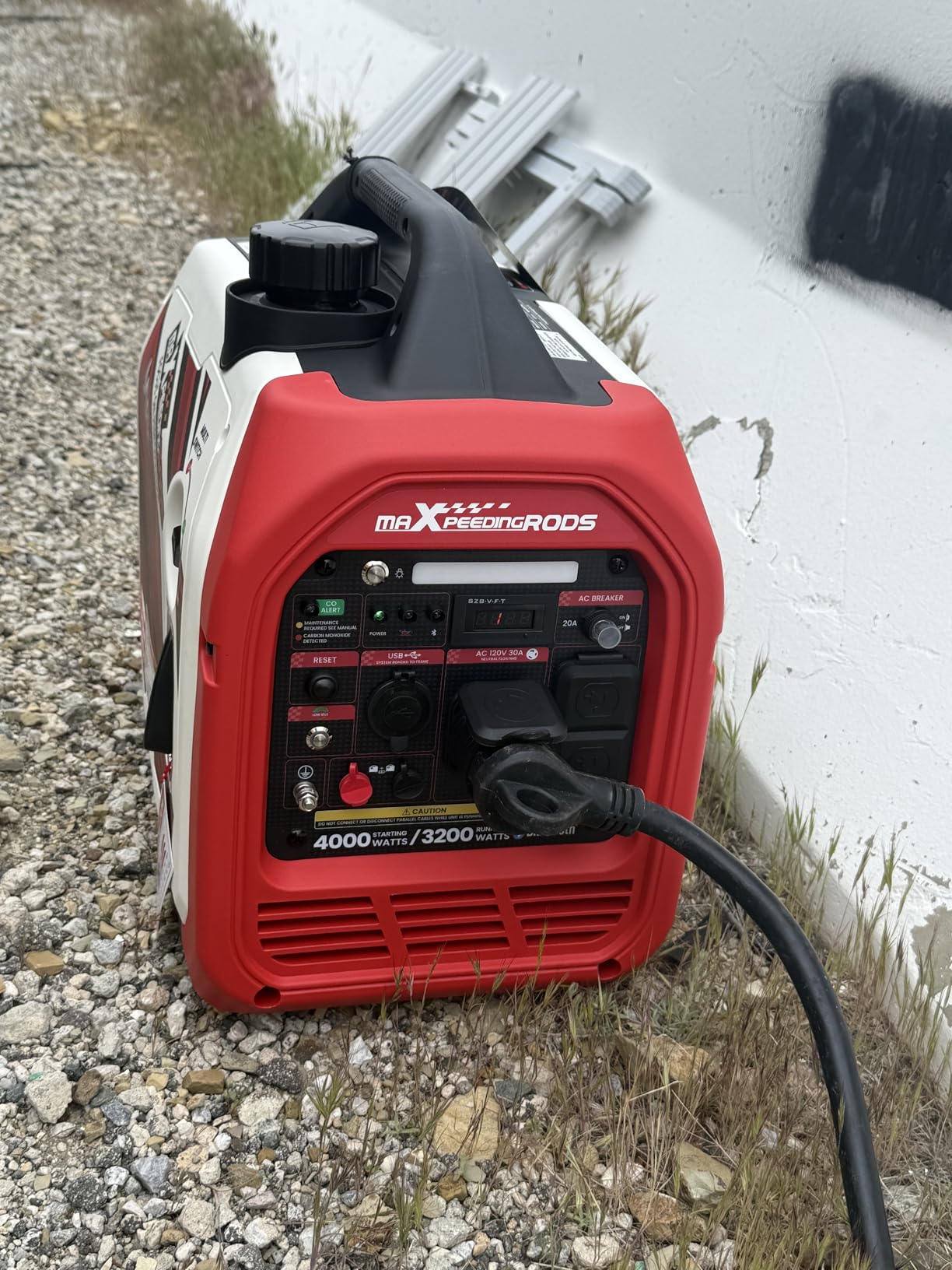
Output is 4000 peak and 3200 running watts, which suits a 13,500 BTU AC. The panel carries a NEMA L5-30R RV outlet plus an included L5-30P to TT-30R adapter, so RV hookup is solved in the box. LED lighting on the unit helps with nighttime operation, and the parallel cables are included rather than sold separately.
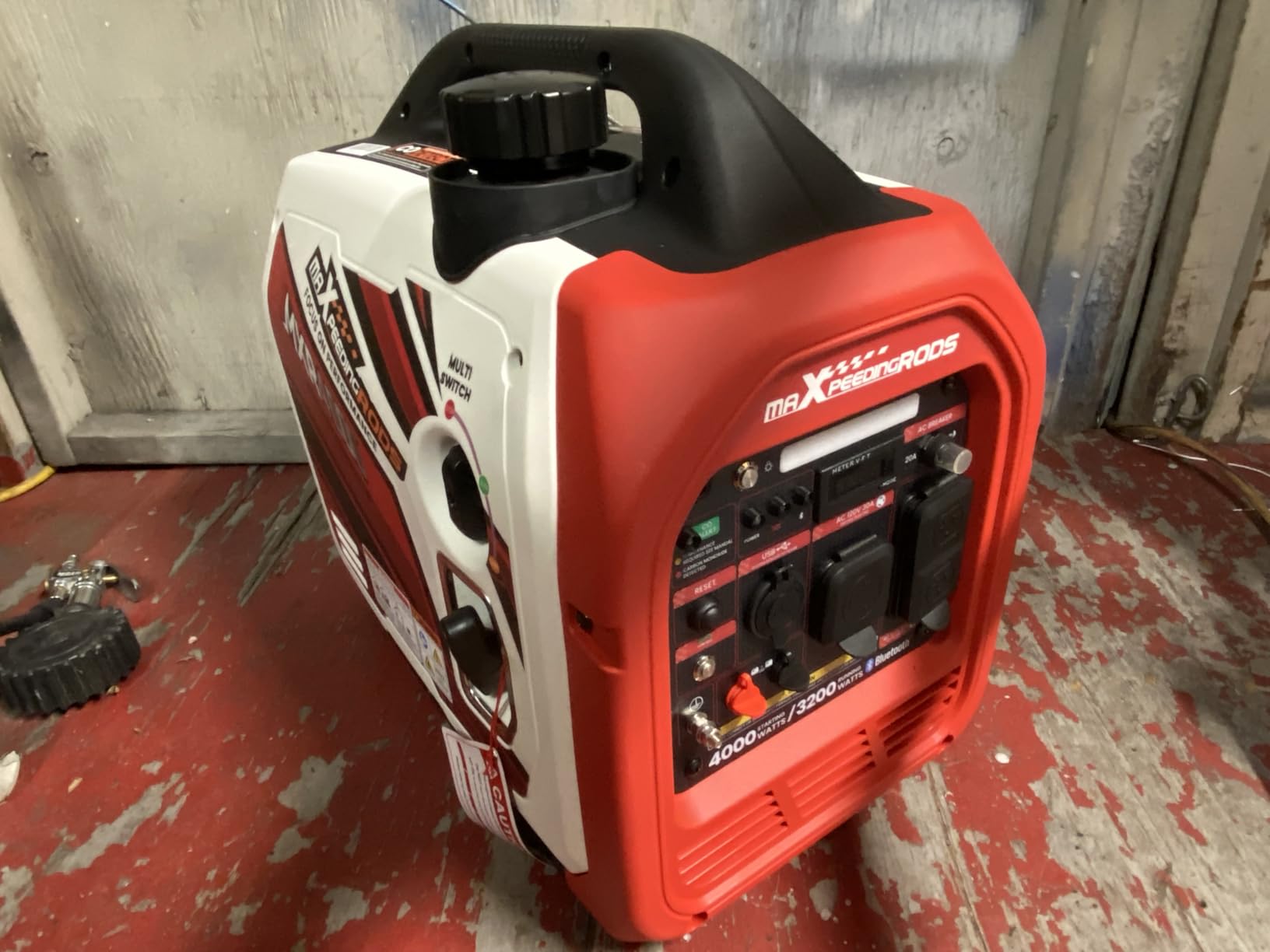
At 48.5 pounds it is the second-lightest unit here, with a body of 19 by 12 by 17.3 inches. The tradeoff is fuel: a 4 liter tank and gasoline-only operation mean you are refilling more often than with a dual fuel machine that carries a bigger tank or a propane cylinder.
Is the rating drop a reason to skip it?
At 4.2 with 820 reviews, it sits below every other unit in this group, and a meaningful share of one-star reviews reflects quality and reliability concerns rather than missing features. For a weekend of camping that risk is manageable. For a machine you depend on every night in August, it is a fair question.
The feature set is genuinely good for the money, but reliability is what you are paying for with a generator. We would pick a unit with a longer warranty and a higher average if the budget stretches.
What else to know before buying?
Starting is recoil only, which adds friction every time you cycle power. And 3200 running watts is tight for a rooftop AC plus other loads, so treat it as a 13,500 BTU machine rather than a 15,000 BTU one.
Owners who like the data but want more output should look at the WEN 4500 watt inverters in this list, which pair the clean output with a 3500 running watt rating.
10. BILT HARD 4500W Dual Fuel – Quiet Dual Fuel with a Real RV Outlet
BILT HARD Dual Fuel Gas & Propane Powered Generator 4500W, Gas & Propane Powered Generator with CO Sensor, RV Ready, Parallel Capable, 4-Cycle Engine Portable Outdoor Generators for Home, Camping
4500 starting watts
3500 running watts
58 dBA at 23 feet
CO sensor
57.7 lb
Pros
- 30A TT-30R RV outlet plus a 20A duplex
- 58 dBA at 23 feet for a dual fuel unit
- 3500 rated watts on gasoline
- Integrated CO sensor with auto shutdown
- Dual fuel with LPG hose and regulator included
Cons
- Recoil start only
- One-year warranty
- Parallel kit sold separately
- Small tank means frequent gasoline refills
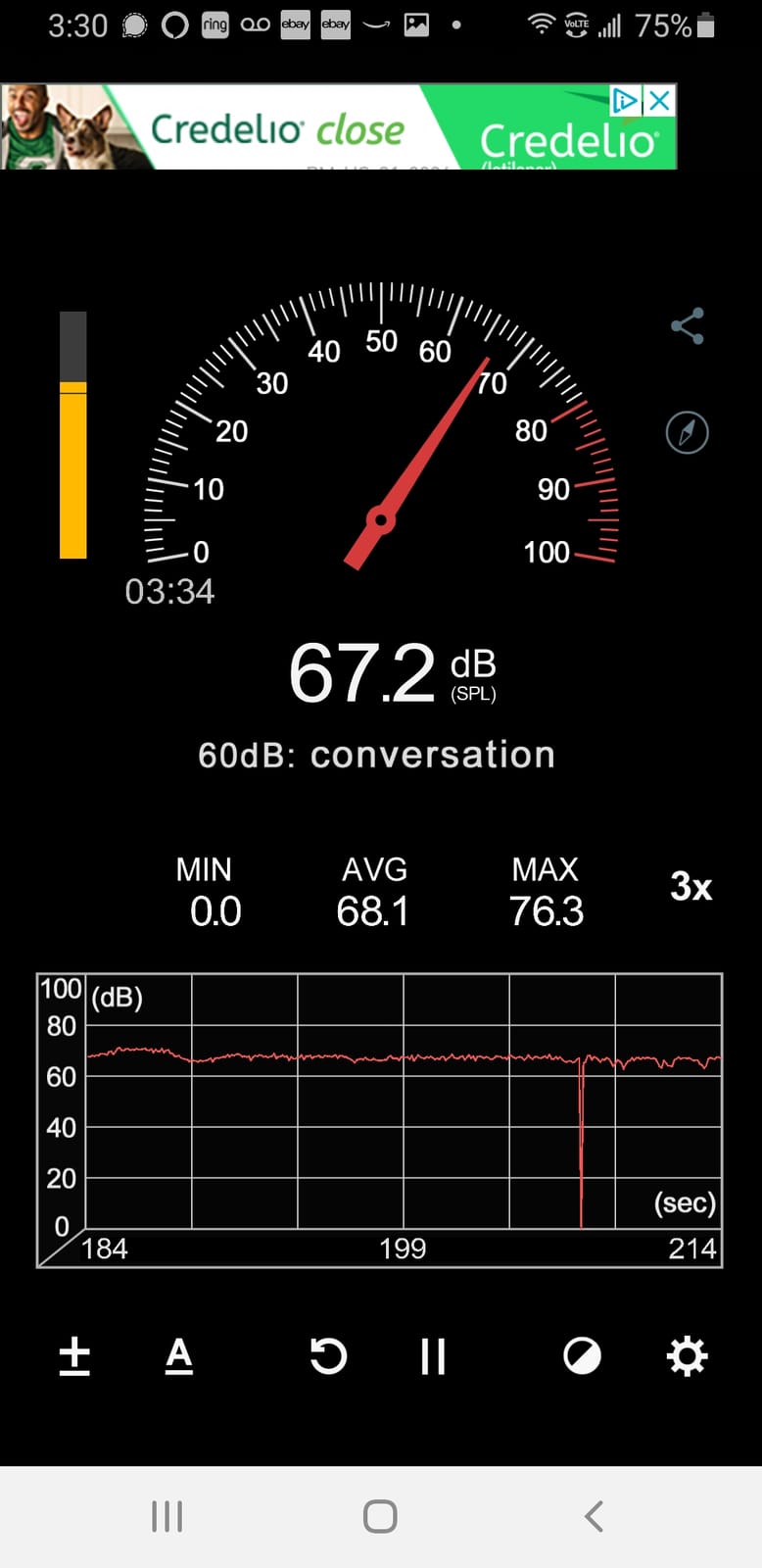
The combination that stands out is a genuine 30A TT-30R RV outlet, dual fuel capability, and a measured 58 dBA at 23 feet. Most dual fuel machines in this output range are noticeably louder or do not include a proper RV receptacle at all.
On gasoline it produces 4500 starting and 3500 running watts, and on propane 4150 starting and 3200 running. That clears a 15,000 BTU compressor on either fuel, and 3500 running watts leaves room for the fridge and converter alongside it. Total harmonic distortion under 3 percent keeps the output clean for electronics.
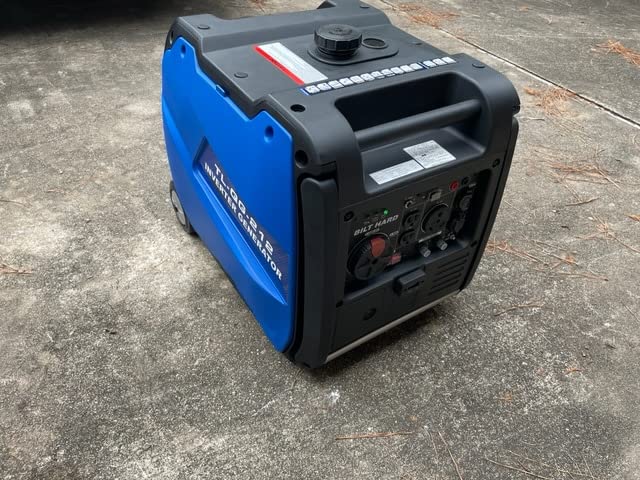
Up to 13 hours of runtime, a 141cc OHV air-cooled four-cycle engine, and an included LPG hose and regulator round out a capable package. The CO sensor shuts the engine down automatically, Eco mode trims fuel use, and a built-in handle makes the move from vehicle to campsite simple at 57.7 pounds.
How does it handle a rooftop AC plus appliances?
Comfortably, on gasoline. With 3500 rated watts you have roughly 1,700 to 2,000 watts of continuous headroom after a 15,000 BTU AC settles, which covers a 12V converter, a refrigerator compressor cycling, and a couple of device chargers. The 20A duplex and dual USB ports handle the low-draw items.
On propane the 3200 rated figure is tighter, so run the stove and the AC on separate times. The microwave still should not be switched on during compressor startup.
What do you trade for it?
Recoil start only, which means a pull cord every time, and a one-year warranty that is the second shortest here. The parallel kit is not included, so adding a second generator later means buying the kit separately.
For owners who want propane flexibility and a quiet panel without paying for electric start, this is a sensible middle ground.
11. AIVOLT 4300W Dual Fuel Inverter – Best for Remote Start Convenience
AIVOLT 4300W Dual Fuel Inverter Generator 53dB Quiet for RV Camp Home
4300 starting watts
3.3 KW running
53 dBA claimed
18 liter tank
64 lb
Pros
- Remote key fob start from inside the RV
- Dedicated 30A outlet for rooftop ACs and microwaves
- 34 hours of propane runtime at 25% load
- 53 dBA claimed
- UL2201 and EPA certified
Cons
- Lowest average rating here at 4.1
- Measured noise often higher than advertised
- Some fuel system and carburetor faults after delivery
- Only one outlet listed in specifications
Remote start is the feature nobody else in this list offers at this output. A key fob lets you power the generator up from inside the trailer, so you are not walking outside in the dark before coffee to yank a cord, and the dedicated 30A outlet is sized for exactly the rooftop AC and microwave combination.
Output is 4300 starting watts and 3.3 KW running, which handles a 15,000 BTU unit on either fuel. Runtime is the headline number: 11.5 hours on gasoline and a claimed 34 hours on propane at 25% load from an 18 liter tank, the longest propane runtime figure in this roundup.
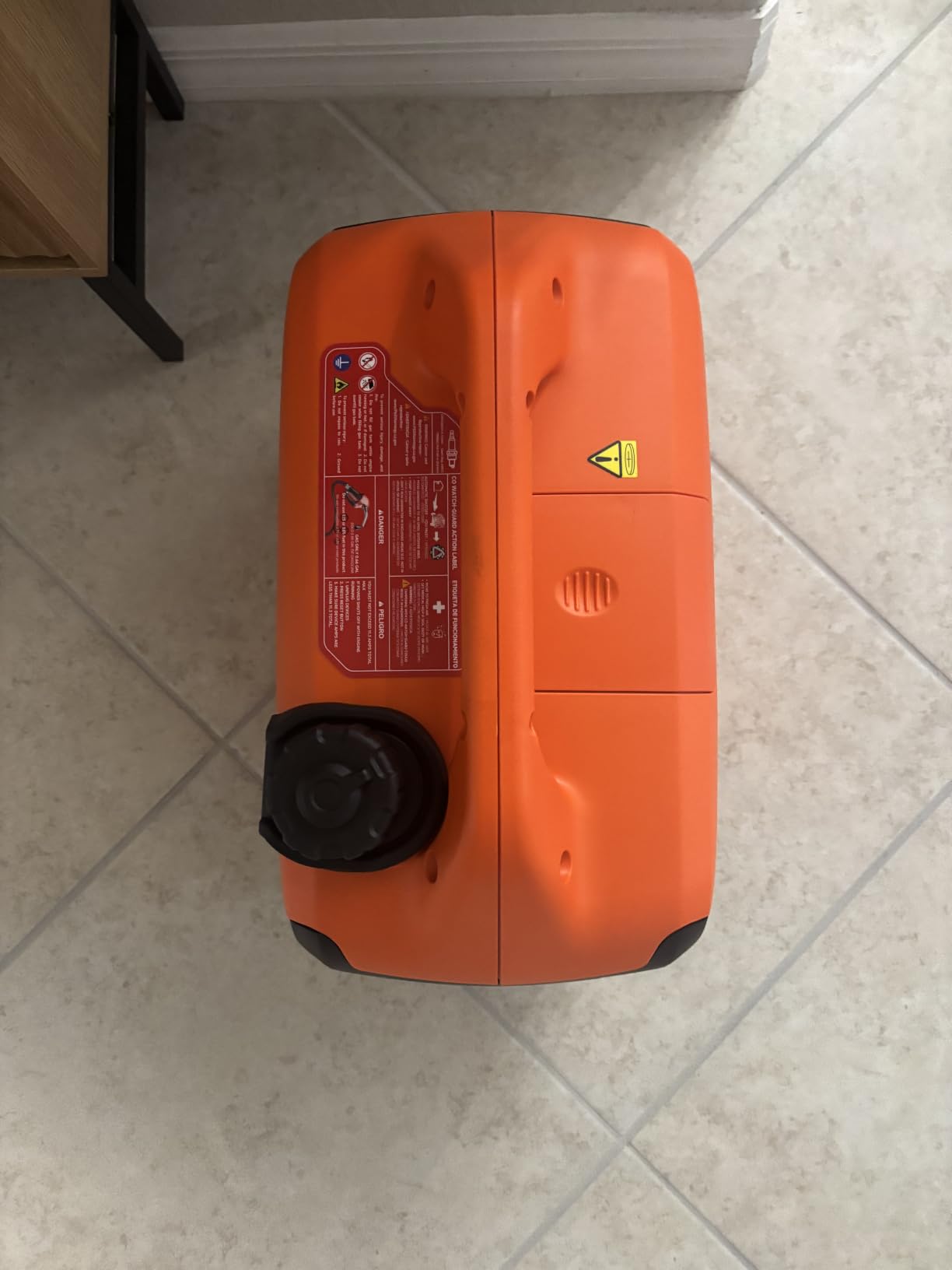
At 64 pounds with built-in wheels and a telescoping handle, it moves over rough ground without a lift. It is UL2201 and EPA certified with CO auto-shutoff and low oil protection, and it is parallel ready with a separately sold kit. Owners report responsive customer service on warranty replacements, which matters given the rating.
Is the 53 dBA figure realistic?
This is the biggest caveat in the review set. Owners report the measured noise level is often higher than the advertised figure under load, which is a common pattern with published decibel numbers. A rooftop AC at steady state is a moderate load, so real-world noise will land somewhere between the 53 dBA claim and the 58 to 61 dBA machines elsewhere in this list.
Treat 53 dBA as a best case, not a promise. If noise is a hard constraint where you camp, a unit with a measured figure like the 58 dBA WEN inverter is a safer bet.
Why the 4.1 rating, and should it stop you?
A notable share of critical reviews describes fuel delivery and carburetor faults shortly after delivery, and some negative feedback appears to reference other sizes in the AIVOLT line rather than this 4300W unit. Only one outlet is listed in the specifications, which is also a mild concern given how loaded a 30A AC circuit runs.
Remote start and 34 hours of propane runtime are real advantages, and the service response owners describe is encouraging. Just budget for a possible warranty claim, and set aside the first few hours to test it thoroughly before you depend on it for a week of camping.
12. WEN 56455i 4500-Watt RV Ready Inverter – Quietest Measured Output Here
WEN 56455i Super Quiet 4500-Watt RV-Ready Portable Inverter Generator with Fuel Shut-Off and Electric Start Black
4500 starting watts
3500 running watts
58 dBA at quarter load
2.2 gal tank
99.2 lb
Pros
- Quiet enough to hold a conversation beside it
- Keyless electric start with recoil backup
- RV TT-30R outlet and clean power
- Fuel shutoff protects the carburetor
- Reliable over three months of daily use
Cons
- About 99 pounds
- Small and slow oil fill tube
- Battery cover will not seat properly
- Gasoline only with no propane
- Start batteries reportedly hard to source
This is tied for the quietest measured figure in the group at 58 dBA at quarter load, and owners describe holding a conversation standing beside it. That number comes from an enclosed inverter design, which is where the noise reduction comes from compared with the open frame units.
Underneath it is a 212cc engine with 4500 surge and 3500 rated watts, which handles either 13,500 or 15,000 BTU rooftop units and leaves room for a converter and a refrigerator. The RV TT-30R receptacle plus clean inverter output is the right combination for a camper, and the keyless electric start works on the first pull with a recoil backup behind it.
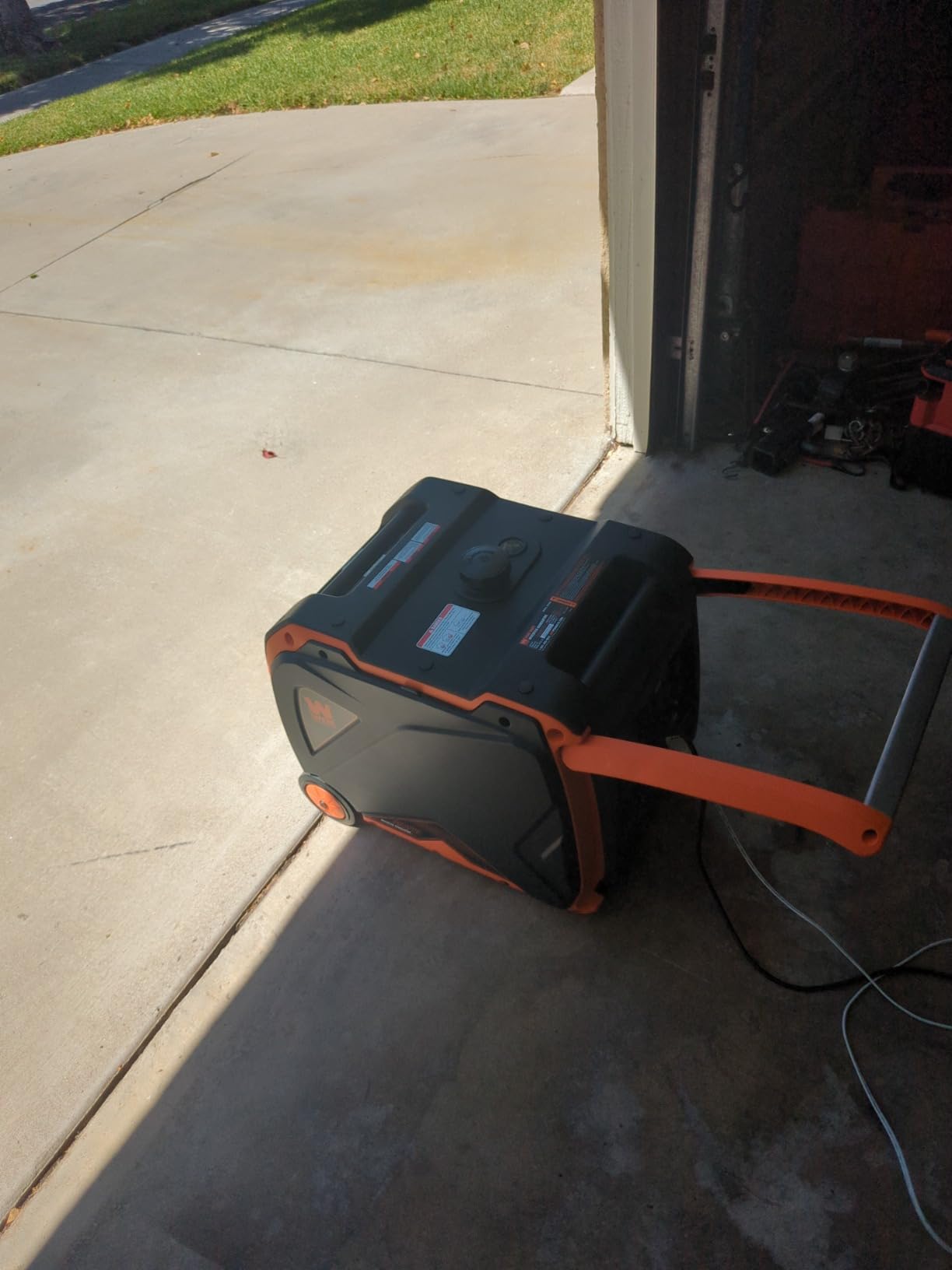
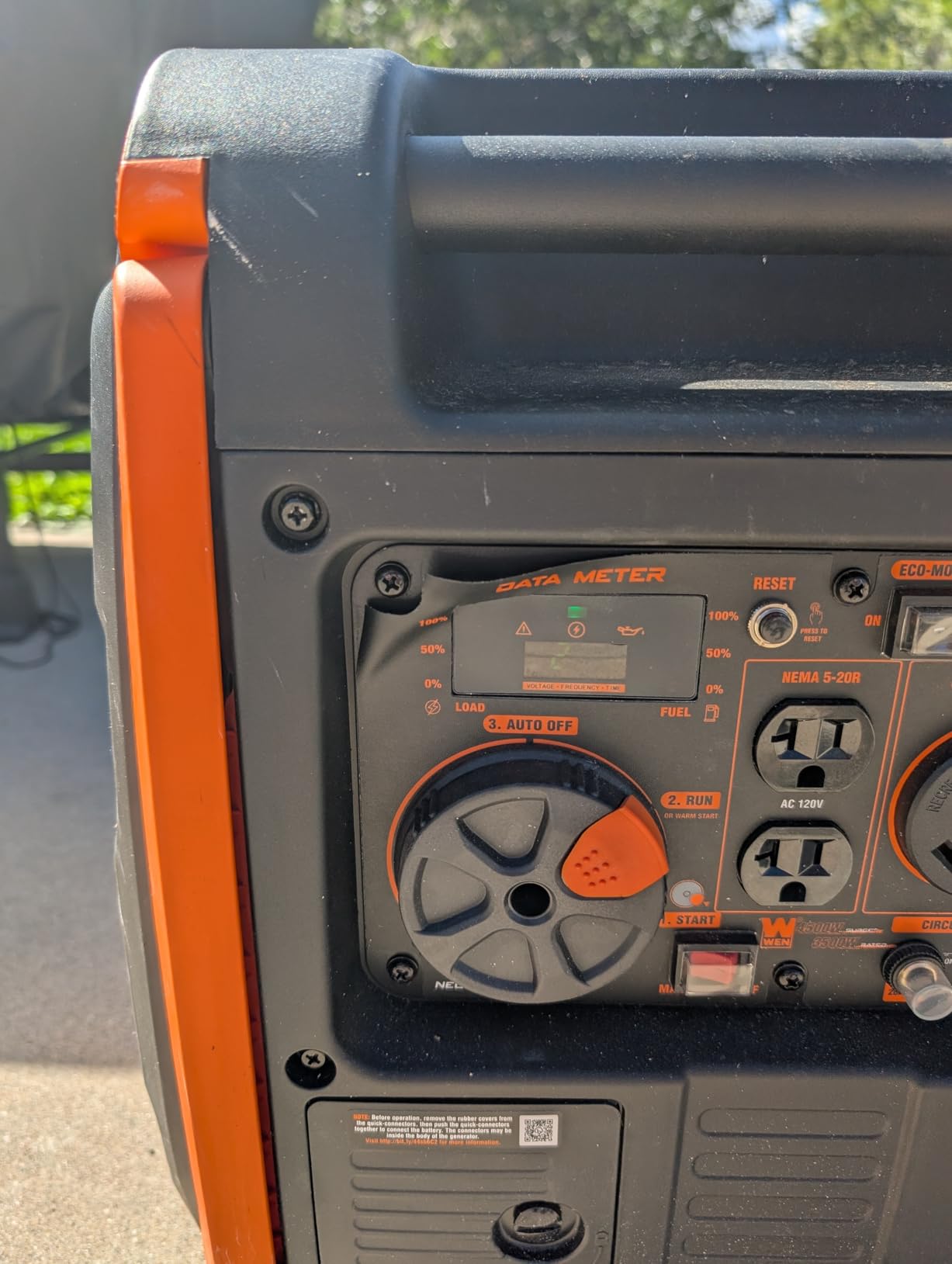
The fuel shutoff burns off remaining fuel in the carburetor before shutdown, which protects the engine over a long season. Owners running it on extended daily duty, including three months of continuous use, report consistent starts and steady output. A digital load and fuel display tracks consumption, and a 2.2 gallon tank gives up to 8.5 hours at half load.
Is it worth paying for a smaller review base?
The performance reports are consistently good across a smaller sample, and quietness is the one thing you cannot add later. The 4.6 average across 138 reviews reflects owners who mostly care about noise and clean power and who report both as delivered.
What you give up is propane capability. Gasoline only means your runtime is capped at 8.5 hours at half load, so a week of nightly AC use means restocking fuel more than once. If you already carry propane bottles, that is a real cost.
What are the setup snags?
At roughly 99 pounds it takes two people to load, and the oil fill uses a flexible tube with a very small opening, which makes filling slow and spill-prone. The battery cover will not seat properly once the terminals are connected, and replacement electric start batteries are reported as hard to source, though the recoil start works.
Those are setup ergonomics problems rather than running problems, and they fade after the first oil change. The machine itself delivers a 58 dBA measured figure with a proper RV receptacle, which is the combination this list is built around.
What You Can Run Alongside Your RV Air Conditioner
Budgeting is where most generator purchases go wrong, because sizing on the AC alone leaves no room for anything else. A 15,000 BTU unit can approach 1,800 running watts, and here are the typical draws you will be stacking on top:
Rooftop AC (15,000 BTU): 1,500 to 1,800 running watts, 3,000 to 3,900 starting watts
Microwave (1,000W): 1,000 to 1,200 running watts
Electric water heater: 1,000 to 1,500 running watts
Hair dryer: 1,000 to 1,875 running watts
Refrigerator (compressor cycling): 100 to 400 running watts
Converter and battery charger: 300 to 900 running watts
Television and audio: 50 to 200 running watts
On a 3,500 running watt generator, the AC plus a converter plus the refrigerator is a comfortable load. Add a microwave and you are close to the ceiling. On a 4,500 watt machine you have room for a microwave, and any electric water heater means you sequence it rather than overlapping.
30 amp service is not 50 amp service
A 30 amp RV service gives you roughly 3,600 watts on a single 120V leg. A 50 amp service has two 120V legs, so the theoretical ceiling is closer to 12,000 watts, not 6,000. No portable generator in this roundup replaces full 50 amp service, and treating one as equivalent is how people overload their rigs.
For a 50 amp RV with a single AC unit, 4,000 to 5,000 watts of generator output is realistic, which is where the 4,500 watt machines in this list land.
Running two rooftop AC units
Two compressors starting together will trip a breaker on any portable generator in this group. Starting them 30 to 60 seconds apart works, but two 15,000 BTU units running steadily draw roughly 3,600 watts before anything else, so you need 7,000 to 8,000 watts of capacity, meaning a larger portable or a built-in generator.
Owners on forums run a parallel setup of two smaller inverters through a 50 amp parallel kit as a quieter alternative to one large machine. Both units must be identical models for the sync to work reliably, and the kit is usually sold separately.
A five-step load plan for a full day of boondocking
Start the generator and let it idle for a minute at no load. Kill every resistive heat load, which means the electric water heater and any space heater. Start the air conditioner first and wait 60 seconds for the compressor to settle. Add the microwave and appliances only after the AC is running steady. Watch the load display, if your unit has one, and keep the total under 80 percent of rated running watts.
Do You Need a Soft Start Kit?
A soft start kit is a small capacitor module that ramps the compressor’s startup current instead of slamming it on at full draw. On a generator sized with a comfortable margin, it is optional. On a 3,000 to 3,500 watt unit pushing a 15,000 BTU unit, it is the difference between a clean start and a browning generator.
Buy one when the margin is thin, when you camp at altitude where output is derated, or when your AC has a history of tripping the generator breaker. Skip it when you are already running a 4,000 watt or larger inverter, which is most of the units in this roundup.
Carbon monoxide rules that are not optional
Never run a generator inside the RV, inside a generator compartment, inside a storage bay, or in a pop-top with the engine running. Ten feet from the trailer and away from openings is the working rule, and “away from openings” includes an open door or window with a screen, because screens do not filter carbon monoxide.
Every unit in this list has some form of CO protection, and several shut the engine down automatically. Treat that as a backup, not as permission. If your rig has a hardwired CO detector, keep it powered and test it before every season.
Connection safety
Use a properly rated RV generator connection cord with the correct NEMA configuration. An adapter changes the plug shape, not the amperage limit, so a 30A adapter on a 50A cord does not create more capacity. Match your cord and receptacle rating to the outlet on the generator, and never improvise a connection.
If you are weighing a smaller unit for a campsite without a rooftop AC, our window air conditioner roundup covers a lower-power alternative to a generator entirely.
How We Picked These Generators
We compared published specifications across twelve units, then filtered for the one number that decides this category: starting wattage relative to a real compressor startup burst. Every generator listed here clears the roughly 2,800 to 3,500 watt startup demand of a 13,500 BTU rooftop unit on gasoline.
Beyond the surge margin, we weighted running watt headroom, noise rating, the presence of a real RV receptacle, fuel flexibility, runtime, and dry weight. We also read the owner review themes, because a machine that is quiet on paper and unreliable in practice is not a recommendation.
One limit worth stating plainly: none of these were load-tested on a compressor rig in our shop. Our wattage reasoning is drawn from published specs and reported owner experience, and the published decibel figures reflect manufacturer measurements taken at different distances and loads.
Frequently Asked Questions
How big of a generator do I need to run RV AC?
A 13,500 BTU rooftop unit typically needs 2,800 to 3,500 starting watts and 1,300 to 1,600 running watts, so a 3,500 to 4,000 starting watt generator is the practical minimum. A 15,000 BTU unit needs closer to 4,000 to 4,500 starting watts. Add 20 percent margin if you camp above 6,000 feet, since output drops about 3 percent per 1,000 feet.
Can I run my RV air conditioner with a generator?
Yes, as long as the generator’s starting watts cover the compressor surge and its running watts cover the steady load plus anything else you switch on. A rooftop AC draws a brief high-current burst when the compressor starts, then settles to a much lower continuous draw. Under-size the generator and you get browning, flickering lights, and tripped breakers instead of cooling.
How many watts do you need to run an AC in a camper?
For a camper with a 13,500 BTU rooftop unit, budget about 1,300 to 1,600 running watts for the AC itself and 2,800 to 3,500 starting watts for the compressor surge. A 15,000 BTU unit needs 1,500 to 1,800 running and 3,000 to 3,900 starting watts. A 3,500 running watt generator leaves room for a refrigerator and a battery converter alongside the AC.
Will a 4000 watt generator run a RV air conditioner?
Usually yes, for a 13,500 or 15,000 BTU unit, provided the 4,000 figure refers to starting watts rather than a peak marketing number. Check the running watt rating too: you want at least 3,000 running watts so the compressor and one or two other appliances fit. Also check the outlet, because a genuine 30A RV receptacle saves you an adapter.
Will a 5000 watt generator run a 50 amp RV?
Partly, and the gap is often misunderstood. A 50 amp RV service has two 120V legs, so full service is closer to 12,000 watts. A 5,000 watt portable covers one rooftop AC plus a converter, a refrigerator, and some lighting, but it is not a substitute for a 50 amp pedestal. Watch the load display and sequence your microwave and water heater.
Do I need a soft start for my RV air conditioner?
Only if the margin is thin. A soft start capacitor ramps the compressor startup instead of drawing full surge current at once. If your generator already has 4,000 starting watts or more of headroom, it is an unnecessary expense. On a 3,000 to 3,500 watt unit, or when camping at altitude, it is cheap insurance against a bogged engine and a tripped breaker.
The Verdict: Which RV Generator Should You Buy?
The Champion 4000-Watt Dual Fuel RV Ready inverter is our pick for most rigs, because it is the rare machine that pairs 4,000 starting watts with a genuine 25A TT-30R outlet and stays under 55 pounds. If you are staying off-grid for a week, the WEN DF475T buys you 3,800 running watts and 240V output for home backup, while the Champion 4250 open frame wins on a 22-hour gasoline runtime.
Whatever you choose, size on starting watts, budget for a 20 percent margin at altitude, and connect with a properly rated RV cord. That is the complete answer to which of the best RV generators for air conditioners is right for you: the one whose starting watts clear your compressor, whose running watts leave room for the rest of your loads, and whose noise level lets you keep the compressor running after quiet hours.