
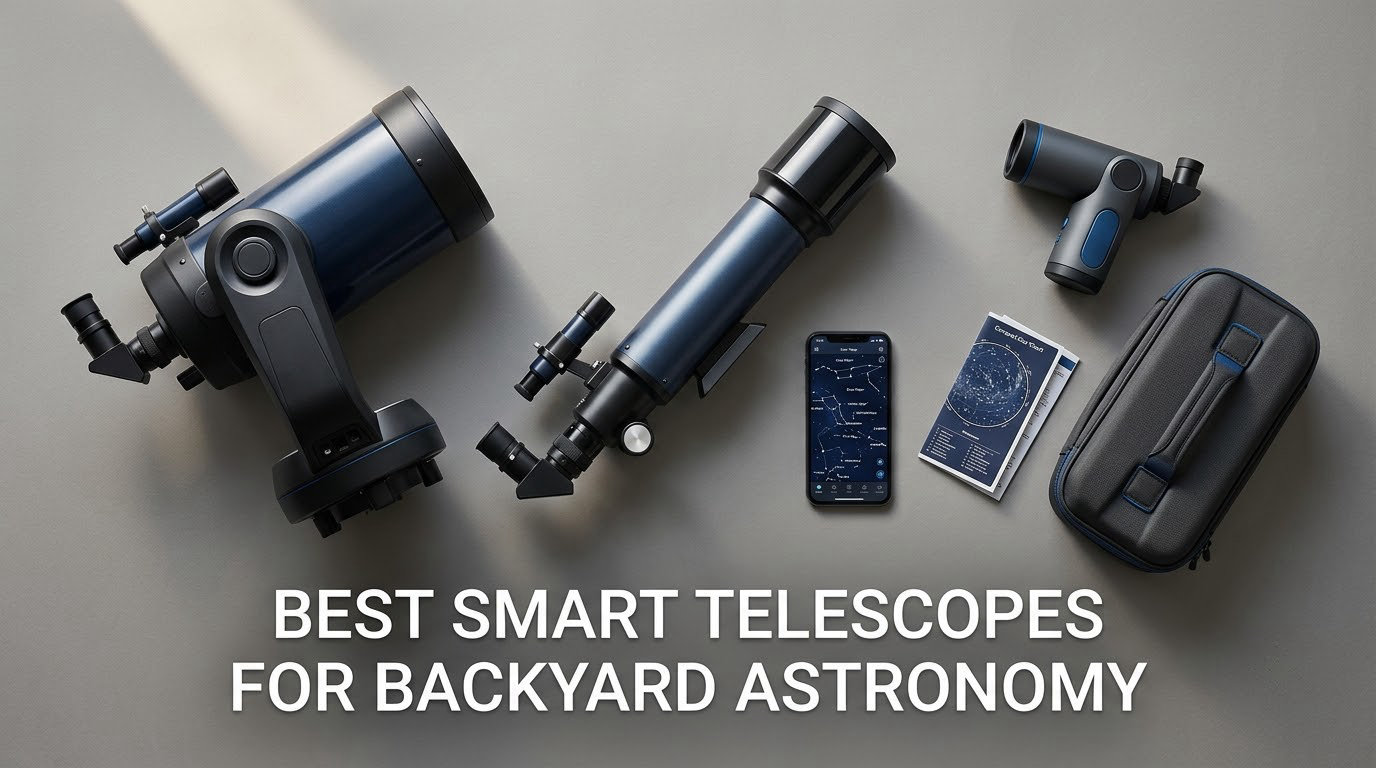
If you want the best smart telescope for backyard astronomy, the ZWO Seestar S30 Pro is the pick most suburban observers end up happy with, because it is one of the few all-in-one units that produces a finished colour photograph of a nebula from a light-polluted patio in about five minutes of setup. If you want a telescope rather than a camera, the Celestron NexStar 8SE gathers far more light and shows you Saturn through an eyepiece, at the cost of weight and manual effort.
That split is the honest core of this roundup. A smart telescope is an appliance: you tap a target on your phone, the scope plate-solves where it is pointing, slews, tracks, and live-stacks short exposures into an image. A computerized telescope is a real optical instrument you look through, sometimes with a motor to help it track. Both earn a place on a patio table, but for different reasons, so I ranked six of them side by side here.
A word on method: this is a research-based roundup, not a hands-on shoot. Every specification here comes from the manufacturer listing, and every performance judgement is cross-checked against long-term owner reports on Reddit’s r/telescopes and r/AskAstrophotography, owner threads on CloudyNights, and reviews from specialists such as astrobackyard, Digital Camera World, BBC Sky at Night and Skies & Scopes. Model lineups in this category turned over substantially in 2026, so I have named the specific model in every heading rather than a family, because buying a superseded generation by accident is the most common mistake we saw in owner discussions.
For the wider field, our picks for smart telescopes across every price tier and our guide to computerized telescopes cover the options that did not make this backyard-focused shortlist.
Table of Contents
Top 3 Picks for Best Smart Telescopes for Backyard Astronomy In 2026

Celestron NexStar 8SE
- 8 inch aperture
- 2032mm focal length
- Fully computerized GoTo mount
- SkyAlign in minutes
ZWO Seestar S30 Pro
- Automatic GOTO and tracking
- Built-in light pollution filters
- 4.6 degree field of view
- Tripod included
StarSense LT 114AZ
- Sky recognition pointing
- Curated nightly target list
- 114mm reflector
- Two eyepieces and a Barlow included
In 2026All Six Picks at a Glance (October 2026)
| Product | Specifications | Action |
|---|---|---|
| Celestron NexStar 8SE |
|
Check Latest Price |
| ZWO Seestar S30 Pro |
|
Check Latest Price |
| Celestron StarSense LT 114AZ |
|
Check Latest Price |
 Celestron AstroMaster 130EQ-MD Celestron AstroMaster 130EQ-MD |
|
Check Latest Price |
 DWARFLAB Dwarf 3 DWARFLAB Dwarf 3 |
|
Check Latest Price |
 DWARFLAB Dwarf Mini DWARFLAB Dwarf Mini |
|
Check Latest Price |
What Is a Smart Telescope, and How Does Live Stacking Work?
A smart telescope is an all-in-one robotic imager. It plate-solves its own position, slews to a target you tap on your phone, tracks it against the Earth’s rotation, and stacks hundreds of short exposures into a finished colour photograph on your screen. There is no eyepiece, no star chart, and no manual alignment.
Here is the actual sequence, because it explains every spec on this page. The camera takes a trial photograph of the star field. Software matches that star pattern against a known catalogue, works out exactly where the tube is pointing, and corrects the mount. The scope then swivels continuously to cancel the Earth’s rotation while it shoots. Each frame is aligned to the last and added together.
That last part is the whole trick. Random noise does not accumulate the way starlight does, so a hundred stacked frames come out roughly ten times cleaner than a single frame. Doubling your exposure time is worth almost nothing; doubling your frame count is worth a great deal. This is why two scopes with nearly the same aperture can produce very different results, and why a scope that keeps more of its frames on target beats a higher-resolution scope that keeps half of them.
One boundary worth getting right, because buyers confuse it constantly. A computerized GoTo telescope such as the NexStar 8SE or the StarSense LT 114AZ is not a smart telescope. GoTo scopes point an eyepiece at an object; smart telescopes photograph it. The automated GoTo mount in a Celestron scope removes star-chart work, which is a real convenience, but it does not live-stack and it does not produce an image on your phone.
Our earlier explainer on astronomy cameras for deep-sky imaging goes deeper on the sensor side of this equation, which matters once you start comparing megapixels against pixels per inch of sky.
1. Celestron NexStar 8SE Review: The Aperture Winner for a Serious Backyard
Celestron NexStar 8SE Computerized Telescope – Schmidt-Cassegrain
8 inch aperture
2032mm focal length
0.57 arcsec Dawes limit
24 lb
Pros
- Gathers far more light than any smart scope in this list
- 2032mm focal length delivers real planetary magnification
- SkyAlign setup takes minutes
- Single fork arm mount is stable
Cons
- Heaviest option here at about 24 lb
- Batteries and AC adapter not included
- 25mm eyepiece gives a narrow field of view
For a backyard with a table and a place to sit, the NexStar 8SE is the strongest instrument in this roundup and the one I would keep. An 8 inch Schmidt-Cassegrain with StarBright XLT coating collects roughly eleven times the light of a 60mm refractor, which is the difference between a faint smudge and a shape you can actually describe.
The fork-arm mount is the question that decides whether this scope lives in your garage or on your patio, and the answer is favourable. A 2032mm focal length in a 43.2cm tube is a very short physical package for that much magnification, and the single fork arm does not flex the way an entry-level equatorial head does.
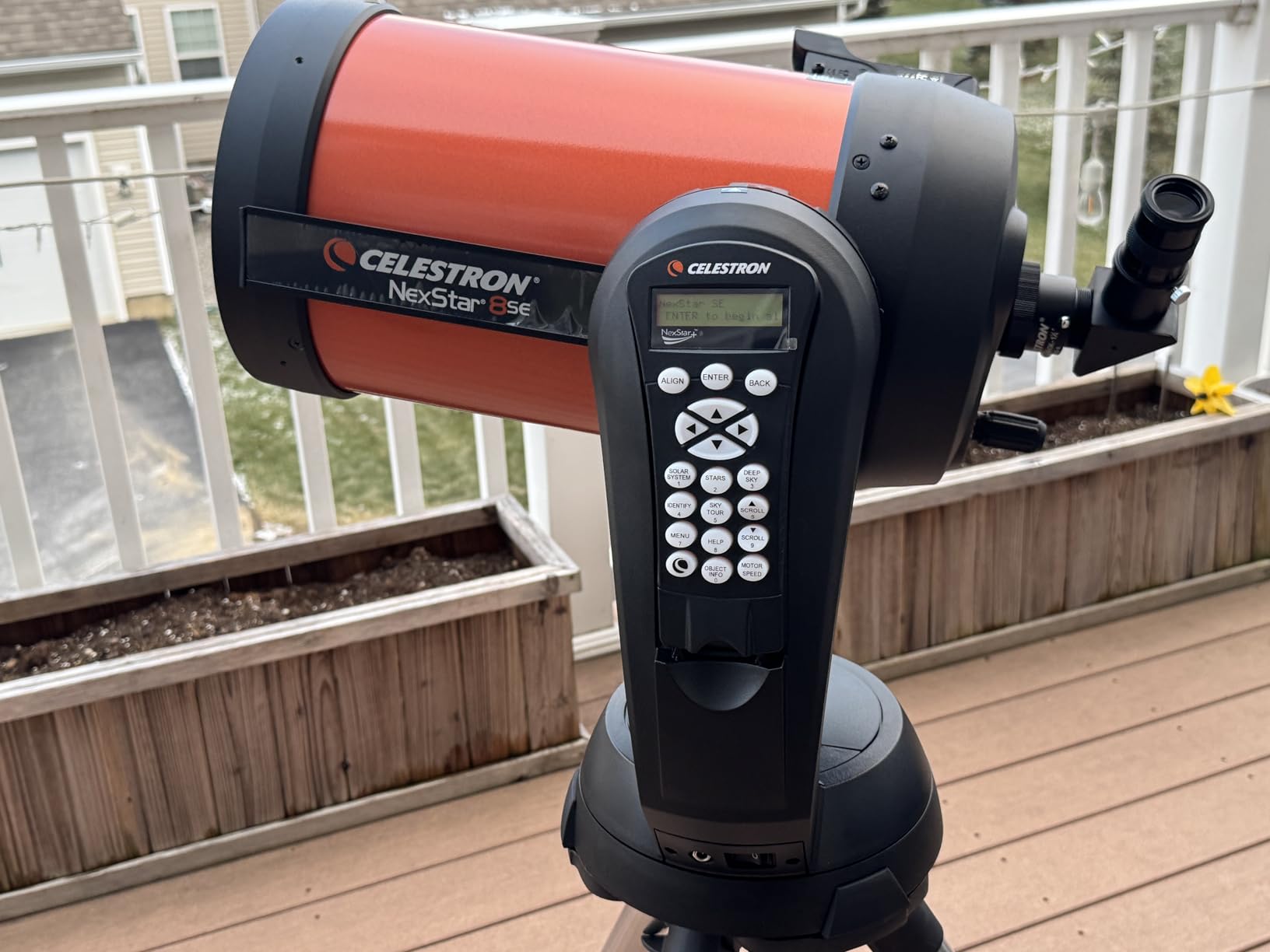
SkyAlign is the feature that converts this from a traditional telescope into something a beginner can use. Point the tube at any three bright stars and the mount works out where you are, in minutes. Then the 40,000-plus object database means you pick M51 from a list rather than reading a star chart. Owners consistently name GoTo and SkyAlign, not the optics, as the reason they moved up from a manual scope.
The Dawes limit of 0.57 arcseconds tells you this is optically capable well beyond what a suburban sky can use. That is not wasted, though. On a night of steady seeing you will see the Cassini Division in Saturn’s rings and detail in the Orion Nebula that no 50mm-class smart scope in this list will approach.
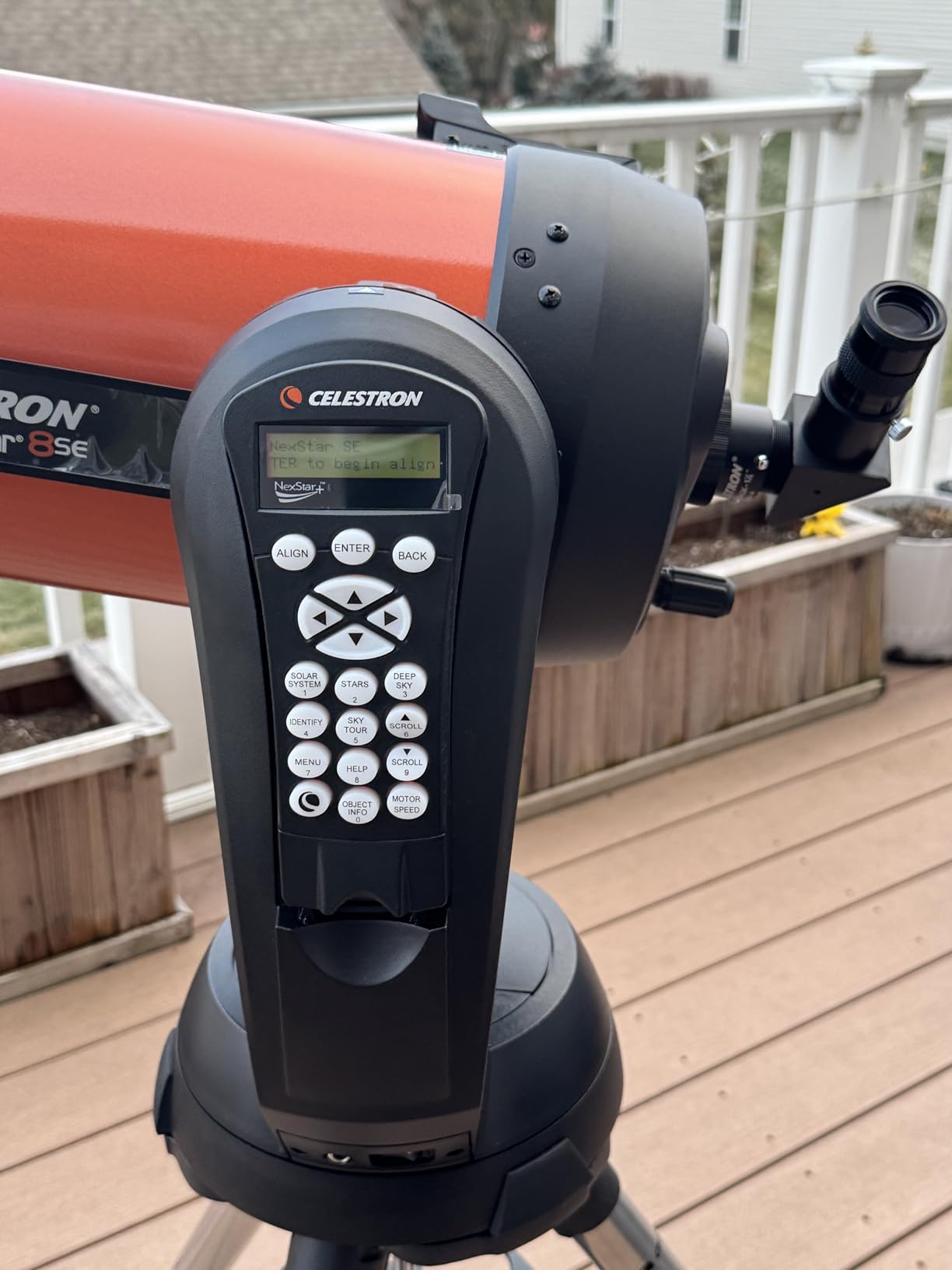
Is the NexStar 8SE worth the weight for a patio?
Only if you have somewhere to leave it. At roughly 24 lb, this is the least portable scope here, and a large-aperture Schmidt-Cassegrain also wants periodic collimation to perform at its best. If your backyard session means carrying the telescope out and back each time, that friction will end the hobby for you before the optics do.
The alternative is to keep it set up. Owners who treat the 8SE as a semi-permanent backyard instrument report the weight stops mattering after the first month. Put it on a concrete pad or a sturdy table, cover it, and it becomes the thing you walk out to.
Where the 8SE will disappoint you
Power is the most common owner complaint, and it is a packaging issue rather than a design flaw. The scope runs on eight AA batteries or a 12V adapter, and neither is included, so budget for those before the first session. The included 25mm eyepiece also gives a narrow field, which makes wide targets awkward without a Barlow or a second eyepiece.
GoTo alignment also adds a layer of complexity compared with a plain manual Dobsonian. If you are buying this as a first telescope ever and you have never used a finder scope, the learning curve is real. Our guide to Dobsonian telescopes for visual astronomy is the calmer path to the same views for less money and half the weight.
2. ZWO Seestar S30 Pro Review: Best Smart Telescope for Light-Polluted Skies
ZWO Seestar S30 Pro Smart Telescope, App-Controlled Astrophotography
30mm aperture
160mm focal length
4.6 degree field of view
3.6 lb
Pros
- Fastest path to a finished image for a complete beginner
- Built-in light pollution filters suit suburban and urban skies
- Tripod and filter included in the box
- One-tap modes for Milky Way and star trails
Cons
- Explicitly not designed for planetary viewing
- Must stay stationary during deep-sky imaging
- Advanced modes need the manual
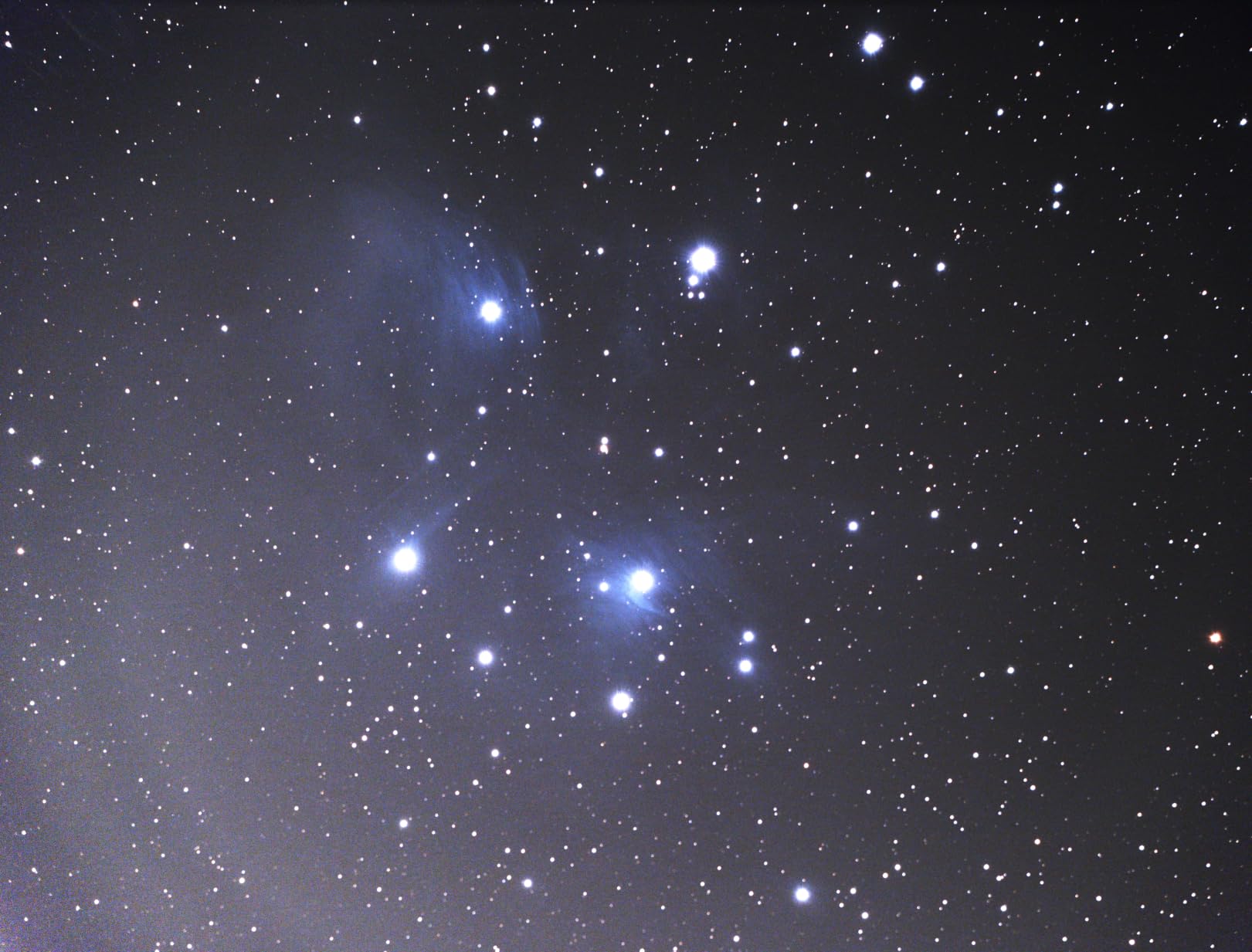
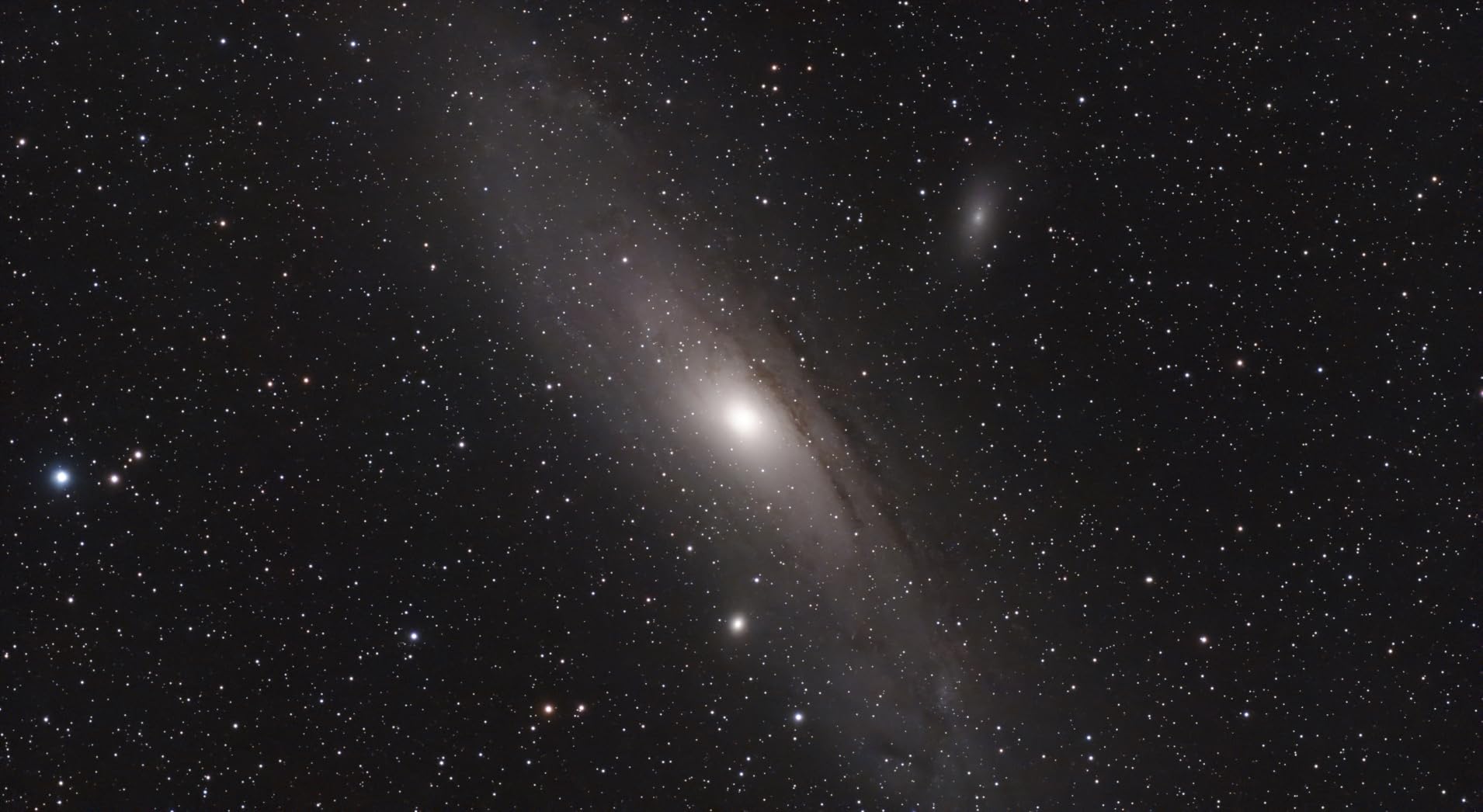
The S30 Pro is the answer to the question most people actually have, which is how do I get a picture of something in the sky from where I live. A 30mm objective at 160mm gives a 4.6 degree field of view, wide enough that the Andromeda Galaxy and the Pleiades sit comfortably inside one frame rather than needing a mosaic.
What makes it work from a patio is the filter. The built-in light pollution filters sit in front of the sensor, which is exactly the intervention that matters when your sky is a Bortle 6 or 7 and the Milky Way is invisible to the naked eye. Reviews describe usable images of nebulae from suburban locations, which for this category is the headline result.
The box contents matter more here than with any other pick on this page. You get the telescope, a tripod, a filter, a quick start guide and a Type-C cable. Most competing packages make you buy a tripod before you can use equatorial mode properly, and that is the most common accessory complaint across the whole category.
There is also dual-camera 4K imaging, with a wide-angle channel for Milky Way panoramas and star trails next to the telescopic channel. AI noise reduction and sky-versus-foreground separation are handled automatically, and there is automatic mosaic stitching when a target overflows the frame. Anti-dew protection is built in, which is the feature that decides whether an all-night backyard session in autumn is a good evening or a frustrating one.
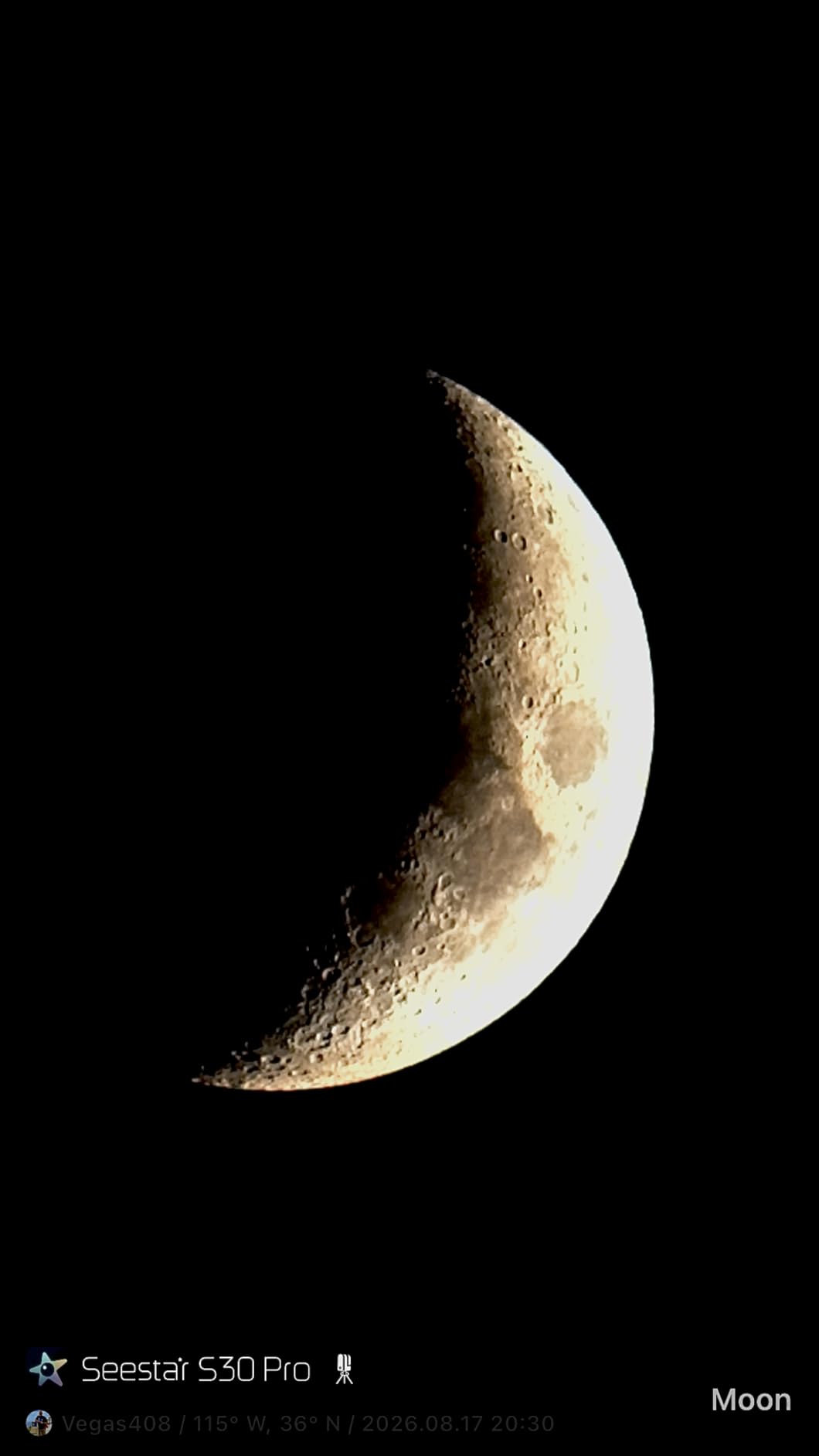
Who the S30 Pro suits best
It suits a household where more than one person wants to look at the sky, because the only thing anyone needs to handle is a phone. Pick a target, walk away, and a finished picture is waiting. It also suits anyone who has been put off by astronomy by setup, since the entire learning curve is scrolling a list.
It suits the gift buyer more than any other scope here. There is no eyepiece to lose, no collimation to fumble, and nothing to go wrong that a retry will not fix.
What the S30 Pro cannot do
Planets. This is stated plainly by the manufacturer and repeated in owner reviews: the design targets deep-sky imaging, and Jupiter or Saturn come back as small featureless discs. If seeing the rings of Saturn is your goal, look at the 8SE or the AstroMaster 130EQ-MD instead.
The second limitation is physical. The scope must stay stationary while it stacks, which means no carrying it between targets and no walking around the yard mid-session. Set it up, point it, leave it. The third is that the advanced modes genuinely require reading the manual; the one-tap modes are foolproof and the manual ones are not.
3. Celestron StarSense Explorer LT 114AZ Review: The Budget Pick That Onboards Anyone
Celestron StarSense Explorer LT 114AZ Newtonian Smartphone Guided Telescope
114mm aperture
1000mm focal length
10.4 lb
Manual altazimuth mount
Pros
- StarSense app points the scope for you
- Curated nightly target list for beginners
- Two eyepieces and a 2x Barlow included
- Works from urban skies
Cons
- Manual mount means targets drift out of view
- Needs a docked smartphone for navigation
- 1000mm focal length is modest for planets
- Occasional collimation may be needed
The StarSense Explorer LT 114AZ answers the beginner question better than anything else in this roundup, and it is not a smart telescope. A 114mm reflector on a manual altazimuth mount, guided by a phone app that recognises the sky and tells you where to point.
That app is the whole product. You dock your phone, the scope’s StarPointer finder looks at the sky, the app matches the pattern, and then it walks you through finding your first target. The 10.4 lb weight and preassembled tripod mean a beginner can genuinely carry it out to the garden alone.
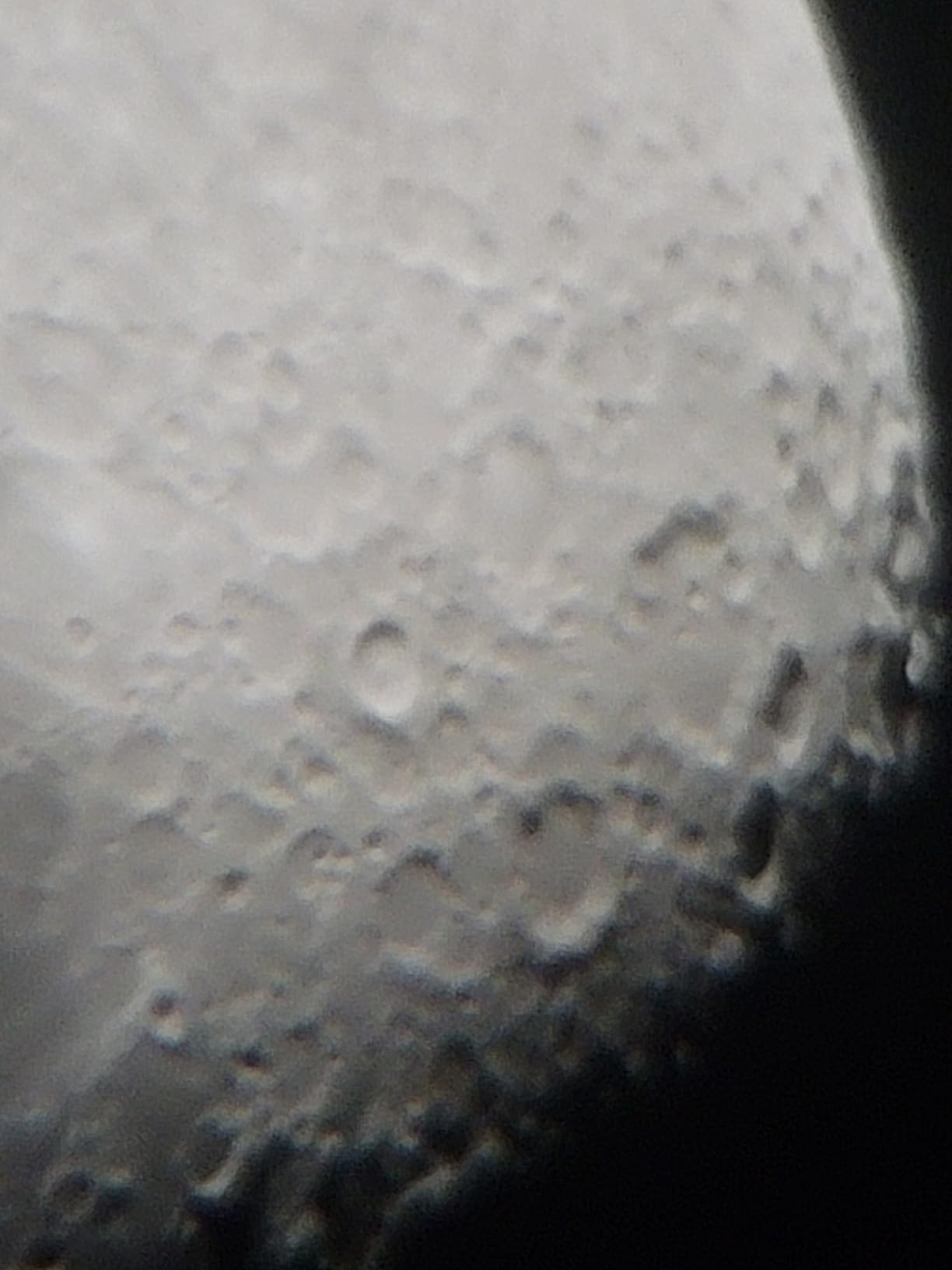
Owners credit the app with removing the learning curve of star charts, and credit the target list with solving the specific anxiety of a first session: not knowing what is worth looking at tonight. The included 25mm and 10mm eyepieces plus a 2x Barlow mean you can go from the Moon to a galaxy in one box.
It works from urban skies, with more targets visible from darker locations, which is an honest framing for anyone in a city. Our guide to reflector telescopes covers the optical design in more depth if you want to know why a Newtonian behaves the way it does.
Is the StarSense LT 114AZ good for a backyard?
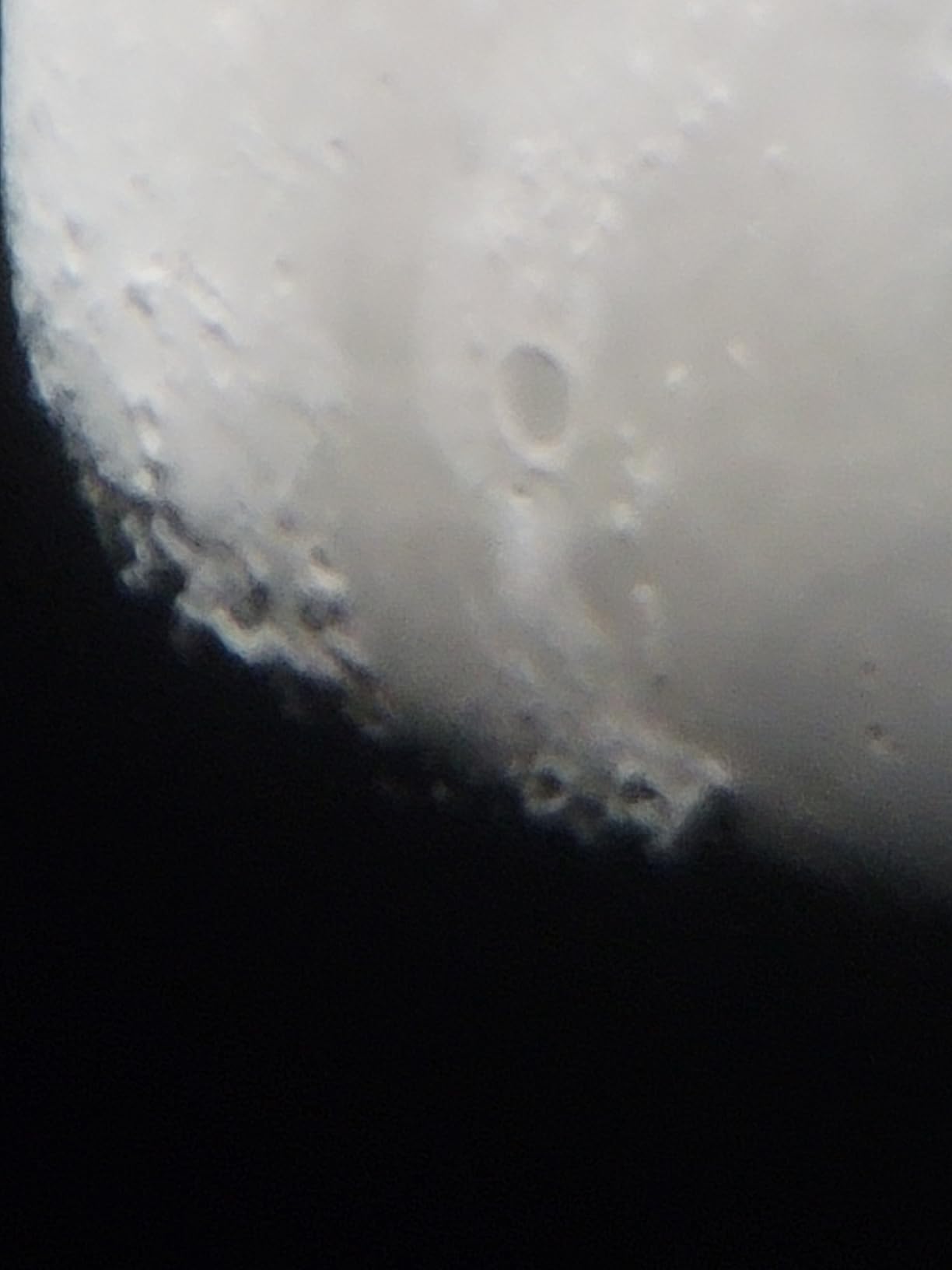
It is good for a backyard where the goal is looking, not producing. A 4.5 inch reflector shows you the Moon, Jupiter, Saturn with visible rings at the right time of year, the Orion Nebula and Andromeda. That is a real observing session, and it is the experience a smart telescope simply cannot deliver because it has no eyepiece.
For families this is often the more forgiving instrument. A child can look through an eyepiece, ask questions, and hand it to the next person. Nobody has to explain what an exposure is.
Where it falls short
The manual altazimuth mount is the real limitation. Targets drift out of the field during a long session and have to be re-aimed, and there is no motor to do it for you. The sliding rod gives you slow altitude adjustment, but that is manual centring, not tracking.
The 1000mm focal length is also modest for planetary detail compared with a longer refractor, so Saturn is a target you look at rather than a target you study. And the reflector tube means occasional collimation adjustment, which is the maintenance step that stops some beginners.
4. Celestron AstroMaster 130EQ-MD Review: Motorized Tracking on a Real Equatorial Mount
Celestron AstroMaster 130EQ-MD Telescope with Motorized Tracking
130mm aperture
650mm focal length
0.89 arcsec Dawes limit
17 lb
Pros
- Strong light gathering for a beginner reflector
- Motor drive helps with entry-level astrophotography
- Tool-free assembly
- No chromatic fringing on stars
Cons
- Spherical primary mirror causes aberration and bloated stars
- CG-3 mount has tight and loose spots
- Shaky tripod
- 17 lb is heavy to move
The AstroMaster 130EQ-MD is the traditional value entry in this roundup, and its appeal is that the mount is genuinely equatorial with a motor. A CG-3 German equatorial with motorized right-ascension tracking is a step up in capability from the altazimuth mount in the StarSense, at 130mm of aperture and a 0.89 arcsecond Dawes limit.
That motor is the reason to consider it. With tracking, a fixed camera can hold a brighter nebula or galaxy long enough to be worth photographing, which is the first rung of the astrophotography ladder. Two-axis slow-motion knobs let you centre manually once the motor is holding.
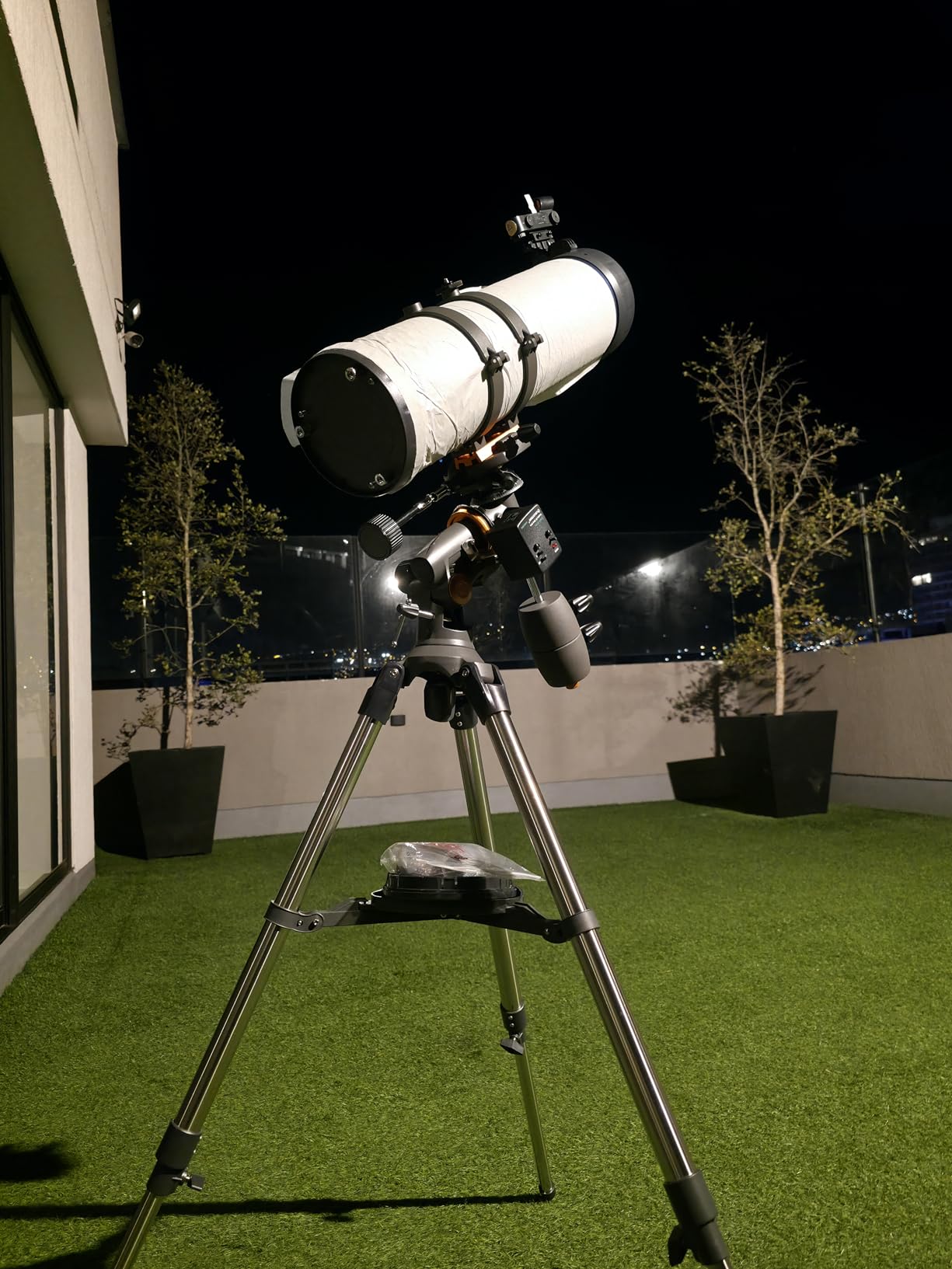
The kit is generous for the money. You get a 20mm eyepiece with an erect image corrector, a 10mm eyepiece, the motor drive, a red-dot finder, and a preassembled tripod and mount, with no tools needed for assembly and clear instructions to get from box to backyard quickly. Aluminum and SiO2 mirror coatings and no chromatic fringing on stars make it a forgiving first reflector.
With nearly two thousand reviews and a wide spread of opinions, this is the most divided product we looked at. Fans value the aperture, the included motor and the setup. Critics focus on the mechanics, and they are not nitpicking.
Is the 130EQ-MD good for entry-level astrophotography?
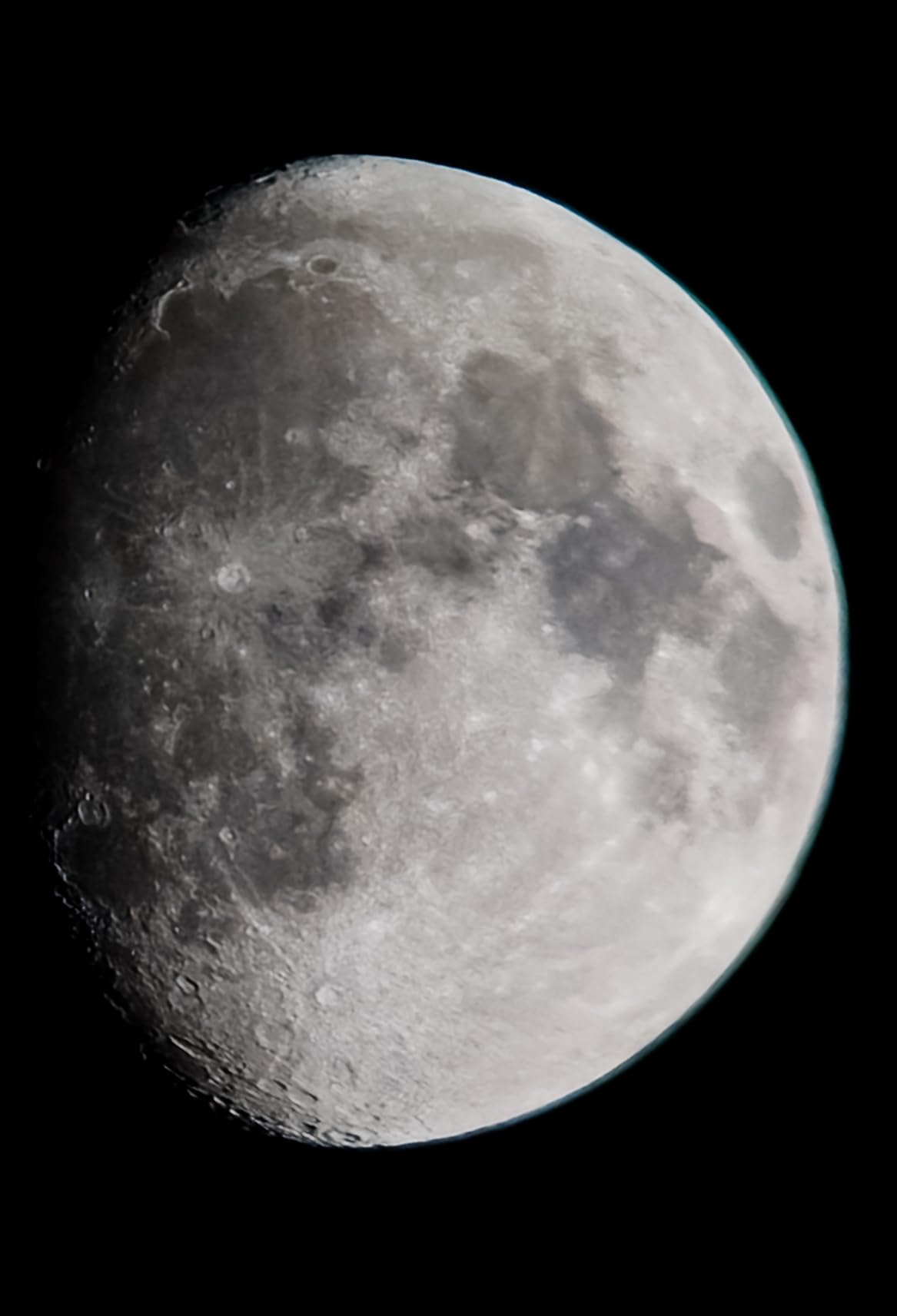
For bright targets on short exposures, yes, and that is a narrower claim than most listings make. A motorised equatorial mount plus a 130mm aperture will capture the Moon, a decent Milky Way field, and the brighter emission nebulae. It will not hold faint galaxies for the long integrations a dedicated rig would, because 130mm of aperture limits how much signal you can gather per second.
It suits a beginner who wants to grow into astrophotography without changing mount philosophy later, because the CG-3 is a real equatorial platform you can keep.
What owners complain about most
The primary mirror is spherical, not parabolic. That means spherical aberration and noticeably bloated stars, and it is the single most-cited optical complaint. The mount has tight and loose spots in the slow-motion controls, knobs that bind and can detach, and worm gears that grind. The tripod is noticeably shaky, and the scope shifts when you touch it.
There is also a design conflict: with the motor drive installed, the right-ascension fine-adjust knob is blocked, so you cannot use it manually. The 20mm eyepiece is widely reported as low quality, and the red-dot finder often arrives out of alignment. At 17 lb, it is also the second-heaviest thing here.
5. DWARFLAB Dwarf 3 Review: Best for Travel, Wildlife and Wide Night Scenes
DWARFLAB Dwarf 3 Smart Telescope, App-Controlled Astrophotography Camera
35mm aperture
2.28 kg
Altazimuth mount
2 year warranty
Pros
- Dual camera system covers deep-sky and wide-field scenes
- Listed at 2.28 kg so it is genuinely portable
- One-touch cloud processing
- Carrying bag and magnetic filters included
Cons
- About 10 percent of ratings are 1 star
- Still needs manual colour and contrast edits
- No equatorial wedge in the box
The Dwarf 3 is the most capable instrument here for something that has nothing to do with astronomy. Its dual imaging system pairs a telephoto channel for deep space and wildlife with a wide-angle channel for Milky Way panoramas and star trails, on a body listed at 2.28 kg with a carrying bag in the box.
That combination is why 4K smart auto-tracking exists on it in the first place. The same tracking that keeps a nebula sharp will follow a deer across a field at dusk. Owners consistently describe it as a dual-purpose camera rather than a telescope with a hobby bolted on.
The keeper rate is the number that matters most here, and it is the reason forum consensus keeps putting this class of scope at the top for image depth. Owner reports in telescope forums describe keeping 80 to 90 percent of frames on the Dwarf 3 with careful polar alignment, against roughly half at times on a Seestar. Since signal builds with the square root of your kept frames, that ratio converts directly into a cleaner stack from the same total time. That difference is the main reason this class of scope keeps appearing at the top of owner recommendations for image depth.
Because the manufacturer publishes the control interface rather than hiding it, owner communities self-host control software for this hardware. That is a quiet but real advantage if the stock app ever stops being developed.
Who the Dwarf 3 works for
It works for anyone who wants one device for a dark-sky trip and the backyard. At 2.28 kg with an included carrying bag, it packs into a car boot or a carry-on without ceremony, and a 35mm aperture gives it a real edge over the 30mm units for smaller deep-sky targets.
It also works for the person whose idea of a night outdoors includes more than the sky. Daytime landscape capture and wildlife tracking are documented uses, and the app is written to be usable across a wide age range.
What owners complain about
About 10 percent of ratings are one star, which is a meaningful share of dissatisfied users and the highest of any pick here. The recurring theme is reliability and connectivity rather than image quality.
The other consistent note is that the one-touch cloud processing gets you close, not finished. Reviewers report still doing manual colour, contrast and sharpening work for the best results, so the automation saves time rather than replacing post-processing. And the mount is altazimuth with no equatorial wedge in the box, which limits how long you can push tracking.
6. DWARFLAB Dwarf Mini Review: The Lightest Way Into Astrophotography
DWARFLAB Dwarf Mini Smart Telescope – 1.85lb Portable Astronomy Telescope
30mm aperture
150mm focal length
2.45 degree field of view
Just under 2 lb
Pros
- Weighs just under 2 lb so it goes in a backpack
- Plate solving and auto GoTo need no manual pointing
- EQ mode allows exposures up to 90 seconds
- Magnetic solar filter included
- Built-in light pollution filters
Cons
- Sensor resolution is too low for large prints
- Planets appear as featureless discs
- Small targets do not enlarge well
- Tripod with a fluid head is not included
The Dwarf Mini is the smallest, lightest thing in this roundup at just under two pounds, and it is the most convincing first step into astrophotography for a specific kind of person: someone who wants to carry their telescope to a genuinely dark site rather than observe from a lit patio.
Owner reviews describe capturing a colour galaxy within about five minutes of opening the box with essentially no astronomy knowledge. Plate-solving and auto GoTo handle finding and tracking, equatorial mode with app-guided polar alignment allows single-frame exposures up to 90 seconds, and the app includes a built-in interactive star map.
It performs well under heavy light pollution for its aperture class, and a magnetic solar filter is included, so it can be pointed at the Sun on eclipse day or used for sunspot work rather than being a deep-sky-only device. A 2 year warranty and 2.45 degree field of view round out an unusually complete package for its size.
One owner detail worth repeating from forum threads: someone photographed an interstellar comet with a Seestar S50 from a street in Kendal, Cumbria, dodging streetlight glare simply by shifting position. That is the whole category in one sentence. The automation means you can move twenty feet down the garden to get out of a bad light and try again, which no traditional setup makes easy.
Is the Dwarf Mini good enough as a first telescope?
For deep-sky photographs from home, yes, and reviewers overwhelmingly call it the best value entry point in the category. The on-device and cloud stacking means a beginner gets a finished image before losing interest.
It also suits children and travel better than anything else here. A magnetic solar filter makes it safe in a way that removes the biggest worry parents have about a telescope, and the weight means it does not get left in a cupboard because it is too much to move.
Where the Dwarf Mini runs out of road
Resolution. The sensor class is fine for screens and social sharing and not fine for large prints, and this is the clearest compromise in the roundup. Small deep-sky objects look tiny and do not enlarge well at this resolution, so it rewards bright targets rather than faint ones.
Planetary viewing is the other wall, because the 150mm focal length and 30mm aperture make planets featureless discs. And EQ mode needs a separate tripod with a fluid head for comfort, which is not included, so factor that into the real cost before the first session. A few owners also report initial Wi-Fi connection friction that needs a second attempt, and some report internal dust particles on the lens that cannot be cleaned.
Are Smart Telescopes Worth It? The Honest Limitations
They are worth it for photographs, not for planets. Every limitation in this category follows from the same design decision: a small sensor, a wide field, and a stacking pipeline. That combination is superb at pulling faint nebulae out of a bright sky and poor at magnifying a planet enough to see cloud bands.
There is also no eyepiece. If the emotional core of stargazing for you is putting your eye to a glass and seeing Saturn, a smart telescope cannot do it and will not improve with firmware. That is what the 8SE and the StarSense LT 114AZ are in this roundup for.
Batteries derate badly in cold weather. Owners report rated runtimes of four to six hours dropping to two or three below 40F, so a winter backyard session needs a power bank. Dew is the other seasonal problem, and it is worth checking whether the model you are considering has a built-in heater.
Field-of-view cropping is the quiet disappointment. Andromeda and the North America Nebula overflow a narrow frame, which turns a quick session into a slow mosaic session, and it is the main reason to pay for a wider unit like the S30 Pro at 4.6 degrees.
There is a buying hazard specific to this year. The original Seestar S50 and S30 were discontinued and replaced by Pro models, and Vaonis, Celestron and DWARFLAB all refreshed their lineups at the same time. Buyers in owner threads report unknowingly purchasing outgoing hardware. Check the exact model name, not the family name, and confirm the box contents list matches what you expected.
App dependency is the long-term risk. Your telescope is controlled by software on a phone, and the Orion Telescopes closure in 2023 is a reminder that brands can disappear. This is a small argument for buying a manufacturer that publishes its control interface.
Skip a smart telescope entirely if you can drive to a Bortle 2 or 3 site a couple of times a year. From genuinely dark skies a Dobsonian shows far more for far less, and no amount of stacking substitutes for photons you never gathered. Buy smart for the backyard; buy visual for the trip.
Your First Night in the Backyard: A Step-by-Step Plan
Set up where the tripod sits for the whole session, not where the view is prettiest. Put it away from house lights, security floods and streetlamps, and note where your own house lights fall. Turn off or cover indoor lighting for the session, because the light bouncing off a patio table will undo everything the scope’s filters are doing.
Run power and app checks before dark. Charge the battery, connect to the scope’s Wi-Fi while you are still outside, and confirm the app sees it. First-session connection problems are the single most common complaint in this category and almost always resolve on a second attempt, so do not do it for the first time twenty minutes after sunset.
Set your privacy options now. The Seestar app has been reported by competitor coverage and owner reports to publish exact observing coordinates by default, which tells anyone who looks that your house has a telescope pointed at the sky. Turn off location sharing and automatic cloud upload if you would rather keep your session private. Unbind the account before you ever resell a scope.
Plan one long target rather than a shopping list. The stacking curve rewards patience, so pick one bright nebula, let it run for 60 to 90 minutes, and let the pipeline work. Chasing targets every ten minutes is how people conclude the scope is disappointing when it was simply never given time.
Know your sky class. From Bortle 3, expect the Milky Way, open clusters and the brighter galaxies. From Bortle 5, expect the Orion Nebula, the Pleiades, Andromeda, the Ring Nebula and double stars. From Bortle 7, expect the large emission nebulae and clusters, with galaxies as a stretch. From Bortle 9, expect Moon, planets and a handful of the brightest clusters through a GoTo scope, and treat deep-sky as a trip you travel for.
For an automated first target, the Moon through a GoTo scope is unsatisfying but instant, and it confirms your optics work. For a smart telescope, the Orion Nebula at one-tap is the right opener, because it is bright enough to succeed and large enough to show structure in a stacked image.
How to Choose a Smart Telescope for a Backyard
Decide first whether you want pictures or views, because everything else follows. Pictures point you to a smart telescope. Views point you to a GoTo or manual telescope with an eyepiece. Buying the wrong one of those two is the most common and most expensive mistake in this category.
Aperture and sensor pull against each other, and marketing exploits that. Bigger aperture means more light and better resolution. Bigger sensor means a wider field and a different kind of target. The 8SE wins the first, the S30 Pro and the StarSense win the second, and there is no single number that settles it.
Field of view decides what you can frame in one shot. The S30 Pro’s 4.6 degrees holds the Andromeda Galaxy; the 8SE’s 0.75 degrees will not. If your target list is large nebulae and galaxies you would like whole, a wide field matters more than resolution.
Look at pixel scale, not megapixels. Arcseconds per pixel tells you how much sky one pixel covers, and roughly two to four arcseconds per pixel is the sweet spot for these focal lengths. A high-megapixel sensor on a very fast scope can be undersampled and produce mushy stars, which is the point competitors make when they push aperture and resolution in opposite directions.
Then check keeper rate, which is the unprinted spec that predicts image depth. The percentage of frames tracking actually keeps is what determines your signal-to-noise. Astronomically literate users also point out that apertures in this class are not diffraction limited, so treat resolution claims cautiously. Expect faint targets beyond roughly magnitude 12 to 13 per square arcsecond to be marginal on 50mm-class smart scopes.
Filters decide how the scope performs under your sky. Built-in light-pollution filters and dual-band narrowband filters are what rescue nebulae from a city backyard, because they cut the sodium and LED wavelengths that swamp everything else. Narrowband will not rescue galaxies, which emit a broad continuum that no emission-line filter removes.
Budget for the landed cost. Most models here ship without a tripod or without batteries, and a power bank for winter sessions, an equatorial wedge for longer exposures, or a second eyepiece will all add up. The S30 Pro and the Dwarf 3 are the two that include the most in the box.
Finally, consider the app and the brand. The Seestar, DWARFLAB and Singularity apps are the ones with the deepest object catalogues and the most reliable automatic capture. Consider who maintains the app in five years, because a telescope that loses software support becomes an expensive paperweight.
Frequently Asked Questions
Can smart telescopes see planets?
Barely. A 50mm-class smart telescope takes a very small, featureless disc of Jupiter or Saturn, because its short focal length and small sensor are tuned for wide-field deep-sky stacking rather than magnification. For visible planetary detail you want a traditional telescope with a long focal length, such as the Celestron NexStar 8SE in this roundup.
Do smart telescopes work in light pollution?
Yes, and that is the main reason to buy one. Built-in light-pollution filters cut the sodium and LED wavelengths that dominate a suburban sky, and live stacking recovers faint signal that the eye would never see. From a Bortle 6 or 7 patio you can realistically image the Orion Nebula, the Pleiades, Andromeda and large emission nebulae, though galaxies stay a stretch.
Do smart telescopes need WiFi or internet?
They need a connection for setup and control, because the scope joins the app over its own Wi-Fi network. Cloud stacking and processing also run server-side, so a full-quality stacked image generally needs internet access. Field use without a signal still works for basic capture on some models, but you lose the automated processing that makes the category convenient.
How long does a smart telescope battery last?
Rated runtimes in this category are typically four to six hours per charge, and owners report that dropping below 40F cuts that to two or three hours. For winter backyard sessions, plan on a power bank rather than the internal battery. The DWARFLAB Dwarf 3 also runs from its lithium-ion battery, and the Celestron 8SE needs eight AA batteries or a 12V adapter, neither of which is included.
Do smart telescopes require a subscription?
The hardware functions without a paid tier on the models in this roundup, and the one-tap capture and stacking modes are free. Paid plans, where they exist, add cloud storage and extra processing rather than unlocking the telescope itself. The ongoing cost of a smart telescope is more accurately described as accessories: a tripod, an equatorial wedge, a power bank and replacement filters.
Is the DWARF Mini better than the Dwarf 3 for beginners?
The Dwarf Mini is the better first purchase for a beginner who will observe from a light-polluted patio, because its built-in light pollution filters and EQ mode of up to 90 second exposures get you a finished image quickly from a small sensor. The Dwarf 3 is the better choice if you want to travel to dark skies, photograph the Milky Way with its wide-angle camera, or capture wildlife, since it is listed at 2.28 kg with a wider 35mm aperture and a dual imaging system.
The Bottom Line for Backyard Astronomy in 2026
The Celestron NexStar 8SE is our pick for the best telescope for backyard astronomy, and it wins on the one axis nothing else here can match: light. If you have somewhere to set it up and you want to look through an eyepiece at Saturn’s rings, it is the right instrument, and the GoTo mount removes the star-chart work that stops most beginners.
If you specifically want the best smart telescope from a lit patio, the ZWO Seestar S30 Pro is the pick. Built-in light pollution filters, a 4.6 degree field that holds whole galaxies, and a tripod in the box make it the least friction from carton to image, and it is the best value in this roundup for suburban skies.
Below that, the Celestron StarSense Explorer LT 114AZ is the safest first telescope for a family that wants to look rather than photograph, and the Celestron AstroMaster 130EQ-MD is the traditional route into motorized tracking if you want to grow toward astrophotography on a real equatorial mount. The DWARFLAB Dwarf 3 earns its place for travel, dark-sky trips and wildlife, and the DWARFLAB Dwarf Mini is the lightest, cheapest-feeling, most giftable way to start.
Whichever you choose, give it one long session on one target before you judge it, and turn your patio lights off while you do.