

Stackable food dehydrators are the answer for small kitchens because they trade a wide countertop footprint for vertical height, then collapse back down when the batch is finished. We compared 10 of the most popular compact models for this guide, weighing tray capacity, stored height, noise, wattage and how much usable room each one gives you per shelf of a narrow cabinet.
The short answer: the NESCO FD-75A Snackmaster Pro is the best stackable food dehydrator for most small kitchens, because its top-mounted fan moves air across every tray without you rotating them, its 600W element finishes batches in a reasonable number of hours, and the whole body closes to a 10 inch tall cylinder that slides onto a cabinet shelf. If you need the flattest storage profile, the Elite Gourmet EFD329WDX stores at just over 6 inches tall thanks to collapsible trays.
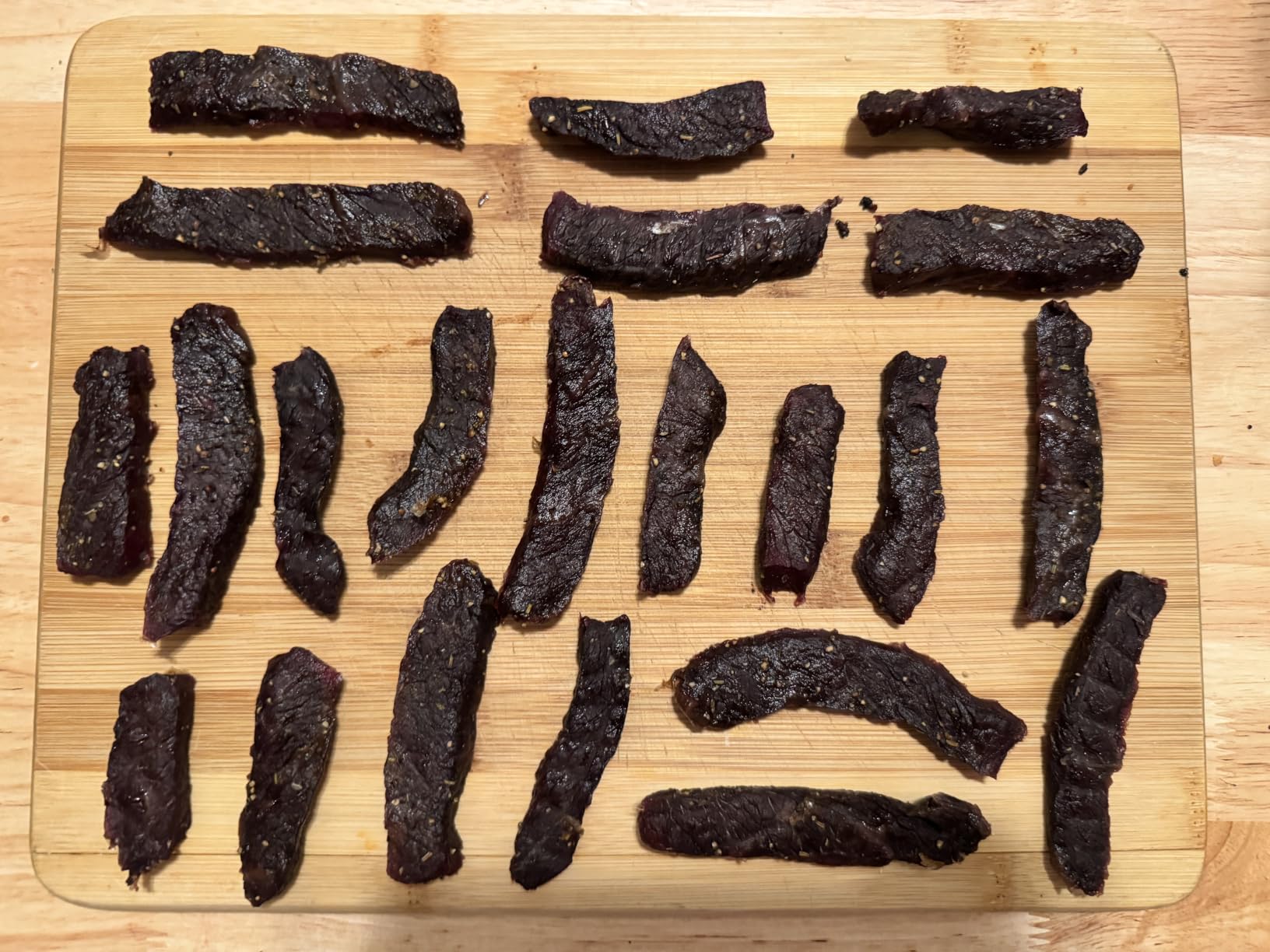
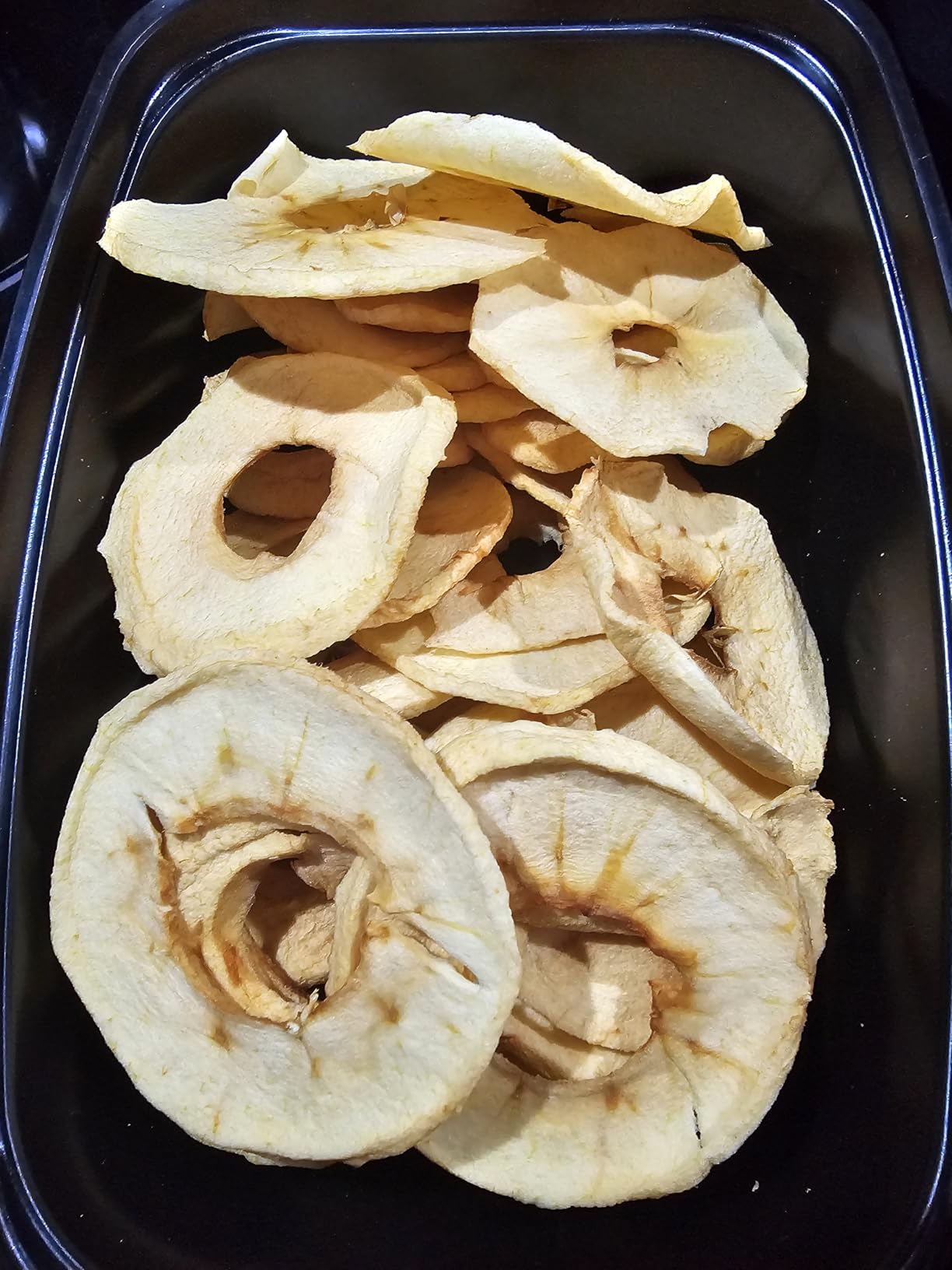
Why bother dehydrating in a small kitchen at all? Because most people who start with one tray of apple slices end up drying a season’s worth of garden herbs, a weekend of beef jerky and a holiday gift batch of fruit leather in the same week. A stackable design lets that happen without permanently claiming half your counter. If you are still working out what you want to make, our general food dehydrator roundup covers the bigger shelf-style models too.
Everything below is measured against the same three questions that decide whether a dehydrator works in a tight space: how tall is it when stored, how heavy is it to lift back down, and does the fan noise bother you at 2am during an overnight run.
Table of Contents
Top 3 Picks: Best Stackable Food Dehydrators for Small Kitchens in 2026
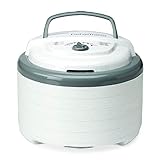
NESCO FD-75A Snackmaster Pro
- Expands from 5 to 12 trays
- 600W element
- Top-mounted fan airflow
- 95-160F dial control

Cosori CFD-N051-W 5-Tray
- Hottest 165F setting
- Under 47 dB quiet
- Expands 5 to 7 trays
- 48-hour timer

Elite Gourmet EFD329WDX
- Collapsible SlimStore trays
- Stores just 6.17 in tall
- 48-hour timer
- 95-158F range
The NESCO takes our top slot on the strength of airflow rather than raw feature count. Its fan sits on the lid instead of the base, so warm air drops down through all five trays and across the heating element in a single loop, and the 600W element outruns every other dehydrator in this group on a thick tray of green beans.
The Cosori earns the runner-up spot for temperature precision and for the 165F ceiling, which is the single most useful spec on the list if you make meat. The Elite Gourmet takes third because the collapsible tray design solves the storage problem better than anything else here, and 11k reviews say the rest of the package holds up.
All 10 Models at a Glance (October 2026)
| Product | Specifications | Action |
|---|---|---|
| NESCO FD-75A Snackmaster Pro |
|
Check Latest Price |
| Elite Gourmet EFD329WDX |
|
Check Latest Price |
| Cosori CFD-N051-W |
|
Check Latest Price |
 Magic Mill MFD-5000 Magic Mill MFD-5000 |
|
Check Latest Price |
 Hamilton Beach 32100A Hamilton Beach 32100A |
|
Check Latest Price |
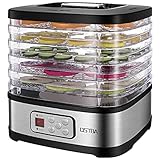 OSTBA GGJ-261B OSTBA GGJ-261B |
|
Check Latest Price |
 Commercial Chef CCD100W6 Commercial Chef CCD100W6 |
|
Check Latest Price |
 Rosewill RHFD-15001 Rosewill RHFD-15001 |
|
Check Latest Price |
 Rosewill RHFD-24001 Rosewill RHFD-24001 |
|
Check Latest Price |
 OVENTE DF215GY OVENTE DF215GY |
|
Check Latest Price |
Read the table for shape first. Round bodies are 12 to 13 inches wide but stack neatly and slide into a corner of a cabinet, while rectangular bodies trade a smaller footprint for more square drying space and wider trays. Then read the wattage column, because it is the number that decides whether a 14 hour run becomes a 20 hour run.
1. NESCO FD-75A Snackmaster Pro: The One That Scales With Your Garden
NESCO FD-75A Snackmaster Pro Food Dehydrator, For Snacks, Fruit, Beef Jerky, Gray
600W
5 trays, expandable to 12
95-160F
13 in round base, 10 in tall
Pros
- Expands from 5 to 12 trays as your harvests grow
- Top-mounted fan dries every tray without rotation
- 600W element is the most powerful in this group
- Quiet enough to sleep beside
- Includes fruit roll sheets and clean-a-screens
Cons
- No built-in timer so you need a kitchen timer
- Uneven drying at the top of tall stacks
- Plastic mesh trays are tedious to scrub
This is the dehydrator we keep coming back to, and it has been the reference point in our kitchen for years. The 13 inch round body takes up a surprisingly small circle of counter, and because the whole stack is just a column of trays, it tucks into the back of a lower cabinet better than any rectangular model we tested.
The airflow design is the part that matters. NESCO put the fan in the lid, so air is pulled down through the topmost tray and pushed back up past the heater, which means the top and bottom of a five-tray stack see similar conditions. Compare that with base-fan designs, where the tray nearest the element consistently dries faster and the top tray lags behind.
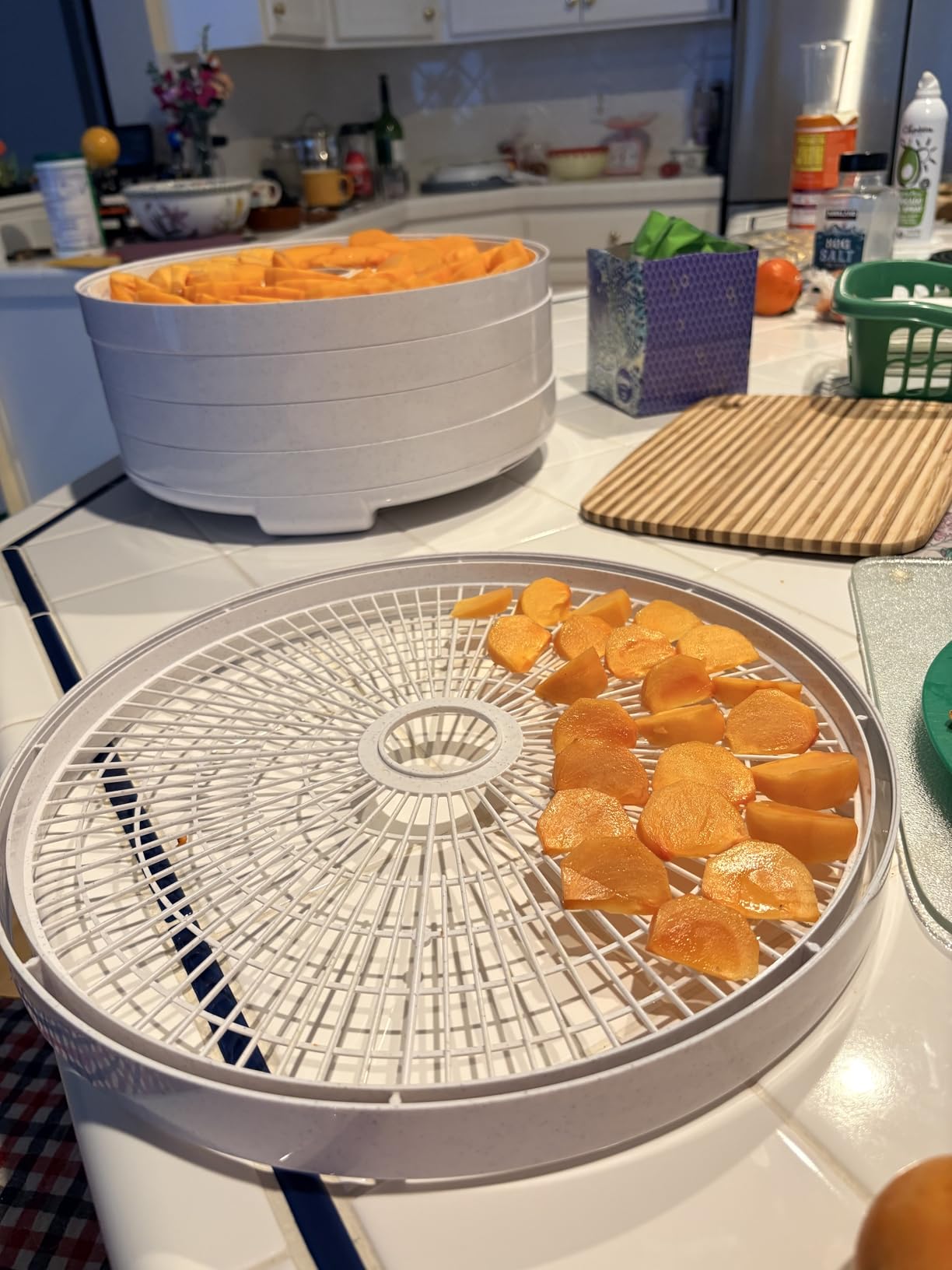
Out of the box you get two Clean-A-Screen mesh inserts, two fruit roll sheets, five trays and a sample of jerky seasoning and cure, which is the most complete accessory bundle in the group. There is no recipe book, and there is no built-in timer, so long runs need an inexpensive kitchen timer you set by hand.
The dial runs from 95F to 160F in steps, and the 600W element is roughly double what the three cheapest models here use. That difference shows up most clearly on dense cuts, where a 240W machine can leave the center chewy long after the edges look done.
Owners on r/dehydrating describe the FD-75A as the unit they keep for years and expand into, and that matches what we saw with the tray collars: they are loose-fitting, so alignment takes a moment, but the stack never wobbles once the lid is on. The tradeoff shows up in cleaning, since the plastic mesh has small square cells that catch fruit juice and want a stiff brush.
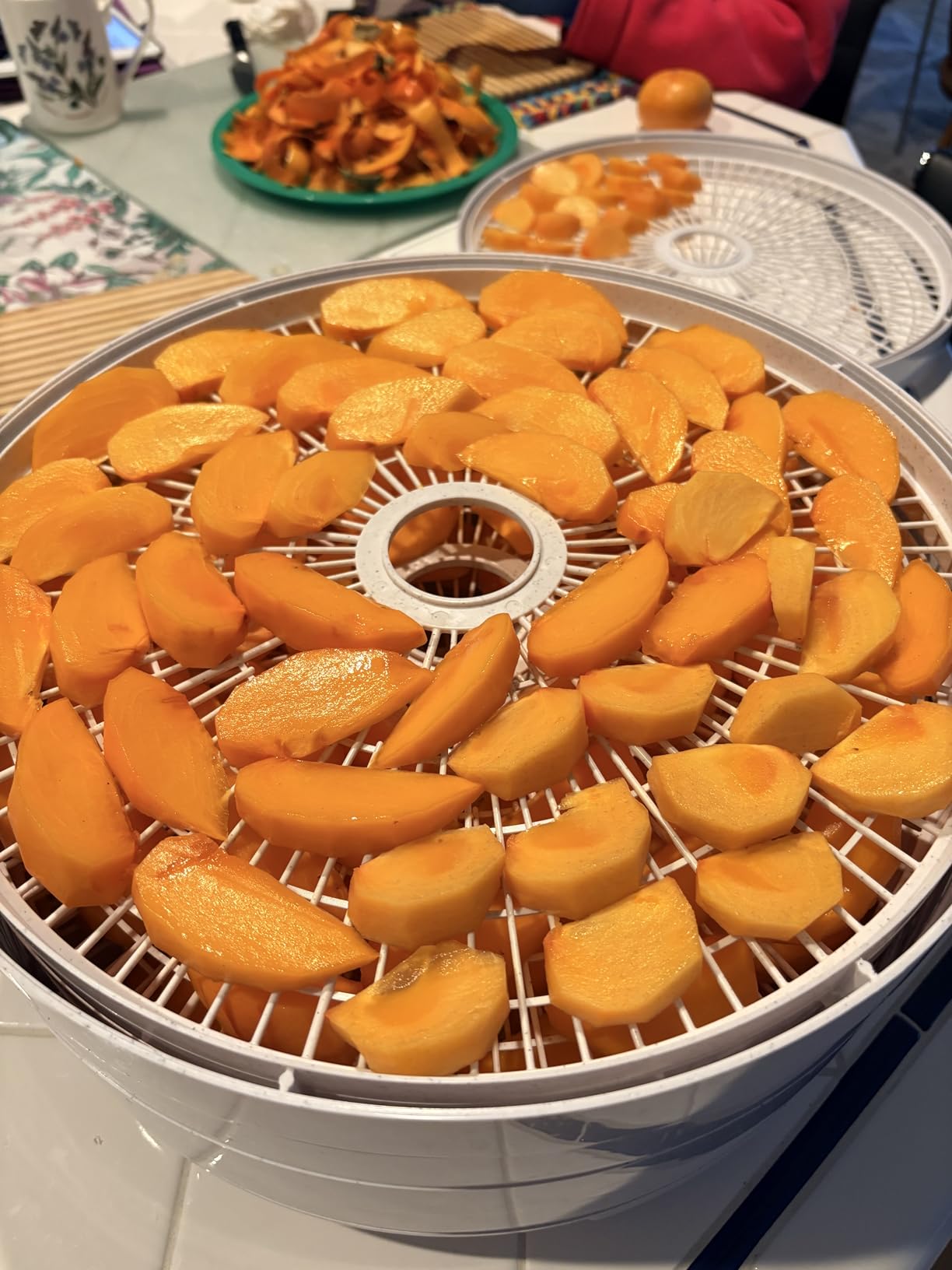
When the NESCO FD-75A earns its counter space
It is the right call if you preserve food in volume, if you already own food dehydrator trays from another brand that fit the column, or if you want one appliance that grows from a weekend hobby into a harvest-season workhorse. Five trays with 600W is the sweet spot between a first appliance and a garage unit.
It is also the right call for a kitchen with real cabinet depth. At 10 inches tall and 13 inches wide, it needs a shelf at least 14 inches across, and you need roughly 4 inches of clearance above it for the lid to come off while it is running.
Where it frustrates people
The missing timer is the most common complaint, and it matters more than it sounds. A fruit leather run at 140F can take 8 to 10 hours, and without auto shutoff you are either staying up to switch it or risking a scorched batch.
Expansion also costs you time. Going from 5 to 12 trays does not just stack more food, it stacks more food that shares the same 600W, so each tray dries more slowly. Our advice is to run a full five-tray stack first and add height only when the five-tray load is routine rather than special.
2. Elite Gourmet EFD329WDX: The One That Flattens Into a Drawer
Elite Gourmet Digital Food Dehydrator, 5 SlimStore® Collapsible Trays
350W
5 collapsible SlimStore trays
95-158F
11.6 in round base, 6.17 in tall
Pros
- Collapsible trays nest into the base for a 6.17 in stored height
- Dishwasher-safe trays wipe clean in seconds
- 48-hour timer in 30-minute steps
- Quiet base-mounted fan
- Light enough to lift with one hand
Cons
- Tight tray spacing blocks thick cuts like halved peppers
- Brittle plastic that some owners report cracking
- Occasional reports of a plastic taste in the output
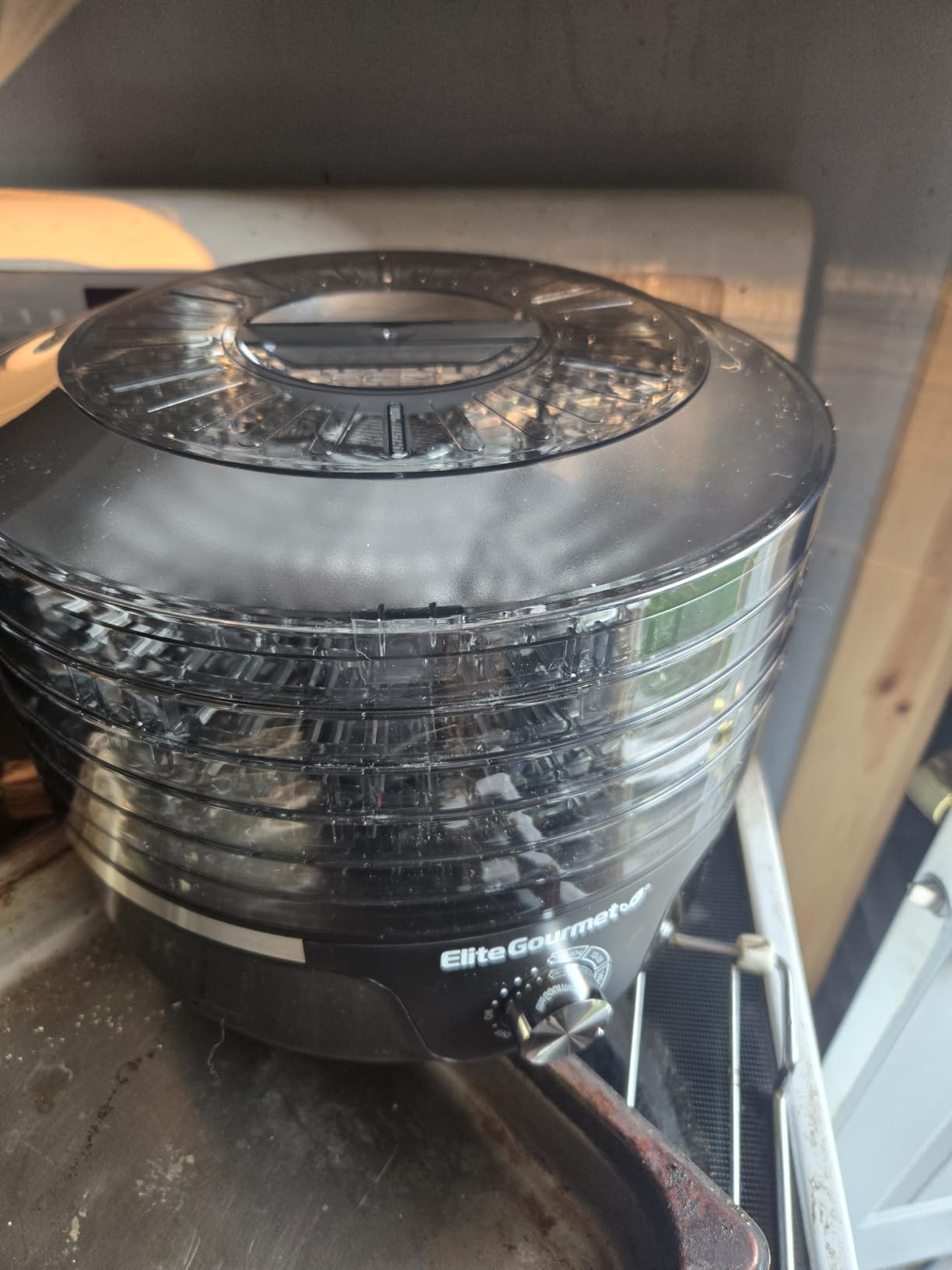
No other dehydrator in this group solves the storage problem the way the Elite Gourmet does. The five SlimStore trays collapse downward into the base so the whole unit measures 6.17 inches tall, which means it fits under a sink, on the bottom shelf of a short cabinet, or even on a high kitchen shelf you would never have considered before.
In use it is a normal 5-tray round dehydrator. A base-mounted fan and heater circulate air upward, temperature adjusts from 95F to 158F on the digital panel, and the timer runs to 48 hours in 30-minute increments. There is no auto shutoff beyond the timer completing, but the timer itself removes the need for a separate kitchen clock.
The 350W element sits in the middle of this group, which means fruit chips and herbs dry in a sensible timeframe and thicker cuts take patience. It is a noticeably slower machine than the 600W NESCO or the 500W Hamilton Beach, and reviewers regularly describe results as slower than expected on larger pieces.
Cleaning is the nicest surprise. The trays go in the dishwasher, the body wipes down with a damp cloth, and there are no crevices to scrub. Compare that with a plastic mesh tray on a cylindrical body, where dried sugar from fruit leather bakes into the cell walls and takes a soak to loosen.
Our honest note is the tray spacing. Because the trays collapse, the vertical gap between them is short, and owners trying to dry thick items like lemon wheels or halved hot peppers have to stagger them across two runs. Plan on thin slices and one-layer fruit, which is what most people dehydrate anyway.
Who should buy the Elite Gourmet
Buy it if your kitchen is genuinely tight on vertical cabinet space, or if you want a dehydrator you can pull out, use for a weekend, and slide into a drawer. First-time buyers who plan to make fruit chips, herbs and pet treats get a complete, well-reviewed package here.
It is also a strong second unit. People who start with this and later need more capacity usually move up to a wider box-style machine rather than stacking more trays, so treat it as a small-batch workhorse rather than the main event.
What to watch out for
The collapsible trays are thin plastic, and a few owners report cracking after extended high-heat use. Treat the trays as consumable parts and check them each season, because a cracked tray can warp the stack.
The 158F ceiling is also worth noting. If you make jerky regularly, the top end of this dial is lower than what the Cosori and Magic Mill reach, and you will want to read our jerky-focused dehydrator guide before you commit.
3. Cosori CFD-N051-W: The Hottest And Quietest Set Here
Cosori Food Dehydrator, 5 BPA-Free Trays, 165°F Temperature Control, 350W
350W
5 trays, expandable to 7
95-165F
12.2 in round base, under 47 dB
Pros
- 165F maximum
- the highest safe drying ceiling in the group
- Under 47 dB for overnight runs in an apartment
- Precise 1-degree temperature increments
- Coated solid trays release fruit leather easily
- Expands to 7 trays with adjustable height
Cons
- Recipe book drying times are approximate
- Lid and housing can crack under sustained high heat
- Fruit leather and jerky mats sold separately
- Very sensitive touch controls
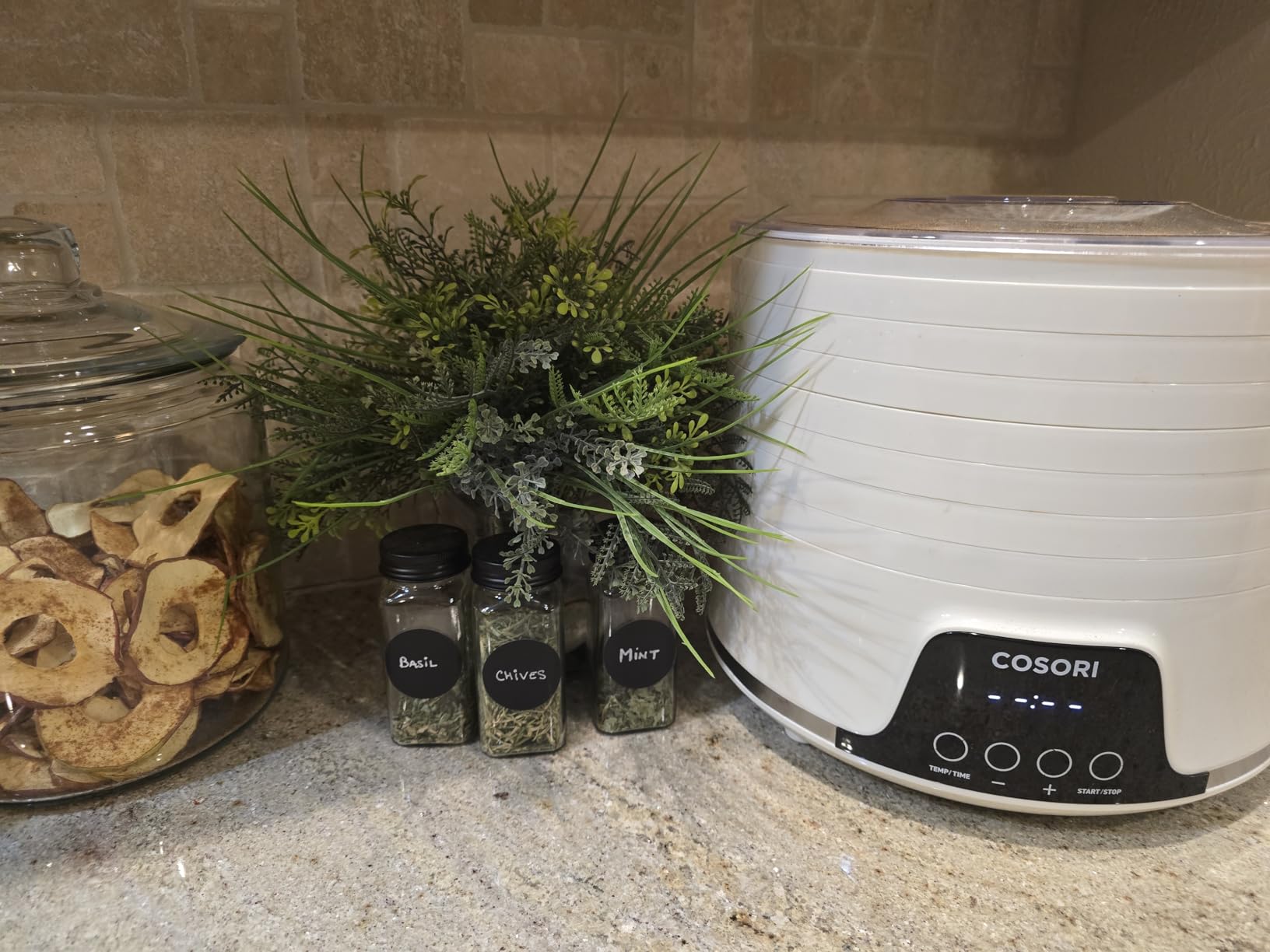
The Cosori is the spec winner on paper, and in practice it is the one we would put in a bedroom-adjacent kitchen. Rated under 47 dB, it is quiet enough to run overnight without the fan cutting through the floor of a second-bedroom apartment, which for most small-kitchen buyers is a deciding factor before capacity even enters the conversation.
More important than the noise figure is the 165F ceiling. That top setting is what lets you dry meat safely rather than merely slowly, and the temperature adjusts in single-degree steps from 95F, so you can hold a specific temperature overnight and trust the machine is still there when you wake up.
The build is more solid than the usual clear plastic shell, and the coated solid trays are a genuine upgrade: they release sticky fruit leather with a fingernail instead of a spatula. There is also a 50-recipe book in the box with temperature and time charts, and the stack expands from 5 to 7 trays with adjustable height for thicker cuts.
That adjustability is the feature that separates it from the Elite Gourmet. The tray slots let you raise a tray to create clearance for a banana half or a chunk of sweet potato, which is exactly the fix for the tight-spacing problem that limits most slim cylindrical models.
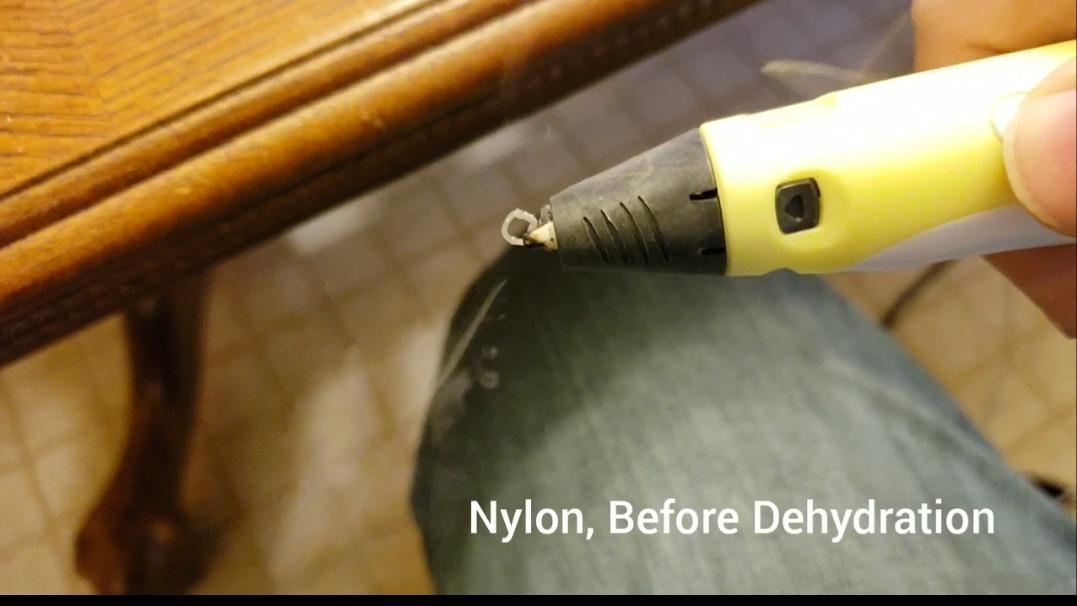
Two caveats. The included recipe timings are approximate enough that experienced users rotate trays mid-run, and the touch panel is so sensitive that a stray brush of the counter can jump a setting by hours. Owners on r/dehydrating also note that popular uses reach well past snacks, with 3D printer filament drying being a common one, which loads the unit differently than food does.
When the Cosori is the right buy
It suits anyone drying meat, anyone sharing a wall with a neighbor, and anyone who wants set-and-forget control with a 48-hour timer in 30-minute steps. Solid coated trays also make it the least annoying model to own if fruit leather is a regular output.
For herb and small-snack work, the quiet motor and single-degree control give you finer results than a dial model at the same wattage. We also like the 2 year manufacturer warranty, the longest explicit coverage in this group alongside the OSTBA.
Where it falls short
Accessories are not included. If you want dedicated fruit leather sheets or jerky mesh, that is a separate purchase, which is an odd omission for a model marketed at fruit leather and pet treats.
A small number of units have reported cracking at the lid or housing under sustained high heat, and a few have had juice reach the motor area and fail early. We would not treat that as common, but if you run 165F for long stretches, check the housing periodically and keep loads from touching the walls.
4. Magic Mill MFD-5000: Stainless Trays And The Widest Temperature Control
Magic Mill Food Dehydrator Machine | 5 Stackable Stainless Steel Trays, 48H Digital Adjustable Timer & Temperature Control Upto 167° Electric Dryer & Preserver for Jerky, Fruit, Dog Treats & Much More
240W
5 stainless steel trays
95-167F
8.5 in deep, 11.8 in wide, 11 in tall
Pros
- Stainless steel trays outlast plastic mesh by years
- Tray spacing adjusts 0.6 to 1.1 in for thick cuts
- Trays detach fully and are dishwasher safe
- Compact rectangular body suits a narrow counter
Cons
- 240W element means long drying times
- Heavier than plastic-tray rivals
- Smaller review base than the other models
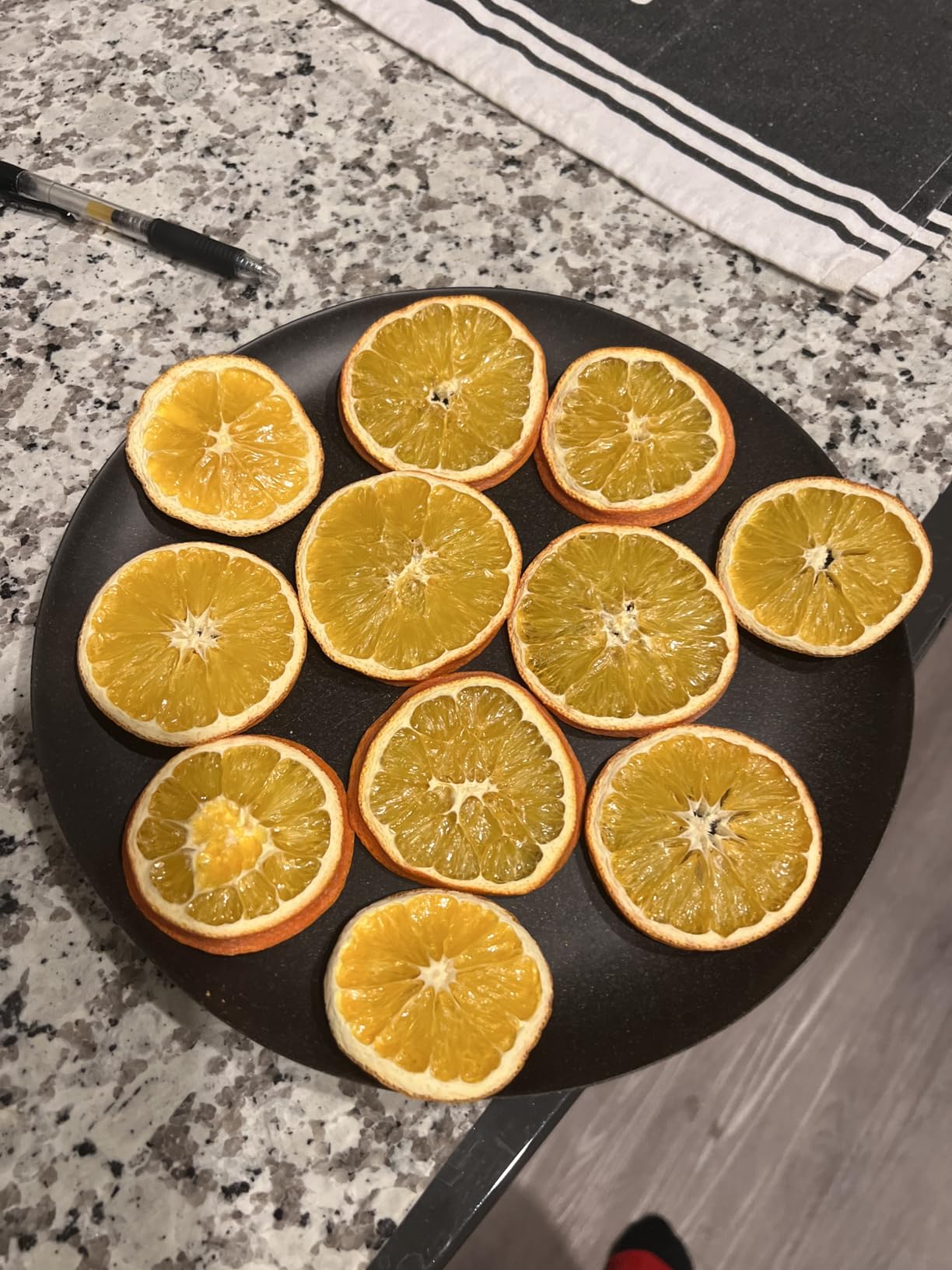
The Magic Mill solves a problem none of the round models do. Its five stainless steel trays slide into slots with adjustable spacing from 0.6 to 1.1 inches, so you can set a taller gap for a chunk of squash or a thick cut of meat and a tighter gap for five trays of apple chips in the same run.
At 11.8 inches wide by 8.5 inches deep, it is also the narrowest rectangular body in the group, and at 11 inches tall it stores like a mid-size countertop appliance. That geometry works well in a galley kitchen where the run of counter is long but shallow.
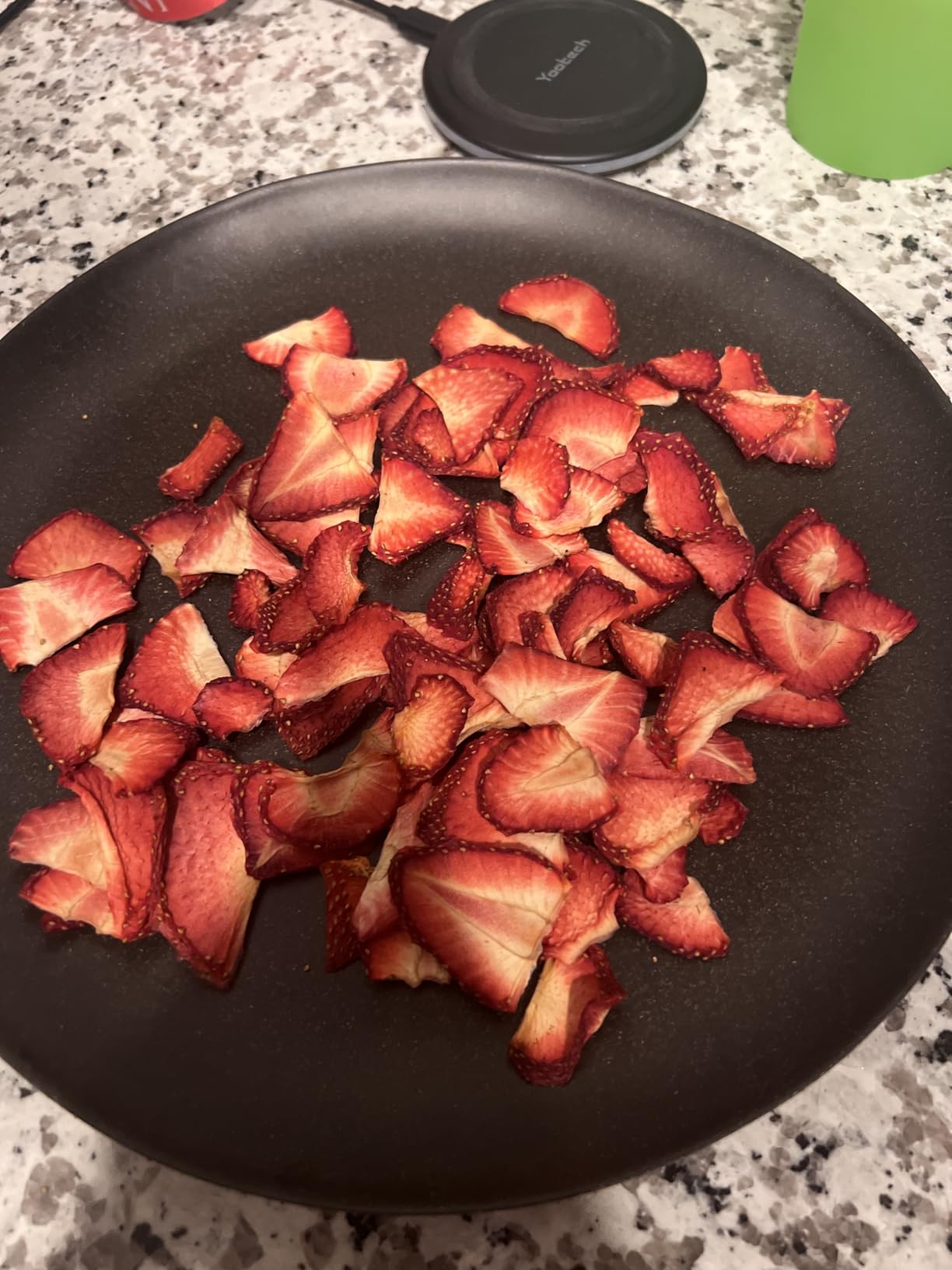
The stainless construction is the real story. Plastic mesh trays warp and crack over years, and owners on r/dehydrating point to the Magic Mill as a middle ground between cheap plastic stacks and heavier boutique units. These trays detach fully and go in the dishwasher, and there is no plastic mesh to trap sugar residue.
The digital panel handles temperature and a 48-hour timer without fuss, and the listed control range runs from 95F to 167F, the highest ceiling in this group. Owners on the same forum describe it as a reasonable pick for people who want stainless without moving up to a much larger machine.
The compromise is wattage. At 240W, this is one of the two or three slowest dryers here, and that is not a defect, it is a gentler heat. Expect a full run to take meaningfully longer than the NESCO or the Hamilton Beach, and plan your schedule around a 14 hour fruit batch rather than an 8 hour one.
Who the Magic Mill suits
It is built for people drying vegetables, thick fruit slices and larger cuts, and for anyone who has already broken a plastic tray and decided to stop replacing them. The adjustable spacing also makes it a good fit for meat, since you can open a single gap without sacrificing the other four trays.
If cleaning is a factor in your household, the fully detachable dishwasher-safe stainless trays are the easiest in this group. There is nothing to disassemble beyond sliding a tray out of a slot.
Where buyers push back
Weight. At 2.75 kg with five stainless trays loaded, lifting it out of a low cabinet is a two-hand job, which is a real consideration if your storage shelf sits below waist height.
Long drying times are the other recurring note. Owners also point out that the review base is smaller than the NESCO or the Cosori, so long-term durability reports are thinner. It is a spec-driven pick rather than a proven-longevity pick.
5. Hamilton Beach 32100A: The Most Drying Space Per Square Inch
Hamilton Beach Digital Food Dehydrator for Fruit, Jerky, Vegetables & More
500W
5 stackable trays, 4.2 sq ft
100-160F
13.2 in wide, 10.4 in deep, 11.3 in tall
Pros
- 4.2 square feet of drying space from only 5 trays
- Square body uses cabinet width better than round models
- 500W base heater dries without tray rotation
- Dishwasher-safe trays and lid
- Clear vented lid for progress checks
Cons
- Louder than most competitors
- comparable to a box fan
- Only one coarse mesh screen included
- Long drying times in humid air
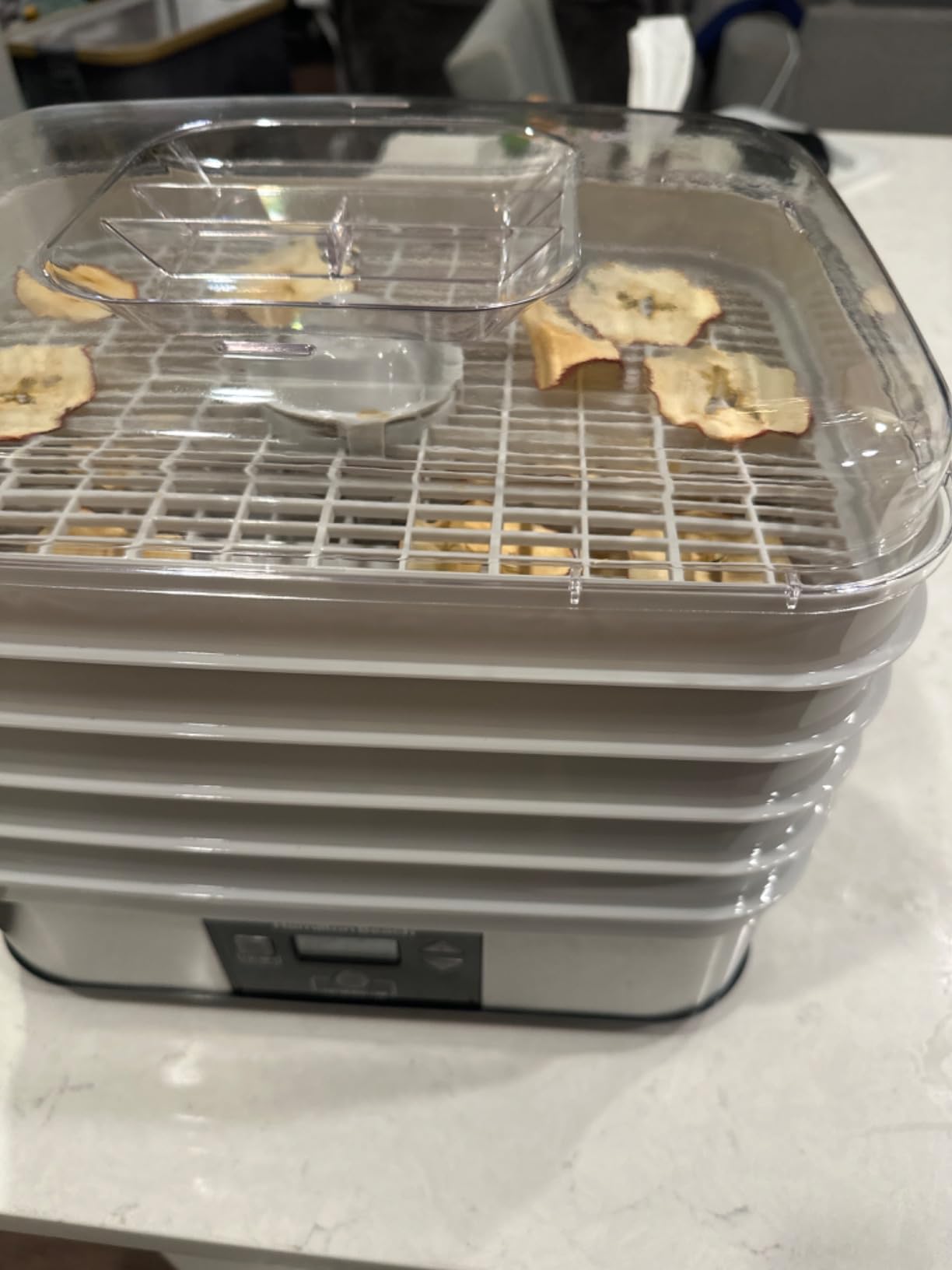
Square geometry is the Hamilton Beach advantage. A 13.2 inch wide square holds more usable tray area per tray than a 12 or 13 inch circle, which is how you get 4.2 square feet of drying space out of just five trays. When your kitchen is measured in cabinet inches, that difference decides how much food you can do in one overnight run.
The 500W base-mounted heater with a quiet fan dries evenly enough that most owners report not rotating trays at all. The digital timer counts down from 1 to 48 hours and shuts the machine off on its own, which means you can start a run before bed and go to sleep without a separate kitchen timer.
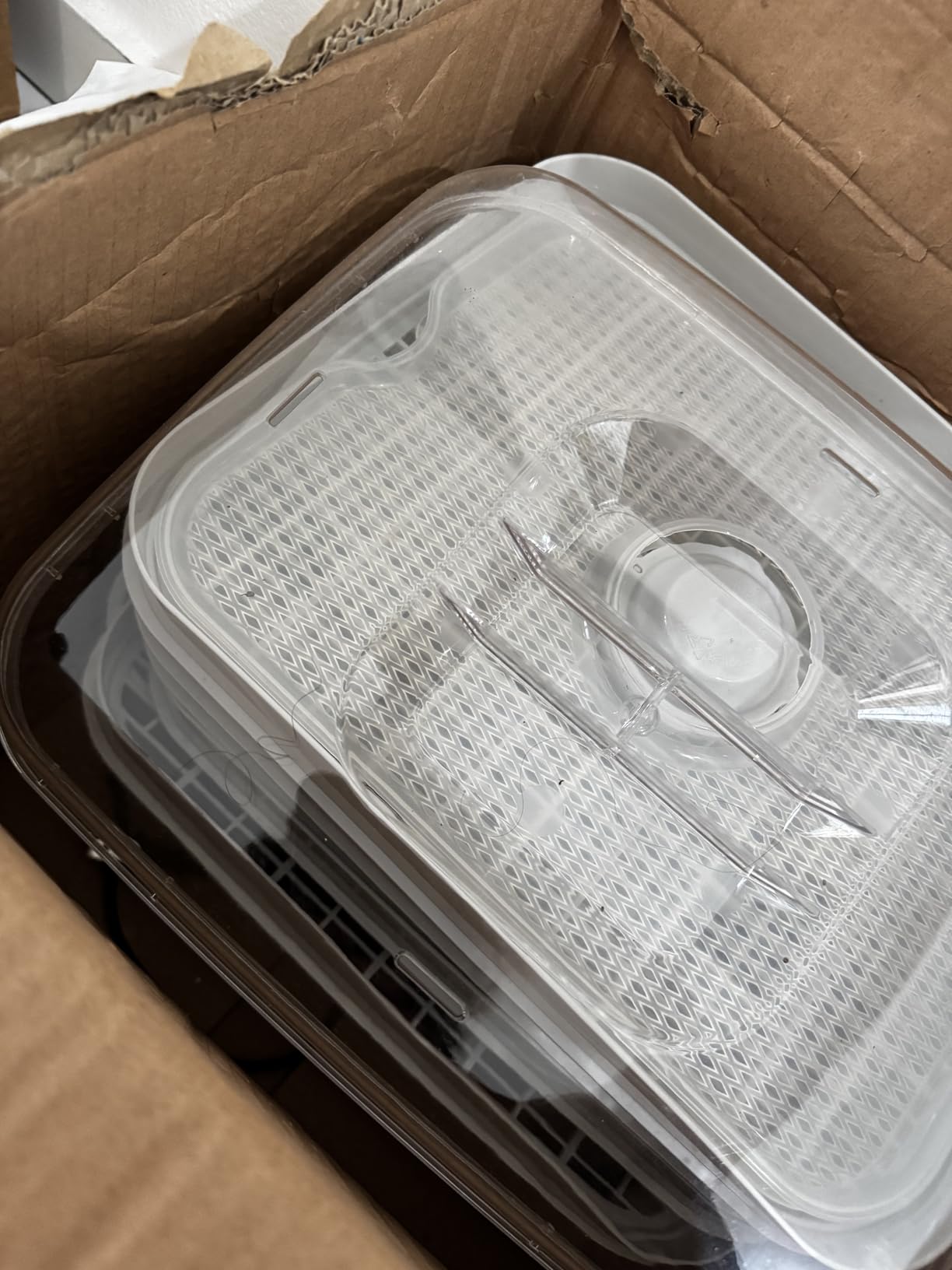
Cleaning is straightforward. Trays and lid are dishwasher safe, the trays are stackable for storage, and a clear vented window lets you check progress without cracking the door and letting humidity out. A mesh screen for herbs and a solid fruit leather sheet are included in the box.
Owners on r/dehydrating frequently name the square footprint as the reason the 32100A works in a small kitchen, and the auto shutoff is called out just as often as the reason people keep coming back to it. The 500W element sits in the middle of this group and is a good balance between speed and electricity use.
Two honest weaknesses. The fan is louder than the Cosori or the Elite Gourmet, closer to a box fan than to a refrigerator hum, which is a real consideration in a thin-walled apartment. And only one fine mesh screen is included, with gaps wide enough that small herbs or nuts can drop into the base.
When the Hamilton Beach wins
Pick it when batch size matters more than stored height. Five trays covering 4.2 square feet means a full load of apple slices, which a five-tray round model simply cannot hold, and it fits under a standard cabinet with about 11.3 inches of clearance.
It is also a good pick for anyone who wants set-and-forget behavior. Digital temperature from 100F to 160F, a 48 hour countdown timer and automatic shutoff together mean a weekend run needs no supervision at all.
Where it does not fit
Noise rules it out for a bedroom or a home office, and the mesh screen situation means small-leaved herbs like thyme need a second pass after they shrink, or a different screen entirely.
At 8 pounds with the trays in, it is also one of the heavier bodies here. If your storage shelf is high, that is fine. If it is below counter level, the 3.3 pound Commercial Chef is much easier to lift down.
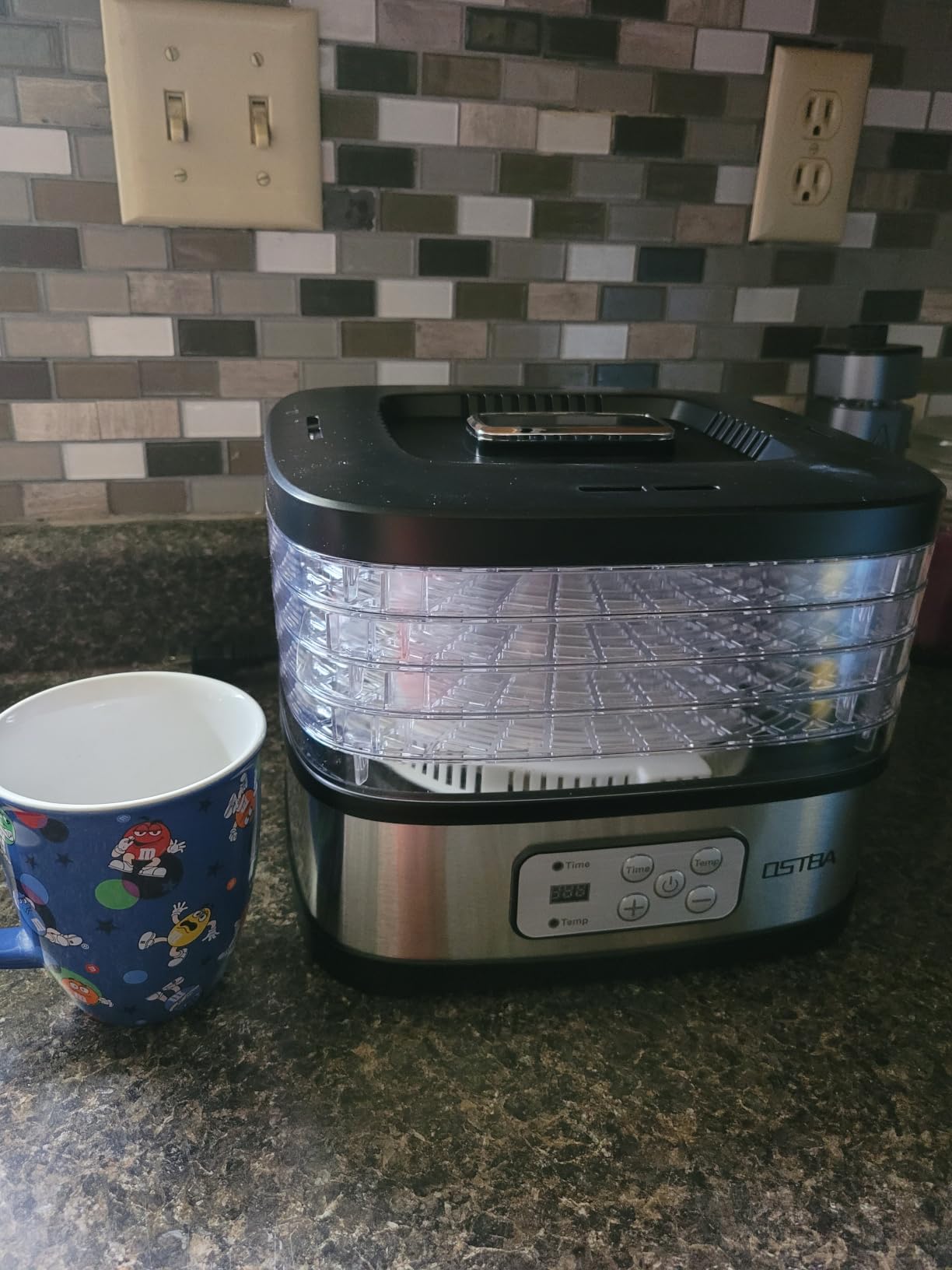
6. OSTBA GGJ-261B: The Longest Runs On A Small Footprint
OSTBA Food Dehydrator, 5 Trays, 240W Dryer for Jerky, Fruit & Snacks
240W
5 dishwasher-safe trays
95-158F
10.24 in wide, 9.45 in deep, 8.27 in tall
Pros
- 1 to 72 hour timer is the longest run time here
- LED panel shows set and remaining time and temperature
- Quiet
- near a soft hum
- Dishwasher-safe trays and a wipe-clean stainless body
- 24 month warranty
Cons
- Small tray footprint limits batch size
- 240W element dries slowly and can leave chewy results
- Fan cover stains easily
- Completion alarm is loud at night
The OSTBA exists for one specific problem, and it solves it better than anything else in this group. The timer runs from 1 to 72 hours with automatic shutoff, which is the longest continuous run available here, and it matters for anyone drying thick vegetable chips, whole herb bunches or a large batch of dog treats in one session.
At 8.27 inches tall and 10.24 inches wide, it is also one of the more compact bodies in the lineup, so the 72 hour capability does not come at the cost of a tall cabinet shelf. The LED panel is clear enough to read at a glance in a dim kitchen, showing both the setting and the remaining time.
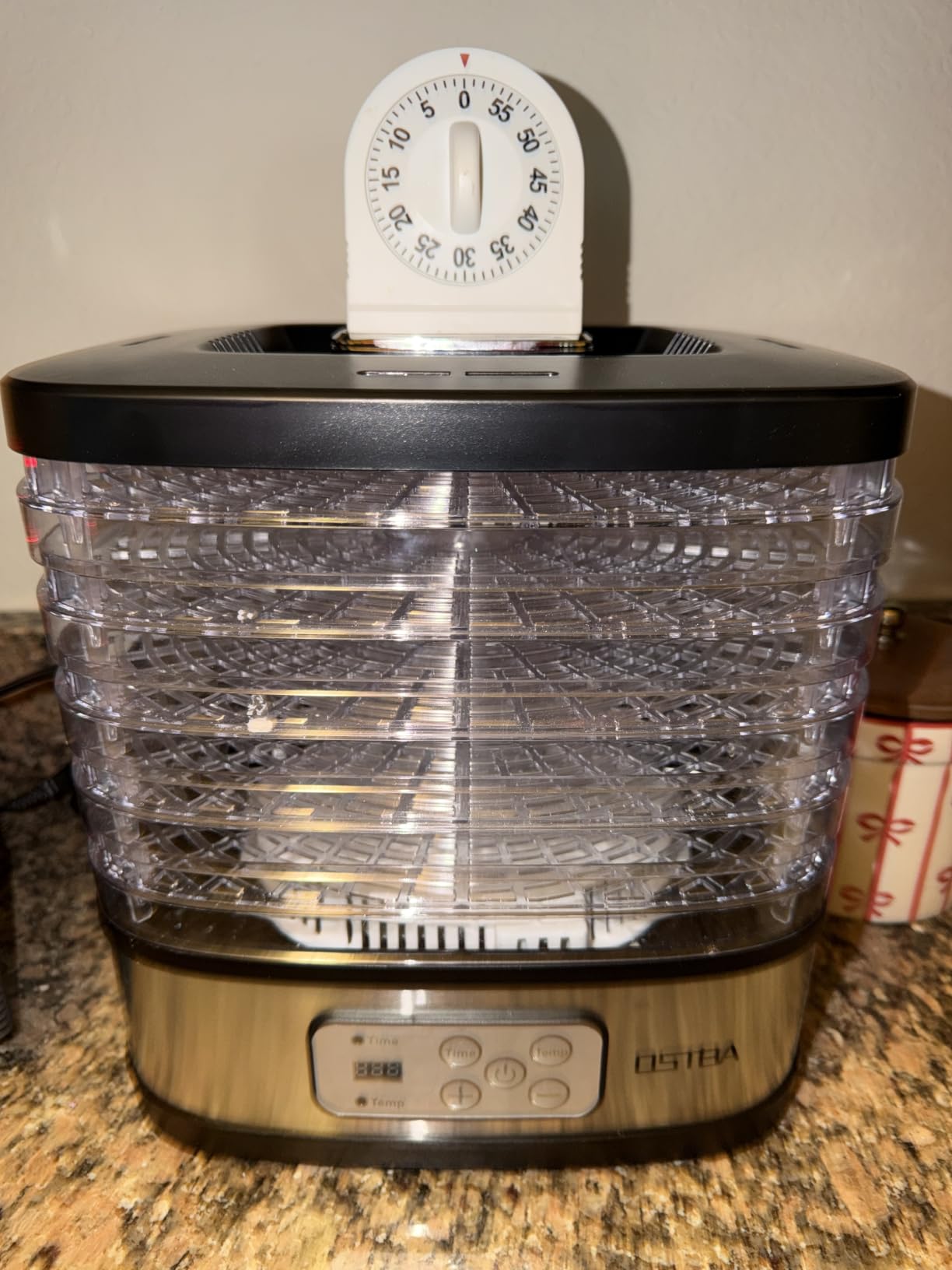
Airflow circulates 360 degrees through the chamber, five BPA-free trays stack compactly, and the stainless steel body wipes clean without a fight. A recipe book covers herbs, fruit roll-ups and pet treats, and pet treat makers pick this one up more than almost any other compact model.
The 240W element is the limitation that shapes everything else. Low wattage means slow, gentle drying, and owners report results that can finish chewy in the middle if the load was crowded or the slices were thick. It is a fine dehydrator for herbs and thin fruit, and a slow one for anything substantial.
Small details worth knowing: the white plastic fan cover stains with fruit pigment and wants a wipe after every run, and the completion alarm is loud enough to wake a light sleeper at 3am. If you run overnight, plan to mute it or start the run before bed with the doors closed.
Best use cases for the OSTBA
It is a strong pick for a large batch of small items, where many trays of uniformly thin slices beat fewer trays of thick ones. Dried herbs, fruit leather sheets, small dog treats and vegetable chips all fit that profile, and the 72 hour timer means you set it once.
The 24 month warranty is tied for the longest explicit coverage in this group, which matters for anyone planning to keep a machine running for years rather than seasons.
Where buyers report frustration
Temperature calibration needs user correction. Owners report herb settings running low and meat settings running high, so treat the dial as a starting point and adjust after your first run rather than trusting the recommended numbers.
Batch size is the other limit. The trays are small, so a serious harvest means multiple 72 hour runs rather than one, and the low wattage makes each of those runs long.
7. Commercial Chef CCD100W6: The Lightest Body On The List
Commercial Chef Food Dehydrator, Five 9.25” BPA-Free Trays, CCD100W6, White
280W
5 clear 9.25 in trays
104-158F
9.92 in wide, 9.43 in deep, 7.01 in tall
Pros
- 3.3 pounds
- the lightest body we tested
- Stores in a pantry or cupboard easily
- Clear trays show progress without opening the lid
- Slide-out tray design is easy to learn
- Quiet enough for normal kitchen use
Cons
- No timer
- so you need a separate kitchen timer
- Dial thermostat runs cooler than the marked setting
- Thin clear plastic trays feel flimsy
- Short power cord limits placement
When the deciding factor is whether you can lift the thing at all, this is the one. At 3.3 pounds and 7.01 inches tall, the Commercial Chef is the smallest and lightest body in the group, and it stores in a low cupboard, a pantry shelf or the top of the refrigerator without you thinking about it.
The five circular trays are 9.25 inches across and completely clear, so you watch a batch progress without opening the lid and letting warm moist air escape. The slide-out design means you pull one tray at a time, which is easier on wrists than lifting a five-tray column out of a cabinet.
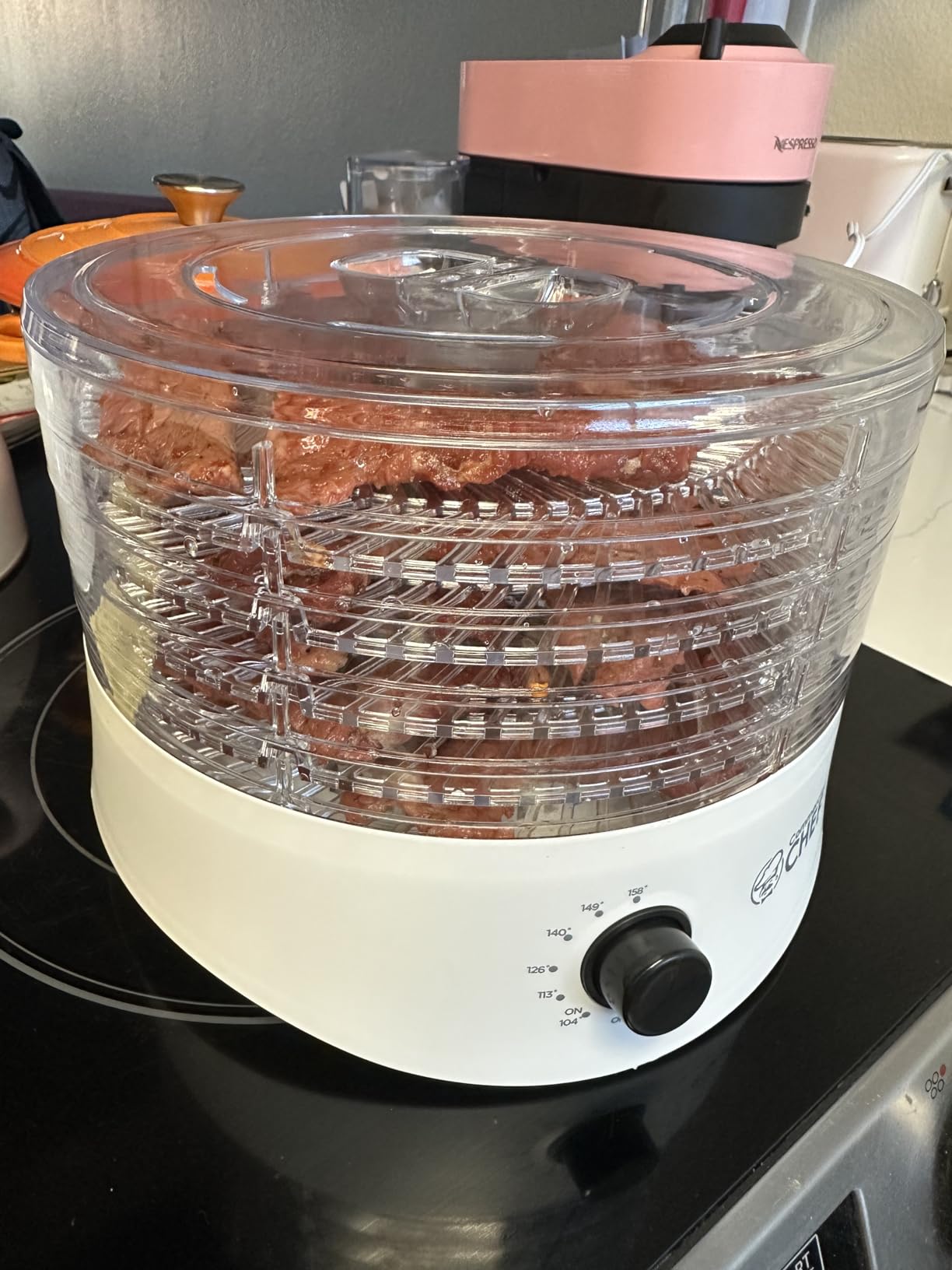
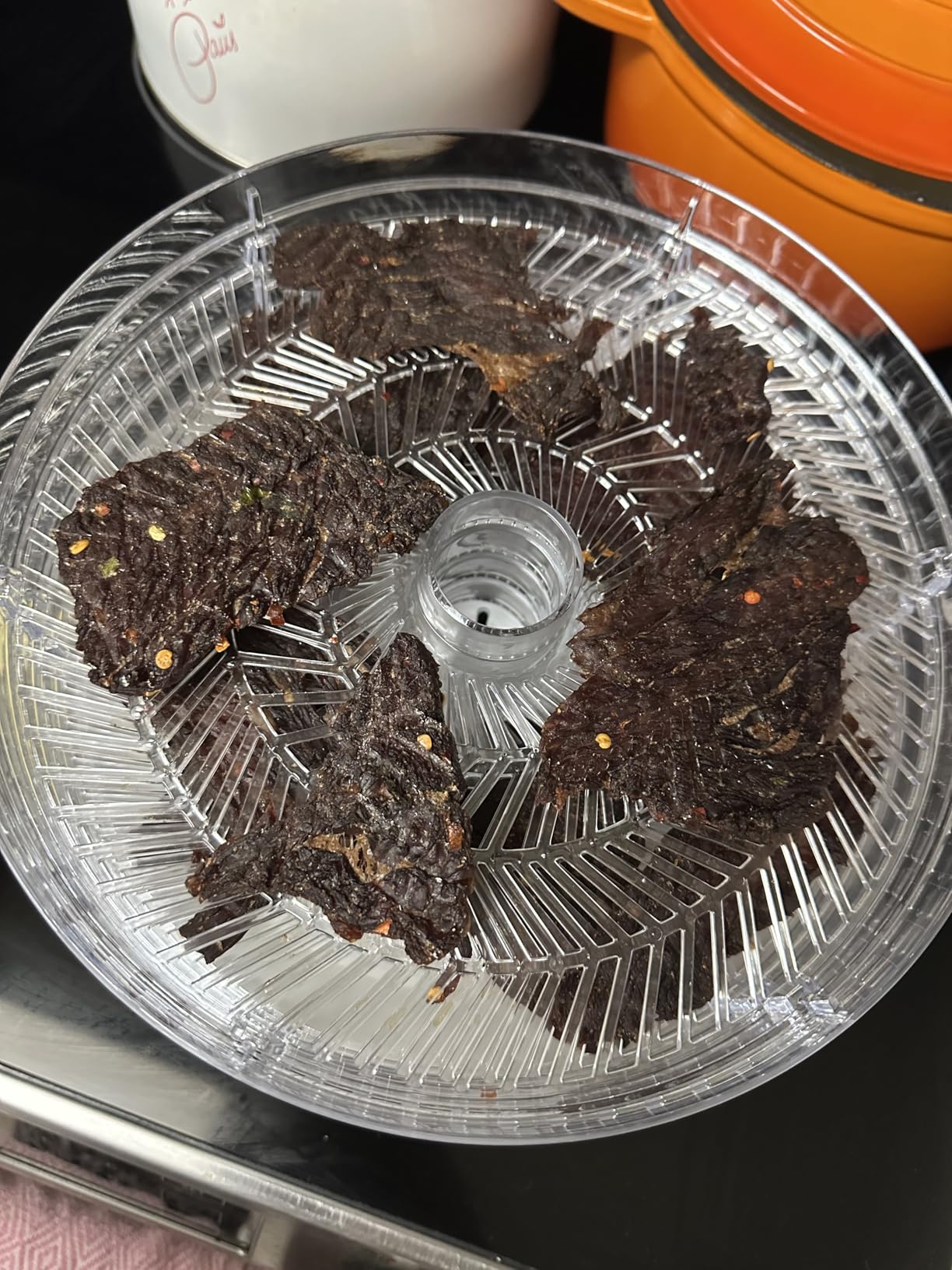
It is a genuinely capable dehydrator for what it covers. Fruit chips, herbs, vegetables, flowers and dog treats all come out well, and at 280W the heat is gentle enough that you are not racing to pull thin slices before the edges scorch.
What it does not have is precision. There is no digital timer, so every run needs a separate kitchen timer. The thermostat is a mechanical dial that reviewers report running cooler than the printed setting, which stretches drying times well past the recipe guidance.
For most first-time buyers, that is enough. We would choose this only if the low price and low weight are the deciding factors, not if you plan to make jerky, where the temperature ceiling and calibration both matter.
Who should buy the Commercial Chef
It fits renters, dorm-style kitchens and anyone who wants to try dehydrating without committing counter space permanently. A first batch of apple chips or a bundle of herbs will tell you quickly whether you want to go further.
It is also a practical second machine for someone who dries mostly flowers, potpourri or small pet treats, where the small tray size is not a limitation.
Where it falls behind
The missing timer and the uncalibrated dial are the two that matter. Unattended runs are the reason people buy dehydrators in the first place, and a dial that runs cool means you finish on schedule but not on temperature.
The clear trays also feel thin, and a dropped unit can crack them. At 3.3 pounds that is less likely, but the material has no margin. Budget for replacement trays over a decade of use.
8. Rosewill RHFD-15001: The Quietest Round Design With A Long Track Record
Rosewill Food Dehydrator Machine, 5 BPA-Free 12.6’ Trays, Adjustable Temperature Controls | 95-158°F | 350W, Jerky, Herbs, Fruit, Veggies, Dried Snacks, White
350W
5 trays plus herb and roll sheets
95-158F
12.5 in round base, 5 lb, 10.8 in tall
Pros
- Quiet fan
- comfortable for overnight runs
- Only 5 pounds so it is easy to lift down from a cabinet
- Herb and fruit roll sheets included with the trays
- Owners report units still running after 10 to 20 years
Cons
- No timer
- so runs are tracked manually
- Runs cooler than the dial shows and can take far longer than recipes
- Shallow trays limit items to about an inch tall
- Trays yellow and crack over the years
The Rosewill is the quiet choice among round models, and it is the one in this group with the longest service history. Owners report running these for a decade or two, which is exactly the kind of durability signal that matters when you are installing an appliance on a high cabinet shelf and hoping to leave it there.
At 5 pounds it is light enough to lift down one-handed, and the 12.5 inch round body nests into a corner without demanding a deep cabinet. Unlike the bare-bones models, it includes a herb tray and a fruit roll sheet alongside the five stackable trays, so you can start both of those projects on day one.
Airflow comes from a base-mounted fan that distributes heat evenly across the chamber, and a large viewing window means you can check progress without breaking the seal. Removable parts are dishwasher safe, and at 350W the running cost per hour sits at the lower end of this group.
The catch is temperature accuracy. Owners consistently report the chamber running cooler than the dial indicates, and some say drying took two to four times longer than the guide suggested. Adjust your expectations rather than the machine: set the dial a few degrees higher and allow extra time.
Trays are also shallow. Anything taller than roughly an inch will not sit properly, so whole thick-cut items and fish fillets are out. That is fine for fruit, herbs and trail mix, which is most of what a small dehydrator gets asked to do.
Best fit for the Rosewill RHFD-15001
It suits a kitchen where quiet matters more than precision, and where the goal is fruit, herbs, granola, dried flowers and pet treats rather than meat. The included herb and roll sheets make it a friendly first machine.
If you already own a box-style dehydrator and want a second, quiet appliance that stores flat in a cupboard, the 5 pound body and 10.8 inch height are both easy to live with.
What to plan around
No timer, and a thermostat that under-reads. Both are manageable with a kitchen timer and a raised dial setting, but they add friction that digital models simply do not have.
Long-term tray wear is the maintenance note. Clear plastic trays yellow and eventually crack with sustained heat, so if you buy this as a ten-year machine, budget for a set of replacement trays rather than assuming the original set lasts as long as the body does.
9. Rosewill RHFD-24001: The Smallest Counter Footprint Here
Rosewill Compact Food Dehydrator, 5 Stackable Trays with Adjustable 48H Timer and Temperature Control – 400W Electric Food Dryer for Jerky, Fruits, Herbs, Veggies, Meat & Dog Treats
400W
5 adjustable trays
95-158F
11.4 in wide, 8.3 in deep, 8.2 in tall
Pros
- 8.3 in depth is the shallowest body we tested
- 48-hour timer with automatic shutoff
- Tray spacing adjusts 0.8 to 1.5 in
- Accurate and stable digital temperature control
- Quiet running with non-slip feet
Cons
- Small tray area limits each batch
- Low airflow can leave fruit rubbery
- Thin documentation
- Heaviest body in the group at 14.7 pounds
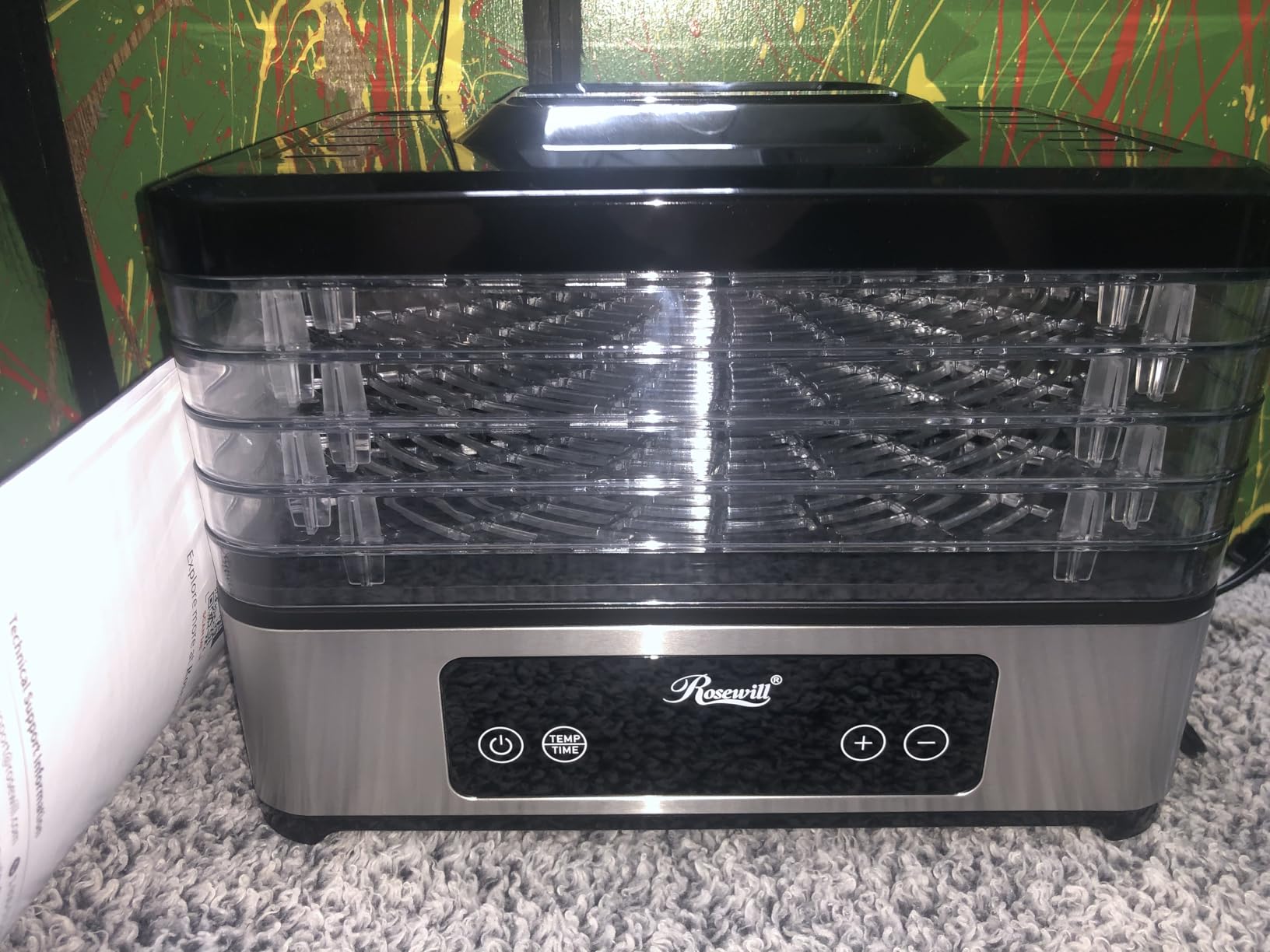
This is the model to look at if your counter is a narrow strip between the stove and the sink. At 8.3 inches deep and 11.4 inches wide, it has the shallowest footprint in the group, and at 8.2 inches tall it stores low, in the same real estate as a toaster oven. For a galley kitchen or a studio apartment, that geometry is worth more than raw capacity.
Inside, it does several things well. The 400W element is more powerful than most compact models, temperature control is accurate and stable rather than approximate, and the timer runs from 0.5 to 48 hours with automatic shutoff. Tray spacing rotates from 0.8 to 1.5 inches, which lets you open a gap for thicker cuts without removing a tray.
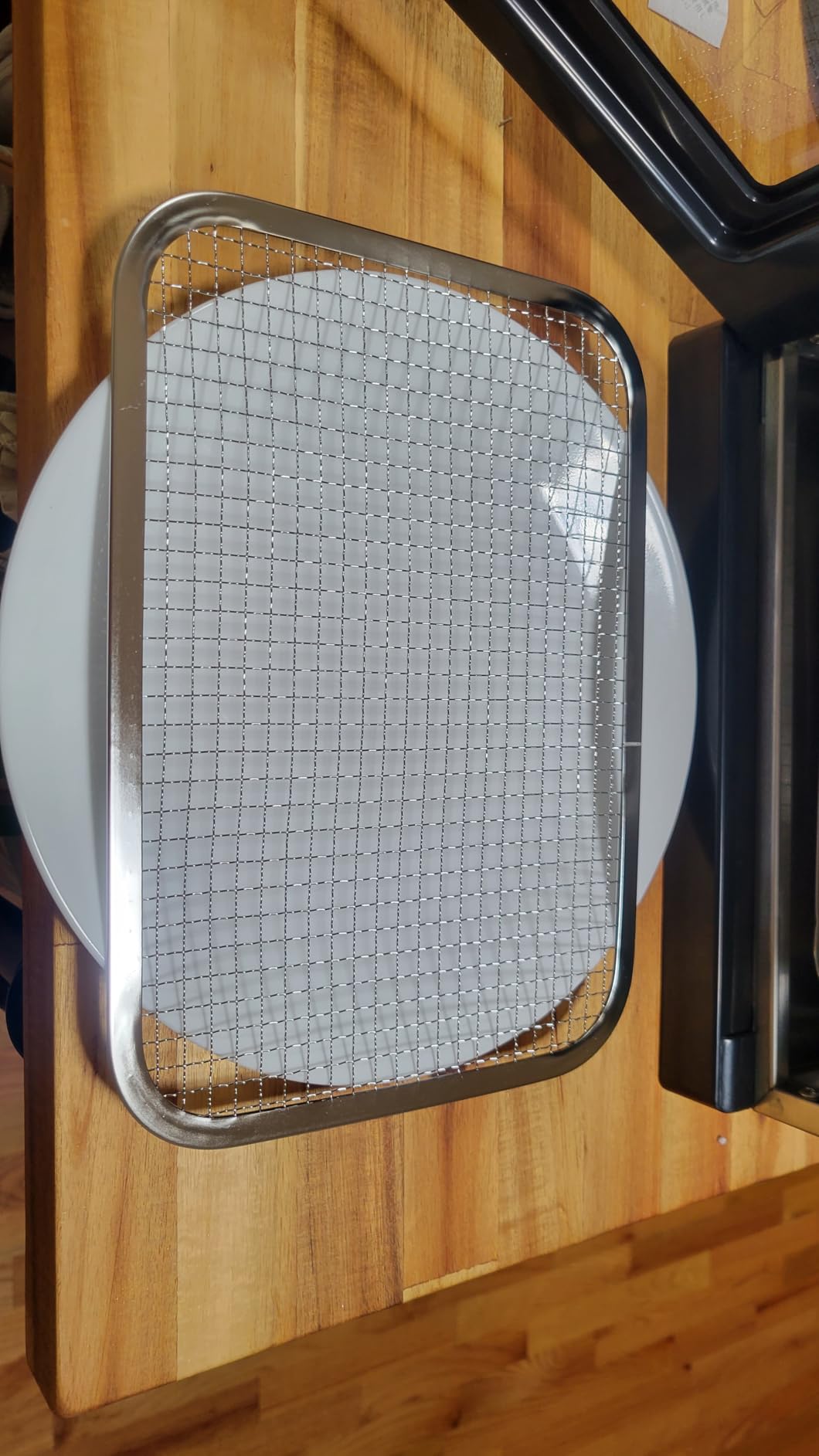
The owner reviews we read are newer and thinner than for the other models, and the pattern is consistent: people like the footprint, the digital timer and the temperature accuracy, and several use it for large dog treat batches where a wide open tray matters more than tray count.
Airflow is the weak point. Several owners note that low airflow can leave fruit rubbery even after extended runs, which suggests the compact chamber needs patience and thinner slices than you might cut at first. A thicker, denser cut in a small chamber simply has less air moving past it.
There is also a documentation issue. The instructions are thin enough that settings have to be learned by trial, and the listed specification pages conflict with the stated 95F to 158F control range, so confirm the ceiling before planning jerky around it.
Where this compact Rosewill fits
It is a good fit for a shallow counter, a low cabinet, or a kitchen where you need the appliance to disappear completely between runs. The 48 hour auto shutoff means overnight and all-day batches are realistic.
Adjustable tray spacing and accurate digital temperature also make it more flexible than its small size suggests, and several owners use it specifically for pet treats laid out in a single open layer.
Where it gets awkward
Weight. At 14.7 pounds it is by far the heaviest body here, and that matters a lot for a model you are meant to install low and pull out often. Storage it high and the weight stops being a problem; store it under a counter and it will be.
Batch size and airflow go together. The tray area is small and the air moves gently, so a crowded run under-dries in the middle. Fewer, thinner pieces per load finishes more reliably than a full stack.
10. OVENTE DF215GY: Small, Simple And Easy To Put Away
OVENTE Food Dehydrator Machine, 240W, 5-Stackable Trays, Grey DF215GY
240W
5 clear 10 in trays
Thermostat dial
10.55 in round base, 3.8 lb
Pros
- 3.8 pound body stores anywhere
- Clear trays let you watch progress without opening
- Thermostat with automatic overheating protection
- Dishwasher-safe removable trays
- Zero learning curve
Cons
- No digital timer or temperature display
- Lowest rating in the group at 4.2 stars
- Small tray diameter limits batch sizes
- Knob controls are less precise
The OVENTE is the simplest machine here, and simplicity has value when space is the problem. At 3.8 pounds and 10.55 inches across, it is the second-lightest body in the lineup, it has a thermostat dial and a power button, and that is the entire control surface. There is nothing to learn and nothing to program.
Five clear 10 inch trays stack vertically, and because they are transparent you can follow a batch from the outside without lifting the lid. The trays unclip for the dishwasher, and the built-in thermostat includes automatic overheating protection, which is a sensible safety feature for an appliance you might leave running while out.
At 240W with low, gentle heat it is well suited to fruit, herbs, jerky, vegetables, yogurt and small pet treats. The gentlest element in the group is also the one that preserves the most color in strawberries and blueberries, which is a genuine advantage if appearance is your priority.
Its review base is by far the smallest here at 113 ratings, and that tells you something real: there is not yet a long history of people reporting them surviving a decade. We would treat it as a low-commitment first machine rather than a long-term kitchen fixture.
The controls are the limitation. A knob thermostat with no display means you set a number and hope, there is no timer at all, and a 10 inch tray diameter means fewer pieces per run than the rectangular models manage.
Who the OVENTE suits
It suits a first dehydrator purchase for someone drying fruit or herbs, and anyone who wants an appliance they can carry to a different counter or a different room without thinking about it.
Automatic overheating protection is the detail that makes it a reasonable choice for a home left empty during the day, and the clear trays remove the temptation to keep opening the lid, which is the most common reason small batches stall.
Where it falls short
Precision. Without a display or a timer, you are managing the run with a kitchen clock and an estimate, and the 10 inch tray diameter means a serious harvest needs many separate loads.
Given the same budget, the Commercial Chef or the OSTBA both add a timer and a longer warranty for a similar footprint, so we would pick one of those unless the OVENTE’s specific feature set appeals to you.
Horizontal vs Vertical Airflow in a Small Kitchen
The cleanest way to sort stackable dehydrators is by where the fan lives, because that determines how you load, rotate and store the machine. Vertical airflow models put the fan and heater at the base and push air up through a column of trays, while horizontal airflow models move air across a wider chamber and use a door for loading.
Vertical airflow is what a stackable design requires, and it has a distinct storage advantage. Because trays load from the top and stack vertically, the closed body is a narrow column. The NESCO at 13 inches wide by 10 inches tall, the Rosewill RHFD-15001 at 12.5 by 10.8, and the Elite Gourmet that collapses to 6.17 inches all slide into a standard lower cabinet without you rearranging the shelf.
Horizontal or shelf-style bodies are wider and shallower, and they are what gives you square drying space. The Hamilton Beach gets 4.2 square feet out of five trays precisely because a 13.2 inch square holds more usable area than a circle. The cost is stored height and a wider footprint.
There is a heat consequence too. A base fan heats the bottom trays first, so on taller stacks the lower trays dry faster and users end up rotating the stack mid-run. A lid-mounted fan on the NESCO circulates warm air down and back up, which is why that model needs rotation less often than a five-tray base-fan stack of the same size.
One more practical difference. In a very tight kitchen, a top-loading column means you stand in front of the counter and lift trays straight up, which is easy. A front-loading box means you pull a tray out toward you over whatever is in front of the appliance, and that needs clear counter in depth, not just width.
Temperature Guide by Food Type for Compact Dehydrators
Most compact models cover 95F to around 160F, with the Cosori reaching 165F, the Magic Mill listed to 167F, and the NESCO topping out at 160F. Matching the setting to the food matters more in a small chamber than in a large one, because lower airflow units lose temperature faster when the door opens.
Herbs go at the bottom of the range, 95F to 115F, and the goal is to dry them in the shade of the chamber rather than cook them. Owners of the OSTBA note that its herb setting runs low, which is useful information, because a genuinely low ambient temperature in a small box is hard to hold.
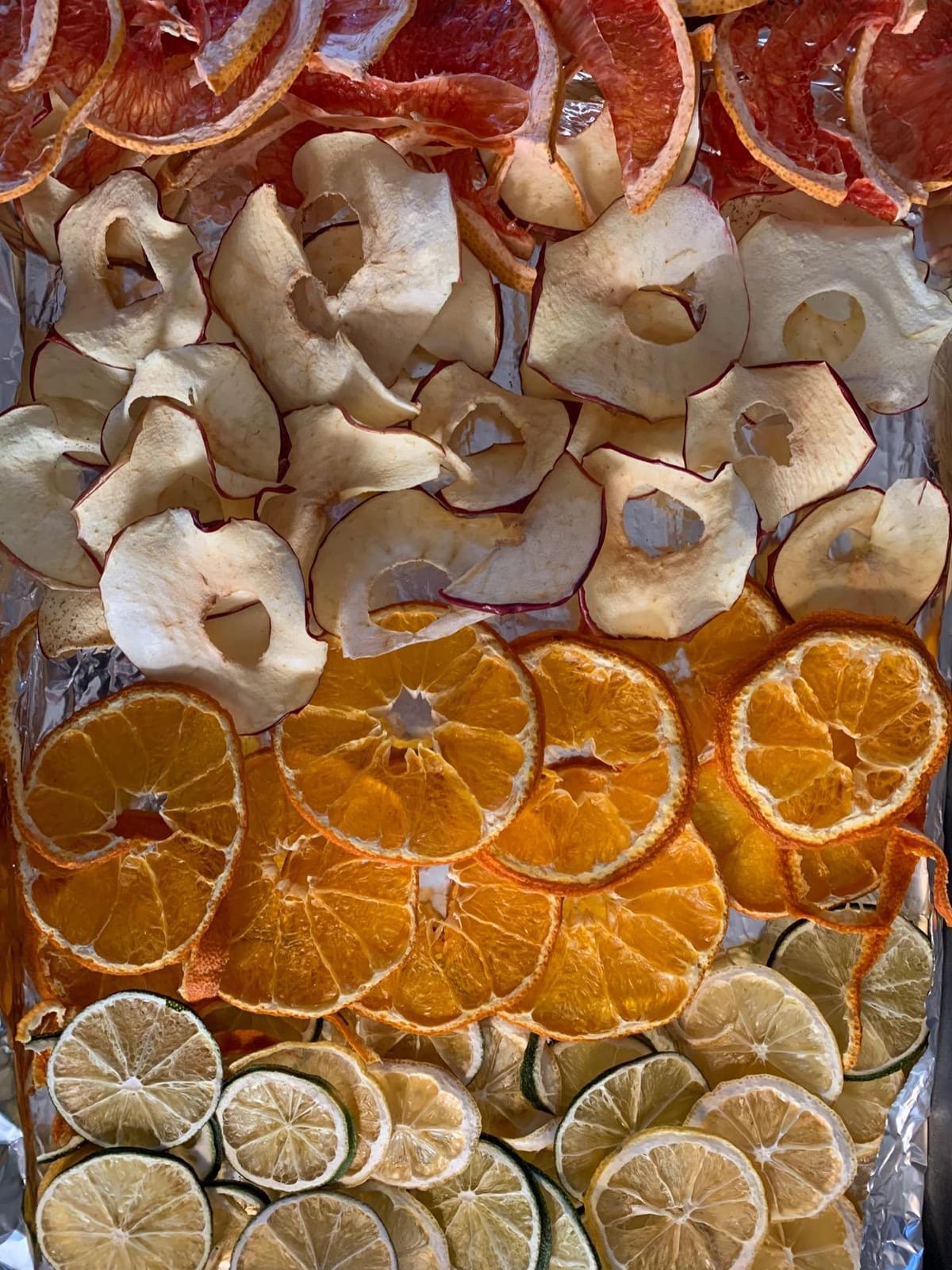
Fruit chips and slices sit at 130F to 150F, and thinner slices matter more here than on a big machine. Apple at an eighth of an inch dries in a single run; a quarter-inch slice in a 240W body can finish chewy in the center. If your first batch is disappointing, cut thinner before you blame the machine.
Fruit leather wants 140F to 155F on a solid or coated tray, and this is where the tray surface matters. The Cosori’s coated solid trays release leather cleanly, while a fine mesh screen is the wrong surface for it. Our fruit drying guide covers batch sizing in more detail.
Vegetables such as peppers, tomatoes and zucchini belong at 135F to 150F, and thick-cut peppers are the acid test for tray spacing. The Magic Mill and the Rosewill RHFD-24001 both adjust their tray spacing, which is the difference between a single long run and two shorter ones.
Jerky is the one that demands the ceiling. USDA guidance for air drying meat calls for a temperature high enough to kill pathogens, and in practice that means the 160F to 165F end of the dial. That rules out the Elite Gourmet at 158F, the Commercial Chef at 158F and the OSTBA at 158F as our only meat machines, and it is why the Cosori’s 165F setting carries weight in this group.
Yogurt and pet treats use the low end, 95F to 115F, and those runs are long and unattended, which is exactly where a 48 or 72 hour timer and auto shutoff stop being optional features. Check for them if that is your use case.
Small Kitchen Buying Checklist: Footprint, Storage and Expandability
Measure before you buy, and measure twice for the stored height rather than the operating height. A dehydrator’s footprint is not the whole of its cabinet requirement, because you need room to lift the lid and pull the top tray clear. Add 3 to 4 inches above whatever height you measured.
Then check the depth you need in front of the unit, not just behind it. A top-loading column can be pulled to the counter edge. A front-loading box needs clear space in front of the door, which in a narrow kitchen often means clearing the area every time you start a batch.
Weight decides how often you will actually use it. The 3.3 pound Commercial Chef and 3.8 pound OVENTE invite weekly use from a high shelf. The 14.7 pound Rosewill RHFD-24001 is fine installed high and genuinely awkward stored low. Match the weight to the shelf height, not to the counter.
Wattage decides your schedule. The 600W NESCO and 500W Hamilton Beach finish batches in fewer hours. The 240W models, including the OSTBA, Magic Mill, Commercial Chef and OVENTE, are gentler and slower. If you plan to dry a whole harvest, wattage is not a minor spec.
Timer and auto shutoff determine whether you can run a batch unattended. A 48 or 72 hour countdown with automatic shutoff means you set it and leave. A dial-only model with no timer, which includes the NESCO, the Commercial Chef and the Rosewill RHFD-15001, needs a kitchen timer you trust.
Cleaning shapes how often you will run it. Fully detachable dishwasher-safe stainless trays, as on the Magic Mill and the OSTBA, are the easiest. Coated solid trays that release sticky fruit leather, as on the Cosori, are close behind. Plastic mesh trays in a cylindrical body are the hardest, because dried sugar bakes into the cell walls.
Expandability is the last check. The NESCO grows from 5 to 12 trays and the Cosori from 5 to 7, and both are worth paying a little more for if you already garden. A machine that never grows means a second machine later, which defeats the point of choosing compact in the first place.
Finally, warranty and replacement parts. Coverage ranges from one year on most models to two years on the Cosori and 24 months on the OSTBA. Longer-lived owners on r/dehydrating consistently emphasise replacement tray availability over warranty length, because a warped mesh tray is the part that actually fails.
Frequently Asked Questions
What is the best food dehydrator for a small kitchen?
The NESCO FD-75A Snackmaster Pro is the best all-round choice for a small kitchen, because its 600W element dries quickly, the lid-mounted fan circulates air across all trays without rotation, and the 10 inch tall round body stores in a standard lower cabinet. If stored height is your only concern, the Elite Gourmet EFD329WDX collapses to just over 6 inches tall.
Are stackable dehydrators good for small kitchens?
Yes. A stackable vertical-airflow design loads trays from the top and stores as a narrow column, so it needs far less counter width than a front-loading box dehydrator. The tradeoff is tray spacing, because vertical gaps are shorter, which limits how thick a slice you can dry in one layer. Models with adjustable tray spacing, such as the Magic Mill MFD-5000 and the Rosewill RHFD-24001, handle thick cuts better.
How many trays do I need for a small dehydrator?
Five trays is the practical minimum for a home kitchen, and it is what most of the models here ship with. Five trays fill a single overnight run of fruit chips, herbs or pet treats. If you garden or make jerky regularly, look for expandability: the NESCO FD-75A grows from 5 to 12 trays and the Cosori CFD-N051-W from 5 to 7. Expanding a stack increases total drying time because every tray shares the same wattage.
Can a small dehydrator make jerky safely?
Only if it reaches a high enough temperature. Air drying meat requires the hot end of the dial, and in practice that means 160F to 165F. Among the models here, the Cosori CFD-N051-W at 165F and the Magic Mill MFD-5000 with a listed 167F range give you the most headroom, and the NESCO FD-75A reaches 160F. Models topping out at 158F are better suited to fruit, herbs and vegetables.
What is better than a dehydrator?
It depends on the food. A conventional oven dries at low heat but uses far more energy and takes up your working oven. A freeze dryer produces a lighter, more evenly dried result and keeps more colour, but costs more and needs counter space most small kitchens do not have. Sun drying needs no power at all but depends on humidity and direct sun. Air fryers crisp already-dehydrated food rather than drying it from fresh.
How much counter space does a small dehydrator need?
Add 3 to 4 inches above the listed height for lid clearance, and in front of a front-loading model for the open door. Round vertical-airflow bodies are about 10 to 11 inches tall and 12 to 13 inches wide, while rectangular shelf-style bodies run 10 to 13 inches wide but are shallower at 8 to 10 inches deep. Measure the cabinet shelf, not the counter, since that is where the appliance will live between runs.
Bottom Line: Which Stackable Dehydrator Fits Your Kitchen
The best stackable food dehydrator for small kitchens in 2026 is the NESCO FD-75A Snackmaster Pro. It has the most powerful element in the group, a fan position that dries every tray without constant rotation, and a body that stores as a 10 inch tall column. Pick it if you want one appliance that grows from a weekend project to a harvest season.
Choose the Cosori CFD-N051-W instead if you make meat, run overnight batches, or share thin walls with a neighbour, because the 165F ceiling and sub-47 dB running are the two things no other compact model combines. Choose the Elite Gourmet EFD329WDX if stored height is your binding constraint, since collapsible trays store it at just over 6 inches.
For thick cuts, the Magic Mill MFD-5000 offers stainless trays with adjustable spacing. For maximum batch size, the Hamilton Beach 32100A squeezes 4.2 square feet from five trays. For long unattended runs, the OSTBA GGJ-261B runs to 72 hours.
Measure your cabinet shelf before you order, add clearance above the height, and pick the wattage that matches how much food you actually plan to dry. That one decision prevents almost every disappointment we see with compact dehydrators.