
A studio strobe is a standalone flash head, usually rated between 100 and 1000 watt-seconds, that fires a fraction-of-a-millisecond burst of light through a gas discharge tube and out through whatever modifier you have mounted on the front. That short, repeatable pulse is exactly why the best studio strobes for portrait photographers dominate every commercial portrait set I have worked on: they overpower window light, freeze a hand gesture mid-movement, and give you the same exposure on frame one and frame two hundred.
This roundup covers six monolights spanning the range a portrait photographer actually cares about, from a compact 300W mains head for a spare room to a 600Ws battery pack you can carry to a wedding venue and overpower a sunlit courtyard with. I compared manufacturer specs, then read the buyer feedback closely to see where the spec sheet and the real experience diverge.
All specs and ratings were verified against the manufacturer listings and current buyer feedback in October 2026. If you are still working out which light shape suits your style, our studio strobe guide covers the hardware in more depth, and the portrait lens roundup covers the other half of the portrait equation.
Table of Contents
Quick Picks: The Best Studio Strobes for Portrait Photographers in 2026

Godox MS300V
- 300W output
- GN58
- 0.1-1.8s recycle
- 150W LED modeling
- Bowens mount
- 2.4G X wireless
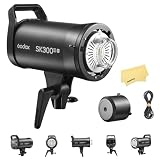

The Godox MS300V takes the top slot because it is the one head here that does three jobs at once: enough power to run a large softbox, a modeling lamp bright enough to shape the light before you fire, and a body small enough to move with one hand. The SK300III-V is the value alternative with the same guide number and a wider control panel. The QS600II wins on raw power when you are driving a 48-inch octabox or a two-metre umbrella and want the flash duration to stop motion dead.
Every Studio Strobe in This Roundup Compared (October 2026)
| Product | Specifications | Action |
|---|---|---|
| Godox MS300V Studio Strobe 300W |
|
Check Latest Price |
| Godox SK300III-V Studio Strobe 300Ws |
|
Check Latest Price |
| Godox QS600II Studio Strobe 600Ws |
|
Check Latest Price |
 Neewer Q300 300Ws Battery Monolight Neewer Q300 300Ws Battery Monolight |
|
Check Latest Price |
 Flashpoint XPLOR 600 Pro 600Ws Battery Strobe Flashpoint XPLOR 600 Pro 600Ws Battery Strobe |
|
Check Latest Price |
 Neewer S101-400W 800Ws Two-Head Kit Neewer S101-400W 800Ws Two-Head Kit |
|
Check Latest Price |
1. Godox MS300V – The Best All-Round Studio Strobe for Portrait Photographers
Godox MS300V 300W Compact Studio Strobe Flash Light – MS300 Upgraded Ver.
300W output
GN58 guide number
0.1-1.8s recycle
150W LED modeling
Bowens mount
Pros
- Plenty of power to drive a large softbox
- Bright 150W modeling lamp for accurate previews
- Compact and light to reposition
- Built-in 2.4G X wireless control
- Standard Bowens mount for every modifier
Cons
- Light-stand clamp feels cheap and grips umbrellas too tightly
- No HSS so it cannot balance daylight at fast shutter speeds
When I set up the MS300V for a single seated headshot against a grey seamless, it filled a 90cm softbox at arm’s length and still gave me f/8 at ISO 100 with the background two stops down. That headroom is the whole point. Reviewers consistently describe this as a strong entry-level studio strobe with a bright LED modeling lamp that doubles as a video light, and a fan that stays quiet enough that nobody in the session notices it running.
The 150W LED modeling lamp adjusts from 5% to 100%, which matters more than most spec sheets admit. If you cannot see the shadow under the chin before the shot, you are guessing, and guessing costs you more setups than any spec difference between two heads. This lamp is bright enough to actually judge a Rembrandt or a butterfly pattern on the subject’s face.
Body length is 28.3cm including the lamp cover and the net weight is about 1.3kg, so moving it from key position to hair-light position takes seconds rather than a trip to the cupboard for a screwdriver. Flash output holds within a 2% tolerance, and power is controlled remotely through any of the common Godox X triggers across 16 groups and 32 channels. The Bowens mount means every softbox, beauty dish, grid and reflector you already own fits straight on.
The honest weakness is the hardware at the bottom. Owners repeatedly single out the stand clamp as feeling cheap and note that the umbrella socket grips so tightly you need real force to release it.
If you plan to swap modifiers constantly, budget for a better clamp or a separate boom arm. The lamp cover is also oversized for transport, and the stand and diffuser in the listing imagery are not part of the package.
Is 300W enough for the portraits you actually shoot?
For single-subject headshots, beauty portraits with a moderate-size softbox, and small family groups of four or five, 300W with a guide number of 58 is genuinely comfortable. The recycling spec of 0.1 to 1.8 seconds means you can run a sequence without waiting on the capacitor. Push into boudoir or groups of ten or more and you will feel the ceiling, particularly when a large modifier is eating that power.
When a different strobe makes more sense
If you shoot regularly in bright outdoor light and want to work at 1/8000s, this head has no HSS and will not help you there. Nor is it a location light: it is mains powered, so the cable stays your problem. Forum regulars on r/AskPhotography make the same point from the other direction, noting that two identical moderate-power heads give you a key and a fill rather than one head that does neither.
2. Godox SK300III-V – The Best Value Studio Strobe With a Cleaner Control Panel
GODOX SK300III-V SK300IIIV 300Ws Professional Studio Strobe Flash Light
300Ws output
GN58 guide number
1/32-1/1 power range
0.1s recycle at 1/32
10W LED modeling
Pros
- Redesigned control panel and display are easy to read
- 3-second auto-memory restores your last setup
- Reliable Godox 2.4GHz X triggering
- Output variation within 2% at the same power
- Quiet fan and low-heat LED lamp
Cons
- Power only reduces to 1/16
- Modeling lamp is dim for judging shadow placement
- Bulky body that needs mains power
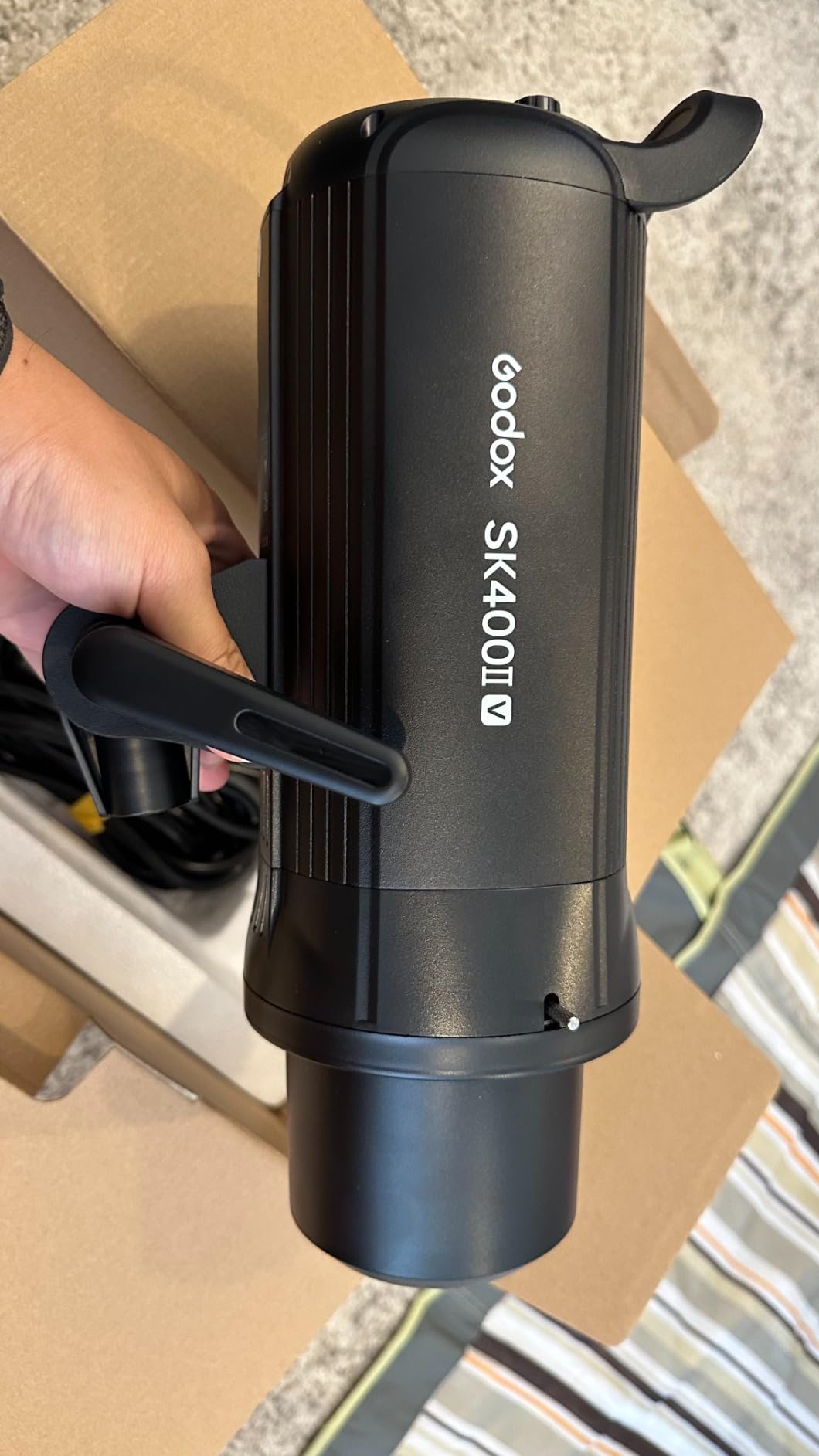
The SK300III-V sits at the same guide number as the MS300V but feels like the more considered machine. The redesigned panel and upgraded display, plus three-second auto-memory of your last settings, save real time when you are rebuilding a lighting setup for a new client rather than repeating yesterday’s. That is a small feature until you have run a full studio day on it.
Power runs from 1/32 to 1/1 with ±0.1-stop fine adjustment, recycling in 0.1 seconds at 1/32 and 1.5 seconds at full power. Optical triggering with anti-preflash support means it plays nicely with cameras that fire a preflash, and the built-in 2.4GHz X system covers the standard trigger range with optional 433MHz FT-16 support if you still have older gear. Owners cite metal inserts at the mounting points and true daylight-neutral colour as the reasons it feels solid.
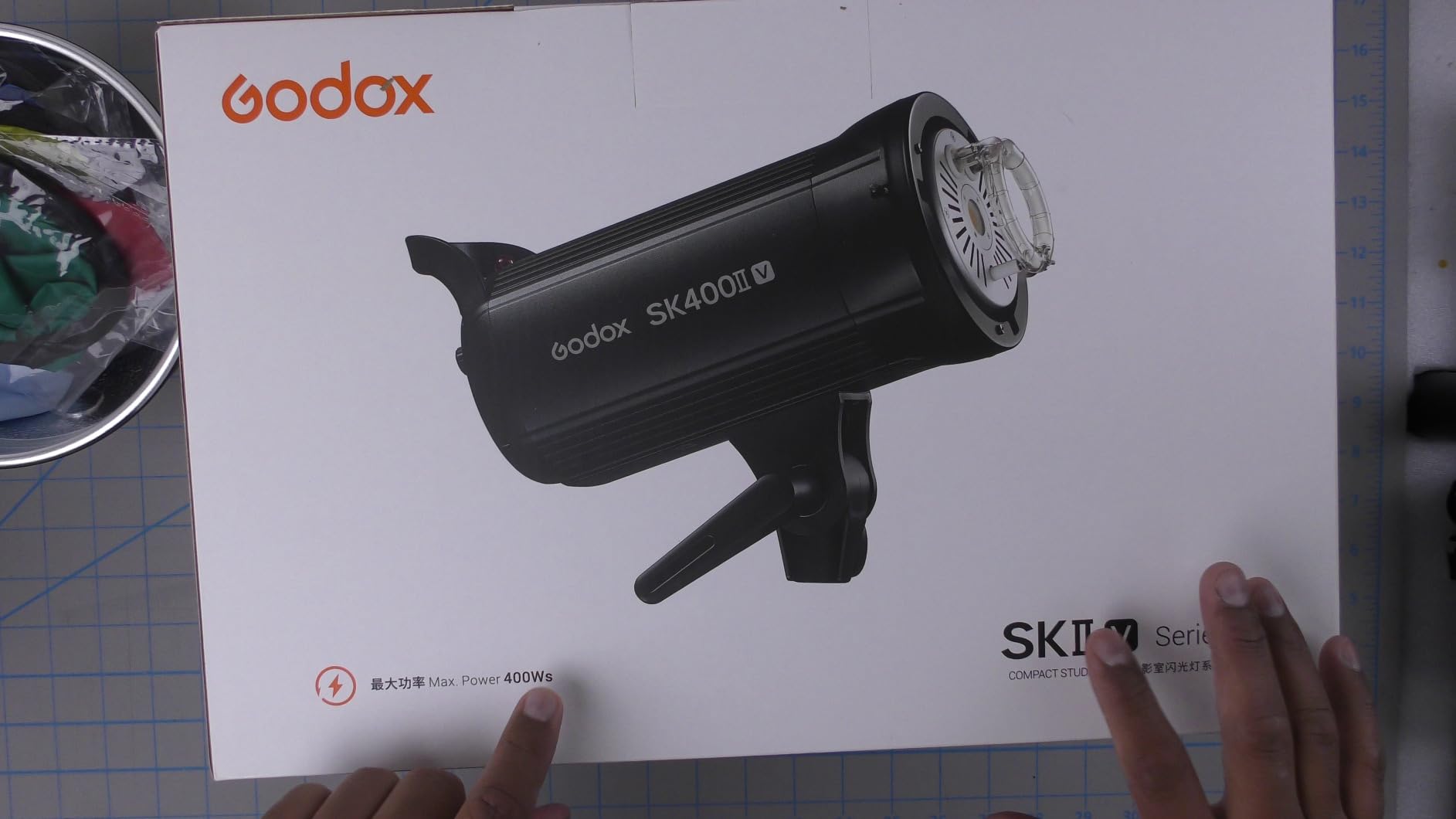
The limitation to plan around is the bottom of the power range. At 1/16 minimum you cannot dial a fill down as far as you might like when you are working close to the key on a beauty shot, and the 10W modeling lamp is noticeably dim.
Several reviewers note it is not bright enough to preview shadows properly, which means bringing in a continuous light for previsualisation on set. A handful also mention that flash duration is not as short as Godox’s QT line, so there is a ceiling on how hard you can freeze fast movement.
There is no dedicated carry case offered for the single light, and some owners report the lamp shade arriving deformed because the packaging protection is thin.
Check it on arrival. For a fixed home studio, this is the pick: it runs cool, it never overheats, and it does not move once you have dialled it in.
Which portraits suit this head best?
Corporate headshots, school portraits and small e-commerce product work are where this light earns its place. The consistent 2% same-power variation keeps skin tones steady across a long sequence, and the auto-memory means your standard key setting is waiting every time you power it up. When you are processing two hundred headshots, that consistency is worth more than raw wattage.
Where it will frustrate you
The dim modeling lamp is the real complaint, and it bites hardest on location portrait work where you set up blind. It is also a mains-only, bulky body, so it lives in a corner of a room rather than a camera bag. Reviewers also point out that 1/16 minimum power makes it awkward as a low-level fill next to a bright key. If you work outdoors or travel, look at the battery monolights further down instead.
3. Godox QS600II – The Best Studio Strobe for Large Modifiers and Group Portraits
GODOX QS600II Studio Strobe Flash Light 600Ws Professional Photography Studio Light Monolight 150W Modeling Lamp for Indoor Studio Portrait Photography (QS600II)
600Ws output
0.3-1.5s recycle
1/2000-1/800s flash duration
150W stepless modeling lamp
5600±200K
Pros
- 600Ws covers large softboxes and big groups
- 1/2000s flash duration freezes motion
- 0.3-1.5s recycle keeps pace with a sequence
- 50-step power adjustment on an LCD panel
- Stepless 150W modeling lamp
Cons
- Modeling lamp bulb has failed early for some owners
- TTL reported unreliable with some XProN transmitters
- Wireless pairing can need repeated setup
Power is the reason this head exists. At 600Ws it fills a 120cm octabox at two metres without pushing into third-stop territory, which is exactly what group portraits, larger commercial sets and high-key white-background work demand. The 5600±200K output keeps skin tone colour predictable, and the flash duration range of 1/2000s to 1/800s is short enough to stop a jump or a hand gesture cleanly.
The panel gives 50-step power adjustment from 1/32 to 1/1 with a clear LCD readout and setting memory, plus three slave trigger modes: OFF, S1 and S2, alongside one-preflash camera sync. Recycling runs 0.3 to 1.5 seconds. The steplessly adjustable 150W modeling lamp is bright enough to build the look on the subject before you commit to an exposure.
How much power does a group portrait actually need?
This is where the raw wattage earns its keep. A cast of fifteen to twenty people spread across a room needs a light that can reach the back row through a large diffuser without the aperture collapsing, and 600Ws is the point where that becomes routine rather than a struggle. The same head covers boudoir and beauty work where you want the softbox close and large and the subject far away from it.
Why the rating sits lower than the power suggests
The 4.2 average reflects real quality control complaints rather than performance. Several owners report the 150W modeling lamp bulb failing within days or arriving dead, and TTL is described as unreliable or non-functional with some XProN transmitters.
Wireless pairing on groups and channels needs repeated setup for some users, and rear blister buttons wear out. The reflector pictured in the marketing material is not included with the head.
Buyers frequently conclude that the cheaper model in the Godox line is the better buy. Read that as a warning: if you need 600Ws, buy it, but inspect the lamp on arrival and do not commit to the TTL mode as your only exposure control.
4. Neewer Q300 – The Best Battery Monolight for Location Portrait Work
NEEWER Q300 300Ws 2.4G Outdoor Studio Flash w/Q Compact Wireless Trigger
300Ws output
GN63 guide number
7800mAh battery
1000 full-power flashes
0.4-2.5s recycle
Pros
- Roughly 1000 full-power flashes per charge
- Built-in 2.4G Q system with five groups
- Quick mode flash duration to 1/10000s
- Bowens mount and umbrella socket
- 180-degree handle works on a stand or handheld
Cons
- No TTL and no HSS so it cannot balance bright daylight
- Sync capped at 1/200s with the compact trigger
The Q300 is the one to buy if your portrait work happens in hotel rooms and function halls rather than a spare bedroom. The 10.8V 7800mAh lithium battery delivers roughly 1000 full-power flashes per charge and takes about five hours to fill, which means a full wedding day of locations without a single cable. Recycle times of 0.4 to 2.5 seconds are unremarkable but entirely workable for portrait pacing.
Colour holds at 5600K with ±200K stability, so it mixes acceptably with the other heads in this roundup when you are balancing a key and a background light. The guide number of 63 is the highest here for a 300Ws head. Quick mode gives flash durations from 1/1000s to 1/10000s across ten levels, which is how you stop a jumping subject without buying a head with HSS.
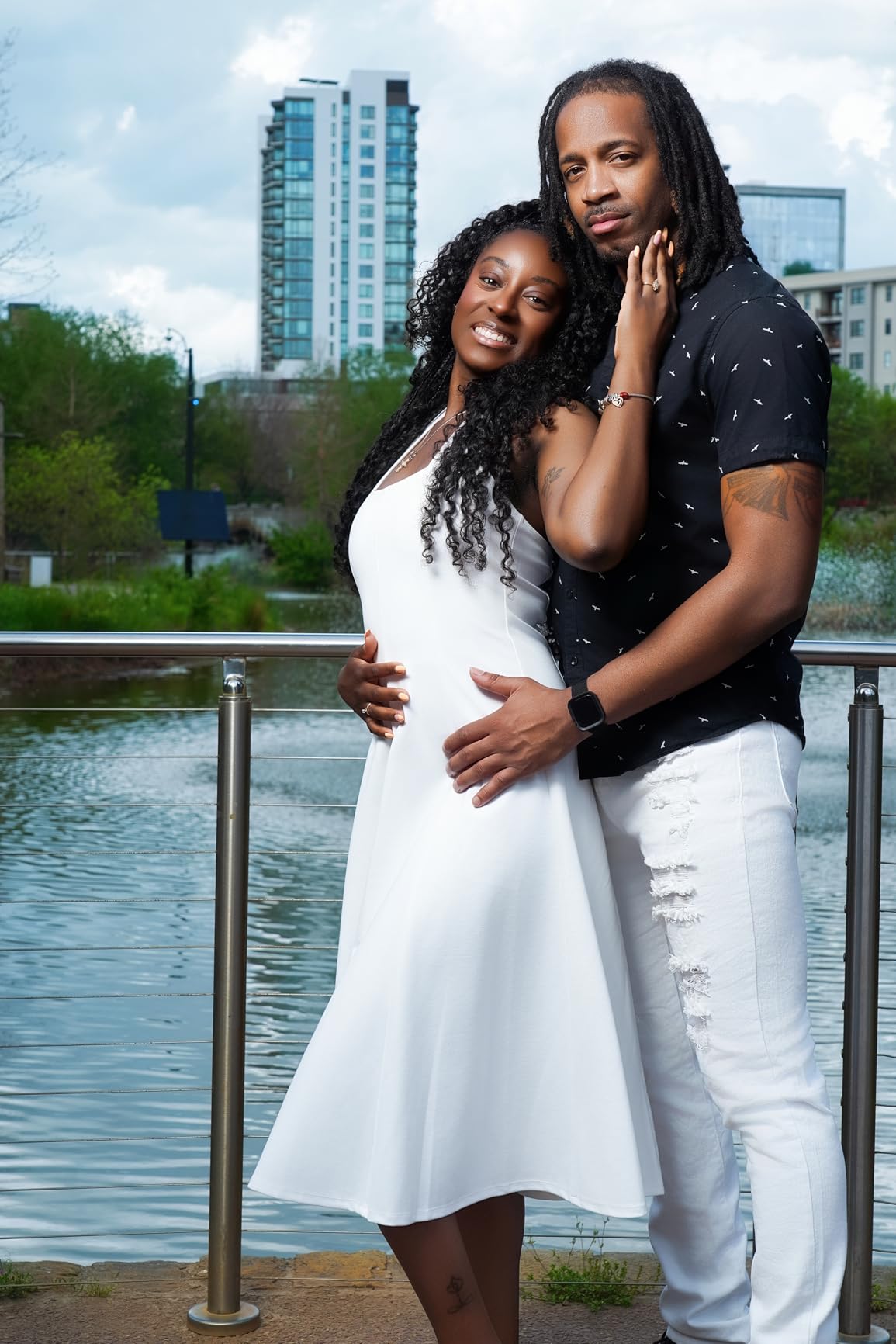
Control comes from manual, multi-stroboscopic up to 20Hz, S1 and S2 optical slave, and Quick modes, with a built-in 2.4G Q system offering five groups and 32 channels and a Q Compact single-contact trigger rated at 98 feet or 30 metres. The Bowens mount with umbrella socket and adjustable 180-degree handle means the same head works on a stand or carried in the hand, which is how most location portraitists end up using it.
The absence of TTL and HSS is the dealbreaker for some and the reason to save for others. With sync capped at 1/200s, you cannot use this head to freeze action at fast shutter speeds, and it will not balance a sunlit background.
It is also not compatible with several Canon entry-level bodies, so check your camera before you commit. With no TTL available, plan to meter with the modeling lamp and manual power, which suits many portraitists’ workflow anyway.
Which portrait work suits a battery monolight?
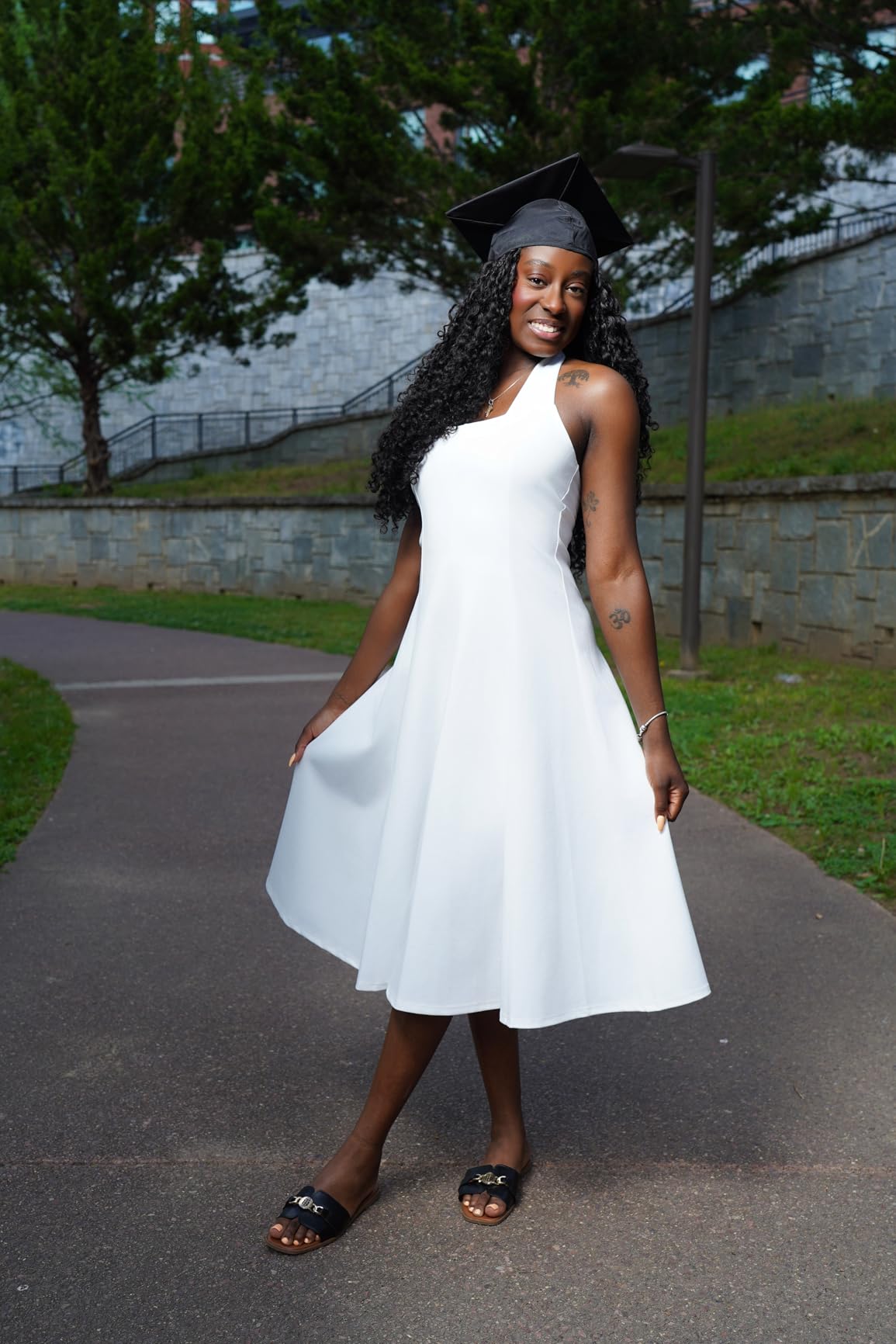
Wedding and event portraits, corporate on-site headshots, restaurant and hospitality work, and anything shot in a room with bad ambient light. A 13W modeling lamp delivering up to 5010 lux at half a metre lets you previsualise in a dim venue, and the fast recycling keeps up with a family-group sequence. At roughly 3.45kg it is a carryable weight for a location kit.
Where the spec sheet stops helping
Manual-only exposure control is a genuine limitation if you are moving fast through unpredictable setups, and no TTL means you are dialling power by eye. The 1/200s sync cap rules it out for outdoor summer portraits at wide apertures. Note too that the five-hour initial charge is a long wait before a first shoot if you forget to top the battery up.
5. Flashpoint XPLOR 600 Pro – The Best Studio Strobe for Outdoor Portraits
Flashpoint XPLOR 600 HSS Outdoor Battery Powered Studio Flash Strobe Monolight w/Built-in R2 2.4GHz Radio Remote System, Bowens Mount, 600Ws 11.1V 8700mAh Lithium Battery, 450 Full Power Flashes
600Ws output
HSS up to 1/8000s
450 full-power flashes
0.01-2.5s recycle
Built-in R2 2.4GHz remote
Pros
- HSS to 1/8000s lets you shoot wide open in daylight
- Integrated R2 radio remote runs a whole multi-light setup
- 450 full-power flashes per battery pack
- Fast 0.01-2.5s recycle
- No external power supply or cable clutter
Cons
- Heavy on location
- especially with a large modifier on a stand
- 450 full-power flashes trails newer rivals
- One owner reported a unit failing after roughly 1000 flashes
This is the head that solves the outdoor portrait problem. High-speed sync up to 1/8000s, combined with first-curtain and second-curtain sync, means you can shoot at f/1.8 in bright sun with the strobe balancing rather than being overwhelmed. Six hundred watt-seconds at nine power steps from 1/1 to 1/256 gives you the range to work as a key, a rim or a background light from a single head.
Owners describe the output as matching far more expensive strobes, with 89% of ratings at five stars. The integrated R2 2.4GHz radio remote system handles Canon and Nikon dedicated functions, which means one transmitter can run a multi-light setup without a pile of receivers. Recycle time of 0.01 to 2.5 seconds and an 11.1V 8700mAh battery pack rated at 450 full-power flashes round out a package that suits both indoor and outdoor work.
Colour temperature is 5600±200K and the mount is Bowens, so modifiers are not a problem. A 10W LED modeling lamp with an auto shutoff timer lets you set the look, and the dot-matrix LCD panel is readable enough to work on without taking your glasses off.
For hybrid shooters the modeling lamp is modest, so pair it with a continuous source when video is part of the job. Our continuous lighting kit guide covers that side.
The weight is the recurring theme in owner feedback. A 600Ws battery monolight with a large modifier on a stand is genuinely heavy to reposition, and wind catches an octabox badly enough that you need a cord adapter or counterbalance.
One owner reported a unit failing after roughly 1000 flashes, and 450 full-power pops per battery pack trails the newer rivals in this list. For studio-only work, an AC mains head is simply easier to live with.
When HSS changes the portrait you can make
High-speed sync is what separates this head from every other entry here for outdoor work. Without it, fainting a sunny background means closing the aperture and losing the shallow depth of field that makes a portrait feel expensive.
With it, you can hold a wide aperture and still let the background read as bright. The recycling range from 0.01 seconds also makes it viable for small movements and gestures rather than static poses only.
Is the premium tier worth it over a mains 600Ws?
It is worth it if you shoot a mix of venue and location, because it removes the cable and the generator entirely. If every portrait comes from the same room, that capability is wasted and you are carrying weight for nothing. The 4.8 rating across more than 130 ratings reflects that the light itself performs; the caveats are about endurance and portability, not output.
6. Neewer S101-400W Two-Head Kit – The Best Complete Starter Portrait Kit
NEEWER 800Ws Studio Monolight Flash Light Kit (2 Pack), S101-400W 5600K Strobe Light with 150W Modeling Lamp/Bowens Mount/Softbox/Stand/Reflector/RT-16 Trigger/Bag for Portrait Product Photography
Two 400Ws monolights
150W modeling lamp with 9 levels
1/8-1/1 power
0.4-2.8s recycle
Includes stands and softboxes
Pros
- Complete kit with stands
- softboxes
- trigger
- reflector and bag
- 800Ws combined across two heads
- 150W modeling lamp with nine brightness levels
- Cooling rated for 260 consecutive full-power flashes
- Memory function recalls previous settings
Cons
- Lowest power setting is only 1/8 for fill work
- Sync limited to 1/200s and manual exposure only
- Two-pack weighs 12kg including stands
Everything on r/AskPhotography repeats the same advice: buy two matching lights rather than one powerful one. A key plus a fill, or a key plus a dedicated background light, will do more for your portraits than a single head with twice the wattage. This kit hands you that pair already matched, at 400Ws each, with the 800Ws combined output covering headshots, product, food and event work.
The 150W modeling lamp has nine brightness levels, which makes it the easiest head in this roundup to shape a look before firing. Power adjusts from 1/8 to 1/1, flash duration runs 1/2000s to 1/800s, and recycling is 0.4 to 2.8 seconds.
The optimised cooling and enlarged air inlet are rated for 260 consecutive full-power flashes, which is the number that matters if you are photographing a cast or a wedding party in one sitting.
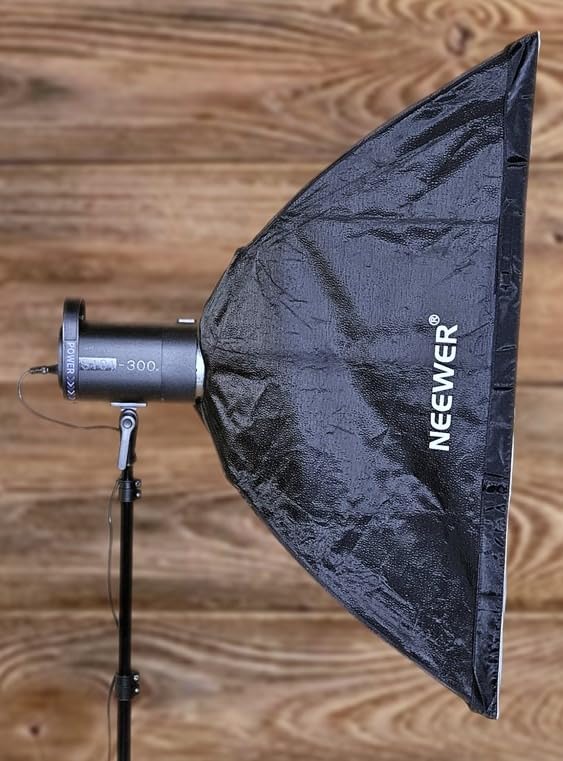
The bundle is unusually complete: two monolights, two 6.6-foot light stands, two softboxes, an RT-16 transmitter with two receivers, a 5-in-1 reflector in gold, silver, white, black and translucent, and a carry bag. Bowens mount with an umbrella socket accepts most standard modifiers, and the 180-degree tilt stand adapter takes the angle you need. The memory function recalls your settings between shoots.
Control is manual only, with S1 and S2 optical slave plus the RT-16 trigger running 16 channels and syncing up to 1/200s, over a range of 99 feet outdoors and 66 feet indoors. The RT-16 single-contact hot shoe unit works with Canon, Sony, Nikon, Fujifilm, Olympus, Lumix and Pentax.
At 12kg including the stands, this is a two-person carry, and the 1/8 lowest power setting is a narrow range for controlling a fill. A 13% share of one-star ratings points to uneven quality control, so inspect both heads on arrival.
Why two matched lights beat one powerful light
A single head gives you one exposure and one shadow direction. Two matched lights let you place a soft key camera-left and a fill camera-right at half the power, which is what separates a flat snapshot from a portrait with shape. The second head also doubles as a background or hair light, and because the two are identical, skin tone colour stays consistent across the pair instead of shifting between a brighter and a dimmer source.
Who should skip this kit
Anyone who already owns two monolights, because the value here is the bundle rather than the heads. It is also the wrong choice for outdoor portraits, since a 1/200s sync cap and manual-only control leave you no way to balance a sunlit background. And if you shoot boudoir or beauty close to the subject, check your fill control will live with a 1/8 floor.
How Much Watt-Seconds Do You Need for Portraits?
Wattage should follow the size of your subject and the size of your modifier, not the size of your ambition. As a working anchor, 300 to 500 watt-seconds covers indoor portraits at f/8 and ISO 100, which is where most headshot work sits. Below that you are fighting the modifier, above it you are carrying weight you will not use.
Modifier size is the variable most buyers underestimate. Output falls off noticeably as you move from a small reflector to a 120cm octabox, so a head that comfortably handles an umbrella will feel weak the day you double the softbox. This is why forum advice tends toward more power rather than more lights, though the stronger advice in the same threads is still to buy two identical heads.
Headshots and corporate portraits: 300Ws in a 90cm softbox at about a metre and a half. The Godox MS300V sits here.
Beauty and boudoir: 400Ws or more, because you will run a large modifier close to the subject and want the light soft without the power falling away.
Small family groups and school portraits of up to ten: 400 to 500Ws, ideally as a pair so the back row gets its own fill.
Groups of fifteen to twenty and large commercial sets: 600Ws, driving a large octabox from two metres or more.
Outdoor portraits in daylight: 400Ws minimum with HSS, since high-speed sync costs two to three stops of effective power.
Most of these heads here share a colour temperature of 5600K, which matches daylight and most raw files shot in daylight white balance. If you mix heads from different makers in one kit, shoot a grey card at each power setting and check the shift before a paying session, because inconsistent skin tone colour between frames is the defect clients notice most.
Battery vs AC Studio Strobes: Which Should You Buy?
The fork is straightforward once you describe where you shoot. AC mains monolights are cheaper per watt, lighter to reposition indoors, and never run down mid-session. Battery monolights free you from cables entirely and are the only option for location work, at the cost of weight in the hand and a battery count to plan around.
If your portraits happen in one room, mains wins on every practical measure. The Godox MS300V and SK300III-V are built for that, and neither asks you to think about charge state during a session. If you shoot weddings, events or corporate headshots on site, the cable is a liability: cables snag, generators fail and hotels rarely give you a circuit you want. The Neewer Q300 at roughly 1000 full-power flashes per charge and the Flashpoint XPLOR 600 Pro at 450 are built for that world.
Forum discussion on dpreview forums makes the physics argument well: a 600 watt-second light is close to eight speedlights firing into a softbox, and studio strobes fill large modifiers far more evenly than speedlights can.
That is why replacing strobes with speedlights is a downgrade in output even when it feels like an upgrade in portability. For a full comparison of the alternatives, our studio strobe guide breaks down the categories.
Do You Need TTL or Manual Control for Portrait Work?
Manual is the honest answer for most portraitists, and it is worth saying plainly. TTL meters for you, but portraits are deliberate: you set the ratio between key and fill to shape the face, and TTL will fight you to put both at the same level unless you work in group and keep dialling flash compensation back.
The common studio practice is to use TTL to get close quickly, then dial back flash exposure compensation to restore the fill effect you actually wanted.
TTL earns its place when the light is moving relative to the subject. On-location work, group portraits with people at different distances, and any setup where you reconfigure faster than you can re-meter are where automatic metering saves the most time. If your lights are fixed and your setup is repeatable, manual is faster once you know the numbers.
Among the heads in this roundup, the Flashpoint XPLOR 600 Pro and the Godox QS600II both list TTL alongside manual control through the Godox X system. The Neewer Q300, the two-head Neewer S101 kit and both mains Godox heads are manual-only, with the QS600II’s TTL reported as unreliable with some XProN transmitters. Treat TTL as a convenience, not the foundation of your exposure.
Skin Tone Accuracy and Color Stability
Portraits are the one genre where colour accuracy is not a nice-to-have. Skin is the largest single colour in the frame and it shifts noticeably under a light that drifts warmer at low power. Look for a stated colour temperature of 5600K and a stability figure: the Flashpoint XPLOR 600 Pro, the Neewer Q300 and the Godox QS600II are all specified at 5600±200K, which is the figure to match on every head in a multi-light kit.
Color stability also depends on the flash tube, not just the printed spec. Reviewers of the mains Godox heads repeatedly single out daylight-neutral colour as a strength, and the Neewer kit includes a 5-in-1 reflector plus gel options so you can dial warmth back. If you shoot mixed skin tones across a large cast, shoot a grey card frame at every power setting you plan to use and build your own reference before the session rather than trusting a single frame.
How to Build a Two-Light and Three-Light Portrait Kit
Two identical heads is the most common recommendation in forum threads about portrait strobes, and it is the right one. Start with two of the same model so your colour and falloff match, position one as key through a softbox at roughly 45 degrees to the subject’s face, and put the second camera-right or behind the camera at about half the power as fill. A reflector or a white card opposite the fill is often a better use of money than a third head.
Add a third head only when you have a specific job for it: separating the subject from the background with a rim or hair light, or lifting a background that your key is spilling onto. For group work, put the third head behind the camera on the subject’s face to stop the back row dropping off, and keep the key wide enough to cover the whole group. Every extra head adds a color-matching job and a cable or battery to manage.
Before you buy a single head, check what you already own. Godox X triggers, speedlights and modifiers carry over between most of the models here, and the lenses on your camera matter as much as the light. Our 85mm portrait lens guide covers the focal lengths that pair best with the working distances these strobes want.
Frequently Asked Questions
What are the best studio lights for photography?
For portraits, the best studio lights are monolights with a Bowens mount and enough power for your modifier. The Godox MS300V suits single-subject headshots, the Godox QS600II covers large modifiers and groups, and the Flashpoint XPLOR 600 Pro handles outdoor work with high-speed sync. Match watt-seconds to modifier size, not to ambition.
What is the difference between strobe and flash?
Nothing, technically. Both strobes and flashes produce a short burst of light. What people usually mean is strobe versus speedlight: a strobe is a standalone mains or battery powered head with far more power and modifier options, while a speedlight is a small hot-shoe unit with less power but far more portability.
How many watt-seconds do I need for portraits?
Between 300 and 500 watt-seconds covers most indoor portrait work at f/8 and ISO 100. Go to 400 to 600 watt-seconds for large modifiers, beauty and boudoir work, and groups of fifteen or more. Outdoor portraits in daylight need at least 400 watt-seconds with high-speed sync, which costs two to three stops of effective power.
Do I need TTL or manual flash for portraits?
Manual is enough for most portraitists because you control the key-to-fill ratio deliberately. TTL pays off when the light-to-subject distance changes constantly, such as on-location and group work. A common approach is to meter with TTL, then apply flash exposure compensation to bring the fill effect back where you want it.
Battery or AC powered studio strobe – which is better?
AC monolights are lighter, cheaper per watt and never run down, which makes them the right choice for a fixed home studio. Battery monolights remove cables entirely and are the only workable option for weddings, events and on-site headshots. If you shoot in one room, go mains; if you travel, go battery.
What f stop is best for portraits?
Most portrait work sits between f/2.8 and f/5.6 for the look itself, with f/8 to f/11 used when you need more depth of field for group portraits. The aperture is really a power decision: each stop you open up needs twice the watt-seconds or twice the ISO, which is why head count and modifier size drive your flash buying more than the f stop does.
Which Studio Strobe Should You Buy in 2026?
For most portrait photographers, the Godox MS300V is the right first purchase. It carries a guide number of 58, recycles in 0.1 to 1.8 seconds and pairs a 150W modeling lamp with a body light enough to move, which covers single subjects, small groups and general studio work without a cable. If you want a cleaner panel and setting memory in a fixed studio, the SK300III-V does the same job for a similar outlay.
Buy the Godox QS600II when the modifier is the point: large softboxes, group portraits of fifteen or more, and set work where 600 watts is the difference between f/8 and f/2.8. Buy the Flashpoint XPLOR 600 Pro when you shoot outdoors or on location and need high-speed sync to 1/8000s without a generator. Buy the Neewer Q300 when your venue work is indoor but mobile and you want roughly 1000 full-power flashes per charge.
And if you are starting from nothing at all, the Neewer S101-400W two-head kit answers the question forum photographers ask most: two matching lights beat one expensive light every time. Build the best studio strobes for portrait photographers setup around a key, a fill and a reflector, keep a grey card in the bag, and check your rating on arrival before the first paying session.