
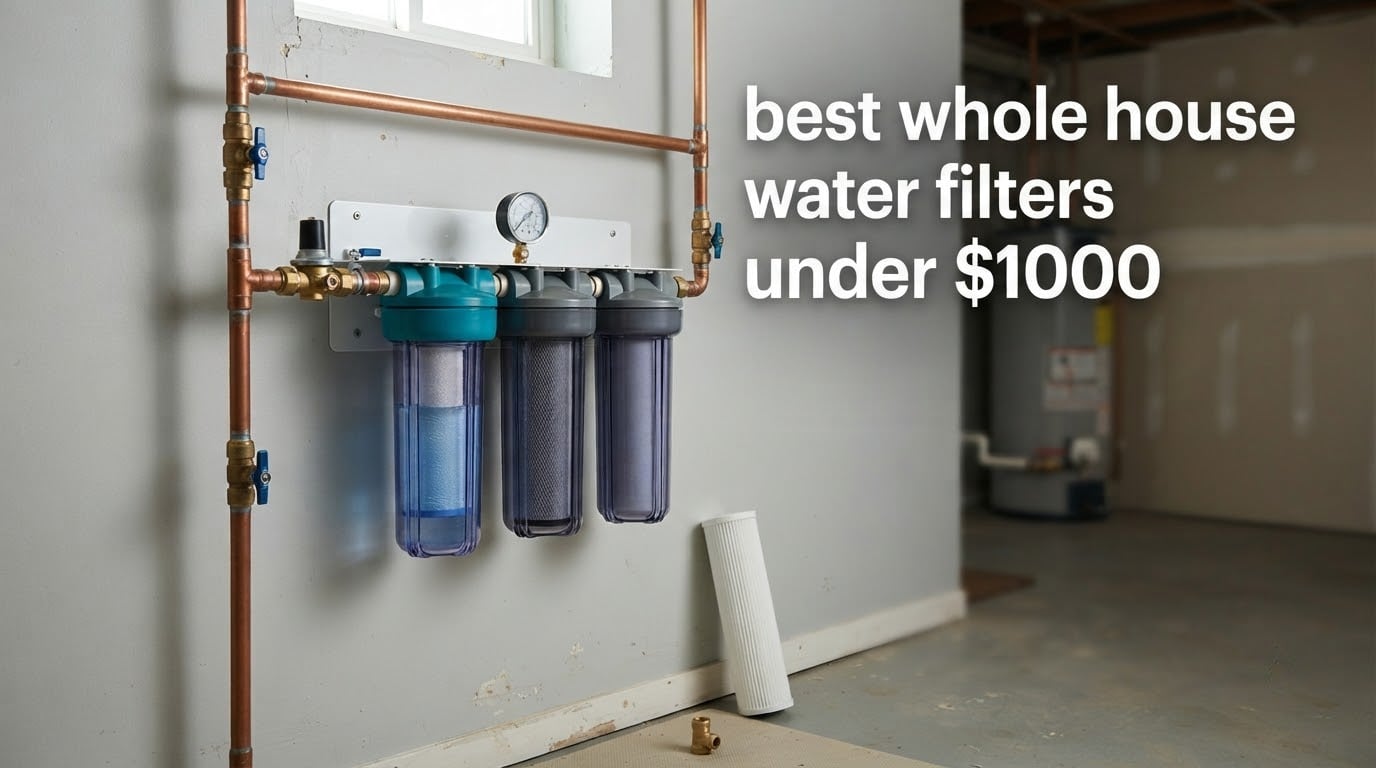
The best whole house water filter under 1,000 dollars for most homes is the iSpring WGB21B, a two-stage sediment and carbon system rated at 15 gpm with 1-inch ports and 50,000 gallons of capacity. It fixes chlorine taste and odor at every tap for a fraction of what a dealer system costs, and cartridges are cheap and widely stocked.
That is the short answer, and the rest of this guide explains it. We spent several weeks reading the specification sheets, warranty terms, and owner feedback behind all ten systems in this roundup, then sorted them by the things that actually decide whether a filter works in your house: flow rate, housing size, certification, media longevity, and the real cost of replacement elements.
A whole house water filter, also called a point-of-entry or POE filter, is plumbed into the main water line where the water enters your home. It treats every drop before it reaches a sink, shower, dishwasher, ice maker, or water heater, which is why it does more for chlorine odor in a bathroom than a shower filter ever will.
Before you read further, branch on your water source, because it decides almost everything. On municipal water, the problem is usually chlorine or chloramine, taste and odor, and sediment from aging pipes, and a sediment-plus-carbon cartridge system handles it. On a well, the suspects are iron, sulfur, sediment, and bacteria, and carbon alone will not fix any of them. If you are not sure which you have, start with the whole house water filter basics guide and then come back.
We also want to set one expectation early. A 1,000-dollar ceiling buys you genuine whole house filtration, but it does not buy you a water softener, a reverse osmosis system, a UV sterilizer, or a catalytic carbon setup for chloramine. Those are add-on categories, and pretending otherwise is how buyers end up disappointed. We cover exactly what you give up in our budget section below.
Table of Contents
Top 3 Best Whole House Water Filters Under 1,000 in 2026
iSpring WGB21B 2-Stage
- 15 gpm on 1 inch ports
- 50000 gallon capacity
- Sediment plus CTO carbon stages
- No power or drain line required

iSpring WGB32B 3-Stage
- 20 x 4.5 inch industrial housings
- 100000 gallon capacity
- Two carbon block stages
- 15 gpm rated flow

Waterdrop WHF21-PG 2-Stage
- 5 micron PP plus GAC media
- Compact 14 inch wide body
- 1 inch inlet and outlet
- 15 gpm rated flow
The iSpring WGB21B takes the top slot on the balance of rating, review volume, flow capacity, and simplicity. The WGB32B edges it on owner satisfaction with its 20-inch housings. The Waterdrop WHF21-PG is the cheapest credible way to get a two-stage system on the main line.
All 10 Whole House Water Filters Under 1,000 Compared (September 2026)
| Product | Specifications | Action |
|---|---|---|
| iSpring WGB21B 2-Stage Whole House Water Filter |
|
Check Latest Price |
 Express Water Ultimate Protection 3-Stage System Express Water Ultimate Protection 3-Stage System |
|
Check Latest Price |
| iSpring WGB32B Commercial-Grade 3-Stage Filter |
|
Check Latest Price |
 A. O. Smith AO-WH-Filter Whole House Filter A. O. Smith AO-WH-Filter Whole House Filter |
|
Check Latest Price |
| Waterdrop WHF21-PG 2-Stage Whole House Filter |
|
Check Latest Price |
 Reverse Osmosis Revolution 3-Stage Clear Housing System Reverse Osmosis Revolution 3-Stage Clear Housing System |
|
Check Latest Price |
 Aquasana WH-1000 Carbon and KDF System Aquasana WH-1000 Carbon and KDF System |
|
Check Latest Price |
 SimPure DB10C-2 Clear 2-Stage Whole House Filter SimPure DB10C-2 Clear 2-Stage Whole House Filter |
|
Check Latest Price |
 3M Aqua-Pure AP904 Whole House Filtration System 3M Aqua-Pure AP904 Whole House Filtration System |
|
Check Latest Price |
 HQUA WF3-01 3-Stage Whole House Filtration System HQUA WF3-01 3-Stage Whole House Filtration System |
|
Check Latest Price |
What a Whole House Water Filter Actually Does (Point-of-Entry)
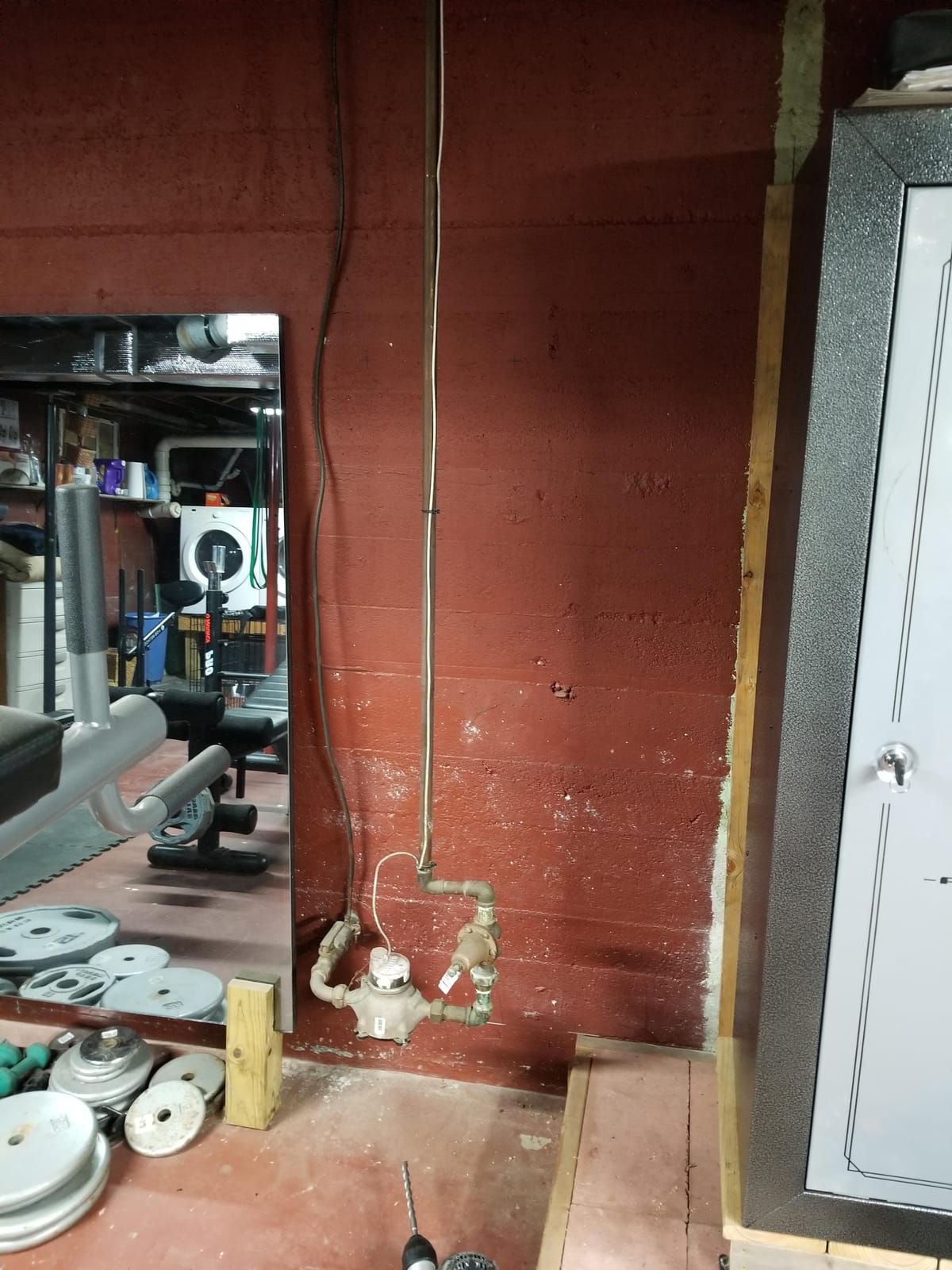
A point-of-entry filter sits on the cold water main, usually after the shutoff valve and before the water heater. Everything downstream drinks from it, which is the whole point and also the reason sizing matters so much.
Water passes down through layered media in order. A sediment stage made of polypropylene or a carbon block traps sand, silt, rust flakes, and scale down to roughly five microns. A carbon stage then adsorbs chlorine, chloramine, volatile organic compounds, pesticides, and the taste and odor that come with them. Some systems add a third stage for heavy metals or anti-scale media.
Three capabilities define the category. First, mechanical filtration removes particulate, and no amount of carbon will do that job. Second, adsorption removes dissolved chemicals and gases, which is what carbon is for. Third, nothing in this category removes dissolved minerals, so no filter here reduces total dissolved solids or softens water. Every listing that says otherwise is wrong.
If you want a fuller breakdown of media types and how they differ, we covered the fundamentals in our whole house filtration systems comparison. For most city water households, sediment plus carbon is the correct pairing, and that is what seven of our ten picks deliver as dedicated stages.
1. iSpring WGB21B 2-Stage Whole House Water Filter – Best Overall
iSpring WGB21B 2-Stage Whole House Water Filtration System, 50000 Gallons
50000 gallon capacity
15 gpm max flow
1 inch inlet and outlet
10 x 4.5 inch housings
80 psi rated
Pros
- Two-stage system removes over 90 percent chlorine plus sediment and rust
- 1 inch ports support 15 gpm with low pressure loss
- Does not reduce TDS so minerals stay in the water
- Pre-assembled bracket with wrench and pressure release valve
- US-based support that supplies replacement parts free
Cons
- Threaded NPT fittings are leak prone and need careful tape work
- Replacement cartridges cost more than you expect for the system price
- Does not reduce dissolved minerals or TDS
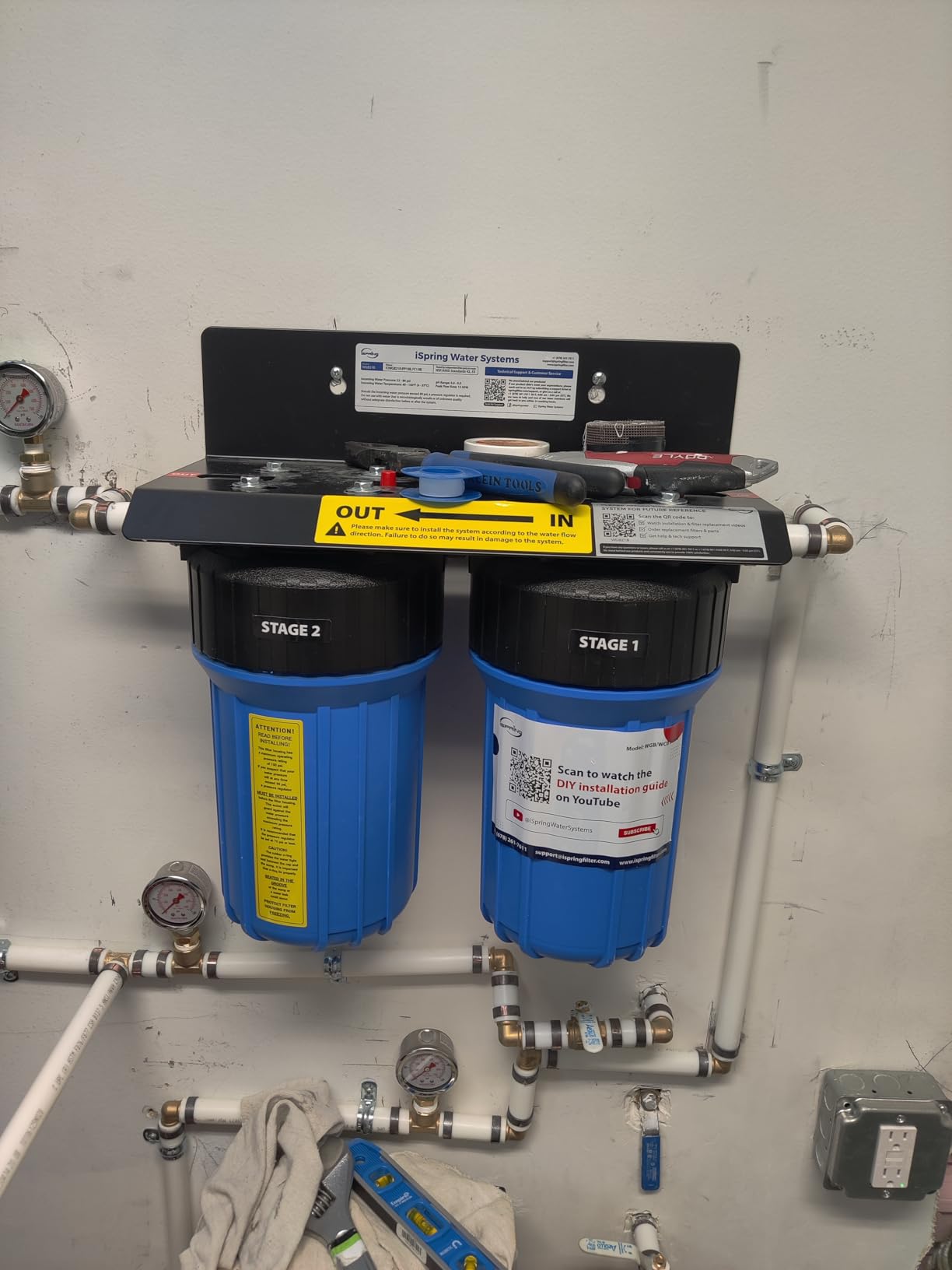
This is the system we kept coming back to while assembling the roundup. It is a two-housing setup rated at 15 gpm with 1-inch inlet and outlet ports, sized to 10 by 4.5 inch cartridges, and rated to 80 psi. For a family of four on municipal water, the stated 50,000-gallon capacity works out to roughly a year between changes.
The first stage is a 5-micron polypropylene sediment filter that catches dirt, sand, silt, dust, rust, and scale. The second is an SGS-tested CTO carbon block that handles cloudiness, taste, odor, over 90 percent of chlorine, plus pesticides and herbicides. Keeping minerals in the water is a real advantage over reverse osmosis, and owners regularly mention fewer spots on dishes as the visible proof it is working.
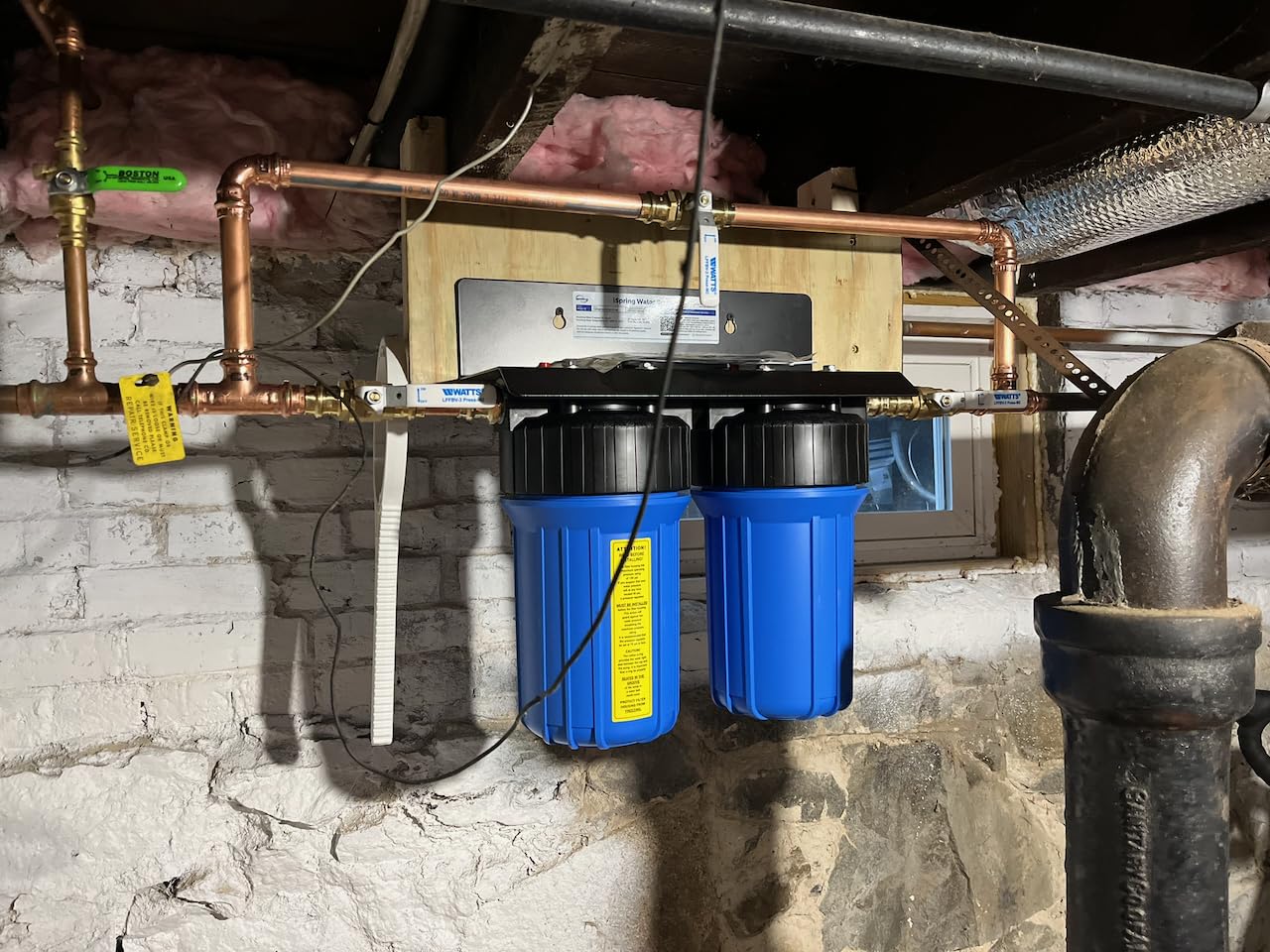
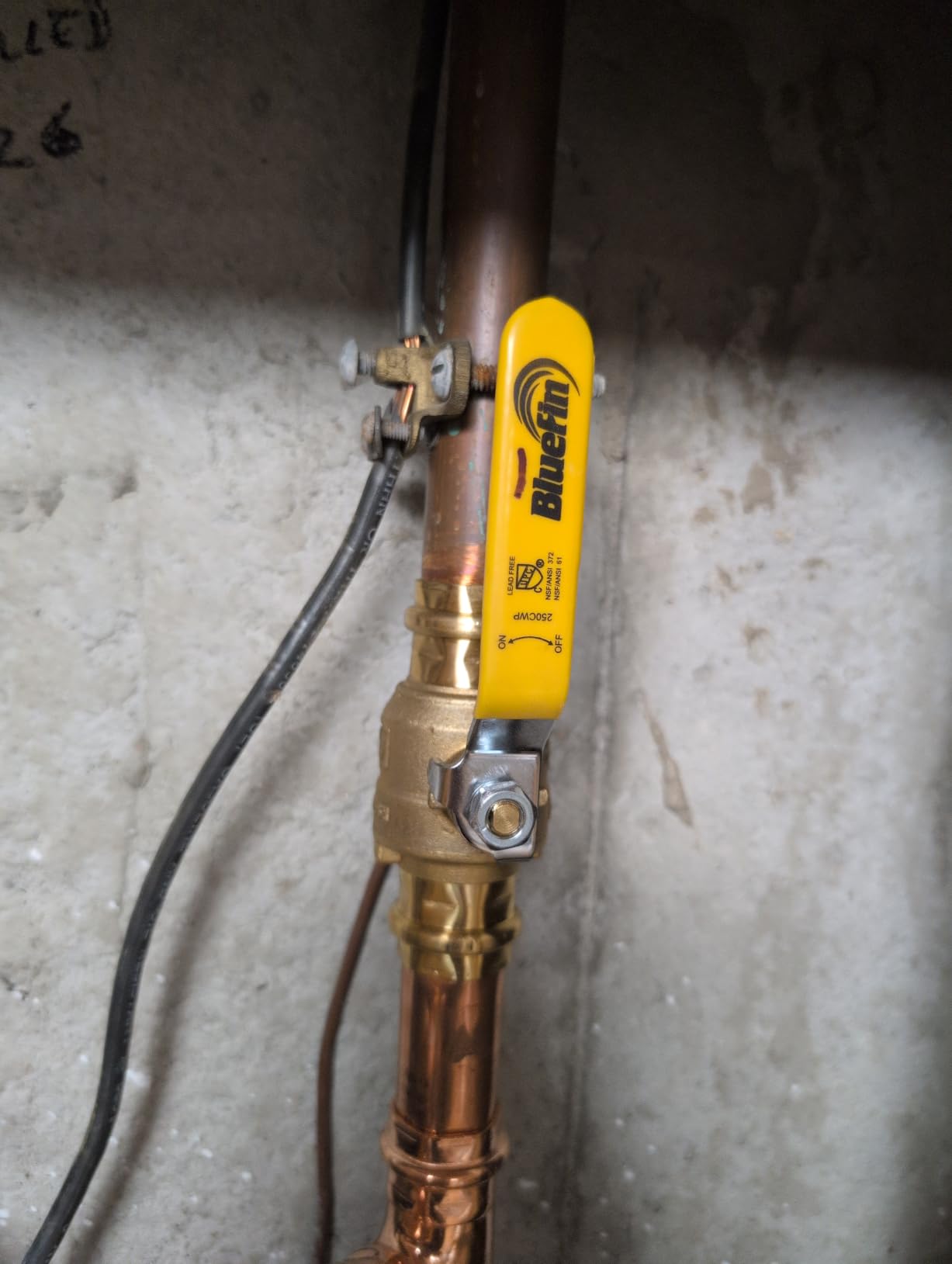
Installation is where the caution lives. The system arrives pre-assembled on a mounting bracket with a filter wrench and a pressure release valve, so the mechanical work is straightforward, but the threaded end fittings are the most common leak point we saw described. Owners who wrap generously with PTFE tape and snug the fittings without over-torquing report a clean install. Those who rush the threads come back with wet floors.
It measures 26 by 19 by 11 inches in the box, so clear a wall space roughly the size of a large trash can next to your main shutoff. Operating range is 40 to 100 degrees F, and because it uses no electricity and no drain line, you can mount it anywhere dry without planning a floor drain.
Who this filter suits best
Households on municipal water who want chlorine taste and odor gone from every tap, plus some protection from pipe sediment, and who want the lowest-friction ownership experience in this list. The no-power, no-drain design means you can forget about it between cartridge changes, and the company backs it with a 30-day return window, a one-year warranty, and lifetime support based in Atlanta.
It is also the right call for renters and mobile homes where a permanent softener or a complex tank setup is not practical, as long as you have a spot that stays dry.
Where it falls short
It is a taste and odor plus sediment system, not a treatment system. It will not lower TDS, it will not soften water, and it will not address iron or sulfur on a well. Cartridge pricing is the other recurring gripe: owners note that replacement filters cost a meaningful share of the original system price once you count a year of changes, so treat the purchase price as only part of the number.
2. Express Water Ultimate Protection 3-Stage – Best Heavy Metal Coverage
Express Water Whole House Water Filter System, Ultimate Protection, 3-Stage
100000 gallon capacity
17 gpm max flow
1 inch connections
Stainless frame with gauges
20 to 80 psi
Pros
- Targets chlorine lead arsenic chromium and scale in one pass
- Freestanding stainless frame and bracket keep a heavy unit stable
- Pressure release buttons and three gauges simplify monitoring
- 17 gpm flow on 1 inch connections suits larger homes
Cons
- Cartridges need changing every 6 to 12 months adding ongoing cost
- Does not reduce TDS or dissolved minerals
- At 63 pounds it needs a planned location and real floor space
This is the pick if your priority is contaminant coverage rather than simplicity. It is a three-stage system rated at 17 gpm, the second highest flow figure in this roundup, and it pairs that flow with a contaminant list that goes well beyond taste and odor.
The stages work together: activated carbon, KDF media, and polyphosphate in a single housing run, with a laboratory-packed polyphosphate stage to keep scale from entering the house. The manufacturer is explicit that this system does not reduce TDS, and that honesty matters more than the marketing gloss. Replacement intervals are 6 to 12 months or 100,000 gallons.
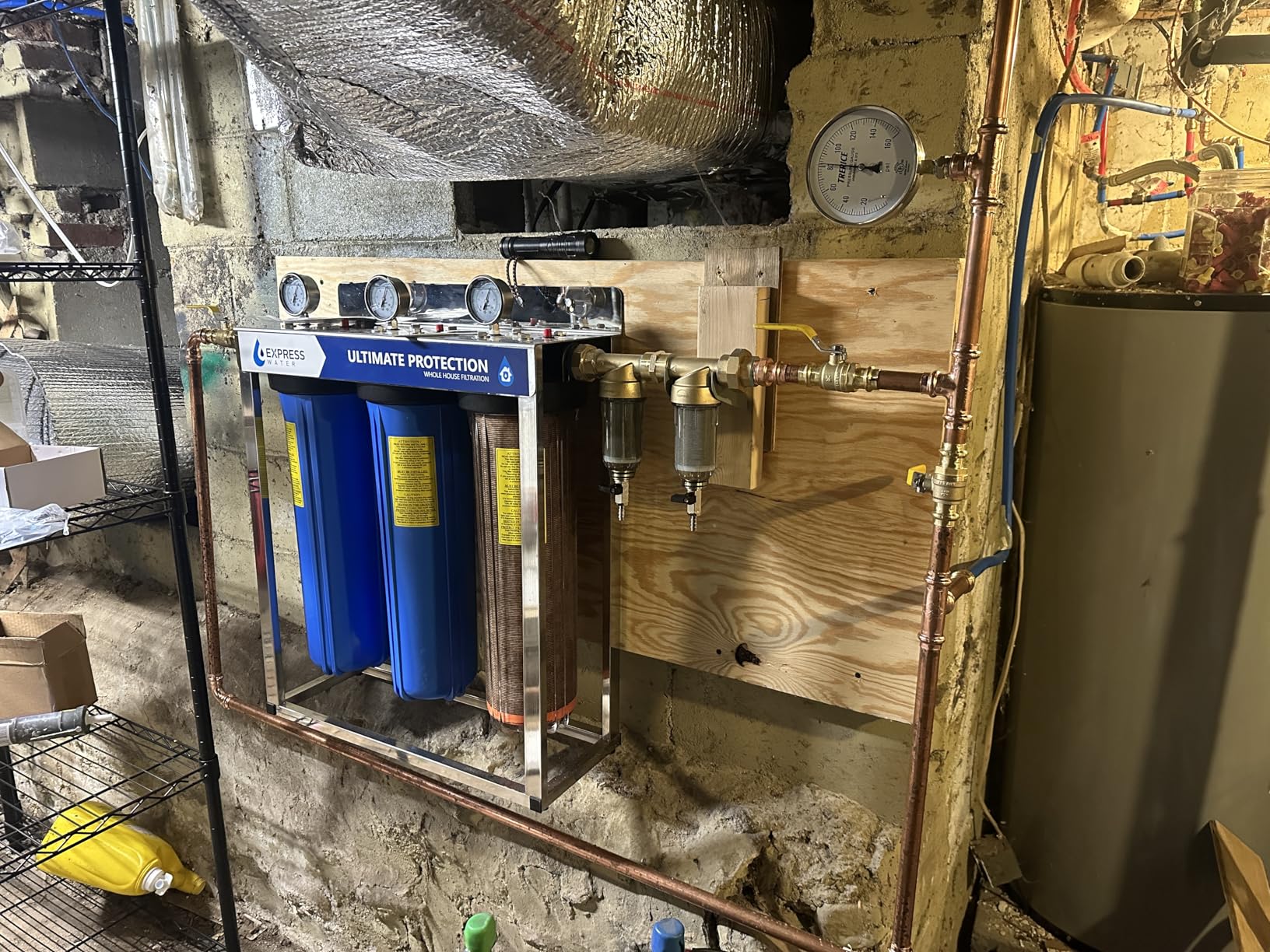
What makes it pleasant to live with is the monitoring hardware. There is a pressure gauge on each of the three filters plus a pressure release button per stage, so you can see which one is loading up instead of guessing at the whole system. The stainless steel bracket and free-standing frame keep a 63-pound assembly upright without wall mounting.
That weight is the trade-off. The unit is listed at 29 by 8.5 by 30 inches and rated for 20 to 80 psi, which is a meaningful footprint for a mechanical room, garage wall, or basement wall. If your installation spot is tight, this is not the one.
Who this filter suits best
Homes where the tap water has an off taste that plain carbon stages do not fully fix, or where a utility report or older plumbing makes lead or metal reduction a real concern. Larger households benefit most, because 17 gpm gives real headroom when two showers and a laundry cycle run at once.
It is also a good match for people who like visible data. Three gauges and three release buttons turn maintenance from a guess into a check.
Where it falls short
The ongoing cost is the honest limitation. Three cartridges on a 6 to 12 month cycle add up faster than a single-element system, and this is the model where total cost of ownership matters most over a decade. There is no bypass valve listed in the box contents, so servicing means shutting off the house supply, and it does not reduce TDS.
3. iSpring WGB32B Commercial-Grade 3-Stage – Highest Rated
iSpring WGB32B Commercial-Grade Whole House Water Filter System
100000 gallon capacity
15 gpm max flow
20 x 4.5 inch filters
1 inch NPT connections
25 to 80 psi
Pros
- Three large housings handle higher flow with less pressure drop
- Removes up to 99 percent chlorine plus sediment rust and odor
- 100000 gallon capacity covers about a year of household use
- Brand supplies replacement manifolds canisters and O-rings free
Cons
- 20 inch housings are heavy and need two wrenches and a bucket to change
- Threaded manifold connections leak if over-tightened
- Some units arrive with damaged threads from transit
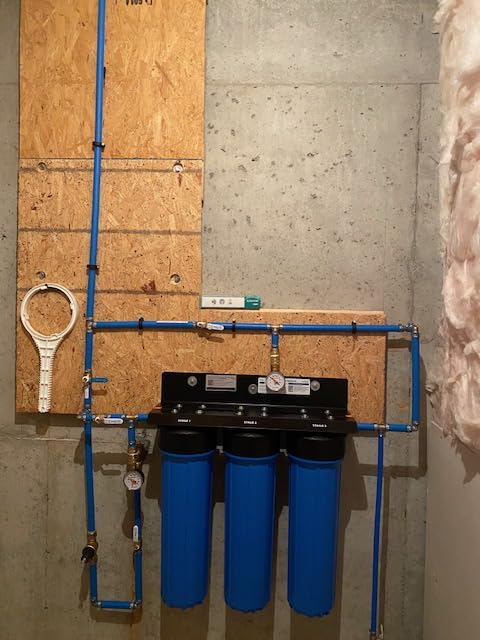
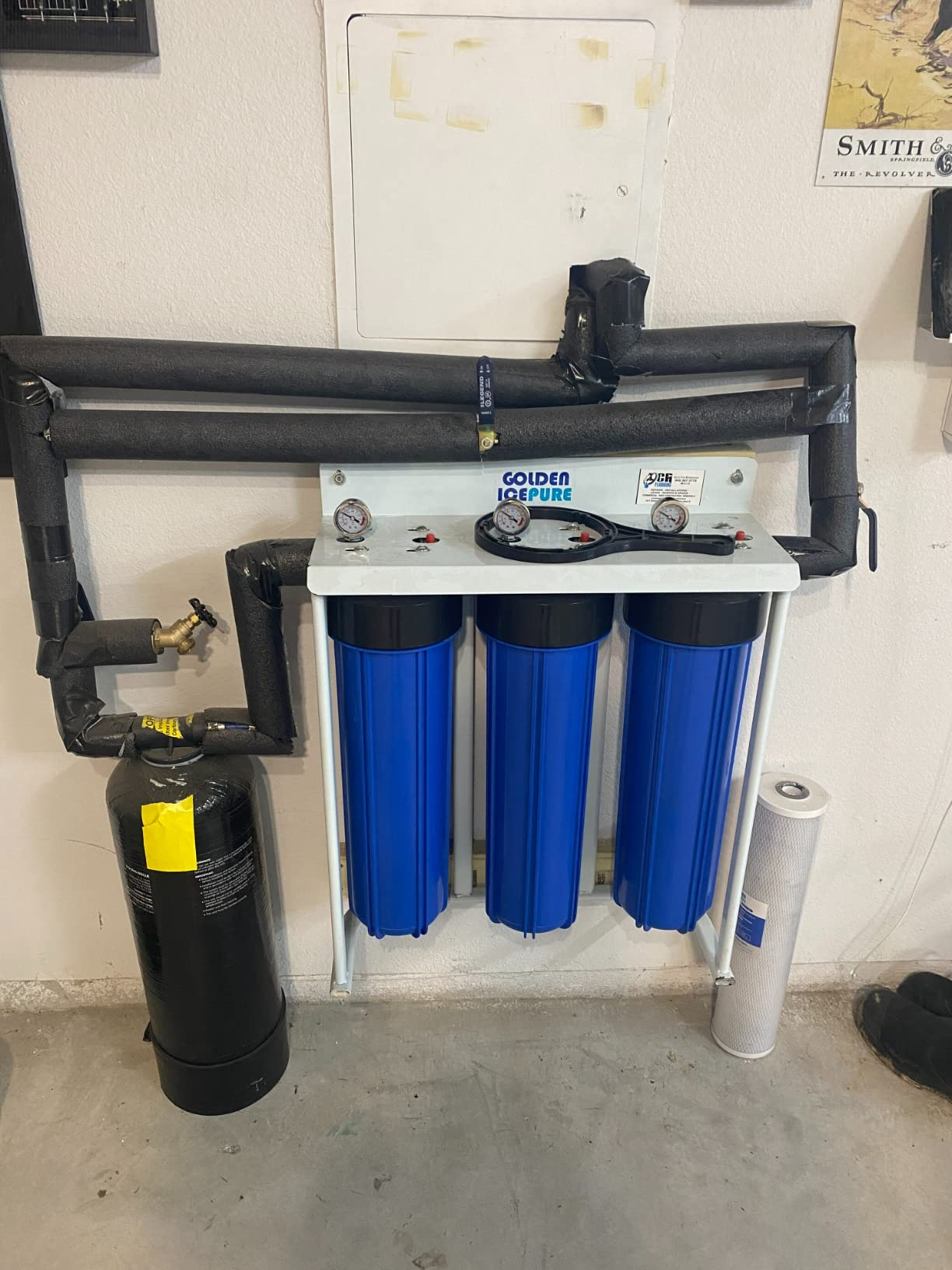
This is the highest rated system in the roundup at 4.7 stars across more than 2,200 reviews, and the rating is not a fluke of a small sample. The reason is the housing size. Three 20 by 4.5 inch industrial-standard cartridges give far more media volume and surface area than 10-inch housings, which translates directly into less pressure drop when several fixtures are running.
The chain is a 5-micron sediment stage followed by two third-party tested coconut shell carbon block stages. Capacity is listed at 100,000 gallons, flow at 15 gpm on 1-inch NPT connections, and the operating window is 25 to 80 psi. Unlike reverse osmosis, it leaves dissolved minerals in place.
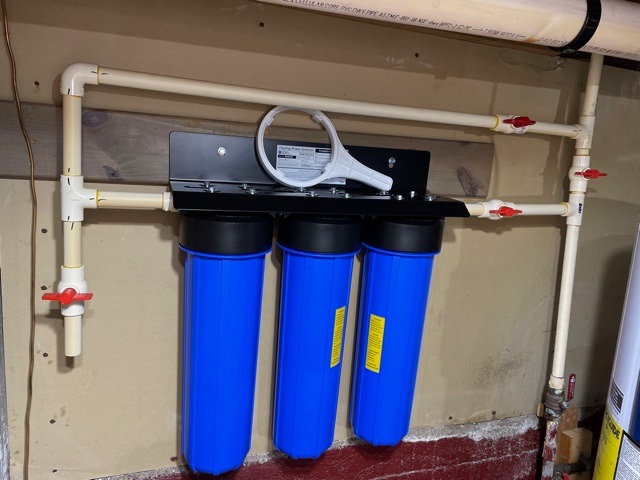
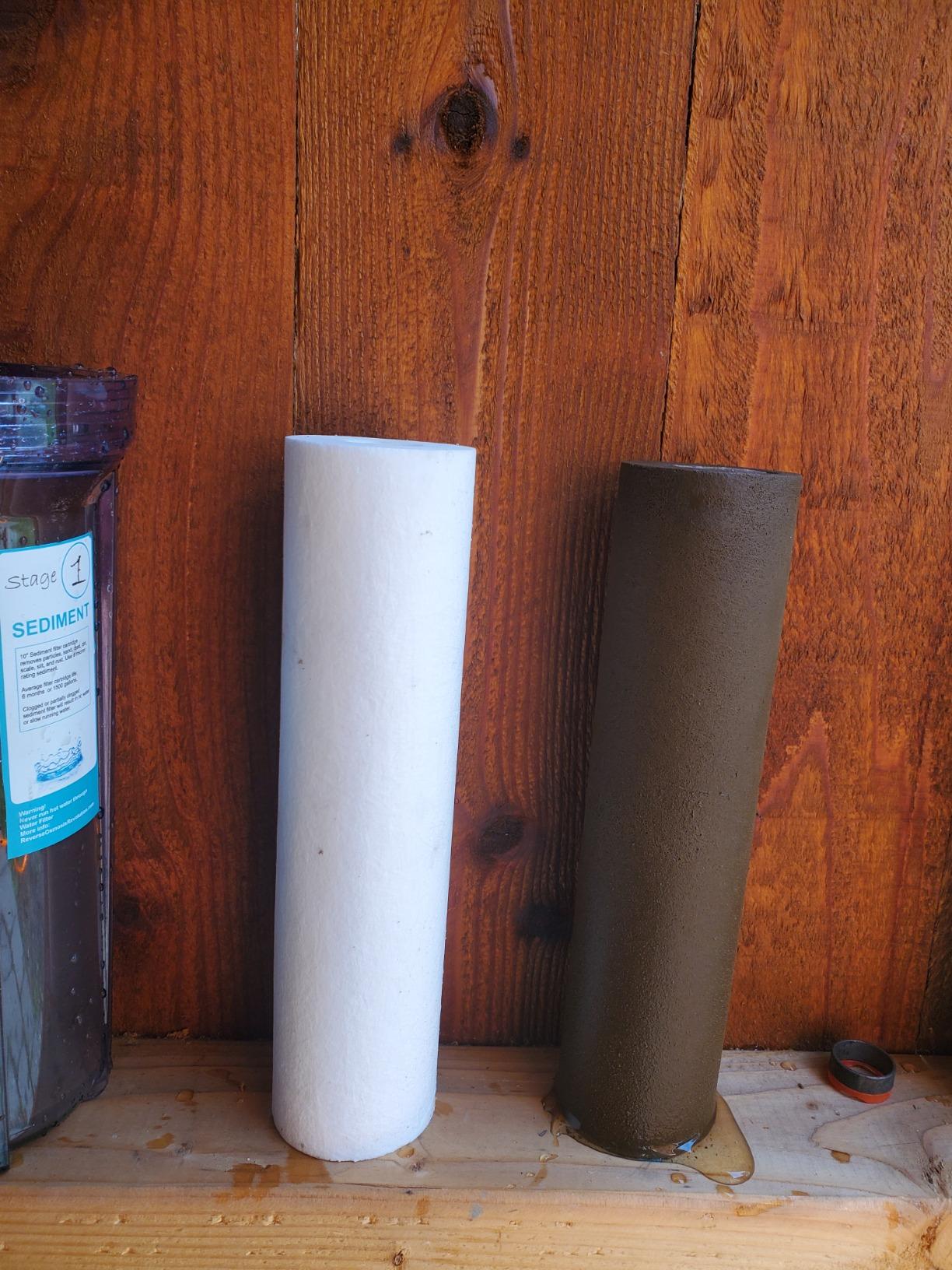
Owners describe dramatic before-and-after results, particularly on discolored city water or iron-heavy well supplies, and the media is visibly dark at change-out, which is a satisfying confirmation that something happened. The support story is the differentiator: this manufacturer has replaced cracked manifolds, canisters, and O-rings at no charge years after the original sale.
The mechanical reality is weight and technique. The manifold weighs 45 pounds, and changing 20-inch cartridges takes two wrenches and a bucket to catch the water. Owners consistently recommend heavy-gauge PTFE tape, plastic threads tightened gently rather than hard, and mounting the assembly on solid framing rather than drywall.
Who this filter suits best
Anyone who cares about pressure drop more than anything else, and households with two or more bathrooms plus a laundry that runs often. The 100,000-gallon capacity also means fewer service visits than a two-stage system on the same flow rating. Registration activates an extended warranty and lifetime technical support.
For a well household with sediment, the first stage buys you protection for the two carbon stages behind it, which is where the real work is done.
Where it falls short
It is one of the heaviest cartridge systems here, and the change procedure is genuinely two-person work in a tight space. There is no NSF/ANSI certification listed in the specification data, so if certification for specific contaminants is a requirement for you, this one does not satisfy it on paper. A minority of owners also report assemblies arriving with damaged threads in transit.
4. A. O. Smith AO-WH-Filter – Fewest Replacement Jobs
A. O. Smith Whole House Water Filter System | 600K Gal | AO-WH-Filter
600000 gallon capacity
6 year element life
7 gpm max flow
NSF/ANSI 42 certified
20 to 100 psi
Pros
- Six year and 600000 gallon cartridge means very few service jobs
- Reduces 96.9 percent of chlorine taste and odor at every tap
- No drain line backflushing or water waste
- Backed by NSF/ANSI 42 certification and a 6 year limited warranty
Cons
- Does not reduce TDS sulfur or iron
- 7 gpm maximum flow is the lowest rated in this roundup
- A sediment pre-filter is recommended ahead of it on well water
The argument for this filter is arithmetic, not features. The element is rated for 6 years or 600,000 gallons, and it carries a 6-year limited warranty, which makes cartridge service close to a non-event compared with the six-month systems in this list. If your goal is to install something and mostly leave it alone, this is the one.
Filtration is activated carbon focused on taste and odor, with a listed 96.9 percent chlorine reduction. It is NSF/ANSI 42 certified, and the specification data notes that chlorine reduction is a listed contaminant claim rather than a generic percentage. Connections are 3/4 inch, and it operates from 20 to 100 psi.
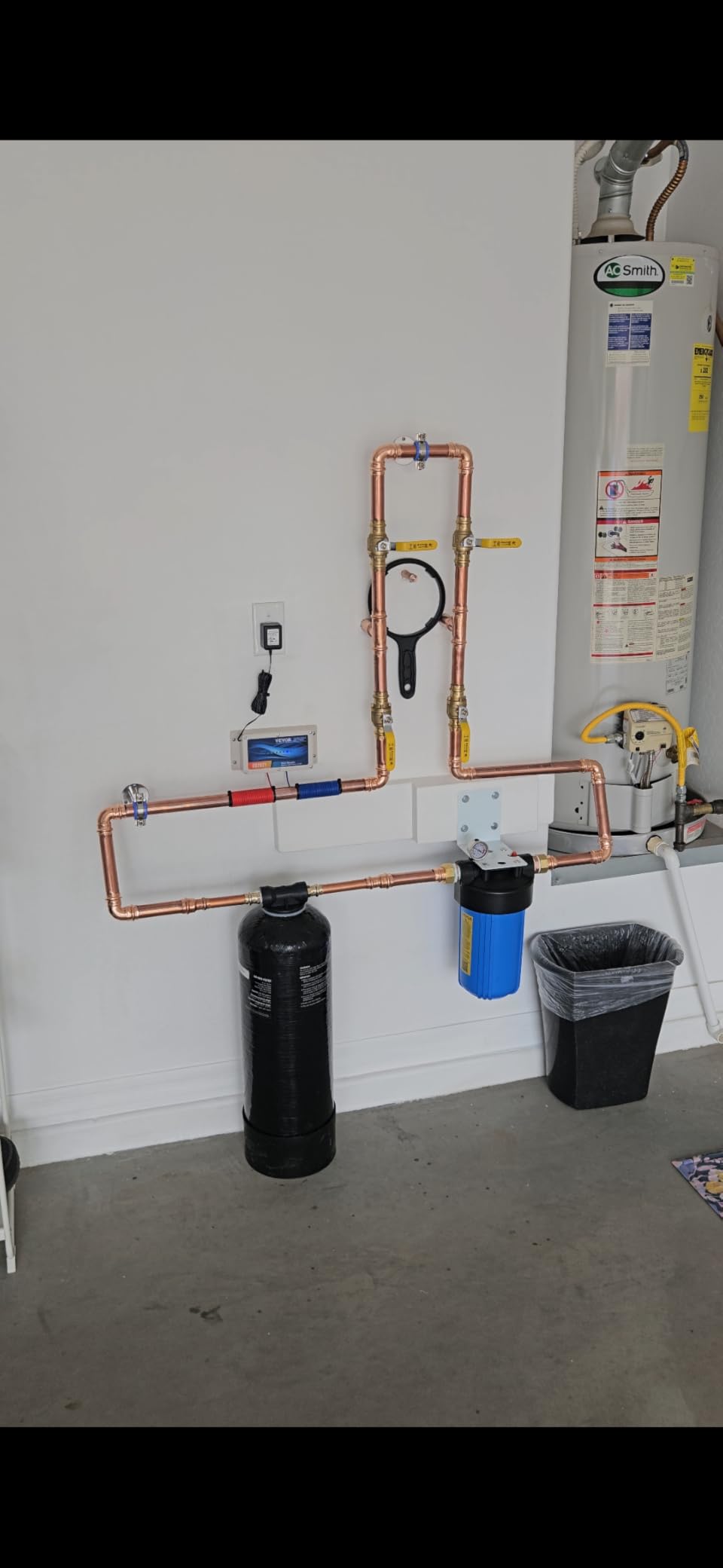
There is no drain line, no backflush cycle, and no water waste, and the box includes the central filter, a shut-off valve, a nipple, and a hose adapter. Replacement parts are listed as available for 6 years, which matters for a unit whose whole value proposition is the long interval.
The 7 gpm rating is the fact you have to weigh. It is the lowest maximum flow here, and the ports are 3/4 inch rather than 1 inch. In a small home with one or two bathrooms, that is ample. In a larger home where a shower, a dishwasher, and irrigation run together, you may feel it.
Who this filter suits best
Municipal water households whose only complaint is chlorine smell and taste, especially in the shower where a point-of-use filter cannot help. The tank-style body is about 30 by 9.5 by 9.4 inches, which is a narrow vertical footprint, and the six-year element means the annual cost of ownership rounds down to almost nothing.
It is also a sensible choice for anyone who refuses to remember cartridge dates. Owners describe it as a set-and-forget central filter.
Where it falls short
It is narrow in scope, and the manufacturer says so directly: it does not reduce TDS, sulfur, or iron. That makes it a poor match for well water unless you pair it with a sediment pre-filter upstream. And at 7 gpm on 3/4 inch connections, it is a poor match for a busy large home, no matter how good the chlorine removal is.
5. Waterdrop WHF21-PG 2-Stage – Best Budget Pick
Waterdrop WHF21-PG 2-Stage Whole House Water Filter System, 5 Micron
50000 gallon capacity
15 gpm rated flow
1 inch inlet and outlet
5 micron PP plus GAC
10 x 4.5 inch filters
Pros
- Two stage 5 micron PP sediment plus GAC carbon covers particles chlorine and metals
- Compact body fits tighter installation spaces
- Housings tested from 25 to 90 psi and through water hammer cycles
- Includes wrench and expansion screws for a DIY install
Cons
- PP filter needs changing every 3 to 6 months and GAC every 6 months
- Manufacturer recommends municipal water for best service life
- Not certified to reduce TDS or hard water minerals
This is the least expensive way to get a legitimate two-stage system onto the main line, and at 15 gpm on 1-inch connections it does not look like a toy. The body is 14.4 by 7.5 by 15.6 inches, which is one of the smaller footprints in the roundup.
The media pairing is a 10 by 4.5 inch polypropylene filter and a granular activated carbon filter, marketed as five-stage filtration in total. The listed reduction targets are particles and sediment above 5 microns plus chlorine, lead, benzene, mercury, smell, sand, and rust. The housing material is listed as NSF/ANSI approved components, and the flow rating is 15 gpm.
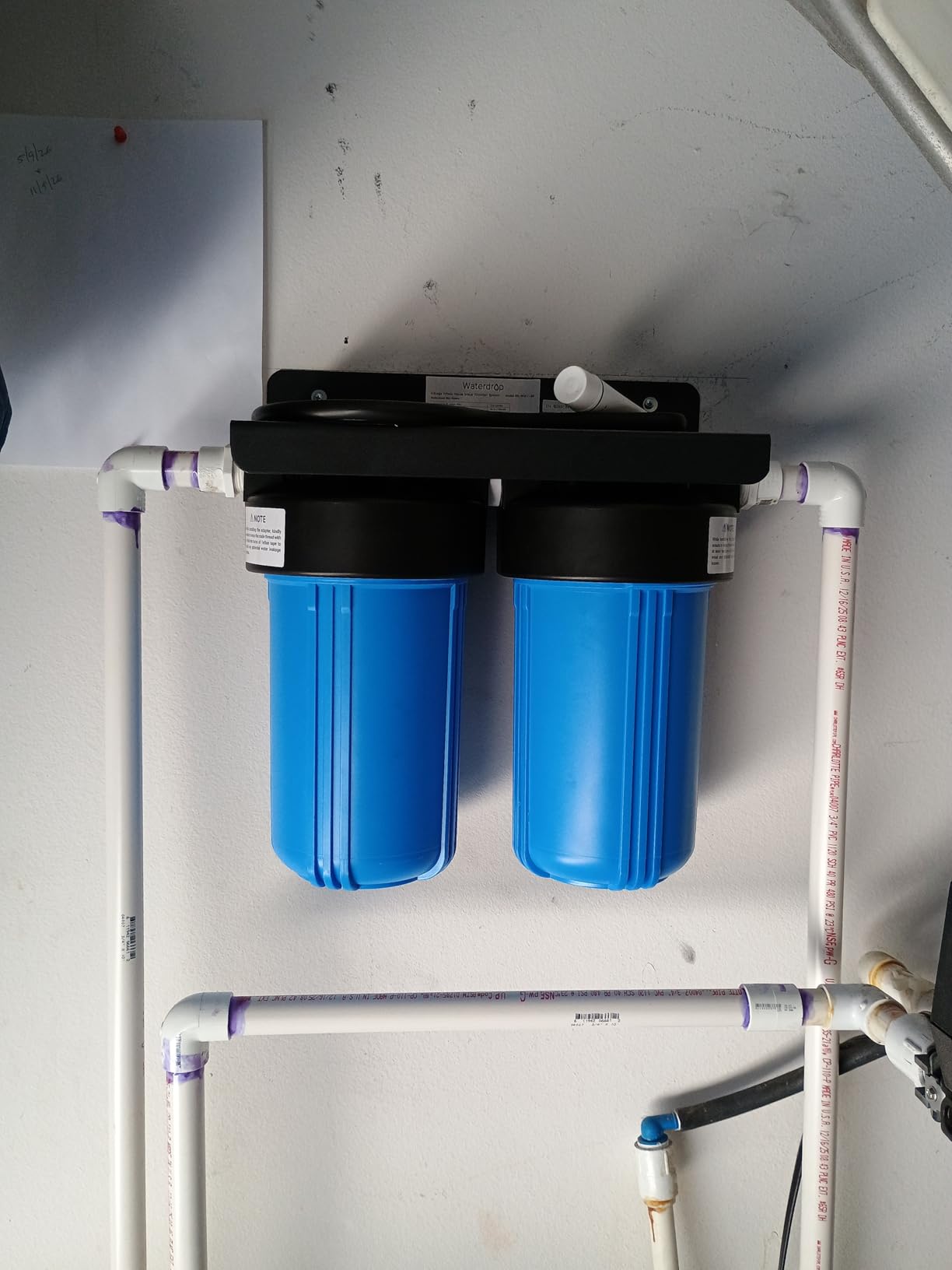
Build quality came up more than you would expect. The housings are rated from 25 to 90 psi and the manufacturer cites testing through more than 100,000 water hammer cycles, which addresses the warping and cracking failure mode that owners of cheaper spin-down housings report. Installation is straightforward, with a wrench and expansion screws in the box.
One installation note worth repeating from owner feedback: do not over-wrap PTFE tape on the threaded connections, because excess tape shortens the life of the copper threads. The manual warning is real and the failure mode is a stripped port later.
Who this filter suits best
First-time buyers on municipal water who want to see what whole house filtration does before committing to a bigger system, and renters or condo owners with a limited install area. The small footprint and 1-inch ports make it flexible in older homes where space behind the main shutoff is tight.
It is also a good match for protecting a water heater and dishwashing appliances from sediment, which is a quieter benefit than better drinking water but often the more expensive one to ignore.
Where it falls short
Cartridge life is the trade-off. The PP element is listed at 3 to 6 months and the carbon at 6 months, so you are doing two service events a year, and owners with hard or sediment-laden well water report the PP element clogging much faster than that. The manufacturer itself recommends municipal water for best service life, and it is not certified to reduce TDS or hardness.
6. Reverse Osmosis Revolution 3-Stage Clear Housing – Best for Well Water Visibility
Whole House 3-Stage Water Filtration System, 3/4″ port with 2 valves and extra 1 year filter supply (2 sets, 6 pcs)
10000 gallon capacity
3/4 inch connection
Sediment GAC and CTO stages
Two extra cartridge sets
15 pound unit
Pros
- Three complementary stages covering sediment chlorine radon and VOCs
- Two extra sets of cartridges add about a year of supply
- Clear housings let you see cartridge condition at a glance
- Cutoff valves and 3/4 inch connection fit many existing setups
Cons
- Clear housings are very hard to loosen once installed and sometimes break
- Cartridges plug quickly on high-iron well water
- Filter life drops to 4 to 6 months with heavy well water use
This is the system we would put in front of a well owner who has never seen their own water at a micron level. The clear housings are the whole pitch: you can look at the cartridge and see it loading up with orange iron or gray sediment instead of guessing from a taste test.
It is three stages on a 3/4 inch connection. Stage one is a 5-micron sediment filter for dust, dirt, silt, sand, rust, and scale. Stage two is a 10-inch granular activated carbon filter listed for chlorine, radon, VOCs, cloudiness, odors, and taste. Stage three is a 10-inch CTO carbon block for chlorine and VOCs including insecticides, pesticides, and industrial solvents.
The value detail most owners single out is the bundle. It includes two extra sets of replacement cartridges, which works out to roughly a full extra year of supply and takes the sting out of the first two years of ownership. The listed capacity is 10,000 gallons and the stated change interval is every 4 to 6 months.
At 15 pounds and 20 by 6 by 16 inches, it is one of the lighter and shallower units here, which matters in a crawlspace or a tight utility closet. The cutoff valves make swapping stages less disruptive.
Who this filter suits best
Well households dealing with sediment, sulfur smell, and orange staining who want visible proof that the media is working, and buyers who would rather not track down spare cartridges twice in the first year. GAC and CTO stages together handle a wider set of organics and gases than a single carbon block, which is why it performs well on sulfur complaints.
The 3/4 inch connection also makes it a realistic option in homes with smaller service lines where a 1-inch unit would need a fitting change.
Where it falls short
Clear housings have a mechanical penalty. Owners report they are very difficult to loosen once installed and that the housings themselves sometimes break during a change, which is a specific and annoying failure mode. On high-iron well water the cartridges plug quickly, and the 10,000-gallon capacity is the lowest in this roundup, so service frequency on a well is the real cost.
7. Aquasana WH-1000 Carbon and KDF – Best Media Longevity
Aquasana Whole House Water Filter System | 1,000,000 Gallons | Carbon & KDF Media | Reduces 97% Chlorine & Sediment | Includes Pre- and Post-Filters | Rhino WH-1000
1000000 gallon capacity
10 year media life
14.6 gpm max flow
Carbon plus KDF dual tank
20 to 100 psi
Pros
- Ten year one-million gallon media life drives per-gallon cost very low
- Carbon and KDF dual tank reduces 97 percent chlorine while preserving minerals
- No electricity drain line or backflushing required
- Kit includes Schedule 80 PVC drain valve shutoff and pre and post filters
Cons
- Warranty is void if you install it yourself
- All-plastic threaded connections leaked for some DIY installers
- Kits have been received without the tank or some fittings
- Does not reduce TDS or hardness
On paper this has the lowest long-run per-gallon cost in the roundup, and the reason is media volume rather than purchase price. The tank is rated for up to 1,000,000 gallons or 10 years, which puts the per-gallon cost in a range that cartridge systems cannot approach. Flow is rated at 14.6 gpm, essentially matching the 15 gpm cartridge leaders.
The media is copper-zinc KDF combined with carbon in a dual tank arrangement, listed at 97 percent chlorine reduction while preserving healthy minerals. It is independently tested to NSF/ANSI Standard 42. There is no electricity, no drain line, and no backflushing, so annual running costs after the first media change are effectively zero.
The kit is unusually complete: Schedule 80 PVC components, an integrated drain valve, a shut-off valve, tank connections, and pre and post filter housings, with fittings for 3/4 inch or 1-inch main lines. The body measures 32 by 9 by 46 inches, so it is the tallest unit in the roundup and needs real vertical clearance.
Who this filter suits best
Households that plan to stay put and want to set filtration and then stop thinking about it for a decade. The 10-year limited warranty and 10-year media life are the strongest long-term numbers in this list, and the KDF stage adds metal reduction that pure carbon cannot provide.
Because it needs no power and no drain, it also works in a garage or exterior wall cabinet in climates that stay above 40 degrees F.
Where it falls short
The install terms are the catch, and they are not small. The warranty is void if you install it yourself, which means most buyers in this price band either accept an uninsured install or budget for a plumber. Owners also report that the all-plastic threaded connections leak repeatedly regardless of tape application, and a minority received incomplete orders missing the tank or fittings. At 4.2 stars, it is the lowest-rated system here for a reason.
8. SimPure DB10C-2 Clear 2-Stage – Best for Small-Space Pick
SimPure Whole House Water Filter System, 2 Stages Clear 10″ x 4.5″
60000 gallon capacity
15 gpm max flow
Clear 10 x 4.5 inch housings
1 inch NPT brass ports
90 psi rated
Pros
- Clear housings allow visual cartridge checks without disassembly
- Dual O-rings and brass female ports reduce connection leaks
- Handles both well and city water including iron staining and sediment
- Compact and rotatable housings fit existing plumbing direction
Cons
- Mounting bracket is not a standard spread and supplied drywall anchors are weak
- Very heavy when full so wall mounting needs framing
- Included pipe tape is low quality and prone to leaking
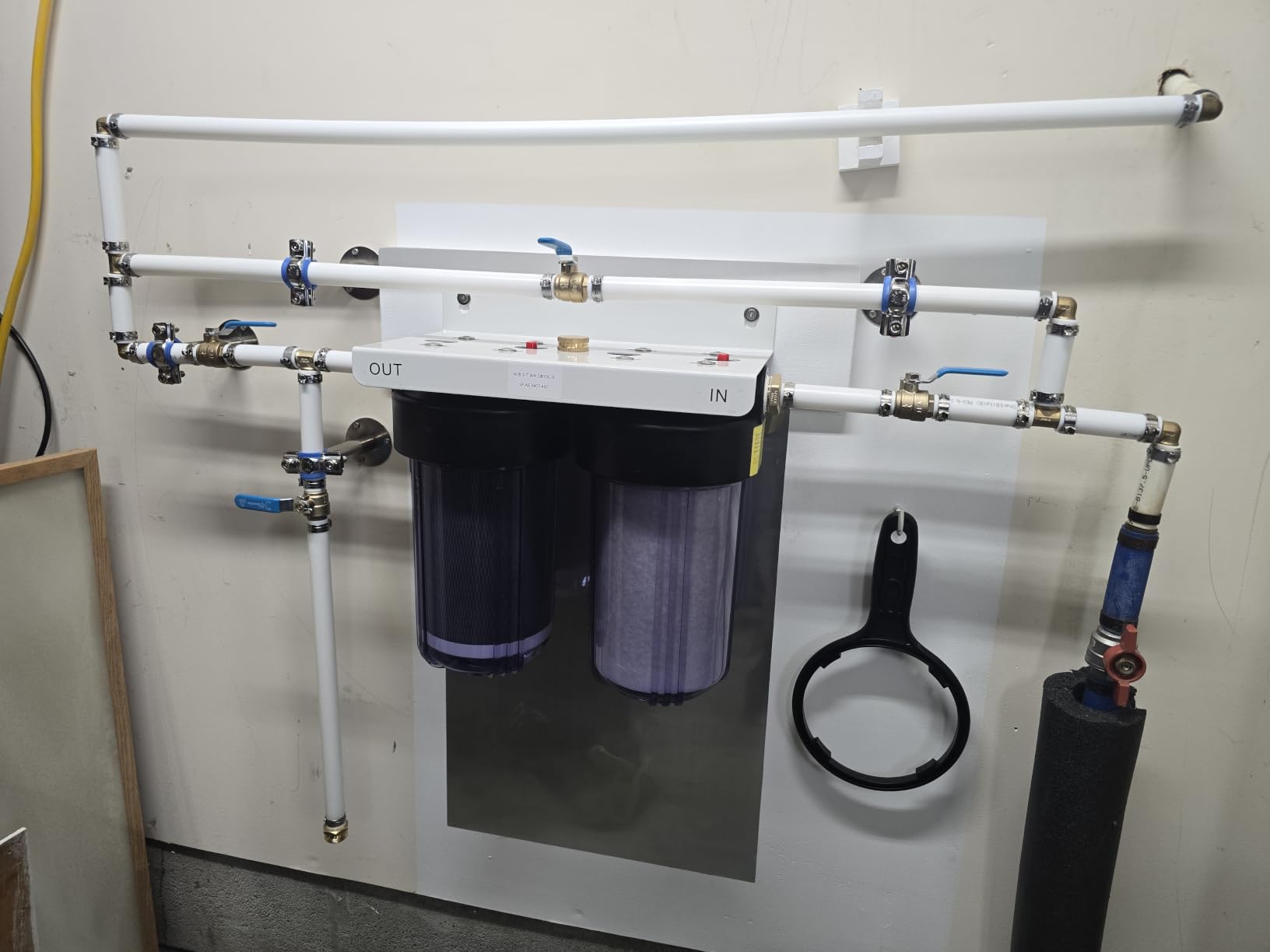
The SimPure sells on two details that most competitors skip. The housings are clear, so you can see the cartridge darken, and the ports are brass with two O-rings each, which is the specific fix for the leaking-plastic-thread complaint that shows up across this category.
Filtration is a 5-micron polypropylene stage for sediment, sand, rust, and large particles, followed by a CTO carbon stage for residual chlorine, discoloration, and odor. Flow is rated at 15 gpm, the operating pressure is 90 psi, and the listed capacity is 60,000 gallons with carbon lasting 3 to 6 months and sediment 6 to 12 months.
Owners including working plumbers rate the housing quality as comparable to costlier name-brand units, which is a meaningful endorsement given the price. Several report no measurable pressure drop, and well owners specifically note effective iron and sediment reduction. The housings rotate to match the direction of existing plumbing, which is a small courtesy that saves real time in a cramped closet.
It weighs about 18 pounds, and that is where the complaints live. The mounting bracket is not a standard 16-inch spread, and the drywall anchors included are not adequate for a unit of that weight. Frame into a stud, or set it on a shelf. The bundled pipe tape is also the wrong tape.
Who this filter suits best
Owners who want a visible condition check without tearing into the plumbing, and well households chasing iron staining where a 5-micron stage is doing meaningful work. The brass ports also make it a strong pick for anyone who has been burned by plastic threads cracking under real line pressure.
The compact body works in utility closets and small mechanical rooms where a 30-inch stainless frame will not fit.
Where it falls short
Mounting hardware is the honest weakness, and you should plan around it rather than discover it. The non-standard bracket spread and weak anchors mean most owners end up framing the wall themselves. The included pipe tape should be discarded in favor of proper PTFE tape, and the shorter carbon life of 3 to 6 months means more frequent service than the sediment stage requires.
9. 3M Aqua-Pure AP904 – Easiest Cartridge Changes
3M Aqua-Pure AP900 Series Whole House Water Filtration System AP904
100000 gallon capacity
Up to 20 gpm flow
NSF Standard 42 and 372
304 stainless steel head
SQC cartridge design
Pros
- Sanitary Quick Change cartridge swaps without a wrench or touching media
- NSF Standard 42 and 372 certification with a 304 stainless steel head
- 100000 gallon capacity and up to 20 gpm suits 3 or more bathrooms
- Works on chlorinated municipal and non-chlorinated well water
Cons
- Single-cartridge design does not address heavy metals
- Replacement cartridges are proprietary to the AP900 line
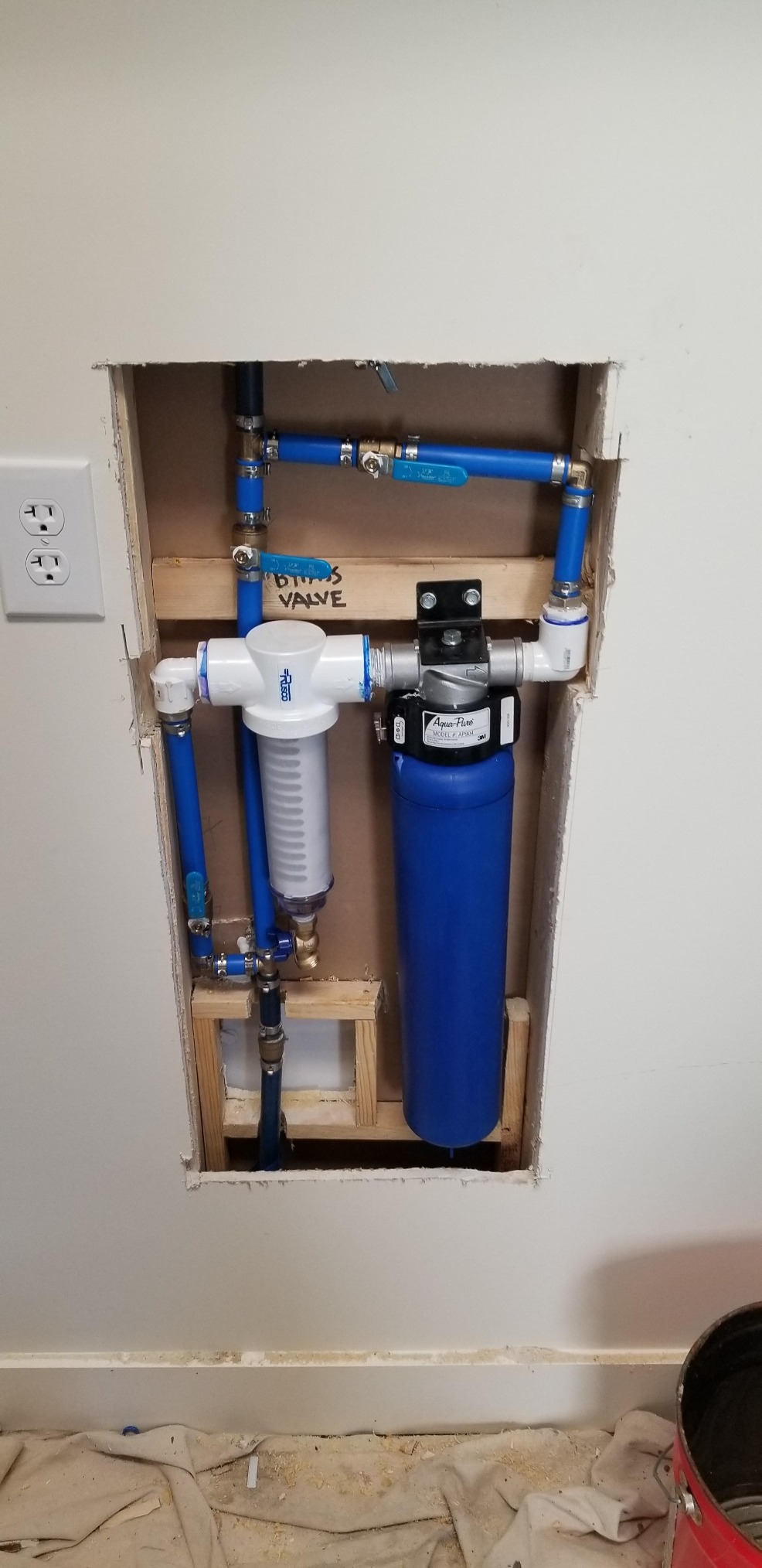
The highest flow rating in the roundup belongs to this one, at up to 20 gpm, and it also has the cleanest cartridge change mechanism. The Sanitary Quick Change design means you twist and pull without a housing wrench and without touching filter media, which is a genuine improvement for anyone who does not want to chase a water leak with tools every year.
The construction is a 304 stainless steel head with an activated carbon block and non-woven pleat media, tested to NSF Standard 42 and 372. That dual certification is unusual at this price. Capacity is 100,000 gallons with roughly one year of filter life, on 1-inch inlet and outlet connections.
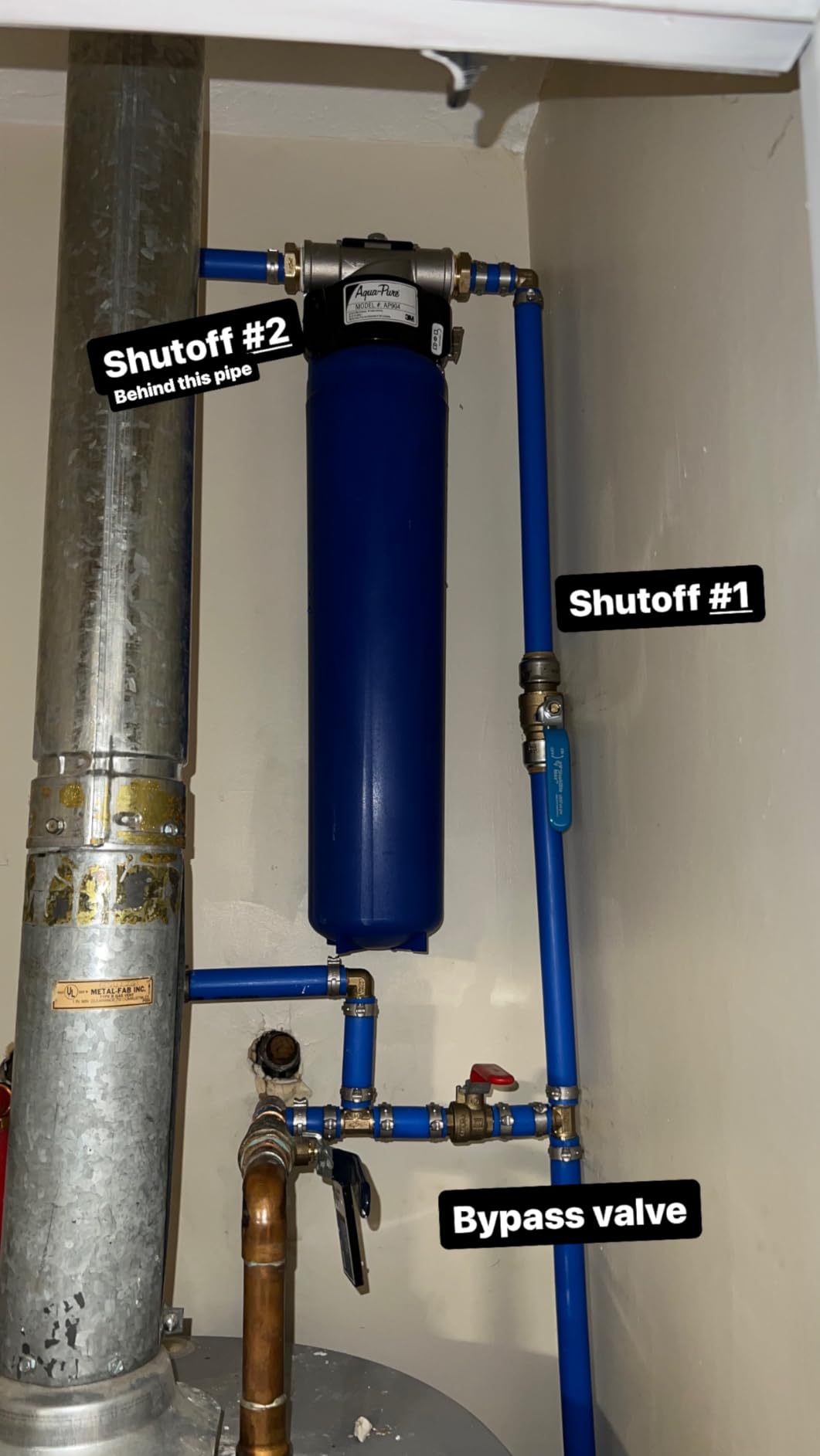
Owners pick it for the brand name as much as the media. Reviews focus on reduced sediment, chlorine taste and odor, and scale reduction that extends water heater and appliance life. The 4.3 average reflects a focused single-stage design rather than a multi-media one, and buyers wanting heavy metal reduction look elsewhere.
Who this filter suits best
Large homes with three or more bathrooms, where 20 gpm is the difference between comfortable and annoying when fixtures overlap. It is also the natural pick for anyone who prioritizes certification on paper, since NSF Standard 42 and 372 is a clearer guarantee than a marketing percentage.
Because the cartridge is a closed sanitary unit, it suits households where nobody wants to handle loose media.
Where it falls short
It is a single-cartridge system. Sediment, chlorine taste and odor, and scale are in scope, heavy metals are not, and there is no second stage catching the first one. The other limitation is supply chain: the AP917HD-S cartridge is proprietary to this line, so if you are the kind of homeowner who does not want to depend on one specific replacement, factor that in before buying.
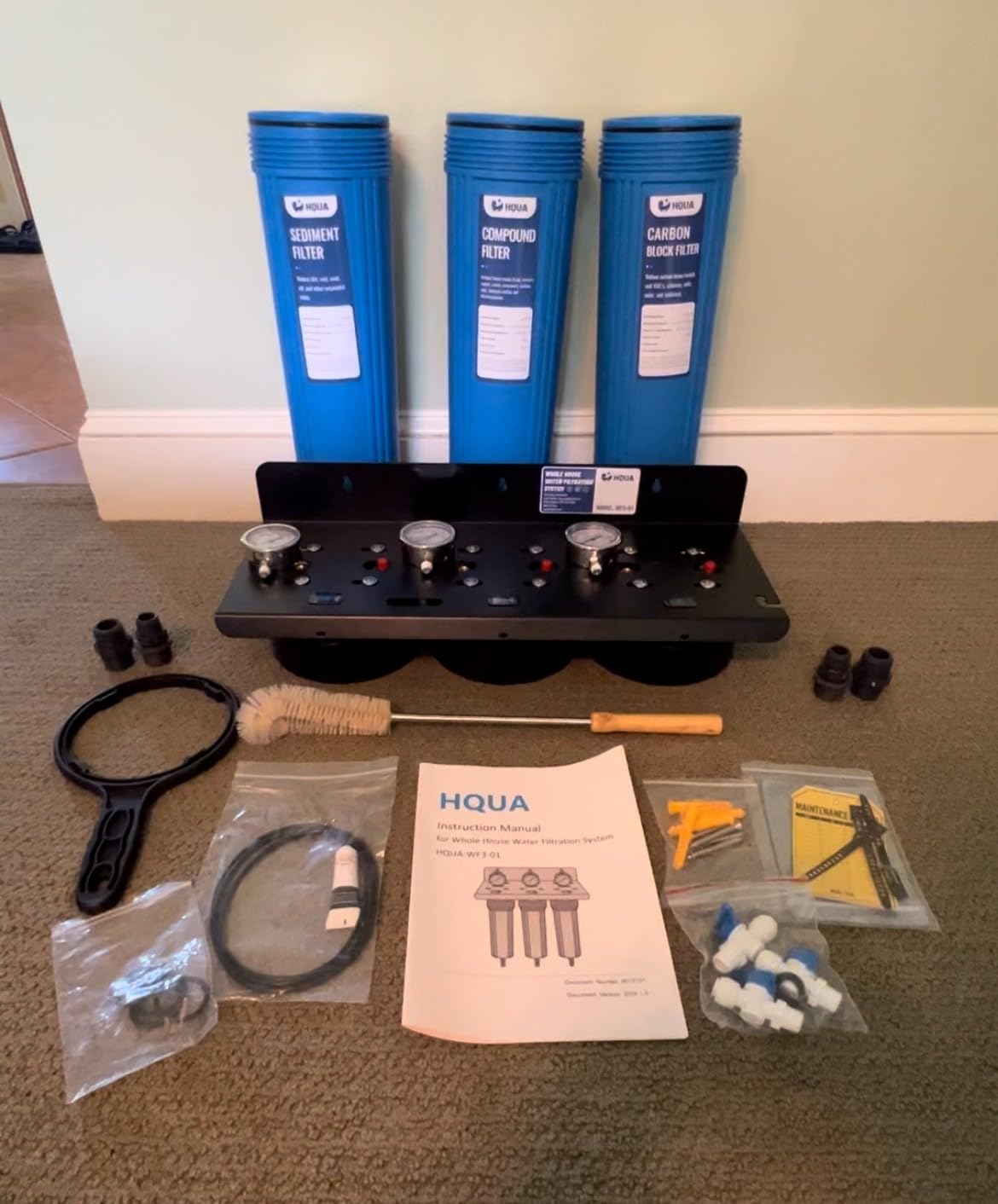
10. HQUA WF3-01 3-Stage – Best Metal Connection System
HQUA WF3-01 3-Stage Whole House Water Filtration System, Reduces Heavy Metals (Lead, Mercury, Arsenic, Cadmium, Chromium), Chlorine, Sediment, Odor, and VOC’s
100000 gallon capacity
15 gpm max flow
Three 20 x 5.5 inch filters
25 to 116 psi
44 pound unit
Pros
- Three 20 inch stages cover sediment heavy metals via GAC and KDF and chlorine
- Brass threaded ports resist the cracking and leaking of plastic connections
- Per-filter pressure gauges 180 day life timers and drain valves aid maintenance
- Includes extra gaskets lubricant fittings and a housing cleaning brush
Cons
- Two O-rings per housing are needed but not called out clearly in the instructions
- Cartridge labels cannot be repositioned to face forward
- 44 pound unit needs plywood backing and stud mounting
This is the newest system in the roundup, and it answers the two complaints that recur most across cheaper three-stage units: plastic threads that crack, and no way to tell when a cartridge is loaded. Three 20 by 5.5 inch housings sit on a bracket or free-stand, flow is rated at 15 gpm, and the operating range is 25 to 116 psi.
The media chain is a sediment filter, a compound carbon block for taste and odor, and a compound GAC plus KDF stage listed for lead, mercury, arsenic, cadmium, chromium, and chlorine. Capacity is 100,000 gallons. The port material is brass-threaded, which is why owners who have compared several systems single this one out for connection durability.
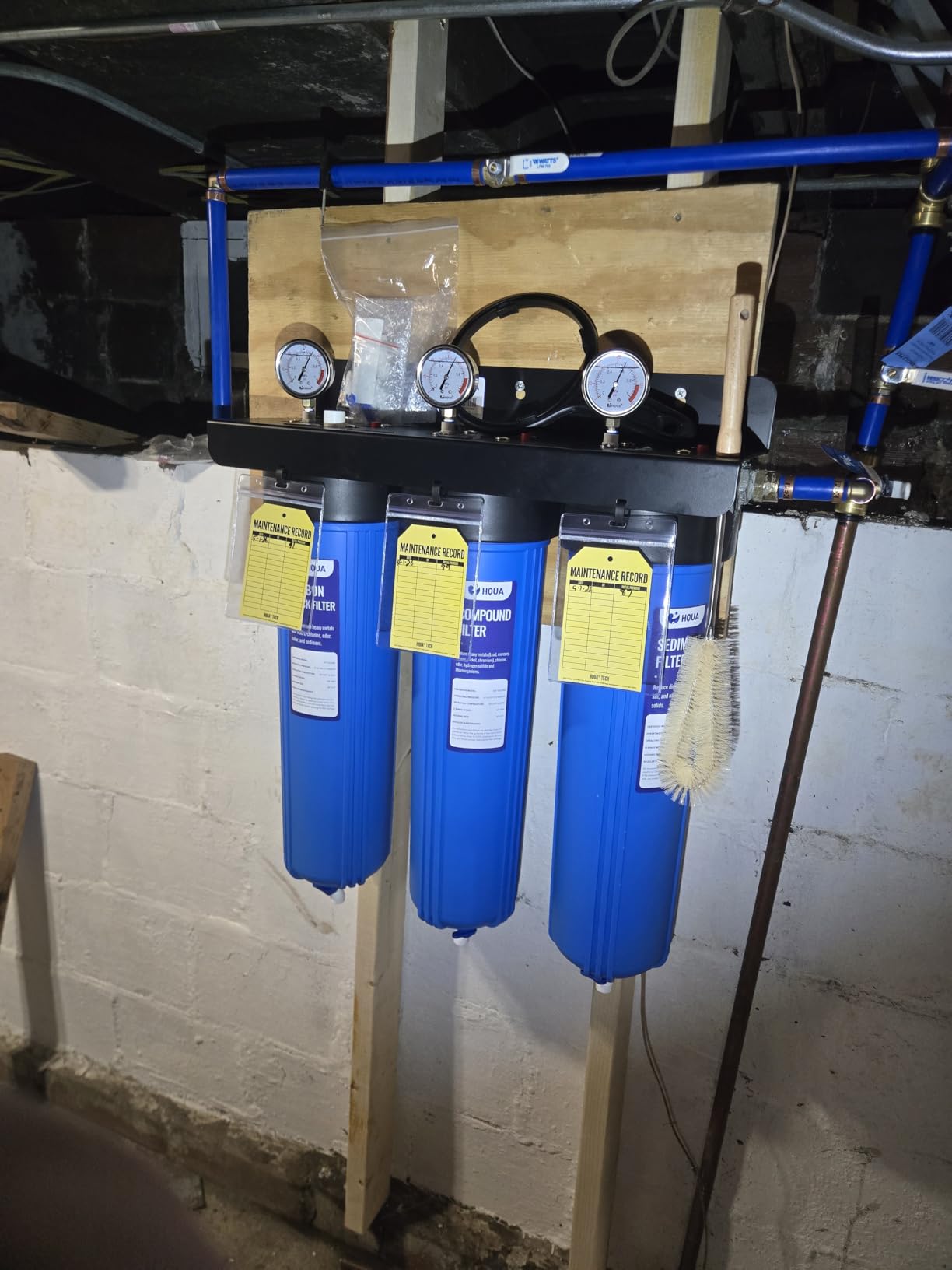
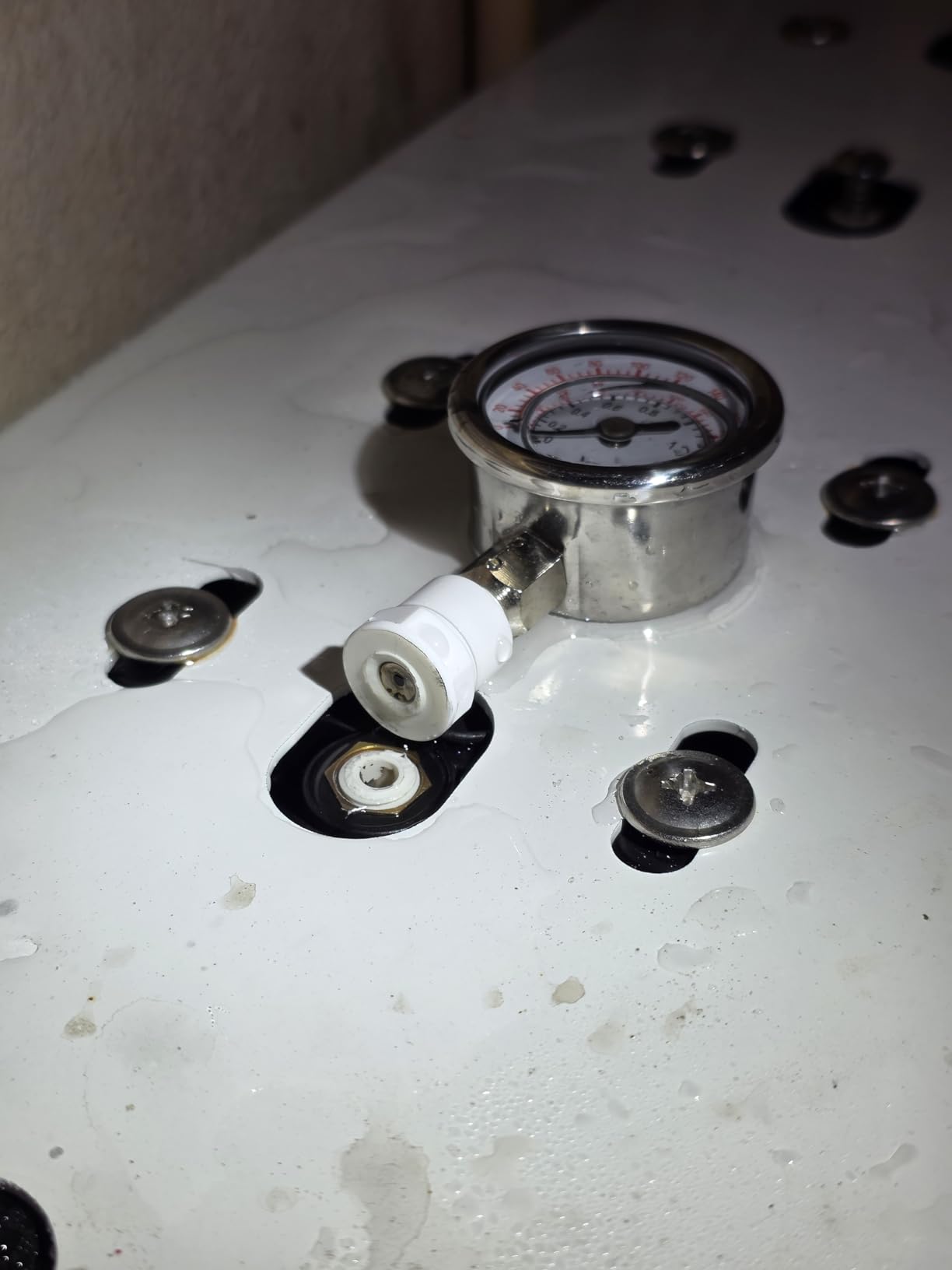
The maintenance hardware is unusually complete. Each housing gets a pressure gauge, there are 180-day countdown life timers, and pressure relief and drain valves are pre-installed. The box also includes spare gaskets, silicone lubricant, both 3/4 inch and 1-inch adapters, and a long brush for scrubbing the inside of the housings during changes. Reversible flow direction means it can be plumbed in whichever orientation your main line allows.
The documentation is the weak point. Each housing needs two O-rings, and owners report the main instructions do not call that out clearly, which sent some into hours of leak troubleshooting. A minority also report persistent threaded-connection leaks at high pressure, so brass is not a guarantee.
Who this filter suits best
Homeowners who want three real stages, metal contact, and the best maintenance instrumentation in the roundup without leaving the budget. At 15 gpm with 20-inch housings, it is a good match for a family with multiple bathrooms, and the compound GAC and KDF stage gives metal reduction that most two-stage systems skip.
At roughly 31 by 23 by 8 inches, it can go bracket-mounted or free-standing, which helps in utility rooms where wall space is limited.
Where it falls short
It weighs 44 pounds, so plywood backing and stud mounting are realistic requirements rather than optional upgrades. The cartridge labels cannot be repositioned to face forward, which matters more than it sounds when you are identifying stages in a dark mechanical room. And with a review count under 200, it carries less long-term field history than the leaders in this list.
What a 1,000-Dollar Budget Does Not Buy
A hard budget ceiling is useful only if you know the edges. Here is what falls outside the sub-1,000 whole house filter category, and why you should not feel shortchanged when these systems do not mention them.
Water softeners are not filters. Ion exchange softening replaces hardness minerals with sodium, and none of the ten systems here does it. If your water is hard, you need a softener, and you should install the carbon filter ahead of it so sediment and chlorine do not foul the resin.
Reverse osmosis is a different category entirely. RO membranes strip dissolved minerals and produce a separate purified stream, and whole house RO at meaningful flow rates does not exist in this price band. If your goal is low TDS drinking water, the right answer is a point-of-use RO system under a sink, which we covered alongside our whole house water monitoring picks for quality-checking what your filter is actually doing.
UV sterilization needs electricity and a dedicated power supply, and it addresses bacteria and viruses rather than sediment or chlorine. Catalytic carbon for chloramine is a media upgrade, not a housing upgrade, and a properly loaded catalytic carbon tank at whole house scale pushes past this ceiling. You will also find less flow headroom here: the highest rated flow in this roundup is 20 gpm, which is fine for a house but not for a large property with irrigation.
How to Size a Whole House Water Filter in Four Steps
Sizing is where most buyers go wrong, and the mistake shows up as a pressure drop you blame on the filter. Four steps get you there.
Step one, count your fixtures. A rough guide is that a two-bath home typically uses 5 to 8 gpm, a three or four-bath home runs 8 to 12 gpm, and a home with a large lawn irrigation zone can spike well past that. Your filter should comfortably exceed your peak simultaneous demand, not your average use.
Step two, check the main line size before you check the filter. A 3/4 inch main cannot deliver 15 gpm no matter what you hang off it, and two systems in this roundup use 3/4 inch connections. A 1-inch main is what makes the 15 gpm and 17 gpm ratings usable.
Step three, pick housing diameter over tank size. Going from 10-inch to 20-inch cartridges in the same footprint is the single best pressure-drop upgrade available, and it is why the 45-pound three-stage system outperforms lighter units with similar headline flow. More media surface area means lower friction, and the difference is most noticeable when a shower and a washing machine run at once.
Step four, plan the space and the service path. Leave clearance to pull a 20-inch housing, keep the assembly away from floor drains you do not want wet, and confirm a bypass or at least a reachable shutoff valve. If you have ever wanted to track your water usage or pressure over time, a dedicated monitor is a useful companion piece to any whole house install.
City Water or Well Water: Match the Media First
The single most common purchasing mistake we saw described by owners is buying carbon and expecting it to handle a problem carbon was never built for. Match the contaminant first, then the housing.
On municipal water, your targets are chlorine or chloramine, taste and odor, and sediment from aging infrastructure. Chlorine is straightforward for activated carbon. Chloramine is not: standard granular carbon removes chlorine slowly and incompletely, and a buyer who discovers this after installing a carbon-only system ends up replacing the media and starting over.
Before you buy, check your utility’s annual Consumer Confidence Report. It lists the disinfectant used and the target level. If it says chloramine, you need catalytic carbon media, and you should plan on a budget above this ceiling. This is the single most important five minutes of research in the whole buying process.
On a well, your targets are different in kind. Iron, sulfur, sediment, and bacteria are not dissolved chemicals that carbon adsorbs; iron and sediment are particulates, sulfur is a gas that requires different media, and bacteria require disinfection. A sediment pre-filter protects everything downstream, and a well also means a shorter change interval, because the media loads much faster.
The honest framing from owners on local water forums is that a few hundred dollars of filtration is usually sufficient if municipal water is not already bad, and that spending more is not automatically better. Match the media to the contaminant, not the tank to the budget.
How to Choose a Whole House Filter Brand: NSF/ANSI 42, 53 and 58
NSF/ANSI 42 covers aesthetic claims: taste, odor, chlorine, and sediment. NSF/ANSI 53 covers health-related contaminants such as lead, mercury, and cryptosporidium. NSF/ANSI 58 covers reverse osmosis. Only three systems in this roundup list a specific certification, and knowing what those numbers mean protects you from vague claims.
A red flag to watch for is a large reduction percentage with no contaminant named beside it. A. O. Smith lists 96.9 percent chlorine reduction and NSF/ANSI 42 certification, and Aquasana lists 97 percent chlorine reduction with independent testing to NSF/ANSI 42. That specificity is the difference between a claim you can verify and one you cannot.
Brands fall into a few practical groups. Consumer cartridge brands such as iSpring, Waterdrop, and SimPure compete on housing quality, parts availability, and support willingness, and iSpring in particular is repeatedly praised for sending replacement manifolds and O-rings at no charge years after purchase. Branded filtration names such as 3M Aqua-Pure trade price for certification and a proprietary cartridge ecosystem. Tank-based specialty brands such as Aquasana compete on media life, and often attach a self-install warranty restriction that you need to read closely.
One ordering rule worth learning before you buy: install the carbon and sediment filter ahead of any water softener. Sediment and chlorine both shorten resin life, and this is consistent consensus among water treatment hobbyists. The same advice applies to any future reverse osmosis stage, which should come last.
Finally, read the warranty in one specific way. Length matters less than the conditions attached to it. A 10-year warranty that is void on a DIY install is a shorter warranty in practice than a 1-year warranty that covers parts and labor, and that distinction is worth more attention than the number on the box.
What Installation Actually Involves and What It Costs You in Time
Installing a point-of-entry filter is a moderate plumbing job, and the honest answer to whether you need a plumber depends on one product in this roundup. Everything else can be done by a competent homeowner with a pipe wrench, PTFE tape, and an afternoon.
The sequence is consistent: shut off the main, cut the cold line, install the system in the desired flow direction, add a bypass or at minimum isolating valves, restore pressure slowly, and bleed air at the nearest faucet until flow is steady. Allow two to four hours for a first-timer with a two-housing system, and longer if you are working in a crawlspace.
Three practical points. First, PTFE tape belongs on tapered NPT threads, not on flared or compression fittings, and over-wrapping can gum up the threads. Second, plastic threads should be snugged, not torqued. Third, the listed weights in this roundup run from about 10 to 63 pounds, and a 44 or 63 pound assembly on drywall anchors will eventually come down.
The one system where you should budget for a professional is the Aquasana WH-1000, because its warranty is void on a self-install. If you install that one yourself, you are choosing to carry the risk, and the reported plastic-thread leaks make a professional connection a sensible expense. Everything else here installs cleanly with basic tools.
Related whole house upgrades that touch the same mechanical space, like whole house fans or whole house dehumidifiers, follow the same clearance and access planning, and it is worth mapping the available wall space before you order anything.
Total Cost of Ownership: The Element Math
Purchase price is the least useful number in this roundup, because the systems differ by an order of magnitude in how often you buy elements. A quick method: divide the element cost by the stated interval, then multiply by the number of years you plan to stay.
Short-interval systems tell you their own story. A two-stage system on 3-to-6-month PP and 6-month carbon cycles means two service events a year, each with a new cartridge. The three-stage systems in this roundup list 6 to 12 month or one-year intervals on 100,000-gallon capacity, which halves the labor factor. The Reverse Osmosis Revolution bundle includes two extra sets of cartridges, so its effective cost in year one is lower than the sticker suggests.
Long-interval systems win on pure arithmetic. A 600,000-gallon element rated 6 years, and a 1,000,000-gallon tank rated 10 years, both push per-gallon cost far below anything a cartridge system can offer. The catch is a fixed entry cost: you either accept a self-install restriction or you pay a plumber once.
Frame it against the alternative rather than the sticker. Professional dealer systems in the same category start well above 1,000 dollars and carry media replenishment costs that climb each year. Within the budget tier, the question is not which system is cheapest, it is which one you will still be happy changing cartridges for in year five. That is a question about interval, media availability, and how much you value your time.
Frequently Asked Questions
What is the best whole house water filter for the money?
The iSpring WGB21B is the best whole house water filter under 1,000 dollars for most households. It is a two-stage sediment and carbon system rated at 15 gpm on 1-inch ports with 50,000 gallons of capacity, so it clears chlorine taste and odor and pipe sediment at every tap. It needs no electricity and no drain line, and its cartridges are inexpensive and easy to find.
What size whole house water filter do I need?
Size by peak simultaneous flow, not average use. A two-bath home typically needs 5 to 8 gpm, a three or four-bath home 8 to 12 gpm, and a home with irrigation can exceed that. Choose a system rated above your peak demand and prefer 20-inch housings over 10-inch ones, because larger cartridges cut pressure drop. Also confirm your main line is 1 inch, since 3/4 inch lines cannot deliver 15 gpm.
Do I need a plumber to install a whole house filter?
Most homeowners can install these systems in an afternoon with a pipe wrench and PTFE tape. The exceptions are worth flagging: the Aquasana WH-1000 voids its warranty on a self-install, and any assembly weighing 44 pounds or more needs stud framing rather than drywall anchors. If you are replacing copper with PEX or moving the main line, call a plumber.
Can a whole house water filter remove chloramine?
Only if it uses catalytic carbon. Standard granular activated carbon removes chlorine effectively but breaks down chloramine slowly and incompletely, which is a common reason buyers end up replacing media. Check your utility’s annual Consumer Confidence Report to see which disinfectant is used. Catalytic carbon tanks for whole house scale push above the sub-1,000 budget, so on chloramine you should budget above this ceiling.
What is the difference between a sediment filter and a carbon filter?
A sediment filter is mechanical: it traps sand, silt, rust flakes, and scale down to about 5 microns, and it protects everything downstream from clogging. A carbon filter is adsorptive: it captures chlorine, taste, odor, and volatile organic compounds that are dissolved in the water and pass straight through a sediment stage. Most whole house systems use both in series, with sediment first.
Our Verdict on the Best Whole House Water Filters Under 1,000 in 2026
The iSpring WGB21B is our pick for the best whole house water filters under 1,000 because it does the two jobs most homes need, sediment and chlorine, at 15 gpm on 1-inch ports, with no power, no drain, and cartridges anyone can change. If pressure drop is your main worry, step up to the iSpring WGB32B with its 20-inch housings. If you want the maintenance to mostly disappear, the A. O. Smith six-year element is the quiet answer.
Match your media to your water before you match your budget. City water plus sediment and chlorine means any of these ten will work; a well with iron, or a utility using chloramine, changes the answer and the price. Check your Consumer Confidence Report, measure your peak flow, and then pick.
Once you know which system fits your line, use the buttons above to compare current pricing and read the recent owner reviews before you order.