
If you’ve ever enjoyed the tense build-up in a suspense movie or felt the thrill of an on-edge moment in a spellbinding musical performance, chances are, the power of a diminished triad has hooked you.
Far from being a mystical music theory concept, the D diminished triad is an easily graspable guitar chord that carries with it a world of emotions.
This exquisite touch of tension and release can be your secret weapon once you understand how it functions.
To truly appreciate and utilize this potent tool in your musical arsenal, understanding its structure and application is crucial.
In order to equip aspiring musicians and even established artists with the skill to wield this chord effectively, this article will guide you through everything you need to know about the D diminished triad.
Table of Contents
What is a Triad?
A triad is a three-note chord that forms the foundation of a musical composition. It consists of the root note, a third interval above the root, and a fifth interval above the root. Triads are essential building blocks in music theory and can be major, minor, augmented, or diminished.
- Major Triads: These triads have a root note, followed by a major third interval (four semitones) above the root, and then a perfect fifth interval (seven semitones) above the root.
- Minor Triads: These triads have a root note, followed by a minor third interval (three semitones) above the root, and then a perfect fifth interval (seven semitones) above the root.
- Diminished Triads: These triads have a root note, followed by a minor third interval (three semitones) above the root, and then a diminished fifth interval (six semitones) above the root.
- Augmented Triads: These triads have a root note, followed by a major third interval (four semitones) above the root, and then an augmented fifth interval (eight semitones) above the root.
Understanding these different qualities of triads is crucial for creating harmonically rich compositions and allows musicians to convey different moods and emotions within their music.
Also Read: D Sharp Minor Blues Scale [Master The Moods Of Music Theory]
Constructing the D Diminished Triad

To construct the D Diminished Triad, we need to understand the three components that make up this chord: the root note, the minor third, and the diminished fifth. Let’s break it down step by step:
The Root Note: D
The first component of the D Diminished Triad is the root note, which is D in this case. The root note serves as the foundation for the chord and determines its name. In this case, we are focusing on creating a triad with D as its base.
The Minor Third: F
The next component is the minor third interval above the root note. In this case, it’s F. A minor third is made up of three semitones or half steps above the root note. So from D, we count three semitones up to land on F.
The Diminished Fifth: A♭
The final component of the D Diminished Triad is the diminished fifth interval above the root note. In this case, it’s A♭. A diminished fifth consists of six semitones or half steps above the root note.
Putting it all together, we have D (root), F (minor third), and A♭ (diminished fifth) as our three notes that form the D Diminished Triad.
It’s important to note that using proper notation is crucial for communication among musicians. Typically, when notating music, a lowercase “d” is used to represent a diminished triad. In sheet music, you may see “Ddim” or “D°” to indicate a D Diminished Triad.
Understanding how to construct chords like the D Diminished Triad allows guitarists and musicians to expand their harmonic vocabulary and add depth to their compositions and improvisations.
Now that we’ve covered how this chord is constructed, let’s explore its practical applications and how you can incorporate it into your playing.
D Diminished in Various Notations
When learning to play the D Diminished Triad, it’s essential to become familiar with the different ways it can be notated.
Understanding standard notation, tablature, and keyboard diagrams will give you a comprehensive understanding of the chord structure and allow for seamless integration into your playing.
Standard Notation
In standard notation, the D Diminished Triad is written as follows:
- The root note “D” is represented by a notehead on the bottom line of the staff.
- The minor third “F” is represented by a notehead two steps above “D” on the staff.
- The diminished fifth “Ab” is represented by a notehead two steps above “F” on the staff.
Also Read: D Major Blues Scale [Unlock A New Dimension Of Music]
Tablature
Tablature is a popular notation system used by guitarists to visualize finger positions on the instrument. When notating the D Diminished Triad in tablature, you’ll find the following representation:
- The root note “D” is represented by the number “x” on the 5th fret of the A string.
- The minor third “F” is represented by the number “x” on the 7th fret of the D string.
- The diminished fifth “Ab” is represented by the number “x” on the 6th fret of the G string.
Keyboard Diagram
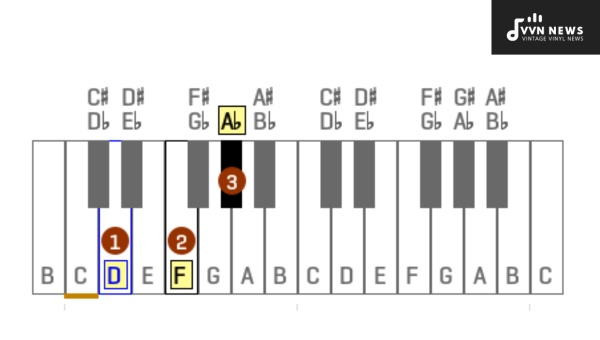
If you prefer playing the D-Diminished Triad on a keyboard, understanding how to read it in diagram form will be valuable. The diagram below illustrates the D Diminished Triad on a keyboard:
D#E#(F)
C#
A#B#(C)
In this diagram:
- The root note “D” is represented by D# or E# (also known as F), depending on which enharmonic equivalent you prefer.
- The minor third “F” is located two keys to the right of D#/E#, or simply written as E#.
- The diminished fifth “Ab” can be seen as A#, which is two keys to the right of F/E#.
By familiarizing yourself with these various notations, you’ll be able to read and play the D-Diminished Triad across different instruments and musical contexts. Experiment with these notations to find what works best for your unique playing style.
Differences Between Major, Minor, and Diminished Triads

Triads are essential components of music theory and provide the foundation for chords and harmonies.
Understanding the differences between major, minor, and diminished triads is crucial in creating and analyzing musical compositions. Here’s a breakdown of these triad types:
Major Triads
A major triad consists of a root note, a major third interval above the root, and a perfect fifth interval above the root.
The major third interval is four semitones (half steps) above the root, while the perfect fifth interval is seven semitones above the root.
Major triads have a bright, happy sound and are often associated with feelings of joy or triumph. They form the basis of many popular songs in various genres.
Minor Triads
On the other hand, minor triads have a distinct melancholic sound. They include a root note, a minor third interval above the root (three semitones), and a perfect fifth interval above the root.
The minor third creates a more somber and introspective feel compared to its major counterpart.
Minor triads are commonly used in blues, rock, classical music, and other genres to evoke feelings of sadness or contemplation.
Also Read: D Flat Major Blues Scale [Add New Colors To Your Music]
Diminished Triads
Diminished triads possess a unique dissonant character that adds tension to musical compositions. They consist of a root note, followed by a minor third interval (three semitones) above the root and then a diminished fifth interval (six semitones) above the root.
The diminished fifth creates an unsettling quality that often resolves to another chord or sets up opportunities for modulation in music composition.
The differences between major, minor, and diminished triads, musicians can create distinct emotional landscapes in their compositions and enhance their ability to analyze and interpret the music they encounter.
Common Uses of the D Diminished Triad in Music
The D Diminished Triad, consisting of the notes D, F, and Ab, is a versatile chord that finds its place in various musical genres. Here are some common uses of the D Diminished Triad:
- Jazz Music: The diminished chord is widely used in jazz music to create tension and add color to chord progressions. In jazz improvisation, the D Diminished Triad can be used as a passing chord or to substitute for dominant chords.
- Classical Music: The dissonant and mysterious quality of the diminished triad makes it a popular choice in classical compositions. It can be found in both solo piano pieces and orchestral arrangements, adding depth and complexity to the music.
- Film Soundtracks: Many film composers utilize the D Diminished Triad to create suspenseful and dramatic moments in their soundtracks. It can evoke feelings of uncertainty, unease, or impending danger.
- Blues and Rock Music: While diminished chords are not as common in blues and rock music compared to major and minor chords, they can still be used effectively for creating tension and adding a unique flavor to guitar solos or chord progressions.
- Modulation: The D Diminished Triad is often used as a pivot chord when modulating between different keys. It functions as a common tone between two unrelated keys, helping to transition from one key to another smoothly.
- Chord Substitution: In jazz or contemporary music, musicians may substitute dominant chords with diminished chords for added complexity and harmonic interest. This substitution technique can create unexpected twists in a song’s progression.
- Secondary Dominant Chords: The D Diminished Triad can function as a secondary dominant chord leading towards other major or minor chords within a piece of music.
The various applications of the D-Diminished Triad allow musicians to incorporate this chord into their compositions and improvisations, adding richness and depth to their music.
Whether in jazz, classical, or other genres, the unique qualities of the diminished triad can bring an exciting and captivating element to your musical creations.
Also Read: D Minor Blues Scale [Unveiling The Darker Side Of Music]
Finger Positions for Different Instruments

Mastering the D Diminished Triad not only involves understanding its theoretical aspects but also requires familiarity with the finger positions on various instruments. Here’s a breakdown of the finger positions for guitar, piano, and violin:
Guitar Finger Positions
When playing the D Diminished Triad on the guitar, you have several options for finger placements based on your playing style and technique. Here is a common fingering suggestion for the D Diminished Triad in open position:
- Place your index finger on the 1st fret of the high E string (top string).
- Place your middle finger on the 2nd fret of the B string (2nd from top).
- Place your ring finger on the 3rd fret of the G string (3rd from top).
You can strum all six strings or selectively pluck these three strings to emphasize the triad.
Piano Finger Positions

Playing the D Diminished Triad on the piano requires proper hand positioning and coordination between fingers. Here’s how you can play it:
- Position your right hand with thumb (1) on D.
- Use your middle finger (3) to play F.
- Lastly, place your pinky finger (5) on Ab.
Ensure that your fingers are curved, and you press each key firmly to produce a clear sound.
Violin Finger Positions
On a violin, fingering positions are different because you play each note using one finger per string.
- Start with your first finger placed on D string.
- Then place your second finger directly above it on A string.
- Finally, place your third finger directly above it on E string.
Remember to keep each finger’s placement precise while maintaining a relaxed posture and bow hold.
While these are general suggestions for fingering positions, it’s important to note that individual players may have their own preferred fingerings based on hand size, comfort, and playing style. Experiment with different finger positions to find what works best for you.
D Diminished Triad Inversions

When playing a D Diminished Triad, it is possible to create different voicings by rearranging the order of the notes. These rearrangements are called inversions. Inversions help add variety and depth to your chord progressions and can make your playing more interesting.
First Inversion: F, Ab, D
The first inversion of the D Diminished Triad places the third note, F, as the lowest note in the chord. This creates a different sound and changes the harmonic structure. To play this inversion on guitar or piano, simply move the bottom note (D) up an octave.
Second Inversion: Ab, D, F
The second inversion of the D Diminished Triad places the fifth note, Ab, as the lowest note in the chord. This inversion provides a fresh perspective on the triad and offers new melodic possibilities. To play this inversion on guitar or piano, move both lower notes (D and F) up an octave.
It is worth mentioning that inversions can be applied to any triad and not just the D Diminished Triad. Mastering these different voicings will greatly expand your understanding of music theory and increase your versatility as a guitarist or pianist.
Referencing chord charts or diagrams can be helpful when learning new inversions. Practicing these inversions in different keys will also improve your overall understanding of music theory and give you more control over your playing.
Also Read: D Flat Minor Blues Scale [Explore Depths Of Musical Emotion]
Examples of D Diminished in Popular Music
The D Diminished Triad has been used in various popular music genres to create tension, add color, and enhance musical compositions. Here are some notable examples of popular songs that utilize the D Diminished Triad:
- “Hotel California” by Eagles: In the iconic guitar solo of “Hotel California,” guitarist Don Felder incorporates the D Diminished Triad to create a haunting and mysterious sound. The chord progression in the solo includes a descending sequence of D(dim), Bm, F#, and A7sus4, which adds a unique flavor to this classic rock anthem.
- “Purple Haze” by Jimi Hendrix: Known for his innovative guitar playing, Jimi Hendrix often experimented with unconventional chord progressions. In “Purple Haze,” he employs the D-Diminished Triad to create an intense and psychedelic atmosphere. The intro riff features a series of diminished chords, including D(dim) and E(dim), adding to the song’s distinctive sound.
- “Lucy in the Sky with Diamonds” by The Beatles: The Beatles were masterful at incorporating interesting chord progressions in their music. In “Lucy in the Sky with Diamonds,” they use a descending chord pattern that includes the D Diminished Triad (D(dim)), among others, to create an ethereal and dreamlike quality that perfectly complements the song’s lyrics.
- “All The Things You Are” by Jerome Kern: This jazz standard has been recorded by numerous artists over the years, and it features several instances of the D-Diminished Triad within its chord progression. It is often used as a vehicle for improvisation due to its complex harmonic structure.
- Classical Music Compositions: The D Diminished Triad is frequently employed in classical music compositions as well. Composers such as Beethoven, Mozart, and Chopin have included the D Diminished Triad in their works, providing a sense of tension and drama.
FAQs about the D Diminished Triad
What are the notes in a D-diminished triad?
A D Diminished Triad consists of the notes D, F, and Ab.
How is the D Diminished Triad represented in standard notation?
In standard notation, the D Diminished Triad is written as D°.
Can I use the D Diminished Triad in different genres of music?
Yes, While commonly used in jazz and classical music, the D Diminished Triad can add interest and tension to various genres.
Are there different fingerings for playing the D Diminished Triad on guitar?
Yes, there are multiple fingerings available based on preference and technical ability, allowing for flexibility in your playing.
Conclusion
Mastering the D Diminished Triad is an essential skill for any guitarist looking to expand their musical repertoire.
The construction and characteristics of this chord structure will allow you to incorporate it into your playing effectively.
By exploring various finger positions and inversions, you can create unique chord progressions and add tension and color to your compositions.
Whether you’re a beginner or an advanced guitarist, the D Diminished Triad is a powerful tool that will elevate your playing to new heights.
So grab your guitar and start exploring the world of the D Diminished Triad today.