
If you’re exploring music theory, it won’t be too long before you come across the term ‘D flat diminished triad.’
It might sound a bit complex, perhaps even a tad intimidating, but don’t worry.
This term is nothing more than a way musicians describe a particular group of notes that have a very specific relationship with each other.
Getting to grips with the D flat diminished triad can open up a whole new world in your musical journey.
It’s relevant for both budding composers searching for that elusive haunting melody or hardened pros looking to inject some fresh spice into their solos.
Regardless of where you are in your musical journey, understanding this principle is bound to take your music-making skills to the next level.
Table of Contents
What are Triads?
In music theory, a triad is a three-note chord that forms the foundation of many musical compositions. Triads are built by stacking two intervals called thirds on top of a root note.
The three notes are typically referred to as the root, the third, and the fifth. The root is the starting note that gives the triad its name, while the third and the fifth determine its quality (major, minor, augmented, or diminished).
Triads provide harmonic support and serve as building blocks for melodies and harmonies. They can create a range of emotions and moods depending on their structure and context within a composition.
Structure of a D Flat Diminished Triad

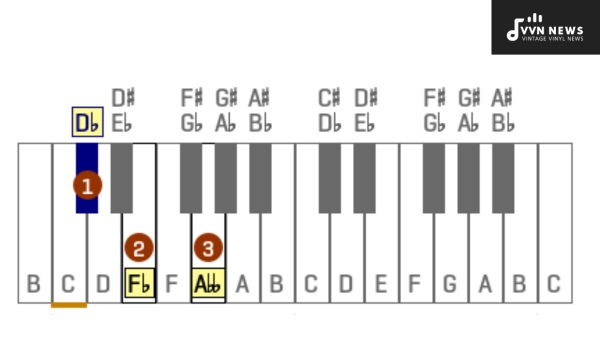
The D Flat Diminished Triad is made up of three distinct notes: D♭, F♭, and A♭. Let’s break down the structure of this chord:
- Root note: The root note is the starting point of the chord, which gives it its name. In this case, the root note is D♭.
- Minor third interval: The second note in the triad is a minor third above the root. In the case of a D Flat Diminished Triad, the next note is F♭.
- Minor third interval again: Lastly, we add another minor third interval above the second note to complete the triad. This brings us to A♭.
The structure of a D Flat Diminished Triad consists of a root note (D♭) followed by two successive minor thirds (F♭ and A♭). This unique combination offers an intriguing sound that can be both haunting and mysterious in nature.
Also Read: Music Notes [A Complete Guide For Beginners And Up]
How to Build the D Flat Diminished Triad?
Building a D Flat Diminished Triad involves understanding the structure of the chord and its component notes. Let’s break down the steps involved in constructing this unique chord:
- Start with the root note: The D Flat Diminished Triad begins with the root note, which is D♭.
- Find the minor third: To form a diminished triad, we need to go up three half steps from the root note. In this case, we find F♭.
- Locate the next minor third: From F♭, we must go up another three half steps to find the next note. This brings us to A♭.
- Combine the notes together: Now that we have our three component notes – D♭, F♭, and A♭ – we can stack them together to form the D Flat Diminished Triad.
In summary, we have D♭ as our starting point, followed by a minor third interval up to F♭, and then another minor third interval up to A♭. When played together, these three notes create the distinctive sound of a D Flat Diminished Triad.
It’s important to note that since F♭ is enharmonically equivalent to E, some musicians may choose to notate it as E instead for ease of reading.
Keep in mind that these instructions are specific to building a D Flat Diminished Triad.
To construct diminished triads in other keys, you would simply start with a different root note and follow these same steps using appropriate intervals within that key signature.
D Flat Diminished in Various Inversions

Inversions are different positions of a chord where the notes are rearranged, and the root note is not at the bottom. The D Flat Diminished Triad can be played in three different inversions: the root position, first inversion, and second inversion. Let’s explore each inversion in detail.
Root Position
The root position of the D Flat Diminished Triad has its root note (D♭) at the bottom. The next note, which is a minor third above the root, is F♭, followed by another minor third interval to A♭. When played together, these notes create the distinct sound of the D Flat Diminished chord.
First Inversion
To play the first inversion of the D Flat Diminished Triad, you need to take the third (F♭) and move it up one octave. This means that F♭ becomes F♮. The order of the notes in this inversion is now A♭ (bottom), D♭ (middle), and F.
Second Inversion
For the second inversion of the D Flat Diminished Triad, you need to take both the root note (D♭) and raise it up one octave and also take the note that was on top (A♭) and raise it up one octave as well. This results in A♮ becoming A double flat (A ♯). The order of notes for this inversion is now F (bottom), D♭ (middle), and A ♯.
Also Read: G Flat Major Scale [Deep Dive Into Basic Music Theory]
Common Fingerings on the Piano
Mastering the fingerings for the D Flat Diminished Triad on the piano is essential for effectively incorporating this chord into your playing. The following fingerings will help you navigate the keys and produce a clear and cohesive sound.
- Root Position:
- Place your thumb on D♭, your index finger on F♭, and your pinky on A♭.
- Maintain a relaxed hand position, keeping your fingers slightly curved and your wrist loose.
- First Inversion:
- Start with your thumb on F♭, your middle finger on A♭, and your pinky on D♭.
- Keep the same relaxed hand position as in root position.
- Second Inversion:
- Begin with your thumb on A♭, your ring finger on D♭, and your pinky on F♭.
- Maintain the same relaxed hand position throughout.
It is crucial to practice these fingerings slowly at first to ensure accuracy and develop muscle memory. Gradually increase the tempo as you become more comfortable with these patterns.
Playing the D Flat Diminished on Guitar
Playing the D Flat Diminished Triad on the guitar can be a rewarding experience. It adds a unique flavor to your chords and melodies, creating a sense of tension and release in your music. Here, we will explore how to play the D Flat Diminished Triad on the guitar.
- Finding the root note: The root note of the D Flat Diminished Triad is D♭. Locate this note on your guitar’s fretboard. It can be found on the 4th string, 9th fret.
- Building the triad: To create the D Flat Diminished Triad, stack two minor thirds above the root note. In this case, these notes are F♭ and A♭. Locate these notes on your guitar’s fretboard: F♭ can be found on the 5th string, 8th fret, and A♭ can be found on the 6th string, 8th fret.
- Finger positioning: Place your index finger on the root note (D♭) at the 9th fret of the 4th string. Next, use your ring finger to hold down F♭ at the 8th fret of the 5th string. Finally, use your pinky finger to hold down A♭ at the 8th fret of the 6th string.
- Strumming or picking: Once you have positioned your fingers correctly, strum or pick all three strings simultaneously.
- Voicings and inversions: Experiment with different voicings and inversions of the D Flat Diminished Triad across different areas of your guitar’s neck for a richer sound and more convenient fingering options.
Also Read: D Flat Major Blues Scale [Add New Colors To Your Music]
The Role of the D Flat Diminished in Jazz
Jazz music is known for its complex harmonies and improvisational nature. The D Flat Diminished Triad plays a significant role in jazz compositions, adding tension and creating unique harmonic progressions. Here’s a closer look at how the D Flat Diminished Triad is used in jazz:
1. Substituting for dominant chords:
The D Flat Diminished Triad can be used as a substitute for dominant seventh chords. When substituting, the D Flat Diminished Triad shares two common tones with the dominant chord it replaces.
This creates a chromatic movement in the bassline and adds tension to the progression.
2. Altered dominant chord resolutions:
In jazz, there are often chord progressions that include altered dominant chords. The D Flat Diminished Triad can be used to substitute for an altered dominant chord, such as a G7♭9 or G7♭13 chord.
This substitution provides a unique and dissonant sound that resolves to a tonic or another chord.
3. Diminished scale improvisation:
The D Flat Diminished Triad is derived from the diminished scale, which is commonly used for improvisation in jazz. By incorporating the D Flat Diminished Triad into your improvisations, you can create tension and explore different melodic possibilities within the context of a diminished scale.
4. Turnarounds and passing chords:
Turnarounds are commonly used in jazz to provide harmonic motion at the end of phrases or sections of music.
The D Flat Diminished Triad can be used as a passing chord or substitution in turnarounds to add color and interest to progressions.
The D Flat Diminished Triad adds complexity and tension to jazz compositions through its various applications as a substitute chord, an altered dominant resolution, an improvisational tool, and a passing or turnaround chord. Its dissonant qualities contribute to the distinctive and evocative sound of jazz music.
Also Read: D Flat Music Note [Cracking The Code Of Musical Notation]
Emotional and Sonic Qualities

The D Flat Diminished Triad, with its unique structure and tension, can evoke specific emotions and create distinct sonic qualities in your music. Here are some key characteristics of the D Flat Diminished Triad:
Tension and Unsettledness
The D Flat Diminished Triad creates a sense of tension and unsettledness due to its compact structure. The minor third intervals between each note create a dissonant sound that can be both captivating and eerie.
Dark and Mysterious
The D Flat Diminished Triad’s somber character lends itself well to creating a dark and mysterious atmosphere in your compositions. Its dissonance can add an air of intrigue or suspense, making it perfect for dramatic or melancholic passages.
Chromaticism and Modulation
Due to its symmetrical structure, the D Flat Diminished Triad can smoothly transition between different keys. By using this chord in your compositions, you can introduce chromaticism and explore modulation techniques. This versatility adds depth and complexity to your music.
Rich Harmonic Texture
When incorporated into a larger harmonic progression, the D Flat Diminished Triad provides a rich texture that enhances the overall sound. It can add complexity and depth to chord progressions, making them more interesting to the listener.
Jazz Influence
The D Flat Diminished Triad is commonly used in jazz music. Its ability to smoothly transition between keys makes it a favorite amongst jazz musicians for creating colorful harmonic movements. Incorporating this chord into your jazz compositions adds an element of sophistication and complexity.
To fully harness the emotional and sonic qualities of the D Flat Diminished Triad, experiment with its use in different musical contexts, such as chord progressions, melodies, or improvisations.
Common Progressions and Sequences
The D Flat Diminished Triad can be used in a variety of progressions and sequences to create tension, suspense, or a sense of movement in your music. Here are some common ways to incorporate the D Flat Diminished Triad into your compositions:
- Descending Chromatic Progression: This progression involves moving chromatically downwards from one chord to the next. For example, you can start with a D Flat Diminished Triad and move to a C Major Triad, then to a B Flat Minor Triad, and so on. This creates a descending chromatic line that adds interest and tension to your music.
- Diminished Cycle: The D Flat Diminished Triad can also be used as part of a diminished cycle progression. In this progression, you move from one diminished chord to the next by descending in minor thirds. For example, you can start with the D Flat Diminished Triad, then move to the B Diminished Triad, then to the G Diminished Triad, and so on.
- Secondary Dominant: Another way to use the D Flat Diminished Triad is as a secondary dominant chord. In this context, it can function as the vii°7/V (diminished seventh chord built on the leading tone of the dominant chord) resolving to V (dominant chord). For example, in the key of C Major, you could use a D Flat Diminished Triad before resolving it to G Major.
- Modal Interchange: The D Flat Diminished Triad can also be borrowed from related keys or modes. For instance, if you are in the key of C Major but want to add some harmonic interest or tension, you can borrow the D Flat Dimished Triad from C Harmonic Minor or C Melodic Minor.
It is important to experiment with different progressions and sequences to find the ones that resonate with you.
These examples are just a starting point, and there are endless possibilities when it comes to incorporating the D Flat Diminished Triad into your music.
Also Read: How To Transpose Down An Octave [Master This Musical Skill]
D Flat Diminished in Popular Music

The D Flat Diminished Triad has found its way into many popular music genres, adding a unique and distinct sound to various compositions. Here are some examples of how the D Flat Diminished Triad is used in popular music:
- Jazz: In jazz, the D Flat Diminished Triad is commonly used as a passing chord or as part of a turnaround progression. It adds tension and complexity to improvisations and can create a sense of anticipation before resolving to another chord.
- Pop: In pop music, the D Flat Diminished Triad can be found in ballads or songs with an introspective mood. It is often used as a color chord to add emotional depth and create a sense of melancholy or longing.
- Rock: The D Flat Diminished Triad can add an edgy and intense flavor to rock music. It is frequently used in guitar solos or as part of power chord progressions for added tension and drama.
- R&B/Soul: In R&B and soul music, the D Flat Diminished Triad can be utilized to create harmonic movement and add richness to chord progressions. It often features in soulful ballads or as a passing chord between other chords.
- Film Scores: The haunting and mysterious qualities of the D Flat Diminished Triad make it a favorite choice for film composers looking to evoke tension, suspense, or darkness in their scores. Its dissonance can heighten the emotional impact of a scene or underscore dramatic moments.
- Electronic Music: In electronic music genres like ambient, downtempo, or experimental, the D Flat Diminished Triad can be used for its ethereal and atmospheric qualities. Its dissonant nature provides an otherworldly texture that can enhance the overall sonic landscape of these genres.
The D Flat Diminished Triad has made its mark on popular music by adding tension, complexity, and emotional depth to various genres.
Its unique sound and dissonant qualities have allowed it to find a place in jazz improvisations, pop ballads, rock solos, R&B harmonies, film scores, and electronic music.
FAQs about the D Flat Diminished Triad
What is the function of a diminished triad in music?
Diminished triads often serve as transitional chords, adding tension and leading to a resolution. They can create a sense of suspense and instability in musical compositions.
2. What is the difference between a diminished triad and a minor triad?
While both diminished and minor triads contain a minor third interval, the fifth in a diminished triad is lowered by one half step compared to the perfect fifth found in a minor triad.
How can I identify the D Flat Diminished Triad on sheet music?
Look for the three notes (D♭, F♭, A♭) written together vertically or horizontally with the chord symbol “D♭dim” or “D♭°” above it.
Can I use inversions of the D Flat Diminished Triad in my compositions?
Yes, inversions allow you to rearrange the order of the notes within the chord while still maintaining its quality. Experiment with different inversions to add variety and texture to your music.
Where can I hear examples of songs that feature the D Flat Diminished Triad?
The D Flat Diminished Triad is commonly found in jazz, classical, and even popular music compositions. Listen to pieces by George Gershwin, Franz Liszt, or The Beatles to hear this intriguing chord being used creatively.
Conclusion
The D Flat Diminished Triad is a fascinating chord with a unique and complex sound.
Understanding its structure and applications can greatly enhance your musical knowledge and abilities.
Whether you’re a music enthusiast or an aspiring musician, exploring the intricacies of the D Flat Diminished Triad opens up new possibilities for creating rich and captivating music.
So, give it a try in your compositions and enjoy the depth and complexity it can bring to your musical creations.