
When you first dip your toes into the world of music theory, chord formations can seem daunting.
Among the multitude of chords that exist, one that is particularly intriguing is the D minor triad.
This three-note chord is simple yet carries a distinctive, resonant quality that has found its rightful place in many memorable melodies.
Often played on stringed instruments like guitars and pianos, this triad plays a crucial role in establishing mood and tonality in music compositions.
The smooth blend of the D minor triad’s notes creates a somber and poignant sound that often invokes intense emotions. Let’s journey together to unravel more about this fascinating chord.
Table of Contents
What is the D Minor Triad?
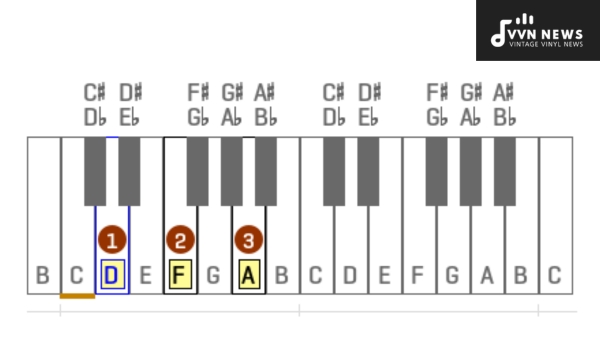
The D Minor Triad is a three-note chord consisting of the notes D, F, and A.
It is categorized as a minor triad because it follows the pattern of a minor third followed by a major third interval.
The root note, D, provides the foundation for the chord, while the F and A notes add color and character.
The D Minor Triad is commonly used in music compositions in the key of D minor and creates a melancholic and emotive sound.
This chord’s structure and how it relates to other chords will greatly enhance your ability to create beautiful melodies and harmonies.
Also Read: D Minor Pentatonic Scale [Make Your Music Sing With Emotion]
Construction of D Minor Triad

The construction of a D Minor Triad involves the intervals between each note. To construct the chord, we start with the root note, D, and then move up by specific intervals to find the other two notes.
- Root Note: The foundation of the D Minor Triad is the note D.
- Minor Third Interval: To find the second note of the triad, we need to move up from the root by a minor third interval. In this case, a minor third above D is F.
- Major Third Interval: To complete the triad, we need to find another note that forms a major third interval above F. In this case, a major third above F is A.
- Final Chord: Putting it all together, the D Minor Triad consists of three notes: D (root), F (minor third), and A (major third).
Understanding how to construct triads is essential as it allows you to build chords on any given root note and gives you greater flexibility in your musical compositions and improvisations.
Playing D Minor Triad on Different Instruments
Learning how to play the D Minor Triad on different instruments opens up a world of possibilities in your musical journey.
Let’s take a look at how you can play this chord on some popular instruments:
Guitar:
The guitar is a versatile instrument that allows for various voicings and positions of chords. To play the D Minor Triad on the guitar, start with the open D string (fourth string) as your root note.
Place your index finger on the first fret of the first string (E string) to fret the F note and your ring finger on the third fret of the second string (B string) to fret the A note. Strum all six strings for a full sound or focus on only strings 4-1 for a more specific sound.
Piano/Keyboard:
The piano or keyboard offers a clear visual representation of notes, making it easier to grasp chord shapes.
In its most basic form, play D as your root note with your thumb, F with your middle finger, and A with your pinky finger.
You can also experiment with different inversions and octaves of these notes to create different textures and voicings.
Violin/Viola/Cello:
On bowed instruments like violin, viola, and cello, playing chords is not as straightforward as on guitar or piano.
One option is to arpeggiate the chord by playing each note individually in quick succession using separate bow strokes.
Another option is to double-stop two notes simultaneously by positioning your fingers appropriately on adjacent strings.
Flute/Clarinet/Saxophone:
On wind instruments like flute, clarinet, and saxophone, playing triads involves utilizing different combinations of open holes or keys.
For the D Minor Triad, you would cover holes or keys corresponding to D, F, and A together while blowing into the instrument.
Mastering the D Minor Triad on different instruments may require practice, but with time and dedication, you’ll become comfortable playing this versatile chord in different musical contexts.
Inversions of D Minor Triad

Inversions of a chord occur when you rearrange the order of the notes while keeping the same three pitches.
These inversions provide different voicings and can add variation and interest to your musical compositions. Let’s explore the inversions of the D Minor Triad:
- Root Position: The root position is when the root note (D) is at the bottom, followed by the third (F), and finally, the fifth (A). It is represented as Dm.
- First Inversion: In the first inversion, we take the third of the triad (F) and move it up an octave. This makes F the bass note, followed by A, and finally, D. It is represented as F/Dm.
- Second Inversion: The second inversion involves taking the fifth of the triad (A) and moving it up an octave. This makes A the bass note, followed by D, and finally, F. It is represented as A/Dm.
Inversions are not limited to a specific instrument or technique but can be applied across various musical contexts. Here are a few examples of how to play these inversions on different instruments.
Also Read: D Sharp Minor Pentatonic Scale [Inject Drama Into Your Melodies]
Triads in D Minor
In the key of D minor, several triads can be formed using the notes of the diatonic scale. Let’s take a closer look at each triad and its structure and characteristics.
D Minor
The D Minor triad is the tonic chord in the key of D minor. It consists of the notes D, F, and A. This chord is often used to establish a sense of tension and resolution in music compositions.
E Diminished
The E-diminished triad is built on the second degree of the D minor scale. Its notes are E, G, and Bb. The diminished quality gives this chord a dark and mysterious sound that can create tension in a musical setting.
F Major
The F Major triad is constructed on the third degree of the D minor scale. It consists of the notes F, A, and C. This chord carries a more uplifting and brighter sound compared to the previous two chords.
G Minor
The G Minor triad is formed on the fourth degree of the D minor scale. Its notes are G, Bb, and D. This chord adds a melancholic touch to compositions due to its minor nature while still maintaining some stability.
A Minor
The A Minor triad is built on the fifth degree of the D minor scale. It comprises the notes A, C, and E. This chord shares similar characteristics with its relative major counterpart (C Major), but with a more subdued and introspective feel.
Bb Major
The Bb Major triad takes its place as a sixth-degree chord in the key of D minor. Its notes are Bb, D, and F. This chord brings a sense of warmth and brightness to musical compositions due to its major tonality.
C Major
The C Major triad serves as another major chord within the key of D minor. It is built on the seventh degree and consists of the notes C, E, and G. This chord offers a clear and stable sound that complements the other triads in D minor.
The various triads within the key of D minor, you can easily create chord progressions and melodies that evoke different moods and emotions.
Also Read: F Sharp Minor Pentatonic Scale [How To Use In Your Compositions]
Mastering D Minor Triad Inversions on Guitar & Piano

Inversions are different voicings of a chord that help to add variety and interest to musical compositions.
Mastering D minor triad inversions on guitar and piano opens up a world of possibilities for creating beautiful chord progressions and melodies. In this section, we will explore how to play inversions of the D minor triad on both instruments.
Playing D Minor Triad Inversions on Guitar
On the guitar, inversions are achieved by changing the order of the notes within a chord. Here is a guide on how to play D minor triad inversions:
- Root Position (R): Start by playing the root position D minor triad, which is played with the root note (D) as the lowest note, followed by F and A.
- First Inversion (1st): To play the first inversion, move the lowest note (D) up one octave so that F becomes the lowest note, followed by A and then D.
- Second Inversion (2nd): For the second inversion, move both the lowest and middle notes up one octave, so that A becomes the lowest note, followed by D and then F.
- Third Inversion (3rd): The third inversion involves moving all three notes up one octave so that F becomes the highest note, followed by A and then D.
Playing D Minor Triad Inversions on Piano
On the piano, inversions are achieved by rearranging the positions of a chord’s notes. Here is a guide on how to play D minor triad inversions:
- Root Position (R): The root position is played with your right-hand fingers 1-3-5 starting from middle C – C being your thumb (finger 1), E being finger 3, and G being finger 5. The left hand can play the same notes in a lower octave for a fuller sound.
- First Inversion (1st): To play the first inversion, move the root note (D) up one octave. Your right hand will now play fingers 1-3-5 starting on D – D being your thumb (finger 1), F being finger 3, and A being finger 5.
- Second Inversion (2nd): For the second inversion, move both the lowest and middle notes up one octave. Your right hand will play fingers 1-3-5 starting on A – A being thumb (finger 1), C being finger 3, and D being finger 5.
- Third Inversion (3rd): The third inversion involves moving all three notes up one octave. Your right hand will play fingers 1-3-5 starting on F – F being your thumb (finger 1), A being finger 3, and C being finger 5.
Mastering these inversions on guitar and piano opens up endless possibilities for chord progressions and creative arrangements using the D minor triad. Take the time to practice these inversions in different contexts and explore how they can be used to create unique and captivating music.
Chord Progressions with D Minor Triad
Chord progressions form the backbone of music compositions, providing a sense of structure and movement.
The D Minor Triad can be incorporated into various chord progressions, adding depth and emotion to your musical arrangements.
Here are some commonly used chord progressions involving the D Minor Triad:
- Dm – G – C: This progression is known as the vi – IV – I progression in the key of C major. Starting with the D Minor Triad, it transitions to a G major chord before resolving to a C major chord.
- Dm – Am – Em: This progression is popular among folk and pop genres. It utilizes the vi – iii – vi progression, beginning with D Minor and moving to A minor and E minor.
- Dm – F – C: This is a simple yet powerful progression in the key of F major. The D Minor Triad leads to an F major chord before resolving to a C major chord.
- Dm7 – G7 – C: This progression introduces seventh chords for added complexity. Starting with the Dm7 (a D minor triad with an added minor 7th), it moves to a G7 (a dominant seventh) before resolving to a C major chord.
- Dm – Bb – C: In this progression, D Minor leads to a Bb major chord before resolving to C major. This creates a sense of tension and release, commonly found in jazz and blues genres.
These chord progressions will allow you to create captivating musical arrangements using the D Minor Triad as your foundation.
Experiment with different progressions, tempos, and melodies to personalize your compositions while harnessing the emotive power of this unique triad.
Songs Featuring D Minor Triad

The D Minor Triad is a versatile chord that has been used in countless songs across various genres of music. Let’s dive into some notable songs that prominently feature the D Minor Triad.
1. “I Will Always Love You” by Whitney Houston
This iconic ballad showcases the beauty of the D Minor Triad in its opening piano chords. The chord progression in the verses follows a sequence of Dm – Bb – C – F, with the Dm chord serving as the emotional foundation of the song.
2. “Hurt” by Johnny Cash
Johnny Cash’s haunting cover of “Hurt” by Nine Inch Nails features the D Minor Triad throughout its poignant arrangement. The song’s somber tone is heightened by the repeated use of this minor chord.
3. “Nothing Else Matters” by Metallica
Metallica’s power ballad boasts a memorable guitar intro centered around the D Minor Triad. The song combines both soft and heavy elements, and the use of this triad contributes to its evocative and melodic nature.
4. “Mad World” by Tears for Fears
The melancholic piano-driven hit “Mad World” prominently features the D Minor Triad in its opening chords and throughout the song. This chord choice helps create a sense of sadness and introspection that complements the song’s lyrics.
5. “Hey Jude” by The Beatles
In one of their most beloved tracks, The Beatles utilize a descending chord progression that includes the D Minor Triad. This adds emotional depth to an already timeless anthem, showcasing how powerful this triad can be even in uplifting songs.
Understanding which chords are used in popular songs can be a valuable exercise for any musician or songwriter.
It allows you to see how different chords can evoke different emotions and enhance your musical expression.
Also Read: G Sharp Minor Pentatonic Scale [Add Dimension To Your Music]
FAQs About D Minor Triad
What is the significance of the D Minor Triad in music?
The D Minor Triad is commonly used in music because of its ability to convey a sense of melancholy and emotion. It adds depth and complexity to compositions in minor keys.
How is the D Minor Triad constructed?
The D Minor Triad consists of three notes: D, F, and A. It follows the pattern of a minor third interval between the root note (D) and the middle note (F), followed by a major third interval between the middle note (F) and the top note (A).
Can I play the D Minor Triad on different instruments?
Yes, you can play the D Minor Triad on various instruments such as piano, guitar, violin, and more. The notes (D, F, A) can be played simultaneously or consecutively in different octaves depending on your instrument.
Are there different inversions of the D Minor Triad?
Yes, there are three possible inversions of the D Minor Triad. These inversions involve rearranging the order of the notes so that a different note becomes the lowest pitch. The first inversion has F as the lowest note, followed by A and then D. The second inversion has A as the lowest note, followed by D and then F.
Can you provide examples of songs that use the D Minor Triad?
Certainly! Some popular songs that feature the D Minor Triad include “Boulevard of Broken Dreams” by Green Day, “Someone Like You” by Adele, and “Blackbird” by The Beatles. These songs showcase how versatile and impactful this chord can be in creating emotional melodies.
Conclusion
The D Minor Triad is a fundamental chord in music theory that is widely used in various genres.
It consists of the notes D, F, and A and creates a melancholic and emotive sound.
With its structure and how it relates to other chords, you can enhance your musical compositions and improvisations.
Whether you’re playing the D Minor Triad on guitar, piano, or any other instrument, practicing different inversions and exploring chord progressions that incorporate this triad will broaden your musical vocabulary.