
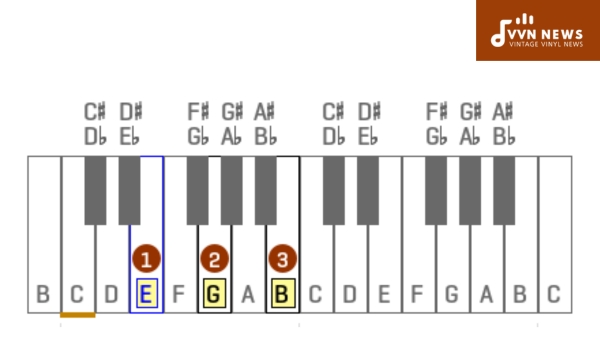
As a music enthusiast, nothing brings me more joy than the harmonious marriage of notes in a chord. One of my favorites that never fails to command my attention is the E minor triad.
This triumvir understandably creates an ambiance that is both sad and enchanting.
Diving into the world of music theory, you would encounter endless chords and notes, each one unique in resonating with its essence.
But why focus on the E minor triad? Maybe it’s because of its versatility or because of how it stands out in many famous compositions.
Either way, unraveling its intricacies is quite the musical journey. Its beauty lies not only within its melody but also within the captivating stories these three simple notes can convey.
Table of Contents
What defines an E Minor triad?

An E Minor triad is a chord consisting of three notes that create a distinctive sound and convey a specific mood.
In the case of the E Minor triad, these three notes are E, G, and B. The first thing you may notice is that the E Minor triad has a minor quality, which means it has a slightly somber or melancholic feel compared to major chords.
The root note, E, provides the foundation for the chord, while the G and B notes add layers of depth and complexity. When played together, these three notes produce a harmonious sound that is characteristic of the E Minor triad.
Steps to construct an E Minor triad?
To construct an E Minor triad, you need to follow a simple formula that applies to all minor triads.
- Start with the root note: In this case, we start with the note E. It serves as the foundation of the chord.
- Determine the interval pattern: A triad is made up of two intervals – a minor third and a perfect fifth. The minor third creates the characteristic “minor” sound, while the perfect fifth adds richness and stability.
- Find the first interval (minor third): To find the first note of the triad, count three half steps (or semitones) higher from the root note E. This lands us on G.
- Find the second interval (perfect fifth): Starting from G, count four half steps higher to reach B – this is our second note for the triad.
- Play all three notes together: Now that we have E, G, and B, play them simultaneously to create an E Minor triad.
Remember that when constructing any triad on a musical instrument, it’s essential to know how each note contributes to its overall sound and character.
Take some time to familiarize yourself with playing and recognizing this chord on your instrument of choice through practice and experimentation.
Also Read: G Flat Minor Triad [Mastering Complex Guitar Chords]
Methods to Play E Minor Triad on Various Instruments

Playing the E Minor triad on different instruments allows you to explore its unique sound and incorporate it into your musical repertoire.
Here, I will walk you through the steps of playing the E Minor triad on popular instruments, such as guitar, piano, and ukulele.
Guitar
Playing the E Minor triad on the guitar is relatively straightforward, thanks to its familiar finger positions. Here’s a step-by-step guide:
- Start with the open position: Place your index finger on the second fret of the A string and strum from the low E string.
- This fretted note is your root, E. Keep it pressed down.
- Use your middle finger to press down on the second fret of the D string (G note).
- Lastly, place your ring finger on the second fret of the B string (B note).
Once you have mastered this open position, you can also explore other variations further up the neck.
Piano
On a piano or keyboard, playing an E Minor triad requires a specific arrangement of keys. Follow these steps:
- Start by finding an E note on your keyboard or piano.
- For simplicity, use your right hand’s thumb (1), middle finger (3), and pinky finger (5) to play three consecutive white keys: E, G, B.
- Play them simultaneously or in quick succession for a harmonious sound.
Remember that pianos are tuned so that every black key has an adjacent white key, making it easier to find your starting note.
Bass
If you’re playing bass guitar and want to incorporate an E Minor triad into your grooves, follow these instructions:
- Begin by placing your index finger on the seventh fret of the A string (E note).
- Next, use your pinky finger to press down on the ninth fret of the D string (G note).
- Finally, use your middle finger to play the eighth fret of the G string (B note).
This configuration allows for smooth transitions as you navigate between notes while maintaining a solid bassline foundation.
Also Read: A Flat Minor Triad [Guide to Unusual Guitar Chords]
Ukulele
To play the E Minor triad on a ukulele, use the following fingerings:
- Place your middle finger on the fourth fret of the G string (E note).
- Use your index finger to hold down the second fret of the C string (G note).
- Finally, use your ring finger to press down on the third fret of the E string (B note).
Strumming all three strings simultaneously will produce a pleasing E Minor chord sound on this instrument.
These methods are just starting points, and you can explore different positions and inversions to create unique melodies and progressions.
What are the inversions of an E Minor triad?
Inversions are alternate ways of arranging the notes within a chord. They can add variety and interest to your compositions, allowing you to explore different musical possibilities.
In the case of the E Minor triad, there are three possible inversions: first inversion, second inversion, and root position.
- Root Position: This is the most basic form of the E Minor triad. It consists of the notes E, G, and B in their lowest possible positions. The root note (E) is played as the lowest note in this inversion.
- First Inversion: To create the first inversion of an E Minor triad, you need to raise the root note (E) by an octave. This means that G becomes the lowest note in this inversion, followed by B and then E.
- Second Inversion: The second inversion involves further raising the root note (E) by another octave. Now, B becomes the lowest note in this inversion, followed by E and then G.
These inversions offer different tonal qualities and voicings of the E Minor triad, allowing for diverse musical expressions.
It is important to note that regardless of the inversion, the chord retains its E Minor quality and characteristic sound.
What triads make up the E Minor scale?

The triads that make up the E Minor scale is essential for musicians looking to create harmonious and cohesive compositions in this key.
Triads are chords made up of three different notes, with each note being a third apart from the others.
In the case of the E Minor scale, we have seven different triads that can be built from the individual notes of this scale. Let’s examine each of these triads in detail:
E Minor Triad (E-G-B)
The first and primary triad in the E Minor scale is, unsurprisingly, the E Minor triad itself. Composed of the notes E, G, and B, it features a root note (E), a minor third interval (G), and a perfect fifth interval (B).
This triad forms the foundation for compositions in E Minor and is essential to establishing its melancholic sound.
F# Diminished Triad (F#-A-C)
Moving on to the second triad in the scale, we encounter the F# Diminished triad. Comprised of F#, A, and C, this chord features a root note (F#), a minor third interval (A), and a diminished fifth interval (C).
The diminished quality of this chord adds tension and suspense to musical compositions.
G Major Triad (G-B-D)
Next up is the G Major triad. Consisting of G, B, and D, this chord is characterized by its major quality. It includes a root note (G), a major third interval (B), and a perfect fifth interval (D).
The G Major triad provides contrast within compositions written in E Minor by introducing a brighter and happier sound.
A Minor Triad (A-C-E)
The fourth triad found in the E Minor scale is none other than A Minor. Composed of A, C, and E, this chord features a root note (A), a minor third interval (C), and a perfect fifth interval (E).
A Minor is closely related to the E Minor scale, and its inclusion adds depth and versatility to musical arrangements.
Also Read: A Sharp Diminished Triad [Discover This Unique Chord]
B Minor Triad (B-D-F#)
Continuing onward, we discover the B Minor triad. Made up of the notes B, D, and F#, this chord features a root note (B), a minor third interval (D), and a perfect fifth interval (F#).
The B Minor triad adds richness and complexity to compositions within the key of E Minor.
C Major Triad (C-E-G)
The sixth triad in the E Minor scale is the C Major triad. Comprising C, E, and G, this chord features a root note (C), a major third interval (E), and a perfect fifth interval (G).
It serves as another contrasting element within compositions written in E Minor due to its major quality.
D Major Triad (D-F#-A)
Lastly, we encounter the D Major triad. Composed of D, F#, and A, this chord features a root note (D), a major third interval (F#), and a perfect fifth interval (A).
The inclusion of this triad in compositions within the key of E Minor provides further tonal variation.
These triads that make up the E Minor scale allow musicians to create captivating melodies and harmonies while exploring different dimensions of emotion in their compositions.
By incorporating these chords strategically into their music, they can fully harness the expressive potential of the key of E Minor.
Tips for Mastering E Minor Triad Inversions on Guitar and Piano
Mastering the inversions of the E Minor triad is crucial for expanding your chord vocabulary and enhancing your music compositions.
In this section, I will share some valuable tips and techniques to help you navigate through these inversions on both guitar and piano.
Guitar:
- The E Minor Triad: Before diving into inversions, familiarize yourself with the basic E Minor triad shape on the guitar. Start by playing the open E string, followed by the second fret on the A string (B note), and the third fret on the D string (G note). This forms the root position of the E Minor triad.
- Move Up The Fretboard: To play inversions, start by utilizing barre chords. For example, to play the first inversion of E Minor, place your index finger across all six strings at any given fret (acting as a movable nut) and barre it. Then, position your other fingers according to the specific inversion you want to play.
- Utilize Finger Patterns: Another approach is to incorporate popular finger patterns for playing different inversions up and down the neck. For example, for the second inversion, align your ring finger with the root note on the A string and construct a chord shape around it.
- Practice Chord Progressions: Incorporate inversions into chord progressions to enhance your musical arrangements. Experiment with moving smoothly between different inversions of E Minor within a progression or song.
Piano:
- Begin with Root Position: Start by familiarizing yourself with the root position of the E Minor triad on piano – place your right-hand thumb on E, middle finger on G, and pinky finger on B.
- Move to First Inversion: To play the first inversion, take your thumb off E and move it to G while keeping your other fingers in their current positions.
- Play Second Inversion: For second inversion, lift your thumb off G and move it to B while keeping your other fingers in their current positions.
- Practice Arpeggio Patterns: One effective way to develop dexterity and fluidity with triad inversions on the piano is to practice arpeggio patterns. Start slow and gradually increase speed as you gain proficiency.
Famous songs that use the E Minor Triad
The E Minor triad is a popular chord progression found in numerous famous songs across various genres.
Its signature sound adds depth, emotion, and intensity to the music. Here are some notable songs that utilize the E Minor triad:
- “Wonderwall” by Oasis: This iconic song features a timeless chord progression centered around the E Minor triad. The haunting strumming pattern of E, G, and B chords creates a captivating atmosphere throughout the track.
- “Hotel California” by Eagles: In this classic rock ballad, the E Minor triad is used to contribute to the song’s haunting and introspective tone. The chord progression of E Minor, G Major, D Major, and A Major forms the backbone of this legendary track.
- “Yesterday” by The Beatles: As one of The Beatles’ most beloved songs, “Yesterday” showcases a gentle and reflective ambiance through its use of the E Minor triad. This melancholic track provides a perfect example of how an emotionally charged chord progression can captivate listeners.
- “Creep” by Radiohead: “Creep” is known for its powerful guitar riff built around the E Minor triad. The song’s haunting melody combined with its intense lyrics creates a unique musical experience that has resonated with listeners for decades.
- “Boulevard of Broken Dreams” by Green Day: This alternative rock anthem features a prominent use of the E Minor triad in its chord progression. It brings out a sense of longing and introspection that perfectly complements the song’s lyrics about loneliness and disillusionment.
- “Hallelujah” by Leonard Cohen/Jeff Buckley: “Hallelujah” has been covered extensively by various artists due to its poignant lyrics and evocative chords. The song’s emotional impact is greatly enhanced by the use of the E Minor triad, emphasizing its melancholic themes.
These songs serve as excellent examples of how the E Minor triad can be utilized to evoke different moods and enhance the overall musical experience.
Whether it’s in rock, pop, or folk music, the E Minor triad has consistently proven its ability to resonate with listeners on a deep emotional level.
FAQs About E Minor Triad
How do you construct an E Minor triad?
To construct an E Minor triad, start with the root note (E), add the minor third (G), and then the perfect fifth (B).
Can I play the E Minor triad on different instruments?
Yes, the E Minor triad can be played on a variety of instruments. On guitar, you can play it as an open chord or in different positions along the neck. On piano, play E, G, and B keys simultaneously.
What are the inversions of an E Minor triad?
The inversions of an E Minor triad are Em/G (first inversion) and Em/B (second inversion). In these inversions, the notes are rearranged so that a different note becomes the lowest tone.
What other chords make up the E Minor scale?
Alongside the E Minor triad, other chords in the E Minor scale include F# diminished (F#dim), G Major (G), A minor (Am), B minor (Bm), C major (C), and D major (D).
Any tips for mastering E Minor triad inversions on guitar and piano?
Practice transitioning between different positions on the guitar while maintaining the quality of the chord. On piano, practice various fingering techniques to smoothly move between inversions. Regular practice will greatly improve your mastery of these chord progressions.
Conclusion
The E Minor triad is a fundamental chord in music theory that holds immense significance.
Its distinctive sound and minor quality allow musicians to elicit a range of emotions in their compositions.
Whether you are a guitarist, pianist, or any other instrumentalist, mastering the E Minor triad opens up a world of possibilities for creating captivating melodies and harmonies.
With its construction, inversions, and common chord progressions, you can confidently incorporate this versatile triad into your musical repertoire. Embrace the power of the E Minor triad and let your creativity soar!