
Enter the world of musical theory, and you’ll be quickly introduced to a plethora of chords, each with its unique sound and emotion.
Among these is the F sharp minor triad, a small but potent collection of notes that holds significant sway in many musical genres.
This complex chord might seem daunting at first glance but fear not; with patience and practice, anyone can master its harmonious tune.
The F sharp minor triad is such a remarkable piece of music theory that it has traveled through time, making its place in classical compositions, as well as rhythm and blues, rock and roll.
Whether you’re an aspiring musician or a seasoned performer looking to expand your repertoire, familiarizing yourself with this triad can help in creating thoroughly engaging performances that are bound to captivate your audience.
Table of Contents
Describe an F Sharp minor triad
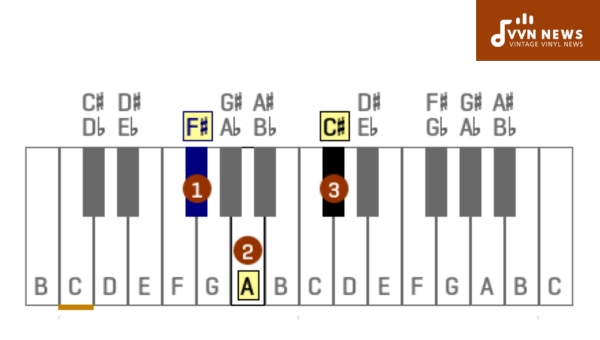
The F Sharp Minor Triad is a three-note chord that consists of the notes F#, A, and C#. It is derived from the F# natural minor scale and represents the chord built on the root note of F#.
The F Sharp Minor Triad has a melancholic and somber quality, commonly associated with sadness or introspection.
Its sound can be described as dark and mysterious yet beautiful. The triad is formed by stacking a minor third interval (F# to A) and a major third interval (A to C#).
This combination creates the distinctive minor sound that is characteristic of the triad.
Also Read: B Minor Pentatonic Scale [Inject Your Music With Dramatic Flair]
How to form an F Sharp Minor Triad?

Forming an F Sharp minor triad is straightforward once you recognize the structure of a minor triad and the F Sharp minor scale. Here’s how you can create this chord:
- Start with the F Sharp Minor Scale: The F Sharp minor scale consists of the following notes: F#, G#, A, B, C#, D, E. Every note in this scale will be used to form the triad.
- Determine the Root Note: The root note of the triad is F#. It serves as the foundation for the entire chord.
- Identify the Third Interval: To form a minor triad, we need to play a minor third interval above the root note. In this case, count three semitones up from F#, which gives us A.
- Find the Fifth Interval: Lastly, we need to add a perfect fifth interval from our root note. Count seven semitones up from F#. This brings us to C#.
- Combine all Three Notes: Now that we have identified the root note (F#), the third interval (A), and the fifth interval (C#), we can combine these three notes to form an F Sharp Minor Triad.
Remember that every instrument has its unique way of playing chords, so you may need to adjust fingerings or positions accordingly when playing this chord on different instruments such as guitar or piano.
Playing a F Sharp Minor Triad on Different Instruments
Playing an F Sharp minor triad on different instruments can be an exciting way to explore the unique sound and character of this chord.
Here is a breakdown of how you can play the F Sharp minor triad on some popular instruments:
Piano/Keyboard
- To play the F Sharp minor triad on the piano, position your right hand with your thumb (1) on F#, your middle finger (3) on A, and your pinky finger (5) on C#.
- For a fuller sound, you can add additional octaves to each note by playing them at different heights on the keyboard.
Guitar
- On the guitar, there are multiple ways to play the F Sharp minor triad. Here is one common shape:
- Place your index finger on the 2nd fret of the low E string (F#).
- Position your ring finger on the 4th fret of the A string (C#).
- Lastly, place your pinky finger on the 4th fret of the D string (A).
- Another option is to use barre chords or different voicings across the guitar neck.
Bass Guitar
- On a bass guitar, playing an F Sharp minor triad involves using power chords or simplified versions of full triads.
- Place your index finger on the 2nd fret of the E string (F#).
- Position your ring or pinky finger across all strings at the 4th fret for A and C# notes.
- Alternatively, you can experiment with different fingering patterns that suit your playing style.
Woodwinds and Brass Instruments
- For woodwind and brass instruments that use traditional sheet music notation, playing an F Sharp minor triad would involve reading and playing the correct notes for F#, A, and C# as indicated on the sheet music.
- The fingerings or positions specific to your instrument is important for accurate execution.
These are just standard ways to play the F Sharp minor triad on each instrument. As you become more comfortable and experienced, feel free to explore different inversions, positions, and variations to enhance your musical creativity.
Also Read: B Flat Minor Pentatonic Scale [Create Emotive Music In Minutes]
Variations of F Sharp Minor Triad Inversions

In music theory, inversions refer to different arrangements of the notes within a chord. They can provide distinct tonal characteristics and add variety and complexity to a musical composition.
When it comes to the F Sharp Minor Triad, there are three main inversions: root position, first inversion, and second inversion. Let’s explore each one in detail.
Root Position
The root position of the F Sharp Minor Triad is the most fundamental arrangement of the chord.
It consists of F#, A, and C# played in that order from the lowest pitch to the highest.
In the root position, the root note (F#) is at the bottom, followed by the minor third (A), and finally, the perfect fifth (C#).
This arrangement provides stability and serves as a reference point for other inversions.
First Inversion
To create a first inversion F Sharp Minor Triad, we take the first note of the root position (F#) and move it an octave higher.
This results in an A at the bottom, followed by C# and F#. The first inversion adds a unique character to the chord, with a slightly brighter sound compared to the root position.
Second Inversion
In contrast to the previous inversions, the second inversion places C# as the lowest note, followed by F# and A.
This configuration produces an even brighter and more open sound compared to both root position and first inversion.
These variations allow musicians to experiment with different harmonic possibilities in their compositions or arrangements.
By utilizing inversions effectively, one can create dynamic chord progressions that engage listeners and evoke specific emotions.
Also Read: A Flat Minor Pentatonic Scale [Unleash Subtle Tension In Your Music]
Guitar and Piano Guide for F Sharp Minor Triad Inversions
In this guide, I will walk you through the different inversions of the F# minor triad on the guitar and piano.
Triad inversions are vital for expanding your chord vocabulary and creating interesting musical arrangements.
Guitar:
To play the F# minor triad on the guitar, we’ll use three basic shapes. Let’s start with the root position inversion, where the root note is played as the lowest note:
- Root Position: Place your index finger on the 2nd fret of the low E-string (F#). Now, place your ring finger on the 4th fret of the A-string (C#), and your pinky finger on the 4th fret of the D-string (A).
- First Inversion: For this inversion, place your index finger on the 2nd fret of the D-string (A). Your middle finger should be on the 3rd fret of G-string (E), and your pinky on the 4th fret B string (F#).
- Second Inversion: Start by placing your index finger on the 9th fret of the A-string (C#). Your ring finger should be placed on the 11th fret of the D-string (F#), and your pinky finger at the 11th fret G string (A).
Piano:
On the piano, playing F# minor triad inversions can be achieved by moving around notes in different positions:
- Root Position: Begin with your right hand by placing your thumb on F#, index finger on A, and middle finger on C#. This arrangement represents the root position.
- First Inversion: To play a first inversion, move each note up by one key above their previous positions. So now, your thumb plays A, your index finger plays C#, and your middle finger covers E.
- Second Inversion: Shift your hand so that your thumb is on C#, index finger on E, and middle finger on F#. This arrangement represents the second inversion.
Remember that inversions allow us to create smooth transitions between chords.
Experiment with these variations across different octaves on both guitar and piano to uncover unique sounds and create captivating musical progressions.
With these inversions, you’ll have a strong foundation for exploring further chord voicings in your compositions, improvisation, and accompaniment.
As you practice these shapes in different keys, their versatility will become increasingly apparent.
Also Read: G Sharp Minor Pentatonic Scale [Add Dimension To Your Music]
Songs Incorporating F Sharp Minor Triad

The F Sharp Minor Triad is a versatile and expressive chord that has been used in countless songs across different genres.
This chord adds depth, tension, and emotion to musical compositions.
Whether you’re a musician looking to expand your repertoire or simply interested in exploring the sounds of this triad, here are a few popular songs that incorporate the F Sharp Minor Triad.
1. “Hotel California” – The Eagles
The iconic guitar-driven intro of “Hotel California” showcases the F#m triad, creating a hauntingly melancholic atmosphere.
The chord is played as a barre chord on the second fret of the guitar, creating a rich and distinct sound.
2. “Someone Like You” – Adele
Adele’s emotional ballad “Someone Like You” beautifully illustrates the power of the F#m triad on the piano.
The repeated progression of F#m – D – A/E emphasizes the sorrowful tone of the song.
3. “Nothing Else Matters” – Metallica
Metallica’s classic ballad features a prominent use of the F#m triad, adding to its heavy and introspective feel.
The chord is powerfully strummed on an electric guitar, evoking emotions of longing and introspection.
4. “Over My Head (Cable Car)” – The Fray
In this popular hit by The Fray, an acoustic guitar plays an arpeggiated version of the F#m chord throughout much of the song.
This creates a delicate and vulnerable sound that complements the introspective lyrics.
5. “Hallelujah” – Leonard Cohen
Leonard Cohen’s timeless masterpiece “Hallelujah” features several variations of the F#m triad.
This complex composition showcases the versatility and emotional impact that can be achieved with this chord.
6. “Creep” – Radiohead
Radiohead’s haunting anthem “Creep” also uses the F#m triad to great effect.
The chord progression of F#m – E – D – A captures the song’s brooding and introspective atmosphere, making it an unforgettable anthem.
By studying these songs and exploring their use of this chord, you can gain a deeper understanding of its versatility and potential applications in your musical endeavors.
Also Read: D Minor Pentatonic Scale [Make Your Music Sing With Emotion]
FAQs about the F Sharp Minor Triad
What notes make up an F Sharp Minor Triad?
A F Sharp Minor Triad consists of the notes F#, A, and C#.
How do you form an F Sharp Minor Triad?
To form an F Sharp Minor Triad, start with the root note F#, then add the minor third (A) and the perfect fifth (C#).
Can I play an F Sharp Minor Triad on different instruments?
Yes, you can play an F Sharp Minor Triad on various instruments such as guitar, piano, keyboard, and even strings like violin or cello.
Are there different inversions of the F Sharp Minor Triad?
Yes, the F Sharp Minor Triad can be inverted to create different voicings. The first inversion is A-C#-F#, while the second inversion is C#-F#-A.
Are there other triads associated with the F Sharp Minor scale?
In addition to the F Sharp Minor Triad, other triads associated with the F Sharp Minor scale include A Major (the relative major), E Major (the dominant), B Major (the subdominant), and D# Diminished.
Conclusion
The F Sharp Minor Triad is a powerful and versatile chord in music theory. Its distinct sound and unique structure make it a popular choice for composers and musicians across various genres.
Understanding how to form and play the F Sharp Minor Triad on different instruments will expand your musical repertoire.
By exploring inversions, associated scales, chord progressions, and songs that incorporate this triad, you can further enhance your application of the F Sharp Minor Triad.
Embrace the musical possibilities this chord offers and let your creativity soar.