
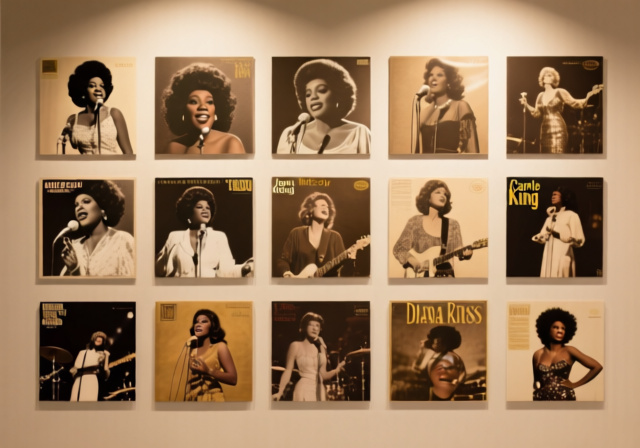
The female singers of the 1960s and 1970s were revolutionary artists who transformed popular music across folk, rock, soul, and country genres, using their powerful voices to address social issues and express personal experiences during decades of significant cultural change.
These women broke industry barriers through exceptional songwriting, powerful vocals, and cultural influence during the civil rights and women’s liberation movements, becoming some of the first female artists to write their own songs, produce albums, and achieve commercial success while addressing themes of independence and social justice.
The 1960s and 1970s represented a golden age for female vocalists, with artists like Aretha Franklin, Joni Mitchell, and Carole King not only achieving massive commercial success but also fundamentally changing how women were perceived in the music industry. From the folk revival in Greenwich Village to the soul explosion in Detroit and the rock revolution in Laurel Canyon, female singers weren’t just participants—they were leaders who shaped the sound and direction of popular music.
In this comprehensive guide, I’ll explore the iconic voices that defined these transformative decades, examining their musical innovations, cultural impact, and lasting influence on generations of artists who followed. You’ll discover how these women overcame industry barriers, created timeless music, and changed the course of music history forever.
Table of Contents
The Musical Revolution: How Women Transformed 60s and 70s Music
The musical landscape of the 1960s and 1970s was fundamentally reshaped by female artists who brought new perspectives, vocal techniques, and songwriting approaches to popular music. This transformation occurred against the backdrop of major social movements including civil rights, women’s liberation, and anti-war activism, creating a perfect storm of artistic innovation and cultural change.
The folk revival of the early 1960s opened doors for female singer-songwriters like Joan Baez and Judy Collins, who proved that women could command audiences with just their voices and acoustic guitars. Their success paved the way for the confessional songwriting movement that would dominate the 1970s, with artists like Carole King and Carly Simon turning personal experiences into universally relatable hits.
Simultaneously, the Motown revolution in Detroit created unprecedented opportunities for Black female artists. Diana Ross and The Supremes became international superstars, while Aretha Franklin emerged from gospel roots to become the “Queen of Soul,” using her powerful voice to soundtrack the civil rights movement with anthems like “Respect” and “(You Make Me Feel Like) A Natural Woman.”
The rock explosion of the late 1960s and early 1970s saw women like Janis Joplin and Grace Slick challenge gender norms with their raw, powerful performances, proving that women could rock as hard as their male counterparts. This breakthrough opened doors for later rock pioneers like Stevie Nicks and Pat Benatar, who would achieve massive success in the latter half of the 1970s.
Throughout these decades, female singers weren’t just creating music—they were building communities, supporting each other’s careers, and collectively changing the industry’s perception of what women could achieve. The Laurel Canyon scene in Los Angeles became a creative hub where artists like Joni Mitchell, Carole King, and Linda Ronstadt collaborated and inspired each other, creating some of the most enduring music of the era.
Iconic Female Singers Who Shaped The Soundtrack Of A Generation (September 2026)
1. Aretha Franklin – The Soul Revolutionary
Aretha Franklin stood at the forefront of both musical and social revolution, transforming gospel traditions into powerful soul anthems that became the soundtrack of the civil rights movement. Her 1967 album “I Never Loved a Man the Way I Love You” marked her arrival as a major force, featuring the iconic “Respect”—a song originally written and recorded by Otis Redding that Franklin completely reimagined as a declaration of female empowerment.
Franklin’s technical innovations extended beyond her vocal prowess. She was among the first female artists to demand and receive creative control in the studio, arrangements that blended gospel, jazz, and blues into something entirely new. Her piano playing provided the foundation for many of her biggest hits, and her ability to reinterpret songs made them entirely her own.
Throughout the 1970s, Franklin continued to evolve musically while maintaining her status as a cultural icon. Albums like “Young, Gifted and Black” (1972) and “Amazing Grace” (1972) showcased her versatility and spiritual depth, while her collaborations with contemporary artists kept her sound fresh and relevant. By the time she became the first woman inducted into the Rock and Roll Hall of Fame in 1987, she had already secured her place as one of the most influential musicians of the 20th century.
Franklin’s influence extends far beyond her impressive 18 Grammy Awards and 75 million records sold. She paved the way for countless female artists across genres, from Whitney Houston to Beyoncé, demonstrating that women could be both commercially successful and artistically innovative while maintaining control over their careers and creative output.
2. Joni Mitchell – The Songwriting Genius
Joni Mitchell emerged from the Canadian folk scene to become one of the most innovative songwriters of the 20th century, known for her poetic lyrics, unique guitar tunings, and willingness to push musical boundaries. Her 1971 masterpiece “Blue” is frequently cited as one of the greatest albums ever recorded, featuring deeply personal songs about love, loss, and self-discovery that influenced generations of confessional songwriters.
Mitchell’s technical innovations were revolutionary. She developed a distinctive approach to open guitar tunings, creating complex chord progressions that gave her music a unique harmonic quality. Her vocal style, characterized by its wide range and emotive phrasing, could convey both vulnerability and strength within the same song, creating an intimate connection with listeners.
Throughout the 1970s, Mitchell continued to evolve musically, incorporating jazz elements into albums like “Court and Spark” (1974) and “Hejira” (1976). Her collaborations with jazz musicians like Charles Mingus and Jaco Pastorius further expanded her musical vocabulary, creating fusion works that transcended genre boundaries and influenced both folk and jazz communities.
Mitchell’s influence on contemporary artists is immeasurable. Prince called her his favorite songwriter, while Taylor Swift has cited Mitchell’s confessional approach as a major influence on her own writing. Her willingness to experiment with different musical styles while maintaining lyrical depth has inspired artists across genres to push their own creative boundaries.
3. Carole King – From Brill Building to Tapestry
Carole King’s journey from Brill Building songwriter to solo superstar represents one of the most remarkable transformations in pop music history. After writing dozens of hits for other artists in the 1960s including “Will You Love Me Tomorrow” for The Shirelles and “(You Make Me Feel Like) A Natural Woman” for Aretha Franklin, King stepped into the spotlight with her 1971 album “Tapestry,” which stayed on the Billboard charts for over six years.
“Tapestry” was revolutionary in its intimate approach and emotional honesty. Songs like “It’s Too Late,” “I Feel the Earth Move,” and “You’ve Got a Friend” captured the complexities of relationships and personal growth with a directness that resonated with millions of listeners. The album’s success—selling over 25 million copies worldwide—proved that deeply personal songwriting could achieve massive commercial appeal.
King’s piano-based songwriting style became a template for countless singer-songwriters who followed. Her ability to blend pop sensibilities with personal lyrics created a new standard for confessional songwriting, while her success as a female artist in a male-dominated industry opened doors for other women to pursue similar careers.
Beyond her own recorded work, King’s songwriting legacy includes 118 Billboard hits, making her one of the most successful songwriters in pop music history. Her influence can be heard in artists as diverse as Alicia Keys, Sara Bareilles, and Ed Sheeran, all of whom have cited King’s blend of technical skill and emotional honesty as a major inspiration.
4. Diana Ross – Motown Royalty and Solo Pioneer
Diana Ross rose to fame as the lead singer of The Supremes, Motown’s most successful act with 12 number-one hits, before launching a solo career that would establish her as one of the most iconic entertainers of the 1970s. Her transition from group member to solo star set a template for other artists seeking similar paths, while her success demonstrated the commercial viability of Black female artists in the mainstream pop market.
Ross’s solo work in the 1970s showcased remarkable versatility. From the disco-infused “Love Hangover” (1976) to the dramatic ballad “Home” from “The Wiz” soundtrack, she proved capable of excelling across multiple genres and styles. Her 1973 Central Park concert drew an estimated 500,000 people, cementing her status as a major live attraction.
As an actress, Ross broke new ground with her portrayal of Billie Holiday in “Lady Sings the Blues” (1972), earning an Academy Award nomination for Best Actress. This achievement demonstrated that female musicians could successfully transition to acting, opening doors for future artists like Whitney Houston and Lady Gaga.
Ross’s influence extends beyond her musical achievements to her role as a fashion and cultural icon. Her glamorous style and stage presence set standards for live performance, while her ability to reinvent herself musically across decades has inspired artists from Madonna to Beyoncé, who have cited Ross as a major influence on their own careers.
5. Tina Turner – The Queen of Rock ‘n Roll
Tina Turner’s journey from the Ike & Tina Turner Revue to solo superstardom represents one of music’s most remarkable comeback stories. After leaving an abusive marriage and partnership in the 1970s, Turner rebuilt her career from scratch, emerging in the 1980s as a solo superstar with albums like “Private Dancer” (1984). However, her work in the 1960s and 1970s laid the groundwork for this later success.
With the Ike & Tina Turner Revue, Turner created electrifying performances that blended rock, soul, and R&B into something entirely new. Songs like “River Deep – Mountain High” (1966) and “Proud Mary” (1971) showcased her raw vocal power and dynamic stage presence, influencing countless rock and soul performers who followed.
Turner’s ability to channel pain and struggle into powerful performances created a new template for emotional authenticity in popular music. Her resilience in overcoming personal and professional challenges inspired generations of artists, particularly women facing similar obstacles in the music industry.
Today, with over 100 million records sold and 12 Grammy Awards to her name, Turner is recognized as one of the most successful female artists in music history. Her influence can be heard in artists from Mick Jagger (who cited her as a major influence) to contemporary performers like Janelle Monáe, who have incorporated elements of Turner’s style into their own work.
6. Joan Baez – Folk Voice of a Generation
Joan Baez emerged as a leading voice in the folk revival of the early 1960s, using her clear soprano voice and commitment to social justice to become one of the most important protest singers of her generation. Her early recordings introduced traditional folk songs to new audiences, while her original compositions addressed issues of peace, civil rights, and social justice.
Baez’s introduction of Bob Dylan to mainstream audiences at the 1963 Newport Folk Festival marked a pivotal moment in music history, but her own contributions should not be overlooked. Songs like “We Shall Overcome” became anthems of the civil rights movement, while her anti-war stance during the Vietnam era made her a target of government surveillance but also a hero to the anti-war movement.
Throughout the 1970s, Baez continued to evolve musically while maintaining her commitment to social activism. Her 1975 album “Diamonds & Rust” represented a artistic high point, featuring title track that reflected on her relationship with Dylan and became one of her most enduring songs.
Baez’s influence extends beyond her musical achievements to her role as a pioneer for female artists who wanted to combine music with activism. Her willingness to use her platform for social causes inspired later artists like Buffy Sainte-Marie and Tracy Chapman, while her longevity as a performer—still touring into her 80s—demonstrates the enduring power of folk music and principled artistry.
7. Stevie Nicks – Rock Mystic and Fleetwood Mac Icon
Stevie Nicks joined Fleetwood Mac in 1975 and quickly became one of the most recognizable female voices in rock music, writing and singing some of the band’s biggest hits including “Dreams,” “Rhiannon,” and “Landslide.” Her mystical stage presence, distinctive vocals, and poetic songwriting created a unique brand of rock mysticism that influenced countless artists.
Nicks’s work on Fleetwood Mac’s “Rumours” (1977) represents one of the most significant contributions to rock history. The album, which documented the interpersonal tensions within the band, featured her contributions “Dreams” (the band’s only number-one single) and “Gold Dust Woman,” songs that showcased her ability to transform personal experience into universal art.
Her solo career, beginning with “Bella Donna” in 1981, further established her as a major force in rock music. The album featured collaborations with Tom Petty and the Heartbreakers and demonstrated her ability to succeed outside the Fleetwood Mac context.
Nicks’s influence on contemporary artists is profound, with artists like Haim, Florence Welch, and Taylor Swift all citing her as a major influence. Her ability to blend rock music with mystical and spiritual elements created a template for female artists who wanted to explore similar territory, while her longevity as a performer—still touring and recording—demonstrates the enduring appeal of her artistic vision.
8. Linda Ronstadt – The Versatile Vocal Chameleon
Linda Ronstadt’s remarkable vocal versatility made her one of the most successful female artists of the 1970s, with her ability to excel across country, rock, pop, and traditional Mexican music earning her the nickname “the Queen of Rock.” Her 1974 album “Heart Like a Wheel” marked her commercial breakthrough, featuring hits like “You’re No Good” and “When Will I Be Loved.”
Ronstadt’s success was built on her ability to interpret songs written by others, bringing her distinctive emotional intensity to material from songwriters like Warren Zevon, J.D. Souther, and Karla Bonoff. Her covers often became definitive versions, with her rendition of “Blue Bayou” (1977) becoming one of her signature songs.
Throughout the 1970s, Ronstadt sold over 50 million records and became one of the most successful female artists of the decade. Her success demonstrated that women could achieve massive commercial success while maintaining artistic integrity and working with diverse material.
Ronstadt’s influence extends to her role as a champion of other artists. She was among the first to record songs by emerging songwriters like Zevon and Bonoff, helping to launch their careers. Her willingness to explore different musical genres—from traditional Mexican music on “Canciones de Mi Padre” (1987) to the Great American Songbook on her Nelson Riddle collaborations—demonstrated artistic courage that inspired other artists to pursue similar musical explorations.
9. Patti LaBelle – Godmother of Soul and Disco Pioneer
Patti LaBelle’s journey from the doo-wop group The Bluebelles to the groundbreaking trio Labelle and eventually solo stardom represents one of the most remarkable evolutions in soul music history. With Labelle, she created “Lady Marmalade” (1974), a groundbreaking song that blended soul, funk, and early disco elements while introducing sexually liberated themes that pushed boundaries for female artists.
LaBelle’s powerhouse vocals and theatrical stage presence set new standards for live soul performance. Her ability to convey raw emotion while maintaining technical precision influenced countless singers who followed, while her glamorous stage costumes and elaborate presentations created templates for visual performance in soul and R&B.
Her solo work in the late 1970s, while commercially modest, laid the groundwork for her massive success in the 1980s with albums like “The Winner in You” (1986). This demonstrates her artistic perseverance and ability to evolve with changing musical trends.
LaBelle’s influence can be heard in artists from Whitney Houston to Beyoncé, who have cited her vocal technique and stage presence as major influences. Her willingness to push boundaries both musically and visually created new possibilities for female artists in soul and R&B, while her longevity as a performer—still touring and recording—demonstrates the enduring power of her artistic vision.
10. Carly Simon – Confessional Songwriter Pioneer
Carly Simon emerged in the early 1970s as a leading voice in the confessional songwriter movement, using her distinctive vocal style and brutally honest lyrics to create some of the decade’s most enduring songs. Her 1971 self-titled debut album featured “That’s the Way I’ve Always Heard It Should Be,” establishing her talent for capturing complex emotional states in accessible song form.
Simon’s breakthrough came with “You’re So Vain” (1972), a song that became a cultural phenomenon due to its mysterious subject and Simon’s refusal to reveal the inspiration behind the lyrics. This mystery, combined with the song’s sophisticated arrangement and Simon’s confident vocal performance, made it one of the defining songs of the 1970s.
Throughout the decade, Simon continued to evolve as a songwriter, exploring themes of love, relationships, and personal growth with increasing sophistication. Her 1977 album “Boys in the Trees” featured “Nobody Does It Better,” the theme from “The Spy Who Loved Me,” demonstrating her ability to write for film while maintaining her artistic identity.
Simon’s influence on confessional songwriting is profound, with artists like Alanis Morissette, Fiona Apple, and Taylor Swift all citing her direct emotional honesty as a major influence. Her willingness to address complex personal topics in her music created new possibilities for female songwriters who wanted to explore similar territory.
Regional Music Scenes: Where The Magic Happened?
The musical innovations of the 1960s and 1970s didn’t happen in isolation—they emerged from vibrant regional scenes that provided creative communities, performance venues, and collaborative environments. These geographic centers became incubators for the musical revolution that female singers helped lead.
Laurel Canyon in Los Angeles became perhaps the most famous of these scenes, with artists like Joni Mitchell, Carole King, and Linda Ronstadt living and working in close proximity. The creative community that developed there produced some of the most enduring music of the era, with frequent collaborations and cross-pollination between artists. The canyon’s relaxed atmosphere and natural beauty provided the perfect backdrop for the singer-songwriter movement that would dominate the early 1970s.
Detroit’s Motown Records created an unprecedented environment for Black female artists to achieve commercial success while maintaining artistic integrity. The label’s systematic approach to artist development, combined with its talented pool of songwriters and musicians, helped launch the careers of Diana Ross, Martha Reeves, and Mary Wells. Motown’s success in crossing over to white audiences while maintaining its roots in Black musical traditions created a model for integration in the music industry.
New York City’s Greenwich Village hosted the folk revival of the early 1960s, with venues like The Bitter End and Gerde’s Folk City providing stages for artists like Joan Baez and Judy Collins. The intellectual and political atmosphere of the Village created the perfect environment for protest music and socially conscious songwriting, while the close-knit community of folk musicians provided support and inspiration for emerging artists.
Nashville’s country music scene, while traditionally male-dominated, began opening doors for female artists like Loretta Lynn, Dolly Parton, and Tammy Wynette in the 1960s and 1970s. These women brought new perspectives to country music, addressing themes of female independence and domestic life with unprecedented honesty. Their success paved the way for later country artists like Rosanne Cash and Emmylou Harris to blend traditional country with folk and rock influences.
San Francisco’s psychedelic rock scene provided opportunities for female artists like Grace Slick of Jefferson Airplane and Janis Joplin to achieve prominence in a male-dominated genre. The city’s counter-cultural atmosphere and experimental spirit created space for women to push boundaries both musically and socially, influencing the broader women’s liberation movement.
Beyond The Music: Cultural Legacy And Social Influence
The female singers of the 1960s and 1970s weren’t just creating music—they were shaping culture and advancing social change through their art, activism, and personal examples. Their influence extended far beyond record sales and concert tickets to impact fashion, politics, and social norms.
Many of these artists became involved in the civil rights movement, using their platforms to support racial equality and social justice. Aretha Franklin’s performances at civil rights rallies and benefits provided the soundtrack for the movement, while Joan Baez’s participation in anti-war demonstrations and her refusal to pay taxes to support the Vietnam War demonstrated the potential for artists to influence political discourse.
The women’s liberation movement found powerful voices in female singers who challenged traditional gender roles through both their music and their careers. Artists like Carole King and Carly Simon demonstrated that women could write about their own experiences and achieve commercial success, while performers like Tina Turner showed that women could be powerful and independent in the male-dominated world of rock and roll.
Fashion and style became important tools for these artists to express their identities and challenge conventions. Diana Ross’s glamorous stage costumes set new standards for presentation in popular music, while Joni Mitchell’s bohemian style influenced fashion trends for decades. Stevie Nicks’s mystical witchy aesthetic created a new template for female rock performers, combining femininity with power in ways that subverted traditional expectations.
The music industry itself was transformed by the success of these female artists. Their achievements forced record labels and radio stations to take women more seriously as artists and creators, opening doors for future generations. The commercial success of albums like Carole King’s “Tapestry” and Joni Mitchell’s “Blue” proved that female-driven projects could achieve massive success, changing industry perceptions about what kinds of music could sell.
These artists also influenced each other, creating supportive networks that helped sustain them through industry challenges. The Laurel Canyon community, in particular, provided a collaborative environment where female artists could share ideas, resources, and emotional support. This sense of community and mutual support became a model for later generations of female artists seeking to navigate the challenges of the music industry.
Enduring Influence: How These Artists Changed Music Forever
The impact of the female singers of the 1960s and 1970s continues to resonate in contemporary music, with their innovations and approaches still influencing artists across genres. Their legacy can be heard not just in covers and samples but in the fundamental ways they changed what’s possible for women in music.
Modern artists frequently cite these pioneers as major influences. Taylor Swift has acknowledged the impact of Carole King’s confessional songwriting on her own work, while Beyoncé has referenced Aretha Franklin as a primary inspiration for both vocal technique and business acumen. Contemporary singer-songwriters like Brandi Carlile and Lana Del Rey draw on the emotional honesty and musical innovations of artists like Joni Mitchell and Carly Simon.
The technical innovations introduced by these artists continue to shape contemporary music. Joni Mitchell’s unique guitar tunings and harmonic approach have influenced countless guitarists, while Aretha Franklin’s gospel-inflected piano style can be heard in the work of artists like Alicia Keys and H.E.R. The vocal techniques developed by these singers—particularly their ability to convey raw emotion while maintaining technical precision—set standards that continue to influence vocal coaching and performance.
The business models pioneered by these artists remain relevant today. Aretha Franklin’s insistence on creative control in the studio anticipated the artist-producer model that would become common in later decades. Diana Ross’s successful transition from group member to solo star created a template that would be followed by artists from Beyoncé to Harry Styles. Linda Ronstadt’s genre-crossing career demonstrated the commercial potential of musical versatility in an era when artists were often expected to stay within specific genre boundaries.
The social and political consciousness of these artists continues to inspire contemporary musicians to use their platforms for advocacy. The tradition of artist activism established by figures like Joan Baez and Nina Simone can be seen in the work of modern artists like Beyoncé, H.E.R., and Janelle Monáe, who address issues of racial justice, gender equality, and social change in their music and public statements.
Perhaps most importantly, these artists fundamentally changed expectations about what women could achieve in the music industry. Their success demonstrated that women could be singer-songwriters, producers, and business leaders while maintaining artistic integrity and commercial success. This legacy continues to inspire new generations of female artists to pursue their own visions and push boundaries in whatever genres they choose to work in.
As we look back on the remarkable achievements of these pioneering women, it’s clear that their influence extends far beyond their recorded output. They changed not just what music sounded like, but who could make it and what it could address. In doing so, they created new possibilities for artistic expression and social change that continue to resonate and inspire today.