
Getting to grips with the complexities of musical notation can be a daunting task for anyone.
One essential component that enriches our knowledge of this beautiful language is the concept of diminished triads.
In today’s post, I’ll provide you with a complete guide on the G diminished triad, shedding light on its structure, application, and unique tonal characteristics.
The G Diminished Triad properly opens the world to incredible music compositions, enhancing your appreciation for various genres and their intricacies.
It’s not about simply reading sheet music; it’s about comprehending the heart and soul behind every note. You don’t need to be a seasoned musician to grasp this.
So let’s embark on the journey of unraveling the mystery behind these three little notes that pack a powerful musical punch!
Table of Contents
What Is a Diminished Triad?
In music theory, a diminished triad is a chord consisting of three notes: the root, the minor third, and the diminished fifth.
It is known for its dissonant and tense sound, often associated with suspense or tension in compositions.
The diminished triad can be constructed by stacking two minor thirds on top of each other.
To create a diminished triad, you start with a root note and then add the note that is three-half steps above it (the minor third), followed by the note that is three-half steps above the second note (the diminished fifth).
The result is a chord that has an unstable quality due to its close intervallic relationships.
The diminished triad can be written using Roman numerals as viio, indicating its function as a leading tone or dominant chord.
It is versatile and can be found in various musical genres, such as classical, jazz, and even rock music.
The diminished triad opens up exciting harmonic possibilities, allowing musicians to explore complex tonalities and create unique musical textures.
Whether you’re composing, improvising, or analyzing music, knowledge of the diminished triad adds depth and sophistication to your musical vocabulary.
The Structure of G Diminished Triad

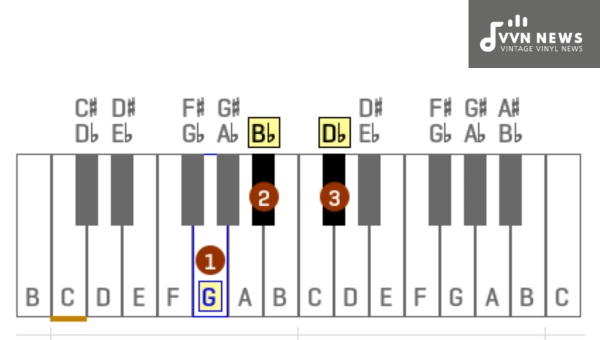
The G diminished triad is a specific variation of the diminished triad, featuring the root note G and two subsequent notes: Bb and Db. Let’s break it down step by step its structure:
- Root Note (G): The G serves as the base or starting point for the triad. It anchors the chord and gives it its tonal center.
- Minor Third Interval (Bb): The next note in the G diminished triad is Bb, which is three half steps above G. This interval creates a dissonant quality, contributing to the unique sound of the chord.
- Diminished Fifth Interval (Db): Lastly, we add Db, which is three half steps above Bb. This interval completes the diminished triad and further adds to its tense and intriguing nature.
G diminished triad consists of G as the root note, followed by a minor third interval (Bb) and a diminished fifth interval (Db).
This structure, you can effectively identify and utilize G-diminished triads in your musical compositions or improvisations.
Also Read: G Flat Diminished Triad [Discover Underrated Guitar Chords]
Common Uses of G Diminished Triad in Music
The G diminished triad is an indispensable tool for musicians to create tension and add color to their compositions.
Its unique sound can evoke a wide range of emotions and can be used in various musical contexts.
Let’s explore some common uses of the G diminished triad in music:
- Leading Tone Chord: In Western music theory, the diminished triad is often used as a leading tone chord. As the viio chord is a major key, it provides a sense of anticipation and leads naturally to the tonic chord. For example, in the key of C major, using the G diminished triad (G-Bb-Db) before resolving to C major creates tension and a strong resolution.
- Diminished Key Modulations: The G diminished triad can also be used to modulate to different keys or tonal centers. By emphasizing certain notes within the triad and resolving them into new chords, musicians can seamlessly transition between keys or create interesting harmonic progressions.
- Jazz Harmony: Jazz composers and improvisers often incorporate the diminished triad as a passing chord or substitution in their compositions. It adds chromaticism and creates movement within harmonic progressions. It is frequently found in dominant chords where it functions as an altered dominant chord or an extension of a dominant chord.
- Chord Extensions: The G diminished triad can serve as a foundation for building more complex chords through extensions and alterations. By adding additional notes such as the seventh or ninth, musicians can create rich and sophisticated harmonies that enhance their compositions.
- Soloing and Improvisation: Musicians who are soloing or improvising can use the G diminished triad as an expressive tool to create tension and release in their melodic lines. By incorporating this unique chord structure into their improvisation, they can add variety and interest to their solos.
It’s essential to note that while these are some common applications of the G diminished triad, its uses are not limited to these examples.
Musicians have limitless creative possibilities when it comes to incorporating this chord structure into their music.
How to Build and Play the G Diminished Triad

Building and playing the G diminished triad is a vital skill for any musician looking to add complexity and depth to their playing.
Follow these steps to construct the G diminished triad on your instrument of choice:
the Structure of G Diminished Triad
The G diminished triad consists of three notes: G, Bb, and Db. These notes are derived from the harmonic intervals of a minor third between each note.
Finding the Root Note
Start by locating the root note, which is G in this case. On a guitar, you can find it on the 3rd fret of the low E string or the 8th fret of the A string. On a piano, it is simply the white key that is labeled with ‘G’.
Adding the Minor Third
To find the second note, Bb, move three half steps (or frets) up from the root note.
On a guitar, this would be on the 6th fret of the same string or the 1st fret of the A string. On a piano, it is three white keys up from G.
Also Read: B Diminished Triad [Master This Unique Guitar Chord]
Including The Diminished Fifth
The final note needed to complete the G diminished triad is Db. Move another three-half steps up from Bb to reach this note.
On a guitar, you can find it on the 9th fret of either E string or any black key three white keys away from Bb on a piano.
Playing The G Diminished Triad
Now that we have all three notes – G, Bb, and Db – play them simultaneously to form the G diminished triad.
On a guitar, you can play these notes as an open chord using strings six (low E), four (D), three (G), and two (B). On a piano, you would play G, Bb, and Db with your right hand.
Experiment with Different Voicings
To add variety to your playing, explore different voicings of the G diminished triad.
These can be achieved by rearranging the order of the notes or adding additional octaves.
Experiment with different positions on the guitar fretboard or try various inversions on the piano to discover unique sounds and textures.
By following these steps and practicing regularly, you will gain proficiency in building and playing the G diminished triad.
Incorporating this chord into your musical arrangements will add depth and complexity to your compositions or improvisations.
So grab your instrument and start exploring the enchanting world of the G diminished triad!
G Diminished Triad Inversions
Inversions are a common technique used to rearrange the order of notes within a chord, creating different voicings and expanding the harmonic possibilities.
By practicing inversions, you can bring fresh perspectives to your compositions and arrangements.
The G diminished triad can be inverted in three distinct ways: first inversion, second inversion, and third inversion.
Each inversion changes the position of the notes while maintaining the same chord tones.
First Inversion
In the first inversion of a G diminished triad, we take the root note (G) and move it up an octave.
This means that the new order of notes will be Bb, Db, G. By doing so, Bb becomes the bass note of the chord instead of G.
Also Read: A Sharp Diminished Triad [Discover This Unique Chord]
Second Inversion
The second inversion involves taking the first inversion and moving it up another octave.
Thus, in this configuration, Db becomes the lowest note of the chord, followed by G and Bb.
Third Inversion
The third inversion is created by moving the second inversion up an octave. The order of notes in this case will be Bb, G, Db.
By familiarizing yourself with these inversions and practicing them on your instrument, you’ll gain greater flexibility in voicing your chords.
Experimenting with different inversions can add interesting harmonic motion to your compositions or help create melodic lines within chord progressions.
The Role of G Diminished Triad in Chord Progressions

In the realm of music theory, chord progressions form the backbone of a composition, providing structure and movement.
The G diminished triad plays a unique and important role within these progressions, adding tension, color, and a sense of resolution.
Knowing how to incorporate this chord into your compositions can elevate your musicality to new heights.
- Tonal Ambiguity: The G diminished triad has an unstable quality due to its dissonant intervals. As a result, it can be used to create tension and ambiguity in chord progressions. It adds an intriguing element that keeps the listener engaged and eager for resolution.
- Leading Tone: The G diminished triad frequently functions as a leading tone chord, leading smoothly into another chord or resolving to the tonic (the home key). Its close relationship with the tonic creates a strong pull towards resolution, making it especially effective in creating musical tension.
- Modal Interchange: In modal interchange, chords from parallel keys are borrowed to add color and variety to a composition. The G diminished triad can be borrowed from the parallel minor key (G minor) and used in major key progressions. This unexpected chord change adds depth and interest to the music.
- Diminished Seventh Chords: By adding note to the G diminished triad – namely, the diminished seventh (Fb) – you create a G diminished seventh chord. This variation of the triad is commonly used in jazz progressions as a passing or dominant chord. Its dissonant sound adds complexity to improvisation or composition.
- Secondary Dominants: The G diminished triad can also function as a secondary dominant leading to chords other than the tonic. By treating it as the vii°/V (the diminished seventh chord built on the 5th degree of another key), it creates tension and guides the ear to another chord within the progression.
It’s important to note that the G diminished triad may not always be used alone but rather as part of a larger progression.
Experiment with different chord progressions, incorporating the G diminished triad in various contexts, and pay attention to how it affects the overall mood and tension of your composition.
Also Read: B Flat Diminished Triad [Guide for Novice Musicians]
G Diminished Triad in Different Musical Genres
The G diminished triad is a versatile chord that can be found in various musical genres.
Its dissonant and tense sound adds a layer of complexity and intrigue to compositions, making it a favorite among composers and musicians alike.
Let’s explore how the G diminished triad is used in different musical genres:
Classical Music
In classical music, the G diminished triad often serves as a transitional or tension-building chord.
It is commonly used in modulations or key changes to create instability before resolving to a more stable chord.
Composers use the G diminished triad to add color and suspense to their compositions, heightening emotional tension.
Jazz
Jazz musicians frequently employ the G diminished triad as part of their improvisation toolkit.
In jazz improvisation, the diminished scale derived from the G diminished triad provides endless melodic possibilities.
It is a popular choice during chord substitutions and passing chords that add harmonic complexity and interest.
Blues
In blues music, the G diminished triad can be used as a substitute for dominant chords, adding tension and creating harmonic movement within the blues progression.
Blues guitarists often incorporate the G-diminished triad into their solos to create fiery and expressive licks that stand out.
Also Read: F Sharp Diminished Triad [Boost Your Musical Finesse Today]
Funk
Funk music thrives on rhythmic grooves and tight harmony. The use of the G diminished triad in funk adds an element of surprise and tension to funk progressions, emphasizing syncopation and maintaining rhythmic momentum.
Funk bass players often use this chord structure to create funky basslines with surprising twists.
Rock and Metal
Rock guitarists turn to the G-diminished triad for its dark and heavy sound.
It is commonly used in rock and metal power chord progressions to add depth and intensity.
The dissonance of the G diminished triad lends itself well to creating an aggressive atmosphere that suits the genre’s energy and power.
Gospel and Soul
Gospel and soul music frequently incorporate the G diminished triad to add emotional depth and richness to chord progressions.
It often appears in gospel-style passing chords, providing a distinctive sound that enhances the musical arrangement.
The G diminished triad’s tension can evoke strong emotions, creating a sense of longing or yearning in the music.
Contemporary Pop
Even in contemporary pop music, the G diminished triad can be found sprinkled throughout various songs.
It is used to create unique chord progressions that stand out from traditional major or minor tonalities.
Pop songwriters use these chords strategically to inject artistic flair into their compositions and capture listeners’ attention.
The G diminished triad finds its place across different musical genres due to its dissonant and intriguing character.
As you explore different musical genres or compose your pieces, consider incorporating the G diminished triad to elevate your harmonies and create captivating musical moments.
Also Read: G Major Triad [Revolutionize Your Music Knowledge Today]
FAQs about G Diminished Triad
Can you explain the structure of a G diminished triad?
A G diminished triad consists of the notes G, Bb, and Db, which are spaced three-half steps apart from each other.
What is the role of a G-diminished triad in music?
The G diminished triad is often used as a passing chord or a transition chord to add tension and suspense to compositions.
How do I build and play a G-diminished triad on my instrument?
To build a G diminished triad, start with the root note (G) and stack a minor third (Bb) and then another minor third (Db) above it. On the piano, you can play these notes simultaneously or individually on your instrument of choice.
Are there different inversions or voicings for the G diminished triad?
Yes, there are several inversions and voicings for the G diminished triad. These inversions involve rearranging the order of the notes while preserving the overall structure of the chord.
In what musical genres can I find examples of the G diminished triad?
The G diminished triad can be found in various musical genres, including classical music, jazz, blues, and even some rock songs. Its unique sound adds texture and complexity to compositions across different styles and genres.
Conclusion
Mastering the G diminished triad opens up a world of musical possibilities.
With its structure and applications, you can add depth and complexity to your compositions or improvisations.
Remember to experiment with different inversions and voicings to explore the full potential of this chord.
Whether you’re a pianist, guitarist, or any other instrumentalist, incorporating the G-diminished triad into your playing repertoire will undoubtedly enhance your musical journey.
So grab your instrument and start exploring the captivating world of the G diminished triad today!