
Music and its components are akin to an intricate puzzle. When we learn these elements, such as the G flat diminished triad, it opens up a new dimension of appreciation towards melodies and harmonies.
This music theory can seem intimidating at first, but rest assured, with the right guide and practice you can master this aspect of music.
The G flat diminished triad might sound complex but is quite straightforward. It forms an essential building block in the field of music theory, producing unique sounds that add depth to any piece of music.
As you explore these musical phenomena further, you’ll experience an unconventional side of music that lies beyond simple major and minor tones.
This could be the beginning of your fascinating journey into the intricate world of melody composition.
Table of Contents
What is G Flat Diminished Triad?
The G Flat Diminished Triad is a chord consisting of three notes: the root, the third, and the fifth. In the key of G flat, this triad is built on the note G flat.
In its structure, we need to explore half-steps or semitones. A half-step is the distance between two adjacent keys on a keyboard or two adjacent frets on a guitar.
In a diminished triad, each note is three half-steps apart, creating a distinct and evocative sound.
To illustrate this in music notation:
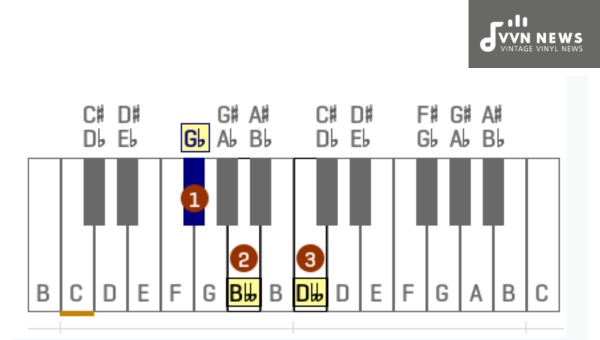
- The root note of the G Flat Diminished Triad is G flat.
- The third note is B double flat (which equates to A natural).
- The fifth note is D double flat (which equates to C natural).
This combination of notes gives the chord its distinctive flavor and contributes to its tonal complexity.
Structure of G Flat Diminished Triad: The Root, 3rd and 5th
The G Flat Diminished Triad consists of three essential notes: the root, the third, and the fifth.
The structure of this chord is crucial for musicians looking to incorporate it into their compositions or improvisation.
- The Root (G flat): The root is the foundation on which the chord is built. In the case of the G Flat Diminished Triad, the root note is G flat. It serves as the starting point and provides stability to the overall sound.
- The Third (B double flat/A natural): The third note determines whether a chord is major or minor. In this case, it’s notated as B double flat, but its enharmonic equivalent is A natural. The third contributes to the chord’s overall quality and character.
- The Fifth (D double flat/C natural): The fifth note acts as a harmonic support for the triad. In this chord, it’s notated as D double flat but can also be understood as C natural in terms of pitch.
Combining these three notes—G flat (root), B double flat/A natural (third), and D double flat/C natural (fifth)—creates the distinct tonal color of the G Flat Diminished Triad.
These notes relate to each other and are essential in grasping both theory and practical application behind diminished chords.
Also Read: D Major Triad [Unlock The Secrets Of Music Theory]
How to Play the G Flat Diminished Triad on Piano and Guitar

Learning how to play the G Flat Diminished Triad on piano and guitar might seem challenging at first, but with practice and dedication, you can master it. Let’s break it down step by step for each instrument.
Piano:
- Starting with your right hand, position your thumb on G flat (the root note). Your middle finger should rest on B double flat (the third note), and your pinky finger should be on D double flat (the fifth note).
- Keeping your fingers curved, press down all three notes simultaneously to sound the G Flat Diminished Triad.
- Practice playing the triad in its root position, consisting of G flat, B double flat (A natural), and D double flat (C natural). Experiment with different rhythms and dynamics to familiarize yourself with its sound.
- Once you’re comfortable with the root position, try playing inversions of the triad. Inversions involve rearranging the order of the notes while still maintaining the same three-note structure.
Guitar:
- To play the G Flat Diminished Triad on guitar, start by placing your index finger on the 4th fret of the low E string. This is your root note, G flat.
- Next, position your middle finger on the 4th fret of the A string (third note) and place your ring finger on the 4th fret of the D string (fifth note).
- Strum all three strings at once to sound out the triad.
- As with piano, practice playing both ascending and descending patterns using different strumming techniques, such as picking or arpeggios.
Mastering finger placement and coordination takes time and patience, so don’t get discouraged if it feels challenging at first.
Regular practice will help you develop muscle memory and improve your ability to play the G Flat Diminished Triad smoothly and fluently.
It’s worth noting that there are multiple positions on the guitar neck where you can play the G Flat Diminished Triad.
Explore different positions and experiment with playing the triad in higher or lower octaves to expand your musical vocabulary.
Also Read: F Sharp Major Triad
G Flat Diminished Triad Inversions
Inversions are a crucial concept in music theory, as they allow for different voicings and variations of a chord.
The G Flat Diminished Triad can be played in two inversions: the 1st inversion and the 2nd inversion. Let’s take a closer look at each inversion:
1st Inversion
To create the 1st inversion of the G Flat Diminished Triad, we take the root note, G flat, and move it up an octave.
This means that the 3rd note, B double flat (A natural), becomes the new bass note.
The 5th note, D double flat (C natural), moves up to become the middle note. The resulting chord is B double flat (A natural), C natural, and G flat.
Playing the 1st Inversion on Piano:
Using your right hand, place your thumb on A natural, your middle finger on C natural, and your pinky finger on G flat.
Playing the 1st Inversion on Guitar:
To play this inversion on guitar, use barre chords or partial barre chords. Place your index finger barred across all strings at the 4th fret to cover A natural, C natural, and G flat.
2nd Inversion
The 2nd inversion of the G Flat Diminished Triad involves taking the root note, G flat, and moving it up two octaves.
This places the 3rd note, B double flat (A natural), as the highest note in the chord.
The 5th note, D double flat (C natural), becomes the new bass note. The resulting chord is C natural, G flat, and B double flat (A natural).
Playing the 2nd Inversion on Piano:
Place your pinky finger on C natural, your index finger on G flat, and your thumb on A natural.
Playing the 2nd Inversion on Guitar:
Using partial barre chords, place your index finger barred across all strings at the 9th fret to cover C natural, G flat, and B double flat (A natural).
Mastering these inversions will give you flexibility and options when playing the G Flat Diminished Triad.
Practice moving between inversions smoothly to create interesting chord progressions and add depth to your musical compositions.
Also Read: G Major Triad [Revolutionize Your Music Knowledge Today]
Exploring the Keys Encompassing the G Flat Diminished Triad

When it comes to music theory, the keys that comprise a particular chord are essential for musicians and composers.
In the case of the G Flat Diminished Triad, knowing the keys involved can open up a world of possibilities for creating beautiful and captivating melodies.
Let’s take a closer look at the keys encompassing this unique triad:
The Key of G Flat Major
The G Flat Diminished Triad naturally belongs to the key of G flat major. This key contains six flats: B flat, E flat, A flat, D flat, G flat, and C flat.
The diminished triads in this key are built on the 7th (F flat), 2nd (A flat), and 5th (D flat) degrees of the G flat major scale.
Harmonic Function in Music
Diminished chords like the G Flat Diminished Triad often have interesting harmonic functions.
They can function as passing chords between other chords or provide tension that resolves to a more stable chord.
In some cases, composers may use them to create an atmosphere of suspense or melancholy in their music.
Modal Interchange and Borrowed Chords
Modal interchange is a technique often used in music composition where chords from parallel or related scales are borrowed to add variety and color to a piece.
Since G flat major is closely related to Bb minor (the relative minor), composers can borrow chords from Bb minor to enhance their compositions using modal interchange.
Also Read: A Flat Major Triad [Simplify Complex Music Theory Today]
Symmetry and Transpositions
One interesting aspect of diminished triads is their symmetry. Any note within this triad can serve as its root, which means that transposing it by moving any note up or down by a consistent interval will yield another diminished triad.
For example, if we transpose the G Flat Diminished Triad up by three half-steps, we will have a B Diminished Triad.
Common Chord Progressions
The G Flat Diminished Triad can be utilized in various chord progressions to create unique musical experiences.
For example, combining it with the tonic (G flat major), subdominant (C flat major), and dominant (D flat major) chords can provide an intriguing sequence that adds depth and intrigue to your compositions.
Exploring the keys encompassing the G Flat Diminished Triad allows musicians to expand their harmonic palette and compose rich and captivating music.
With its harmonic function, modal interchange possibilities, symmetry, and transpositions, musicians can unlock a world of creative possibilities and add complexity and emotion to their compositions.
So go ahead and experiment with the G Flat Diminished Triad in your musical journey – you never know where it might take you!
Tracks that Incorporate the Use of G Flat Diminished Chords
G Flat Diminished chords are an intriguing addition to music compositions, and many artists have incorporated them into their tracks.
These chords add tension, creating a unique atmosphere within a piece of music.
If you’re interested in exploring tracks that feature G Flat Diminished chords, here are a few noteworthy examples:
- “All the Things You Are” by Jerome Kern: This jazz standard, famously performed by artists like Ella Fitzgerald and Frank Sinatra, includes G Flat Diminished chords in its harmonic progression. The subtle yet impactful use of these chords helps to create tension and adds depth to the melodic lines.
- “I Fall in Love Too Easily” by Jule Styne: Another classic jazz ballad, this song includes G Flat Diminished chords that enhance its emotional depth. The chord’s dissonance beautifully complements the melancholic lyrics and evokes a bittersweet sentiment.
- “Blackbird” by The Beatles: In this iconic track from The Beatles’ White Album, Paul McCartney weaves G Flat Diminished chords into the fingerpicked guitar arrangement. These chords serve as transitions between sections, providing an element of surprise and adding complexity to an otherwise straightforward progression.
- “Fly Me to the Moon” by Bart Howard: This popular jazz standard has been performed by countless artists over the years. In certain renditions, including Frank Sinatra’s version, you can find G Flat Diminished chords strategically placed throughout the song, enhancing its romantic and dreamy feel.
- “Cry Me a River” by Arthur Hamilton: This emotional ballad is known for its sultry and dramatic atmosphere. Within its chord progression lies several instances of G Flat Diminished chords, adding moments of tension that heighten the song’s intensity.
These tracks offer just a glimpse into the diverse ways in which G Flat Diminished chords can be utilized in music.
From jazz standards to classic rock ballads, this chord adds flavor and depth to compositions across various genres.
Exploring these tracks can provide valuable insights into the effectiveness and versatility of the G Flat Diminished triad.
Also Read: A Major Triad [Master This Building Block Of Music]
FAQs about the G Flat Diminished Triad
How is a diminished triad different from a major or minor chord?
A diminished triad differs from major and minor chords in that it has a unique combination of notes, creating a distinct tonal quality that is neither major nor minor.
Can the G Flat Diminished Triad be played on the piano and guitar?
Yes, the G Flat Diminished Triad can be played on both the piano and guitar by following specific fingering patterns and chord shapes.
Are there different inversions of the G Flat Diminished Triad?
Yes, the G Flat Diminished Triad can be inverted, meaning that its notes can be rearranged with a different note as the bass or lowest note in the chord.
What are some tracks or songs that use G Flat Diminished chords?
There are various songs across different genres that incorporate G Flat Diminished chords, such as “Autumn Leaves” by Joseph Kosma and “Laura” by David Raksin.
Is understanding music theory important for using the G Flat Diminished Triad effectively?
Yes, knowing music theory, including scales and chord progressions, can greatly enhance your ability to utilize and incorporate the G Flat Diminished Triad effectively in your compositions or improvisations.
Conclusion
The G Flat Diminished Triad may seem complex, but its structure and significance can greatly enhance your music theory.
By knowing the root, third, and fifth notes that make up this chord, you can play it on instruments like the piano or guitar.
Exploring inversions and different keys where the G Flat Diminished Triad can be used opens up a whole new world of musical possibilities.
So, whether you’re a musician or simply interested in expanding your knowledge of music theory, take the time to explore and experiment with the G Flat Diminished Triad—unleash your creativity and add a touch of musical complexity to your compositions.