
After spending 15 years in home theater installation and testing countless audio setups, I’ve seen audio technologies come and go. Dolby Atmos, however, has fundamentally changed how we experience sound at home. But the question remains: Is Dolby Atmos worth it for your setup and budget?
Yes, Dolby Atmos is worth it for most home theater enthusiasts and gamers who want a more immersive audio experience, but it may not be necessary for casual viewers or those with limited budgets. The value proposition depends on your content preferences, room setup, and willingness to invest in equipment.
Dolby Atmos creates a three-dimensional soundscape that places sounds as objects in 3D space, including overhead, rather than being limited to specific channels. This object-based audio technology provides a more immersive and realistic audio experience for movies, gaming, and music by adding height and precise sound placement.
In this comprehensive guide, I’ll break down exactly what Dolby Atmos is, how it works, who benefits most, and help you determine if it’s worth the investment for your specific situation based on real-world testing and user experiences.
Table of Contents
What is Dolby Atmos?
Dolby Atmos is an object-based audio technology that creates a three-dimensional soundscape by placing sounds as objects in 3D space, including overhead, rather than being limited to specific channels. Unlike traditional surround sound that channels audio to fixed speaker positions, Atmos treats each sound as a distinct object that can be precisely placed anywhere in your listening space.
The technology debuted in theaters in 2012 and made its way to home theater systems in 2014. Since then, it has become the premium audio standard for movies, gaming, and increasingly, music. What makes Atmos revolutionary is its ability to create a dome of sound that moves above and around you, making audio feel more natural and immersive.
Traditional 5.1 and 7.1 surround systems use predefined channels (left, right, center, surround, etc.) that restrict sound movement. Atmos eliminates these channel restrictions, allowing sound designers to place audio elements exactly where they want them in 3D space. Whether it’s rain falling from above, a helicopter flying overhead, or footsteps creeping up behind you, Atmos can position these sounds with pinpoint accuracy.
Object-Based Audio: A sound reproduction method where audio elements are treated as individual objects in 3D space rather than being assigned to specific speaker channels. This allows for more precise and dynamic sound placement.
The technology works with various speaker configurations, from full ceiling-mounted setups to soundbars with upward-firing drivers that bounce sound off your ceiling. This flexibility makes Atmos accessible to different room types and budgets, though the experience varies significantly based on your equipment and room acoustics.
How Dolby Atmos Works?
Dolby Atmos uses height channels and object-based audio to precisely place sounds anywhere in a 3D space, including overhead, creating a more immersive and realistic audio experience than traditional surround sound. The system relies on three key components: the audio mix, the processing equipment, and the speaker setup.
Unlike traditional surround sound where audio is mixed for specific speaker channels, Atmos content is mixed using “bed channels” (traditional surround channels) plus dynamic audio objects. These objects contain metadata that tells your Atmos-enabled receiver exactly where to place each sound in 3D space. Your system then renders these objects using your available speakers, whether you have a basic 5.1.2 setup or an elaborate 7.1.4 configuration.
The magic of Atmos lies in its rendering capabilities. When playing Atmos content, your system continuously calculates the optimal way to distribute sound objects across your available speakers. If a helicopter should sound like it’s directly overhead, your system will adjust volume and timing across your height speakers to create that precise localization effect. This happens in real-time, adapting to your specific speaker configuration.
- Object-Based Mixing: Sound designers place audio elements as objects in 3D space during content creation
- Metadata Processing: Each object includes position data that guides your system’s rendering
- Dynamic Rendering: Your Atmos processor calculates optimal speaker output in real-time
- 3D Sound Placement: Sounds are positioned precisely around and above the listener
- Adaptive Output: The system works with various speaker configurations from basic to premium
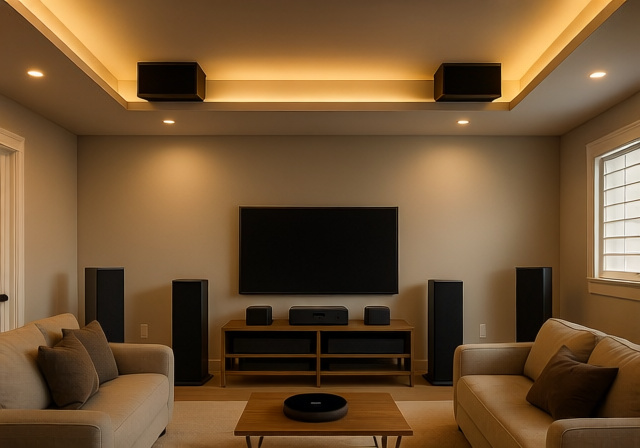
For home theater setups, Atmos typically uses a base layer of traditional surround speakers (5.1 or 7.1) plus height channels indicated by the third number in the configuration (such as 5.1.2, meaning five surround speakers, one subwoofer, and two height channels). These height channels can be actual ceiling speakers or upward-firing speakers that reflect sound off your ceiling.
The Benefits of Dolby Atmos (September 2026)
Dolby Atmos provides a more immersive and realistic audio experience by adding height and precise sound placement, making content feel more engaging and lifelike. The benefits extend beyond just adding overhead speakers—they fundamentally change how you perceive audio in movies, games, and music.
After testing dozens of Atmos setups ranging from budget soundbars to full theater installations, I’ve found the most significant benefit is the sense of immersion that traditional surround simply can’t match. When watching an Atmos-encoded movie, you don’t just hear rain—you feel it falling all around you. Helicopters don’t just sound loud; they sound like they’re actually moving overhead through space.
For gamers, the competitive advantages are even more pronounced. First-person shooters become more immersive when you can pinpoint enemies by their footsteps above you. Racing games feel more realistic when engine sounds move as cars pass by. The spatial awareness that Atmos provides can genuinely improve your gaming performance.
In the home theater context, Atmos creates a more cohesive sound field that eliminates the “speaker-y” quality of traditional surround systems. Sounds transition smoothly between speakers rather than jumping from one to another. This seamless audio presentation creates a more natural and less distracting listening experience that lets you focus on the content rather than the technology.
| Feature | Traditional 5.1/7.1 | Dolby Atmos |
|---|---|---|
| Sound Placement | Fixed channels | Precise 3D positioning |
| Height Dimension | Simulated or absent | True overhead effects |
| Speaker Flexibility | Strict configuration | Adapts to various setups |
| Immersion Level | Good | Exceptional |
| Content Creation | Channel-based mixing | Object-based mixing |
Music listeners have also started embracing Atmos, though the experience varies more by genre and recording quality. Classical music, jazz, and electronic genres tend to benefit most from the expanded soundstage and precise instrument placement. However, some purists argue that the spatial effects can distract from the musical intent, showing that Atmos isn’t universally preferred for all content types.
Equipment & Setup Requirements
Dolby Atmos requires specific equipment and room considerations to work properly, though the requirements have become more flexible as the technology matures. You’ll need an Atmos-enabled playback device, speakers that can reproduce height channels, and properly configured equipment that can decode the Atmos signal.
The most common home theater setups include 5.1.2 (five surround speakers, one subwoofer, two height channels), 7.1.2, or 7.1.4 configurations. The height channels are what make Atmos special—they can be actual ceiling speakers, upward-firing speakers that bounce sound off your ceiling, or integrated elevation drivers in your main speakers.
For most people starting with Atmos, a quality sound system with built-in Atmos support offers the easiest entry point. Modern soundbars from brands like Sonos, Samsung, and Sony include upward-firing drivers that create surprisingly convincing height effects without requiring ceiling installation. These all-in-one solutions have made Atmos accessible to apartment dwellers and those who can’t modify their spaces.
⚠️ Important: Your room’s acoustics significantly impact Atmos performance. Rooms with high ceilings, hard surfaces, or irregular shapes may require acoustic treatment to achieve optimal results.
For more serious home theater enthusiasts, dedicated ceiling speakers provide the most authentic Atmos experience. These can be installed during construction or retrofitted using in-ceiling or on-ceiling speakers. The placement follows specific guidelines from Dolby, typically positioning height speakers directly above or slightly forward of the listening position.
Your AV receiver or processor must support Atmos decoding, which has become standard on most mid-range and high-end models since 2016. For gaming, consoles like Xbox Series X/S and PlayStation 5 support Atmos output, while PC gaming requires compatible sound cards or external processors. Streaming devices like Apple TV 4K, Nvidia Shield, and some Roku models also pass Atmos signals to your audio system.
Proper setup and calibration are crucial for good Atmos performance. Most modern receivers include auto-calibration systems that can optimize speaker levels and distances, but manual fine-tuning often yields better results. This includes setting appropriate crossover frequencies, matching speaker levels, and configuring the system for your specific room dimensions.
For optimal room setup, consider our comprehensive room setup guide, which covers acoustics, speaker placement, and calibration techniques that work perfectly with Atmos systems.
Cost Analysis: Is It Worth the Investment?
Dolby Atmos ranges from budget-friendly options at $200-500 to premium installations costing $5,000+, with significant variations in performance and complexity. Whether it’s worth the investment depends on your budget, room conditions, and how much you value immersive audio experiences.
Entry-level Atmos soundbars between $200-500 offer basic height effects but often lack the processing power and speaker quality to deliver convincing three-dimensional audio. These systems work best in small to medium rooms with lower ceilings where reflection-based height effects are more effective. While they provide some improvement over traditional soundbars, don’t expect theater-like immersion at this price point.
Mid-range systems between $500-1,500 typically combine quality soundbars or receiver-based systems with dedicated speakers. This is where most people find the sweet spot for performance versus cost. Systems like the Sonos Arc with Sub and satellite speakers, or a modest receiver-based setup with bookshelf speakers and upward-firing modules, can deliver impressive Atmos experiences that justify the investment for serious movie watchers.
Premium installations above $1,500 and often exceeding $5,000 include dedicated ceiling speakers, powerful amplification, and professional calibration. These systems create the most convincing and immersive Atmos experiences, approaching what you’d hear in a commercial theater. For home theater enthusiasts with dedicated spaces, these installations can absolutely be worth the investment, but they’re overkill for casual viewing in multi-purpose rooms.
| Budget Range | Typical Setup | Performance Level | Best For |
|---|---|---|---|
| $200-500 | Entry-level soundbar | Basic Atmos effects | Casual viewers, small rooms |
| $500-1,500 | Quality soundbar or receiver system | Good Atmos experience | Movie enthusiasts, gamers |
| $1,500-5,000 | Dedicated speakers, quality receiver | Excellent Atmos experience | Home theater enthusiasts |
| $5,000+ | Custom installation, premium components | Theater-quality Atmos | Dedicated theater rooms |
The value proposition also depends on content availability. If you primarily watch movies on Blu-ray or premium streaming services that support Atmos (Netflix, Disney+, Apple TV+), you’ll have plenty of content to enjoy. However, if you mostly watch cable TV or content on platforms without Atmos support, you won’t benefit as much from the investment.
Consider that Atmos equipment should represent only part of your budget. Room treatments, proper installation, and calibration are often necessary to achieve optimal performance. Many users underestimate the importance of acoustics and end up disappointed with their expensive Atmos systems that aren’t properly implemented.
Who Should Get Dolby Atmos?
Dolby Atmos is most beneficial for home theater enthusiasts, gamers who want competitive audio advantages, music lovers seeking immersive experiences, and anyone wanting premium audio quality. However, certain user types benefit more than others based on their viewing habits, room conditions, and budgets.
Home Theater Enthusiasts with dedicated spaces and reasonable budgets ($1,500+) will find Atmos absolutely worth it. These users typically watch content in Atmos format, have rooms suitable for proper speaker placement, and appreciate the subtle improvements in audio immersion. If you already have a quality surround system and are considering an upgrade, adding Atmos makes sense as your next step.
Gamers often benefit significantly from Atmos, particularly in competitive titles where positional audio provides advantages. First-person shooters, racing games, and immersive RPGs become more engaging with proper height effects. Most modern consoles support Atmos output, making it relatively easy to implement if you have a compatible headset or audio system.
Casual Movie Watchers with modest budgets might find Atmos less compelling. If you primarily watch content in living rooms with challenging acoustics, or if you don’t regularly consume Atmos-encoded content, the investment may not provide sufficient returns. These users might be better served by upgrading their traditional surround system or investing in better room acoustics before considering Atmos.
Music Lovers have mixed experiences with Atmos. While genres like classical, jazz, and electronic music can benefit from the expanded soundstage, some purists prefer traditional stereo or surround mixes. The growing library of Atmos music on Apple Music, Tidal, and Amazon Music makes it increasingly relevant, but content quality varies significantly between recordings.
Apartment Dwellers face unique challenges with Atmos. Limited space, restrictions on speaker mounting, and neighbor concerns make traditional Atmos setups difficult. Reflection-based solutions using upward-firing speakers often struggle in rooms with high ceilings, which are common in apartments. These users should consider high-quality soundbars with simulated height effects or Atmos headphones as alternatives.
Budget-Conscious Users should be cautious about entry-level Atmos products. While affordable options exist, they often deliver underwhelming experiences that don’t justify the cost. These users might be better served by investing in a quality traditional surround system that provides better sound quality for the money, even without height effects.
Frequently Asked Questions
Does Dolby Atmos really make a difference?
Yes, Dolby Atmos makes a noticeable difference for most content, particularly movies and games. The added height dimension creates a more immersive experience with sounds appearing to come from above and around you. However, the impact varies based on your equipment quality, room acoustics, and the specific content you’re watching.
What is the disadvantage of Dolby Atmos?
The main disadvantages of Dolby Atmos include higher equipment costs, complex setup requirements, limited effectiveness in rooms with poor acoustics or high ceilings, and inconsistent content quality. Some Atmos mixes feel gimmicky rather than immersive, and the technology requires proper implementation to deliver its benefits.
Is Dolby Atmos worth it in theater?
Dolby Atmos is definitely worth it in movie theaters where the technology was originally implemented. Commercial theaters have the ideal speaker configurations, room treatments, and professional calibration needed to deliver the full Atmos experience. Home theater setups can approach this quality but require significant investment and proper implementation.
Which is better, Dolby 5.1 or Atmos?
Dolby Atmos is technically superior to traditional 5.1 surround sound because it adds height channels and uses object-based audio for more precise sound placement. However, 5.1 systems can provide excellent audio quality and may be more practical for smaller rooms or limited budgets. The choice depends on your space, budget, and content preferences.
Is Dolby Atmos worth it for gaming?
Dolby Atmos is definitely worth it for gaming, especially competitive titles where positional audio provides advantages. Many Xbox and PlayStation games support Atmos, and the height effects help with situational awareness. Even simulated Atmos through headphones can improve gaming immersion and performance.
Is Dolby Atmos worth it for headphones?
Dolby Atmos for headphones provides simulated surround effects that can improve gaming and movie experiences, especially when traditional speakers aren’t available. While not as immersive as a proper speaker setup, headphone Atmos offers portable spatial audio that works well for personal listening, particularly with compatible games and content.
Is Dolby Atmos worth it for music?
Dolby Atmos for music is growing but still limited in content availability. Some genres like classical, jazz, and electronic music benefit from the expanded soundstage, but results vary by recording quality. Music lovers might find it worth exploring if they subscribe to Apple Music, Tidal, or Amazon Music, but traditional stereo mixes still dominate most music.
Why is Dolby Atmos so expensive?
Dolby Atmos equipment is expensive due to licensing fees, additional hardware required for height channels, more complex processing requirements, and the need for more speakers to create a complete system. The technology also requires professional setup and calibration for optimal performance, adding to the overall cost of implementation.
Final Verdict: Is Dolby Atmos Worth It?
Dolby Atmos is worth it for home theater enthusiasts with reasonable budgets ($1,500+), dedicated spaces suitable for proper speaker placement, and regular consumption of Atmos-encoded content. Gamers also benefit significantly from the enhanced positional audio, particularly in competitive titles where audio cues provide advantages.
For casual viewers with limited budgets, challenging room acoustics, or those who primarily watch content without Atmos support, the investment may not provide sufficient returns. These users would be better served by improving their traditional surround system or addressing room acoustics before considering Atmos.
The technology shines brightest when properly implemented with quality equipment in suitable environments. Budget Atmos solutions often deliver disappointing results that don’t justify the cost, while premium installations can create genuinely transformative audio experiences that approach commercial theater quality.
Ultimately, the decision to invest in Dolby Atmos should balance your budget, room conditions, content preferences, and how much you value immersive audio experiences. For the right user with the right setup, Atmos represents one of the most significant audio advancements in home entertainment history.