
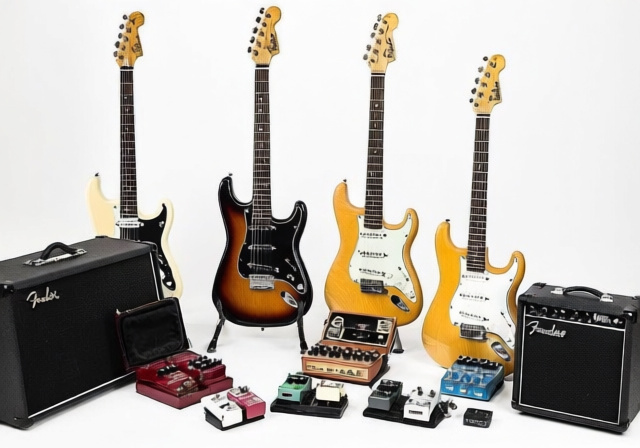
Josh Klinghoffer has carved out a unique place in guitar history through his innovative approach to tone and gear. As the youngest Rock and Roll Hall of Fame inductee at age 33, his tenure with Red Hot Chili Peppers (2009-2019) and current role with Pearl Jam showcase his versatility as a musician.
Josh Klinghoffer is a multi-instrumentalist known for his work with Red Hot Chili Peppers (2009-2019) and currently touring with Pearl Jam. His guitar setup relies primarily on vintage Fender Stratocasters through multiple amps with a complex effects chain, creating distinctive tones that bridge vintage warmth with modern versatility.
What makes Klinghoffer’s approach special is his ability to blend vintage gear sensibilities with contemporary effects. Unlike his predecessor John Frusciante, Josh developed his own sonic identity through careful gear selection and meticulous signal chain design. His setup evolved significantly during his RHCP years and continues to adapt to Pearl Jam’s different sonic requirements.
In this guide, I’ll break down every aspect of Josh’s gear setup, from his prized Stratocaster collection to his complex effects pedalboard and amplifier configuration. You’ll discover how he achieves his signature tones and learn practical tips for incorporating similar elements into your own setup.
Table of Contents
Josh Klinghoffer’s Guitar Collection (September 2026)
At the heart of Klinghoffer’s tone are his vintage Fender Stratocasters, particularly models from the 1960s and early 1970s. These guitars form the foundation of his sound across different musical contexts, from RHCP’s funk-rock to Pearl Jam’s arena rock.
His primary guitar during much of his RHCP tenure was a 1962 Fender Stratocaster in Fiesta Red finish. This particular instrument, with its worn maple neck and aged pickups, delivered the perfect balance of warmth and bite needed for the band’s diverse catalog. The guitar’s natural aging contributed to its unique voice, with microphonics and resonance that can’t be replicated in modern instruments.
Alongside his ’62 Strat, Josh frequently used a 1968 Fender Stratocaster in Olympic White. This guitar featured different pickup characteristics that provided more midrange presence, making it ideal for certain songs and live situations. The contrasting tones between his main Strats allowed him to select the perfect voice for each musical context.
During the I’m With You and The Getaway tours, Klinghoffer added a 1957 Fender Stratocaster to his collection. This pre-CBS model delivered exceptional clarity and articulation, particularly useful for the band’s more intricate arrangements. The guitar’s lightweight swamp ash body contributed to its responsive dynamics and bell-like tones.
For Pearl Jam performances, Josh has expanded his guitar collection to include additional models that better complement the band’s different sonic requirements. While specific details are still emerging, early photos suggest he’s incorporated both vintage and modern Stratocasters to achieve Pearl Jam’s heavier, more aggressive sound.
⚠️ Important: Vintage Fender Stratocasters like Josh’s typically cost $15,000-$50,000 in today’s market. Similar tones can be achieved with quality reissue models or modern alternatives.
What distinguishes Josh’s guitar collection is not just the vintage pedigree but his intimate understanding of each instrument’s unique voice. He’s known to select specific guitars for particular songs based on their tonal characteristics, playability, and even how they respond to different effects in his signal chain.
Effects Pedalboard Setup
Klinghoffer’s effects pedalboard represents one of the most sophisticated setups among contemporary guitarists. His approach to effects goes beyond simple tone shaping to create complex, evolving soundscapes that serve the song while maintaining his signature voice.
The foundation of Josh’s effects chain begins with the Ibanez WH10 V3 wah pedal. This classic wah unit, preferred for its musical sweep and vocal-like qualities, appears throughout RHCP’s catalog. Josh uses it in both traditional wah applications and as a fixed filter for specific frequency shaping. The WH10’s character is particularly evident in solos from songs like “Dark Necessities” where it adds expressive vowel-like qualities to lead lines.
Following the wah, Klinghoffer’s signal chain typically includes overdrive and boost pedals. The Xotic EP Booster serves as his primary boost, providing transparent volume increase with subtle EQ enhancement. This pedal allows him to push his amps into natural saturation while maintaining the fundamental character of his guitars. Josh often uses it for solo boosts and to add hair to rhythm parts without drastic tonal alteration.
For distortion needs, Josh has employed various pedals including the Boss BD-2 Blues Driver and custom-modified Tube Screamers. These units provide the grit necessary for heavier passages while preserving note definition and dynamics. His careful gain staging ensures that even heavily distorted sounds retain clarity and musicality.
Delay effects form another crucial component of Josh’s sound. His board typically includes multiple delay units, most notably the Boss DD-3 Digital Delay. This pedal provides the rhythmic echoes that texture many RHCP songs, from subtle slapback to more pronounced ambient effects. Josh’s delay settings are generally conservative, with times between 200-400ms and minimal feedback for controlled repeats.
Modulation effects, while used sparingly, add depth to certain passages. Josh has incorporated chorus and vibrato pedals for specific songs, always with musical intent rather than effect for its own sake. His use of modulation tends toward subtle enhancement rather than obvious coloration, maintaining the organic quality of his core tone.
The organization of Josh’s pedalboard reflects his practical approach to performance. Effects are arranged for easy access during songs, with frequently used units like wah and boost positioned for immediate activation. His signal chain order is carefully considered to minimize noise and maximize tone quality, with buffer pedals placed strategically to maintain signal integrity across long cable runs.
⏰ Time Saver: Josh uses high-quality isolated power supplies and true bypass loopers to maintain signal purity and reduce noise in complex pedal setups.
For those looking to replicate Josh’s effects approach, start with quality basics: a musical wah pedal, transparent boost, and versatile delay. From there, add modulation and distortion as needed, always considering how each effect serves the musical context rather than overwhelming your core guitar tone.
Amplifier Configuration (September 2026)
Klinghoffer’s amplifier setup combines vintage and modern units to create his versatile tone palette. His amp selection reflects the need for both pristine clean tones and rich overdrive, with enough headroom for large venues while maintaining touch sensitivity for expressive playing.
During his RHCP tenure, Josh frequently used Marshall Major amplifiers. These powerful 200-watt heads, originally designed in the 1960s, provided exceptional headroom and punch necessary for arena-sized performances. Despite their immense power rating, Josh operated them at relatively low volumes, allowing the power section to contribute warmth without overwhelming compression.
Alongside the Marshall Majors, Josh incorporated Fender Super Six Reverb amps for certain applications. These 85-watt combos delivered the classic Fender clean tones with added dimension from their six-speaker configuration. The Super Six’s shimmering cleans and organic overdrive made them ideal for RHCP’s more dynamically varied material.
For studio work and smaller venues, Josh has employed various Fender amps including Princeton Reverb and Deluxe Reverb models. These smaller combos provide the essential Fender voice in more manageable packages, with lower power allowing natural power tube saturation at reasonable volumes. Their responsive dynamics and touch sensitivity make them perfect for nuanced recordings.
Speaker selection plays a crucial role in Josh’s overall tone. He favors vintage-spec speakers like Celestion G12-65s and Jensen C12Ns, which provide the perfect balance between warmth and articulation. These speakers contribute to his tone’s musical character without adding harsh high-frequency peaks or flubby low-end response.
The evolution from RHCP to Pearl Jam has likely influenced Josh’s amp choices. Pearl Jam’s generally heavier and more aggressive sound might require different amplifier configurations, possibly with more emphasis on midrange presence and tighter low-end response. While specific details of his current Pearl Jam setup are still emerging, it’s reasonable to expect adaptations to serve the band’s different sonic requirements.
✅ Pro Tip: Josh uses multiple amps simultaneously in live situations, blending their different characteristics for a composite tone that’s greater than the sum of its parts.
Understanding Josh’s amp approach requires recognizing his emphasis on musicality over brute force. Despite having access to powerful amplification, he typically operates at moderate volumes, allowing room for dynamics and expression. This approach ensures his tone remains responsive to playing nuances while providing sufficient volume for any performance situation.
Strings, Picks & Accessories
The subtleties of Josh Klinghoffer’s tone extend to his choice of strings, picks, and accessories. These often-overlooked elements contribute significantly to his overall sound and playability preferences.
Josh typically uses light gauge strings on his Stratocasters, most commonly a set of 10-46 gauge. This string gauge provides the perfect balance between playability and tone, allowing easy bending while maintaining sufficient low-end authority. The lighter top strings facilitate his expressive lead work, while the heavier bottom strings deliver clarity and definition for rhythm parts.
For string brands, Josh has shown preference for nickel-plated steel strings, which provide a balanced tone with smooth highs and warm mids. These strings complement his vintage-style guitars and amplifiers, contributing to the classic character of his sound. String changes occur regularly to maintain consistent tone and intonation during tours.
Pick selection plays a crucial role in Josh’s articulation and tone. He typically uses medium-thick picks with rounded tips, allowing both precise single-note playing and smooth strumming. The pick thickness provides sufficient attack for lead work while avoiding excessive brightness, while the rounded tip produces warmer tones compared to sharp-tipped alternatives.
Cable quality is another consideration in Josh’s setup. He uses high-quality, low-capacitance cables to preserve the natural tone of his guitars and minimize signal loss. This attention to detail ensures that the subtle nuances of his playing and gear choices remain intact through the entire signal chain.
Other accessories include strap locks to secure his valuable vintage guitars during energetic performances, and quality tuners for quick and accurate pitch adjustments between songs. These practical considerations ensure reliable performance while protecting his investment in vintage instruments.
The attention to detail in these supporting elements reflects Josh’s overall approach to tone – every component matters, from the guitar itself to the smallest accessory. This comprehensive approach ensures consistent performance and allows him to focus on musical expression rather than technical concerns.
How to Achieve Josh Klinghoffer’s Tone?
Replicating Josh Klinghoffer’s distinctive tone requires understanding the interaction between his gear choices and playing approach. While exact vintage gear may be out of reach, modern alternatives can capture the essential characteristics of his sound.
The foundation begins with a quality Stratocaster-style guitar. While vintage models offer unique character, modern reissues or boutique alternatives can provide similar tonal foundations. Look for guitars with alder or ash bodies, maple necks, and vintage-style single-coil pickups. The key is finding an instrument that responds dynamically to playing nuances.
For amplification, consider versatile combos that can deliver both clean and overdriven tones. Modern Fender reissues like the ’65 Princeton Reverb or ’65 Deluxe Reverb offer excellent starting points. For more power and headroom, look at amps like the Fender Hot Rod Deluxe or similar models that can handle larger venues while maintaining touch sensitivity.
Effects should focus on quality basics: a musical wah pedal, transparent boost, and versatile delay. Modern versions of classic pedals like the Ibanez WH10, Xotic EP Booster, and Boss DD-3 provide reliable alternatives to vintage units. The key is using effects to enhance rather than dominate your core guitar tone.
Signal chain order follows Josh’s approach: guitar → wah → boost/overdrive → delay → modulation → amplifier. This configuration allows each effect to operate optimally while maintaining signal integrity. Consider using buffered pedals or dedicated buffer units to preserve high-frequency content across longer signal paths.
Playing technique is perhaps the most crucial element in achieving Josh’s tone. Focus on dynamic control, varying pick attack from soft to aggressive as the music requires. Use your guitar’s volume control to transition between clean and overdriven tones, creating expressive swells and responsive dynamics.
Remember that Josh’s tone evolved through years of experimentation and refinement. Start with quality foundational gear, then adapt and personalize your setup based on your specific musical needs and playing style. The goal isn’t exact replication but understanding the principles behind his approach and applying them to create your own distinctive voice.
Frequently Asked Questions
What guitar does Josh Klinghoffer use?
Josh Klinghoffer primarily uses vintage Fender Stratocasters from the 1960s and early 1970s. His main guitars include a 1962 Fiesta Red Stratocaster, a 1968 Olympic White Stratocaster, and a 1957 Stratocaster that he used during RHCP tours.
How do I achieve Josh Klinghoffer’s guitar tone?
To achieve Josh’s tone, start with a quality Stratocaster-style guitar through a versatile Fender-style amplifier. Add essential effects including a wah pedal (Ibanez WH10 style), transparent boost (Xotic EP Booster style), and delay (Boss DD-3 style). Focus on dynamic playing technique and using your guitar’s volume control for expressive tone shaping.
What effects does Josh Klinghoffer use?
Josh’s pedalboard includes an Ibanez WH10 wah, Xotic EP Booster, various overdrive/distortion pedals (Boss BD-2, custom Tube Screamers), Boss DD-3 delay, and occasional modulation effects like chorus and vibrato. He uses effects tastefully to enhance his core guitar tone rather than dominate it.
What amps does Josh Klinghoffer use?
Josh has used Marshall Major 200-watt heads, Fender Super Six Reverb combos, Fender Princeton Reverb, and Fender Deluxe Reverb amplifiers. He often blends multiple amps for a composite tone that combines their different characteristics.
Does Josh Klinghoffer play drums?
Yes, Josh Klinghoffer is a multi-instrumentalist who plays drums in addition to guitar. He has played drums for various artists and even switched to drums during some RHCP performances when Anthony Kiedis needed a break.
How does Josh Klinghoffer’s gear differ from John Frusciante’s?
While both favor vintage Stratocasters, Josh typically uses cleaner amp settings and more complex effects chains than Frusciante. Josh’s approach generally emphasizes warmth and clarity with more sophisticated delay and modulation effects, while Frusciante often favors more direct, aggressive tones with simpler effects setups.
Final Thoughts
Josh Klinghoffer’s approach to guitars and gear reflects his musical philosophy: tone serves the song rather than overwhelming it. His careful selection of vintage instruments, thoughtful effects implementation, and dynamic playing style create a distinctive voice that honors tradition while embracing innovation.
Whether performing with Red Hot Chili Peppers or Pearl Jam, Josh demonstrates that great tone comes from understanding how gear choices interact with musical expression. His evolving setup continues to inspire guitarists seeking their own voice, proving that the journey of tone discovery never truly ends.