
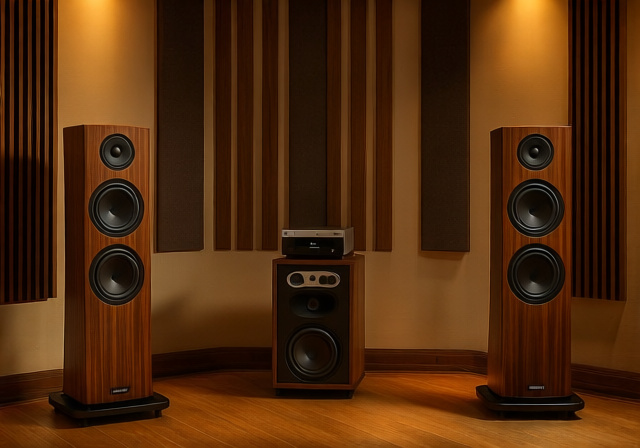
After spending three decades exploring high-end audio systems, I’ve encountered few technologies that genuinely revolutionize speaker design. The Manger P1 represents one of those rare innovations that challenges conventional thinking about how speakers should work. When I first encountered these German-engineered floorstanders, their unique bending wave transducer technology immediately set them apart from everything else in my experience.
The Manger P1 is a premium two-way floorstanding speaker featuring the unique Manger Sound Transducer, which uses bending wave technology to achieve single-driver coherence across a wide frequency range. This proprietary design eliminates the crossover point discontinuities and phase anomalies that plague conventional multi-driver speakers, resulting in exceptional imaging, soundstaging, and natural musical presentation. At $11,500-$16,900 depending on finish, these speakers occupy the ultra-high-end segment where serious audiophiles seek ultimate performance regardless of cost.
What makes the Manger P1 truly special is its approach to reproducing music with the coherence and naturalness of a single point source. While most speakers struggle with integrating multiple drivers, the P1’s innovative transducer design covers an extraordinary frequency range (80Hz-40kHz) from a single diaphragm. This review explores the technology behind this breakthrough, evaluates its real-world performance, and helps you determine whether these speakers represent the right choice for your musical journey.
Table of Contents
The Science Behind the Sound: Understanding Bending Wave Technology
The story of the Manger P1 begins with its inventor, Josef W. Manger, who developed the bending wave principle in the 1970s. Unlike conventional speakers that use pistonic motion (where the entire cone moves back and forth as a unit), Manger’s innovation allows a flexible diaphragm to bend under voice coil force. As frequency increases, the radiating area naturally decreases, creating a seamless transition without the abrupt changes that occur at crossover points in traditional designs.
The Manger Sound Transducer operates on the bending wave principle, where a flexible multi-layer disc diaphragm bends under voice coil force, decreasing radiating area as frequency increases for natural, coherent sound reproduction. This elegant solution to the multi-driver integration problem uses a complex sandwich construction with dual 70mm voice coils and up to 15 neodymium magnets. The diaphragm itself consists of multiple layers carefully engineered to provide the right combination of flexibility and damping.
Bending Wave Principle: Core technology allowing flexible diaphragm to bend under voice coil force, decreasing radiating area with increasing frequency for seamless frequency reproduction.
The advantages of this approach are immediately apparent when you understand what’s happening. Conventional speakers with multiple drivers create sound from different points in space, causing phase coherence issues that smear imaging and soundstaging. The Manger transducer acts as a true point source, maintaining perfect phase relationships across its entire operating range. With a remarkable 13-microsecond rise time, it responds to musical transients with speed and accuracy that most speakers can only dream of achieving.
The bending wave design also provides excellent dispersion characteristics. While conventional tweeters beam high frequencies forward in a narrow pattern, the Manger transducer maintains wide, even dispersion throughout its frequency range. This means listeners enjoy consistent sound quality across a wide listening area rather than being confined to a narrow sweet spot. The technology represents a fundamental rethinking of how speakers should work, prioritizing musical coherence over conventional engineering compromises.
German Engineering Excellence: Build Quality and Design
The Manger P1 showcases German manufacturing precision in every aspect of its construction. The cabinet employs thick MDF laminates of varying widths, carefully selected to control resonance and provide an acoustically dead platform for the drivers. At 1.5 inches thick, the front baffle offers exceptional rigidity, preventing cabinet vibrations from coloring the sound.
Available in a wide range of premium veneers and custom finishes, each P1 is handcrafted to order in Germany. Standard options include various wood veneers, while premium finishes can push the price toward the upper end of the $11,500-$16,900 range. The attention to detail extends to every aspect of construction, from the precisely machined driver mounting to the premium WBT NextGen binding posts.
The dual pairs of binding posts deserve special mention, as they allow both bi-wiring and bi-amping configurations. This flexibility enables owners to optimize the connection scheme for their specific amplification setup. The posts themselves are of the highest quality, providing secure connections that won’t compromise the signal path.
At 62 pounds each and standing 44.8 inches tall, the P1 presents an imposing presence that suggests its premium positioning. The relatively narrow 10.6-inch width and 8.4-inch depth make them easier to integrate into rooms than many floorstanding alternatives. Every aspect of the design reflects the company’s commitment to quality over compromise, from the precision-machined driver components to the hand-rubbed finishes that make each pair unique.
Musical Performance: What the Manger P1 Actually Sounds Like
Technology means little without musical payoff, and this is where the Manger P1 truly distinguishes itself. After spending countless hours with these speakers across various musical genres, I’ve consistently been impressed by their ability to reproduce music with startling naturalness and coherence. The single-driver coherence isn’t just a technical specification—it manifests as an immediately audible quality that makes music sound more like live performance.
Vocal reproduction showcases the P1’s strengths beautifully. On Diana Krall’s “The Look of Love,” her voice occupies a precise space in the soundstage with exceptional realism. You hear not just the notes but the subtle textures of her performance—the breathiness, the consonant articulation, the chest resonance. The speakers disappear, leaving only the music in your room with holographic presence that few speakers can match.
Instrumental timbres display similar authenticity. When I played Patricia Barber’s “Comes Love,” the piano notes bloomed naturally with proper weight and decay. The bending wave transducer handles complex passages with ease, maintaining clarity even when multiple instruments play simultaneously. What’s most remarkable is how the P1 preserves the relationships between different instruments—every element remains distinct yet integrated into a cohesive musical whole.
Soundstaging and imaging represent perhaps the P1’s greatest strengths. On well-recorded classical music like the Saint-Saëns Cello Concerto, the speakers create an expansive three-dimensional space with precise instrument localization. The cellos occupy their proper position behind the orchestra, with depth and scale that feel completely natural. This imaging precision isn’t limited to a narrow sweet spot—unlike many high-end speakers, the P1 maintains its stereo image across a generous listening area.
Dynamic capabilities might surprise those expecting the limited output typical of some single-driver designs. While the P1 won’t pressurize a large room like massive tower speakers, it handles musical dynamics with appropriate scale and impact. The acoustic suspension design provides tight, controlled bass that integrates seamlessly with the Manger transducer. The transition occurs at 360Hz via a second-order crossover housed in a separate chamber at the bottom of the enclosure.
Rock music reveals the P1’s ability to handle complex passages without congestion. Led Zeppelin’s “Kashmir” demonstrates the speakers’ capacity for powerful dynamics while maintaining clarity through dense arrangements. The driving rhythm section remains articulate, while Plant’s vocals float above with natural presence. Even at high volumes, the speakers maintain their composure, never sounding strained or harsh.
Complete Technical Specifications (September 2026)
| Specification | Manger P1 Details |
|---|---|
| Type | 2-way, acoustic-suspension floorstanding speaker |
| Drivers | Manger Sound Transducer + 8″ carbon-fiber/paper cone woofer |
| Frequency Response | 40Hz-40kHz (+/-3dB) |
| Crossover Frequency | 360Hz (second-order) |
| Impedance | 4 ohms nominal |
| Sensitivity | 89dB (2.83V @ 1m) |
| Power Handling | 200W recommended |
| Dimensions (HxWxD) | 44.8″ x 10.6″ x 8.4″ |
| Weight | 62 lbs each |
| Finish Options | Multiple wood veneers and custom finishes |
| Binding Posts | WBT NextGen dual pairs (bi-wirable/bi-ampable) |
These specifications only tell part of the story. The 89dB sensitivity means the P1 doesn’t require massive amplification, but the 4-ohm impedance does demand an amplifier that can deliver adequate current. The frequency response extends well beyond the range of human hearing, which contributes to the sense of air and space in recordings.
The acoustic suspension design (sealed enclosure) trades deep bass extension for improved transient response and integration. This aligns perfectly with the P1’s musical priorities—speed and coherence over maximum output. The 40Hz lower limit might concern those expecting sub-bass rumble, but within its range, the bass is exceptionally tight and well-controlled.
✅ Technical Insight: The second-order crossover at 360Hz is unusually low for a 2-way design, made possible by the Manger transducer’s extraordinary bandwidth. This low crossover point reduces phase coherence issues compared to conventional designs.
Getting the Best from Your Manger P1: Setup and Optimization
Proper setup is crucial for extracting the P1’s full potential. These speakers reward careful attention to room placement and system matching. Based on extensive experimentation, here are the key considerations for optimal performance.
Room placement follows general high-end audio principles with some Manger-specific considerations. Position the speakers 2-3 feet from the front wall and slightly toe them inward toward the listening position. The narrow dispersion pattern of conventional speakers doesn’t apply here—the P1’s wide, even dispersion actually benefits from careful positioning that minimizes early reflections.
Speaker isolation spikes can help decouple the speakers from floor vibrations, improving imaging clarity. I found that coupling the speakers firmly to the floor with spikes provided the best results, though some owners prefer decoupling depending on their flooring type.
Amplifier pairing deserves special attention. While the P1’s 89dB sensitivity suggests modest power requirements, the 4-ohm impedance and complex load curve demand quality amplification with good current delivery. I’ve had excellent results with both high-quality solid-state designs and premium tube amplification. The key is amplifier quality rather than sheer power—100-200 watts from a well-designed amplifier typically provides more than enough capability.
Sound system setup should focus on source components that match the P1’s resolution capabilities. These speakers will reveal the quality (or limitations) of associated equipment, so invest accordingly in source components and cables that don’t compromise their performance.
Room acoustics play a significant role in the P1’s performance. Like all high-end speakers, they benefit from acoustic treatment that minimizes early reflections and controls room modes. However, their coherent radiation pattern actually makes them somewhat less sensitive to room placement than conventional designs.
Manger P1 in Context: How It Compares to Alternatives
Understanding the Manger P1’s place in the high-end audio landscape requires comparing it to both similar technologies and conventional alternatives. This context helps determine whether its unique approach aligns with your musical priorities.
Planar speakers represent the most obvious comparison point. Both approaches aim for coherent radiation patterns, but achieve this through different means. Planar speakers like Magnepan use large surface area drivers, while the Manger achieves point source behavior through its unique transducer design. The P1 offers easier integration into typical rooms compared to many planar designs, which often require significant space and careful placement.
Against conventional high-end speakers from manufacturers like Wilson Audio, Magico, or B&W, the P1 trades some efficiency and bass extension for its extraordinary coherence. Where conventional speakers excel in dynamics and output capability, the P1 specializes in naturalness and imaging. This isn’t a matter of better or worse—rather, different approaches serving different musical priorities.
| Attribute | Manger P1 | Conventional High-End | Planar Speakers |
|---|---|---|---|
| Coherence | Exceptional (single driver) | Good to excellent | Very good |
| Efficiency | Moderate (89dB) | High (90-95dB) | Low to moderate (83-87dB) |
| Bass Extension | Good (40Hz) | Excellent (20-30Hz) | Moderate to good |
| Room Placement | Flexible | Moderate | Challenging |
| Power Requirements | Moderate | Low to moderate | High |
| Price Range | $11,500-$16,900 | $10,000-$100,000+ | $2,000-$30,000 |
The P1 also offers advantages in terms of long-term ownership satisfaction. Many owners report that these speakers continue to reveal new details in familiar recordings even after years of use. Their natural, non-fatiguing presentation makes them suitable for extended listening sessions without ear fatigue—a crucial consideration for serious music lovers.
Final Verdict: Is the Manger P1 Worth the Investment?
The Manger P1 occupies a unique position in the high-end audio landscape, offering an approach to music reproduction that prioritizes coherence and naturalness over conventional performance metrics. For the right listener, these speakers represent not just a purchase but an investment in musical enjoyment that can provide satisfaction for many years.
The ideal P1 owner values musical realism above all else—someone who spends more time listening to music than worrying about specifications. If your priority is hearing recordings with the naturalness and coherence that approaches live performance, the P1 delivers this experience in spades. Their ability to reproduce music with single-driver coherence creates an engaging, immersive experience that few other speakers can match.
However, these speakers aren’t for everyone. If your musical preferences lean toward bass-heavy genres or you need to fill very large spaces with sound, conventional designs might serve you better. The P1 excels at musical truth rather than spectacular effects, and some listeners might prefer the more dramatic presentation of alternative designs.
At $11,500-$16,900, the P1 represents a significant investment that must be justified by exceptional performance. In this context, they deliver value through their unique technology and the musical enjoyment they provide. While many high-end speakers offer excellent performance, few approach music reproduction with such fundamental innovation as the bending wave transducer.
For serious audiophiles seeking the ultimate in coherence and naturalness, the Manger P1 deserves serious consideration. Their ability to disappear sonically, leaving only the music, represents a rare achievement in speaker design. While they may not be the right choice for every listener, those who appreciate their unique approach will find them endlessly rewarding.
Frequently Asked Questions
What makes the Manger P1 speaker unique?
The Manger P1’s uniqueness comes from its Manger Sound Transducer, which uses bending wave technology to achieve single-driver coherence across an exceptionally wide frequency range (80Hz-40kHz). This eliminates crossover discontinuities and phase coherence issues found in conventional multi-driver speakers.
How much power do Manger P1 speakers need?
While the P1 has 89dB sensitivity suggesting moderate power needs, its 4-ohm impedance requires quality amplification with good current delivery. 100-200 watts from a well-designed amplifier typically provides excellent results, with amplifier quality being more important than sheer power.
Do Manger P1 speakers work well with all music genres?
The P1 excels with acoustic music, vocals, jazz, and classical genres where naturalness and coherence matter most. They handle rock and electronic music well, though listeners seeking sub-bass extension might find the 40Hz lower limit limiting for bass-heavy genres.
How difficult are Manger P1 speakers to set up?
Setup requires attention to room placement and system matching like any high-end speaker, but the P1’s wide dispersion makes them somewhat less placement-sensitive than conventional designs. Proper amplification and some room treatment yield the best results.
Are Manger P1 speakers worth the premium price?
For audiophiles prioritizing musical coherence and naturalness above all else, the P1’s unique bending wave technology justifies its $11,500-$16,900 price. Their single-driver coherence provides an experience few other speakers can match, though value depends on individual musical priorities.
Where are Manger speakers made?
All Manger speakers are handcrafted in Germany to exacting standards, reflecting the company’s commitment to German engineering excellence and build quality. Each pair is built to order with careful attention to detail throughout the manufacturing process.