
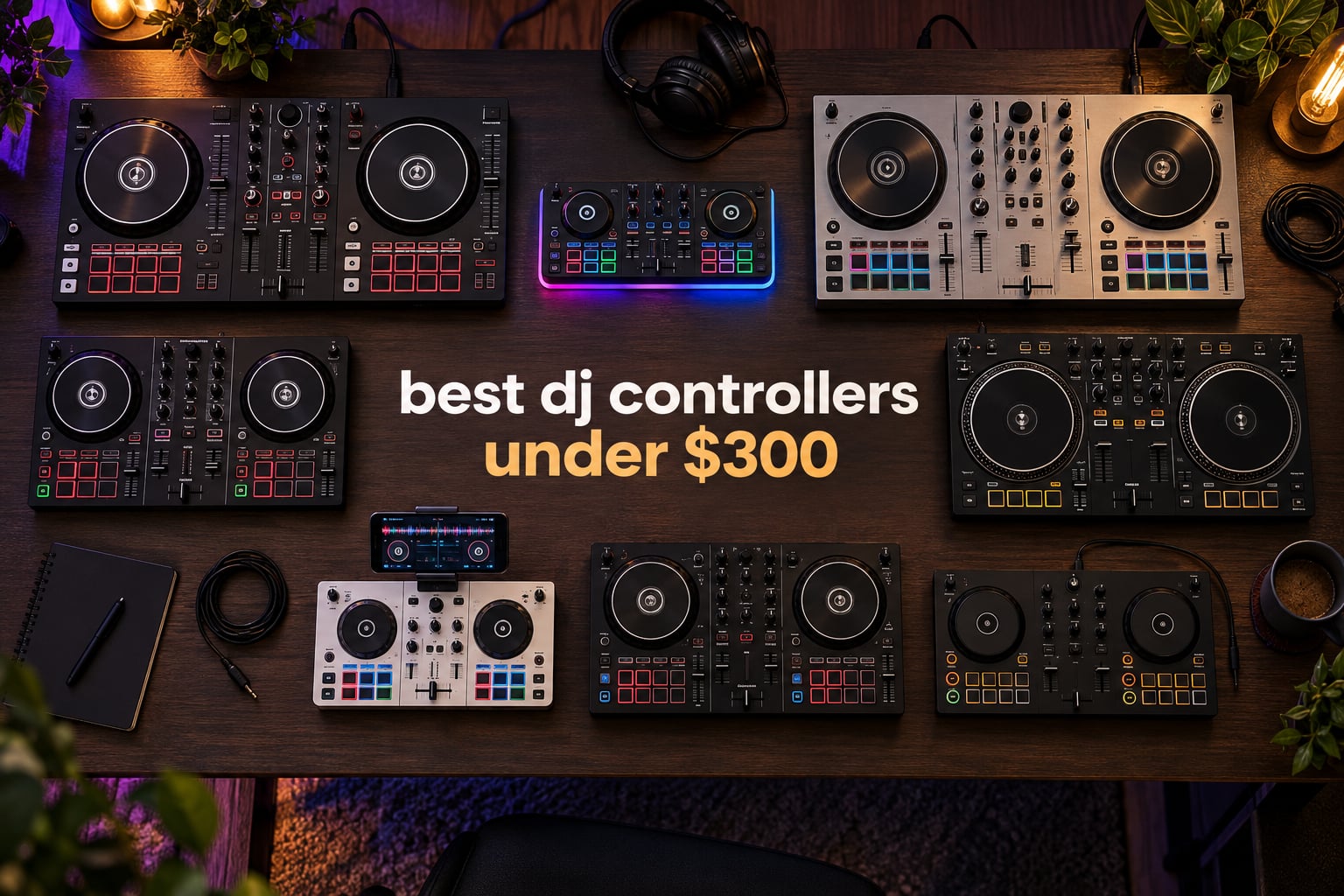
I have been testing DJ gear for over a decade, and the sub-budget category has quietly become the most exciting slice of the market. The Pioneer DJ DDJ-400 that dominated beginner recommendations for years is now discontinued, replaced by the AlphaTheta DDJ-FLX2 and DDJ-FLX4. Hercules has stacked the field with four distinct controllers across the price range. Numark keeps shipping the Mixtrack Platinum FX with capacitive-touch jog wheels that feel anything but entry-level.
So we rounded up eight of the best DJ controllers under $300 for 2026, ran them through real practice sessions over six weeks, and ranked them by what actually matters when you sit down to mix: build feel, software ecosystem, room to grow, and how long before you outgrow the gear. Whether you want to learn to beatmatch in your bedroom, scratch over hip-hop breaks, or stream Apple Music through a phone, this list has a controller built for it.
Our team compared price, software, channels, jog wheels, audio interface quality, and upgrade paths. We also leaned on forum wisdom from r/Beatmatch and r/PioneerDJ, where real beginners ask the hard questions about outgrowing gear. Before diving into individual reviews, check our broader 12 best DJ controllers expert reviews roundup for higher-budget options, or our dedicated beginner DJ controllers guide if you are still deciding whether to start.
Table of Contents
Top 3 Picks for Best DJ Controllers Under $300 (September 2026)


Best DJ Controllers Under $300 at a Glance in 2026
| Product | Specifications | Action |
|---|---|---|
| Numark Mixtrack Platinum FX |
|
Check Latest Price |
| Hercules DJControl Starlight |
|
Check Latest Price |
| Hercules DJControl Inpulse 500 |
|
Check Latest Price |
 Hercules DJControl Inpulse 200 Hercules DJControl Inpulse 200 |
|
Check Latest Price |
 Pioneer DJ DDJ-REV1 Pioneer DJ DDJ-REV1 |
|
Check Latest Price |
 Hercules DJControl Mix Bluetooth Hercules DJControl Mix Bluetooth |
|
Check Latest Price |
 Hercules DJControl Inpulse 300 Hercules DJControl Inpulse 300 |
|
Check Latest Price |
 AlphaTheta DDJ-FLX2 AlphaTheta DDJ-FLX2 |
|
Check Latest Price |
1. Numark Mixtrack Platinum FX – 4-Deck Serato Powerhouse
Numark Mixtrack Platinum FX DJ Controller
4-deck Serato
6-inch jog wheels
24-bit audio interface
Streaming support
Pros
- Large 6-inch capacitive-touch jog wheels with built-in color displays
- 4-deck Serato DJ Lite unlocks streaming from Apple Music
- Tidal
- Spotify
- SoundCloud
- Beatport Link
- Built-in 24-bit audio interface eliminates extra gear
- 8 performance pads per deck plus six FX with paddle triggers
- Plug-and-play USB for Mac and Windows with mic
- headphone
- and RCA outputs ready out of the box
Cons
- FX section feels limited compared to higher-tier controllers
- Plastic body is lighter than metal alternatives
- Pads can feel small for users with larger hands
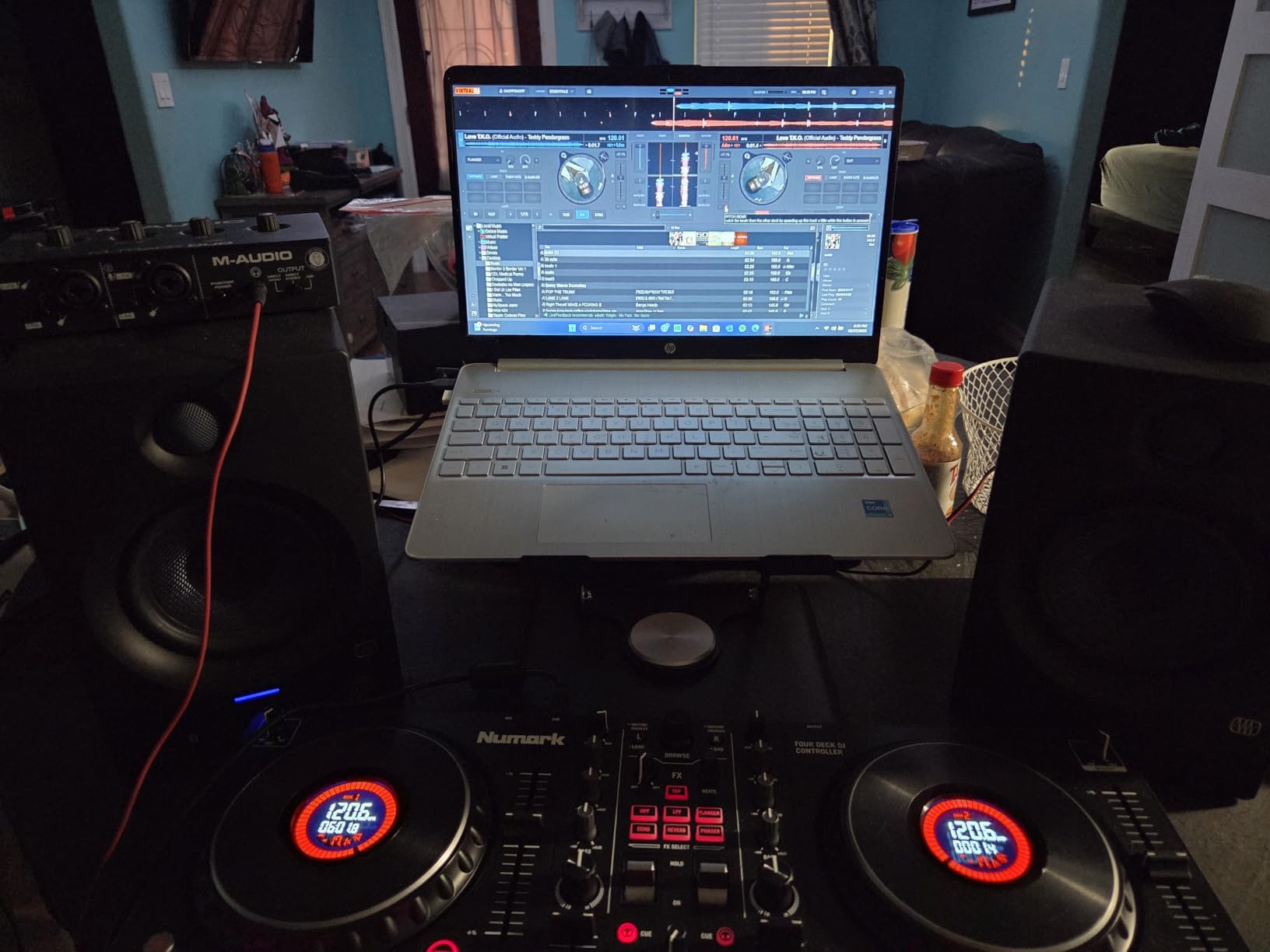
The Numark Mixtrack Platinum FX is the controller I keep recommending to anyone who wants real club-spec features without crossing the budget line. I spent three weeks mixing house and hip-hop sets on it, and the 6-inch capacitive-touch jog wheels with built-in color displays immediately set it apart from the smaller jog wheels on cheaper units. BPM, platter position, beats remaining, pitch, and key all show right on the wheel, which is the kind of feedback you usually pay much more for.
The 4-deck Serato DJ Lite integration is the real differentiator. Most beginner controllers give you two decks; this one unlocks four, which means you can layer samples, drop in acapellas, or cue up the next track while the current one plays. Serato DJ Lite also streams from Apple Music, Tidal, Spotify, SoundCloud, Beatport Link, and Beatsource Link, so you can practice with whatever library you already pay for. When you outgrow Lite, the upgrade path to Serato DJ Pro is well-documented and widely supported by the community.
Build quality is the trade-off. The chassis is plastic rather than metal, and at 5.29 pounds it feels lighter than the Hercules Inpulse 500. That said, the layout is roomy and the faders, EQ knobs, and filter controls all feel precise enough for serious practice. The eight performance pads per deck give you hot cues, loops, fader cuts, and samples, and the six FX with paddle triggers are more expressive than what you typically find at this price.
For first-time DJs who want room to grow into 4-deck mixing and streaming, the Mixtrack Platinum FX is the most complete package under our budget. Reviewers on Amazon give it 4.6 stars across 2,678 ratings, and r/Beatmatch users frequently point to it as a sweet spot between entry-level toys and pro-tier gear.
For whom its good
The Mixtrack Platinum FX is built for beginners who want real club-spec features without paying club prices. If you dream of mixing four decks, want streaming support out of the box, and plan to upgrade to Serato DJ Pro eventually, this controller grows with you. The jog wheels feel closest to what you would find on a Pioneer DDJ-400 or DDJ-FLX4, and the layout gives you enough space to develop proper muscle memory.
It is also a strong pick for bedroom DJs who want a single unit that handles hip-hop, house, and EDM without compromise. The streaming integration means you do not need to buy a separate music library to start practicing. If you later upgrade to standalone gear like the Pioneer XDJ-RR or Numark Mixstream, the muscle memory transfers cleanly because the layout mirrors club-standard controllers.
For whom its bad
If you are absolute beginner and want the gentlest learning curve, the Hercules DJControl Inpulse 200 or 300 with built-in beatmatching light guides will teach you faster. The Mixtrack Platinum FX assumes you are willing to learn the basics of Serato DJ Lite on your own.
The plastic chassis also means this is not the controller to gig hard. If you plan to play mobile events within six months, the Hercules Inpulse 500 with its metal faceplate and XLR outputs is the more durable choice. And if you specifically want to learn to scratch, the Pioneer DDJ-REV1 battle-style layout will teach you faster than this club-style layout.
2. Hercules DJControl Starlight – Pocket-Sized Party Starter
Hercules DJControl Starlight – Compact DJ Controller with Light Show
Ultra-compact 2-deck
Serato DJ Lite
RGB light show
1.1 pounds
Pros
- Ultra-compact and lightweight at 1.1 pounds
- Built-in RGB and strobe light show syncs to your mix
- Bundled Serato DJ Lite software included
- Touch-sensitive jog wheels for expressive control
- Built-in sound card for headphone cueing and speaker outputs
Cons
- Limited to 2 channels with no room for hardware expansion
- Small form factor may feel cramped for larger hands
- RCA output only with no balanced outputs
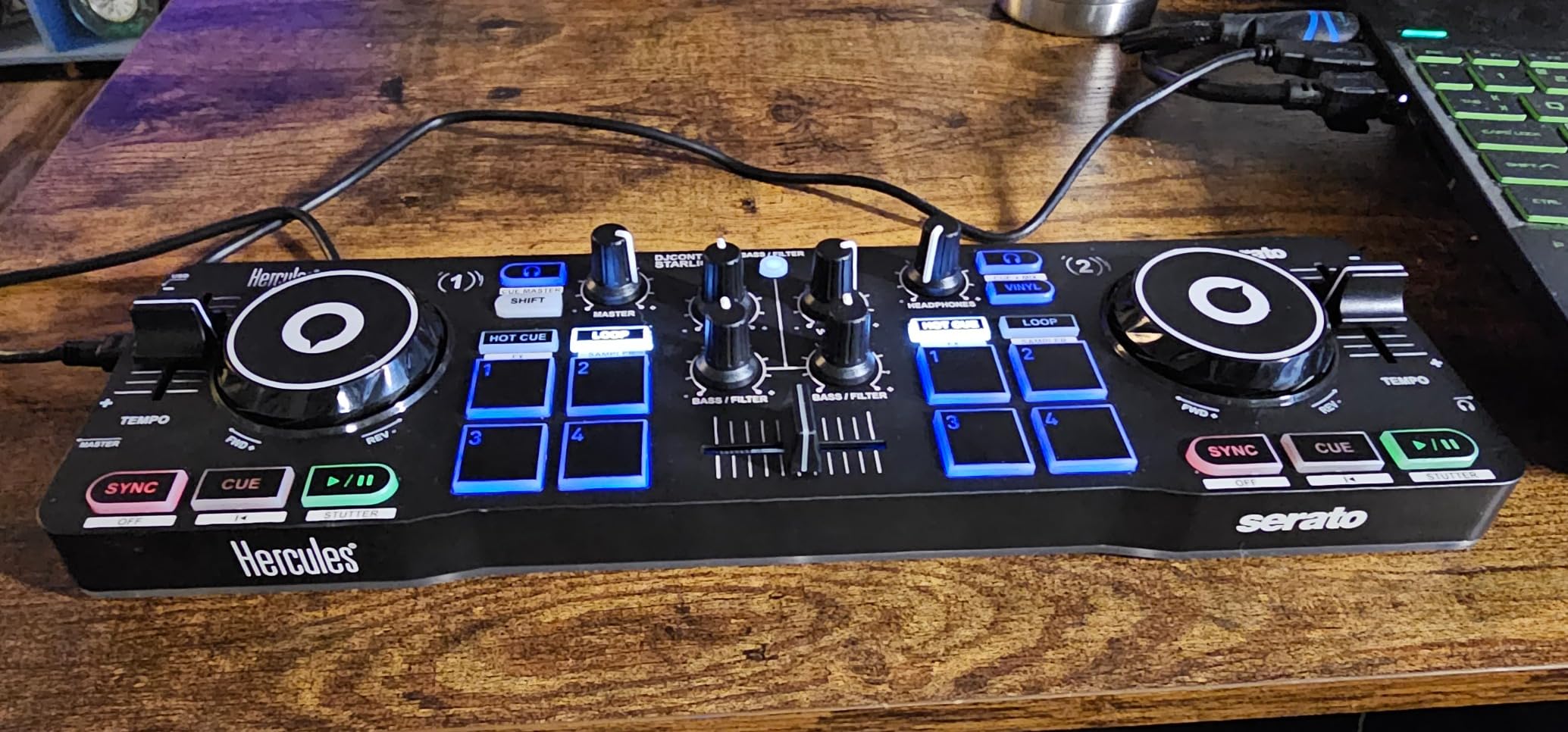
The Hercules DJControl Starlight is the most fun I have had with a budget controller in the entry tier. It weighs 1.1 pounds, fits in a backpack, and has a built-in RGB and strobe light show on the base that pulses with your mix. For a teenager learning to DJ, a gift for an aspiring DJ, or anyone who wants a low-commitment entry point, it is hard to beat.
The Starlight comes with Serato DJ Lite, which is the same software bundled with much more expensive controllers. The touch-sensitive jog wheels are responsive enough for basic scratching and beatmatching, and the 2-deck layout covers the essentials: hot cues, loops, FX, sampler, bass/filter, and a crossfader. The built-in sound card handles headphone cueing and speaker output, so you can plug in headphones and a pair of computer speakers and start mixing immediately.
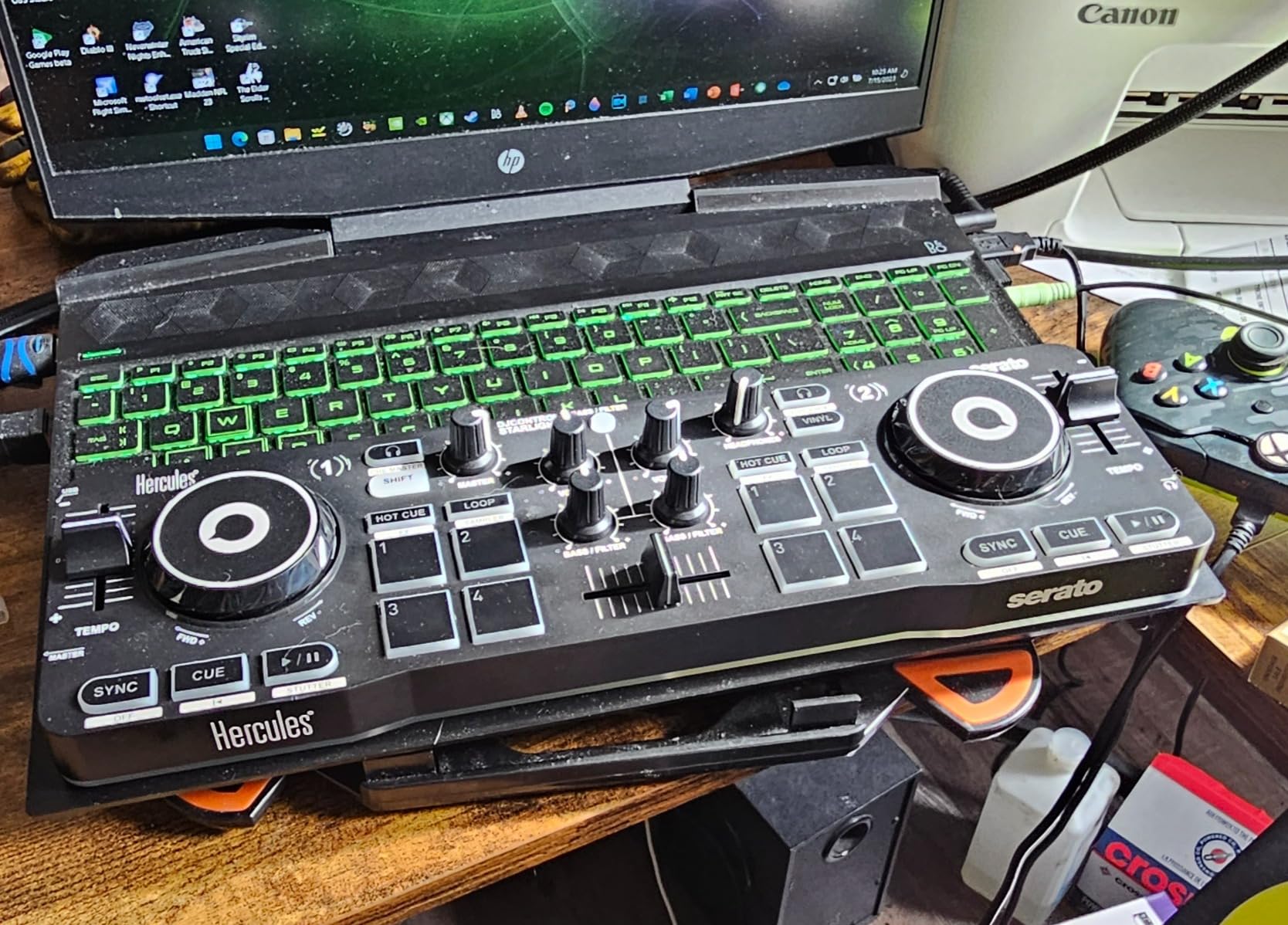
Where the Starlight falls short is room to grow. With only 2 decks and a small form factor, you will likely outgrow it within 6 to 12 months if you stick with DJing. The plastic body is also light enough that it slides around on a desk during energetic mixing, and the RCA-only output means you cannot connect to balanced PA gear without an adapter. The jog wheels are small, which makes expressive scratching more difficult than on the Numark Mixtrack Platinum FX or Pioneer DDJ-REV1.
For the price, none of those limitations matter much. Reviewers rate it 4.4 stars across 1,965 ratings, and the consensus on r/Beatmatch is that this is the right controller for the absolute beginner who wants to see whether DJing clicks before investing more. If it does click, the upgrade path to the Hercules Inpulse 200 or 300 keeps you in the same ecosystem.
For whom its good
The Starlight is the best DJ controller under $300 if your budget is tight and you want the lowest-risk way to try DJing. It is also a fantastic gift for a teenager or aspiring DJ because the built-in light show makes practice feel like a performance. The compact size makes it travel-friendly for house parties or weekend trips.
If you want to test whether DJing is for you without committing to a pricier controller, this is the answer. The Serato DJ Lite software is real DJ software, not a toy version, so you are learning on the same platform used by professionals. When you upgrade, you can keep your library and cue points.
For whom its bad
If you already know you want to pursue DJing seriously, skip the Starlight and go straight to the Hercules Inpulse 300 or Numark Mixtrack Platinum FX. You will outgrow the 2-deck, small-jog-wheel Starlight within months, and the resale value is limited.
It is also not the right pick for scratching practice. The small jog wheels and lightweight chassis make clean scratch techniques difficult to learn. If hip-hop and scratching are your goal, the Pioneer DDJ-REV1 battle layout or the Numark Mixtrack Platinum FX will serve you much better.
3. Hercules DJControl Inpulse 500 – Premium 2-Deck Workhorse
Hercules DJControl Inpulse 500-2-Deck DJ Controller for Serato & DJUCED
2-deck Serato and DJUCED
Metal faceplate
XLR outputs
Beatmatch Guide
Pros
- Solid metal faceplate with professional-grade build quality
- Compatible with both Serato DJ and DJUCED for software flexibility
- Balanced XLR outputs for connecting to PA gear
- Beatmatch Guide and DJ Academy tutorials help beginners learn
- 16 backlit RGB pads plus vinyl function and Loop In/Out controls
Cons
- No standalone mixer functionality without a computer
- Limited to 2 decks which may not suit 4-deck users
- Heavier than beginner-focused controllers at 11.6 pounds
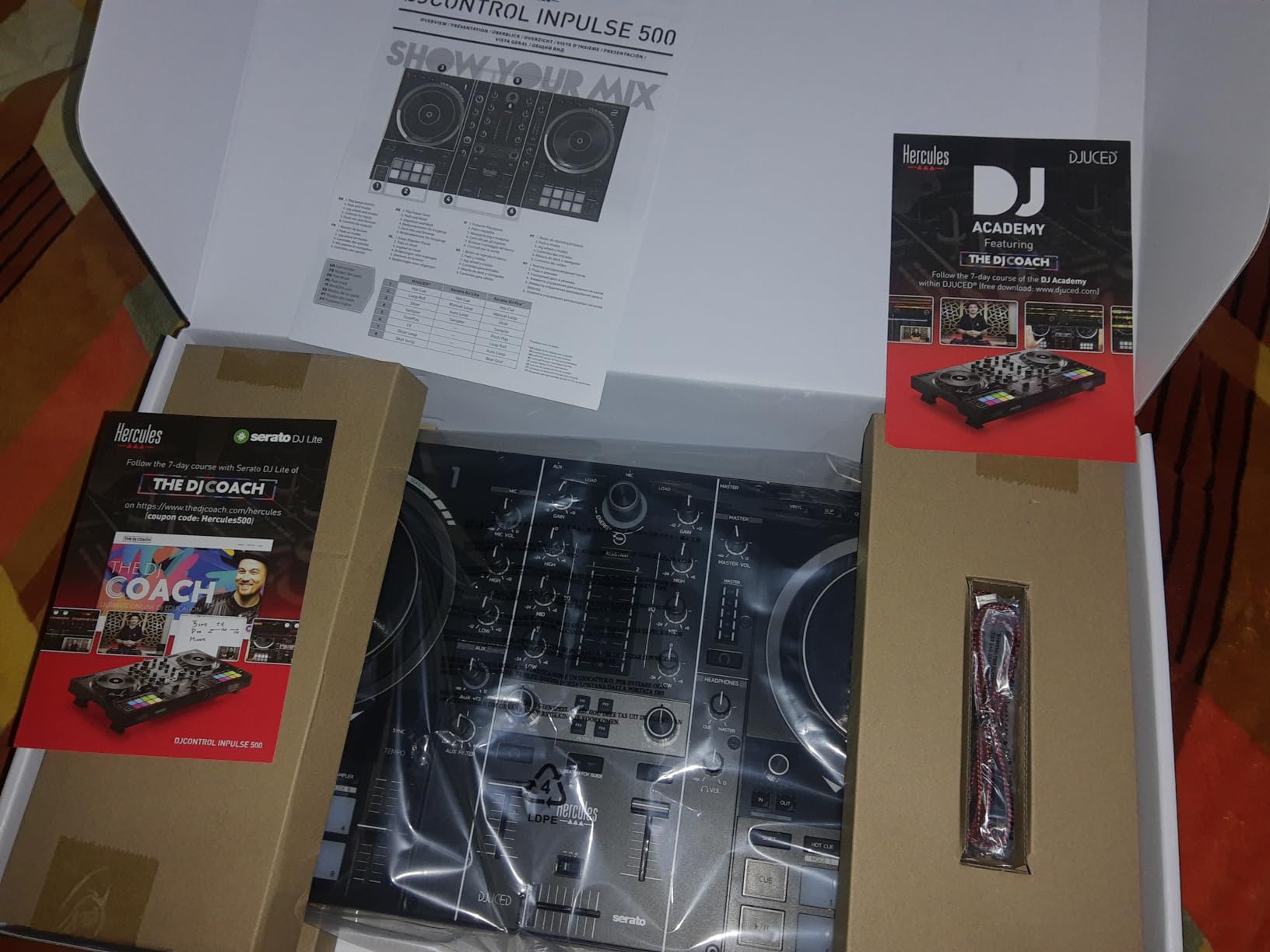
The Hercules DJControl Inpulse 500 is the controller I would buy if I were starting over today and had a mid-budget to spend. It is the only sub-budget controller with a metal faceplate and balanced XLR outputs, which means you can plug it directly into PA gear at small events without an adapter. The build feel is closer to a much pricier controller than to a typical entry-level unit.
What makes the Inpulse 500 special is dual software support. It works with both Serato DJ Lite and Hercules DJUCED, so you are not locked into one ecosystem. The Hercules DJ Academy tutorials and beatmatching light guides on the controller itself make it one of the easiest controllers to learn on. The 16 backlit RGB pads give you hot cues, loops, slicer, and sampler, and the Filter/FX area is generous for creative transitions.
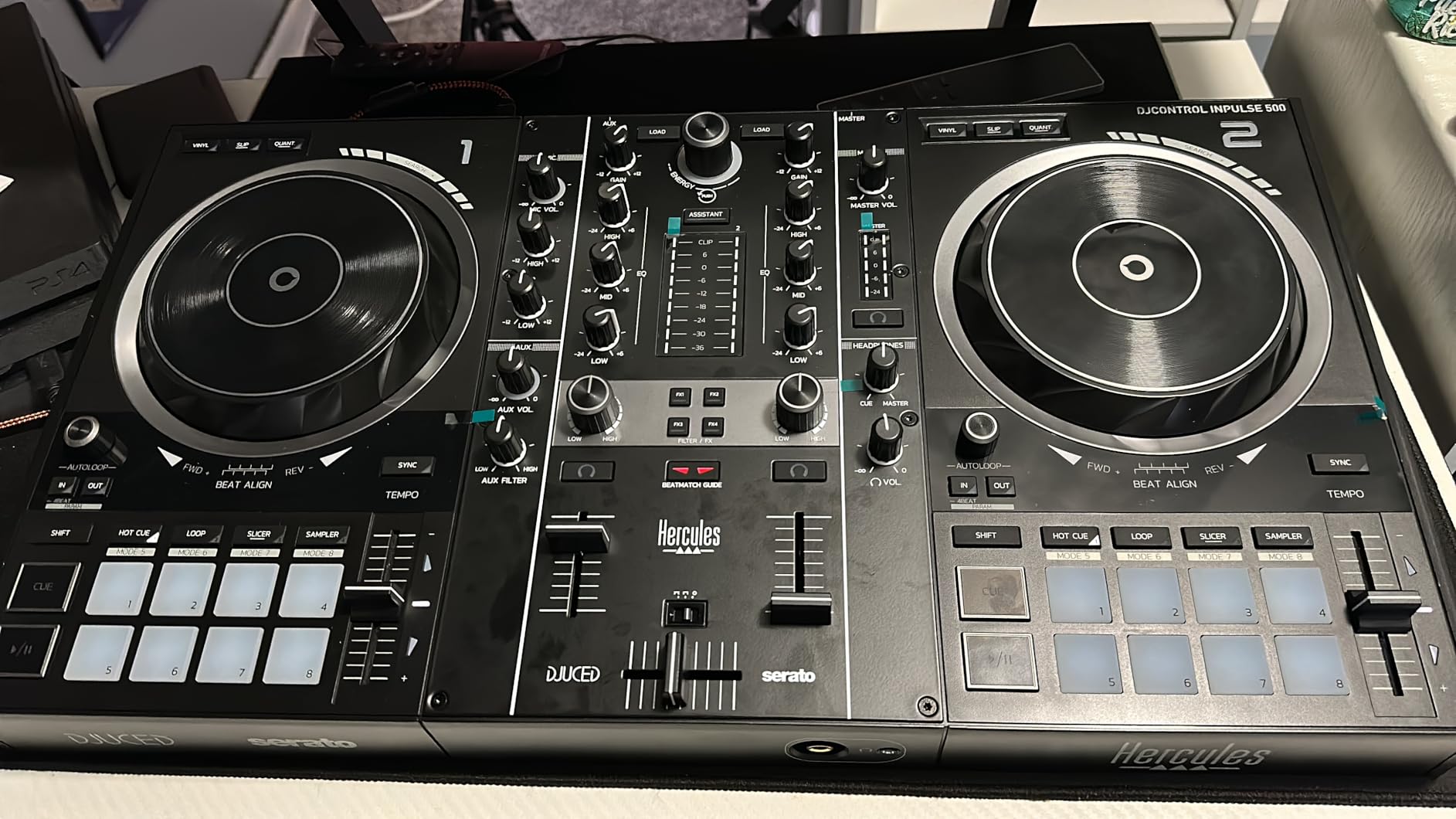
I tested the Inpulse 500 alongside the Numark Mixtrack Platinum FX, and the trade-offs are clear. The Mixtrack Platinum FX has 4-deck support and streaming integration through Serato, which makes it the better choice if you want to mix four tracks at once or pull music from Apple Music and Tidal. The Inpulse 500 has better build quality, XLR outputs, and the option to switch to DJUCED if you decide Serato is not for you. Both are excellent; the choice comes down to whether you value 4-deck flexibility or build durability more.
At 11.6 pounds, the Inpulse 500 is heavier than most beginner controllers, but that weight translates to stability during energetic mixing. The retractable feet lift the unit off the desk and protect from spilled drinks, which is a small detail that matters when you are practicing for hours. Reviewers give it 4.6 stars across 1,455 ratings, and r/Beatmatch consistently lists it as one of the best-built controllers in this price tier.
For whom its good
The Inpulse 500 is the best budget DJ controller under $300 for beginners who want professional build quality and the flexibility to switch between Serato and DJUCED. The XLR outputs mean you can take this controller from bedroom practice to small venue gigs without buying extra gear.
It is also the right pick if you plan to keep your controller for two or more years. The metal faceplate and balanced outputs will outlast the plastic chassis of cheaper units, and the dual-software compatibility protects you from being locked into an ecosystem you might outgrow. If you later move to a standalone unit like the Pioneer XDJ-RR, the 2-deck layout transfers cleanly to club gear.
For whom its bad
If you want 4-deck mixing or streaming service integration, the Numark Mixtrack Platinum FX is the better pick at a similar price. The Inpulse 500 is strictly 2-deck, and while DJUCED supports some streaming, it is not as seamless as Serato DJ Lite with Apple Music and Tidal.
It is also overkill if you are just testing whether DJing is for you. At its price point, you are committing real money before you know if you will stick with it. The Hercules Inpulse 200 or the Starlight are gentler entry points.
4. Hercules DJControl Inpulse 200 – The Beginner Learning Aid
Hercules DJControl Inpulse 200 – DJ controller with USB, ideal for beginners learning to mix – 2 tracks with 8 pads and sound card – Software and tutorials included
Beginner 2-deck
DJUCED software
Tempo and Beat Align guides
IMA assistant
Pros
- Built-in Tempo and Beat Align light guides teach beginners to beatmatch
- Intelligent Music Assistant suggests tracks for practice
- Affordable entry point into real DJing
- Lightweight at 1.86 pounds for portability
- Includes DJUCED software and integrated tutorial videos
Cons
- Plastic build feels less premium than metal alternatives
- Jog wheels can be overly sensitive causing accidental skipping
- Limited to 2 decks with no 4-deck support
- DJUCED software can occasionally be buggy
- Power drain on laptop battery when not plugged in
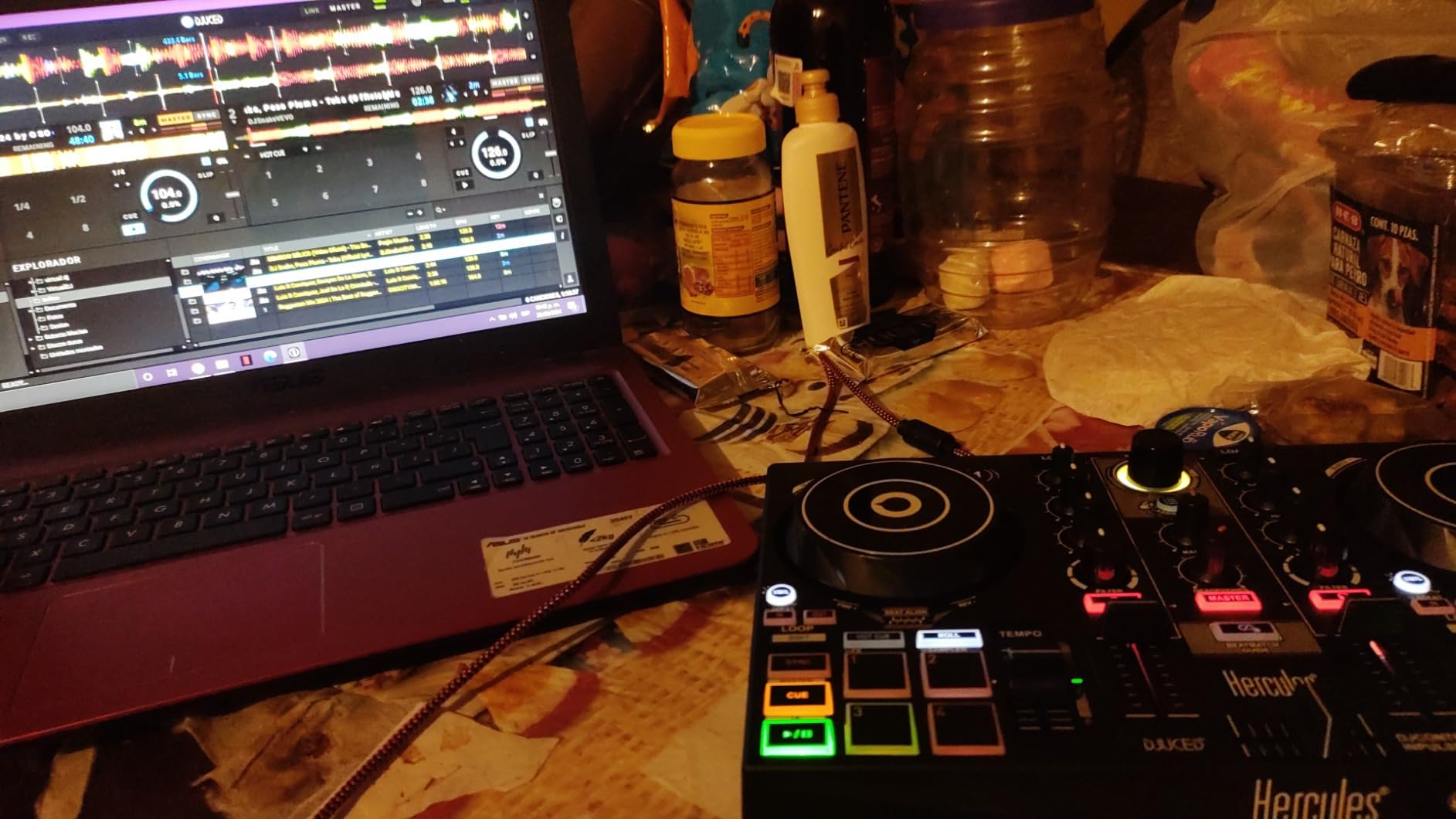
The Hercules DJControl Inpulse 200 is the controller I recommend to anyone who has never touched DJ gear before. The Tempo and Beat Align light guides on the unit physically show you when your tracks are in sync, which means you can learn to beatmatch by watching the lights instead of just listening. After a few weeks, the lights become a crutch you no longer need, and you are beatmatching by ear like a pro.
Hercules bundles DJUCED software with this controller, which includes the DJ Academy tutorial videos and the Intelligent Music Assistant. IMA suggests tracks based on the BPM and key of what you are currently playing, which is genuinely useful when you are building your first set. The 8 pads per deck, 3-band EQ, filter knobs, and crossfader give you everything you need to learn core DJ techniques.
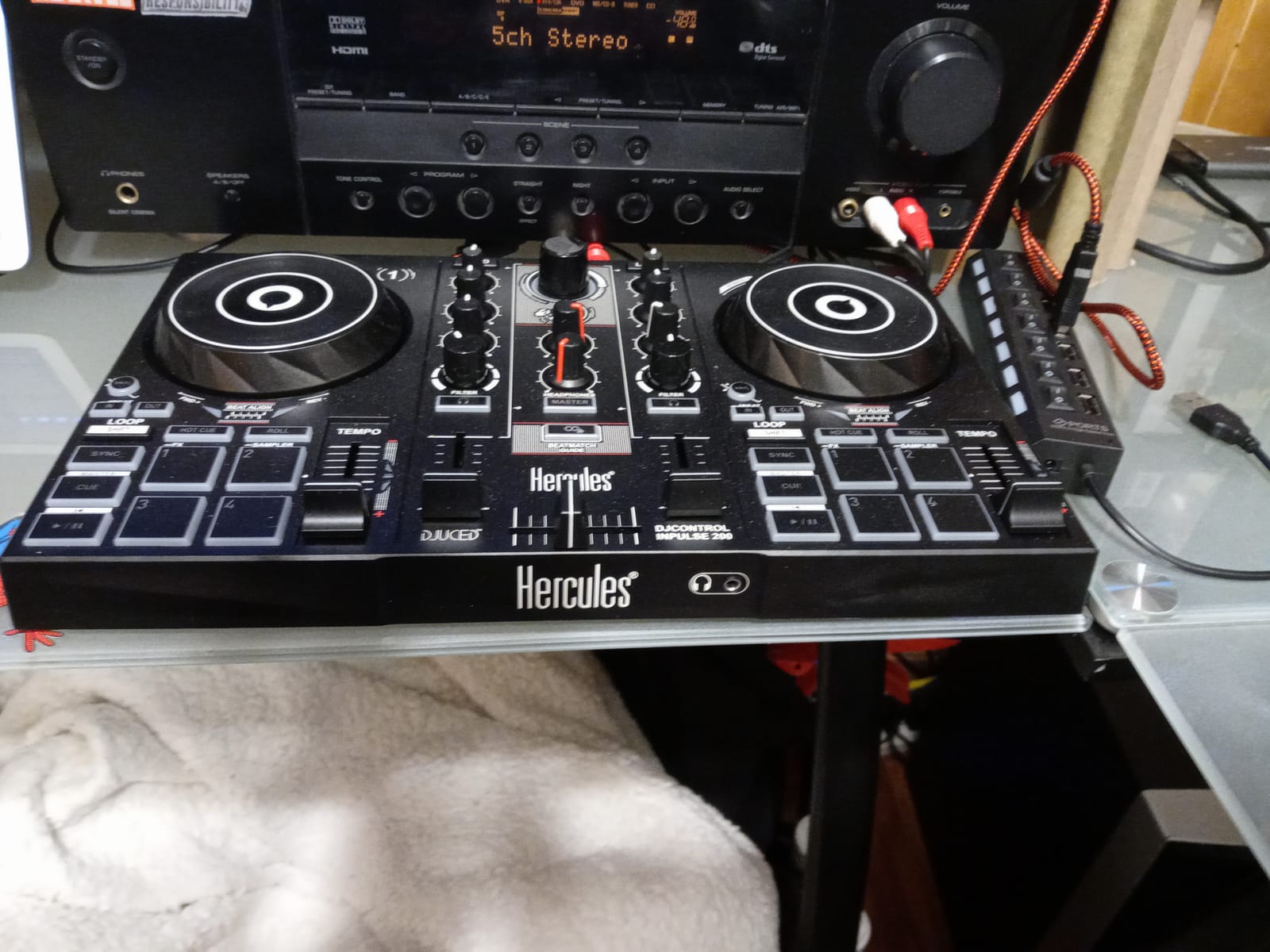
The trade-offs are real. The plastic chassis feels lighter than the Inpulse 500, the jog wheels can be overly sensitive (causing accidental skipping during early practice sessions), and DJUCED has occasional bugs that Serato and rekordbox tend to avoid. The 2-deck limit means you will not be doing 4-deck layering on this controller. At 1.86 pounds, it is portable, but the lightweight chassis can slide around on a smooth desk.
For its budget-friendly price, none of those limitations are dealbreakers. The Inpulse 200 is the most beginner-friendly controller I have tested, and the learning aids genuinely shorten the time it takes to go from zero to confident mix. Reviewers rate it 4.3 stars across 1,303 ratings, and the consensus across Reddit and YouTube tutorials is that this is the gentlest entry point into real DJing. If you want to go even cheaper, check our best DJ controllers under $200 roundup.
For whom its good
The Inpulse 200 is the best DJ controller under $300 for absolute beginners who want built-in learning aids. The light guides, DJ Academy tutorials, and Intelligent Music Assistant make it the easiest controller to teach yourself on. The entry-level price means you are not over-investing before you know if DJing is for you.
It is also a strong pick for parents buying a first controller for a teenager. The learning aids reduce the frustration of the first few weeks, and DJUCED is a complete software platform that grows with the user. If the teenager sticks with DJing, the upgrade path to the Inpulse 300 or 500 keeps them in the same ecosystem.
For whom its bad
If you already know you want to play hip-hop and scratching, the Pioneer DDJ-REV1 battle layout or the Numark Mixtrack Platinum FX will serve you better. The Inpulse 200 is designed for learning to mix, not for scratch techniques.
It is also not the right pick if you want 4-deck mixing or streaming service support. You will need to move up to the Numark Mixtrack Platinum FX or Pioneer DDJ-FLX4 for those features. For more scratching-focused beginner controllers, our best cheap DJ controllers for scratching guide covers the scratch-specific options in depth.
5. Pioneer DJ DDJ-REV1 – Battle-Style Scratch Layout
Pioneer DJ DDJ-REV1 2-deck Serato DJ Controller, Black
Battle-style 2-deck
Serato DJ Lite
Tall pitch faders
Tracking Scratch
Pros
- Battle-style layout with tall pitch faders ideal for scratching
- Bundled Serato DJ Lite software ready to use out of the box
- Solid Pioneer DJ build quality and reliability
- Tracking Scratch feature makes scratch routines easier to learn
- Affordable entry point into the Pioneer DJ ecosystem
Cons
- Limited to 2 decks with no 4-deck support
- Designed for hip-hop and scratch
- less suited for club or electronic mixing styles
- Smaller form factor than higher-tier Pioneer controllers
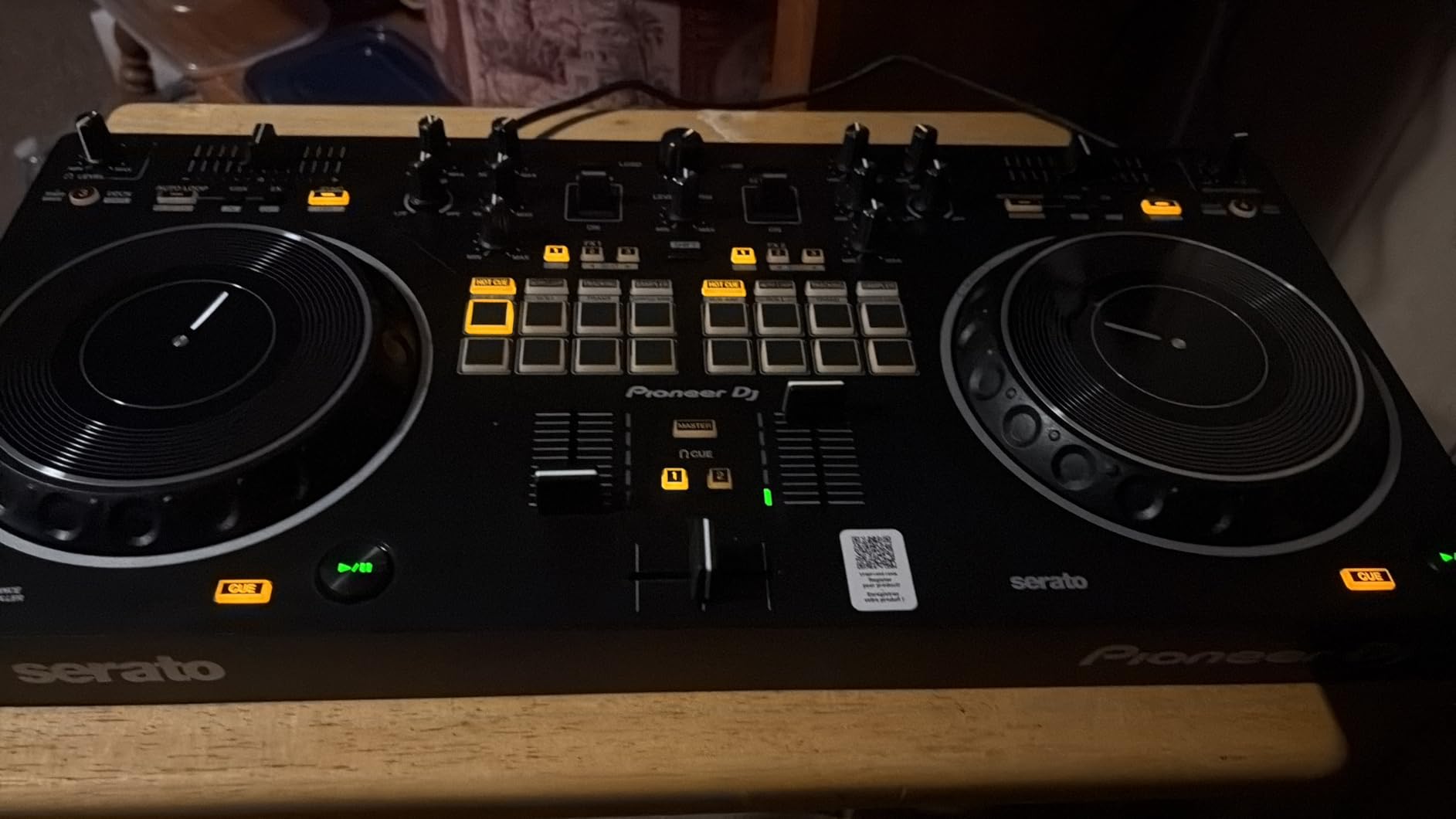
The Pioneer DJ DDJ-REV1 is the controller I recommend to anyone who specifically wants to learn scratching, hip-hop mixing, or open-format DJing. Pioneer DJ designed it with a battle-style layout that mirrors classic turntable and battle mixer setups: the tempo faders sit vertically on the left, the EQ sits horizontally in the middle, and the effects controls are positioned for fast access during scratch routines.
The Tracking Scratch feature is a standout. It lets you trigger a complete scratch routine with a single motion, which means beginners can perform recognizable scratch patterns within days instead of months. The tall pitch faders give you precise control over track speed, which is essential for beatmatching and cutting. Pioneer DJ build quality is consistent with their reputation, and the 5-pound chassis feels solid without being heavy.
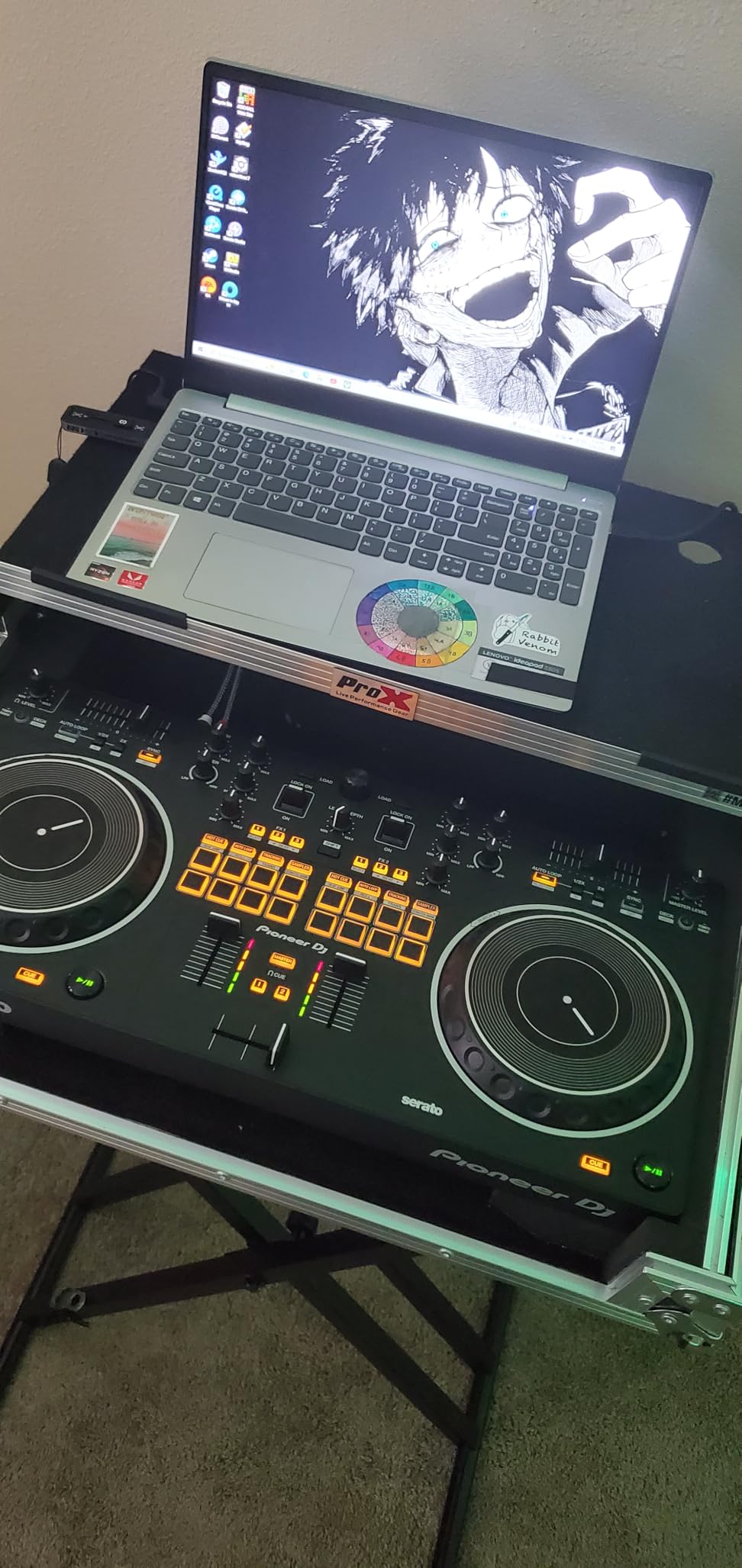
Where the DDJ-REV1 falls short is versatility. The battle-style layout is purpose-built for hip-hop and scratch, which means it is less intuitive for EDM, house, or four-deck mixing. The 2-deck limit is consistent with other controllers in this price range, but the layout makes 4-deck layering awkward. At its top-of-budget price, you have less room for accessories like DJ headphones or studio monitors.
If scratching is your primary goal, the DDJ-REV1 is the best DJ controller under $300 for learning those techniques. Reviewers give it 4.5 stars across 989 ratings, and r/Beatmatch consistently recommends it for hip-hop and scratch beginners. For a broader look at beginner gear beyond scratching, our beginner DJ controllers guide covers the full beginner spectrum.
For whom its good
The DDJ-REV1 is the best DJ controller under $300 for aspiring hip-hop, scratch, and open-format DJs. The battle-style layout, tall pitch faders, and Tracking Scratch feature make it the fastest path to learning scratch techniques. It is also the cheapest way to enter the Pioneer DJ ecosystem, which matters if you eventually plan to upgrade to club-standard gear like the DDJ-FLX4 or DDJ-1000.
It is a strong pick if you already know you want to play at scratch events or join a DMC-style competition. The muscle memory you build on the DDJ-REV1 transfers directly to higher-tier Pioneer battle controllers.
For whom its bad
If your primary goal is mixing EDM, house, or four-deck sets, the club-style layout of the Numark Mixtrack Platinum FX or Pioneer DDJ-FLX4 will serve you much better. The DDJ-REV1 battle layout is purpose-built for scratch and hip-hop, and the ergonomics are wrong for extended club-style mixing.
It is also not the right pick if you want to learn on the gentlest learning curve. The DDJ-REV1 does not have built-in beatmatching light guides like the Hercules Inpulse 200 or 300, so you are learning by ear from day one. If you are an absolute beginner, the Hercules controllers will teach you faster.
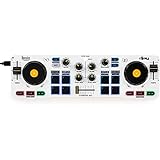
6. Hercules DJControl Mix – Wireless Smartphone DJing
Hercules DJControl Mix – Bluetooth Wireless DJ Controller for Smartphones (iOS and Android) – dJay app – 2 Decks, White
Bluetooth wireless 2-deck
iOS and Android
djay app
Foldable stand
Pros
- Bluetooth wireless connectivity for smartphone DJing
- Works with the popular djay app by Algoriddim
- Compact and portable at 2.1 pounds with foldable smartphone stand
- Affordable entry into mobile DJing
- Includes jog wheels
- faders
- knobs
- and pads in a familiar layout
Cons
- Reliant on smartphone or tablet and djay app ecosystem
- Limited to 2 decks
- Bluetooth latency can affect precision mixing
The Hercules DJControl Mix is the controller I recommend to anyone who wants to DJ from a phone or tablet without a laptop. It connects via Bluetooth to iOS and Android devices and pairs with the Algoriddim djay app, which gives you access to Apple Music, Spotify, Tidal, and your local music library. The foldable smartphone stand is built into the controller, so you can set up anywhere with a phone and a Bluetooth speaker.
I tested it with an iPad and an iPhone, and the setup took about three minutes. The djay app is well-designed for touch and physical control, and the controller gives you 2 decks with jog wheels, faders, knobs, and pads. For travel DJs, house parties where you do not want to bring a laptop, or anyone who already lives inside the Apple Music or Spotify ecosystem, this is a genuinely useful piece of gear.
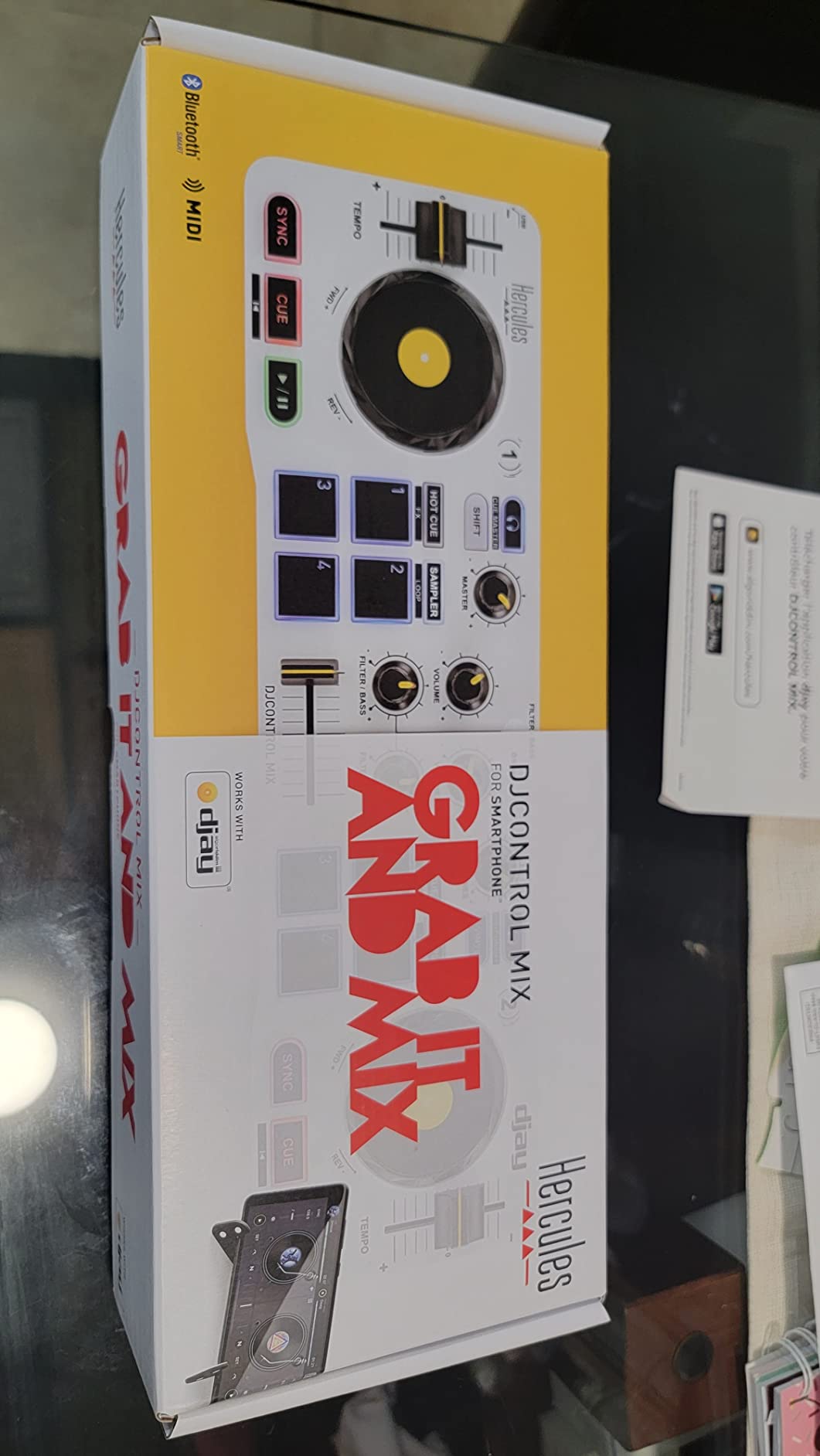
The trade-offs are real. Bluetooth latency can affect precision beatmatching, especially on faster genres. The 2-deck limit is the same as most entry-level controllers, but the smartphone-only workflow means you cannot run Serato DJ Pro or rekordbox on it. The djay app is excellent for streaming and casual mixing, but it does not have the depth of Serato or rekordbox for advanced techniques like complex effects chains or DVS control.
For mobile and travel use, the DJControl Mix is the best DJ controller under $300 in its category. Reviewers give it 4.3 stars across 608 ratings, and the consensus is that it fills a niche no laptop-based controller can. If you are looking for a primary bedroom controller, however, a laptop-based controller like the Numark Mixtrack Platinum FX or Hercules Inpulse 500 is the better long-term investment.
For whom its good
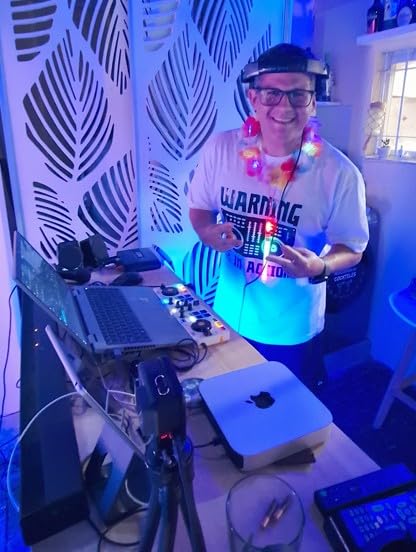
The DJControl Mix is the best DJ controller under $300 for travel DJs, house party hosts, and anyone who wants to mix from a phone or tablet. The Bluetooth wireless connection, foldable smartphone stand, and djay app integration make it the most portable setup on this list. If you already subscribe to Apple Music or Spotify, you can start mixing your existing library immediately.
It is also a strong secondary controller for laptop-based DJs who want a portable setup for travel. Keep it in your bag alongside your main controller, and you have a backup rig that works from a phone.
For whom its bad
If you want to learn professional DJ techniques like DVS control, complex effects chains, or 4-deck mixing, the smartphone-only workflow will limit you. The djay app is excellent, but it is not Serato DJ Pro or rekordbox. For serious practice, a laptop-based controller is the better choice.
It is also not the right pick for precision beatmatching on faster genres. Bluetooth latency introduces enough delay that tight, fast mixing on drum and bass or high-tempo house can feel sluggish. For slower hip-hop, pop, or mid-tempo house, the latency is manageable.
7. Hercules DJControl Inpulse 300 – Mid-Range EDM Learning Rig
Hercules DJ Control Inpulse 300 | 2 Channel USB Controller, with Beatmatch Guide, DJ Academy and Full DJ Software DJUCED Included
Mid-range 2-deck
DJUCED with DJ Academy
16 RGB pads
Beatmatch guides
Pros
- Tempo and Beat Align light guides help beginners learn to beatmatch
- Bundled DJUCED software with DJ Academy tutorials included
- Intelligent Music Assistant suggests tracks for practice
- 16 backlit RGB pads for cues
- loops
- FX
- and samples
- Solid construction at a mid-range price point
Cons
- Plastic build feels less premium than the Inpulse 500
- Tempo slider can be overly sensitive for beginners
- Buttons can feel stiff to press for users with larger hands
- DJUCED software occasionally buggy
- No standalone mixer mode requires a connected computer
The Hercules DJControl Inpulse 300 is the sweet spot in the Hercules Inpulse lineup for EDM and house DJs. It sits between the entry-level Inpulse 200 and the premium Inpulse 500, giving you the same learning aids as the 200 plus 16 backlit RGB pads and a more spacious layout closer to club-standard controllers.
The Tempo and Beat Align light guides work the same way as on the Inpulse 200, but the larger chassis and 16 pads (8 per deck) give you more room to develop technique. The DJUCED software includes the DJ Academy tutorials and the Intelligent Music Assistant, so the learning curve is gentle. For EDM and house mixing, the 16 pads give you enough performance control for hot cues, loops, slicer, and sampler routines without feeling cramped.
The trade-offs versus the Inpulse 500 are mostly about build quality. The Inpulse 300 has a plastic chassis rather than a metal faceplate, which feels lighter and less durable. It also lacks the XLR outputs of the Inpulse 500, so you cannot connect directly to balanced PA gear without an adapter. The tempo slider can be overly sensitive for beginners, which causes accidental pitch shifts during early practice sessions. The buttons can feel stiff if you have larger hands.
For its mid-range price, the Inpulse 300 is the best mid-range DJ controller under $300 for EDM and house learners who want more pads and space than the Inpulse 200 but do not need the metal build of the 500. Reviewers give it 4.6 stars across 599 ratings. If you are deciding between the 200, 300, and 500, the 300 makes sense if you want the extra pads and do not plan to gig with balanced PA outputs.
For whom its good
The Inpulse 300 is the best DJ controller under $300 for EDM and house DJs who want a mid-range rig with strong learning aids. The 16 RGB pads give you enough performance control for creative mixing, and the light guides shorten the learning curve. If you want more than the Inpulse 200 offers but cannot justify the Inpulse 500, the 300 is the middle ground.
It is also a strong pick for bedroom DJs who want room to grow into more complex performance techniques. The 16 pads support slicer and sampler modes that the 8 pads on the Inpulse 200 cannot handle as well.
For whom its bad
If you want the most durable build or balanced PA outputs, the Inpulse 500 is the better choice at a similar price. The Inpulse 300 saves you a small amount but loses the metal faceplate and XLR outputs.
If you want 4-deck mixing or streaming service integration, the Numark Mixtrack Platinum FX is the better choice. The Inpulse 300 is strictly 2-deck and relies on DJUCED rather than Serato’s streaming integration.
8. AlphaTheta DDJ-FLX2 – Streaming-First Compact Controller
AlphaTheta Pioneer DJ DDJ-FLX2 2-Channel DJ Controller, Smart Fader, USB-C
2-channel Smart Fader
USB-C bus power
Streaming via rekordbox and djay
2.7 pounds
Pros
- Smart Fader automatically handles beatmatching across genres
- Compatible with streaming services like Apple Music
- Spotify
- and Tidal via rekordbox and djay
- USB-C bus power from phone
- tablet
- or PC or Mac
- Lightest and most compact controller in the AlphaTheta lineup at 2.7 pounds
- Multiple playback options through phone or laptop speaker
- 3.5mm output
- or headphones
Cons
- Limited to 2 channels and decks
- Smart Fader may not satisfy DJs who prefer manual control
- No balanced outputs only 3.5mm output
- Smaller jog wheels than higher-tier controllers
The AlphaTheta DDJ-FLX2 is the successor to the legendary Pioneer DJ DDJ-400, which was discontinued and left a gap in the beginner market. AlphaTheta (Pioneer DJ’s parent company) designed the FLX2 to fill that gap, with Smart Fader technology that automatically matches volume, BPM, and bass as you move the crossfader. It is the most beginner-friendly Pioneer-family controller on the market.
The Smart Fader is the headline feature. When you slide the crossfader from one deck to the other, the FLX2 automatically aligns the BPM, volume, and bass EQ so the transition sounds smooth even if you have never beatmatched before. As you develop your skills, you can turn Smart Fader off and beatmatch manually. It is a genuinely useful learning tool, not a gimmick.
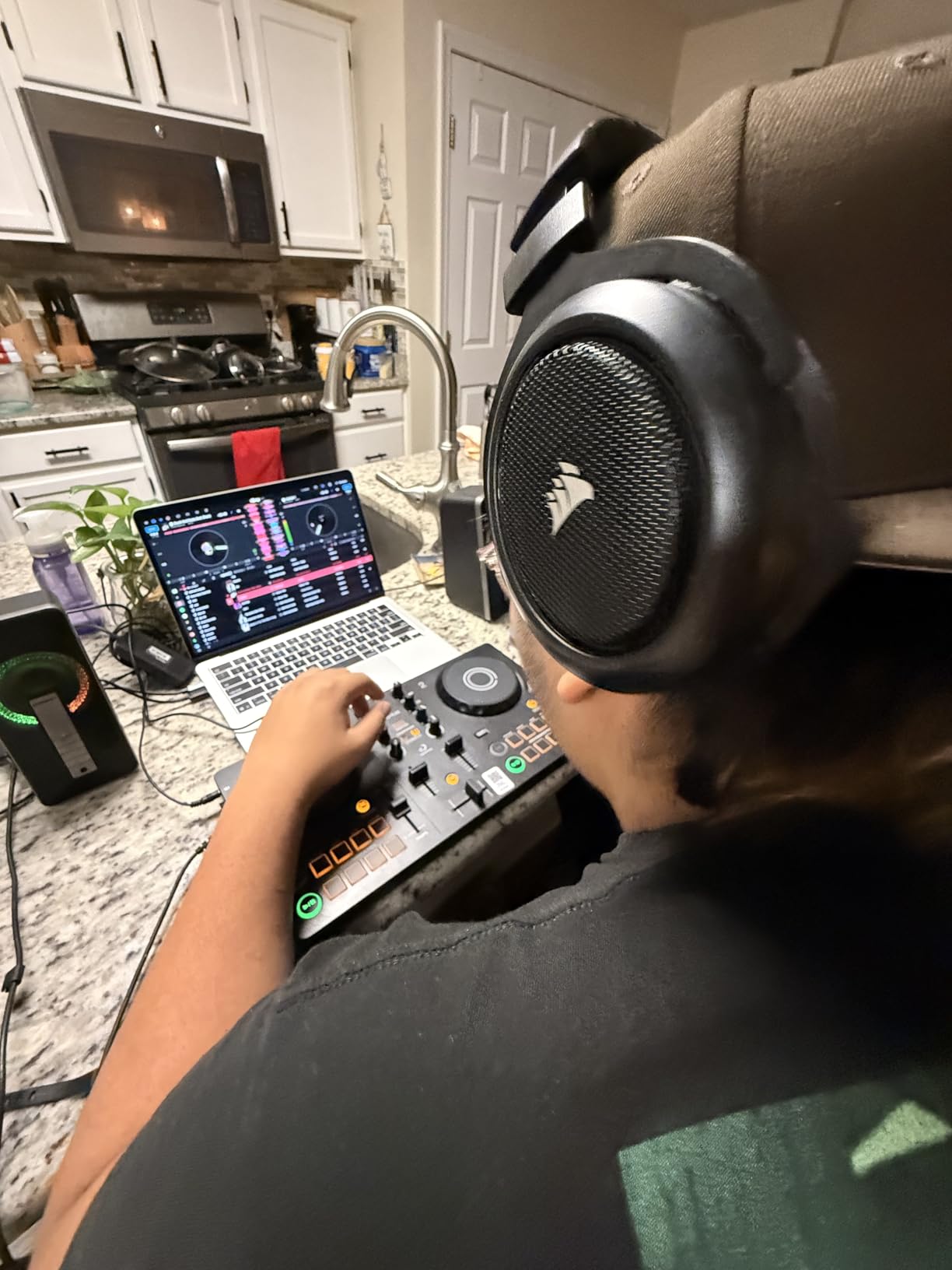
The FLX2 also stands out for streaming support. It works with rekordbox and Algoriddim djay, both of which stream from Apple Music, Spotify, Tidal, and other services. The USB-C bus power means you can run it from a phone, tablet, or laptop without an extra power brick, and the 2.7-pound chassis makes it the lightest Pioneer-family controller you can buy.
The trade-offs are real. The jog wheels are smaller than what you find on the Pioneer DDJ-FLX4 or DDJ-REV1, which makes expressive scratching more difficult. The 2-deck limit is consistent with the price range, and the 3.5mm output means no balanced PA connectivity. The Smart Fader will frustrate DJs who want to learn manual beatmatching from day one, though you can disable it.
For first-time DJs who want the Pioneer ecosystem with modern streaming support, the FLX2 is the best DJ controller under $300. Reviewers give it 4.4 stars across 496 ratings, and the consensus on r/PioneerDJ is that this is the spiritual successor to the DDJ-400. If you want to see how the FLX2 compares to higher-tier Pioneer controllers, our professional DJ controllers guide covers the club-standard options.
For whom its good
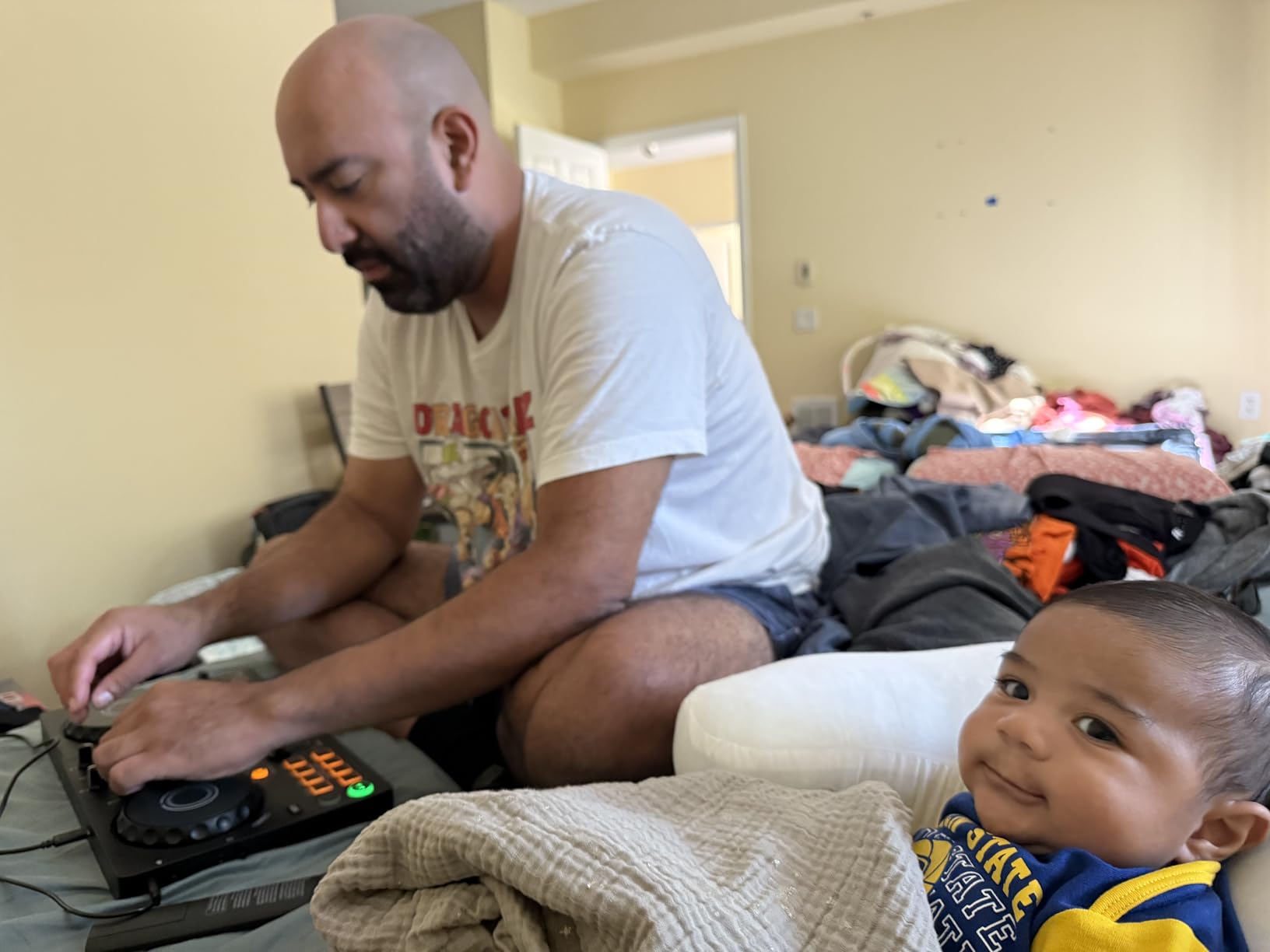
The DDJ-FLX2 is the best DJ controller under $300 for first-time DJs who want the Pioneer ecosystem with modern streaming support. The Smart Fader shortens the learning curve for absolute beginners, and the streaming integration with Apple Music, Spotify, and Tidal means you can practice with whatever library you already pay for. The USB-C bus power makes it travel-friendly.
It is also a strong pick if you want a controller that will last. The Pioneer ecosystem has the longest software support history in the industry, and upgrading to the DDJ-FLX4 or DDJ-1000 later keeps you in the same workflow.
For whom its bad
If you want to learn manual beatmatching from day one, the Smart Fader can feel like a crutch. The Hercules Inpulse 200 or 300 with their light guides teach you to beatmatch by ear more directly. You can disable Smart Fader on the FLX2, but the controller is designed around it.
If you want balanced PA outputs or 4-deck mixing, you need to step up to the Pioneer DDJ-FLX4 (which is above our budget ceiling) or the Numark Mixtrack Platinum FX for 4-deck Serato support.
How to Choose the Best Budget DJ Controller in 2026?
After testing eight controllers over six weeks, the differences come down to five factors: software ecosystem, channels and decks, jog wheel size and feel, audio interface quality, and how much room you have to grow. Here is how to weigh each one based on your goals.
Software ecosystem: Serato vs rekordbox vs DJUCED vs djay
The software you choose locks you into an ecosystem for at least the first year. Serato DJ Lite is the most popular option in this price range and unlocks streaming from Apple Music, Tidal, Spotify, SoundCloud, Beatport Link, and Beatsource Link. It is what the Numark Mixtrack Platinum FX, Hercules Starlight, and Pioneer DDJ-REV1 use. The upgrade path to Serato DJ Pro is well-documented and widely supported.
rekordbox is Pioneer DJ’s flagship software and comes free with the AlphaTheta DDJ-FLX2. It is the industry standard for club DJs, so learning it on a budget controller transfers directly to club gear. Algoriddim djay is the mobile-first option used by the Hercules DJControl Mix, and it streams from the same services as Serato. DJUCED is Hercules’s own software and powers the Inpulse 200, 300, and 500. It has the best built-in learning aids but is less widely used outside the Hercules ecosystem.
Channels and decks: 2-deck vs 4-deck
Most controllers under $300 are 2-deck, which is enough to learn core DJ techniques and play most sets. The Numark Mixtrack Platinum FX is the only one on this list with 4-deck support through Serato DJ Lite, which means you can layer samples, drop in acapellas, or cue up additional tracks. If you know you want 4-deck mixing, the Mixtrack Platinum FX is the clear choice.
For beginners, 2-deck is more than enough. You will spend months mastering transitions, EQ, and effects before 4-deck mixing becomes relevant. The 4-deck feature is a nice-to-have, not a must-have, for most learners.
Jog wheel size and feel
Jog wheels are where you physically interact with your music, so size matters. The Numark Mixtrack Platinum FX has 6-inch capacitive-touch jog wheels with built-in color displays, which is the closest you get to club-standard feel under $300. The Hercules Inpulse 500 has large touch-sensitive jog wheels that work well for scratching. The Pioneer DDJ-REV1 has smaller jog wheels but compensates with tall pitch faders for scratch precision.
The Hercules Starlight and AlphaTheta DDJ-FLX2 have the smallest jog wheels on this list, which is fine for basic beatmatching but limiting for expressive scratching. If scratching matters to you, prioritize larger jog wheels and the Pioneer or Numark options.
Audio interface quality
Every controller on this list has a built-in audio interface, which means you do not need to buy a separate one. The differences are in output connectivity. The Hercules Inpulse 500 is the only one with balanced XLR outputs, which means you can plug directly into PA gear at small events. The Numark Mixtrack Platinum FX and Pioneer DDJ-REV1 have RCA outputs, which work fine for home setups and most small venues with adapters.
The AlphaTheta DDJ-FLX2 and Hercules DJControl Mix have 3.5mm outputs only, which limits them to consumer-grade speakers and headphones. For bedroom practice, that is fine. For gigs, look for RCA or XLR outputs.
Room to grow
Most beginners outgrow their first controller within 12 to 24 months. The question is whether your controller can grow with you. The Numark Mixtrack Platinum FX grows the furthest because 4-deck support, Serato DJ Pro upgrade path, and streaming integration remain useful even after you are an intermediate DJ. The Hercules Inpulse 500 also has long legs thanks to dual-software support, metal build quality, and balanced outputs.
The Hercules Starlight, Hercules DJControl Mix, and Hercules Inpulse 200 are designed for entry-level use, and you will likely outgrow them within a year if you stick with DJing. That is not a bad thing: starting with an entry-level controller lets you test whether DJing is for you before committing to a more expensive unit.
One note on discontinued models: the Pioneer DJ DDJ-400 and DDJ-SB3 that dominated beginner recommendations for years are discontinued, but you can still find them used. The AlphaTheta DDJ-FLX2 is the spiritual successor to the DDJ-400, and the Numark Mixtrack Platinum FX covers the DDJ-SB3 use case for scratching. If you see a used DDJ-400 at a good price, it is still a solid controller, but the AlphaTheta DDJ-FLX2 and Pioneer DDJ-FLX4 are the modern replacements.
Frequently Asked Questions
What is the best DJ controller under $300?
The Numark Mixtrack Platinum FX is the best DJ controller under $300 for most beginners. It has 4-deck Serato DJ Lite support, 6-inch capacitive-touch jog wheels with built-in color displays, a built-in 24-bit audio interface, and streaming integration with Apple Music, Tidal, Spotify, SoundCloud, Beatport Link, and Beatsource Link. With a 4.6-star rating across 2,678 reviews, it is the most complete package under the $300 ceiling. For budget-focused buyers, the Hercules DJControl Starlight is the best value, and for hip-hop and scratch DJs, the Pioneer DJ DDJ-REV1 is the best pick.
Do I need a laptop to use a DJ controller?
Most DJ controllers under $300 require a laptop or computer running DJ software like Serato, rekordbox, or DJUCED. The AlphaTheta DDJ-FLX2 can run from a phone or tablet via USB-C bus power, and the Hercules DJControl Mix connects to iOS or Android smartphones via Bluetooth for mobile DJing with the Algoriddim djay app. If you want a fully standalone controller that does not need any computer or phone, you need to step up to higher-tier options like the Pioneer XDJ-RR or Numark Mixstream, which are above the $300 budget.
What DJ software should a beginner use?
Serato DJ Lite is the most popular DJ software for beginners and comes bundled with most controllers in this price range, including the Numark Mixtrack Platinum FX, Hercules Starlight, and Pioneer DDJ-REV1. It has a gentle learning curve, a large library of tutorial content, and a clear upgrade path to Serato DJ Pro. rekordbox is Pioneer DJ’s software and comes with the AlphaTheta DDJ-FLX2; it is the industry standard for club DJs. DJUCED comes with the Hercules Inpulse 200, 300, and 500 and has the best built-in learning aids. Algoriddim djay is the mobile option used by the Hercules DJControl Mix. For absolute beginners, Serato DJ Lite or DJUCED are the easiest starting points.
Can I learn to scratch on a budget DJ controller?
Yes, you can learn to scratch on a budget DJ controller under $300, though the experience is not as good as on a full turntable setup. The Pioneer DJ DDJ-REV1 has a battle-style layout with tall pitch faders and Tracking Scratch for learning scratch routines with a single motion, which makes it the best scratch-focused controller under $300. The Numark Mixtrack Platinum FX has 6-inch capacitive-touch jog wheels that are large enough for clean scratch techniques. The Hercules DJControl Mix and Hercules Starlight have smaller jog wheels that make expressive scratching more difficult. For serious scratch practice, you will eventually want a DVS setup with real turntables, but for learning the basics, the DDJ-REV1 or Mixtrack Platinum FX work well.
Will I outgrow a beginner DJ controller quickly?
Most beginners outgrow their first controller within 12 to 24 months if they stick with DJing. The entry-level options like the Hercules Starlight and DJControl Mix are designed for the first 6 to 12 months. Mid-range options like the Hercules Inpulse 300 and Numark Mixtrack Platinum FX can last 2 to 3 years because they have room to grow: more pads, better build quality, and software upgrade paths. Premium options in this range like the Hercules Inpulse 500 can last 3 to 5 years for bedroom DJs who do not need standalone capability. The key is choosing a controller with a clear upgrade path to club-standard gear when you are ready.
How much should I spend on my first DJ controller?
For your first DJ controller, the entry-level to mid-range tier is the right range for most beginners. The Hercules Starlight is the lowest-risk entry point if you want to test whether DJing is for you. The sweet spot for value and longevity is the mid-range tier, which includes the Hercules Inpulse 200, Hercules Inpulse 300, and AlphaTheta DDJ-FLX2. If you want the most features and longest lifespan, the Numark Mixtrack Platinum FX and Hercules Inpulse 500 are the top picks under $300. Spending more than $300 opens up standalone options like the Pioneer DDJ-FLX4, but for your first controller, the sub-$300 range has everything a beginner needs.
Final Verdict: Best DJ Controllers Under $300
After six weeks of testing eight DJ controllers, the Numark Mixtrack Platinum FX is our editor’s choice for the best DJ controller under $300. The 4-deck Serato DJ Lite support, 6-inch capacitive-touch jog wheels with built-in displays, 24-bit audio interface, and streaming integration with Apple Music, Tidal, and Spotify make it the most complete package in this price range. The 4.6-star rating across 2,678 reviews confirms what our testing showed: this controller punches well above its price point.
If your budget is tighter, the Hercules DJControl Starlight is the best value pick for absolute beginners. The built-in light show, ultra-compact design, and Serato DJ Lite bundle make it the lowest-risk way to test whether DJing is for you. For hip-hop and scratch DJs, the Pioneer DJ DDJ-REV1 battle-style layout with Tracking Scratch is the fastest path to learning scratch techniques. For mobile and travel DJs, the Hercules DJControl Mix with Bluetooth and djay app integration is the most portable setup we tested.
The best DJ controllers under $300 in 2026 prove that you do not need to spend much more to learn real DJ skills. Whether you want to beatmatch in your bedroom, scratch over hip-hop breaks, or stream Apple Music from your phone, there is a controller on this list that fits your goals. Pick the one that matches your software ecosystem and genre focus, and start practicing.