
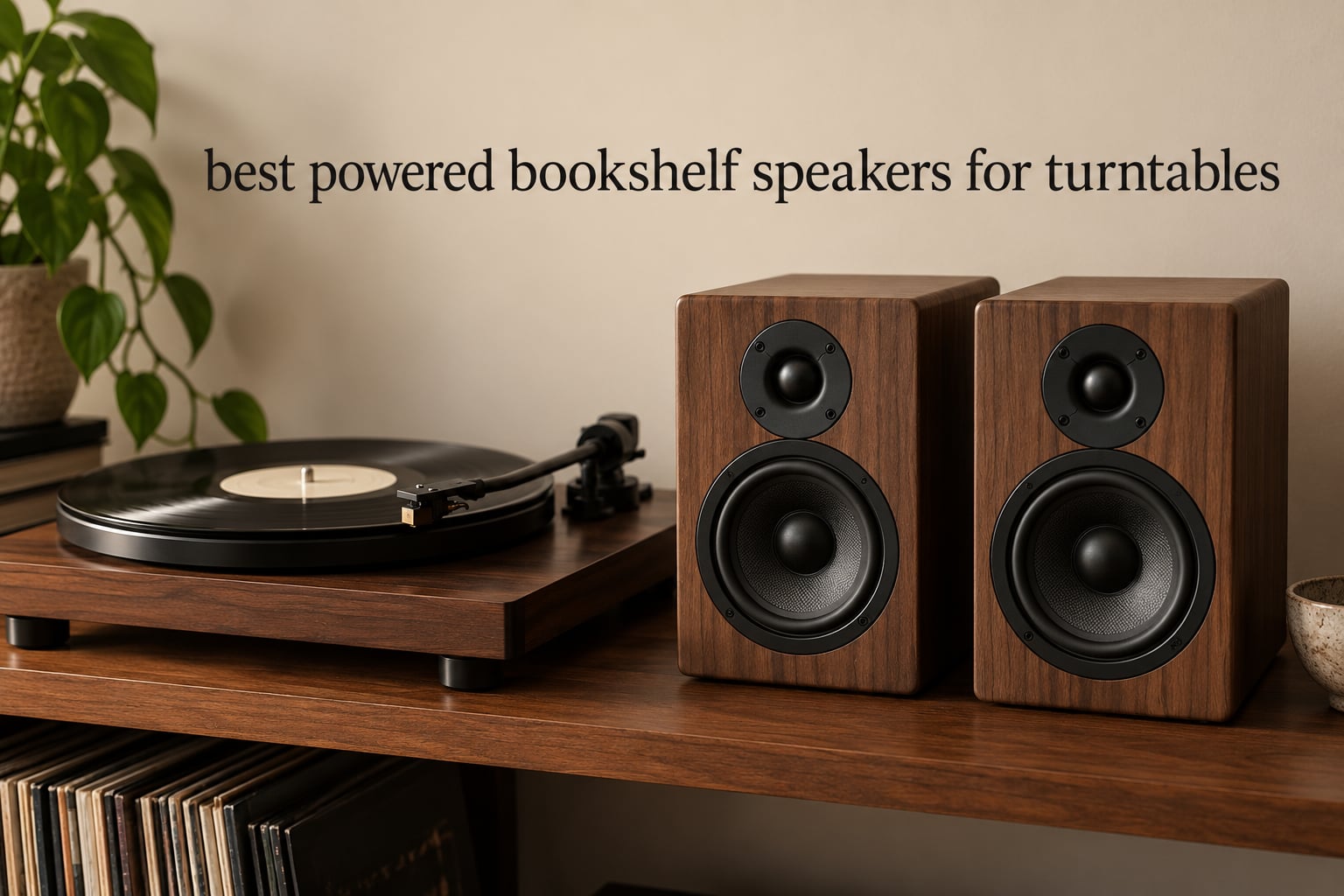
A turntable makes a very small electrical signal, and the speakers decide whether that signal becomes music you actually want to sit and listen to. The best powered bookshelf speakers for turntables solve that problem in one box: the amplifier lives inside the cabinet, so a single RCA cable from the turntable is the whole connection. No receiver, no extra shelf of components, no wondering which amplifier to buy next.
That convenience comes with one rule that trips up more first-time vinyl owners than anything else. Powered speakers only understand line-level signals, and a turntable cartridge produces a phono-level signal. Get that pairing wrong and you will hear thin, quiet, distorted audio that sounds like a broken record player. Get it right and a modest speaker pair will sound genuinely good.
We compared ten powered pairs currently on the market, weighted the phono-stage question first, and checked driver size, amplifier output, input selection and room fit for each. Prices and specifications were checked for 2026, and every pick below includes an honest limitation, not just a list of positives. If you want the short version first, our top pick is the Klipsch R-51PM, which has a switchable phono stage.
If you are still working out what active speakers even are, our complete guide to powered speakers covers the basics, and our wider powered speaker roundup covers options that are not aimed at vinyl.
Table of Contents
Top 3 Best Powered Bookshelf Speakers for Turntables in 2026

Klipsch R-51PM
- Switchable phono/line input
- 5.25 inch woofer
- 120W amplification
- Bluetooth and USB

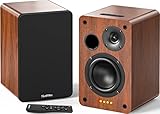
Saiyin DS6701
- Optical
- coax and RCA inputs
- SUB OUT jack
- 4 inch woofer
- Remote with input switching
The Klipsch R-51PM wins because it works with almost any turntable out of the box and has the driver size to fill a real room. The Edifier R1280DB wins on value and on having more input options than anything cheaper. The Saiyin DS6701 is the pick if you want to switch between a TV and a record player without unplugging anything.
All 10 Picks at a Glance (October 2026)
| Product | Specifications | Action |
|---|---|---|
| Klipsch R-51PM |
|
Check Latest Price |
| Edifier R1280DB |
|
Check Latest Price |
 Audio-Technica AT-SP3X Audio-Technica AT-SP3X |
|
Check Latest Price |
 Kanto YU6 Kanto YU6 |
|
Check Latest Price |
 Audioengine A5+ Audioengine A5+ |
|
Check Latest Price |
 Electrohome Huntley EB10 Electrohome Huntley EB10 |
|
Check Latest Price |
 MEVOSTO DS19 MEVOSTO DS19 |
|
Check Latest Price |
| Saiyin DS6701 |
|
Check Latest Price |
 Edifier R2000DB Edifier R2000DB |
|
Check Latest Price |
 Elimavi BT-04 Elimavi BT-04 |
|
Check Latest Price |
Two specs columns decide most of these pairings: whether a phono stage is built in, and how large the woofer is. Everything else is preference.
Do You Need Speakers With a Built-In Phono Preamp?
Ask one question about your turntable: does it have a LINE/PHONO switch on the back, or a PHONO input label next to one of the RCA jacks? Your answer determines almost everything else.
A phono preamp takes the tiny signal from the cartridge and applies the RIAA equalisation curve that turns it into a normal line-level signal. A turntable with a built-in preamp and a LINE/PHONO switch can output line level directly, which is exactly what powered speakers want. Connect that turntable to the RCA input on any speaker in this roundup with the ground wire attached, and you are playing records.
A turntable without that switch, such as a Rega Planar 1 or a Pro-Ject Debut Carbon, outputs phono level only. Plug phono-level audio into a line-level input and you will hear exactly what listeners describe on r/BudgetAudiophile as thin, quiet, distorted sound. This is the single most common first-setup mistake in the vinyl world, and it gets blamed on the speakers when the fault is upstream.
Your turntable has a LINE/PHONO switch. Set it to LINE, connect the RCA out to the speaker RCA in, attach the ground wire to the ground screw if the speakers have one. All ten speakers in this roundup work.
Your turntable has a built-in preamp with a PHONO input and a separate LINE output. Use the LINE output and treat every speaker here as compatible.
Your turntable has no preamp and no switch. Choose speakers with a switchable phono input, such as the Klipsch R-51PM or the Kanto YU6, or add a small external phono stage between the turntable and the speakers.
You want the turntable’s own preamp to do the work. Leave the speakers on a line input and let an external preamp sit in the chain. This is the standard route for moving-moving coil cartridges, which produce too little signal for most entry-level onboard stages.
Bluetooth deserves a warning here too. Most Bluetooth speakers are receivers, not transmitters, so a turntable cannot send audio to them unless that specific turntable has a Bluetooth transmitter built in. If you want wireless, the turntable has to transmit, and the speaker has to receive.
1. Klipsch R-51PM – Best Overall for Vinyl
Klipsch R-51PM Powered Bluetooth Speaker,Black
5.25 inch woofer
120W output
Switchable phono/line with ground screw
Bluetooth plus USB
Pros
- Switchable phono and line input with a ground screw terminal
- 5.25 inch woofer fills a mid-size room
- 120W of built-in amplification
- Compact cabinets at 13 inches tall
- Bluetooth and USB digital alongside analog
Cons
- Bluetooth connection can drop and produce static
- No front-facing power or pairing indicator
- USB input is playback only and needs a computer
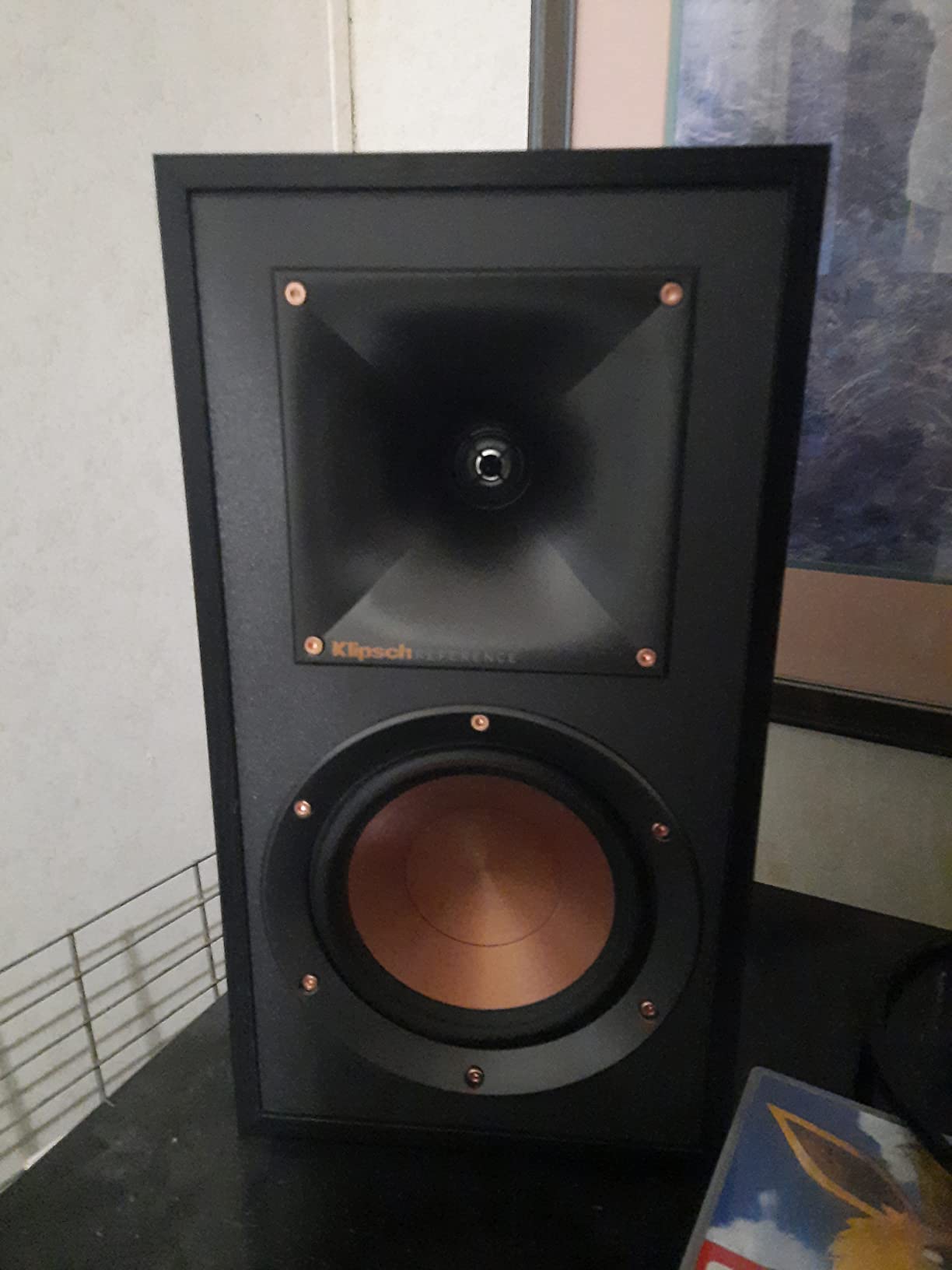
This is the pair we keep coming back to, because it removes the single decision that stops most people buying powered speakers for vinyl. The rear panel has a phono/line switch, so a turntable with no preamp connects directly, and a turntable with a preamp simply uses the line position.
It also has the largest driver here that is not part of a much larger cabinet. A 5.25 inch woofer moving 120 watts is enough to play records without the thinness you get from 4 inch pairs in a room bigger than a bedroom.
At 10.6 pounds and 8.5 by 7 by 13 inches, these sit comfortably on furniture without needing stands, though stands still improve the sound. The cabinets are backed by a two year parts and labour warranty, which is longer than most rivals at this level.
Owners rate the room-filling output and the phono stage most consistently. The most repeated complaints are reliability on Bluetooth and the lack of a visible status light, which means you cannot tell from across the room whether the speakers are on or paired.
Who the Klipsch R-51PM suits
It suits anyone whose turntable has no preamp, which includes most Rega and Pro-Ject owners, plus anyone who wants one box to handle records, a TV and a phone. It is also a sensible first step up from a 4 inch pair in a living room of roughly 150 to 250 square feet.
Where it falls short
The Bluetooth dropouts are real and interrupt a record mid-side. The USB input only carries playback from a computer, so it is not useful for streaming from a turntable. And the missing indicator light is a small irritation that shows up every single time you sit down.
2. Edifier R1280DB – Best Value With More Inputs
Edifier R1280DB Powered Bluetooth Bookshelf Speakers – Optical Input – Wireless Studio Monitors – 4 Inch Near Field Speaker – 42w RMS – Wood Grain
4 inch woofer and silk dome tweeter
42W RMS
Dual RCA plus optical and coaxial
Bluetooth and remote
Pros
- Dual RCA inputs accept a turntable line output
- Optical and coaxial digital inputs for TV and computer
- Side panel bass and treble knobs plus remote
- Balanced sound with no fatigue at moderate volume
- Cables included in the box
Cons
- Remote is thin with no volume bar
- No front power or Bluetooth indicator
- 4 inch woofers give clean but modest bass
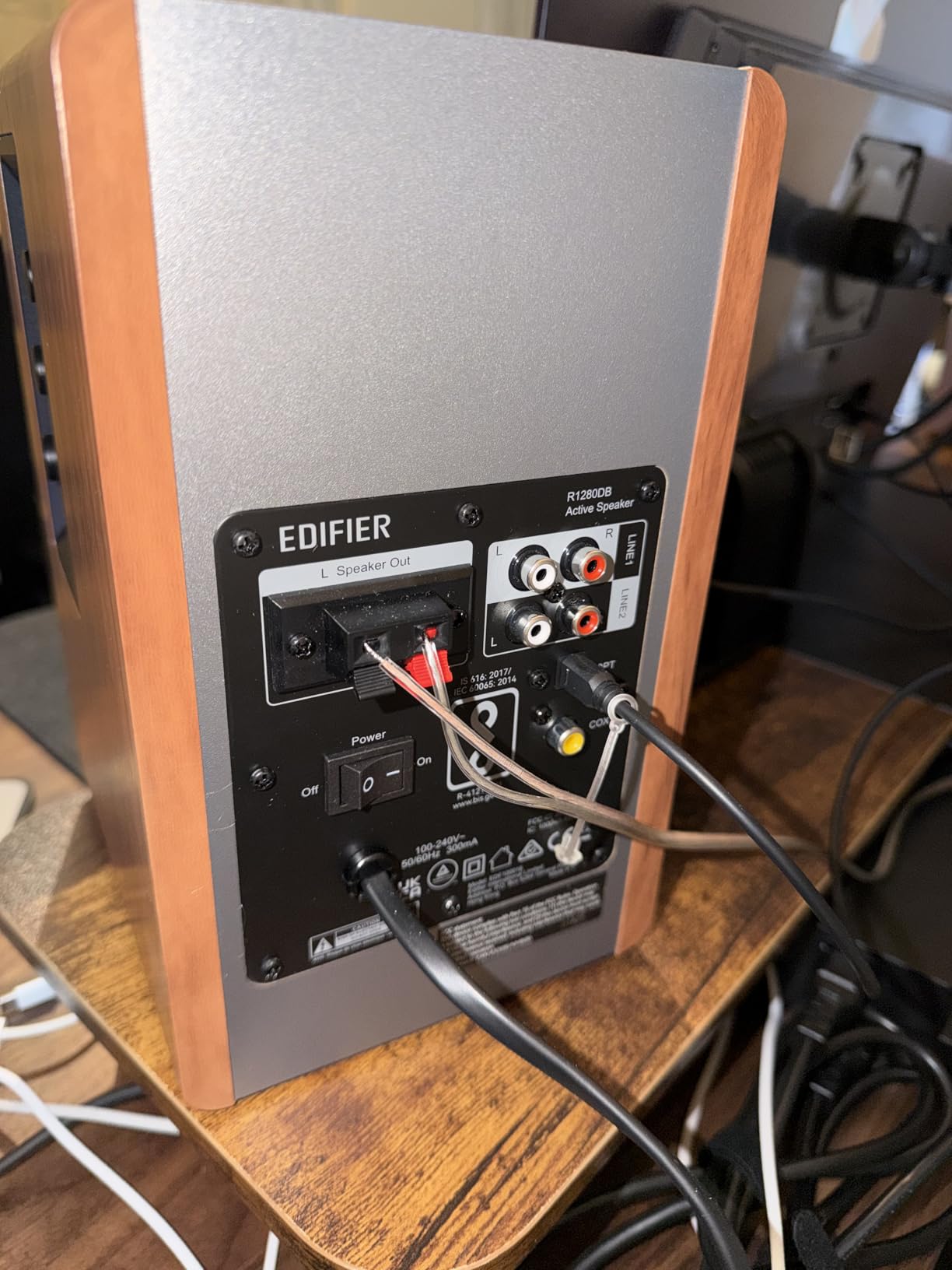
Across r/BudgetAudiophile and r/StereoAdvice, the Edifier 4 inch pair is the name that comes up most often as a first vinyl speaker, and the R1280DB is the version we would point a new buyer toward. It adds optical and coaxial digital inputs and Bluetooth to the basic analog layout.
The dual RCA inputs mean you can keep a turntable and another analog source connected at the same time, which matters if your TV optical feed and your record player share one set of speakers.
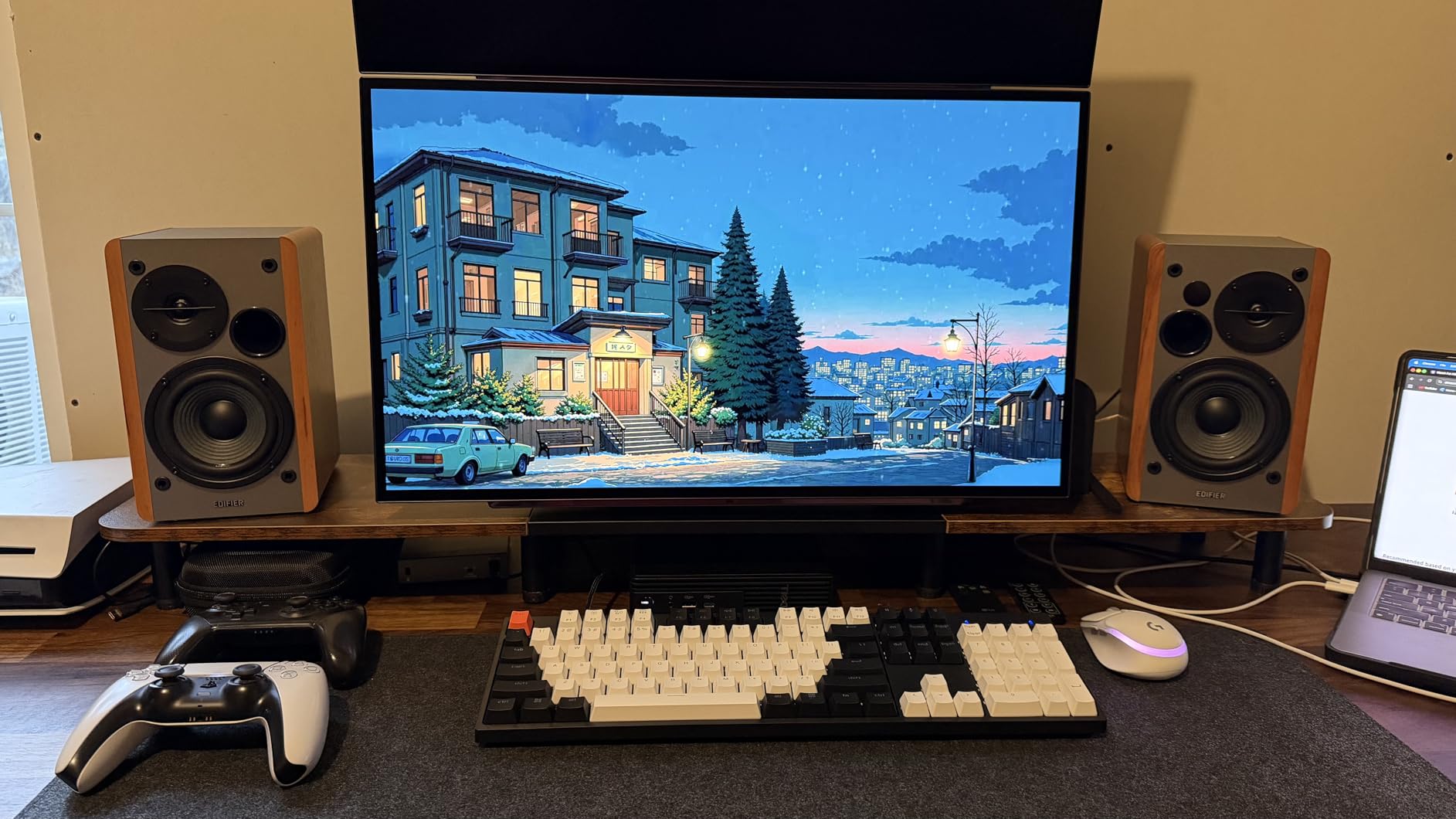
At 42 watts and a 4 inch woofer, the honest limitation is bass. Owners consistently describe the sound as clear and balanced with no listening fatigue, but they also stress that these need stands and careful EQ tuning to sound their best.
Reviewers praise the sound-to-price ratio and the wired clarity of the analog and optical paths. The two recurring gripes are the flimsy remote and the absence of any visible status light.
Who the Edifier R1280DB suits
It suits a first setup in a bedroom, a dorm, or a living room up to about 150 square feet, where 4 inch drivers have room to run. It also suits anyone who wants one pair for a TV, a turntable and a phone without swapping cables.
Where it falls short
If you play bass-heavy records in a larger room, the 4 inch woofer runs out of bottom end before you want it to. There is no phono stage, so a turntable without a preamp still needs an external box or one of the phono-equipped speakers further down this list.
3. Audio-Technica AT-SP3X – Best for Very Small Rooms
Audio-Technica AT-SP3X Bookshelf Speakers
3 inch driver
30W output
Dual RCA plus Bluetooth
Bass boost and LED power button
Pros
- Dual RCA jacks accept a turntable or any analog source
- Multipoint Bluetooth holds two devices at once
- Compact cabinets suit small rooms and desks
- Power button with LED and a volume dial
Cons
- 3 inch drivers limit bass extension and maximum loudness
- No optical or coaxial digital input
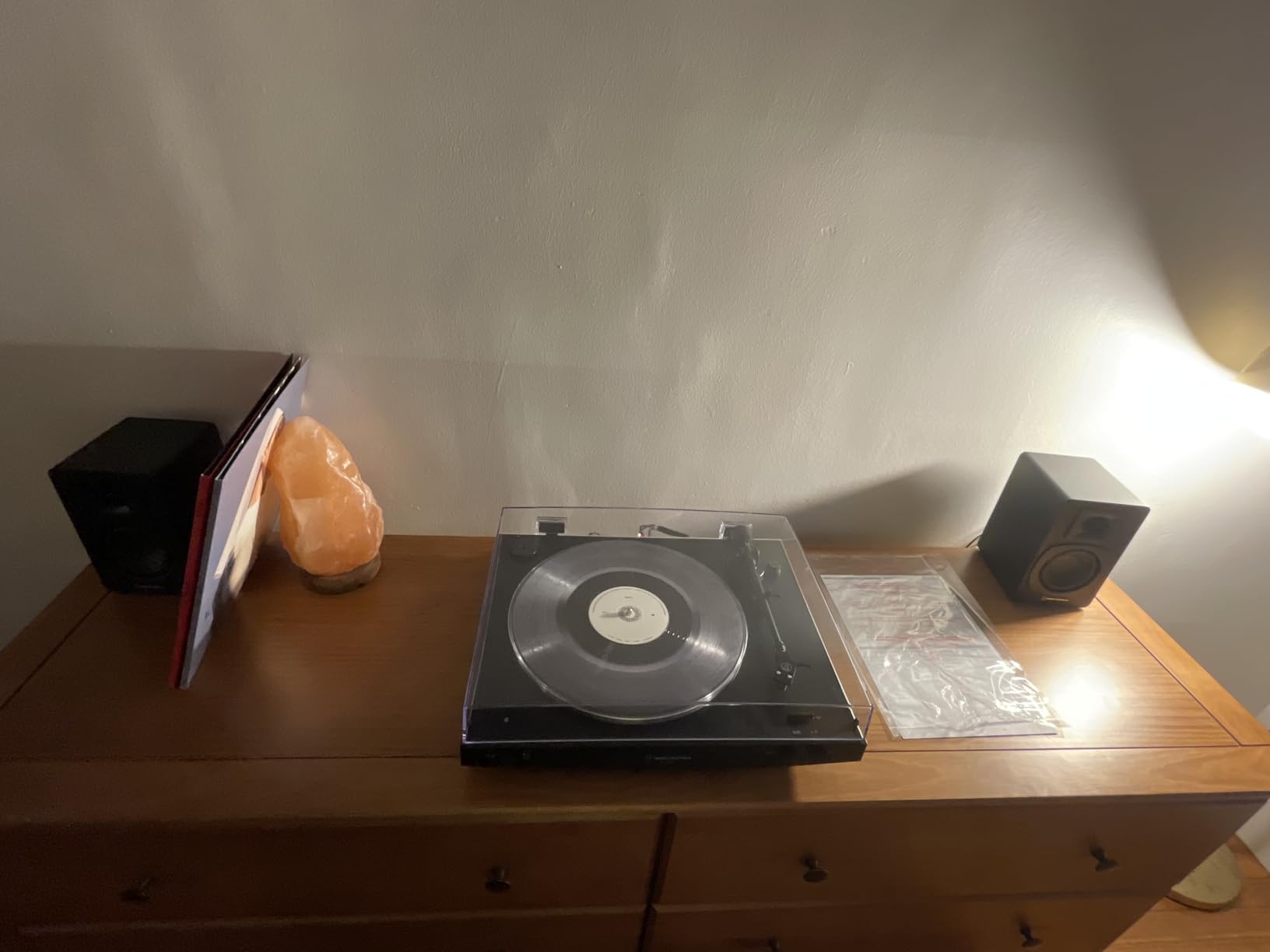
The AT-SP3X comes from a turntable maker, and the input layout reflects that. Dual RCA jacks sit on the back ready for a record player, which means the wiring is exactly what a vinyl setup wants rather than an afterthought.
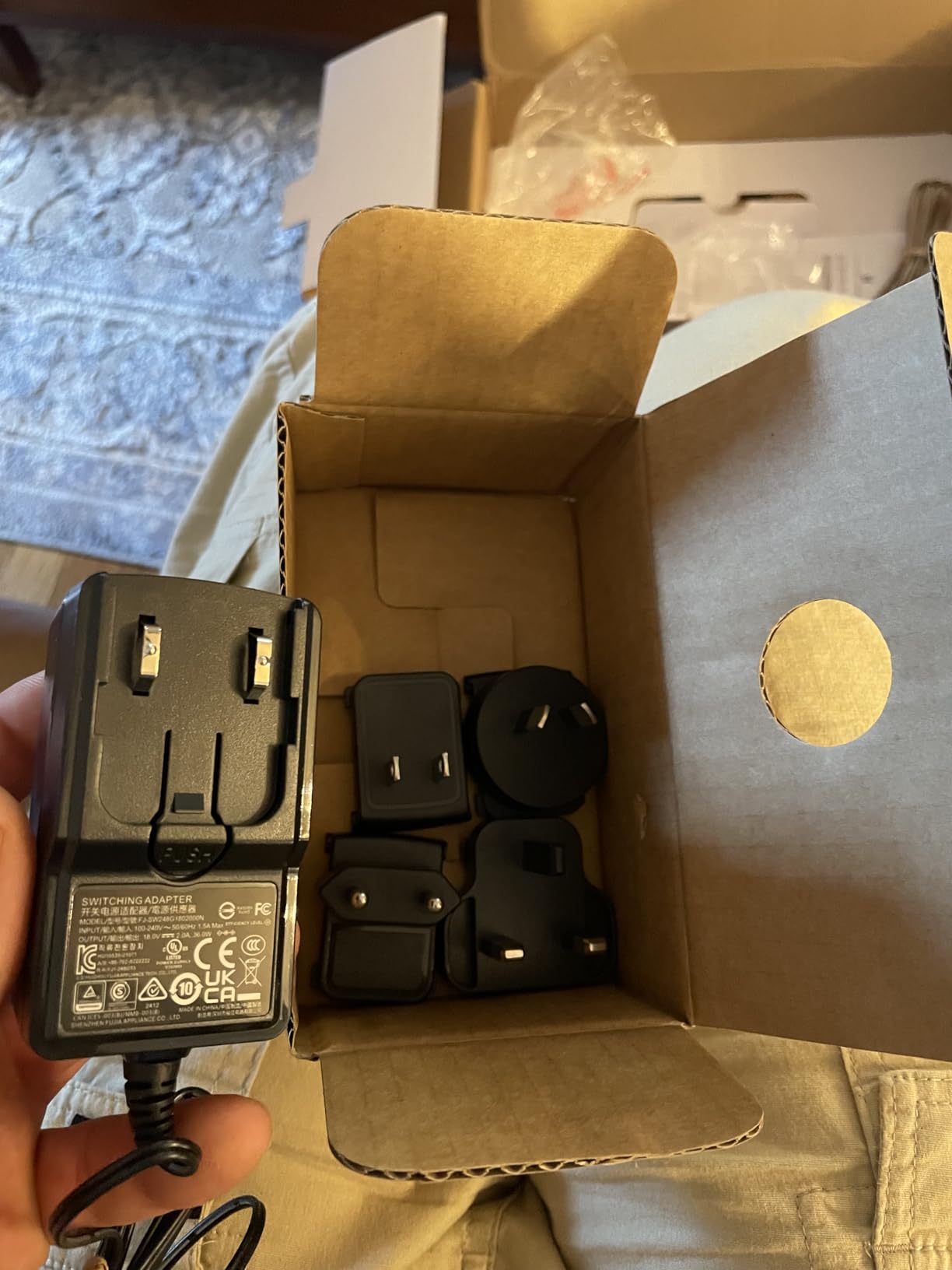
At 3 inch drivers and 30 watts, this is a desktop and small-room speaker. It carries a 70 dB signal to noise ratio and a two year warranty, and it comes with an AC adapter covering three plug standards plus a speaker cable.
Owners rate this pair well above its class, with the wired RCA path and multipoint Bluetooth the most praised features. The small 3 inch drivers are accepted as the trade-off for the cabinet size rather than treated as a fault.
That trade-off is real. Maximum loudness is modest, which means a party in an open-plan living room is not the use case. For late-night listening in a study or a bedroom, the limits rarely come up.
Who the Audio-Technica AT-SP3X suits
It suits a near-field desktop setup or a bedroom under about 120 square feet, and it suits buyers who already own an Audio-Technica turntable and want the brand matched across the system. Multipoint Bluetooth also helps if a phone and a laptop both sit in the mix.
Where it falls short
There is no optical or coaxial input, so connecting a TV means going through the TV’s own analog output or an extra converter. And 3 inch drivers will not deliver the low end that bass-forward vinyl records demand.
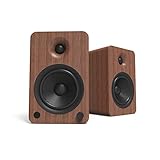
4. Kanto YU6 – Built-In Phono Preamp for Rega and Pro-Ject Owners
Kanto YU6WALNUT Powered Bookshelf Speakers with Bluetooth and Phono Preamp | Pair | Walnut
Integrated phono preamp
5.25 inch Kevlar driver
200W output
Bluetooth aptX and optical input
Pros
- Integrated phono preamp removes the need for an external box
- 200W with 5.25 inch Kevlar drivers plays loudly without obvious distortion
- Remote controls volume
- input
- tone and balance
- Automatic standby and signal detection
- Handcrafted MDF cabinets
Cons
- Audible hum on analog inputs in some setups
- Bluetooth broadcasts constantly and can auto-connect over RCA
- Remote must be pointed at the receiver window
- Cabinet footprint is large for a desk
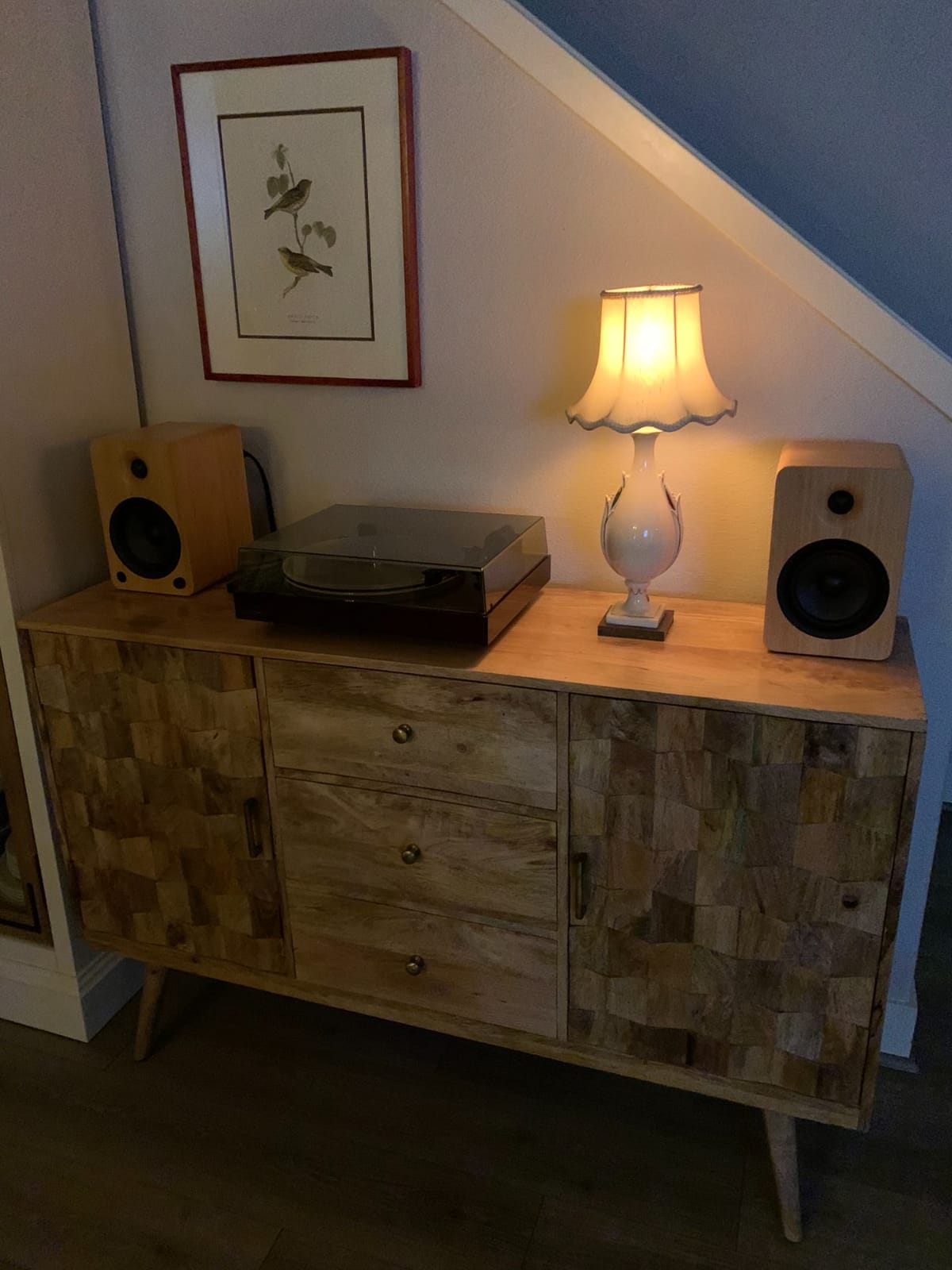
If your turntable has no preamp and no switch, this is the clearest answer in the roundup. The integrated phono preamp sits behind a dedicated input, so a Rega Planar 1 or a Pro-Ject Debut Carbon connects with one RCA cable and no extra box in the chain.
The specification is generous for the money: 200 watts of amplification driving 5.25 inch Kevlar drivers with 1 inch silk dome tweeters, a listed 50 Hz low end, and a two year manufacturer warranty across a 20.1 pound pair.
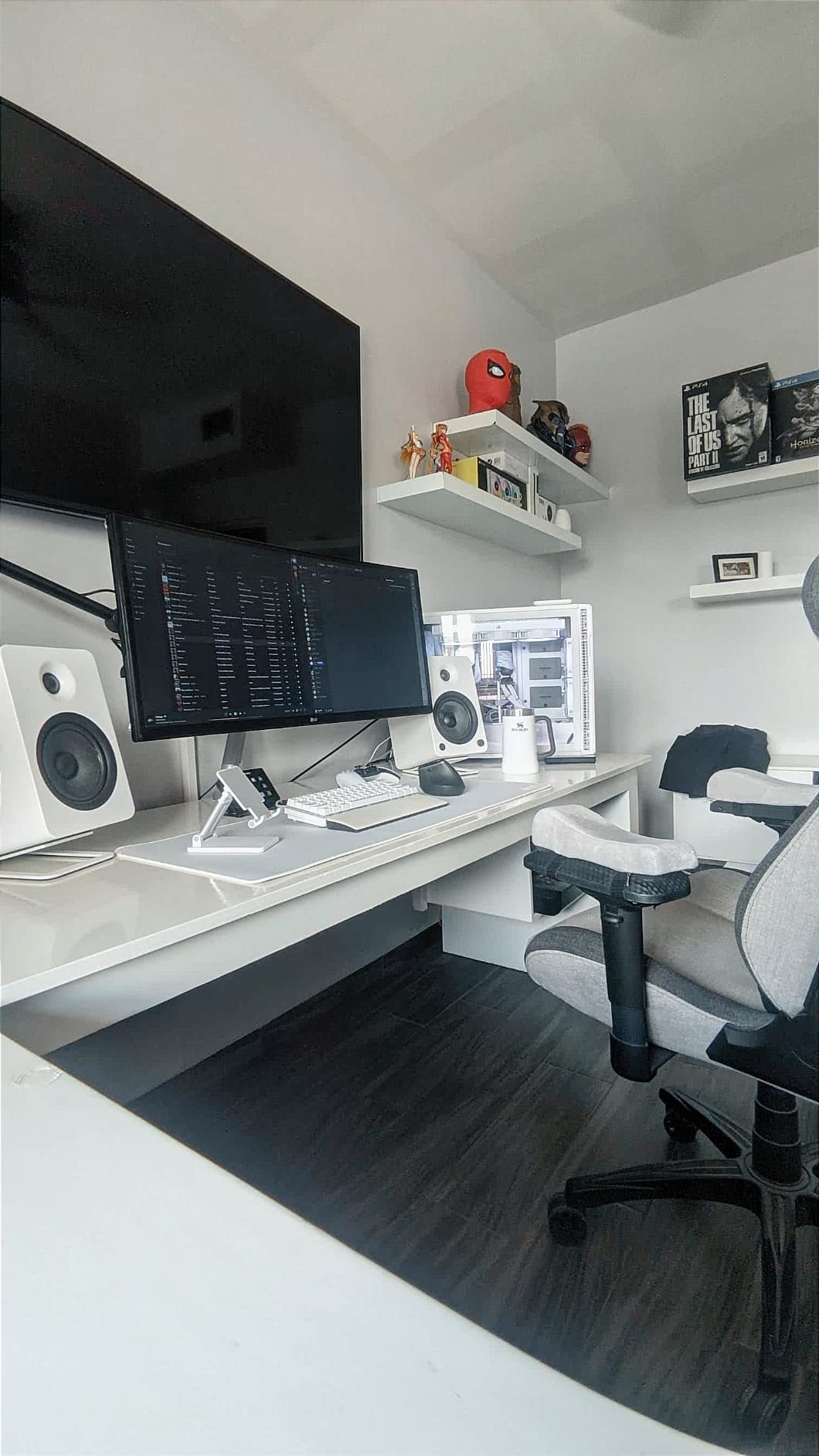
Vinyl owners consistently name the built-in phono stage as the reason to buy this pair, and reviewers treat it as a strong alternative to costlier Klipsch and Audioengine models. The tone controls on the remote have a clearly audible effect, which is rare at this level.
The hum on analog inputs is worth planning for. Some owners report it in certain setups and find that the optical input avoids the issue entirely, which tells you the noise is coming from the analog path rather than the cabinet.
Who the Kanto YU6 suits
It suits owners of a no-preamp turntable who want one box to run records, a TV over optical, and a phone over Bluetooth with aptX. It also suits larger rooms, since 200 watts and a 5.25 inch driver pair have more headroom than anything else here.
Where it falls short
At 15.4 by 12 by 19.5 inches, these are shelf speakers, not desktop speakers. The always-active Bluetooth beacon can grab a connection when RCA is the source you want, and the remote needs a direct line of sight to work.
5. Audioengine A5+ – Best for Wired-Only Listening
Audioengine A5+ Wired Bookshelf Speakers – Powered Speakers
150W amplification
5 inch woofer
RCA and AUX inputs
Wired only, no Bluetooth
Pros
- RCA and AUX inputs are turntable friendly and plug and play
- 150W of clean room filling amplification
- Handcrafted wood cabinets with a 13 step gloss finish
- Three year warranty and strong brand support
Cons
- This wired version has no Bluetooth
- No built-in phono stage so a phono only turntable needs an external unit
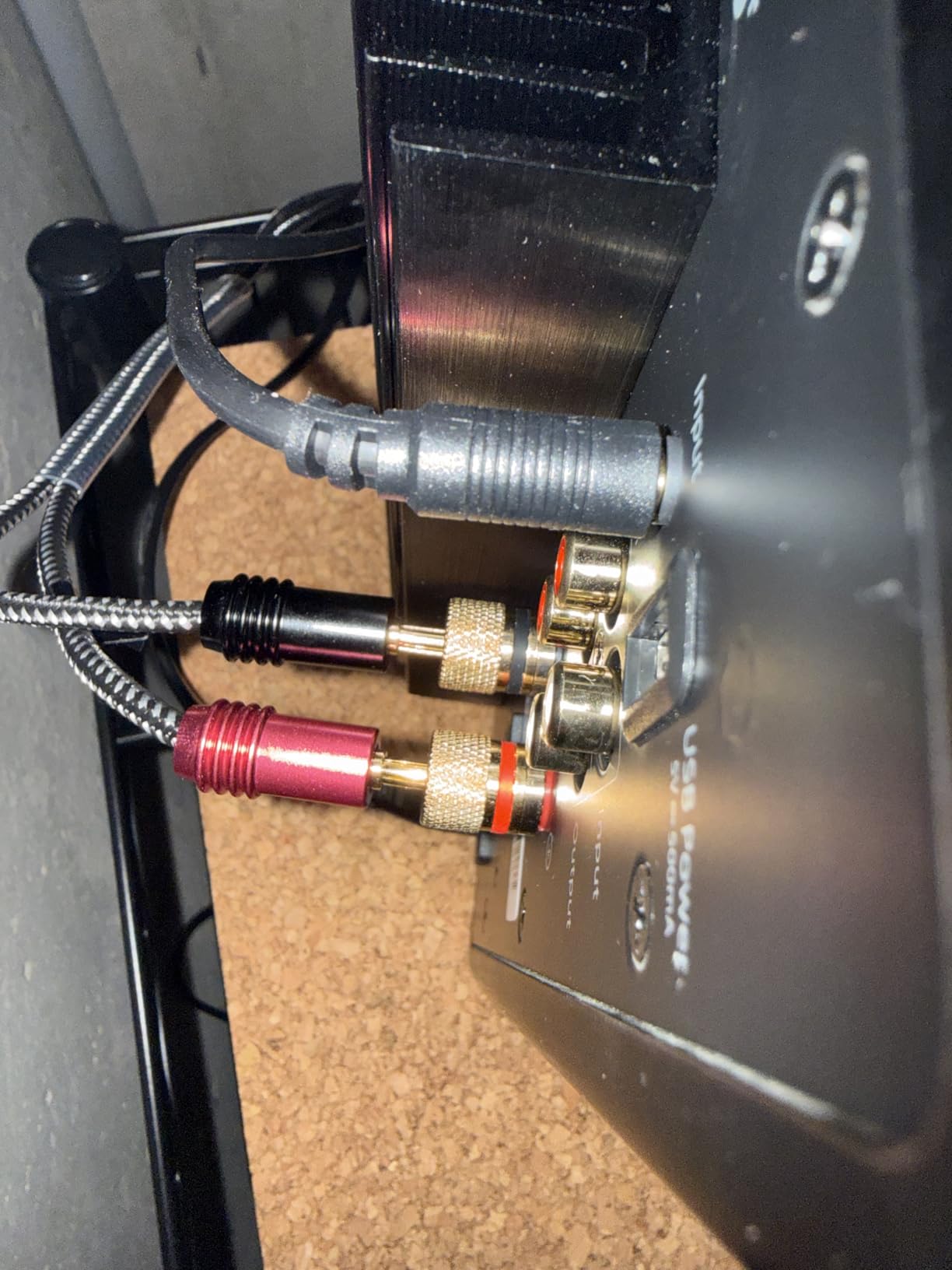
The A5+ is the argument for keeping a vinyl system simple. One RCA cable from the turntable, one power cable, no wireless pairing, no app, and no input menu to think about.
Audioengine rates it at 150 watts with a 5 inch woofer and a 1 inch silk dome tweeter, in a 25 pound pair of handcrafted wood cabinets finished in a 13 step gloss process. The three year warranty is the longest in this roundup.
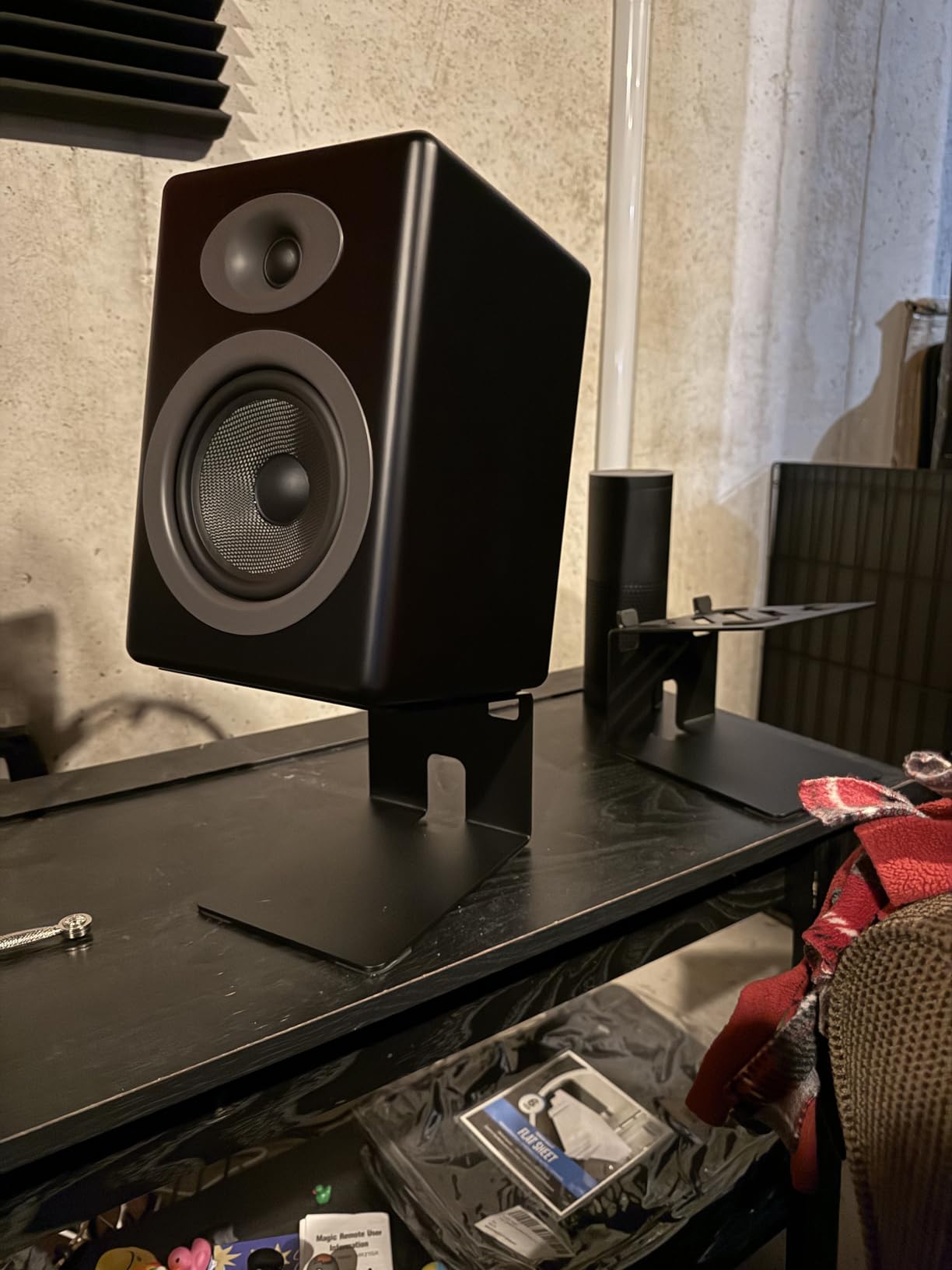
Owners highlight easy turntable hookup and solid, room-filling output, with detailed highs and rich bass. It suits a living room where you want to play an album from start to finish without touching anything but the volume knob.
There is a 95 dB signal to noise ratio on paper, which is why the quiet passages between tracks stay clean in a way that cheaper pairs struggle with. Bass extension down to 50 Hz is enough for most pop and rock records without a subwoofer.
Who the Audioengine A5+ suits
It suits vinyl-only listeners who do not stream and have no need for Bluetooth, optical or HDMI. It also suits anyone who found that wireless pairing added friction rather than convenience in their setup.
Where it falls short
There is no Bluetooth on this wired version, and a separate Bluetooth variant exists as a different model. There is also no phono stage, so if your turntable outputs phono level only, you are buying an external preamp as well.
6. Electrohome Huntley EB10 – Compact Wood Pair With a Turntable Input
Electrohome Huntley Powered Bookshelf Speakers with Built-in Amplifier and 3″ Drivers for Turntable, TV, PC and Wireless Music Streaming Featuring Bluetooth 5, RCA and Aux (EB10)
3 inch driver
20W output
RCA input plus AUX and Bluetooth 5
Wood cabinet, one year warranty
Pros
- RCA input pairs directly with a turntable
- Warm full-bodied sound that is easy to like at low volume
- Compact wood cabinets suit small rooms and shelves
- Bluetooth 5
- RCA and AUX cover turntable
- TV
- PC and phone
- One control button handles volume
- source and power
Cons
- Audible hiss whenever the speakers are powered on
- Power
- source and volume share one button
- Only the active speaker has Bluetooth
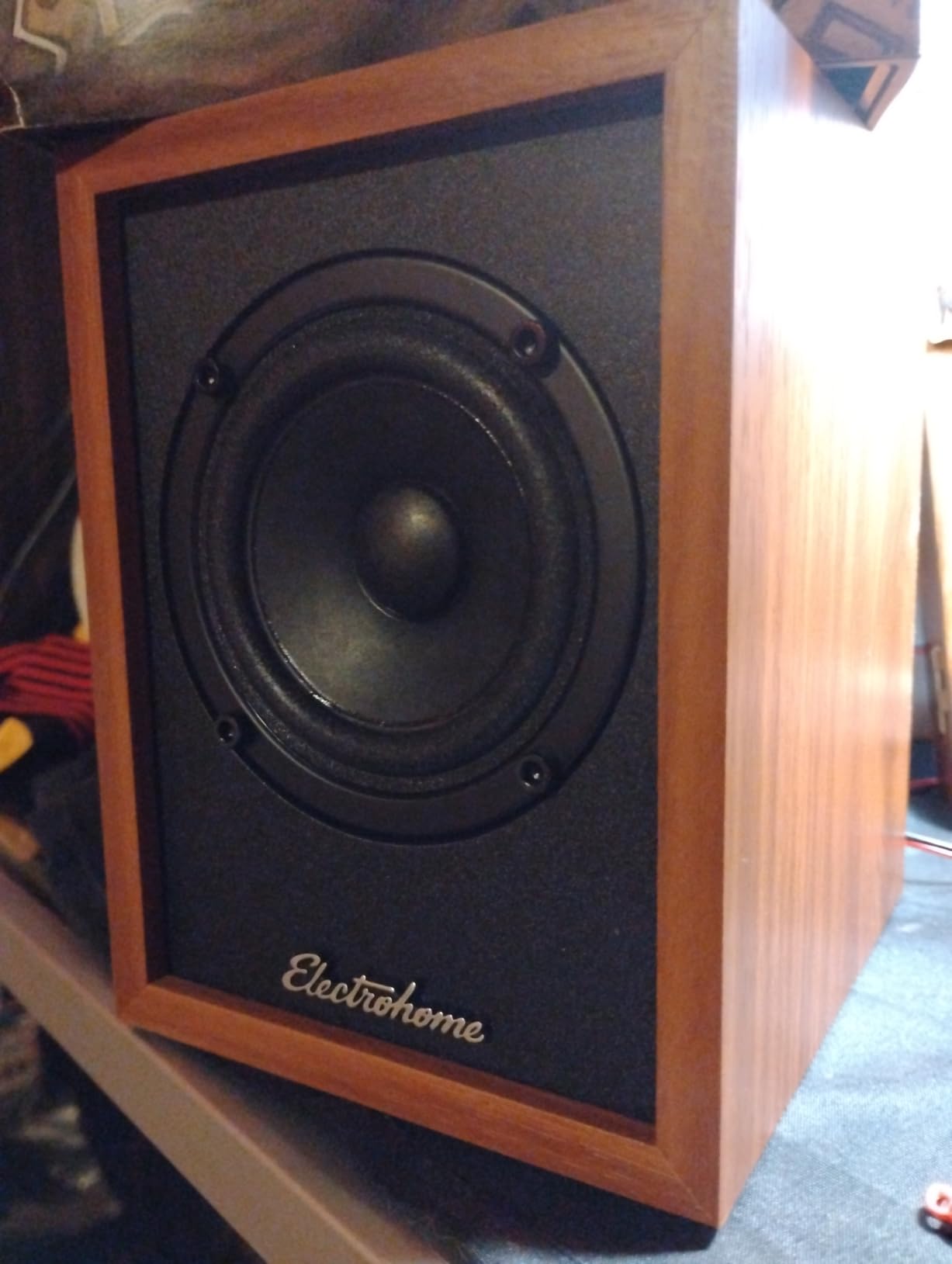
The Huntley EB10 is a small wood-cabinet pair with an RCA input on the back and a listed focus on turntable, TV, PC and phone sources. At 9.09 inches square and 10.91 inches tall, it disappears on a shelf.
Its 3 inch drivers are rear ported in an acoustically tuned wood cabinet, driven by 20 watts. That is modest output, but owners of budget record players report being pleasantly surprised by the warm, full-bodied tone at normal listening levels.
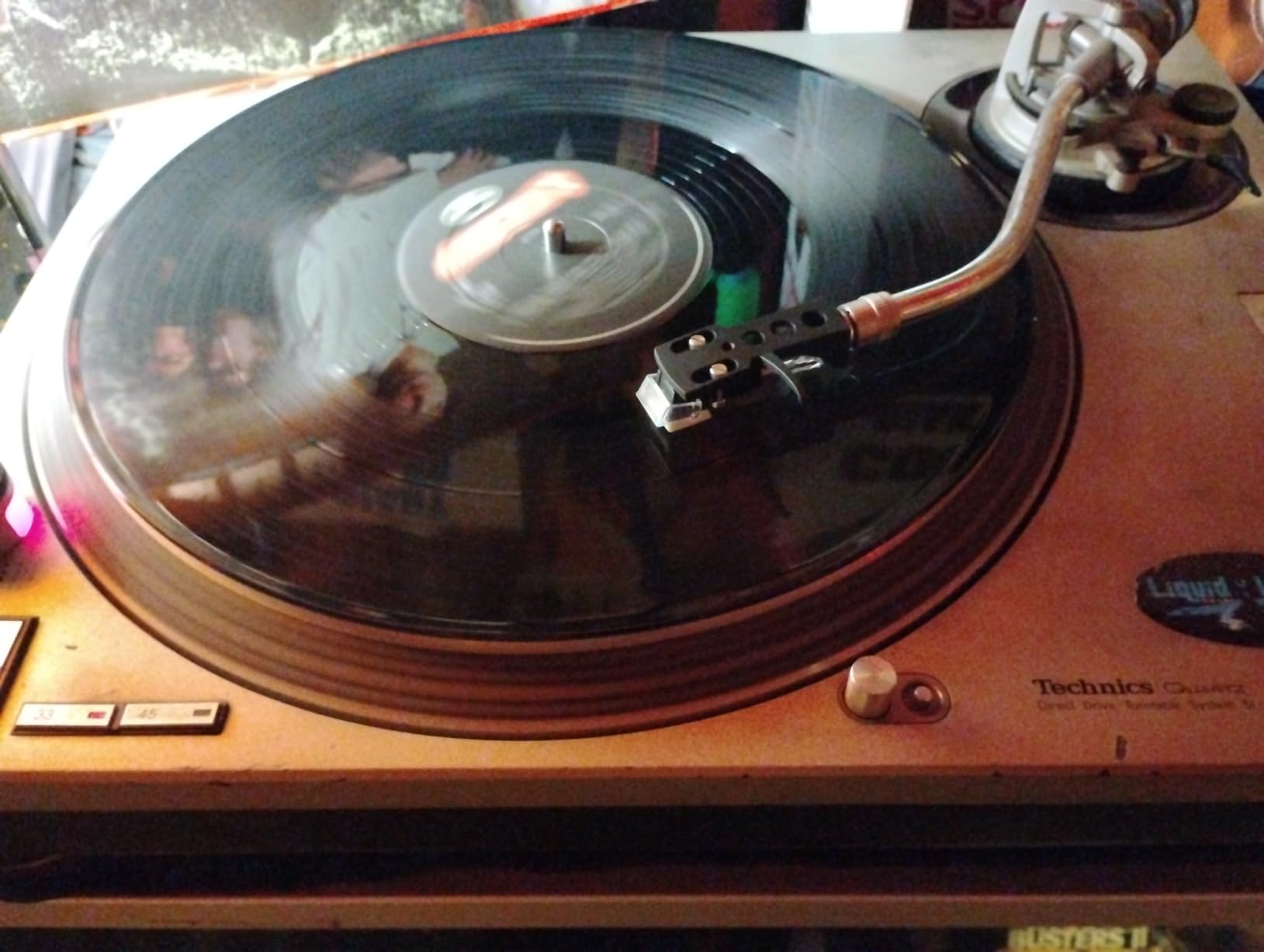
The honest limitation here is hiss. Buyers commonly report constant audible hiss whenever the speakers are powered, which is most audible in quiet passages at low volume. That single issue pulls the rating down relative to its peers.
The one-button control is also fiddly: power, source selection and volume all share the same button, so switching on takes a moment longer than it should. Bluetooth only reaches the active speaker, with the other wired to it.
Who the Electrohome Huntley EB10 suits
It suits a first vinyl setup on a strict budget in a small room, where the priority is getting sound out of a record player at all with one box and no amplifier. The wood finish also suits furniture-heavy rooms better than plastic cabinets.
Where it falls short
The constant hiss is the deal-breaker for anyone who listens to quiet classical or jazz at low volume. At 20 watts there is no headroom for a larger room, and there is no phono stage for a turntable without a preamp.
7. MEVOSTO DS19 – Best 5-Inch Driver Upgrade on a Budget
MEVOSTO 5-Inch Powered Bookshelf Speakers: PC Speakers for Record Player
Dual 5 inch woofers with silk dome tweeters
36W RMS built-in amp
Bluetooth 5.4, USB and RCA
Walnut wood grain cabinets
Pros
- Dual RCA plus AUX accept a turntable with built-in or external preamp
- 5 inch woofers give more output and bass than typical budget pairs
- Independent bass and treble knobs plus remote
- Bluetooth 5.4 and USB cover phone and PC sources
- Walnut wood grain cabinets look better than plastic rivals
Cons
- No built-in phono preamp
- Listed 80 Hz response limits deep bass
- USB input needs a source port that supports audio output
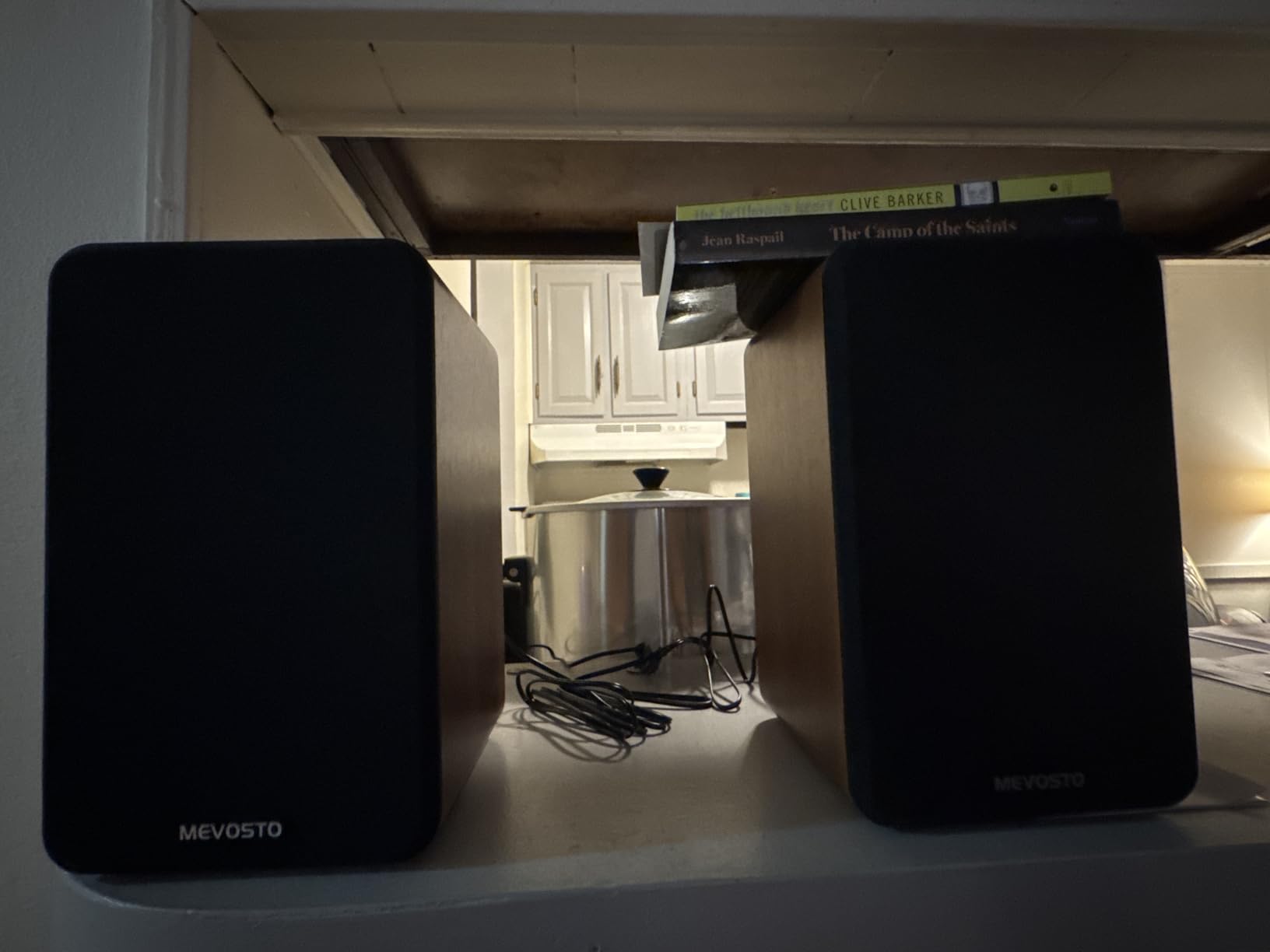
This pair answers the most common complaint about budget bookshelf speakers, which is that 4 inch woofers cannot handle bass-heavy records. The DS19 uses dual 5 inch woofers with 1 inch silk dome tweeters in wood cabinets, driven by a 36W RMS amplifier.
Connectivity is unusually broad for the money: dual RCA, AUX, USB digital audio and Bluetooth 5.4, plus independent bass and treble knobs and an included remote. Each cabinet measures 5.9 by 6.1 by 9.7 inches, so it stays compact.
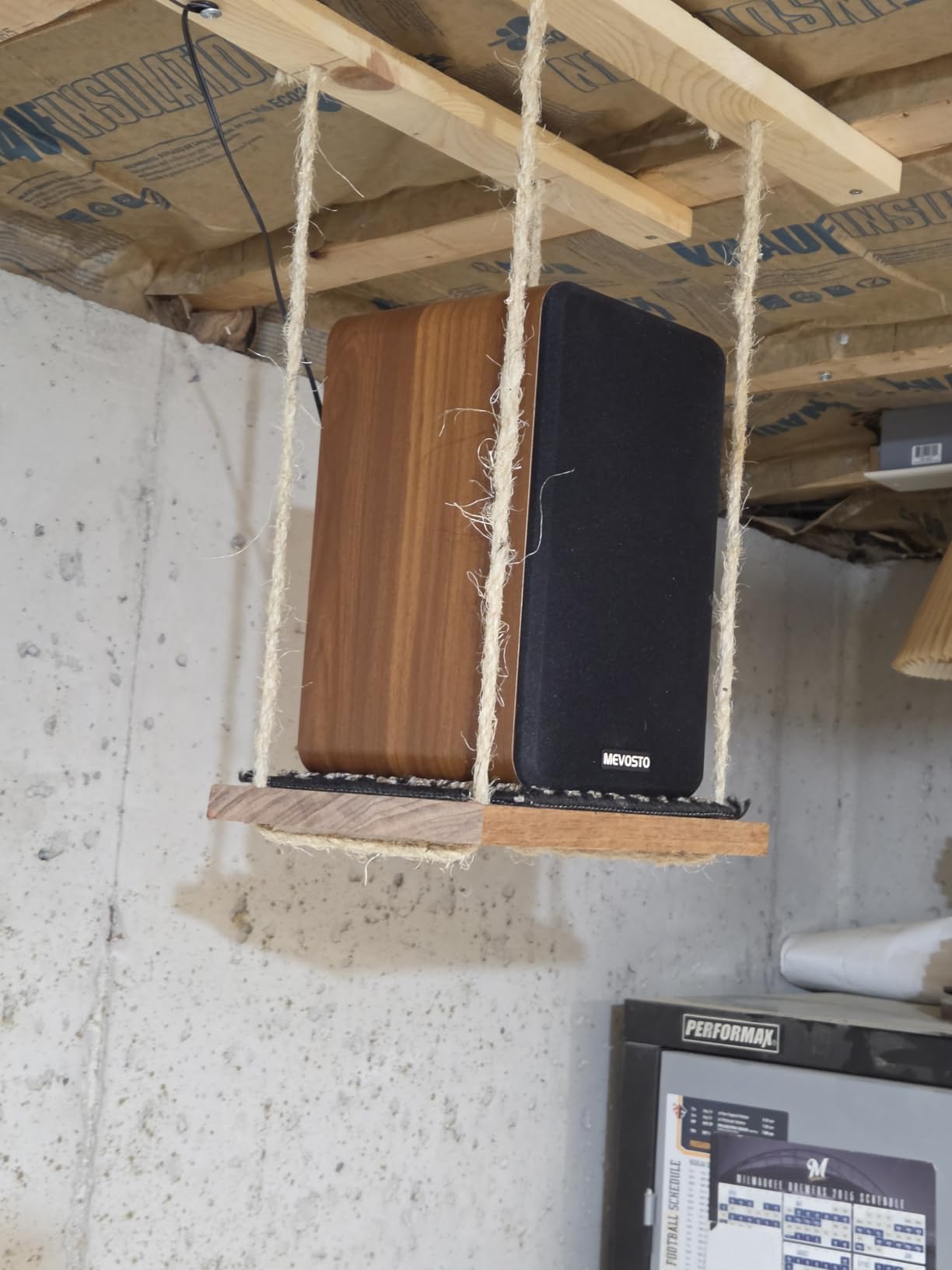
Owners rate this pair as a step above entry-level plastic speakers, pointing to the driver size, the wood cabinet and the range of inputs for vinyl and PC listening. It is a two year manufacturer warranty on an 18V adapter-powered system.
The listed frequency response bottoms out at 80 Hz, which is where the honest limitation sits. The midrange and upper bass are noticeably fuller than a 4 inch pair, but deep low end on a sub-bass heavy record will still run out.
Who the MEVOSTO DS19 suits
It suits buyers who have already tried a 4 inch pair and found it wanting more weight, without moving up to a much larger system. It also suits near-field listening on a desk, where USB or Bluetooth from a computer handles the source and the RCA stays free for the turntable.
Where it falls short
There is no phono stage, so a turntable with phono-only output needs an external preamp. The 80 Hz floor means it is not the choice for records mastered with heavy sub-bass, and there is no optical input for a TV.
8. Saiyin DS6701 – Most Versatile for TV and Vinyl Together
Saiyin Powered Bluetooth Bookshelf Speakers
4 inch woofer with 0.5 inch silk dome tweeter
80W output
RCA, optical and coaxial inputs
SUB OUT jack and remote
Pros
- RCA
- optical and coaxial inputs let a TV and turntable connect together
- Optical and coaxial support 24 bit 192kHz digital audio
- Remote handles volume
- mute
- input switching and playback
- SUB OUT jack allows a powered subwoofer to be added
- No amplifier or receiver needed
Cons
- No built-in phono preamp
- Bluetooth needs a turntable with a transmitter
- No volume readout and the source must be set to PCM
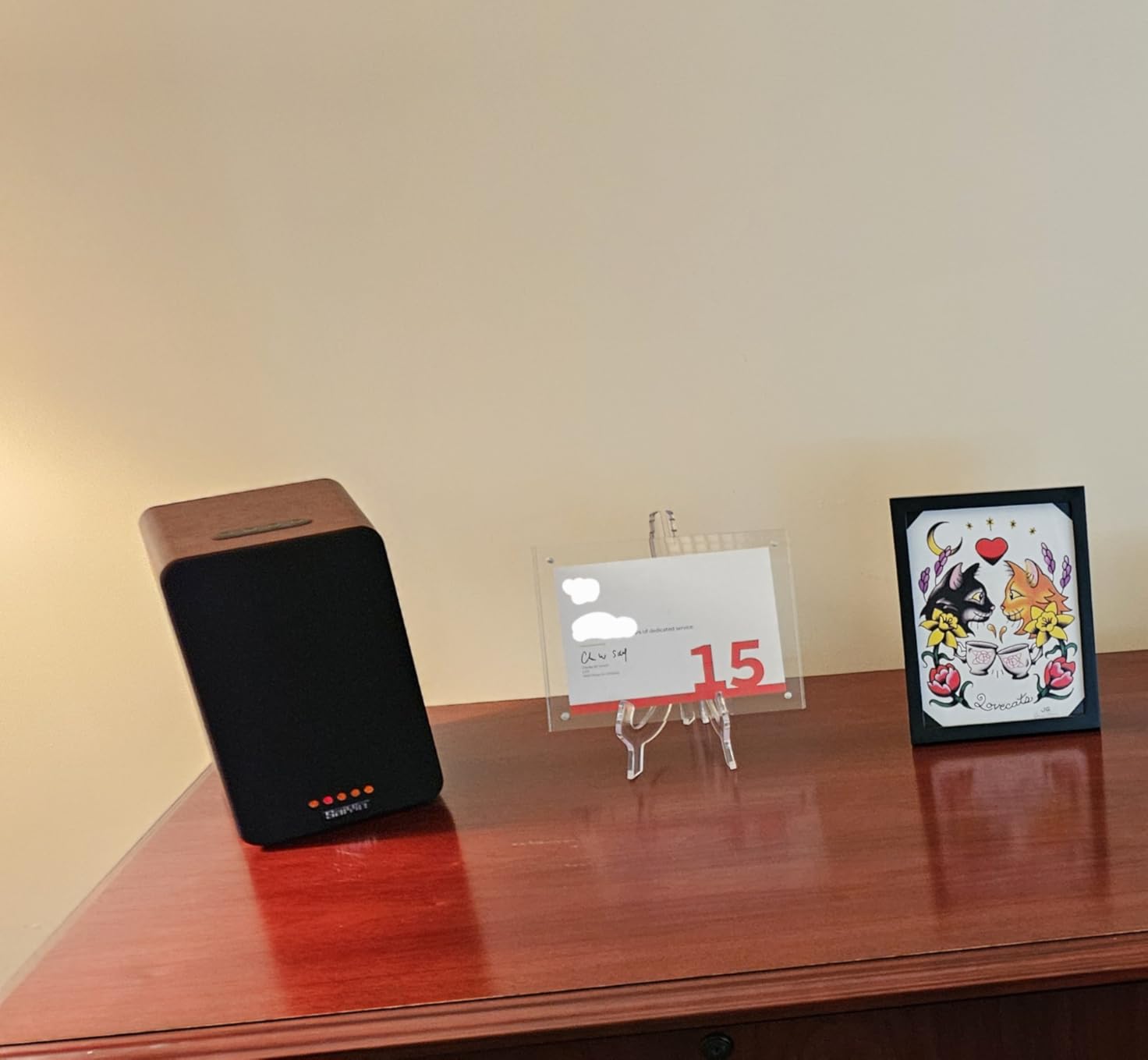
The Saiyin DS6701 is the rare budget pair that puts optical, coaxial, RCA and Bluetooth in one box, which is exactly what a turntable-and-TV room needs. The remote switches between optical, coaxial, line-in and Bluetooth modes.
Under the hood it is a 4 inch woofer with a 0.5 inch silk dome tweeter, rated at 80 watts, with a listed 45 Hz low end and a 10.2 pound footprint. The cabinet mixes ABS, MDF and metal, and the warranty runs three years.
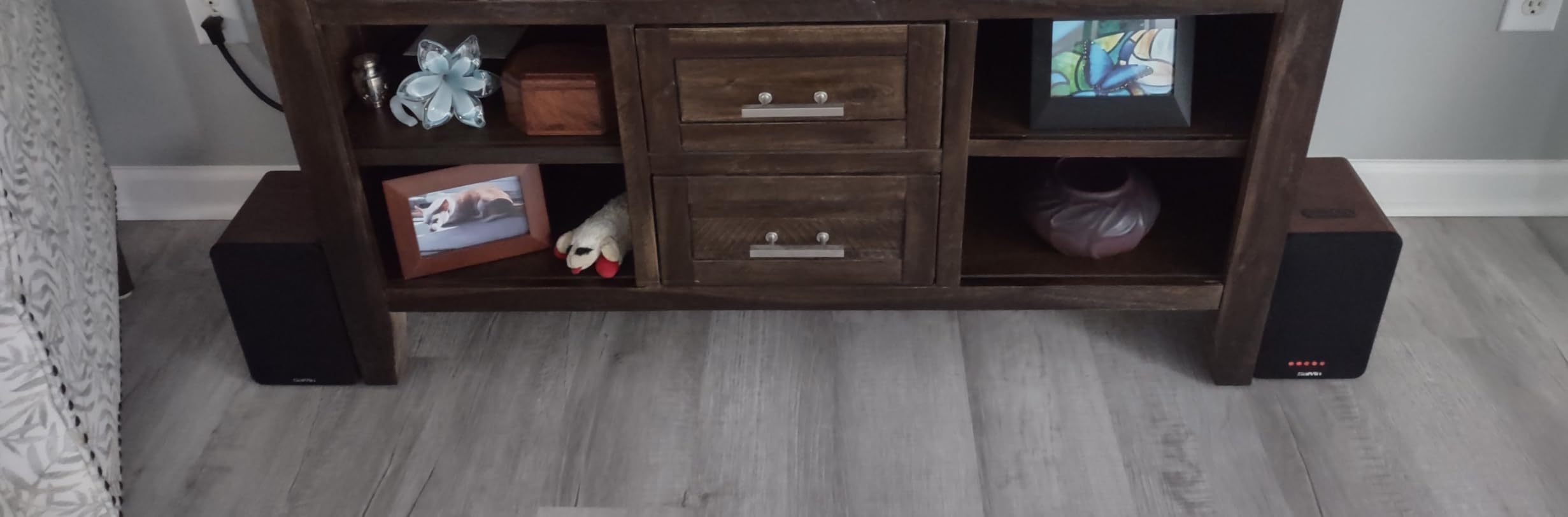
Owners like it for the rare combination of inputs in a single box, and the SUB OUT jack gives a clear upgrade path if you later add a powered subwoofer. Replacement remotes are supplied for the life of the product.
Two cautions apply. The RCA input is line level only, so a phono-output turntable needs a separate preamp, and the digital inputs need the source set to PCM stereo or you will get crackle or silence.
Who the Saiyin DS6701 suits
It suits a shared room where the same speakers handle a TV over optical and records over RCA, and it suits anyone who wants Bluetooth for phone streaming without giving up wired sources. The SUB OUT makes it a reasonable platform if you plan to add bass later.
Where it falls short
Bluetooth only helps if the turntable can transmit, which almost no entry-level turntable does. There is no phono stage, and 4 inch drivers keep the bottom end modest in anything larger than a small room.
9. Edifier R2000DB – Best for Near-Field and Desktop Listening
Edifier R2000DB Powered Bluetooth Bookshelf Speakers, 120W RMS, Warmoak
5 inch woofer with built-in DSP
120W RMS
Frequency response 50Hz-20kHz
Bluetooth, optical and dual RCA
Pros
- Dual RCA ports let a turntable sit alongside Bluetooth and optical sources
- 120W RMS with DSP delivers room filling output and controlled bass
- Wooden enclosure reduces resonance compared with plastic
- Rear panel bass and treble knobs plus remote
- Works well as near-field desktop or monitor speakers
Cons
- Dual RCA is line level only so a phono output turntable needs a preamp
- Cabinets take up more shelf space than 4 inch pairs
The R2000DB is the model we would pick for near-field listening on a desk, because a built-in DSP handles the low end more cleanly than most powered pairs at this level. The listed frequency response runs from 50 Hz to 20 kHz.
It also has the reach to fill a room: 120W RMS with a DSP processor and enhanced bass processing, in wood cabinets rather than plastic. Bluetooth, optical input and dual RCA ports cover every source type you are likely to own.
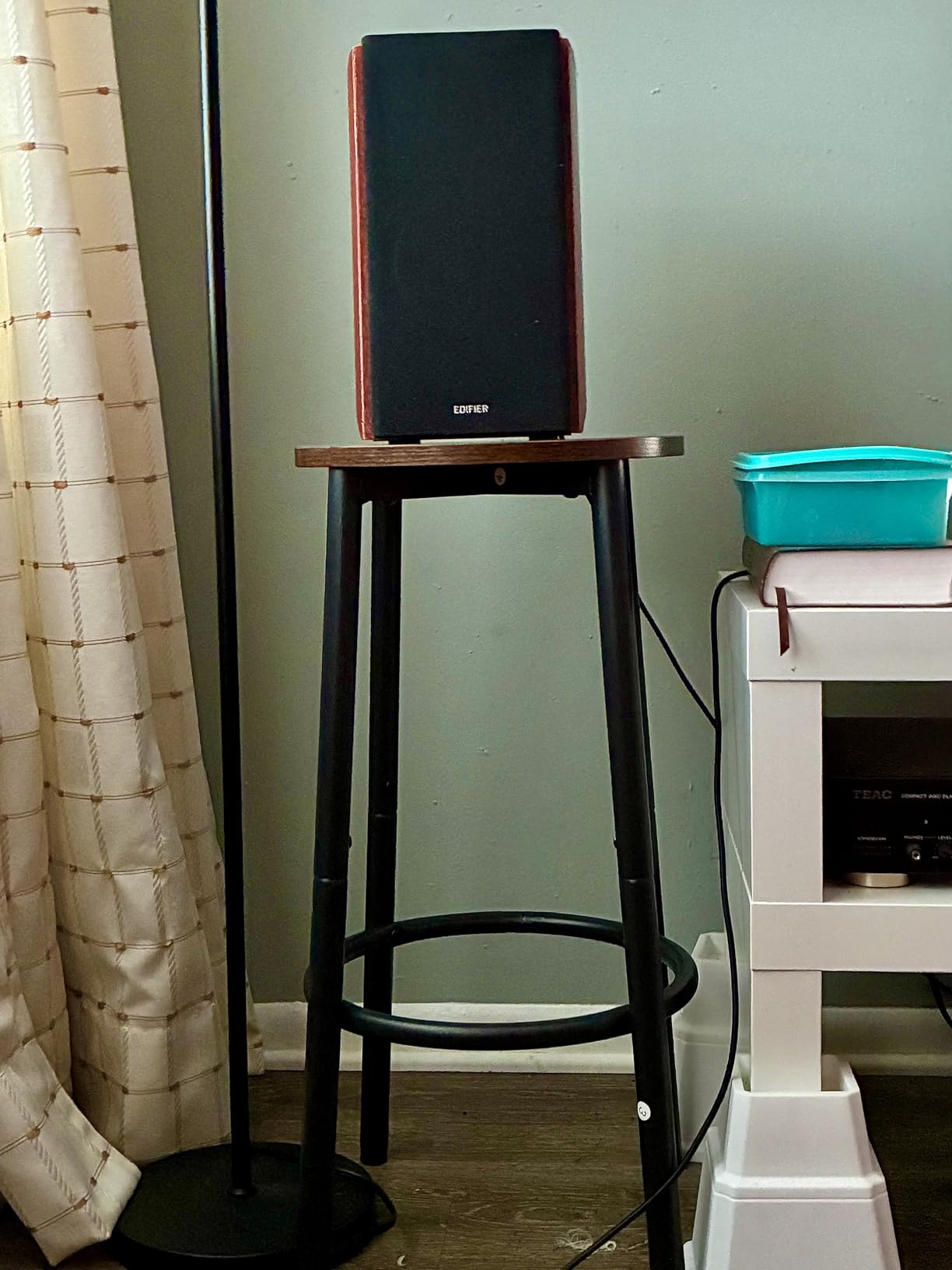
Reviewers treat this as a step up in power and cabinet quality from Edifier’s 4 inch models, and they consistently praise output and bass control. Rear panel volume, bass and treble knobs plus a remote handle everyday adjustment.
The wood enclosure is the detail that matters acoustically here, since it cuts the cabinet resonance that makes cheap powered pairs sound boxy on bass notes. The drawback is size: the cabinets are large for a bookshelf, let alone a desk.
Who the Edifier R2000DB suits
It suits listeners who want a desktop setup with real near-field control, and it suits medium living rooms where 4 inch drivers feel thin. If your turntable and computer share the same speakers, the optical input handles the computer while RCA handles the records.
Where it falls short
The dual RCA inputs are line level only, so a phono-output turntable still needs a preamp. And at these cabinet dimensions, positioning needs planning if the speakers are going on a narrow shelf or a small desk.
10. Elimavi BT-04 – Low-Cost Wired Starting Point
Elimavi 30W X 2 Powered Bookshelf Speakers, RCA Input for Turntable, Brown
Dual 4 inch drivers
60W output
RCA input with 3.5mm cable included
Wall mounting clips, one year warranty
Pros
- RCA input is set up for a turntable and a 3.5mm to RCA cable is included
- Wood grain cabinets reduce resonance and look understated
- Volume
- treble and bass adjustments on the unit
- Wall mounting clips included for shelves or bookcases
- Very low cost for a powered pair
Cons
- No Bluetooth or digital inputs at all
- Basic single knob controls and no remote
- Sound is described as adequate rather than refined
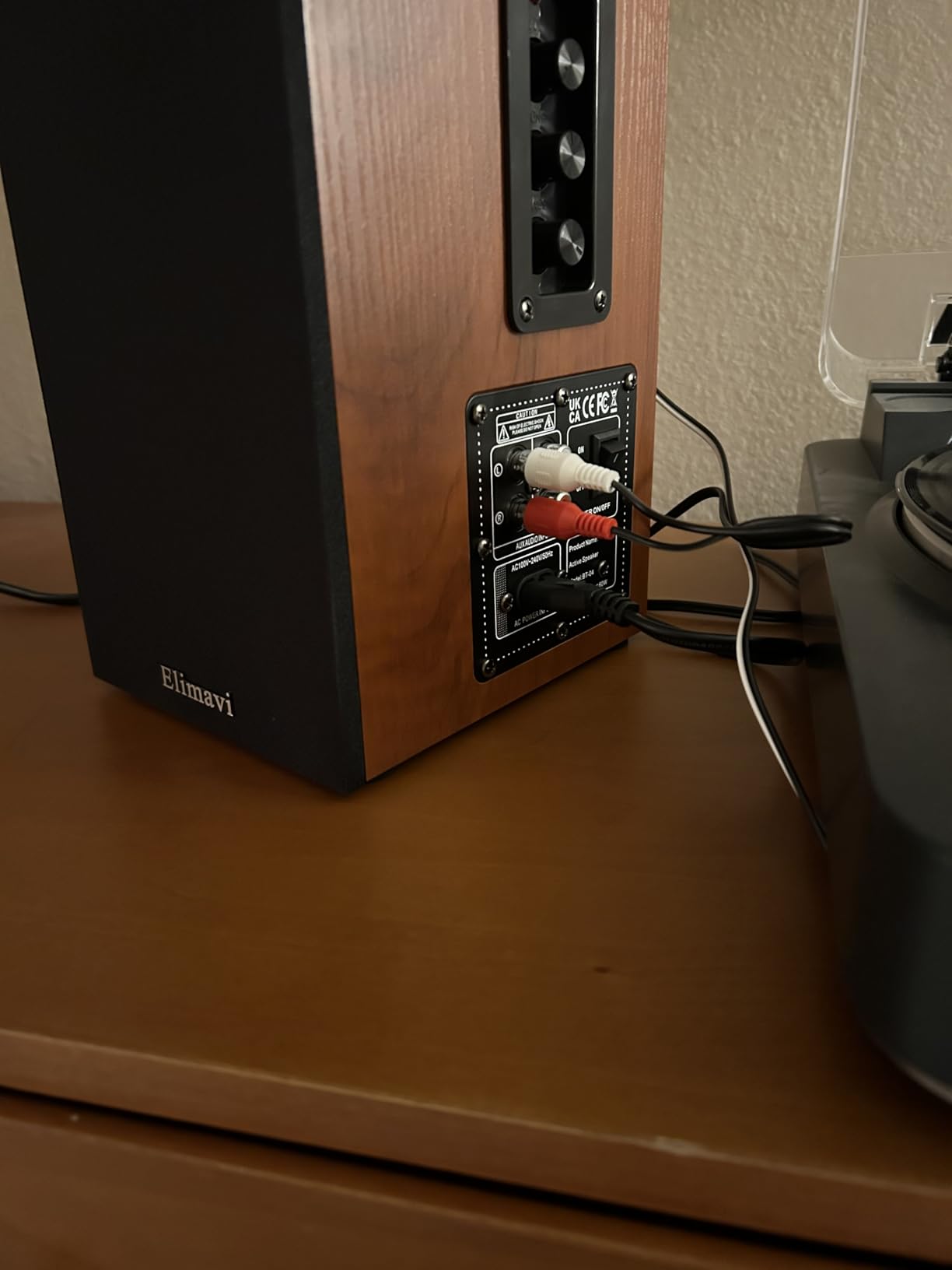
The Elimavi BT-04 is the simplest answer on this list: dual 4 inch drivers, a 60 watt amplifier, and an RCA input that is set up for a turntable, with the 3.5mm to RCA cable already in the box.
Volume, treble and bass adjustment all sit on the cabinet, and wall mounting clips are included for shelves, bookcases or a TV unit. Each speaker measures 5 by 5.9 by 8.66 inches in a wood grain cabinet.
Buyers treat this as an inexpensive way to get sound out of a record player, and they value the included cable and the understated cabinets more than refinement. The box contains both speakers, the connecting cable and the 3.5mm to RCA lead.
The honest limitation is the sound itself. Owners describe it as adequate rather than detailed, and the 4.1 rating reflects a wired-only design with minimal controls and no digital inputs.
Who the Elimavi BT-04 suits
It suits a first-time owner who wants to hear records playing through something other than built-in record player speakers, at the lowest entry point in this roundup. It also suits a second room where only basic playback is needed.
Where it falls short
No Bluetooth means no phone streaming and no wireless turntable connection, and there are no digital inputs for a TV. There is no phono stage, and the single-knob control layout means no remote for switching sources.
How to Choose Powered Speakers for a Turntable
Check the phono stage first. Everything else is preference. If your turntable has a LINE/PHONO switch, any of these ten work. If it does not, shortlist the Klipsch R-51PM and the Kanto YU6, or budget for a small external preamp such as a Pro-Ject Phono Box E or an ART DJ Pre II. Our bookshelf speaker guide for vinyl listening covers the passive route in detail.
Match driver size to room size. Below about 120 square feet, 3 inch drivers are enough. Between 120 and 250 square feet, aim for 4 to 5 inch drivers. Above 250 square feet, look for 5.25 inch drivers or larger with more amplifier power behind them. Our bookshelf speaker roundup goes deeper on driver sizing.
Ignore the marketing wattage. Peak output numbers on listings are not comparable between brands. Look instead at continuous power, weight, cabinet material and whether the amplifier is described as RMS. Two pairs with the same headline number can differ enormously in real output.
Match your sources to the input list. If you share speakers between a TV and a turntable, optical or coaxial digital input saves you from a converter box. If you want a subwoofer later, confirm there is a SUB OUT rather than assuming one.
Spend roughly evenly on turntable and speakers. The advice that comes up most often in vinyl forums is that a cheaper turntable through better speakers beats an expensive turntable through cheap ones. You can upgrade the cartridge on an entry turntable later and hear the change immediately.
Budget for stands and isolation. Speakers on furniture pick up vibration from the turntable, and light shelves resonate with bass notes. Isolation pads and a pair of proper stands will not cost much and do more for the sound than a jump to a pricier speaker pair.
Place them properly. Aim for ear height when seated, put them on stands if possible, angle them slightly toward your chair, and keep them off the back wall by a reasonable margin. Separating the speakers from the turntable surface also reduces hum and feedback.
What to Avoid When Buying Powered Speakers for Vinyl
Bluetooth-only speakers. Most portable Bluetooth speakers have no line-level input at all, so a turntable cannot feed them. Buyers expecting a JBL or Bose portable speaker to work as a vinyl destination run into this immediately.
Soundbars. A soundbar is designed for dialogue and effects, not for the frequency range and stereo separation a record needs. They are also usually narrower than a bookshelf pair.
Unlabelled RCA jacks. Budget speakers often include two identical-looking RCA inputs with no marking. Check the listing photos before buying so you know which jack takes the turntable.
Implausible wattage claims. Listings advertising 200W for a small plastic pair are usually quoting peak output. Cross-check against driver size and cabinet weight before believing them.
Used amplifier versus powered speakers. Plenty of experienced listeners on vinyl and hi-fi forums argue that a used integrated amplifier with passive bookshelf speakers sounds better at the same money, and powered speakers are a convenience compromise rather than a sound compromise. It is a fair argument, and if you already own an amplifier, read our high-end bookshelf speaker guide for the passive path instead.
Humming setups. If you hear a constant hum, the turntable and speakers are likely sharing one power strip or the ground loop is closed through the furniture. Put the turntable on a separate surface, check the ground wire connection, and try a different outlet before blaming the speakers.
Frequently Asked Questions
Are powered speakers good for turntables?
Yes, as long as the signal levels match. Powered speakers have a built-in amplifier and accept line-level input, which is exactly what a turntable outputs when its LINE/PHONO switch is set to LINE. If your turntable only outputs phono level, choose speakers with a switchable phono stage or add a small external preamp.
Should I use line or phono for powered speakers?
Use LINE. Powered bookshelf speakers are line-level devices, so the turntable should be set to LINE whenever a built-in preamp is available. PHONO output is a much smaller signal, and feeding it into a line input produces thin, quiet, distorted audio.
Do powered bookshelf speakers need an amplifier?
No. That is the defining feature. The amplifier is built into one of the cabinets, so you connect the turntable straight to the speaker input with a single RCA cable and skip the stereo receiver entirely.
Can you connect a turntable to Bluetooth speakers?
Only if the turntable has a Bluetooth transmitter. Most Bluetooth speakers are receivers that wait for a phone or computer to send audio. A record player with phono or line RCA output cannot feed them, so a wired RCA connection is the practical route.
What are the best budget active speakers for a turntable?
The Edifier R1280DB is the value pick, with dual RCA inputs plus optical and coaxial digital inputs and 42 watts of power. The Saiyin DS6701 is the lower-cost option with optical, coaxial, RCA and a subwoofer output, and the Elimavi BT-04 is the simplest wired starting point with the cable included.
Do I need a subwoofer for vinyl?
Not for most listeners. Bookshelf speakers with 5 inch drivers reach low enough for most records, and a subwoofer mainly helps in larger rooms or on bass-heavy recordings. If you do want one, check for a SUB OUT jack on the amplifier rather than adding a powered sub with its own bass control.
Which speaker is best for a Rega Planar 1 or Pro-Ject Debut Carbon?
A speaker with a built-in phono preamp, because those turntables have no built-in stage and no LINE/PHONO switch. The Klipsch R-51PM and the Kanto YU6 both have a switchable phono input, and any powered speaker works if you add a small external phono preamp.
Final Verdict: The Best Powered Bookshelf Speakers for Turntables
After comparing all ten pairs, the Klipsch R-51PM comes out ahead. It has a switchable phono stage, a 5.25 inch driver with 120 watts behind it, and a 4.6 rating across more than 2,500 reviews, which is the combination we would want for a first serious vinyl setup.
For a smaller room or a tighter budget, the Edifier R1280DB is the pick, with the widest input selection in the budget tier. For a turntable with no preamp and a larger room, the Kanto YU6 gives you the phono stage and the most amplifier power here.
Whatever you choose, confirm the phono question first. That one check will save you from the distorted, thin sound that makes people think their turntable is broken. Specifications were verified for 2026, and we update this guide as new models land.