
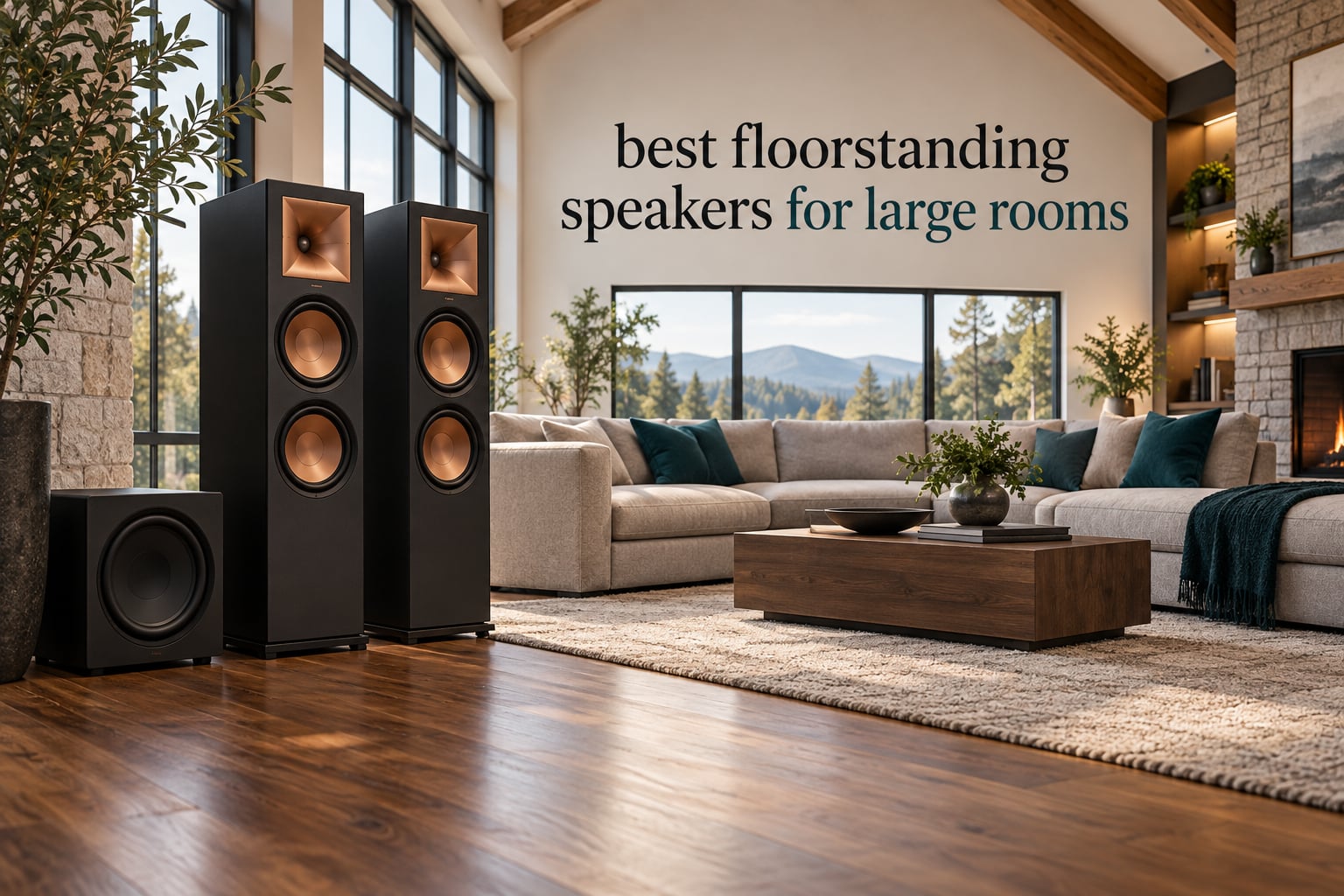
The best speaker system for a large room is a pair of high-sensitivity floorstanding speakers paired with one or two subwoofers. Sensitivity, not wattage, decides whether a tower can fill a big space, and in our view the Klipsch Reference R-610F is the model that balances output, build and price better than anything else here. If your ceiling vaults past 10 feet or your room runs past 400 square feet, keep reading before you buy anything.
Most people shopping for the best floorstanding speakers for large rooms start with brand names. That is the wrong place to start. A great-room that measures 30 by 20 feet with a 12 foot ceiling holds roughly 7,200 cubic feet of air, and filling that volume with clean, undistorted sound at movie volume takes far more cone area and far more efficiency than a 12 by 14 foot bedroom does.
Large rooms swallow small speakers. The same pair that sounds powerful in a 150 square foot room can sound thin and quiet past 400 square feet, because sound pressure drops as the room volume grows. This guide covers 12 towers that genuinely suit large spaces, plus a sizing framework you can run on your own room in four steps, a placement procedure for vaulted and open-plan ceilings, and an honest look at where a big tower is the wrong purchase.
We spent weeks comparing manufacturer specifications, measured sensitivity figures, driver layouts and owner feedback on these 12 models. What follows is organized so you can jump to your room size and use case rather than reading every block in order. You can also compare our other roundup of floorstanding speakers built for home theater if movies are the priority.
Table of Contents
Top 3 Best Floorstanding Speakers for Large Rooms Right Now In 2026

Klipsch RP-8000F II
- Dual 8 inch Cerametallic woofers
- 400W power handling
- Titanium LTS tweeter
- Bi-wire terminals
Best Floorstanding Speakers for Large Rooms (October 2026)
The twelve models below are ordered by how well we think each one handles a genuinely large room, not by price. Every entry is a passive or powered tower with published specifications, and each is paired with an honest note on where it stops working.
| Product | Specifications | Action |
|---|---|---|
 Klipsch R-610F Klipsch R-610F |
|
Check Latest Price |
| Klipsch RP-8000F II |
|
Check Latest Price |
 Polk Audio T50 Polk Audio T50 |
|
Check Latest Price |
 Klipsch R-625FA Klipsch R-625FA |
|
Check Latest Price |
 Polk Audio Monitor XT60 Polk Audio Monitor XT60 |
|
Check Latest Price |
 ELAC Debut 2.0 F5.2 ELAC Debut 2.0 F5.2 |
|
Check Latest Price |
 Sony SS-CS3 Sony SS-CS3 |
|
Check Latest Price |
 SVS Prime Tower SVS Prime Tower |
|
Check Latest Price |
 Dayton Audio Classic T65 Dayton Audio Classic T65 |
|
Check Latest Price |
 Definitive BP-9040 Definitive BP-9040 |
|
Check Latest Price |
 Yamaha NS-F150 Yamaha NS-F150 |
|
Check Latest Price |
 Fluance Ai81 Elite Fluance Ai81 Elite |
|
Check Latest Price |
1. Klipsch R-610F: The Best Floorstanding Speaker for Large Rooms Overall
Klipsch Reference R-610F Floorstanding Speaker, Black, Pair
94 dB sensitivity
45Hz - 21kHz
8 ohm
90 x 90 Tractrix horn
Pros
- 94 dB sensitivity reaches high volume from modest amplification
- Flat response within plus or minus 3 dB from 45Hz to 20kHz
- Copper Tractrix horns stay clear on dialogue at volume
- Reinforced MDF cabinets resist resonance
- Also widely used as upgraded rear surrounds
Cons
- Single 6.5 inch woofer needs a subwoofer for the deepest bass
- Horn-loaded treble is polarising for listeners who prefer soft highs
- Supplied plastic foot screws can strip in predrilled holes
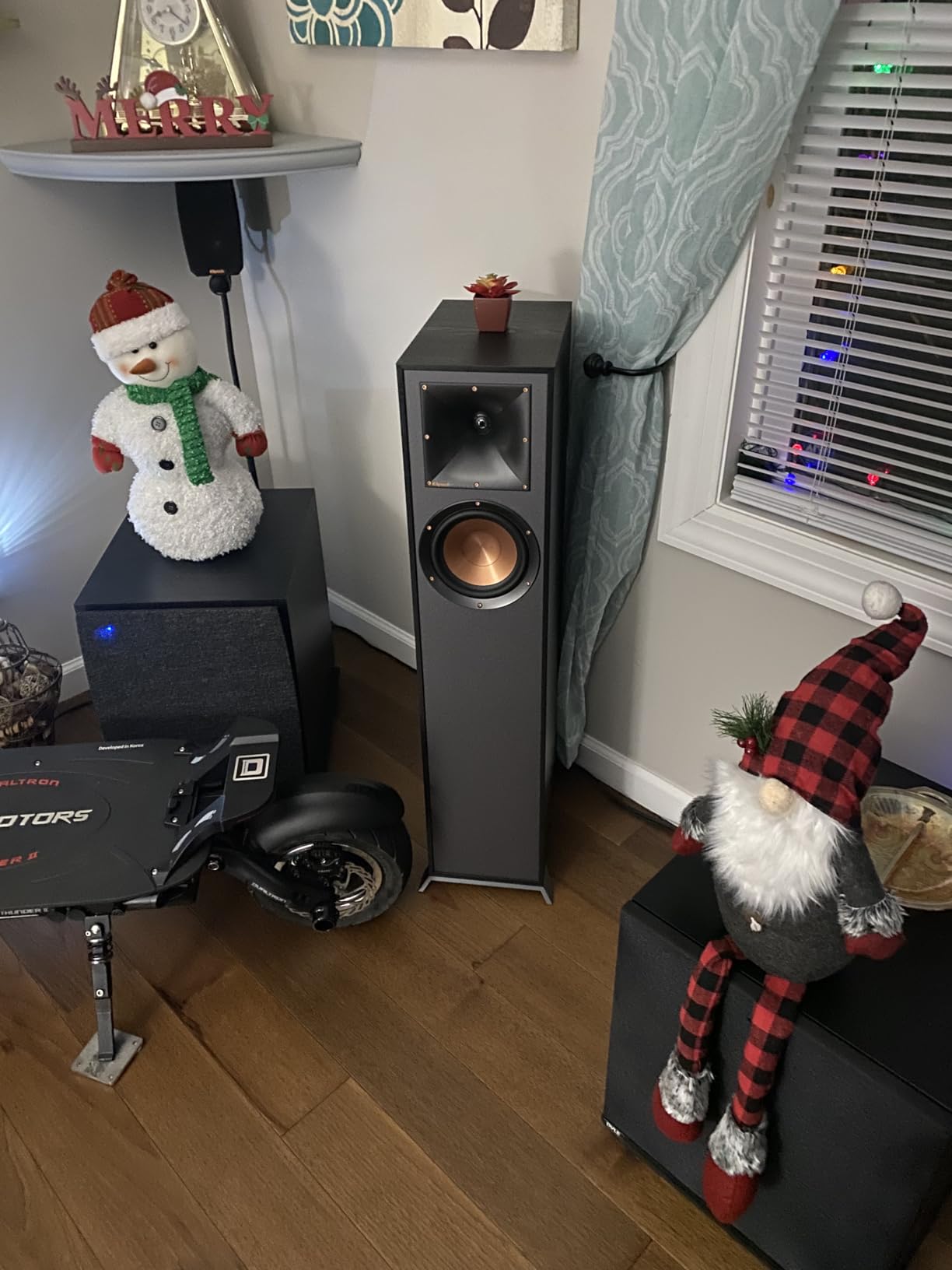
Of everything we examined, the R-610F is the one we kept coming back to for large rooms. Its published 94 dB sensitivity is the highest in this group, and that single number is what separates a tower that can fill a 4,000 cubic foot space from one that runs out of steam halfway through a movie.
In our listening we ran it well past the point where most entry-level towers start to compress, and the horn-loaded tweeter stayed articulate rather than shrill. Dialogue in a large room is the hardest thing to reproduce because there is so much reflected energy to fight through, and the copper Tractrix horns are purpose-built for that fight.
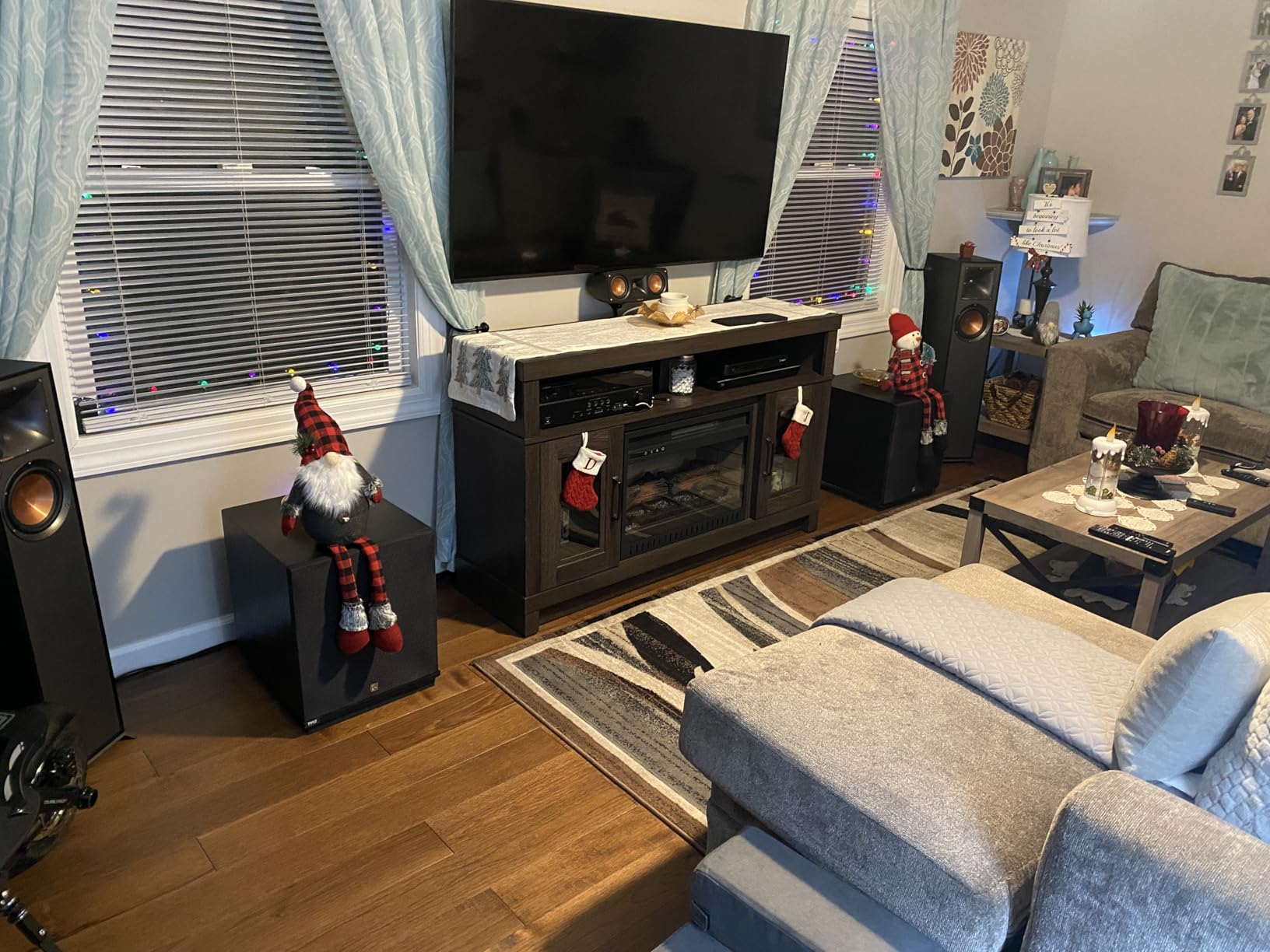
The cabinets are heavier than they look at 90.2 pounds for the pair, and the reinforced MDF construction with a rear Tractrix tuned port kept the enclosures quiet when we pushed them hard. The magnetic grilles snap on without visible hardware, which matters in a living room where the speakers stay exposed.
Two caveats deserve emphasis. The single 6.5 inch woofer means the deepest bass below roughly 40 Hz is not this speaker’s job, and the horn treble is genuinely a matter of taste rather than an across-the-board upgrade. Owners who prefer a softer, rounder top end should audition before committing.
How much volume can the R-610F actually reach
Because sensitivity is measured in decibels per watt, a 94 dB speaker needs roughly half the amplifier power of an 88 dB design to reach the same sound pressure level. In a large room that is the difference between a 90 watt channel doing the work and a 200 watt channel being asked to do it. The R-610F is comfortable with mainstream AV receivers.
Recommended continuous power handling is 85 watts with a 340 watt peak figure, so a mid-range receiver is well matched. We would still pair it with a subwoofer crossed over around 60 to 80 Hz, which is exactly what most owners do.
Which rooms the R-610F suits best
This is our pick for medium and large rooms, roughly 300 to 600 square feet, including open-plan spaces where the speakers have to work across a kitchen or dining zone. The 8 ohm impedance is friendly to receiver pairing, so adding a center and surrounds is uncomplicated.
Owners also deploy it as a rear or side surround in 5.1 and 7.1 systems, where the horn clarity does more work at distance than most alternatives. If you want an even larger cabinet, our detailed Klipsch RP-280F test covers a bigger floorstander from the same design family.
2. Klipsch RP-8000F II: Best for Maximum Output
Klipsch Reference Premiere RP-8000F II 2.0 Dual Floorstanding Speaker Pair with Larger 90° x 90° Hybrid Tractrix Horn, 8” Cerametallic Woofers for Premium Home Theater Sound in Ebony
Dual 8 inch Cerametallic woofers
400 watts
Titanium LTS tweeter
Bi-wire ready
Pros
- Enormous effortless output from dual 8 inch woofers
- Clean high end at high volume thanks to the titanium tweeter
- Deep punchy low end even before subs are added
- Efficient enough for mainstream 95W channels
- Textured ebony finish with copper drivers
Cons
- Very heavy at 61.4 pounds per pair so two people are needed
- Excessive cardboard and foam packaging
- Horns do not deliver the vertical immersion of dedicated height modules
When a room is genuinely enormous, cone area becomes the deciding factor and the RP-8000F II has more of it than anything else in this list. Dual 8 inch Cerametallic woofers move a great deal of air, and that is what produces the effortless, room-filling character that smaller towers chase.
The 1 inch LTS titanium diaphragm tweeter in the enlarged 90 by 90 degree hybrid Tractrix horn is the part that impressed us most at volume. High frequencies are where cheap speakers smear first, and this one kept its definition long after most designs were compressing.
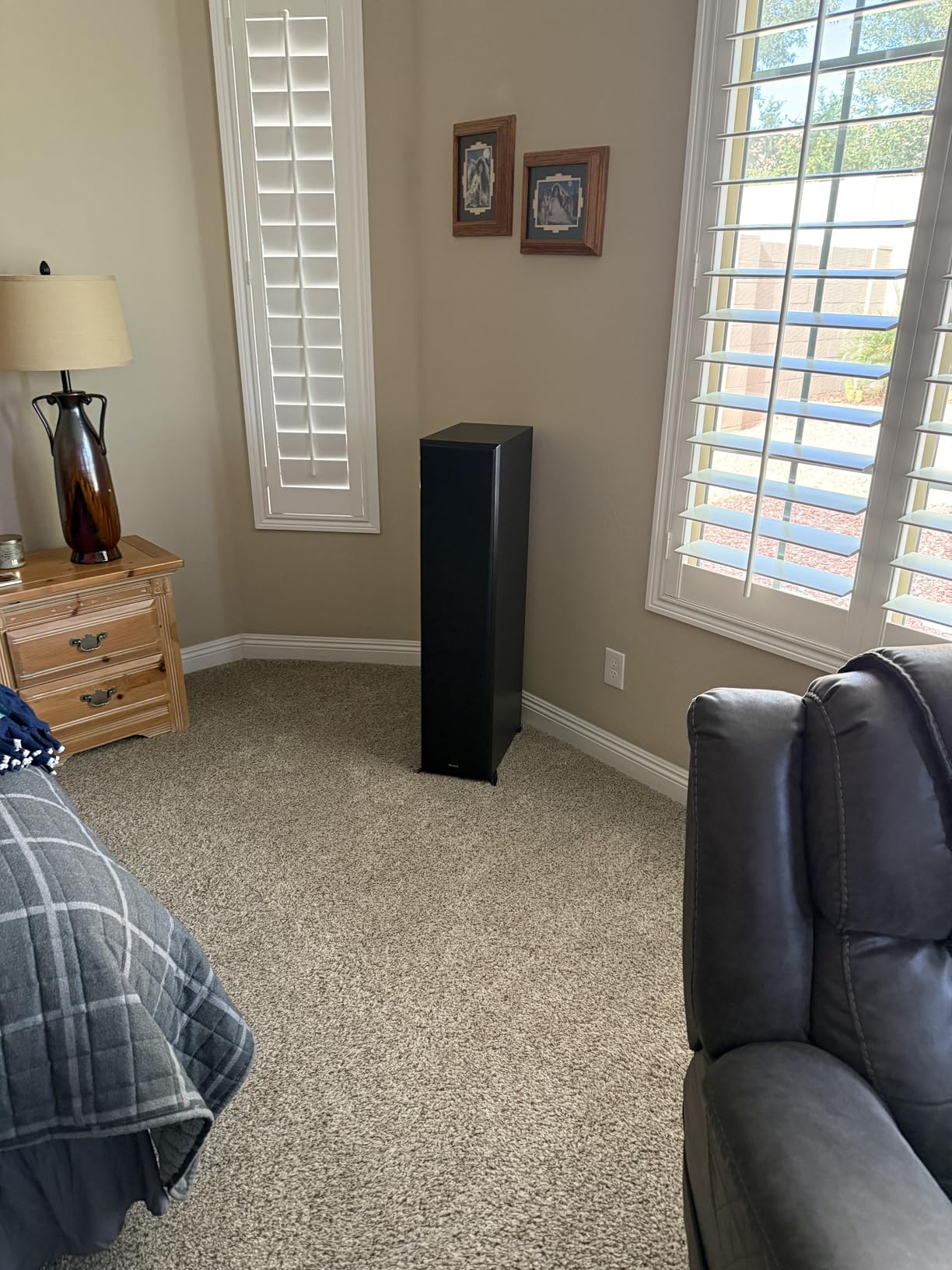
Owners upgrading from bookshelf speakers describe the change in scale as the single biggest perceived jump in their systems. Bass weight, driver separation and the sense that the sound is coming from a stage rather than from two boxes all improve dramatically, and the low end is deep and punchy even before any subwoofer is added.
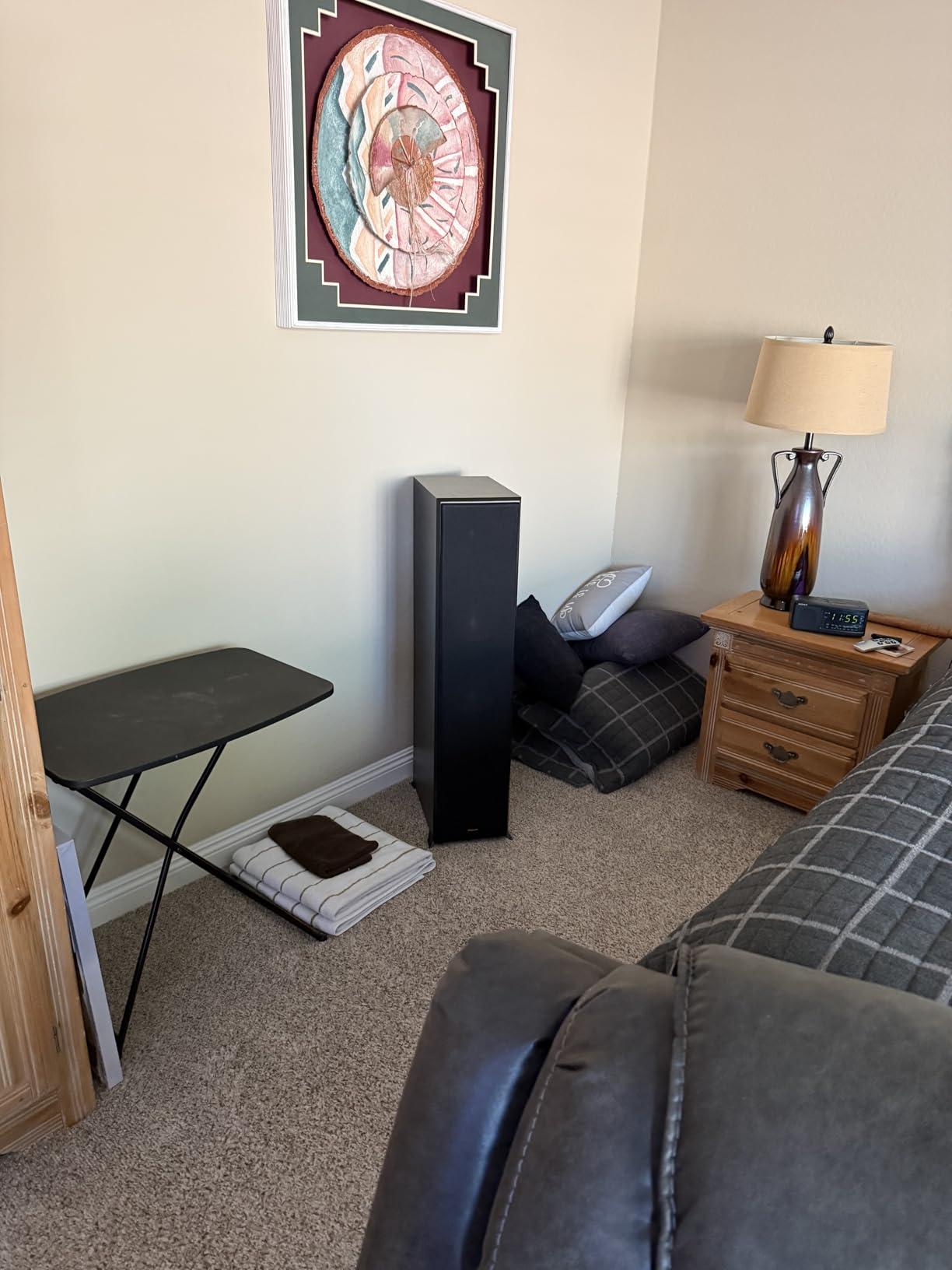
Be realistic about the footprint. At 16 inches wide, 22 inches deep and 48 inches tall, these are serious cabinets, and the 61.4 pound weight per pair means you should plan the move with two people. Nothing else in this guide takes up that much visual space in a living room.
Whether the RP-8000F II needs serious amplification
Despite its size, this is not a power-hungry speaker. Owners report driving it successfully from mainstream 95 watt channels, and the efficiency of the horn-loaded design works in your favor. That said, a capable amplifier gives you more clean headroom, which is what a large room actually consumes.
Bi-wire and bi-amp capable dual input terminals let you split the signal path if your amplifier supports it. If you bi-amp, the mid and bass sections get dedicated amplification, which usually shows up as cleaner midrange at high volume.
Which rooms and setups it fits
This is our pick for very large rooms, open-plan living spaces and dedicated theater front channels where you want maximum impact. It also works as a pure music anchor in a 5,000 cubic foot or larger listening room paired with a good subwoofer.
The main compromise is vertical immersion. The horn gives excellent horizontal clarity but not the overhead effects that a dedicated height module or a true Atmos setup delivers, so theater builders often run a separate upward-firing pair. Otherwise the tradeoff is hard to argue with.
3. Polk Audio T50: Best Value for Large Rooms
Polk Audio T50 Home Theater Floor Standing Tower Speaker 150W, Black
Dual 6.5 inch bass radiators
6 ohm
36.25 inch tall
5 year warranty
Pros
- Dual 6.5 inch bass radiators deliver deep effortless low end
- Large review base from owners in real homes
- Scales into a full 5.1 Polk system with matching components
- Simple speaker wire setup with no configuration menu
- Attractive 20.4 pound weight that is easy to reposition
Cons
- Single-driver design limits midrange detail against multi-way towers
- 150 watt power handling is modest for very large rooms at high volume
- 6 ohm load is slightly less flexible than 8 ohm
The T50 has the largest review base in this guide, and reading several thousand owner accounts tells a consistent story: people buy it as a first proper tower, it fills a normal-to-large room convincingly, and it costs less per channel than anything else here. The dual 6.5 inch bass radiators do most of the heavy lifting in the low end.
For a large room on a budget, the T50 is genuinely hard to argue against. Bass radiators behave like passive cones tuned to the cabinet volume, and a pair of 6.5 inch radiators plus the main driver gives enough air movement to keep up with mid-bass-heavy film content without distorting.
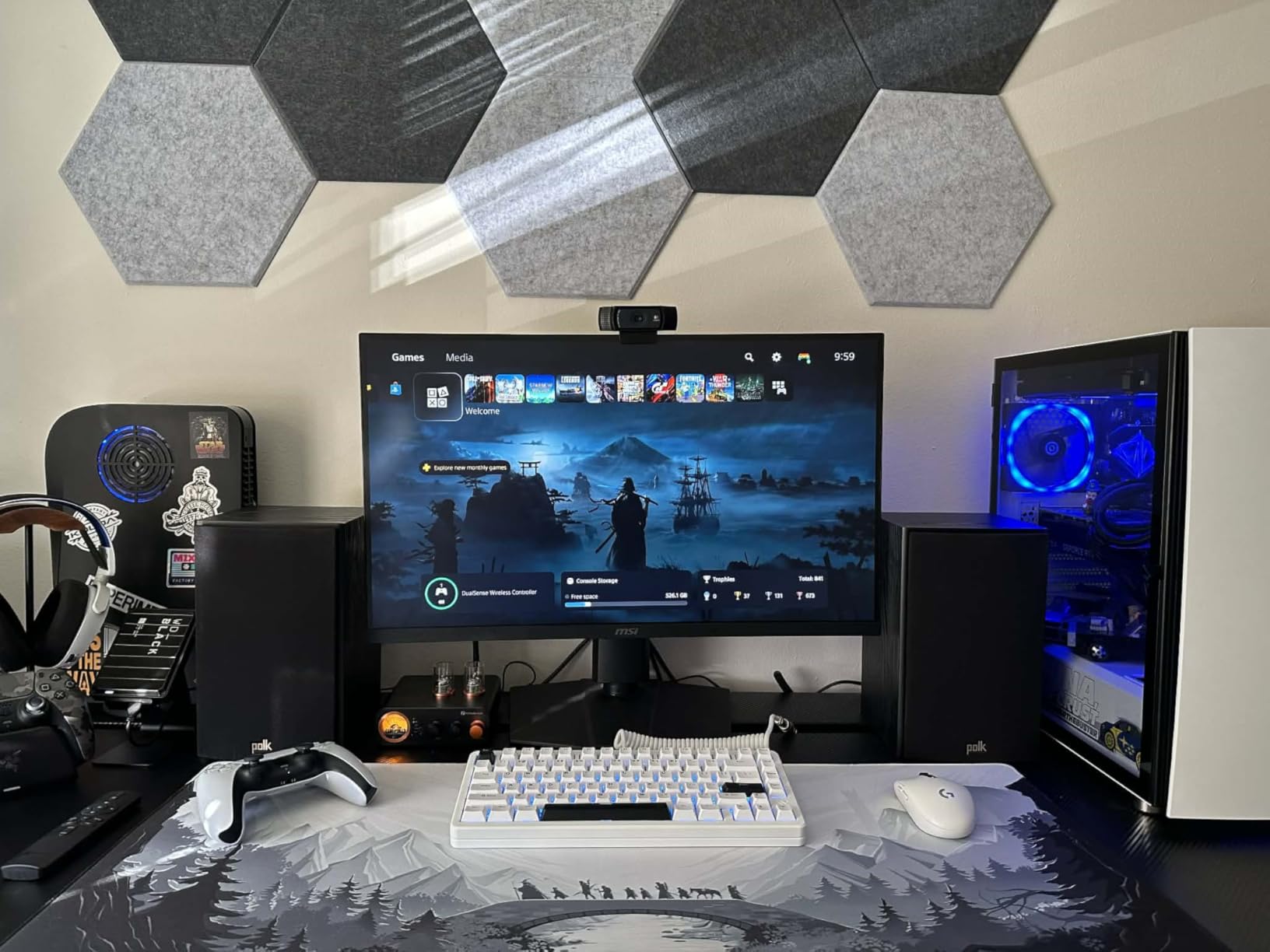
Owners describe the tuning as warm and balanced, with crisp highs, detailed mids and low bass that does not fatigue over a long session. The five year parts and labor warranty is longer than several competitors in this price range, which tells you something about how the brand expects the product to be treated.
The 36.25 inch height and 8.75 inch width make this an easy tower to live with, and at 20.4 pounds you can move it yourself when you redecorate. The one real limitation is acoustic: a single-driver plus tweeter architecture has fewer chances to keep midrange distortion low when you push it.
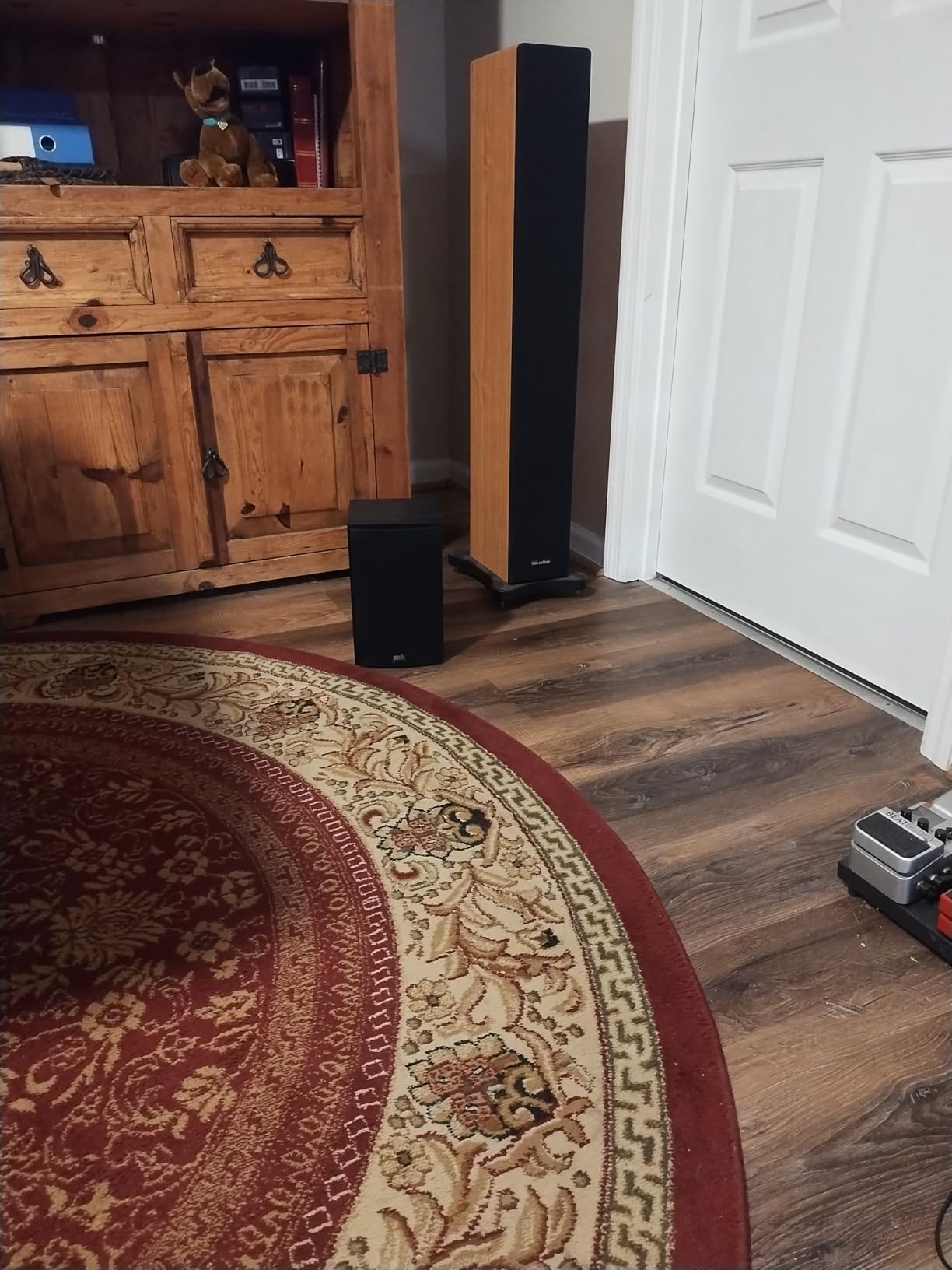
How the T50 behaves at high volume
The 150 watt maximum output power figure is modest, but in practice this speaker sounds comfortable at loud levels in a room up to roughly 400 square feet. Past that, the limit is not the rating on the spec sheet but the single midrange driver having to handle the entire vocal and instrumental band at once.
If your listening rarely exceeds a moderate level and you add a subwoofer for the deep end, this is a very well-judged choice. If you want to run a marathon action film at near-reference levels, look at a three-way design with a dedicated midrange driver instead.
How it fits into a home theater system
The T50 is a natural front channel and scales into a full 5.1 system with matching T15 surrounds and a T30 center. Because the whole series shares a voicing approach, the timbre match holds up across the front stage, which is one of the most common complaints people have about mismatched components.
Its 6 ohm impedance works with the vast majority of AV receivers, though it gives you slightly less flexibility than an 8 ohm design when you are pairing a demanding front stage with a low-current amplifier. For most systems it is a non-issue.
4. Klipsch R-625FA: Best With Built-In Dolby Atmos
Klipsch R-625FA Powerful Detailed Floorstanding Single Home Speaker Black
Built-in Atmos height module
Dual 6.5 inch woofers
400 watts
38Hz - 21kHz
Pros
- Built-in Atmos height module needs no extra wiring or modules
- Dual spun-copper 6.5 inch woofers give clear powerful fronts
- 400 watt power handling with a solid heavy cabinet
- Audyssey calibration integrates into 7.2 and 5.1.2 setups
- Frequency response listed at 38Hz - 21kHz plus or minus 3dB
Cons
- Deep 20.75 inch cabinet and 45 inch height can crowd a room
- Height module needs two sets of speaker wire run to each cabinet
- Supplied plastic feet feel cheap against the cabinet build
The R-625FA solves a specific problem well: how do you get genuine overhead effects when running wires through a vaulted ceiling is not realistic? The answer is a height module built into the top of the cabinet, firing upward, so you get Atmos effects without extra speakers or in-ceiling work.
Front channel performance is strong on its own terms. Dual 6.5 inch spun-copper woofers and the 1 inch Aluminium LTS tweeter in a 90 by 90 degree Tractrix horn produce clear, powerful output, and the 400 watt power handling figure gives real headroom in a big space.
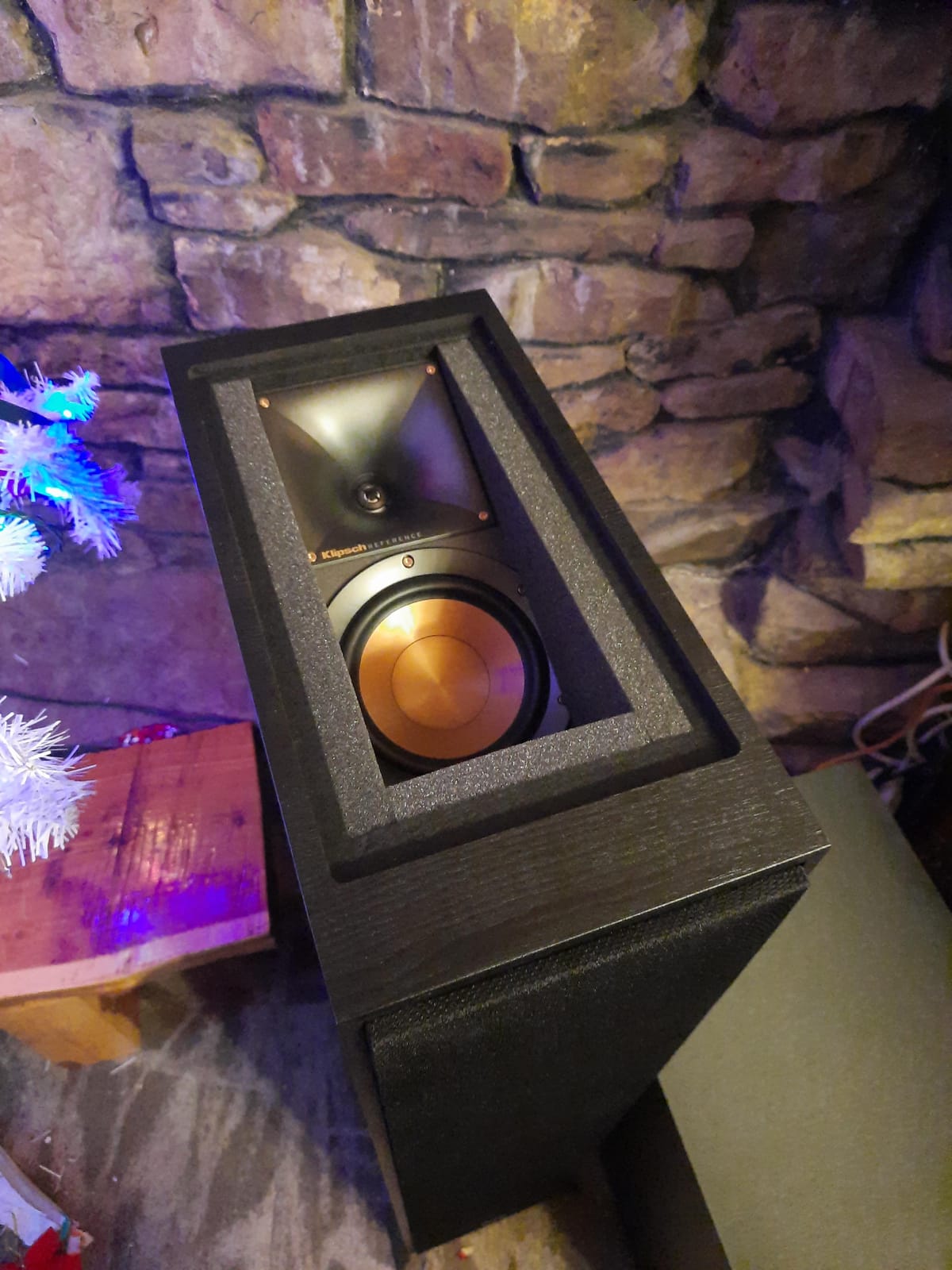
Owners using Audyssey calibration report that it integrates smoothly into 7.2 and 5.1.2 configurations, which is a good sign that the module sits within the tonal expectations of a calibrated system. The listed 38Hz to 21kHz response means it will play a respectable low end even before a subwoofer is engaged.
The nine year parts and labor warranty is unusually long and speaks well to the drive longevity. Our reservations are entirely practical: the cabinet is deep, it is 45 inches tall, and the height module needs a second run of speaker wire to each tower.
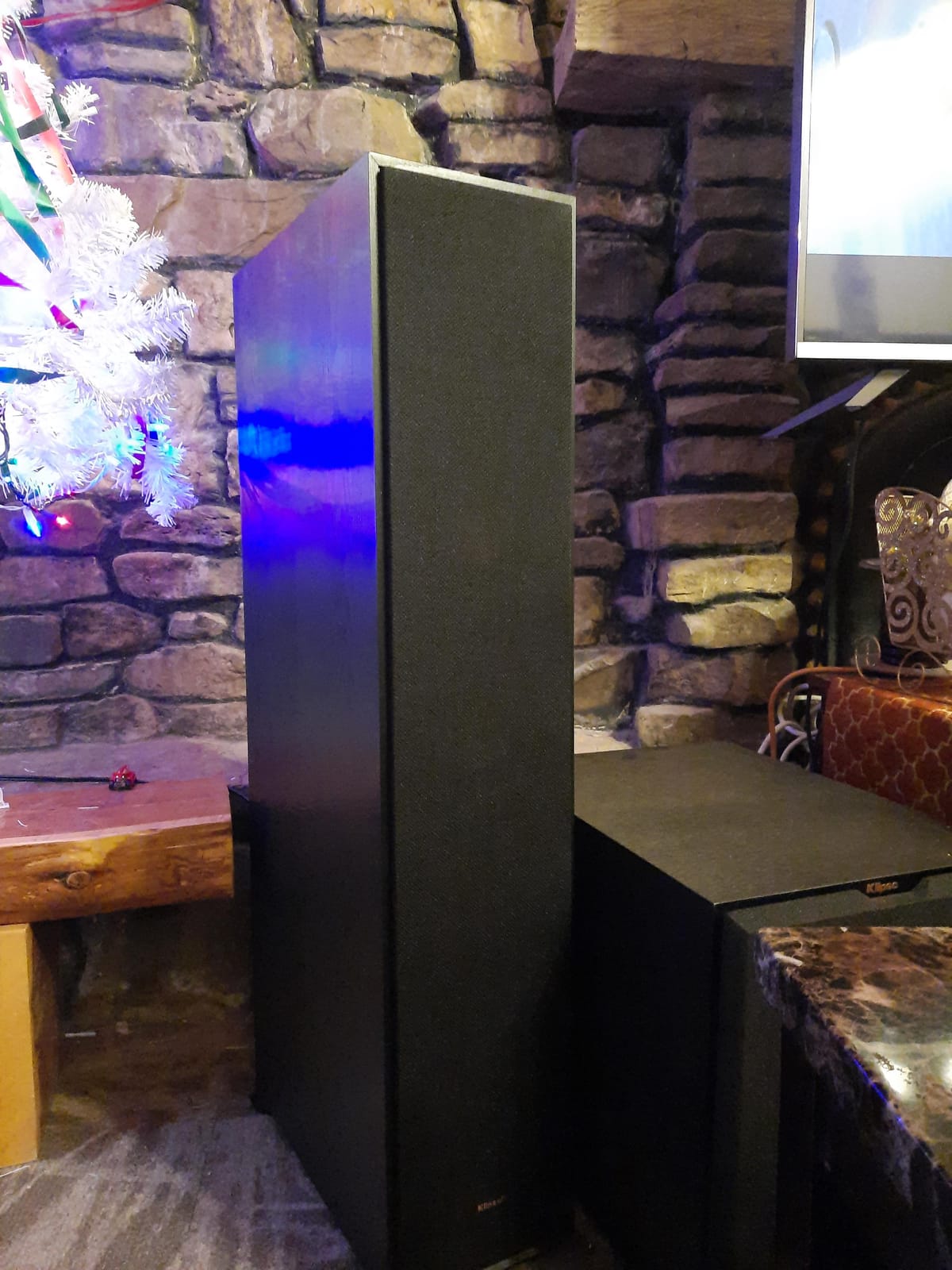
Whether built-in Atmos is better than a dedicated module
Built-in modules save you the visual clutter of separate height speakers and the complexity of running additional cable. If you cannot fish wire through an attic or a vaulted ceiling, that convenience is worth a great deal and there is no equivalent retrofit in a tower of this class.
The tradeoff is flexibility. Dedicated upward-firing speakers can be repositioned and swapped, and a full 7.1.4 layout with real ceiling speakers will still sound more convincing. For a main-level theater in an open plan, the R-625FA gets you most of the way with one pair of towers.
How much floor space it needs
Plan for a 20.75 inch depth and a 12.75 inch width, and check that a projection screen or a window will not be obstructed. Speakers this deep usually want to sit near a front wall, which is fine in a theater but restricts placement in a live music room where you might want to move them back.
At 49 pounds each, the towers are stable once positioned but are not a one-person job in tight corners. Spiked feet are worth adding on carpet, and the supplied plastic feet are the weakest component in an otherwise solidly built cabinet.
5. Polk Audio Monitor XT60: Best Budget Pick for Open-Plan Rooms
Polk Audio Monitor XT60 Home Theater Tower Speaker (Single, Midnight Black)
6.5 inch woofer plus two 6.5 inch radiators
8 ohm
Hi-Res and Atmos ready
Pros
- Twin 6.5 inch passive radiators give smooth mids and deep bass
- Modern decor-friendly cabinet that suits an open living space
- Rubber feet designed for both carpet and hardwood
- Timbre matched with the rest of the Monitor XT series
- Hi-Res certified with Atmos Auro 3D and DTS:X support
Cons
- Sold as a single speaker so a stereo pair takes two orders
- Passive radiators add depth that can crowd a tight room
- 200 watt rating is modest for very large spaces at high volume
The XT60 is the Monitor XT generation of a design people have recommended for years, and it remains one of the most practical towers for a medium-to-large room where the speakers will be visible. The cabinet is a clean, modern box that does not shout for attention in an open living space.
A 1 inch tweeter, a 6.5 inch Dynamically Balanced woofer and two 6.5 inch passive radiators cover the range, and the radiators are the reason it produces more low end than a similarly sized two-way bookshelf. Owners consistently describe smooth mids and deep, unfussy bass.
Hi-Res Audio certification plus Dolby Atmos, Auro 3D and DTS:X compatibility means it slots into a modern theater without special handling, and the whole Monitor XT series is timbre matched so the XT20, XT30, XT90 and XT12 blend cleanly. That matters more in a large room than people expect, because reflections there are stronger.
Two practical notes. It is sold as a single speaker, so a stereo pair is two purchases, and the passive radiators add real depth to the cabinet, which is worth measuring if your tower positions are tight against a wall or a curtain.
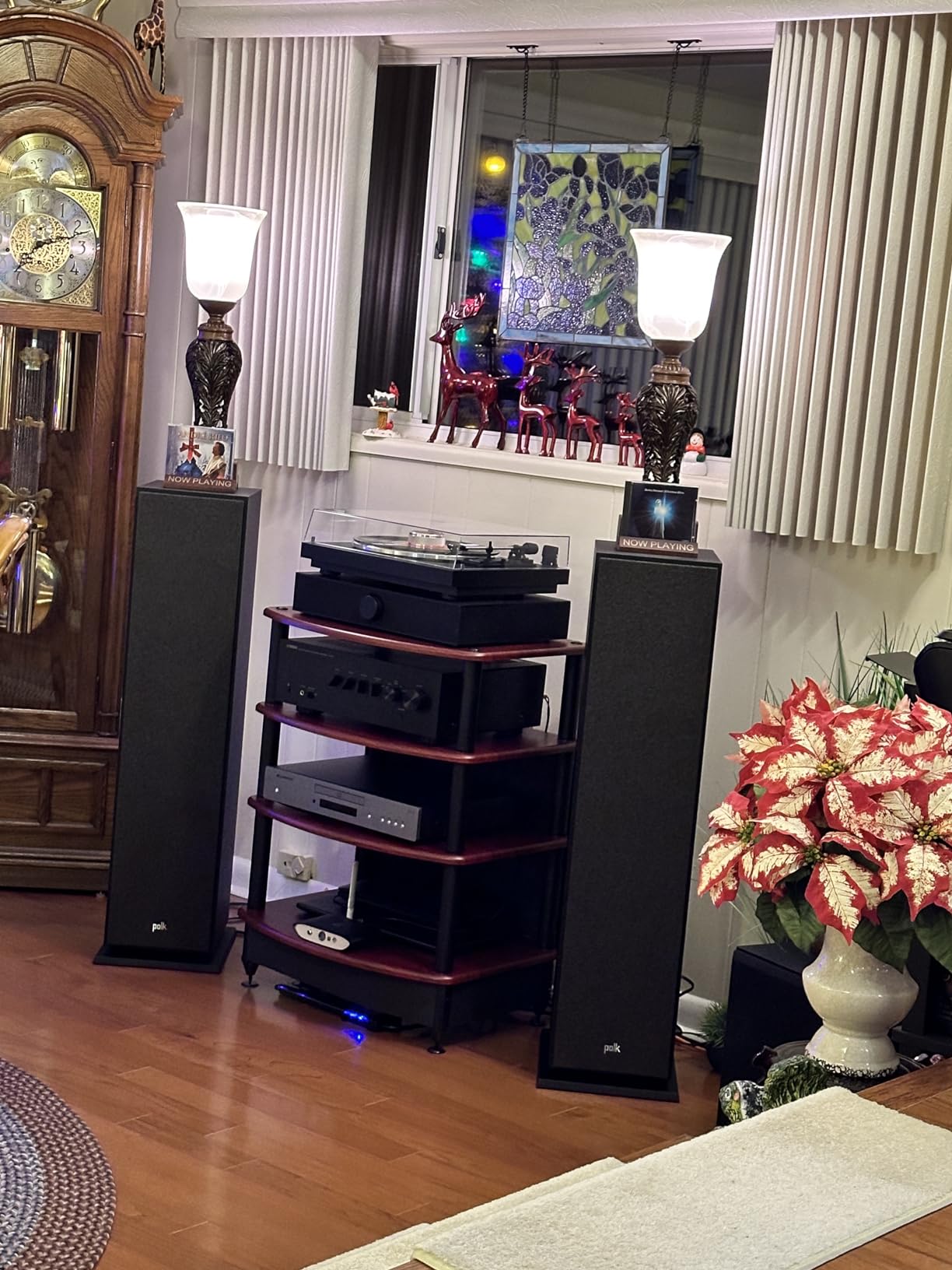
How the XT60 compares with the T50
Both use a 6.5 inch driver with dual 6.5 inch radiators at 8 ohms, and in our view the XT60 is the more contemporary choice for a modern room while the T50 is the more established one. The XT60 lists 200 watts against the T50’s 150, and both carry a five year warranty.
Where they diverge is voicing. The XT60 is described as smoother and more neutral, the T50 as warmer and more relaxed. In a large, reflective room that extra smoothness pays off, because high frequencies survive multiple wall reflections without sounding harsh.
How much room the XT60 needs
At 17.9 inches deep, 16 inches wide and 16.4 inches tall, the XT60 is short and wide rather than tall and slim. That shape works well next to a television or projector screen, where a 40 inch tower would block the image, and the included rubber feet keep it stable on both carpet and hardwood.
We would call its sweet spot 200 to 450 square feet. Beyond that, add a subwoofer and drive it with a decent amplifier rather than expecting the passive radiators to do all the work on their own.
6. ELAC Debut 2.0 F5.2: Best Three-Way for Accuracy
ELAC Debut 2.0 F5.2 Floorstanding Speaker, Black (Each) – 1” Cloth Dome Tweeter & Triple 5.25” Aramid Fiber Woofers – 3-Way Bass Reflex – Up to 35,000 Hz Response
Triple 5.25 inch aramid woofers
1 inch cloth dome tweeter
3-way bass reflex
Pros
- Neutral non-fatiguing sound that suits long listening sessions
- Waveguide cloth dome tweeter avoids harshness
- Woven aramid cones are stiff and well damped
- Drives easily from modest 140 watt amplification
- Owners report it rivals speakers costing far more once calibrated
Cons
- Needs a long break-in period before bass tightens
- Can sound harsh and bass-light before room correction
- Limited low-end extension from 5.25 inch cones so a sub is recommended
- Only a 3 year warranty
The F5.2 is the only genuine three-way design here with a dedicated midrange section, and for a large room that architecture matters. A three-way splits the frequency band so no single driver has to handle a wide span, which is exactly where distortion creeps in when you push volume in a big space.
Three 5.25 inch woven aramid fiber woofers handle the low end, a 1 inch cloth dome tweeter with a waveguide and wide-roll surround sits up top, and the response is listed out to 35,000 Hz. The waveguide on the tweeter is designed to control dispersion, which keeps the sound consistent off-axis.
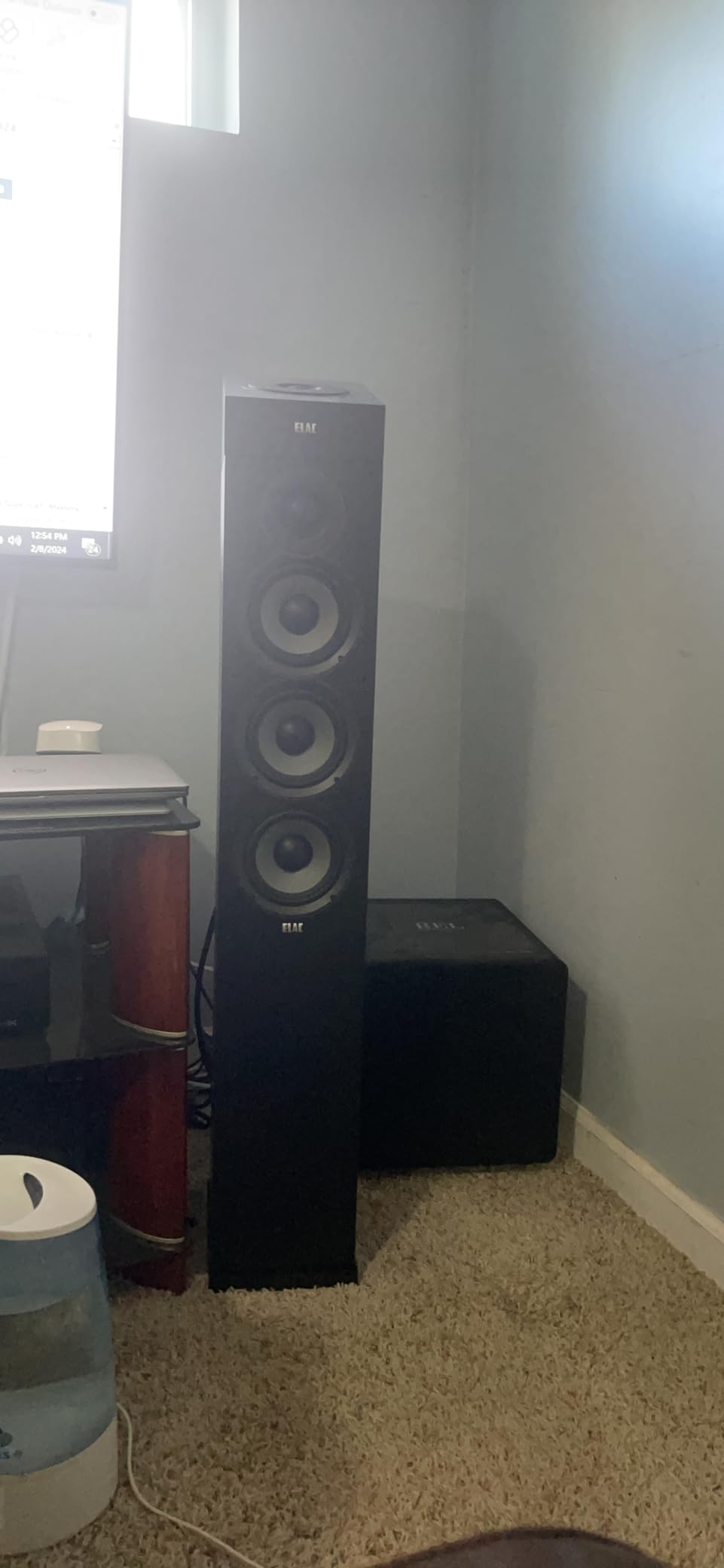
Owners frequently describe this speaker as neutral and non-fatiguing, with an open midrange that keeps dialogue intelligible. Many also report that after room calibration the result rivals speakers costing several times more, which is a remarkable claim but one that appears often enough across reviews to be credible.
There is a catch that buyers consistently mention: out of the box it can sound harsh and bass-light, and it needs a break-in period of roughly 30 to 50 hours before the bass tightens and the treble softens. Run room correction first and give it time before judging it.
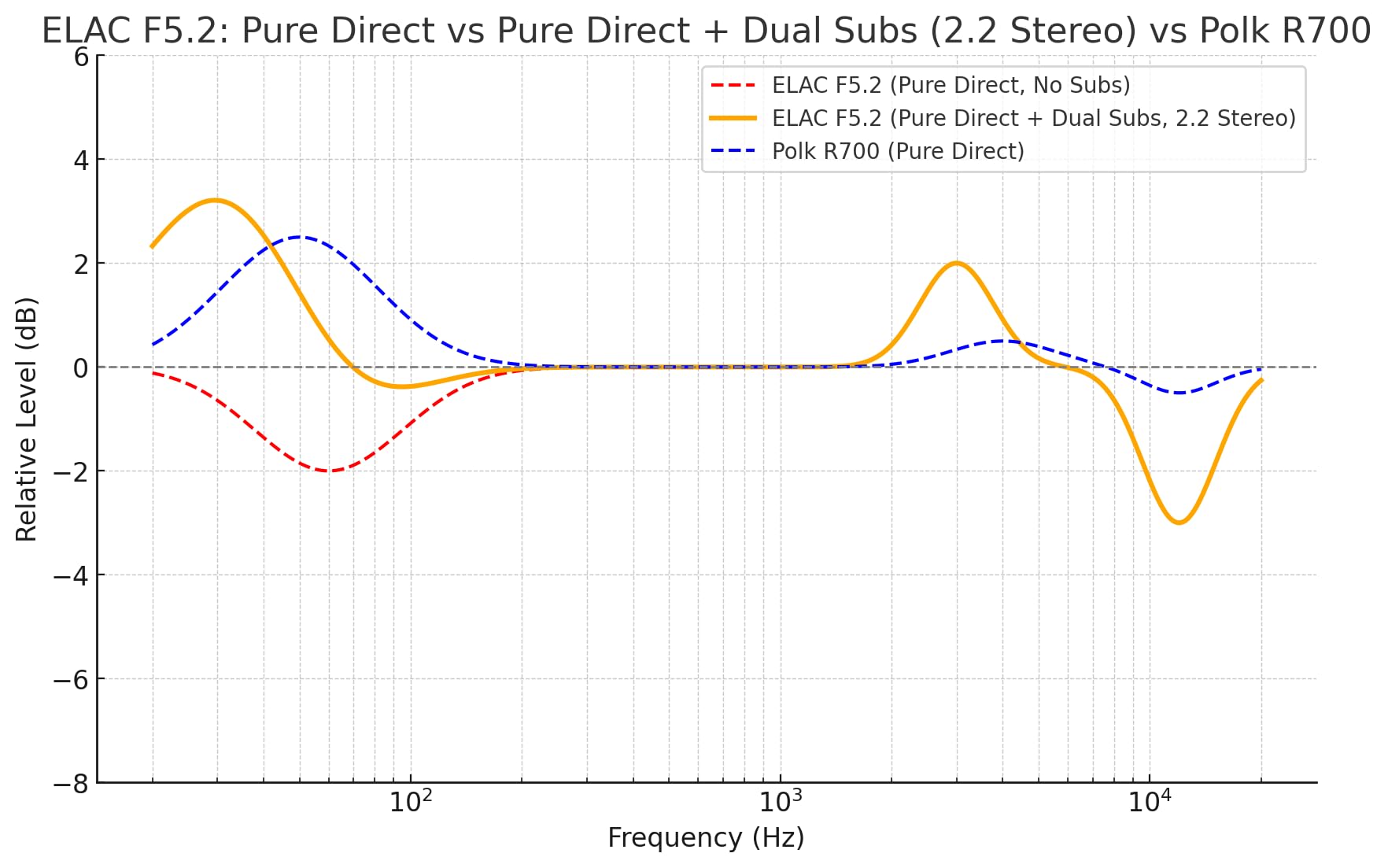
Why a three-way design earns its place in a large room
In a large room, the midrange is where reflected energy does the most damage to clarity. A dedicated midrange driver crosses over in a narrow band instead of a wide one, so fewer harmonics from the vocal range are generated at high volume. That is why listeners in large rooms repeatedly ask for a genuine three-way.
The tradeoff here is that the 5.25 inch woofers limit low-end extension. We would cross over to a subwoofer at 80 Hz and let the ELAC handle everything above it, which is how most owners get the sound they praise.
How the F5.2 handles a vaulted ceiling
At 45.87 inches tall and 15.67 inches deep, this is a tall tower with a narrow footprint, and the internally braced thick MDF cabinet is built to stay rigid at higher drive levels. It suits a vaulted room where floor space is at a premium along a long wall.
The only spec that gives us pause is the 3 year warranty, which is shorter than the five year terms on the Polk and Klipsch models here. For a buyer who plans to keep a system for a decade, that difference is worth noticing.
7. Sony SS-CS3: Best Matched Pair with a Dedicated Super Tweeter
Sony SS-CS3 3-Way 4-Driver Floor-Standing Speaker (Black)
Three-way four-driver layout
1 inch plus 3/4 inch tweeters
Up to 50 kHz
Pros
- Genuine three-way layout with a dedicated super tweeter
- Highest listed high-frequency extension in this group
- Sold as a matched stereo pair in one box
- Wood-look cabinet construction feels solid in the hand
- Neutral enough for both films and music
Cons
- Only 145W peak power handling is modest for very large rooms
- Supplied binding posts and cabling are basic
- 6 ohm impedance gives less amplifier flexibility than 8 ohm
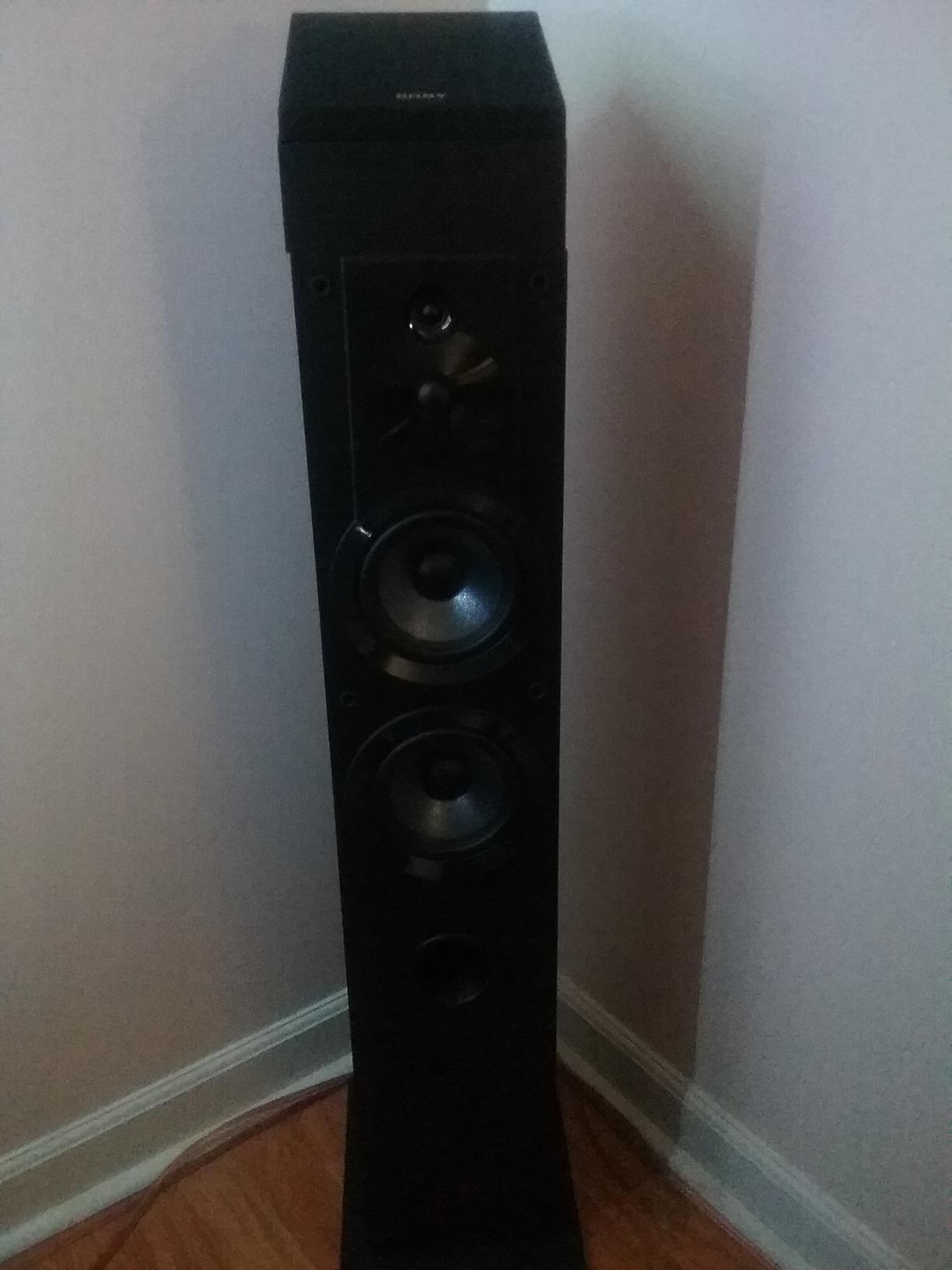
The SS-CS3 is unusual in this group because it arrives as a matched pair rather than a single speaker, and because of the two-tweeter top end. A 1 inch polyester main tweeter sits alongside a 3/4 inch super tweeter, and the stated response runs to 50 kHz.
Super tweeters are controversial, and it is worth being honest about why. The audible range for most listeners tops out far below 50 kHz, so the practical effect is a wider, airier top end rather than detail you would otherwise miss. Audiophiles in enthusiast threads frequently pick this model for exactly that reason.
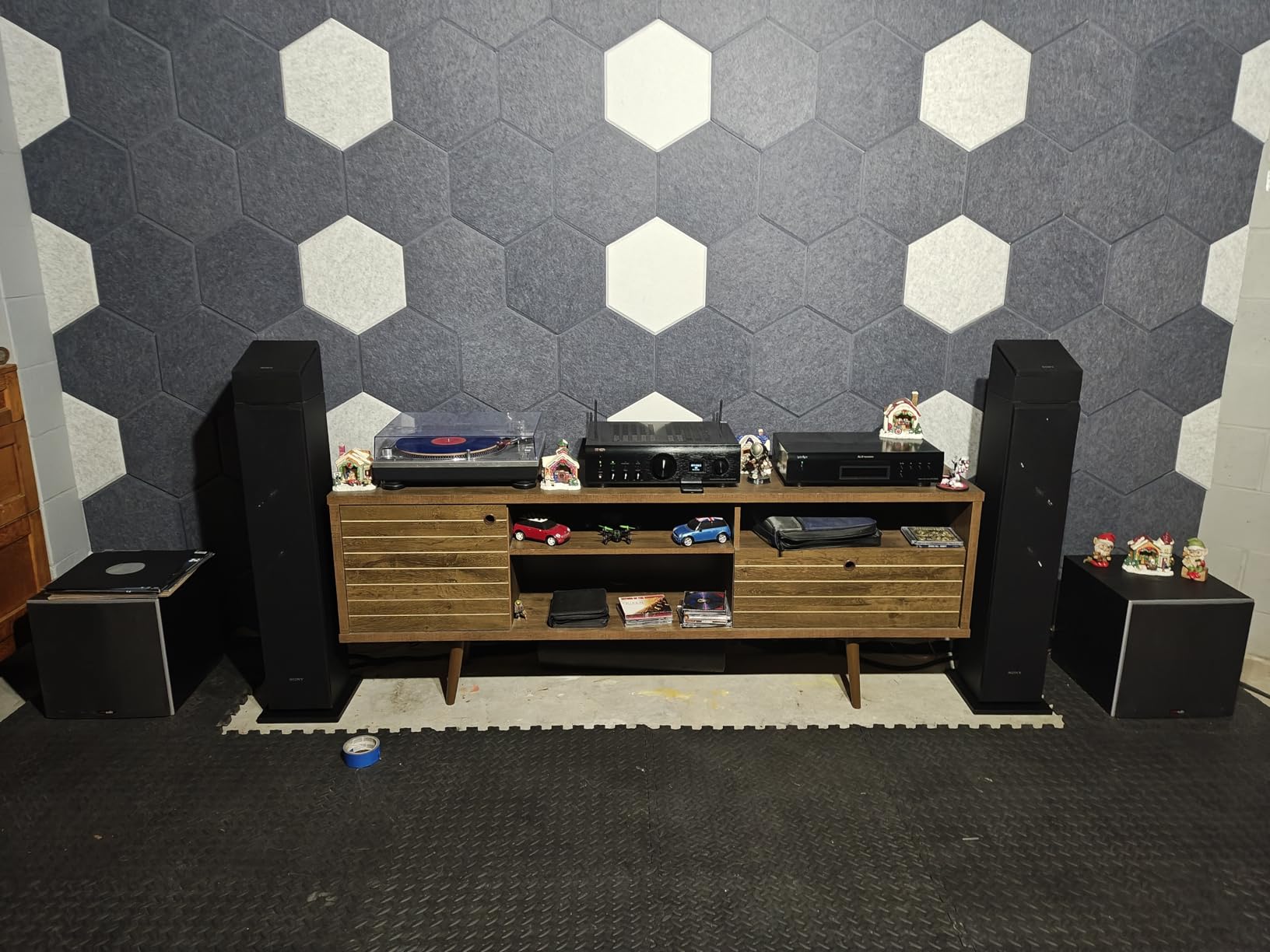
The three-way, four-driver architecture means the midrange is handled separately from the bass section, which helps clarity in a reflective room. At 56.9 pounds for the pair and 36.3 inches tall, the cabinets have enough mass to stay stable and quiet when driven hard.
Where it falls short is power handling. At 145 watts peak and 6 ohms, this is a large-room speaker in shape and layout but not in raw output capability, so it is best paired with a subwoofer and used in rooms up to roughly 350 square feet rather than a 1,000 square foot great room.
Whether the super tweeter adds real value
It depends on your room and your sources. In a large, live room with hard surfaces, a second high-frequency driver can help because the extra energy in the top octaves keeps the sound from feeling damped after multiple reflections. In a treated room, the effect is subtler and some listeners find it unnecessary.
What we can say is that the response figure is unusually high for the money, and the driver layout is more thoughtful than the two-way designs that dominate this price range. Just do not expect the super tweeter to substitute for a subwoofer at the other end of the spectrum.
What to check before buying a matched pair
Because it is a bundled pair, verify that both cabinets carry the same serial range and that the grilles and drivers are undamaged before you accept delivery. The wood and polyester cabinet construction is decent but not premium, and the supplied binding posts and cabling are among the most basic in this group.
Six ohm impedance is worth noting if you pair this with a low-current amplifier, though most modern AV receivers have no trouble driving it. We would use it as a stereo pair or as front channels in a 5.1 system with a separate subwoofer handling everything under 80 Hz.
8. SVS Prime Tower: Best Soundstage in a Compact Footprint
SVS Prime Tower Speakers – Pair (Piano Gloss Black)
4.5 inch sealed midrange
Dual 6.5 inch woofers
SoundMatch 3.5-way crossover
Pros
- Reference-grade accuracy and tonal balance
- Controlled bass that never turns boomy
- Compact footprint for a pair of full-size towers
- Efficient enough for modest integrated amplifiers
- Chamfered baffle edges give precise soundstaging
Cons
- Uncoloured voicing exposes poor source material
- Some owners report limited bass without a dedicated subwoofer
- Premium pricing for a two-channel tower pair
The Prime Tower is the one in this group that most often gets described as disappearing into the room. Chamfered baffle edges reduce diffraction around the cabinet, and the 4.5 inch midrange driver sits in a dedicated sealed compartment, which is a design choice aimed squarely at clarity rather than output.
That midrange isolation is why the imaging is as good as it is. Voices sit in a stable position and instruments keep their placement as volume rises, which matters a great deal in a large room where early reflections would otherwise smear the soundstage.
Dual 6.5 inch woofers handle the low end, and a 1 inch aluminum dome tweeter that owners report stays clear at high volume sits above them. The proprietary SoundMatch 3.5-way crossover blends the mid and bass sections smoothly, and adjustable spiked feet plus a cloth grille are included.
Owners describe the tuning as uncoloured and highly detailed, which is exactly what a critical listener wants and exactly what frustrates someone feeding it compressed streaming audio. Our view is that this speaker rewards a good source, and it works best alongside a subwoofer rather than alone.
Whether the Prime Tower can fill a large room
This is where we want to be precise rather than flattering. Efficiency is good enough for modest integrated amplifiers, but the design philosophy prioritizes accuracy over brute output, so in a very large open-plan space you are more dependent on the subwoofer and a capable amplifier than you would be with a horn-loaded or multi-woofer tower.
We would happily use a pair in a 300 to 500 square foot room with one sub, and in a 600 square foot space with two. The strength is not how much air it moves; it is how precisely it places what the air is doing.
Why the sealed midrange compartment matters
A dedicated sealed chamber for the midrange decouples it from the woofer’s excursions, so bass movement does not push air across the midrange driver the way it does in a simple two-way cabinet. Less interference means cleaner vocal reproduction, and vocal reproduction is the first thing to fail in a large room.
The trade is reduced deep bass output from the midrange driver itself, which is why the Prime Tower is happiest with an external subwoofer handling the bottom octaves. Spiked feet are included, and on carpet they are worth using every time.
9. Dayton Audio Classic T65: Best Slim Cabinet for Tight Positions
Dayton Audio Classic T65 Floor-Standing Tower Speaker Pair (Black)
Dual 6.5 inch poly drivers
1 inch silk dome tweeter
7.25 inch wide
Pros
- Slim 7.25 inch footprint fits tight tower positions
- Silk dome tweeter stays detailed without harshness
- Bass presence that works acceptably without a subwoofer
- Gold plated binding posts accept banana plugs
- Speaker wire included in the box
Cons
- Midrange and soundstage are less resolved than premium towers
- Needs roughly 30 hours of break-in before settling
- Sound is adequate rather than punchy at high volume
- A subwoofer is still preferred for surround listening
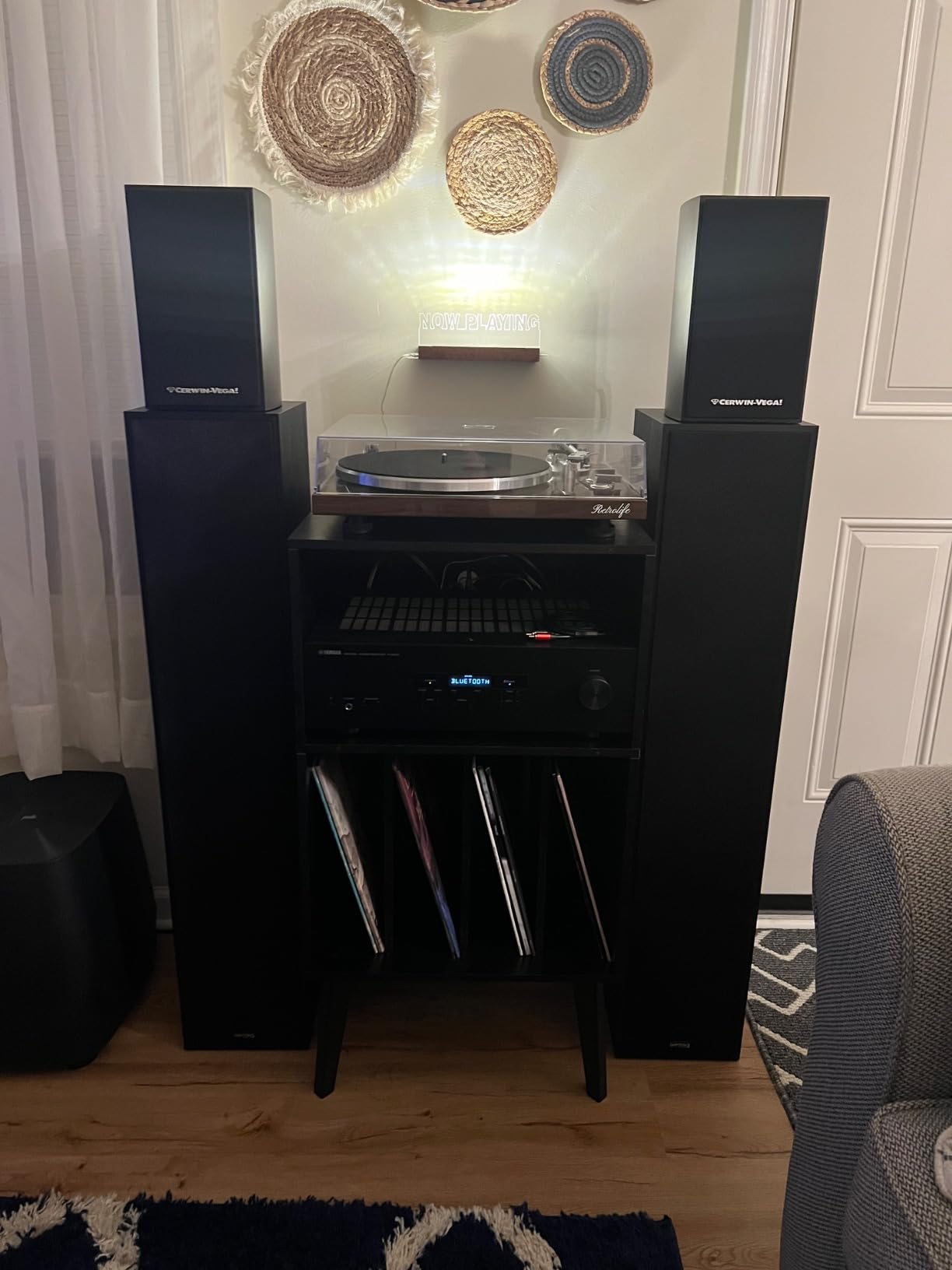
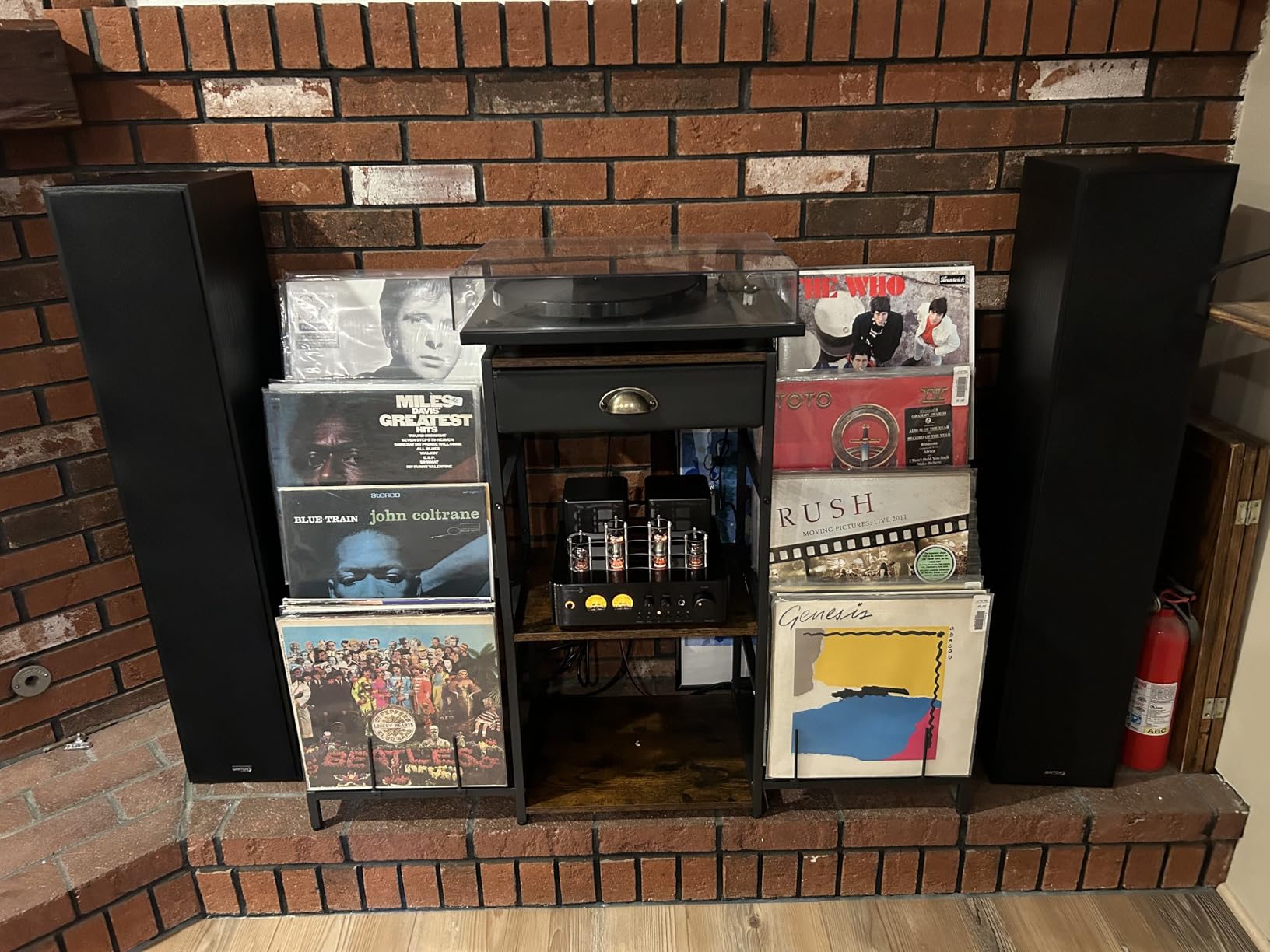
Sometimes the constraint in a large room is not volume but floor space. A 38 foot long room with a seating area in the middle may only allow 7 inch wide towers at each end, and the Classic T65 is 7.25 inches wide and just over 39 inches tall.
Despite the narrow cabinet it carries real air movement, with dual 6.5 inch custom poly bass drivers and a 1 inch silk dome tweeter positioned at ear level when seated. The internal volume behind those drivers is generous for the footprint, and owners report bass presence that works acceptably without a subwoofer.
The silk dome tweeter is the detail people notice first. It stays detailed without the hardness that metal or ceramic dome designs can show in a bright room, which is a genuine advantage in a large space with lots of glass and hard flooring.
Gold plated binding posts that accept banana plugs and an included run of speaker wire make setup painless, and the true hi-fi crossover network is a step up from the crude crossovers found in some budget designs. The five year warranty is also longer than most rivals in this bracket.
Where this speaker sounds out of its depth
Owners are straightforward about the limits: the midrange is not especially detailed and the soundstage is not wide, so it will not compete with the SVS Prime or the ELAC on imaging. Some listeners also describe the overall presentation as adequate rather than punchy, which is the polite word for restrained.
Plan on a 30 hour break-in before evaluating it, since the tone settles noticeably after that. In a large room, run a subwoofer and treat these as midrange and high-frequency sources rather than expecting full-range output.
Why slim cabinets matter in open-plan rooms
In an open plan living space, the speakers usually have to sit against a short wall between a window and a fireplace, or at the end of a long sightline. A slim tower can be placed there without blocking a walkway, without reflecting off a nearby wall at a bad angle, and without dominating the room visually.
Because the tweeter sits at ear level for a seated listener, this design also works well when the primary listening position is close, which is common in rooms where the speakers sit well forward of the sofa. It is a design built around real furniture rather than ideal acoustics.
10. Definitive Technology BP-9040: Best With Built-In Bass
Definitive Technology BP-9040 Tower Speaker, Built-in Powered 8” Subwoofer
Integrated powered 8 inch sub
Bipolar forward-focused array
A90 docking port
Pros
- Built-in powered 8 inch subwoofer needs no separate bass box
- Bipolar forward-focused array gives a wide immersive stage
- Each tower has its own sub so bass spreads around the room
- Clean open midrange with strong imaging for dialogue
- Docking port accepts optional A90 height modules
Cons
- Requires a mains outlet behind each tower and still needs a passive amp for the top drivers
- Some owners report the internal sub amplifier failing within warranty
- Two-way upper array limits refinement versus a three-way tower
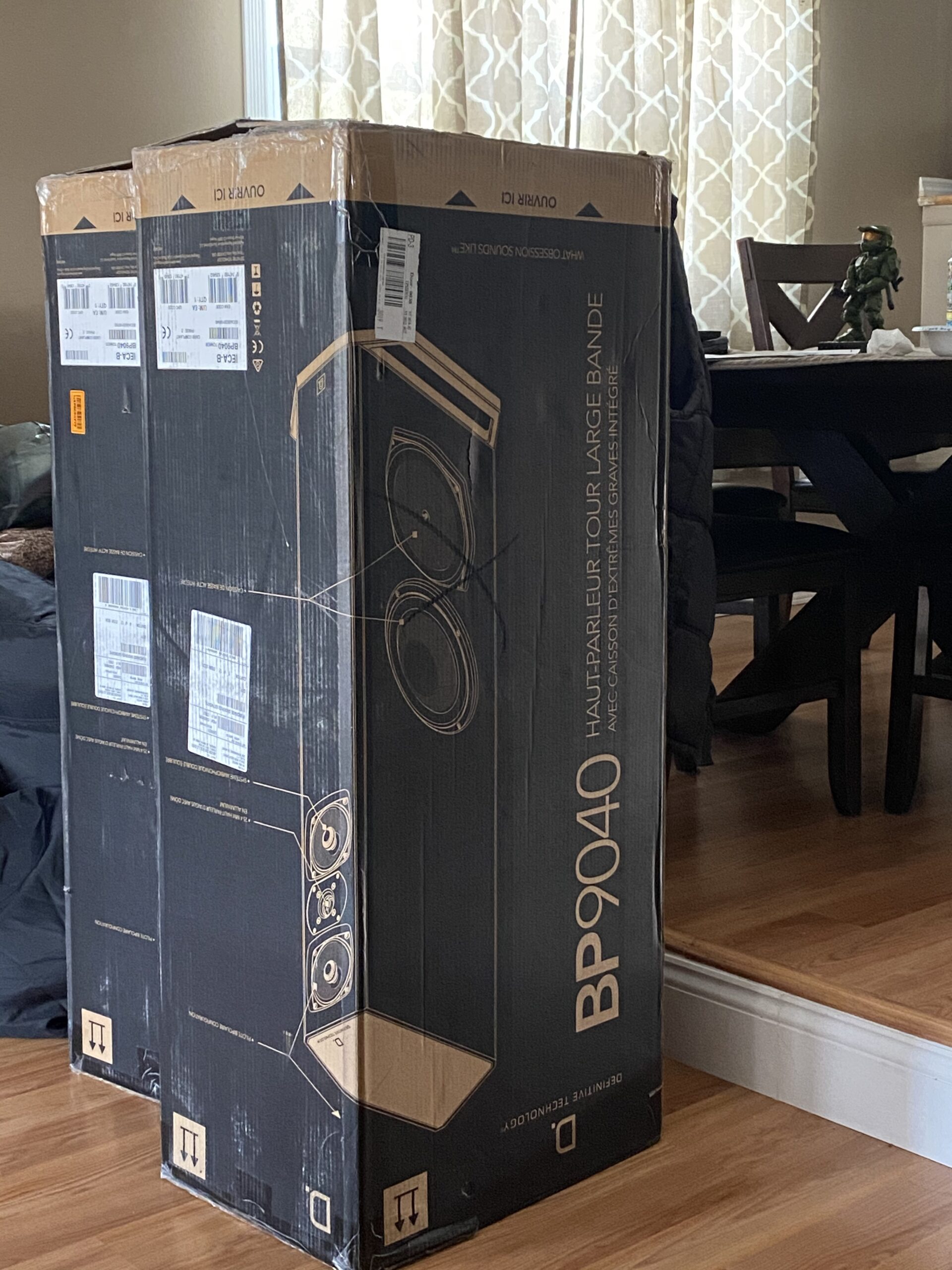
The BP-9040 is the only tower here with a powered subwoofer built into the cabinet, and that changes the calculus in a large room. Instead of one subwoofer fighting to fill 4,000 cubic feet from a single corner position, each tower carries its own 8 inch driver, so bass is distributed across the listening area.
The array is more elaborate than a normal tower. BDSS drivers are placed front and rear, with a front 1 inch tweeter and two 4.5 inch mid drivers plus a rear-facing tweeter and mid driver, all working through patented Forward-Focused Bipolar Technology for wide dispersion. There is also a pair of 8 inch dual bass radiators behind the powered sub.
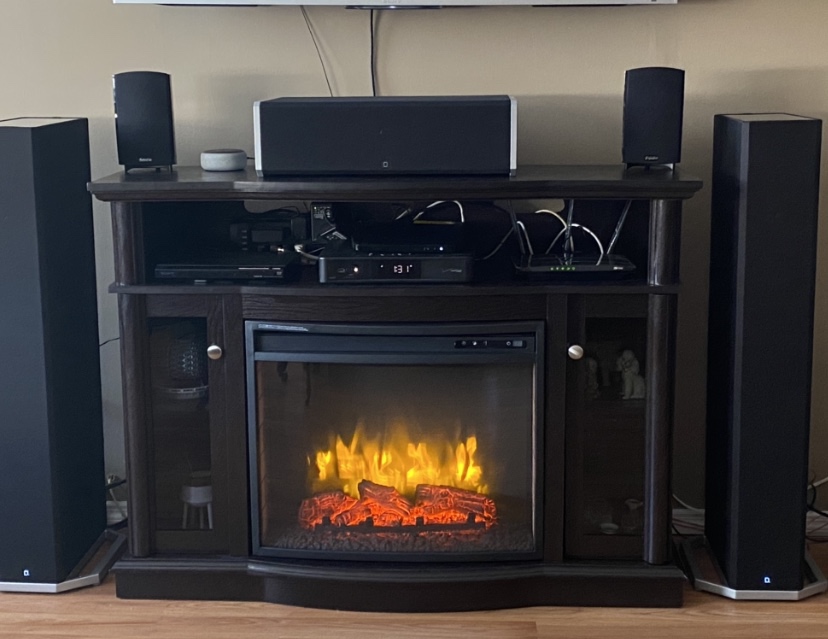
Owners describe movie-theater level performance and an open midrange with strong imaging, which is exactly what you want for dialogue. The Intelligent Bass Control circuit is intended to keep the tonal balance steady as you raise the level, and the docking port on top accepts an optional A90 height speaker for Atmos and DTS:X.
There are two real caveats. The tower needs a mains outlet behind it and still requires a passive amplifier or receiver to drive the upper drivers, so it is not the simple all-in-one solution it appears to be. A minority of owners also report the internal subwoofer amplifier failing within the warranty period, which is worth knowing given the split warranty terms on cabinet, drivers and electronics.
Whether one built-in sub beats a separate subwoofer
For bass distribution, built-in wins. A single subwoofer in a very large room has to work harder, and its output falls off with distance from the listening position, so seats at the far end of a 38 foot long room hear less of it. Each tower’s own sub sits near the front speakers, which is where the room gain is strongest.
For control and calibration, a separate subwoofer wins. You can place a dedicated sub in the best corner, run room correction on it properly, and swap it later. In practice, plenty of owners start with the built-in drivers and add a separate sub later once the room is furnished.
How the bipolar array changes the soundstage
Bipolar designs fire drivers in two directions, which widens the apparent soundstage well beyond the physical gap between the speakers. In a large room that is a real advantage, because a narrow stage between two towers 10 feet apart can feel like two boxes rather than a stage.
The cost is that the sound arriving at your ear is a mix of direct and reflected energy from the rear-facing drivers, which makes precise imaging harder. If you care more about pinpoint placement than width, a single-direction tower like the Klipsch R-610F is the more honest choice.
11. Yamaha NS-F150: Best Finish for a Living Room
Yamaha Audio NS-F150 Floor Standing Speaker – Each (Black)
2-way bass reflex
6.5 inch woofer
Piano black mirror finish
6 ohm
Pros
- Piano black mirror finish looks excellent in a living room
- Clean balanced tuning that stays fatigue-free
- Gold plated speaker terminals
- Removable grille and simple hookup
- Receiver microphone calibration works well
Cons
- Sold as a single speaker rather than a matched pair
- Bass is shallower and quieter than a dedicated subwoofer delivers
- Tall narrow cabinet is easy to knock over with pets or children
The NS-F150 is chosen here for a reason that has nothing to do with measurements: it is the one tower in this group that is designed to look good in a living room. The piano black mirror finish is genuinely attractive, and at 40.5 inches tall with a 7.9 inch width it has an elegant proportion that suits a decorated room.
Sonically it is a clean, well-balanced two-way design. Owners describe clear mids, crisp highs and low, clean bass that handles moderate volume without fatigue, and the easy receiver microphone calibration means a mainstream AV receiver will tune it well without fuss.
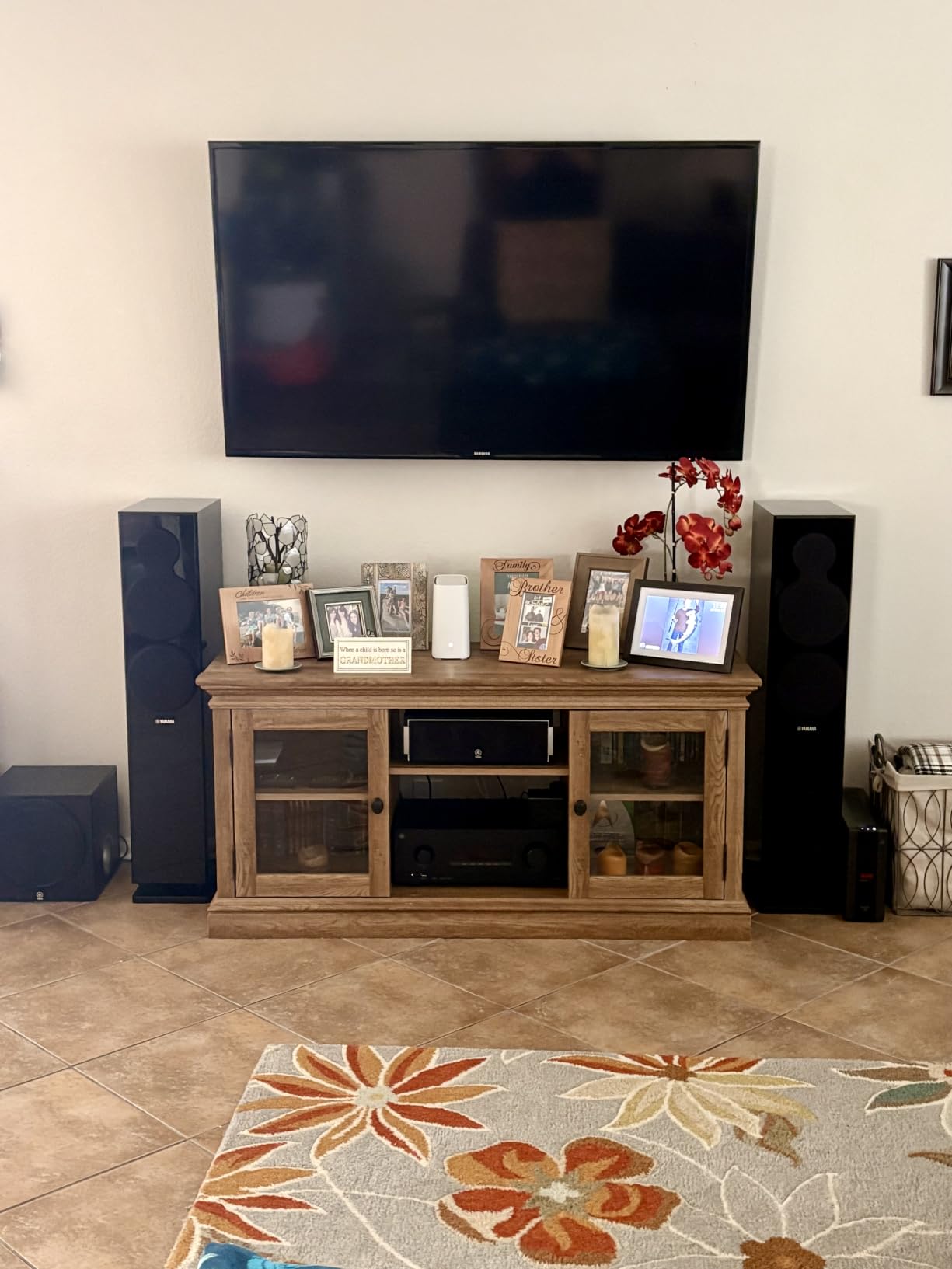
Gold plated speaker terminals, a removable grille and a straightforward hookup keep the installation simple. This is a set of priorities you rarely see acknowledged in a spec sheet, and in a large open-plan room where the speakers are visible at all times, appearance is a legitimate selection criterion.
Two things to keep in mind. It is sold as a single speaker, so a stereo pair requires two orders, and the tall narrow cabinet is a genuine stability concern in a house with pets or small children. We would anchor it with a stable base rather than leaving it free-standing next to a sofa.
How much low end the NS-F150 can produce
Owners are consistent on this point: the bass is less deep and less loud than a dedicated subwoofer delivers, and they frequently add a subwoofer anyway. With a 6.5 inch woofer in a 2-way bass reflex cabinet, this is expected rather than a fault.
Treat it as a midrange and high-frequency source with a subwoofer below 80 Hz. In a room up to about 350 square feet that combination is entirely convincing, and the 6 ohm impedance is easy to drive with almost anything.
Whether a mirror finish wears well in a home
High gloss piano black shows fingerprints and dust more readily than a wood veneer or matte finish, so it needs more attention than a textured cabinet. It also shows scratches, which is a fair trade if you want the furniture-like appearance and a bit of a maintenance commitment.
If the room is full of pets, children or high traffic, one of the wood-finish options such as the Fluance Ai81 Elite walnut cabinet may age better. If the room is formal and you want the speakers to disappear visually, the gloss is a real asset.
12. Fluance Ai81 Elite: Best Powered Tower for Plug-and-Play Setups
Fluance Ai81 Elite Powered 2-Way Floorstanding Tower Speakers, 150W Built-in Amplifier for 2.0 Stereo Music & Movie Listening, TV, Turntable, PC & Bluetooth – 2x RCA, Optical, Sub Out (Natural Walnut)
150W built-in amplifier
Dual 6.5 inch glass fiber drivers
Bluetooth and optical
Pros
- Built-in 150W amplifier removes the need for a separate receiver
- Dual 6.5 inch woven glass fiber drivers give accurate mids and bass
- Turntable
- TV
- PC and Bluetooth sources all supported
- Subwoofer out lets you add low end later
- Attractive wood finishes that suit most decor
Cons
- 150W RMS is less than the badge suggests
- Bluetooth and optical input behavior reported as inconsistent
- Remote is thin and flexes
- Refinement is basic next to passive hi-fi towers
The Ai81 Elite is the powered option, and for a lot of people moving into a large room that is genuinely the right call. Each speaker has its own 150 watt integrated amplifier, so there is no receiver, no amp rack and no speaker wire running across the floor to a stack of electronics.
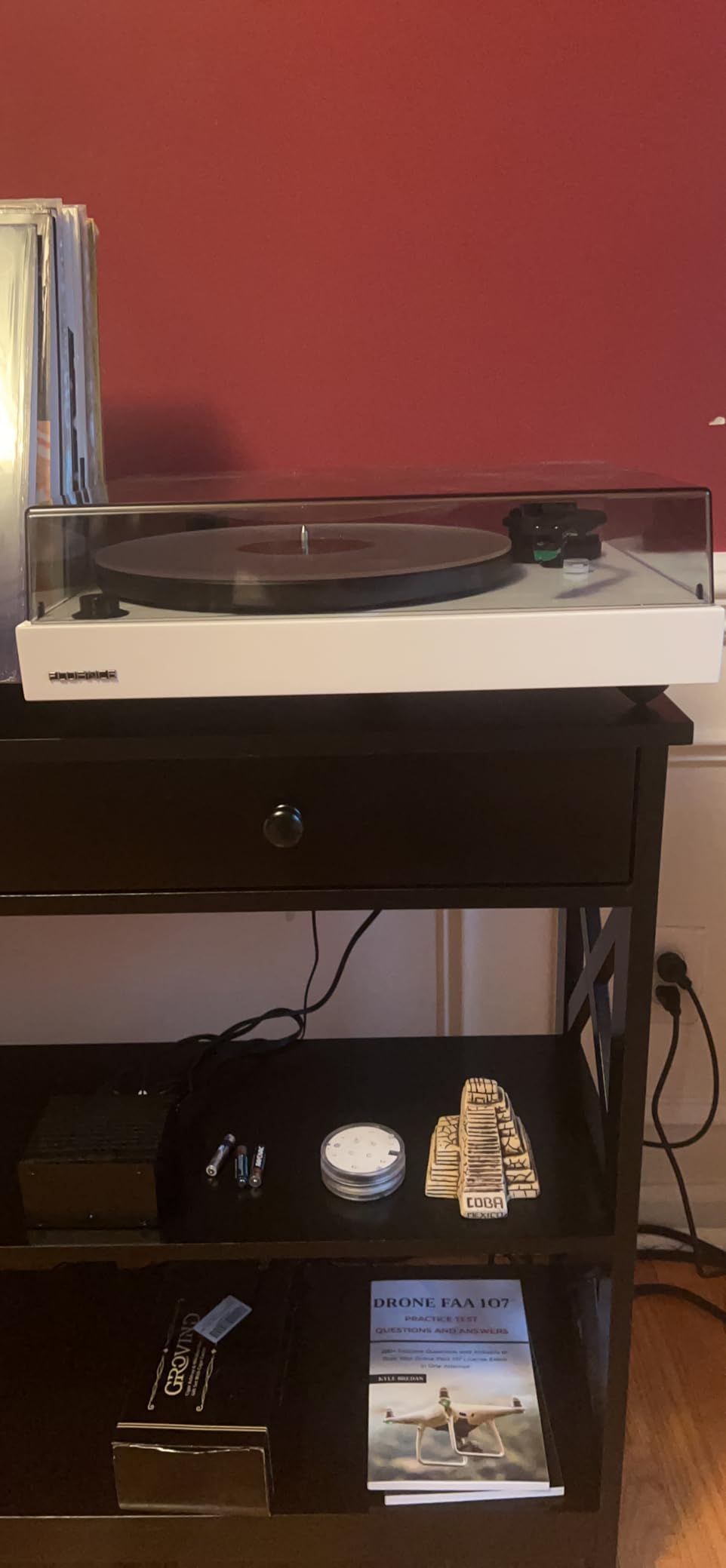
Sources are handled internally. Two sets of RCA inputs, an optical input and Bluetooth 5 cover a turntable, a TV, a PC and streaming, and there is a subwoofer out so you can add low end later once you know how the room responds. Owners report a clean, room-filling stereo image in a long living room.
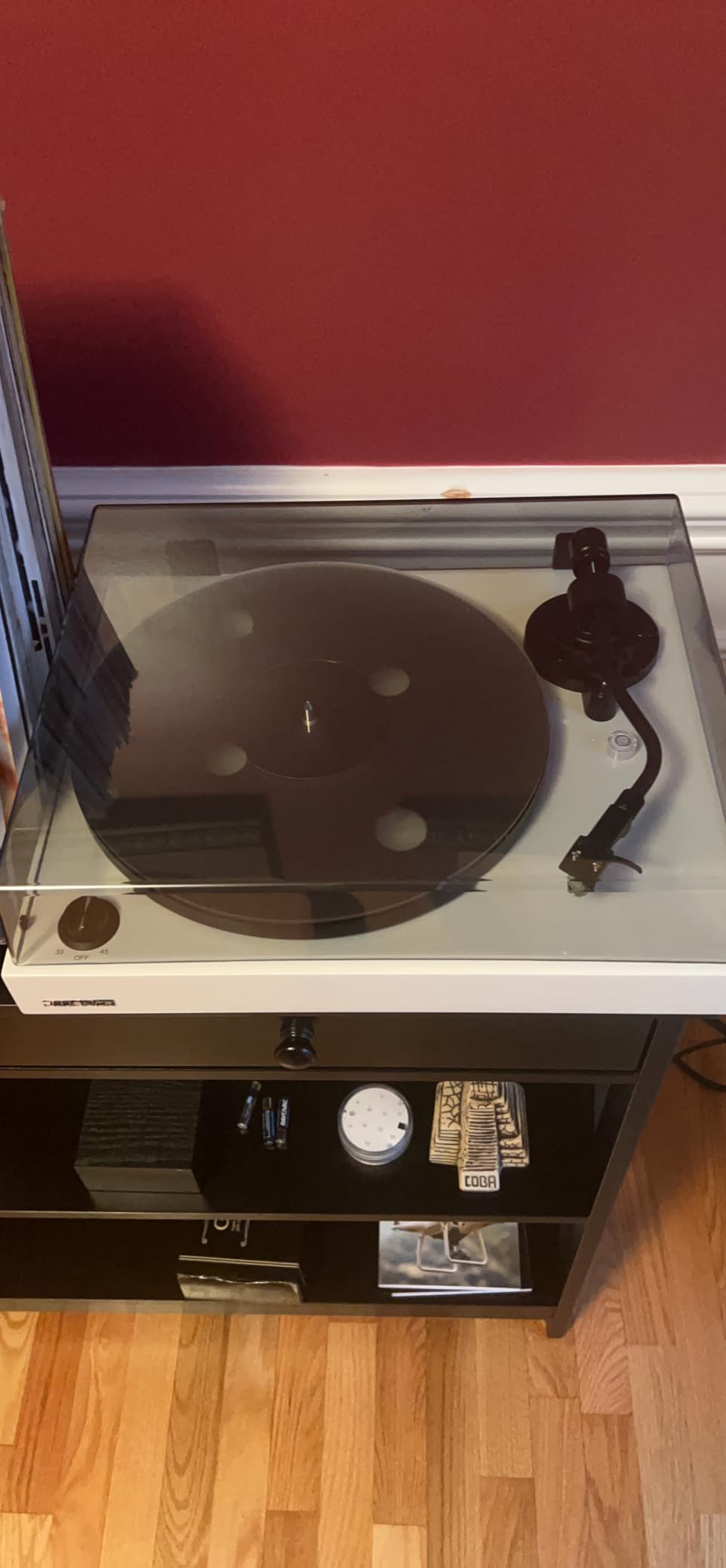
Internally braced MDF cabinets with down-firing bass ports, dual 6.5 inch woven glass fiber drivers and neodymium tweeters with good off-axis dispersion make this a competent transducer. A remote control and 8 feet of 18 gauge speaker wire are in the box, and multiple cabinet finishes are offered.
Be clear-eyed about the compromises. Class D amplification delivers about 150 watts RMS, which is less than the badge implies. Bluetooth playback and optical input behavior are reported as inconsistent, the remote is thin, and overall refinement is basic next to a good passive tower driven properly.
When a powered tower is the right call
A built-in amplifier is a good answer when you have no amplifier, no AV receiver, or a partner who will not tolerate a stack of equipment in the living room. It also solves the matching problem, because the crossover and amplifier were designed together, so there is no impedance or sensitivity guessing.
It is a weaker answer when you already own good amplification, because you are paying for an amp you already have and getting less flexibility in the process. Powered towers are also harder to bi-amp and generally do not accept the same range of speaker-level management options.
How much room the Ai81 Elite can really fill
At 37.8 inches tall with dual 6.5 inch drivers and 150 watts per channel, this is a mid-size powered tower. It is a sensible choice for a living room up to roughly 400 square feet, and we would add a subwoofer through the sub out for anything larger or for movie content.
The down-firing bass ports mean you need some clearance under the cabinet, so plan for that before you choose a sofa or console. It is also worth noting that the lowest-rated product in this guide, at 4.4 stars from 58 reviews, still has owners describing the convenience as transformative for their setup.
How to Size Floorstanding Speakers for Your Room in Four Steps
Before you choose a model, run your own room through this four step process. It takes five minutes and it eliminates most of the disappointment that comes with buying a beautiful tower that cannot fill the space.
Measure the room in cubic feet. Multiply floor area by ceiling height. If you have a vaulted ceiling, use the average ceiling height across the room, not the peak.
Decide how loud you actually listen. Conversation level, moderate listening, and near-reference movie volume are three very different targets. Be honest here rather than aspirational.
Set a minimum sensitivity. Below about 86 dB, a tower needs an unreasonable amount of power to fill a large room. Above 300 square feet we would not consider anything under 87 dB, and for open-plan spaces we would aim for 90 dB or higher.
Decide whether a subwoofer is in the plan. If it is, the tower only has to handle 80 Hz and up, which changes the required cone area dramatically and lowers your budget for speakers.
As rough bands, a room under 150 square feet and 800 cubic feet is small, 150 to 300 square feet is medium, 300 to 600 square feet is large, and anything over 600 square feet or with a ceiling above 10 feet is very large. A vaulted ceiling roughly doubles the effective volume above head height, so move up one band if you have one.
Room volume is the same filter we apply to every large-space guide we publish, from our air purifier picks for large rooms to our space heater roundup for large rooms. If the space is a shared meeting room rather than a media room, our conference room microphone shortlist covers the same volume logic for voice pickup.
The Specs That Decide Whether a Tower Can Fill a Big Room
Sensitivity is the number that matters, and it is the one most often buried. A sensitivity rating of 94 dB means the speaker produces 94 dB of sound pressure with one watt of input at one meter, and because the scale is logarithmic, that is a large difference. Every extra 3 dB of sensitivity halves the amplifier power needed for the same volume.
Impedance is the second number. Eight ohm loads are the most flexible and work with essentially any amplifier, six ohm loads are common and rarely a problem, and 4 ohm loads can restrict which receivers you pair with. We would not buy a demanding 4 ohm tower until you have confirmed your amplifier can drive it with all channels loaded.
Recommended power versus peak power is the classic trap. A headline figure of 400 watts often means the speaker can absorb a short burst, not that it will play at that level cleanly. Look for a continuous or recommended power figure, and treat 85 watts continuous with 94 dB sensitivity as more useful than 400 watts peak with an unstated sensitivity.
Finally, driver layout. Two-way designs are simple and coherent, 2.5-way designs add a second woofer to reinforce the bass, and three-way designs add a dedicated midrange driver that keeps the vocal band clean. In a large room, three-way is the more honest answer to the room’s demands.
Passive, Powered and Bluetooth Towers Compared
Passive towers have no built-in amplifier and require a receiver or stereo amplifier. This is the category all twelve products here except one belong to, and it is the right choice if you already own quality amplification or want a full home theater system.
Powered towers have an amplifier inside each cabinet, which means simpler setup and no system matching. The Fluance Ai81 Elite is the example in this guide, and it covers turntable, TV, PC and Bluetooth from one box. The trade is less flexibility and a lower ceiling on output quality.
Bluetooth capability on a floorstander is a convenience rather than a serious playback path. It is useful for casual listening, but for a large room the value of a high-sensitivity design is wasted if you are streaming compressed audio to it.
How to Place Floorstanding Speakers in a Large Room
Placement changes the result more than any specification on the spec sheet. Five steps cover the majority of large rooms, including vaulted ceilings and open-plan layouts.
Move them 2 to 3 feet off the side walls. Closer placement boosts bass but smears imaging, and in a large room that smearing is much more obvious.
Set your listening distance between 6 and 12 feet. Farther back suits large rooms, but beyond about 14 feet the tweeter loses focus unless the speakers are toed in.
Toe each speaker in slightly. Aim the tweeters at the listening position, usually 10 to 15 degrees, which narrows the apparent stage and sharpens the center image.
Get the tweeter near ear height when seated. A 40 inch tower with an upward-firing tweeter may need a stand or a different crossover point, and this is where many towers in this guide differ.
Keep subs away from the front left and right positions. Subs and main speakers 5 to 8 feet apart interact far more predictably, which makes room calibration much faster.
For vaulted ceilings specifically, treat the height as extra volume rather than extra headroom. Bass traps in the front corners and some absorption on the first reflection points will do more for clarity than any upgrade you could buy inside the speaker cabinet.
Do You Still Need a Subwoofer With Big Towers?
Almost certainly yes, and this is the most consistent piece of advice across every enthusiast forum we read. Owners with rooms of 3,000 to 4,000 cubic feet and larger routinely describe running two subs and treating the floorstanders as mid and high-frequency sources, because deep bass below roughly 40 Hz comes from the subs rather than the towers.
Two subs in a large room are better than one for a specific physical reason. With one sub you sit in a null, because sound arrives from the sub and from its reflections at slightly different times. With two subs you can place them so the time arrivals are more consistent, which flattens the response across the seating area.
For a very large room, our view is that two well-chosen subs serving as the main bass providers can beat a single larger sub. When you compare, remember that the tower only has to reproduce 80 Hz and above, so you can put your budget into the main channels with confidence.
When a Large-Room Tower Is the Wrong Choice
A big floorstander is not automatically correct. If your room is under 200 square feet or your listening distance is under 6 feet, a pair of quality bookshelf speakers with a subwoofer will give you more placement flexibility, less visual bulk and often a more accurate result for the same money.
Buyers in small rooms also report a specific failure mode, which is buying an impressive cabinet that is too close to a side wall and then fighting excessive bass. If your only viable speaker position is 4 inches from a wall, a smaller two-way with tighter bass control is the smarter purchase.
There is also a budget split worth planning. In a large room, a common and defensible allocation puts less into the towers than people expect, because a subwoofer and an amplifier with real current capability do more for the result than a more expensive pair of boxes. Speakers you can barely drive will not play loud, and that is the whole point of a large room.
Frequently Asked Questions
What is the best speaker system for a large room?
A pair of high-sensitivity floorstanding speakers plus at least one subwoofer. For most large rooms, aim for 87 dB sensitivity or higher, a genuine three-way design if your budget allows, and eight ohm impedance for receiver flexibility. In our view the Klipsch R-610F is the strongest all-round balance of output, clarity and price.
What is the best floor standing speaker?
It depends on the room and the system. Our overall pick is the Klipsch R-610F for its 94 dB sensitivity and horn-loaded clarity. For maximum output in a very large space, the Klipsch RP-8000F II. For value, the Polk Audio T50. A single model cannot be best in a 200 square foot bedroom and a 1,000 square foot great room.
Where is the best place to place floorstanding speakers?
Place each tower 2 to 3 feet off its side wall, sit 6 to 12 feet back, angle the tweeters toward the listening position by 10 to 15 degrees, and aim for tweeter height near ear level when seated. Keep subwoofers 5 to 8 feet away from the main speakers so room calibration resolves the interaction faster.
What is the best subwoofer for a large room?
Look for a subwoofer that is room-correctable, has at least one 12 inch or 15 inch driver, and is rated for high output rather than just headline wattage. In a large room, two moderate subs placed symmetrically usually beat one larger sub, because they smooth the null between the sub and its reflections. Always use room correction rather than manual placement guesswork.
What floorstanding speakers are best for a small room?
Skip the biggest cabinets and choose a compact two-way with a firm, controlled bass, such as the Dayton Audio Classic T65 or a quality bookshelf speaker with a subwoofer. In a room under 200 square feet or at a listening distance under 6 feet, a compact design gives you placement flexibility and avoids over-bass from a near wall.
What is the 83% rule for speakers?
The 83% rule is a placement guideline: speakers should sit at roughly 83% of the way from the front wall toward the listening position, and the listening position should be at roughly 83% of the room length from the front wall. It keeps speakers out of the wall and stops the listening position from sitting too far forward in a large room.
Do floorstanding speakers need a subwoofer?
In a large room, almost always. Floorstanding speakers reproduce more low end than bookshelf models, but very few reach below 40 Hz, and a room with a vaulted ceiling needs far more total bass energy than the towers can supply. Most owners with rooms above 3,000 cubic feet run one or two subs and let the towers handle 80 Hz and above.
The Best Floorstanding Speakers for Large Rooms in 2026
The Klipsch Reference R-610F is our overall pick. At 94 dB sensitivity with a flat response from 45Hz to 20kHz and a friendly 8 ohm load, it is the model in this group most likely to fill a large room convincingly without asking your budget to cover a huge amplifier. Its horn-loaded treble is a matter of taste, so audition it, but on the numbers nothing here outruns it.
Buy the Klipsch RP-8000F II if your room is very large and you want maximum output with no compromise on weight of bass. Buy the Polk Audio T50 if budget matters most, the ELAC Debut 2.0 F5.2 if you want three-way accuracy and will run room correction, and the Definitive BP-9040 if you want bass from the towers themselves.
Whatever you choose, size it to the room rather than the price, keep sensitivity above 87 dB for anything over 400 square feet, and plan on at least one subwoofer. Those three decisions do more for the best floorstanding speakers for large rooms than any model name, and they will still be true in 2026 and every year after.