

If you want the short version, the best Canon lenses for beginners is the Canon EF 50mm f/1.8 STM for anyone shooting an EOS DSLR, and the Canon RF 50mm f/1.8 STM if you own a mirrorless EOS R body. Both are small, light, sharp, and they open to f/1.8, which means you can shoot indoors after sunset and still get photos with a softly blurred background. Neither costs much next to the camera it bolts onto, and both teach you more about photography than an expensive zoom will.
That is the honest starting point, and it is the same answer the search engines give when they look at what buyers actually rate highest. The rest of this guide exists because “which Canon lens should I buy” has about forty plausible answers, and picking wrong wastes real money.
Our team compared ten Canon lenses across both major systems: EF glass for DSLRs and RF glass for mirrorless. We looked at maximum aperture, focal range, autofocus motor type, stabilization, weight, minimum focus distance and the rating and review volume behind each one, then matched each lens to the beginner who should actually buy it. Along the way we translate every focal length to its APS-C equivalent, because Canon crops its smaller sensors by 1.6x and a 50mm does not frame the same picture on every body.
One question settles most of the confusion before we start, so it is worth answering now: which Canon body do you have? If it is a Rebel, a 90D, or any other DSLR, you are shopping the EF and EF-S lenses in this list. If it is an R50, R10, R8, RP or any other EOS R mirrorless camera, you want RF and RF-S glass. Everything below is labelled so you can skip half the page.
Table of Contents
Top 3 Best Canon Lenses for Beginners in 2026
These three cover the majority of beginner situations, and they sit at three different points on the cost and capability curve. The 50mm primes are the classic first upgrade; the kit zoom is the cheapest way to get a working Canon system in your hands.

Canon EF 50mm f/1.8 STM
- 50mm f/1.8 prime for Canon EF mount
- STM stepping motor with near-silent continuous AF
- Minimum focus 0.35 m with 0.21x magnification
- Multi-coated optics with 7 rounded diaphragm blades

Canon RF 50mm f/1.8 STM
- 50mm f/1.8 prime for Canon RF mount
- Gear-type STM motor for quiet continuous AF
- Control ring for direct setting changes
- Super Spectra coatings reduce ghosting and flare

Canon EF-S 18-55mm f/3.5-5.6 IS II
- 18-55mm standard zoom on the EF-S APS-C mount
- Optical image stabilization
- 16 elements in 12 groups with UD glass
- Weighs 200 g
All 10 Canon Lenses at a Glance (October 2026)
Here is the whole list in one place, so you can compare mounts, apertures and focal ranges before reading any individual review. Read the mount column first: an EF-S lens will not fit a full-frame DSLR, and EF glass needs an adapter on a mirrorless body.
| Product | Specifications | Action |
|---|---|---|
| Canon EF 50mm f/1.8 STM |
|
Check Latest Price |
| Canon RF 50mm f/1.8 STM |
|
Check Latest Price |
| Canon EF-S 18-55mm f/3.5-5.6 IS II |
|
Check Latest Price |
 Canon RF 35mm f/1.8 IS Macro STM Canon RF 35mm f/1.8 IS Macro STM |
|
Check Latest Price |
 Canon RF 16mm f/2.8 STM Canon RF 16mm f/2.8 STM |
|
Check Latest Price |
 Canon EF-S 55-250mm f/4-5.6 IS STM Canon EF-S 55-250mm f/4-5.6 IS STM |
|
Check Latest Price |
 Canon EF 75-300mm f/4-5.6 III Canon EF 75-300mm f/4-5.6 III |
|
Check Latest Price |
 Canon RF 24-105mm f/4L IS USM Canon RF 24-105mm f/4L IS USM |
|
Check Latest Price |
 Canon RF-S 18-45mm f/4.5-6.3 IS STM Canon RF-S 18-45mm f/4.5-6.3 IS STM |
|
Check Latest Price |
 Lightdow EF 85mm f/1.8 Manual Focus Lightdow EF 85mm f/1.8 Manual Focus |
|
Check Latest Price |
1. Canon EF 50mm f/1.8 STM – The Best Canon Lens for Beginners Overall
Canon EF 50mm f/1.8 STM Lens, Black, Compatible with Canon EOS DSLR Cameras
50mm f/1.8 prime
EF mount
5.6 oz
Min focus 0.35 m
No IS
Pros
- Best-value first prime for Canon DSLRs
- f/1.8 gives creamy bokeh and works in low light
- Sharp in the centre wide open and sharper stopped down
- STM motor focuses quietly for video
- Only 5.6 ounces so it disappears in a bag
Cons
- Softer wide open toward the frame edges
- No image stabilization
- Focus-by-wire manual ring is not precise
- Slow STM focusing for fast action
- No hood or weather sealing
This is the lens most beginners should buy first, and the reasons are not subtle. It weighs 5.6 ounces, so it does not turn a small camera bag into a small suitcase. It has a maximum aperture of f/1.8, which is roughly three and a half times more light than the f/5.6 end of a typical kit zoom. That light is what lets you shoot a birthday party indoors, a concert, or an evening street scene without the blur that comes from forcing a slow shutter speed.
On an APS-C Canon body the 50mm gives a field of view equivalent to about 80mm on full frame. That is portrait territory, which surprises people who bought it expecting a normal lens. On full frame it behaves like the classic 50mm normal prime, good for street work and general handling. Either way it is a focal length that teaches you something: you have to move your feet, and distance is what separates a cluttered photo from a clean one.

Optically it is a simple design, six elements in five groups, multi-coated, with seven rounded diaphragm blades. Those rounded blades are why the out-of-focus highlights turn into soft circles instead of pointy polygons. Owners describe the centre as sharp wide open and noticeably better once you stop down, which in practice means f/2.8 is where most people keep it.
What you give up is real but manageable. There is no image stabilization, so in dim light you need a steady camera or a shutter speed fast enough to freeze your own movement. The manual focus ring is electronic rather than mechanical, which makes fine manual adjustment harder than on a traditional lens. The stepping motor is quiet and smooth but slower than a ring-type ultrasonic motor when something is running toward you.

Is the nifty fifty worth it if you already own a kit zoom?
Yes, and it is the most common first upgrade in the Canon beginner community. The kit zoom forces you to choose between framing and shutter speed in low light, because the aperture narrows as you zoom. The 50mm gives you f/1.8 in every frame, and the change in how your photos look is immediate.
The honest counterpoint is that a prime gives you one focal length and nothing else. If your photography is currently a mix of everything, the 18-55mm kit zoom may serve you better for longer. Choose the prime if you shoot people, if you work indoors, or if you want your photographs to look less like snapshots.
Who should skip this lens?
Skip it if your kit is a full-frame DSLR and your photography is buildings, interiors or tight group shots, because 50mm on full frame is a narrow field of view for those. Skip it if you want video, since there is no stabilization and a fixed focal length limits your framing options.
Also skip it if you have a mirrorless body. This is EF glass; on an EOS R camera it needs an adapter, and at that point the RF 50mm f/1.8 STM gives you the same idea natively. If your camera is a full-frame DSLR and you shoot wildlife or sports, look at a telephoto instead.
2. Canon RF 50mm f/1.8 STM – Best First Lens for RF Mirrorless
Canon RF50mm F1.8 STM Lens
50mm f/1.8 prime
RF mount
5.6 oz
43 mm filter thread
Super Spectra coating
Pros
- Excellent value for a fast RF-mount prime
- Same 5.6 oz weight as the EF version
- Quiet gear-type STM focusing works for stills and video
- 43 mm filter thread keeps filters inexpensive
- Control ring lets you change settings directly
Cons
- No stabilization so you need fast shutter speeds
- Corner softness and fringing wide open
- Mostly plastic build with no weather sealing
- Tight framing on APS-C RF bodies
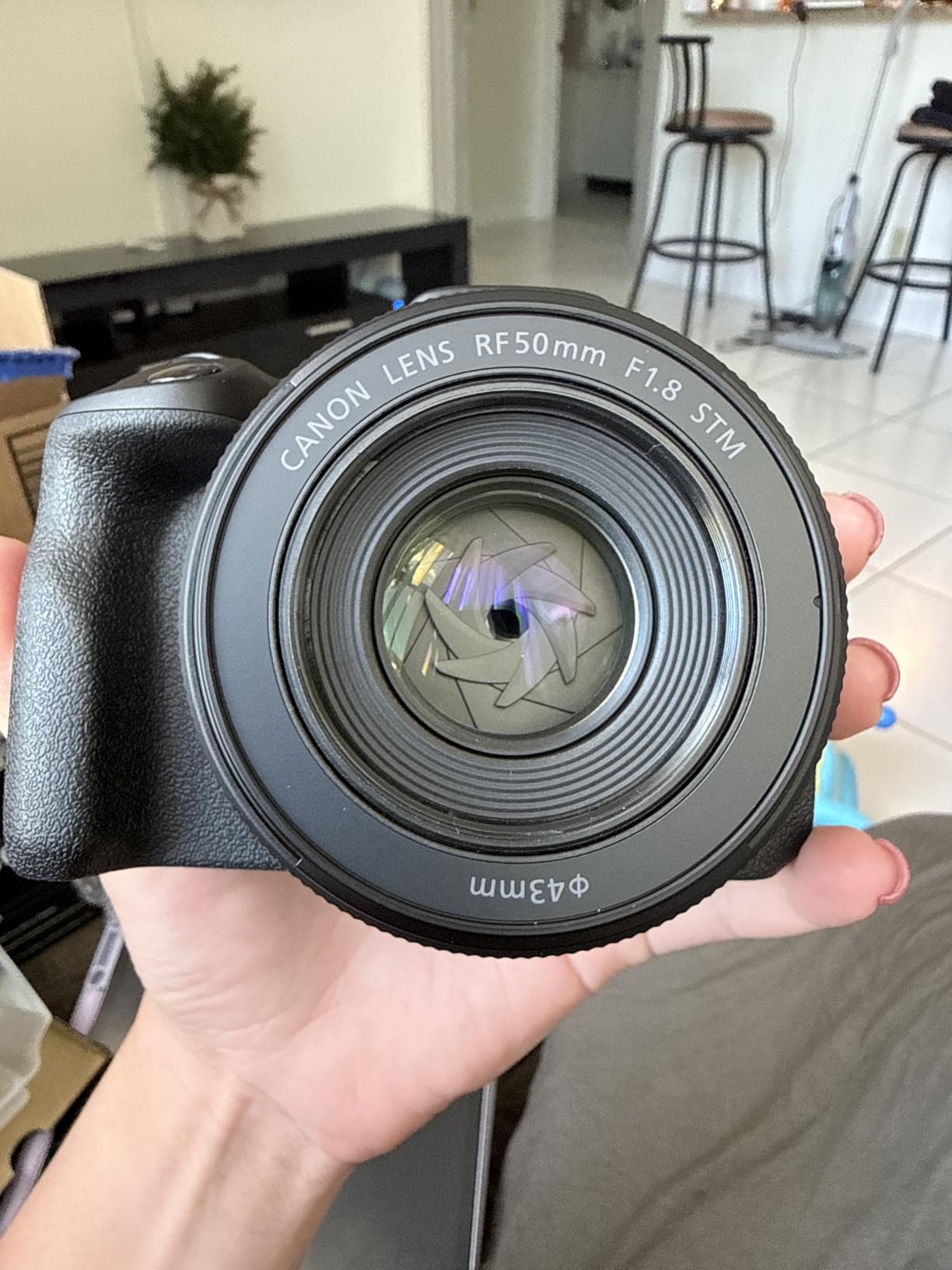
If you bought an R50, an R10 or an RP in the last couple of years, this is your version of the nifty fifty, and the argument for it is identical. It is a 50mm f/1.8 prime at the same 5.6 ounce weight, so it does the same job as the EF version without an adapter in the way.
The RF version adds a few things you notice after a week of use. There is a control ring around the barrel, so you can step through shutter speeds or aperture values with a finger instead of hunting through a dial. Canon tuned the coatings to suppress ghosting and flare, which matters when you point a bright lens into a window. The gear-type stepping motor is tuned for smooth, quiet continuous focusing during video.
Where it falls short mirrors the EF lens. Open the aperture all the way and you will find corner softness, some coma, and visible colour fringing on high-contrast edges. There is no optical stabilization, so on bodies without in-body stabilization you are relying on shutter speed alone for handheld stills and on your video stabilization mode for clips.
Buyers also note the 43 mm filter thread, which is both a pro and a con. Filters for it are cheap and easy to find, but the thread is narrower than the 49 mm or 58 mm sizes used by most other Canon glass, so you will eventually buy another filter set. Build is mostly plastic and it carries no weather sealing, which matters only if you shoot in rain.
How does the 50mm behave on an APS-C mirrorless body?
On the R50 and R10, which use the smaller sensor, 50mm frames like roughly 80mm on full frame. That is a short portrait lens and a tight street lens. In a small room you will find yourself backing into a corner to fit people in, which is the main reason people also buy a wider lens alongside this one.
Because the RF 50mm covers full frame and APS-C, it is the safer purchase if you might upgrade bodies later. A lens bought for APS-C often cannot be carried forward; this one can.
Who should skip this lens?
Skip it if you mostly shoot group photos, architecture or interiors, because a 50mm is too narrow on APS-C for those. Skip it if handheld video is a priority, since there is no stabilization in the lens and the R50 and R10 bodies you would pair it with have no in-body stabilization either.
Also consider the RF 24-105mm f/4 L IS USM instead if you want one lens to do everything and can stretch your budget. But at this price level the RF 50mm is the sensible starting point, and it is the lens our readers pick most often on their first mirrorless body.
3. Canon EF-S 18-55mm f/3.5-5.6 IS II – Cheapest Way Into a Canon DSLR System
Canon EF-S 18-55mm f/3.5-5.6 is II SLR Lens White Box
18-55mm f/3.5-5.6 zoom
EF-S APS-C mount
200 g
Optical IS
Pros
- Classic lightweight zoom covering wide to short telephoto
- Optical stabilization helps with camera shake
- UD glass and aspheric elements give solid centre sharpness
- Only 200 g so it is easy to carry
Cons
- Slow variable f/3.5-5.6 aperture in low light
- Slower and noisier autofocus than newer STM lenses
- Sharpness falls off toward the corners
- Plastic mount with little weather protection
- White-box listings usually carry no warranty
This is the kit-lens answer, and it is a defensible one for a lot of beginners. On an APS-C DSLR the 18-55mm covers everything from a group photo to a head-and-shoulders, with optical image stabilization to help you hold the camera steady. It weighs 200 g, so it never becomes the reason you leave the camera at home.
The optics are more serious than the specification sheet suggests. Sixteen elements in twelve groups with UD glass and aspherical elements means you are not paying for a novelty lens. Sharpness in the centre is good for the class, and many owners find it perfectly acceptable for family photographs, holiday snaps and daytime street work.
The catch is the aperture. It runs f/3.5 at 18mm and narrows to f/5.6 at 55mm, so as you zoom toward the telephoto end you lose more than a stop of light. That is the single reason beginners photograph dim rooms badly and assume their camera is broken. The second catch is the autofocus motor, which is older and noticeably slower and noisier than the STM units in newer lenses.
One practical note about this particular listing: it is a white-box presentation, meaning the lens is supplied unused but without the retail packaging. Several buyers mention the warranty situation, so check what coverage you are actually getting. Optics performance is unaffected, but the paperwork is not the same as a boxed retail unit.
Is the kit zoom actually limiting what you can photograph?
Not as much as its reputation suggests. For anything happening at arm’s length or further, in daylight, this lens frames it. You are constrained by light, not by focal length: indoors in the evening you will want either a faster lens or a body with higher ISO performance.
Several beginners told us the kit lens was fine for their first months of shooting, and that upgrading later felt like getting a whole new camera. That is the normal experience. The zoom teaches framing, and framing is the skill that transfers to every lens you own afterwards.
Who should skip this lens?
Skip it if your photography is portraits, indoor events or concerts, because the narrow aperture will not give you the background blur or the shutter speeds those situations need. Skip it if you shoot video, because the older focus motor is audible on recordings.
Also skip it on a full-frame DSLR. The EF-S mount physically will not fit full-frame Canon bodies, so if you own a 6D, 5D or 1D series camera this lens is not an option at all. On a mirrorless body it works through an EF-EOS R adapter with an APS-C crop mode.
4. Canon RF 35mm f/1.8 IS Macro STM – One Prime for Street, Travel and Close-ups
Canon RF35mm F1.8 is Macro STM Lens
35mm f/1.8 prime
RF mount
10.88 oz
0.5x macro
Min focus 0.17 m
Pros
- Genuine half-frame macro at the same time as a normal prime
- Up to 5 stops of optical stabilization
- Sharp and contrasty even wide open at f/1.8
- Close focus to 0.17 m adds real flexibility
- Compact and light for an everyday carry
Cons
- Some copies show focus hunting and unit-to-unit variation
- Not fast enough for sports or moving subjects
- Visible purple fringing wide open
- Control ring sits close to the focus ring
- Macro work means getting very close to the subject
A fast prime is usually a specialist tool: good for portraits, awkward for anything else. The RF 35mm breaks that pattern because it also focuses to within 0.17 m at 0.5x magnification, so it doubles as a half-frame macro lens. Food, coins, flowers, product shots and close portraits all come out of the same lens.
On a full frame body, 35mm is a useful in-between focal length. It is wide enough for street scenes and interiors, normal enough for travel and everyday documentation, and fast enough at f/1.8 to work in low light. It is not a traditional portrait lens the way 85mm is, so head-and-shoulders portraits get more environmental context than you might want.

The optical stabilization is worth calling out, because most entry-level primes do not have it. Canon rates it at up to 5 stops of shake correction, which matters most on the EOS R bodies that lack in-body stabilization, including the R50 and R10. Owners also report that sharpness holds up well even at f/1.8, which is unusual at this focal length.
What you get in the reviews is a small but real consistency problem. Some units hunt for focus or repeatability differs from copy to copy, which is exactly the kind of defect that cannot be fixed in software. If you buy this lens, check focus accuracy straight away and make sure your return window is open.
Is a half-frame macro magnification enough for real close-ups?
For food, small products, textures and flowers, yes. At 0.5x you can fill the frame with something about the size of a coin, and the minimum focus distance of 0.17 m makes that practical. It is not a true macro lens, so for tiny insects or stacked coin detail you would still want dedicated macro glass with 1:1 magnification.
There is a working rule for macro shots: use a tripod, turn off stabilization, and raise your ISO instead of widening the aperture. Stabilization is designed for handheld movement, and it fights you when the camera is locked down.
Who should skip this lens?
Skip it if you photograph action. Owners are clear that autofocus does not keep up with fast-moving subjects, and it is a lens for still scenes, slow subjects and deliberate framing. Skip it if you need sealed construction for wet weather or dusty locations.
Skip it too if you only ever shoot wide open portraits, because 35mm is a contextual framing rather than a flattering one. If portraits are the goal, the 50mm f/1.8 options in this list separate the subject from the background more cleanly for less money.
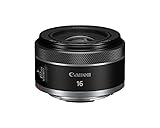
5. Canon RF 16mm f/2.8 STM – Compact Ultra-Wide for Video and Interiors
Canon RF16mm F2.8 STM Lens
16mm f/2.8 ultra-wide prime
RF mount
163 g
Min focus 5.11 in
108 degree view
Pros
- Remarkably light at 163 g for an ultra-wide
- f/2.8 keeps ISO usable in low light
- Good centre sharpness and colour for the class
- Close focus to 5.11 in adds flexibility
Cons
- Strong barrel distortion and vignetting out of camera
- Corners softer than the centre
- Slow autofocus in low light with some focus breathing
- No weather sealing and no hood included
- Unusual 43 mm filter thread
The RF 16mm f/2.8 is a 108 degree ultra-wide that weighs 163 g, and those two numbers together are why it earns its place in a beginner kit. On a full frame body it is wide enough to shoot a small room, a group of people in a tight space, or a landscape without walking backwards.
It is also one of the few Canon primes that genuinely works as a vlogging lens. The gear-type stepping motor is quiet and continuous, the barrel is short enough to stay out of frame on a gimbal or a small tripod, and the f/2.8 aperture keeps your ISO from climbing when you move indoors.

The trade-offs are the usual ultra-wide trade-offs. Straight out of the camera you will see barrel distortion at the frame edges, some vignetting, and the corners will be visibly softer than the centre. That is normal and it is correctable in editing, which is why several owners use this lens as a partial replacement for a kit zoom rather than as its only lens.
The 5.11 inch minimum focusing distance gives you more flexibility up close than most ultra-wides, and magnification reaches 0.26x. Autofocus can be slow in dim conditions and there is some focus breathing during video pulls, so avoid racking focus on this lens in a single take. One reviewer also reported a communication error on a first unit, which is rare but worth knowing.

Can one ultra-wide prime replace a kit zoom?
Partly. It covers the wide end of a kit zoom very well and, at f/2.8, works in situations where the kit zoom cannot. What it does not give you is reach: once a subject fills the frame, there is no way to tighten without moving closer.
A practical answer is to treat the 16mm as the lens you always have mounted, and add something longer later. Many beginners who bought it end up with a fast 50mm next, which gives them wide, normal and short telephoto framing without buying a zoom.
Who should skip this lens?
Skip it if you need a sealed lens for outdoor work in rain, snow or dust. It carries no weather sealing and no hood is included, which means you need to be careful with the exposed front element in bad conditions.
Skip it if you want straight, distortion-free architecture, because a 16mm on full frame bends straight lines at the edges unless you shoot stopped down and correct in software. And skip it if you have an APS-C mirrorless body, where it becomes very wide very fast.
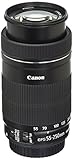
6. Canon EF-S 55-250mm f/4-5.6 IS STM – Long Reach on an APS-C DSLR
Canon EF-S 55-250mm F4-5.6 is STM Telephoto Lens, Black
55-250mm f/4-5.6 zoom
EF-S APS-C mount
375 g
IS about 3.5 stops
Pros
- Sharp for the class thanks to a UD element
- Reach equivalent to about 400mm on full frame
- Stabilization makes handheld long-lens shots practical
- Quiet STM focusing suits video
- Close focus to 0.85 m for pseudo-macro
Cons
- Variable aperture loses light as you zoom
- STM focusing too slow for indoor sports
- All-plastic body with no weather sealing
- Barrel can creep over time
- No hood included
This is the budget telephoto for APS-C Canon DSLRs, and the reason is the crop factor. A 250mm on a Canon APS-C body frames like about 400mm on full frame, which is close-in wildlife and sports territory from a lens that is nowhere near heavy or expensive.
Canon rates the stabilization at roughly 3.5 stops, and reviewers confirm that it makes handheld long-lens shots practical for a beginner. Without stabilization you would need a shutter speed in the region of 1/500 s or faster to freeze both the subject and your own shake, and that pushes your ISO up and your image quality down.
The glass includes a single UD element to reduce colour fringing across the zoom range, and it focuses as close as 0.85 m throughout. That close focus gives usable pseudo-macro results at the telephoto end, with 0.29x maximum magnification. At 375 g it packs noticeably smaller than telephotos of similar reach in other mounts.
The weaknesses are consistent across reviews. The aperture narrows from f/4 to f/5.6 as you zoom, STM focusing is too slow for indoor sports, and the all-plastic barrel with a plastic mount carries no weather sealing. Several owners also note barrel creep developing over years of use, which is common in this class of lightweight telephoto.

How much reach does 250mm actually give on an APS-C body?
Roughly 400mm full-frame equivalent, which is enough to fill the frame with a distant bird, a grandchild at the far end of a field, or a performer on a stage. It is not a sports prime, and it will not hold a sharp image on a bird taking off at full speed, but for stationary wildlife and general distance work it does the job.
One useful habit: shoot at the long end, then crop in. Because the lens is sharp across the range, cropping a 250mm frame can look better than shooting at 150mm, and it costs you nothing but resolution you may not have needed.
Who should skip this lens?
Skip it if you own a full-frame DSLR, because the EF-S mount physically will not attach to a full-frame Canon body. Skip it if your subject moves fast, since the STM motor will not keep pace and there is no way to compensate except by shooting in good light.
Skip it if you also want the 18mm wide end, because this zoom starts at 55mm. On an APS-C body you would need a separate wide lens to cover a room, which is why it works best as a second or third lens rather than a first one.
7. Canon EF 75-300mm f/4-5.6 III – Full-Frame Telephoto Without the L-Series Price
Canon EF 75-300mm f/4-5.6 III Telephoto Zoom Lens for Canon SLR Cameras
75-300mm f/4-5.6 zoom
EF mount
16.8 oz
4x range
Min focus 4.9 ft
Pros
- Long 4x range covers wildlife sports and distant subjects
- Fits every Canon EF-mount DSLR body
- Smoother zoom mechanism than earlier versions
- Light at 16.8 oz compared with L-series telephotos
Cons
- No image stabilization so shutter speeds must stay high
- Variable f/4-5.6 aperture loses light as you zoom
- Slow autofocus with the front element extending while focusing
- Soft from roughly 200mm to 300mm
- Audible motor on video and no weather sealing
The EF 75-300mm f/4-5.6 III is the entry point into Canon full-frame telephoto glass, and it sits in a very specific niche: you have an EF-mount DSLR, you need reach, and you do not want the cost of an L-series lens. At 16.8 ounces it is also the lightest telephoto in this list by a wide margin.
The four-times zoom range covers everything from a head-and-shoulders portrait at 75mm out to distant subjects at 300mm. Canon revised the zoom mechanism in this generation so it feels smoother and more controlled than the earlier versions, which matters when you are framing a moving subject one-handed.

There is no image stabilization, and that is the single fact that shapes how you use it. At 300mm you will need a fast shutter speed, and at the narrow end of the aperture you will need light. In practice that means this lens works well outdoors in daylight and struggles in shade, indoors or at evening events.
Autofocus is slow, and the front element both extends and rotates while focusing, so it is not a lens for video. Sharpness also drops noticeably from around 200mm to 300mm, which reviewers describe as soft rather than unusable. If you mostly shoot birds and sports, expect to use the middle of the range more than the end.

Should you choose this over an L-series telephoto?
For a beginner, almost always. Stabilization, faster autofocus and better sharpness at the long end all cost more money, and none of that matters until you already know what you want to photograph. Most people who later move up report that the 75-300mm taught them where the limits of their technique are.
The counterargument is that a tripod largely does the job of stabilization, and you can buy one for a fraction of the price of a stabilized telephoto. If you already own a tripod, the 75-300mm becomes a much easier lens to use.
Who should skip this lens?
Skip it if your camera is mirrorless and you have no adapter, because this is EF glass and needs an EF-EOS R adapter on an EOS R body. Skip it if you shoot video or indoor action, because the autofocus motor is audible and slow.
Skip it if you need fine detail on distant subjects, such as distant wildlife or far-off sports, because sharpness falls away near 300mm. And skip it if your kit is an APS-C crop body and you will use the lens on a full-frame body later: on APS-C, 300mm already frames like 480mm.
8. Canon RF 24-105mm f/4L IS USM – Premium One-Lens Workhorse
Canon RF24-105mm f/4L is USM Lens
24-105mm constant f/4 zoom
RF mount
1.5 lb
Nano USM
IS up to 5 stops
Pros
- Range covers most shooting situations without swapping
- Constant f/4 keeps exposure steady across the zoom
- Sharp at every focal length and aperture
- Nano USM autofocus is fast and accurate
- Stabilization rated up to 5 stops
Cons
- Corners slightly soft wide open at f/4
- Can struggle in low-contrast scenes like sky over water
- Rubberized build feels below the L-series badge
- Costs far more than entry-level RF glass
This is the most expensive lens in the roundup, and the case for it is simplicity. A 24-105mm covers wide interior shots, normal street framing and short telephoto portraits, and the aperture stays at f/4 the whole way. Nothing about this lens is the cheapest option; it is the option that means you stop thinking about lenses.
Constant aperture is the technical detail beginners should care about most here. A variable f/3.5-5.6 zoom changes brightness as you zoom, which means you are constantly adjusting exposure. A constant f/4 does not, so you can frame freely and keep your settings.
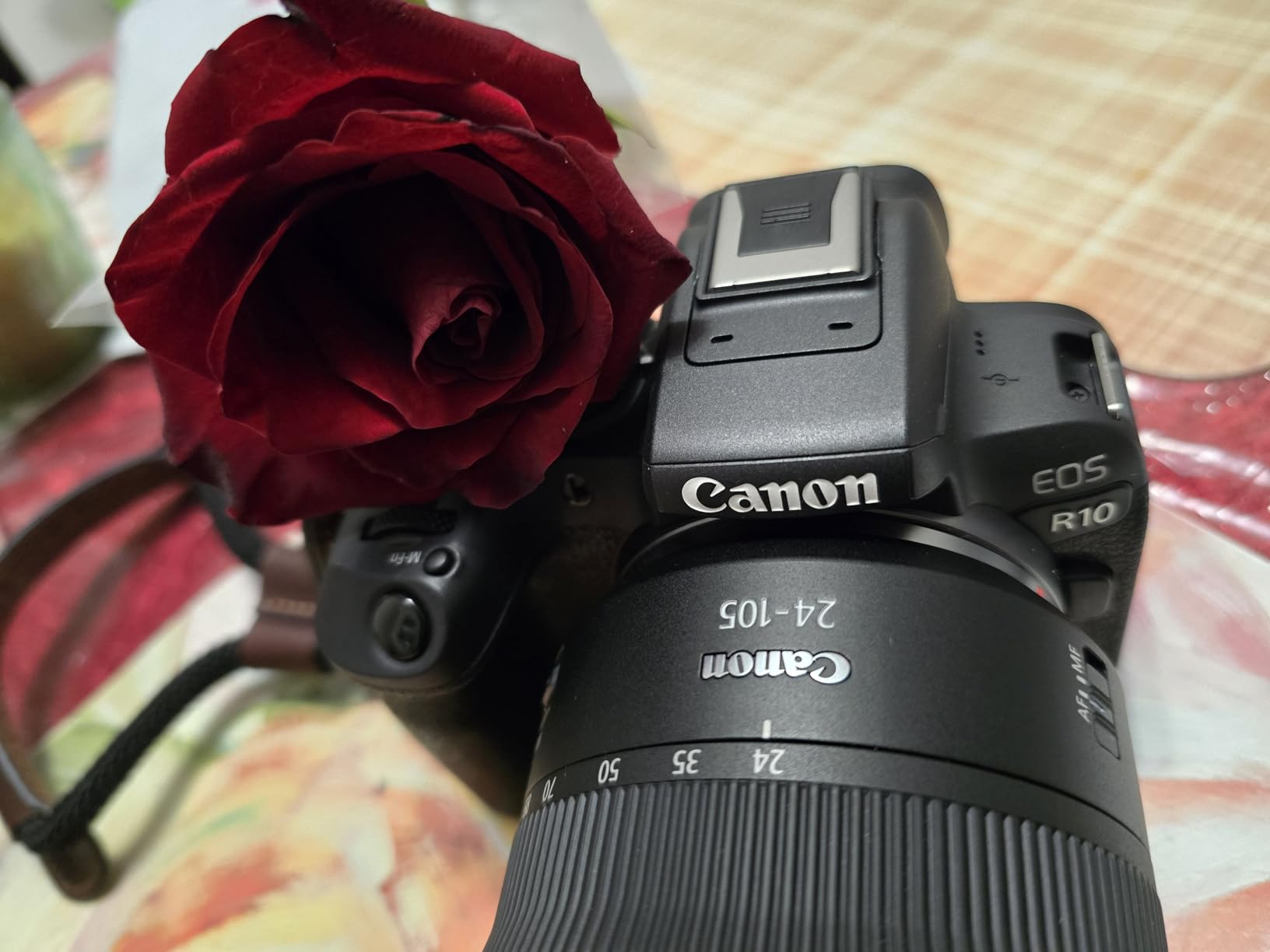
This is also the first L-series lens to use Nano USM focusing, and owners including working photojournalists report fast, dependable autofocus. Optical stabilization is rated at up to 5 stops, which pairs well with the R50 and R10 where there is no in-body stabilization to fall back on. It comes with a lens hood, caps and a protective case, so nothing else is needed to use it outdoors.
The criticisms are consistent. Corners are slightly soft at f/4, the rubberized construction feels a step below what the L-series badge suggests, and autofocus can occasionally fail in unusually low-contrast scenes such as an overcast sky against water. It is also priced a long way above entry-level RF glass.

Is one lens genuinely better than two cheaper lenses?
For image quality, yes: this lens stays sharp across the whole range, where a kit zoom does not. For flexibility, a fast 50mm plus a wide prime gives you better low-light capability and shallower depth of field in a different focal length.
The practical question is how much the gap matters at your stage. If you are still learning which subjects you enjoy, two cheaper lenses teach you more for less. If you already know you need one lens for travel or events, the 24-105mm is hard to argue with.
Who should skip this lens?
Skip it if money is tight. Every other lens here delivers good results for far less, and a beginner will not see the difference this lens makes. Skip it if you need f/1.8 or f/2.8 for indoor portraits, because f/4 is the limit of this lens.
Skip it if you own an APS-C RF body and want a wide view, because 24mm on an APS-C sensor frames about like 38mm on full frame. On those bodies the RF-S lenses and the RF 16mm cover the wide end better.
9. Canon RF-S 18-45mm f/4.5-6.3 IS STM – Tiny Kit Zoom for APS-C RF Bodies
Canon RF-S18-45mm F4.5-6.3 Lens
18-45mm f/4.5-6.3 zoom
RF-S APS-C mount
Compact
IS up to 4 stops
Pros
- Small and light so the camera actually gets carried
- Stabilization improves further on IBIS-equipped bodies
- Everyday range for family travel and casual video
- Reliable autofocus with bodies like the EOS R10
- Two aspheric elements keep results clean
Cons
- Slow f/4.5-6.3 aperture in low light
- Range stops at 45mm so tight portraits are difficult
- Average autofocus and an audible zoom ring on video
- Crops automatically on full-frame RF bodies
- Renewed condition carries some risk
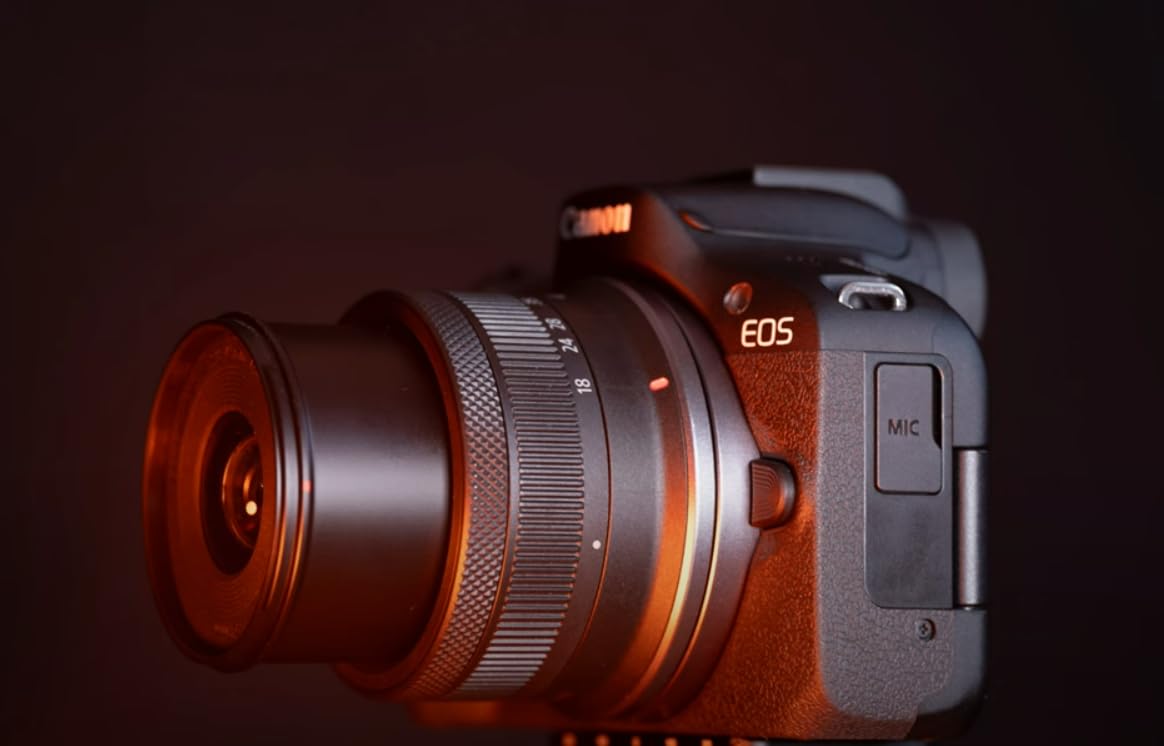
The RF-S 18-45mm is the small, inexpensive companion zoom for APS-C RF bodies like the R50 and R10, and its job is simple: be small enough that you carry it, and good enough that you stop thinking about it. Two aspheric elements and Super Spectra coating keep image quality respectable for a lens at this level.
The stabilization is rated at up to 4 stops on its own, and up to 6 stops when you mount it on a body with in-body image stabilization. That is a meaningful number for a beginner who does not yet understand how much camera shake costs them in dim light.
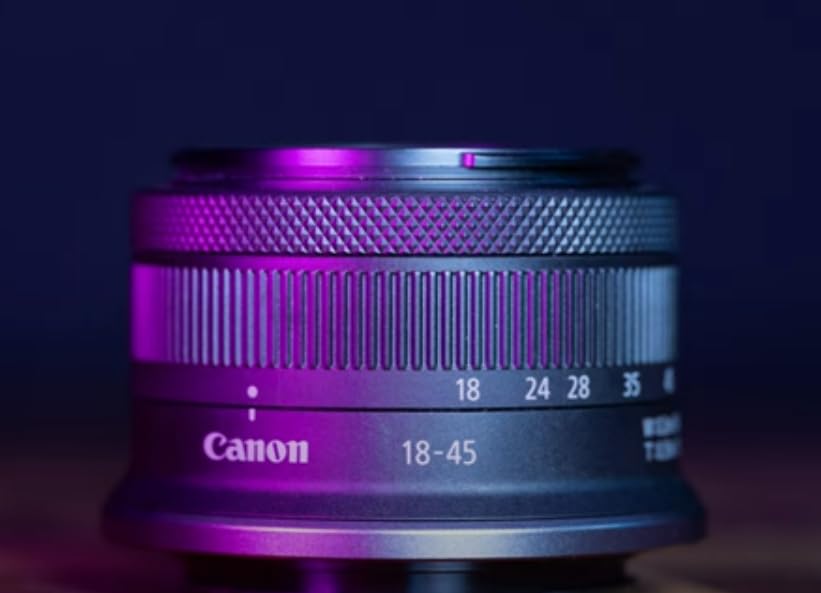
The limits are straightforward. f/4.5-6.3 is slow, so evening and indoor shooting will need high ISO or a flash. The range stops at 45mm, which is a short portrait length on APS-C, roughly equivalent to 72mm on full frame. Autofocus is average rather than fast, and the zoom ring is audible in video recordings.
One more detail worth knowing: because this is an RF-S lens, mounting it on a full-frame EOS R body automatically applies an APS-C crop. That is a graceful way to use the lens now and still have it later, but be aware you are not using the full sensor. This particular listing is renewed, and a few buyers have reported defective examples, so check the lens on arrival.
Should you buy this instead of the kit lens that came with the camera?
Usually no. Most R50 and R10 kits already include an 18-45mm, so buying this lens adds little. The case for buying one is if you already own a body without a lens, or if you want a second body you can put in a small bag without thinking about it.
Where it earns its place is as a lightweight travel kit: pair it with the RF 50mm f/1.8 STM and you cover wide, normal and short portrait framing on a small APS-C body while carrying very little.
Who should skip this lens?
Skip it if you already have an 18-45mm from your camera kit. Skip it if you shoot indoors or at events, because f/4.5-6.3 will force you into high ISO or a flash.
Skip it if you want serious low-light capability or shallow depth of field, and skip it if you need reliability above all else, since this is a renewed listing and a few copies have arrived faulty. If you want a fast prime on the same body, the RF 50mm is the better single purchase.
10. Lightdow EF 85mm f/1.8 Manual Focus – Budget Portrait Prime
EF 85mm f1.8 Portrait Lens – MF for Canon EOS Rebel T8i/T7i/T7/T6i/T5/T3i/T3/T2i/XSi/XS/SL3/SL2/T100/90D/80D/70D/50D/5D Mark IV/6D II/7D II/1D X III II-Manual Focus DSLR Cameras Lenses(EF/EF-S Mount)
85mm f/1.8 manual focus
EF and EF-S mount
6 rounded blades
Bundle with hood and bag
Pros
- Very low cost for an 85mm f/1.8 portrait focal length
- Manual focusing teaches you settings and framing deliberately
- Smooth large focus ring with internal focusing design
- Rounded aperture blades give pleasing background blur
- Broad compatibility with Canon EF and EF-S DSLRs
Cons
- Fully manual focus with no autofocus and no electronic contacts
- Camera must be set to manual mode or show a no-lens error
- Build and optics trail Canon EF 85mm f/1.8L
- Lowest rated lens in this group at 4.1 stars
- Will not mount on Canon mirrorless without an EF adapter
This is the odd one out in the list, and it earns its place for one reason: it gives you an 85mm f/1.8 portrait focal length for very little money on a Canon EF or EF-S DSLR. That focal length on a wide aperture is the classic head-and-shoulders portrait setup, and it is genuinely useful if portraits are what you want to shoot.
It is also fully manual. There are no electronic contacts, so autofocus does not work at all and you focus by hand. Several buyers describe that as a positive, because a manual lens forces you to think about focus and aperture instead of letting the camera decide. Others describe it as the reason they returned it.

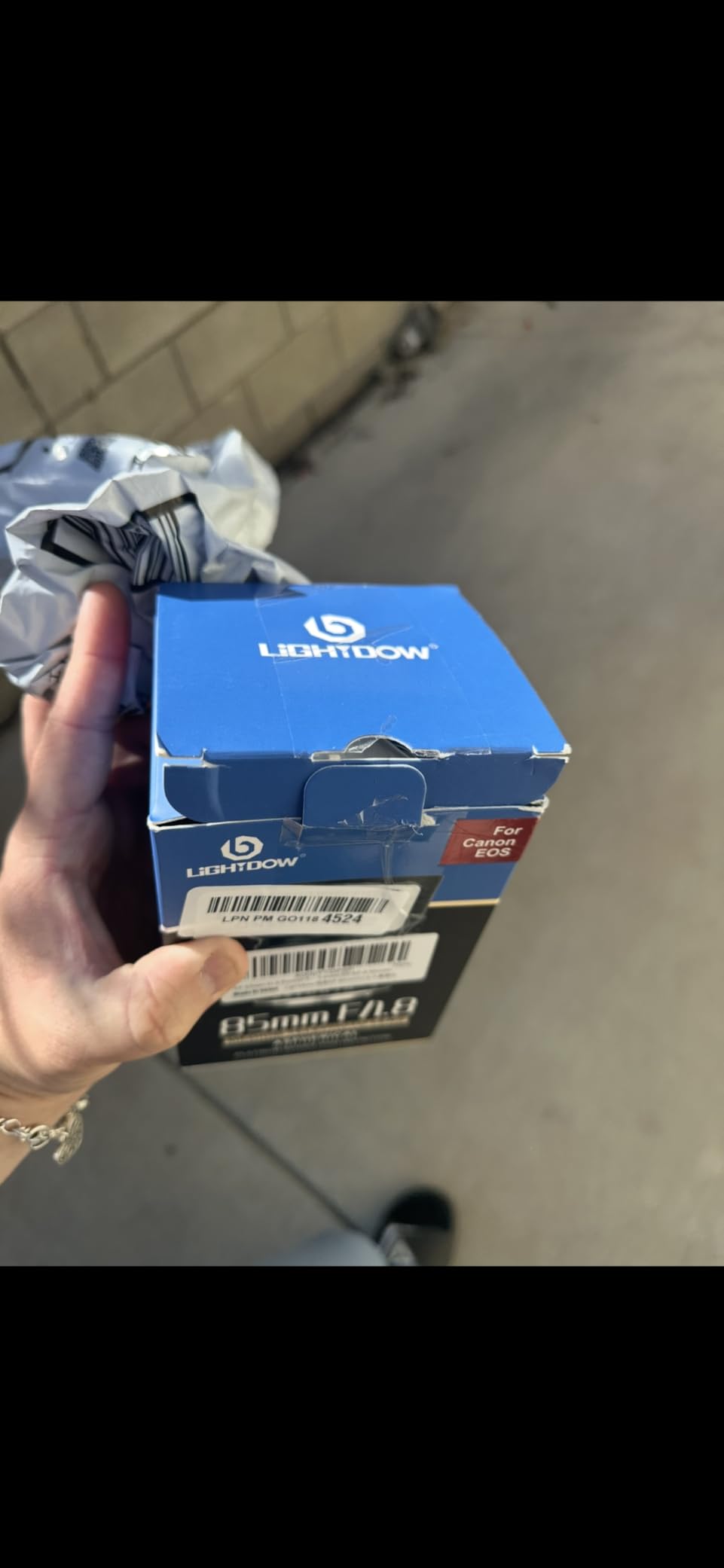
Optically it uses six elements in six groups with a hybrid aspherical element and ultra multi-coating, plus six rounded aperture blades that give the background blur a rounded character. The focus ring is large and smooth, and focusing is internal so the barrel does not rotate while you focus. The bundle includes a hood, a bag, caps and a cloth.
The important operational detail: because there are no electronic contacts, you must set the camera to manual mode after mounting. Otherwise you may see a no-lens error. The optics and build are a tier below Canon’s own EF 85mm f/1.8, and this is the lowest-rated lens in our group at 4.1 stars with a noticeable share of one-star reviews.
Is learning manual focus a good idea for a complete beginner?
It is a genuinely good way to learn exposure and framing, because nothing happens automatically. It is also frustrating in situations where the subject moves or the light changes fast, which is most of what new photographers want to shoot first.
A middle path: use the manual lens for deliberate portrait sessions in good light, and use an autofocus lens for everything else. Many photographers who learned this way say the manual focus practice made them faster with autofocus later.
Who should skip this lens?
Skip it if you photograph anything that moves, if you shoot video, or if you expect the camera to focus for you. Skip it if you own a mirrorless body, because without an EF adapter it simply will not attach.
Skip it if image quality at the edges of the frame matters to you, because the hybrid aspherical element does not match what a first-party L-series portrait lens delivers. If you can stretch to it, Canon EF lenses are the better long-term purchase on an EF mount.
How to Choose a Canon Lens: A Beginner’s Buying Guide
Everything above is a specific lens. This section is about the decision, so you can pick correctly even if none of these ten turns out to be right for you. Four questions settle most cases: what mount is your camera, do you need a prime or a zoom, how much light do you need, and how much are you willing to carry.
EF, EF-S, RF or RF-S: start with the mount your camera uses
Canon has four relevant lens mounts and they are not interchangeable. EF lenses fit Canon DSLRs and full-frame EOS R mirrorless bodies through an adapter. EF-S lenses are APS-C-only designs for Canon DSLRs; they fit EOS R bodies through an adapter with an APS-C crop mode, and they do not fit full-frame DSLRs at all. RF lenses are Canon mirrorless glass and fit EOS R bodies natively. RF-S lenses are the APS-C versions for R50 and R10 bodies, and they apply an automatic crop on full-frame R bodies.
So: EF or EF-S for a DSLR, RF or RF-S for a mirrorless body. If you own EF DSLR glass and are considering a mirrorless body later, the EF-EOS R adapter lets you carry those lenses forward, and Canon owners in community forums generally describe that as a perfectly valid beginner path rather than a mistake.
Prime or zoom: which one should you buy first?
A prime has one focal length, which forces you to move and teaches you framing. It is usually faster, usually smaller and usually cheaper than the equivalent zoom, which is why the 50mm f/1.8 options lead this list. A zoom covers a range, which means fewer lens changes and less missed moments, and that is why kit zooms remain the practical first choice for many beginners.
Our rule of thumb: buy the zoom if you do not yet know what you like to photograph, and buy the prime if you already know you want portraits, low light or shallow depth of field. Plenty of photographers own both eventually, and the order they buy them in matters less than the order in which they use them.
What aperture numbers mean and why f/1.8 matters
The f-number is a ratio, not a measurement, and what it controls is how much light reaches the sensor and how much of the scene stays sharp. A smaller number means a wider opening: f/1.8 lets in far more light than f/5.6, and it makes the background blur. A larger number means a narrower opening: more of the scene is sharp, less light comes in.
That is the whole argument for a fast prime as a first lens. When your only lens is a zoom that runs f/3.5-5.6, you lose light as you zoom, so dim rooms force you into slow shutter speeds and blurry photos. Beginners often assume the camera is faulty. It is not; the aperture is doing exactly what it is designed to do.
STM vs USM autofocus motors
STM means stepping motor, USM means ultrasonic motor. Stepping motors are quiet, smooth and inexpensive, which makes them good for video, and they tend to be less snappy with fast subjects. Ultrasonic motors, including the newer Nano USM, focus faster and track moving subjects better, and they usually cost more.
For stills in good light, either is fine. For video or for children and pets, STM is usually the better trade at the beginner price level. For sports and birds, faster focusing matters more, and that is one of several reasons telephoto lenses are often the last purchase rather than the first.
Image stabilization: when it helps and when it does not
Stabilization reduces blur caused by your hands moving, marked IS on Canon lenses. It does nothing for a subject that is moving, so it will not save a shot of a running child. On lenses here, ratings run from about 3.5 stops on the EF-S 55-250mm to 5 stops on the RF 35mm and RF 24-105mm.
Stabilization matters most at slow shutter speeds with long or wide lenses, and on cameras without in-body stabilization, which includes several entry-level EOS R bodies. It is useless or actively counterproductive on a locked-down tripod for close-up work. A beginner who buys one stabilized telephoto will get far more usable frames out of it.
Crop factor: what 50mm really frames on an APS-C Canon body
Canon APS-C sensors crop by 1.6x, so focal lengths read longer than they are. A 50mm frames roughly like an 80mm on full frame, a 250mm behaves like about 400mm, and an 18-45mm covers a similar view to about 29-72mm. This is the single most useful calculation a Canon beginner can learn, because it is what makes APS-C glass feel telephoto and cheap.
It is also why an EF-S telephoto reaches further than the number printed on the barrel suggests. The trade is that you cannot use EF-S lenses on full-frame bodies, so you are borrowing reach in exchange for future flexibility.
Do you need a new lens at all if you already own a kit lens?
Probably not yet. Several beginners describe the standard path clearly: learn framing and exposure on the kit lens for a few months, then upgrade when a specific limitation starts costing you photographs. That limitation is nearly always a narrow aperture indoors or a focal length that is too short for what you want to shoot.
If you want more Canon-specific buying context, our picks for Canon RF lenses across every category cover the mirrorless system in more depth, and our Canon versus Sony mirrorless comparison is worth reading if you are still choosing a body rather than a lens.
What to check when buying a used Canon lens
Start with the front and rear elements under a bright light. Fog that looks like a soft haze, or haze that is not evenly distributed, is fungus or separation, and both get worse in storage. Rotate the zoom ring through its whole range and listen for grinding, stiffness or a lens that does not hold its position, since that is barrel creep.
On a zoom, shoot at each end wide open and check the corners for softness that does not resolve when you stop down. On any lens with stabilization, look at whether it rattles or drifts when powered on. On a manual-focus lens, check that the focus throw feels even. Finally, confirm the aperture blades are dry and click into each f-stop, and ask whether the lens came with a recent sensor-cleaning service.
Buying used L-series or kit glass is the usual way beginners get professional focal lengths cheaply, but condition matters more than the badge on the barrel. Our guide to more affordable Canon RF lenses and our Canon RF portrait lens picks cover the specific categories where used buying pays off most.
Frequently Asked Questions
What is the best Canon lens for a beginner?
The Canon EF 50mm f/1.8 STM is the best first Canon lens for DSLR users, and the Canon RF 50mm f/1.8 STM is the equivalent for mirrorless bodies. Both are small f/1.8 primes that gather plenty of light in dim rooms, blur the background for portraits, and cost far less than a zoom.
Are Canon EF or RF lenses better?
Neither is better in image quality; they are built for different cameras. EF lenses are DSLR glass and need an EF-EOS R adapter to fit an EOS R mirrorless body, while RF lenses fit mirrorless bodies natively with faster autofocus and wider apertures. Buy the mount your camera uses, and choose EF glass plus an adapter only if you want to carry lenses forward.
Is f/2.8 or f/4 better?
f/2.8 is brighter and gives more background blur, which matters indoors and for portraits. f/4 is about one stop darker but is often sharper across a zoom range, lighter and cheaper. For a single lens, f/2.8 is the better low-light choice; for a walk-around zoom, a constant f/4 such as the RF 24-105mm is the more practical one.
What three lenses should every photographer have?
A practical starter trio is a wide or standard zoom for everyday framing, a fast prime such as a 50mm f/1.8 for portraits and low light, and a telephoto zoom for distant subjects. On Canon APS-C bodies the crop factor makes a 250mm reach like about 400mm, so the telephoto is often the cheapest lens in the kit.
Do I need a lens if I already have a kit lens?
Not immediately. A kit zoom handles most daylight shooting and teaches framing, which transfers to every lens you buy later. Upgrade when a specific limitation costs you photos, and the usual culprit is the narrow aperture of a kit zoom in dim rooms rather than the zoom range itself.
The Bottom Line: Which Canon Lens Should You Buy First?
For a Canon DSLR, buy the EF 50mm f/1.8 STM. For a Canon mirrorless body, buy the RF 50mm f/1.8 STM. If you want one lens that covers the most situations and you would rather not choose, the EF-S 18-55mm IS II is the low-risk option, and if you already own a kit zoom you may not need to buy anything yet.
From there, the order usually goes: a fast prime first, a wide-angle or standard zoom when you want to cover more, then a telephoto once you know whether you enjoy distant subjects. Save the RF 24-105mm for when a single lens has to do everything, and check the mount before anything else, because that is the mistake that ends a purchase before it starts.
Whichever one you pick in 2026, take it outside. The fastest way to learn is to shoot until the lens stops being interesting.