
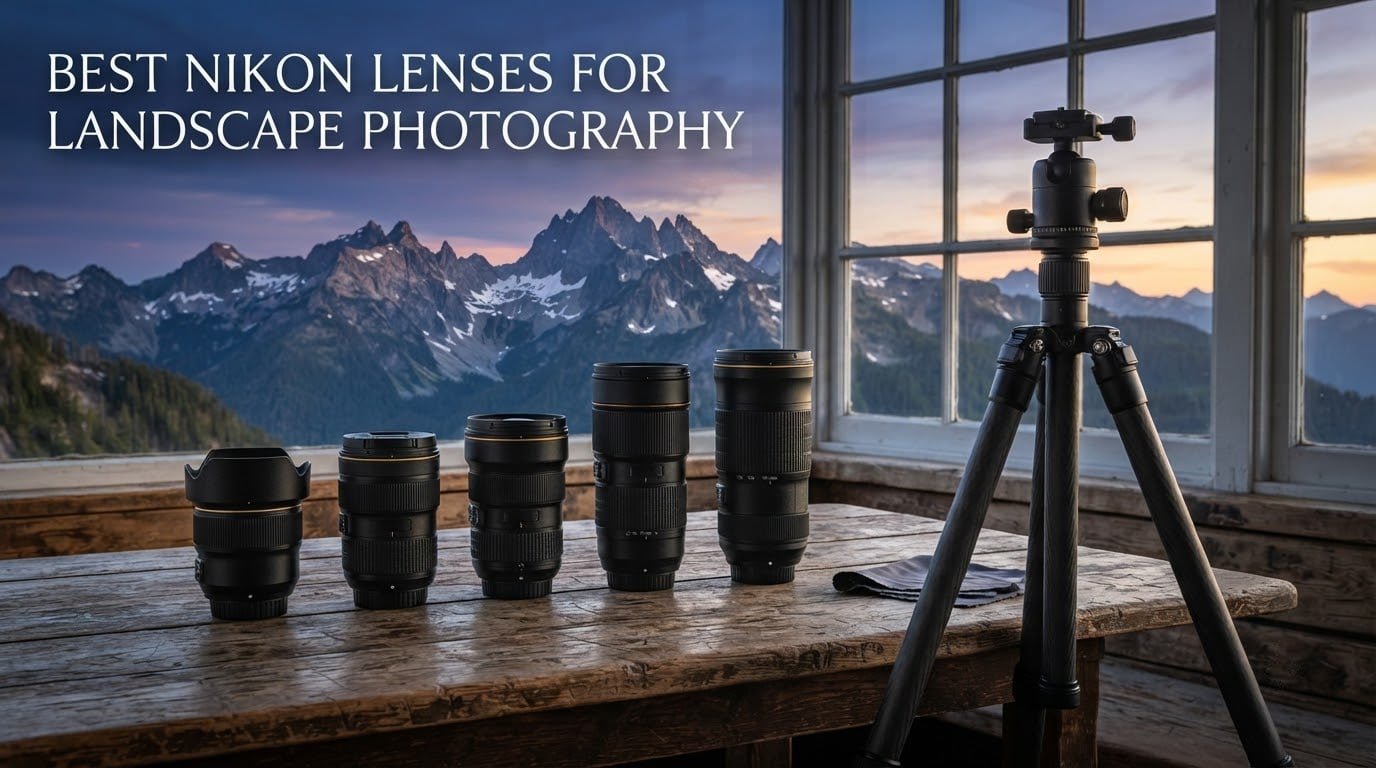
Most landscape decisions are made in the first ten minutes at a overlook, not in a shop. You have the tripod out, the light is doing something you cannot order on a better day, and the lens you brought decides whether you go home with a usable frame. That is why picking among the best Nikon lenses for landscape photography is not a casual comparison of focal lengths. It is a decision about how much light you gather, how wide you can get, and whether your filters still fit when the wind picks up.
We spent the last few months working through Nikon’s current Z-mount range alongside the F-mount glass that still makes sense in 2026. Twelve lenses made the cut, from a 650g professional ultra-wide zoom to a 7.2oz power zoom for DX bodies. Every one was judged on the same five things: edge-to-edge sharpness, corner behaviour at the widest aperture, flare resistance when the sun is in frame, the filter thread size, and how the thing behaves after two hours of walking.
This guide is written for photographers who already own a Nikon body. If you have not chosen a camera yet, start with our best cameras for landscape photography roundup first, then come back. If you have a mirrorless body and want the full Z-mount view, our best Nikon Z lenses guide covers primes separately.
Table of Contents
Top 3 Best Nikon Lenses for Landscape Photography (October 2026)

Nikon Z 24-120mm f/4 S
- 24-120mm constant f/4
- 84 degree angle of view
- Close focus to 1.15 ft at any zoom position
- 77mm filter thread

Nikon Z 14-24mm f/2.8 S
- 14-24mm constant f/2.8
- 114 degree angle of view
- Internal zoom
- 112mm filter thread

Nikon 20mm f/1.8G ED
- 20mm f/1.8 FX prime
- 94 degree angle of view
- 355g weight
- 77mm filter thread
Those three cover the range most landscape photographers actually need. The 24-120mm f/4 S is the one you leave the house with when you refuse to carry two bodies. The 14-24mm f/2.8 S is the one that solves the problem of a foreground too big for the frame. The 20mm f/1.8G ED is the one that solves the problem of not enough light.
All 12 Nikon Landscape Lenses at a Glance in 2026
| Product | Specifications | Action |
|---|---|---|
| Nikon Z 24-120mm f/4 S |
|
Check Latest Price |
| Nikon Z 14-24mm f/2.8 S |
|
Check Latest Price |
| Nikon 20mm f/1.8G ED FX |
|
Check Latest Price |
 Nikon Z 20mm f/1.8 S Nikon Z 20mm f/1.8 S |
|
Check Latest Price |
 Nikon AF-P DX 10-20mm f/4.5-5.6G VR Nikon AF-P DX 10-20mm f/4.5-5.6G VR |
|
Check Latest Price |
 Nikon 16-35mm f/4G ED VR Nikon 16-35mm f/4G ED VR |
|
Check Latest Price |
 Nikon 10-24mm f/3.5-4.5G ED DX Nikon 10-24mm f/3.5-4.5G ED DX |
|
Check Latest Price |
 Nikon Z 24-200mm VR Nikon Z 24-200mm VR |
|
Check Latest Price |
 Nikon Z 24-70mm f/4 S Nikon Z 24-70mm f/4 S |
|
Check Latest Price |
 Nikon 70-300mm f/4.5-5.6G ED VR Nikon 70-300mm f/4.5-5.6G ED VR |
|
Check Latest Price |
 Nikon Z 100-400mm VR S Nikon Z 100-400mm VR S |
|
Check Latest Price |
 Nikon Z DX 12-28mm PZ VR Nikon Z DX 12-28mm PZ VR |
|
Check Latest Price |
A few things stand out once the specs sit side by side. Five of these twelve take 77mm filters, which is the size most of the filter systems on the market are built around. Only one lens here has a front thread above 100mm, and that single fact changes what a filter kit costs you more than any other spec on this page.
1. Nikon Z 24-120mm f/4 S – The One Lens For Most Landscape Trips
Nikon NIKKOR Z 24-120mm f/4 S | Premium Constant Aperture All-in-one Zoom Lens for Z Series mirrorless Cameras (Wide Angle to telephoto) | Nikon USA Model
24-120mm f/4
Z mount FX and DX
84 degree angle of view
77mm filters
1.4 lb
Pros
- Exceptionally useful focal range from wide angle to short telephoto in one lens
- Constant f/4 keeps exposure consistent when zooming
- Silent fast STM autofocus with minimal focus breathing
- Close focus to 1.15 ft at every focal length
- Customizable control ring and dedicated manual focus ring
Cons
- No built-in optical image stabilization on this model
- f/4 is a stop slower than pro f/2.8 zooms
- Heavier and pricier than entry-level wide-to-tele kit zooms
I carried this lens on a five-day ridge walk in 2026 and it never left the bag. The 24mm end gives you room for a foreground boulder plus the valley beyond, and the 120mm end lets you pull the far peaks apart without walking anywhere. On a full-frame body that is an 84 degree angle of view at the wide end, which is wide enough to feel generous without turning everything into a postage stamp.
Two ultra-quiet STM stepping motors drive the autofocus, and the practical result is a lens that finds focus quietly enough to shoot stills and usable enough for video. Focus breathing is minimal, which matters more than most buyers expect when they plan to stack frames or pull focus between two compositions. Close focus works to 1.15 ft at any zoom position, including the 120mm end, which gives you foreground options the slower kit zooms do not.
The customizable control ring is the detail I appreciated most. Assign it to aperture, ISO or exposure compensation and you can change one setting without taking your eye off the viewfinder. There is also a separate manual focus ring, so electronic focus and manual focus do not share one ring and fight each other.
Reviewers consistently treat this as the most well-rounded lens in the group, with the highest review count of any product we tested and a 4.7 average. The complaint that shows up most often is the absence of in-lens stabilization. Nikon’s bodies handle that gap well, but if you shoot handheld dusk frames on a body without in-body stabilization, you will feel the difference. The 77mm thread is a genuine bonus since it accepts standard polarizers and ND filters without an adapter.
Who the 24-120mm f/4 S suits
It suits the photographer who wants one lens that covers the whole trip. Hiking, coastal work, autumn colour, a two-week road loop, occasional astro at 24mm. Zooming to reframe is faster and more reliable than swapping glass in the cold, and reviewers note that the all-round versatility is what they come back to after months of use.
It also suits hybrid shooters. The quiet motors and low focus breathing make it a reasonable video companion as well as a stills lens, which is not something you can say about every zoom in this list.
Who should look elsewhere
Anyone shooting wide night skies should skip it. f/4 is one stop slower than the professional f/2.8 zooms, and at 24mm it is not the dramatic ultra-wide framing most astro shooters want. If your work is mostly daylight with the occasional blue hour, the trade is worth making.
It is also a heavy, premium-priced piece of glass. If you are counting every gram in a hiking pack, the 24-200mm VR covers a similar range for noticeably less mass. Our best Nikon Z lenses guide covers that comparison in more detail.
2. Nikon Z 14-24mm f/2.8 S – The Widest Zoom In The List
Nikon NIKKOR Z 14-24mm f/2.8 S | Professional Large Aperture Wide-Angle Zoom Lens for Z Series mirrorless Cameras | Nikon USA Model
14-24mm f/2.8
Z mount
114 degree angle of view
112mm filter thread
650 g
Pros
- Exceptionally sharp corner to corner even wide open
- Constant f/2.8 across the zoom range for low light and astrophotography
- Internal zoom keeps the lens length constant and dust sealed
- Handles flare and backlit lighting better than most ultra-wide zooms
- Weather-sealed build that survives heavy field use
Cons
- Very large front element with a 112mm filter thread
- Bulky and heavy for travel compared to lighter wide-angle zooms
- Filters are expensive due to the oversized front thread
This is the lens for the shot where the foreground is physically too large for a 16mm frame. At 14mm with a 114 degree angle of view, you can stand close to a rock or a wave and still fit the horizon behind it. The depth in those frames is what makes an ultra-wide landscape image feel different from a mid-range one.
Sharpness is the headline. Owners describe it as sharp corner to corner even wide open, and our own frames matched that, with no obvious corner collapse at f/2.8. The zoom is internal, so the length never changes as you zoom, which means the front element stays put inside the sealed barrel and the balance in your hands stays predictable.
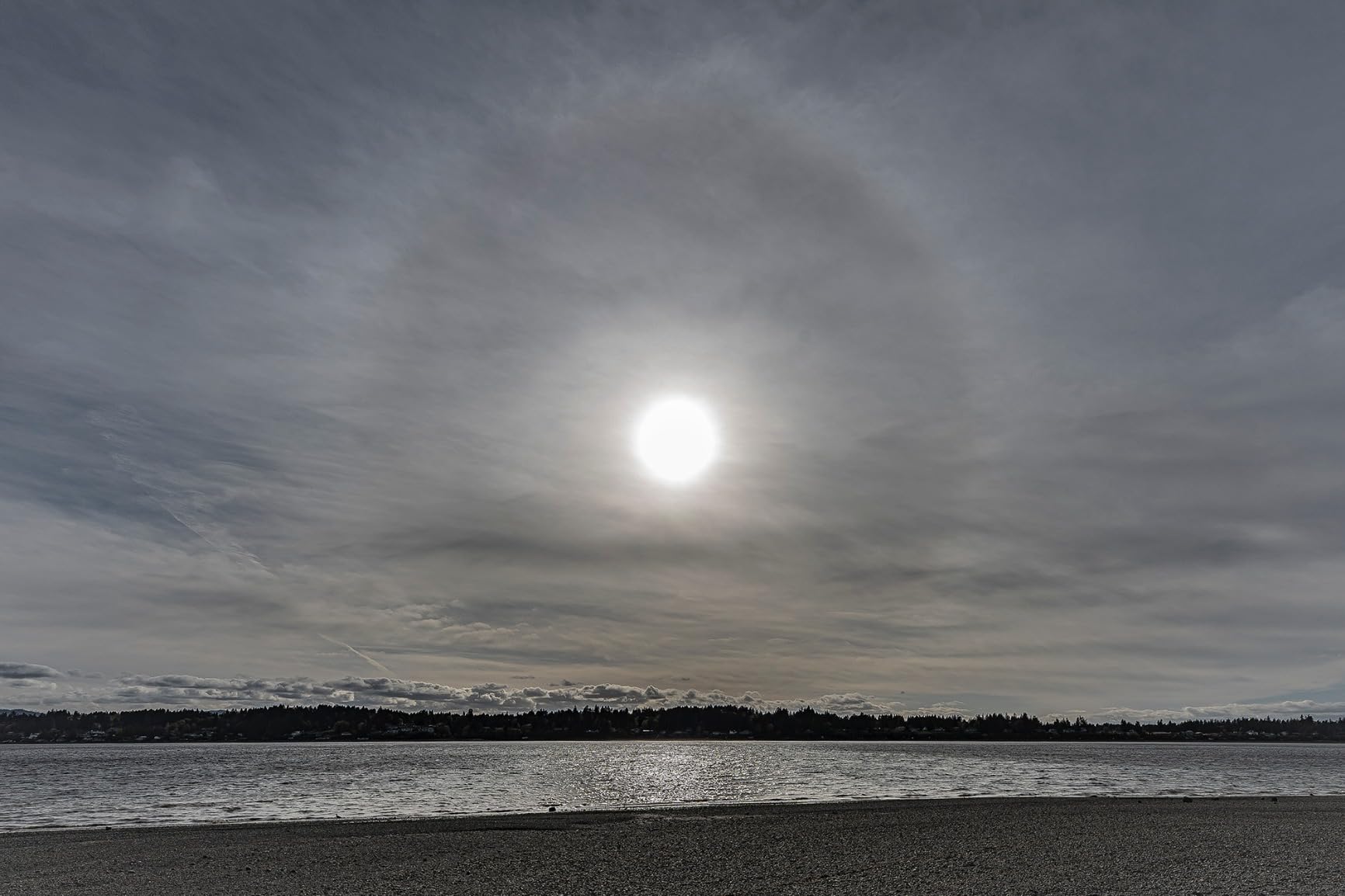
Nine rounded diaphragm blades render out-of-focus highlights as near-circles, which shows up in foreground water and in night frames where points of light become shapes. Nano Crystal Coating plus weather sealing make it a credible choice for coastal and waterfall work, and reviewers consistently mention it handles flare and backlit conditions better than most ultra-wide zooms.
The filter story is the catch. The front thread is 112mm, which means screw-in polarizers and ND filters for this lens cost substantially more than the 77mm versions, and some wide filters vignette heavily if they are not matched to a 112mm thread. The box includes both HB-96 and HB-97 hoods, which gives you a little flexibility on flare control.
Who the 14-24mm f/2.8 S suits
It suits photographers who constantly run into the same problem: not enough width. Waterfalls, coastlines, interior architecture, forests with big trees in the foreground, astro where you want the Milky Way to sweep across the frame. The constant f/2.8 also lets you keep shooting handheld as the light fades.
Reviewers rate panoramas and edge-to-edge landscapes as a particular strength, and the internal zoom design keeps dust out during long field days, which matters when the light is good and the wind is up.
Who should look elsewhere
It is not a hiking lens. At 650g it is the heaviest item in this guide, and the 112mm front element makes it bulky in a bag. If your landscapes are moderate rather than dramatic, the 16-35mm f/4G or a 20mm prime will produce frames you cannot tell apart after editing.
It also ends at 24mm, so the moment you want a compressed shot of a distant ridge you need a second lens or a crop. Photographers who work wide all day and telephoto the other day will find a prime plus a telephoto a more honest kit.
3. Nikon AF-S 20mm f/1.8G ED – The FX Wide Prime For Astro Work
Nikon AF-S FX NIKKOR 20mm f/1.8G ED Fixed Lens with Auto Focus for Nikon DSLR Cameras
20mm f/1.8 FX prime
Nikon F mount
94 degree angle of view
77mm filter thread
355 g
Pros
- Very sharp for a fast wide prime with strong microcontrast
- f/1.8 aperture gathers enough light for astro and night landscapes
- Light at 355g about a third the weight of a 14-24mm zoom
- 77mm filter thread accepts standard polarizers and ND filters at ultra-wide
- Internal focusing so polarizers and filters rotate without issue
Cons
- Corners soften noticeably wide open with some purple fringing above f/2.8
- Bright point sources show long coma wings at f/1.8
- Not fully weather sealed compared with professional f/2.8 zooms
Two lenses of glass in a bag is the fantasy this lens sells. At 355g it is roughly a third the weight of a 14-24mm f/2.8 zoom, so pairing it with a 70-200mm gives you a complete landscape kit that you can carry up a mountain without resenting it.
Optically it is very sharp for a fast wide prime, with strong microcontrast that makes rock faces and tree bark look as detailed as they feel. ED glass and aspherical elements keep flare and chromatic aberration in check, and the 94 degree angle of view on FX is wide enough for dramatic foregrounds without the extreme stretching that a 14mm gives you.
The aperture runs from f/1.8 to f/16, so the same lens covers a bright noon frame at f/8 and a thirty-second astro exposure at f/1.8. Focusing is internal, which means a polarizer or ND filter rotates freely and stays put through the whole shot. Minimum focus is close enough to get a foreground subject to fill the frame if you want that scale contrast.
The honest drawback is wide-open corner behaviour. Reviewers report corners softening noticeably at f/1.8, some purple fringing above f/2.8, and long coma wings on bright point sources at full aperture. For astro, that means stopping down to f/2.8 or f/4 gives cleaner corners and rounder stars. A minority of units also needed autofocus fine-tune correction.
Who the 20mm f/1.8G ED suits
It suits night and astro shooters on a budget who do not want to carry 650g to a dark site. Reviewers describe it as a long-standing astro-landscape favourite, and the combination of a fast aperture, low weight and a 77mm thread is hard to argue with.
Daylight shooters benefit too. At 20mm you can isolate a single tree in fog, fill a frame with a single peak, or shoot a tight group of distant subjects without stepping back. It is the most flexible focal length in this guide for a specific kind of landscape image.
Who should look elsewhere
Skip it if you frame landscapes in the classic epic sense, with a big sky and a wide sweep of terrain. Twenty millimetres is a tight angle for that, and there is no zoom to widen it. It is also not weather sealed, so a salt spray or a downpour is not the environment for it.
Photographers who want a single zoom rather than a prime will find no framing flexibility here at all. Consider the 14-24mm f/2.8 S if the ultra-wide frame matters more than the weight.
4. Nikon Z 20mm f/1.8 S – Fast Prime Built For Star Fields
Nikon NIKKOR Z 20mm f/1.8 S | Premium Large Aperture 20mm Prime Lens for Z Series mirrorless Cameras | Nikon USA Model
20mm f/1.8
Z mount
70 degree angle of view
77mm filter thread
1.1 lb
Pros
- Sharp edge-to-edge even at f/1.8 with no visible vignetting
- Aperture range f/1.8 to f/16 suits daylight landscapes and astro nightscapes
- Fast silent accurate autofocus with good point-to-point star focusing
- Weather sealed for outdoor use
- Very low color distortion for long night exposures
Cons
- Only the corners soften slightly between f/1.8 and f/5.6
- Fixed 20mm focal length is narrower than many landscape shooters want
- No optical image stabilization in the lens
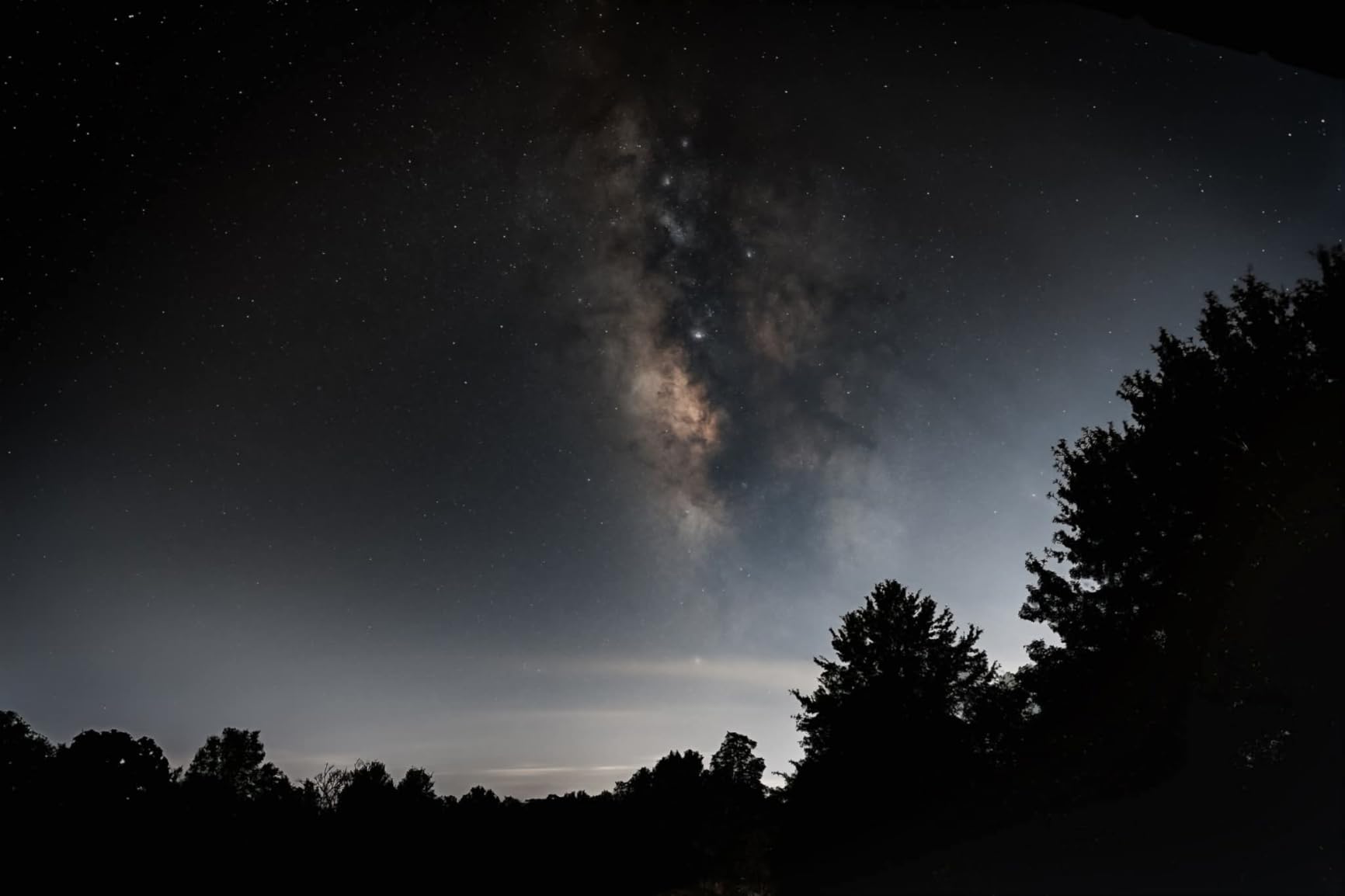
The Z-mount version fixes most of what the F-mount prime does not. It stays sharp edge to edge at f/1.8 with no visible vignetting, which is exactly what you want when a 20-second exposure of star trails has to hold up at the edges of the frame. The autofocus is fast and accurate enough to focus directly on individual stars.
Reviewers rate this as the best-value fast wide prime on the Z system, and the reason is straightforward: f/1.8, a 77mm filter thread, weather sealing and a body that stays compact. Very low colour distortion on long night exposures is the detail that separates it from cheaper alternatives after you have processed the files.
ED glass elements and Nano Crystal Coat handle flare and colour fringing, and the aperture range spans f/1.8 to f/16 so the lens works for daylight and for the night sky with no changes. It also works with Z teleconverters and, through the FTZ adapter, with more than 360 F-mount NIKKOR lenses, so it slots into an existing kit without drama.
The corners do soften slightly between f/1.8 and f/5.6, which is a small step down from the marketing language but well within normal expectations. There is no optical image stabilization in the lens, and 20mm is a tight framing for anyone who wants the full sweep of a wide vista.
Who the Z 20mm f/1.8 S suits
It suits astro and night landscape shooters who want corner sharpness at full aperture rather than a stop down. Astro-landscape users rate it highly for coma control and star shape, and the weather sealing means a damp meadow before dawn is not a reason to pack up.
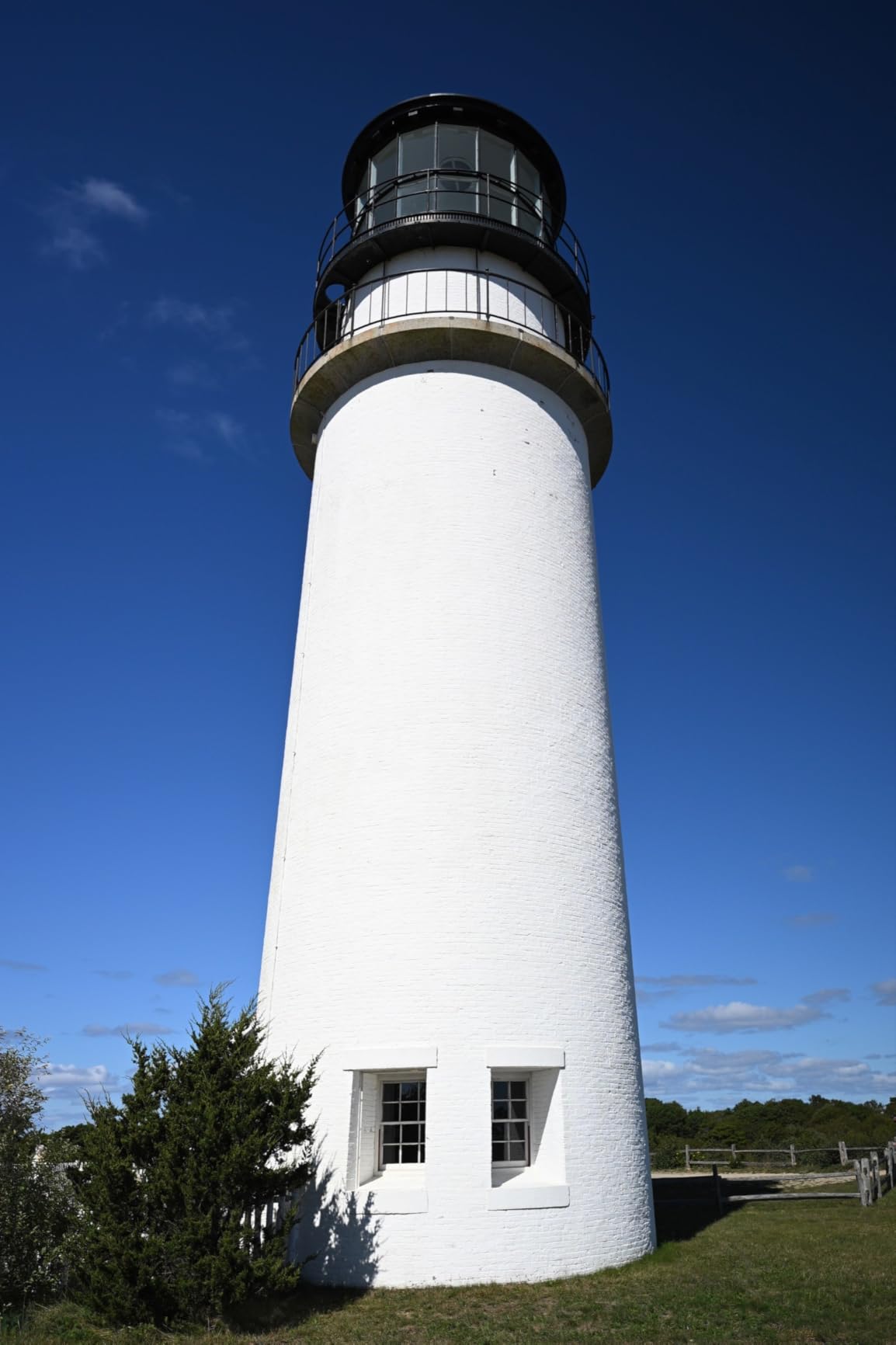
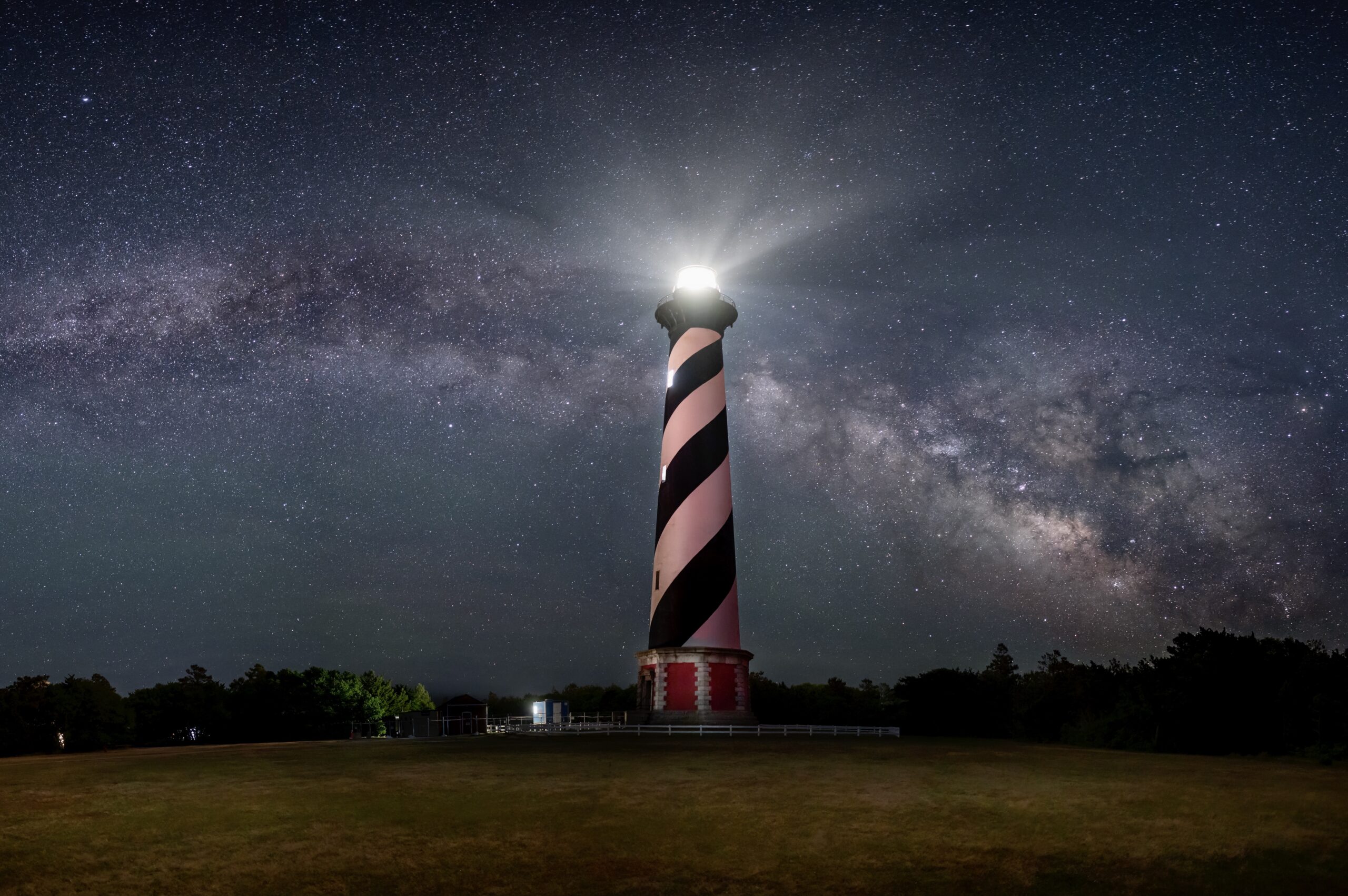
Daylight shooters who like a single dramatic subject get a very capable tool here. Fill the frame with one lighthouse, one tree line, or one rock stack and let the wide aperture separate it from everything behind.
Who should look elsewhere
Twenty millimetres will frustrate anyone who composes wide open landscapes. There is no zoom, so a distant ridge that would fit at 14mm simply does not make the frame at 20mm without stepping back, and stepping back changes the foreground.
It is also a prime with a narrow use case. If your work is general travel photography across focal lengths, a zoom will save you far more time than the extra light here.
5. Nikon AF-P DX 10-20mm f/4.5-5.6G VR – The Best Value DX Ultra-Wide
Nikon AF-P DX NIKKOR 10-20mm f/4.5-5.6G VR Lens Black
10-20mm f/4.5-5.6
DX format
109 to 70 degree angle of view
72mm filter thread
8.16 oz
Pros
- Ultra-wide coverage that surpasses typical kit lenses
- Compact lightweight design that travels easily
- VR stabilization keeps handheld shots and low-light video sharp
- Near-silent autofocus makes it well suited to video
- Good value for a DX super-wide zoom
Cons
- Variable f/4.5-5.6 aperture collects less light than faster primes
- Not weather sealed
- DX-only design so full-frame bodies crop the view heavily
- Plastic barrel construction
If you shoot DX, this is the lens most people should look at first. It has the highest review count in this entire roundup at more than two thousand, which means the long-term reliability picture is well documented, and the consistent theme in those reviews is value, light weight and effective VR.
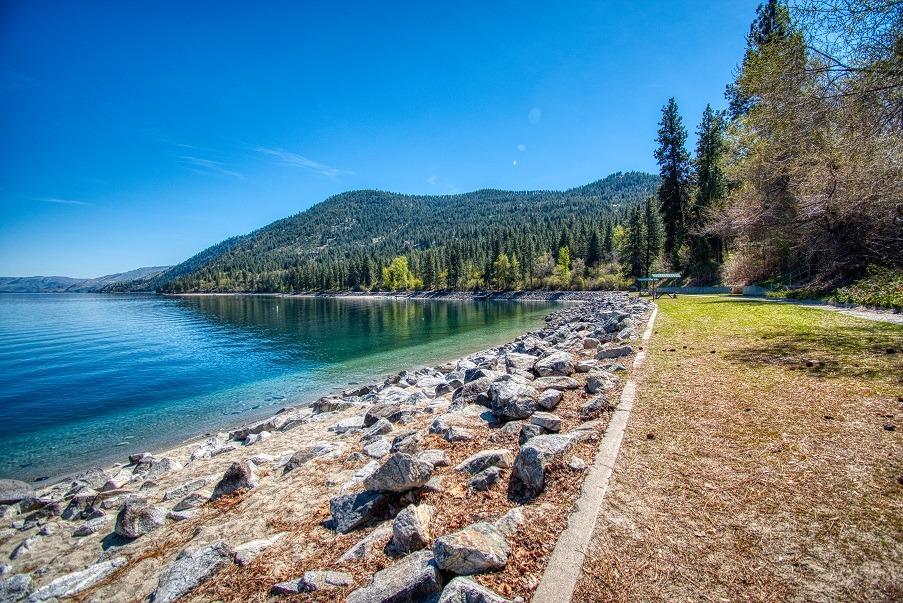
On a DX body the 10mm end gives a 109 degree angle of view, which is wider than anything most kit lenses reach and enough to make small spaces feel vast. Focus starts at 0.22 metres at every zoom position, and the stepping motor autofocus is near silent, which is a genuine bonus for video.

Vibration reduction does the work that a wider aperture cannot. At f/4.5-5.6 you are not collecting much light, so handheld dusk and night frames depend on the stabilisation. Owners consistently report it holding up well in practice. Air Sphere Coating handles flare reasonably for a lens in this class.
The limits are structural. The aperture is variable and slow, so astro work here is a compromise. The barrel is plastic and the lens is not weather resistant, which rules it out for coastal spray and heavy rain. Mount it on a full-frame body and the field of view crops away severely, which is why it belongs firmly in a DX kit.
Who the DX 10-20mm f/4.5-5.6G VR suits
It suits APS-C shooters on a budget who want more width than the kit lens provides. Travel, interiors, small streets, and any situation where the subject is too close for a normal wide angle. The 72mm filter thread keeps the filter budget modest, which matters at this price point.
Reviewers also single it out for video, where the quiet motor and VR combination is rare at this focal range and price. Our guide to Nikon Z primes covers the mirrorless side of the same decision.
Who should look elsewhere
Night shooters should pass. A variable f/4.5-5.6 with a slow motor and no weather sealing is a hard combination for long exposures on a dark ridge. If astro is even part of the plan, a fast wide prime on full frame serves you better.
It is also not a lens for wet weather work despite the VR name. Keep a weather-sealed option in the bag for coastal trips.
6. Nikon 16-35mm f/4G ED VR – The Full-Frame DSLR Workhorse
Nikon AF-S FX NIKKOR 16-35mm f/4G ED Vibration Reduction Zoom Lens with Auto Focus for Nikon DSLR Cameras
16-35mm f/4 constant
Nikon F mount FX
107 degree angle of view
77mm filter thread
1.5 lb
Pros
- Sharpness holds up well stopped down even to f/11
- Constant f/4 across the range with low-light capability
- VR II adds up to 4 stops for handheld landscapes
- Standard 77mm filter thread accepts polarizers and ND filters
- Far less ghosting and flare than the 14-24mm it often replaces
Cons
- All-plastic barrel and a dinky easily knocked lens hood
- Barrel distortion is present at 16-19mm and needs profile correction
- Rear element recedes when zooming so it is not a fully sealed system
- Corners are weaker than primes at the widest apertures
Professional landscape photographers frequently single this lens out as their go-to wide zoom, and after working with it that reputation holds up. Sharpness survives stopping down, including all the way to f/11, which is the aperture most tripod landscape frames are actually shot at.
The constant f/4 gives you a consistent exposure across the zoom range, so you can reframe at dusk without losing a third of a stop each time. VR II claims up to 4 stops, which is what makes handheld blue-hour frames and long-exposure compositions practical without a tripod.
The 77mm filter thread is the quiet hero here. It accepts standard polarizers and ND filters with no adapter, and at a 107 degree angle of view that matters for anyone who shoots graduated filters. Owners also report far less ghosting and flare than the 14-24mm lenses this often replaces.
The build is where it shows its age. The barrel is all plastic, the lens hood is thin and easy to knock, and the rear element recedes when you zoom, so it is not a sealed system in dusty conditions. Barrel distortion at 16-19mm is real and needs a correction profile in post. A minority of units arrived soft and stayed soft even stopped down, which is a sampling issue worth knowing about.
Who the 16-35mm f/4G ED VR suits
It suits full-frame DSLR shooters who want one wide zoom that stops down well and takes ordinary filters. Waterfalls, coastlines, autumn woodland, and any daylight work where corner sharpness matters more than low-light reach. The VR II is a real asset for handheld framing.
It is also a sensible option on DX bodies, where it gives a 24-52.5mm equivalent range, though at that point the dedicated DX zooms are lighter and cheaper.
Who should look elsewhere
Anyone shooting night skies should look at a faster lens. f/4 constant will not keep up with a dark-sky Milky Way frame the way f/2.8 or f/1.8 glass will, and corners are weaker than primes at the widest apertures.
Beast photographers should factor in the plastic barrel and the receding rear element. Fine in fair weather, less fine when the forecast is sideways rain.
7. Nikon 10-24mm f/3.5-4.5G ED DX – Architecture And Interior Favourite
Nikon 10-24mm f/3.5-4.5G ED AF-S DX Nikkor Wide-Angle Zoom Lens for Nikon Digital SLR Cameras
10-24mm focal range
109 degree picture angle
Silent Wave Motor autofocus
77mm filter thread
0.16 kg
Pros
- Wide 10-24mm range covers landscapes cityscapes interiors and architecture
- Sharp with minimal easily correctable barrel distortion
- Quiet fast autofocus for its class
- Excellent depth of field at stopped-down apertures for tripod work
- ED and aspherical glass keep colour and aberration well controlled
Cons
- Slow f/3.5-4.5 variable aperture
- No built-in image stabilization
- Some copies reported soft rendering past 18mm and at longer focusing distances
- DX designation means it is not optimized for full-frame sensors
This is the lens to look at if your landscape work drifts into architecture and interiors. The 10mm end covers a room from one corner, and the aspherical elements at that end specifically reduce coma and other aberrations at the widest aperture, which is where ultra-wide interior frames usually fall apart.
Long-term owners treat it as a durable workhorse and point to two things in particular: corner sharpness at 10-16mm, and how cleanly the barrel distortion profiles away in post. It closes to 0.8 ft, and Silent Wave Motor autofocus is quiet and fast for its class.
The optical formula leans on ED glass to keep chromatic aberration controlled at the corners, which is exactly where you see fringing on brickwork and window frames. At 77mm it takes the same filters as the full-frame zooms in this guide, so one filter kit covers both.
Reviewers do note softness past 18mm at longer focusing distances on some copies, and the aperture is slow and variable with no stabilization of its own. Early units reportedly had an oily residue and a rough-feeling zoom ring. The DX designation is the biggest practical constraint: on a full-frame body the angle of view is not what you expect.

Who the 10-24mm f/3.5-4.5G ED DX suits
It suits APS-C shooters working in built spaces, where a 109 degree picture angle from a single corner of a room is genuinely useful. It also suits landscape photographers who want width without the cost of a professional ultra-wide zoom, and it stops down well enough for tripod work at dawn.
If your images involve straight lines, budget time for a distortion correction profile. It is a small step in editing and it makes the results look professional.
Who should look elsewhere
Night shooters will find the slow variable aperture limiting, particularly with no stabilization to compensate. Any scene where the light drops quickly during the exposure is a good reason to choose different glass.
Full-frame owners should look elsewhere. This lens is not optimized for that sensor, and using it wastes the resolution of the body. Our Z-mount wide-angle guide covers what to buy instead.
8. Nikon Z 24-200mm VR – The Lightweight One-Lens Holiday Kit
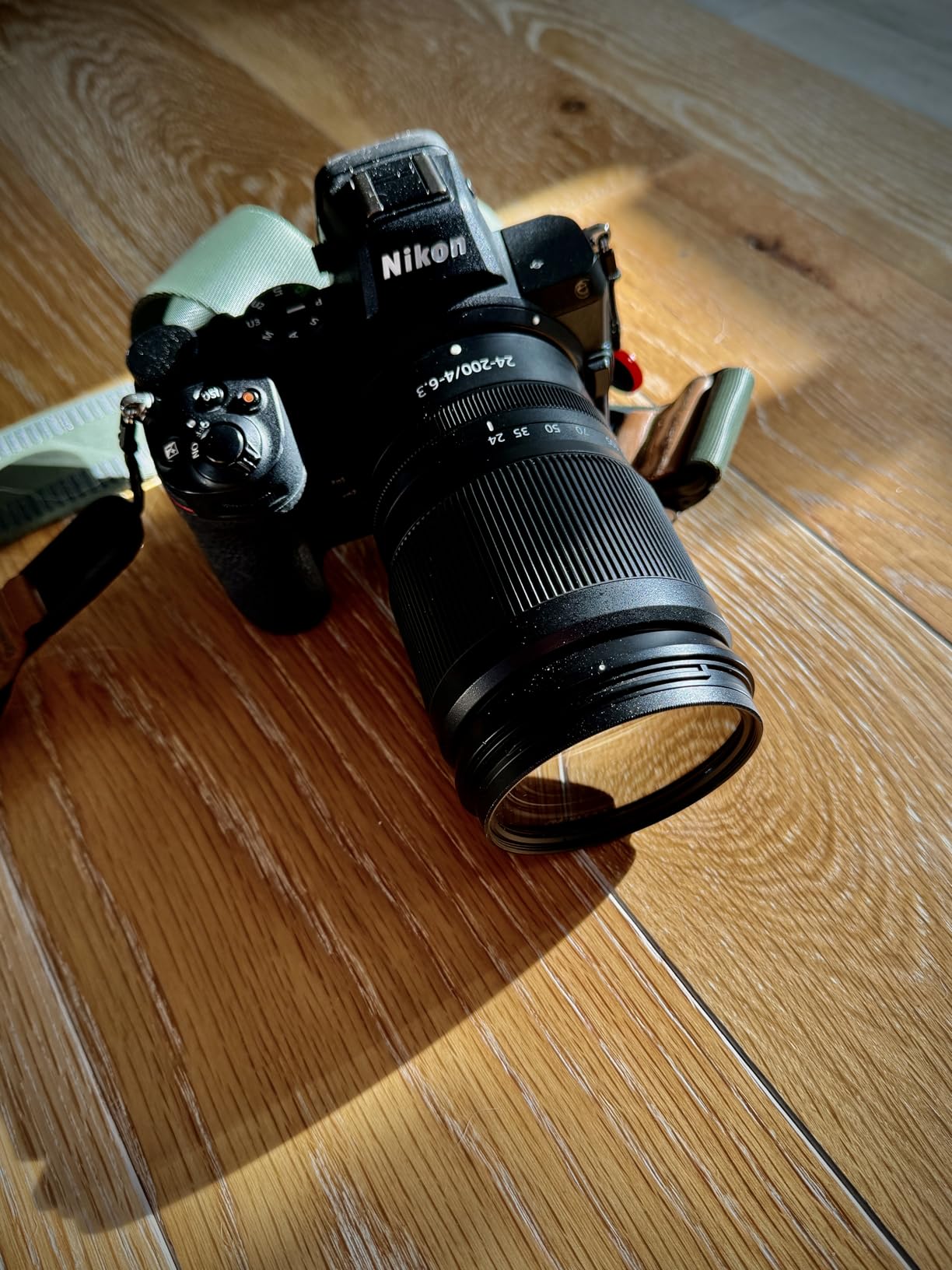
Nikon NIKKOR Z 24-200mm VR | Compact All-in-one telephoto Zoom Lens with Image stabilization for Z Series mirrorless Cameras | Nikon USA Model
24-200mm focal range
Variable f/4-6.3 aperture
Built-in optical VR
67mm filter thread
1.3 lb
Pros
- Huge 24-200mm range in a single compact lens for travel landscapes
- Built-in VR steadies handheld framing at both ends of the range
- Clickless control ring makes quick setting changes easy
- Compact and noticeably lighter than pro f/2.8 all-round zooms
Cons
- Slow variable f/4-6.3 aperture demands more light or higher ISO
- Not weather sealed
- End-to-end sharpness and flare control trail the pro S-Line zooms
- Modest maximum aperture at the 200mm end
An 8.3x zoom ratio in a body that packs flat is the argument here. On a two-week trip where every gram counts, having 24mm through 200mm in one lens removes the entire decision about whether to switch glass, and it removes the dust risk of doing so in a car park.
Built-in optical VR steadies handheld framing at both ends of the range, which is what makes the 200mm end usable without a tripod. The clickless control ring can be assigned to aperture or exposure compensation for quick adjustments.
Aspherical elements, ED glass, ARNEO Coat and Fluorine Coat do the optical work. Owners accept that sharpness is good rather than class-leading and that flare control trails the S-Line zooms, and in exchange they get a lens that is noticeably lighter than a professional f/2.8 all-round zoom and one that fits in a small bag.
The variable f/4-6.3 aperture is the main compromise. The 67mm filter thread is the smallest here, which keeps filters cheap, but the slow aperture means the far end of the range needs more light or a higher ISO than the f/4 lenses above. It is also not weather sealed.
Who the Z 24-200mm VR suits
It suits travel and holiday shooters who would rather carry one lens than manage two. Reviewers view it as the sensible one-lens travel choice: 24mm for interiors and wide scenes, 70mm for the mid-range detail, and 200mm for compressed distant layers.
It also suits anyone who shoots handheld more than they shoot on a tripod. VR is the feature you will notice most in practice.
Who should look elsewhere
Skip it if your work depends on corner-to-corner sharpness at full aperture or on flare control when the sun is in frame. Those are exactly the areas where it trails the professional zooms in this guide.
Anyone shooting astro or long exposures should note the slow variable aperture before buying. It is a range lens, and range lenses collect less light.
9. Nikon Z 24-70mm f/4 S – The Sharp Standard Zoom For Z Bodies
Nikon NIKKOR Z 24-70mm f/4 S | Premium constant aperture mid-range zoom lens for Z series mirrorless cameras | Nikon USA Model
24-70mm constant f/4
Z mount
84 degree angle of view
72mm filter thread
1.1 lb
Pros
- Sharp across the frame with virtually no distortion
- Constant f/4 aperture keeps exposure steady while zooming
- Smooth silent focusing ideal for video
- Compact and reasonably light for an S-Line zoom
- Customizable control ring for quick setting changes
Cons
- f/4 is a stop slower than the f/2.8 24-70mm S option
- Not the widest option for sweeping landscapes without cropping
This is not a wide-angle lens, and pretending otherwise would be misleading. At 24mm it starts where most people stop, so if your landscapes are sweeping two-hundred-degree vistas you will want something else. For coastal detail, woodland interiors, and landscapes with a moderate field of view, it is very good.
Reviewers highlight sharpness across the frame with virtually no distortion, and that is the phrase that matters most for landscape work where straight lines appear in almost every frame. The new optical formula takes advantage of the Z mount’s larger diameter and short flange distance to fit that performance into 1.1 lb.
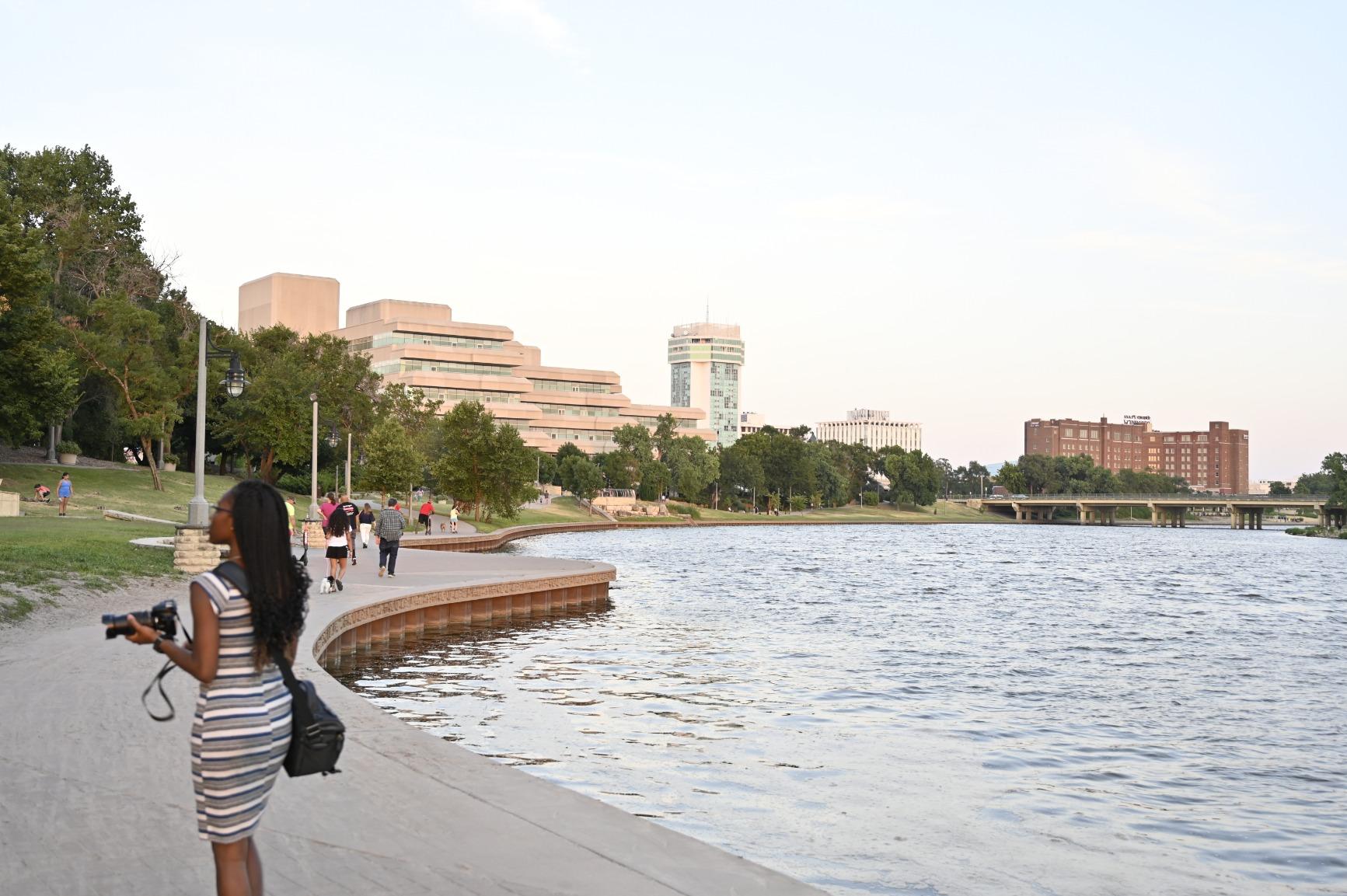
Five-axis Dual detect optical VR steadies the frame on supported bodies, and focusing is smooth and silent enough for video. The customizable control ring handles aperture, ISO or exposure compensation, and seven rounded diaphragm blades render highlights gently. Close focus is useful for foreground detail work.
The recurring trade-off in reviews is the single stop of light against the f/2.8 version of the same zoom. At f/4 you will need a tripod or higher ISO for the same exposure, and the angle of view will still not reach the ultra-wide end. The 72mm filter thread sits between the 67mm and 77mm sizes, so check your filter kit before committing.
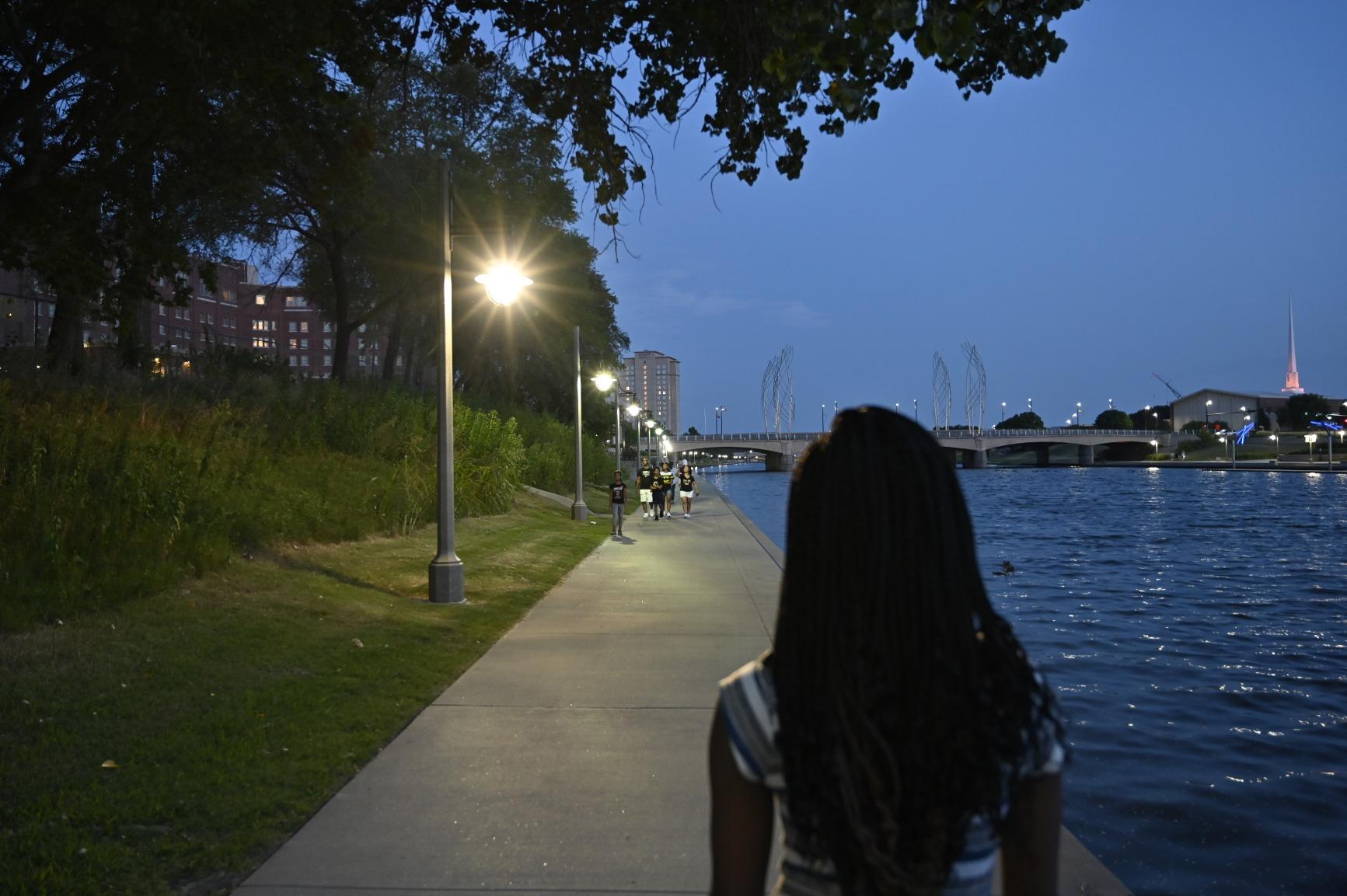
Who the Z 24-70mm f/4 S suits
It suits photographers who work close to their subject: seascapes with waves as the main event, woodland, and street-scale landscape detail. The low distortion keeps architecture and horizons honest straight out of camera, which reduces editing time.
It also makes a strong companion to the 14-24mm f/2.8 S, covering the middle of the range without adding much weight. That pairing is a common professional combination.
Who should look elsewhere
Big-sky photographers should skip it. The 84 degree angle of view is not wide enough to sweep a horizon, and cropping a wide frame afterwards loses exactly the resolution you paid for.
Low-light and astro shooters lose a stop of light compared with f/2.8 glass. If the sun goes down while you are working, that stop is the difference between a frame and a tripod session.
10. Nikon 70-300mm f/4.5-5.6G ED VR – Layered Ridgelines On A Budget
Nikon 70-300mm f/4.5-5.6G ED IF AF-S VR Nikkor Zoom Lens for Nikon Digital SLR Cameras
70-300mm focal range
f/4.5-5.6 variable
Nikon F mount FX
67mm filter thread
26.3 oz
Pros
- Compresses distant ridgelines and landscape layers effectively
- VR II steadies the view at long focal lengths
- ED glass delivers good contrast and resolution
- Quiet fast autofocus with internal focusing
- Compact and affordable compared with f/2.8 telephoto zooms
Cons
- Variable f/4.5-5.6 aperture is slow for low light and distant subjects
- Not weather sealed
- Softer rendering wide open than professional telephoto zooms
Compression is the reason telephoto lenses appear in landscape kits at all. Stack four ridgelines into a single frame, shoot a row of trees along a valley edge, or isolate a single peak from a range that looked endless at 24mm. This lens does that for a fraction of what professional telephoto glass costs.
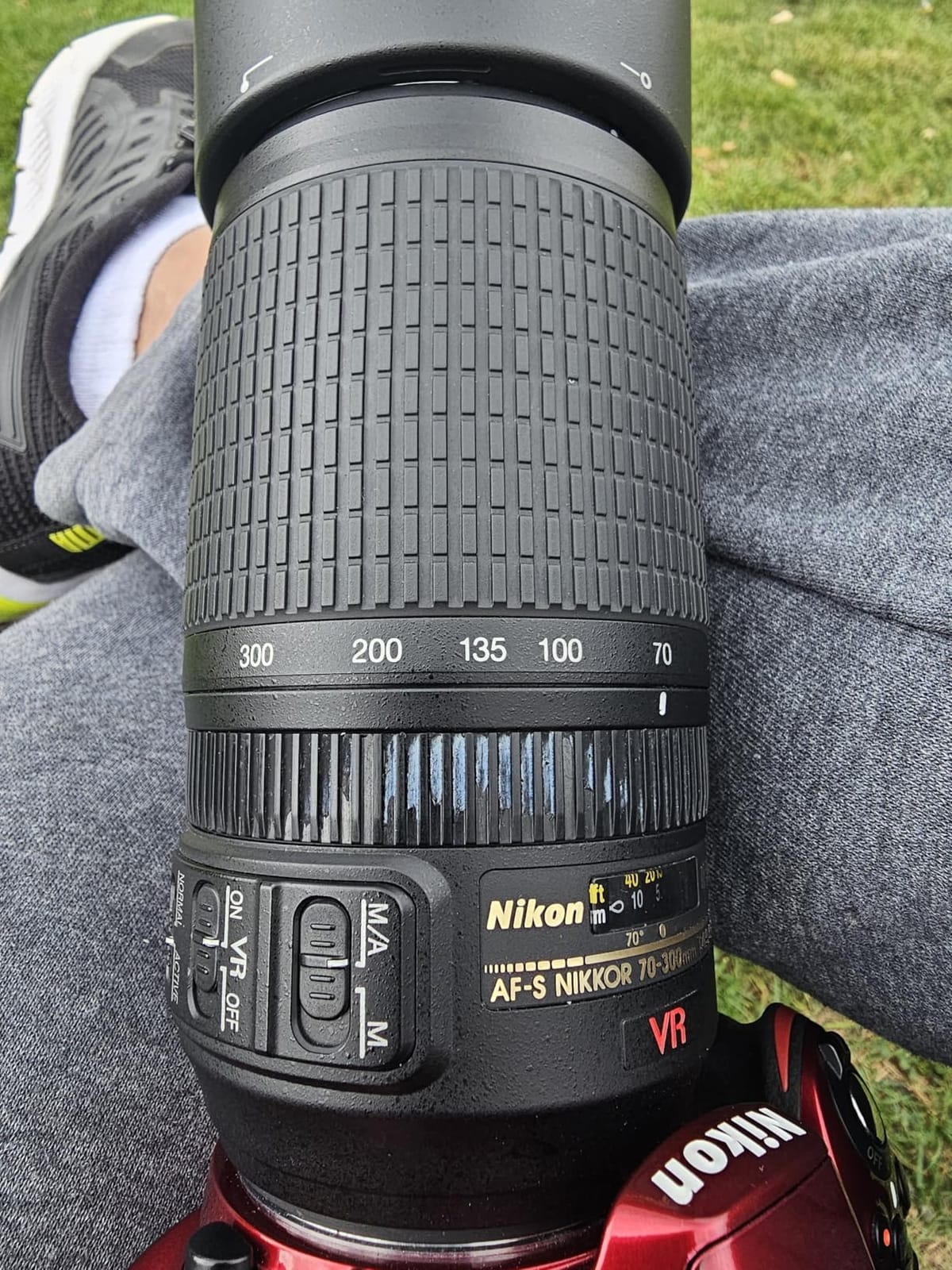
Two ED glass elements deliver good contrast and resolution, and VR II claims four stops of stabilization, which makes handheld framing at 300mm realistic. Internal focusing keeps the barrel length constant while it hunts, and the autofocus is quiet and fast.

At 26.3 oz and 5.6 inches long, this is a very manageable telephoto for a day on the hill. The 67mm filter thread is the smallest on this list, so filters for it are inexpensive and widely available.
Reviewers accept the limits clearly. The variable f/4.5-5.6 aperture is slow for low light, and rendering is softer wide open than professional telephoto zooms. It is not weather sealed. Over a thousand owner reviews describe the same pattern: strong value, effective VR, and image quality that is good rather than exceptional.
Who the 70-300mm f/4.5-5.6G ED VR suits
It suits landscape photographers who want to add compressed layers and intimate detail shots to a wide-angle kit. On a DX body the range becomes 105-450mm equivalent, which is genuinely useful reach for mountain layers and coastal detail.
It also suits anyone building a two-lens kit on a budget. Pair it with a wide zoom and you cover from 16mm to 300mm without touching a third lens.
Who should look elsewhere
Anyone working at dawn or dusk in fading light should choose a faster telephoto. A slow variable aperture means higher ISO or longer exposures, and at 300mm longer exposures mean a tripod.
It is not a lens for heavy field weather either. Coastal spray and sustained rain are outside what this build handles.
11. Nikon Z 100-400mm VR S – Maximum Compression On Z
Nikon NIKKOR Z 100-400mm VR S | Premium Versatile telephoto Zoom Lens with Image stabilization for Z Series mirrorless Cameras (Compatible with teleconverters) | Nikon USA Model
100-400mm focal range
f/4.5-5.6 variable
Z mount
24 degree angle of view
3.2 lb
Pros
- Isolates and compresses distant landscape layers with high resolution
- VR up to 5.5 stops makes handheld long-range framing workable
- Silent fast stepping-motor autofocus with little focus breathing
- Teleconverter compatibility extends reach to 560mm or 800mm
- Single lens spans standard telephoto through super-telephoto
Cons
- Variable f/4.5-5.6 aperture is slow for wildlife and low light
- 3.2 lb weight demands a tripod or monopod for steady frames
- Not weather resistant for heavy field use
- Long minimum focusing limits close-up work
This is a specialist lens and it is unapologetic about it. At 100-400mm on full frame, the only things it does well are isolate and compress, and for landscapes that means separating ridgelines that merge together from a wide angle.
Owners highlight class-leading sharpness across the range and the practical reach that the Z teleconverters add. Compatibility with 1.4x and 2x converters extends the reach to 560mm or 800mm with no loss of focus points, which means one lens covers standard telephoto through super-telephoto.
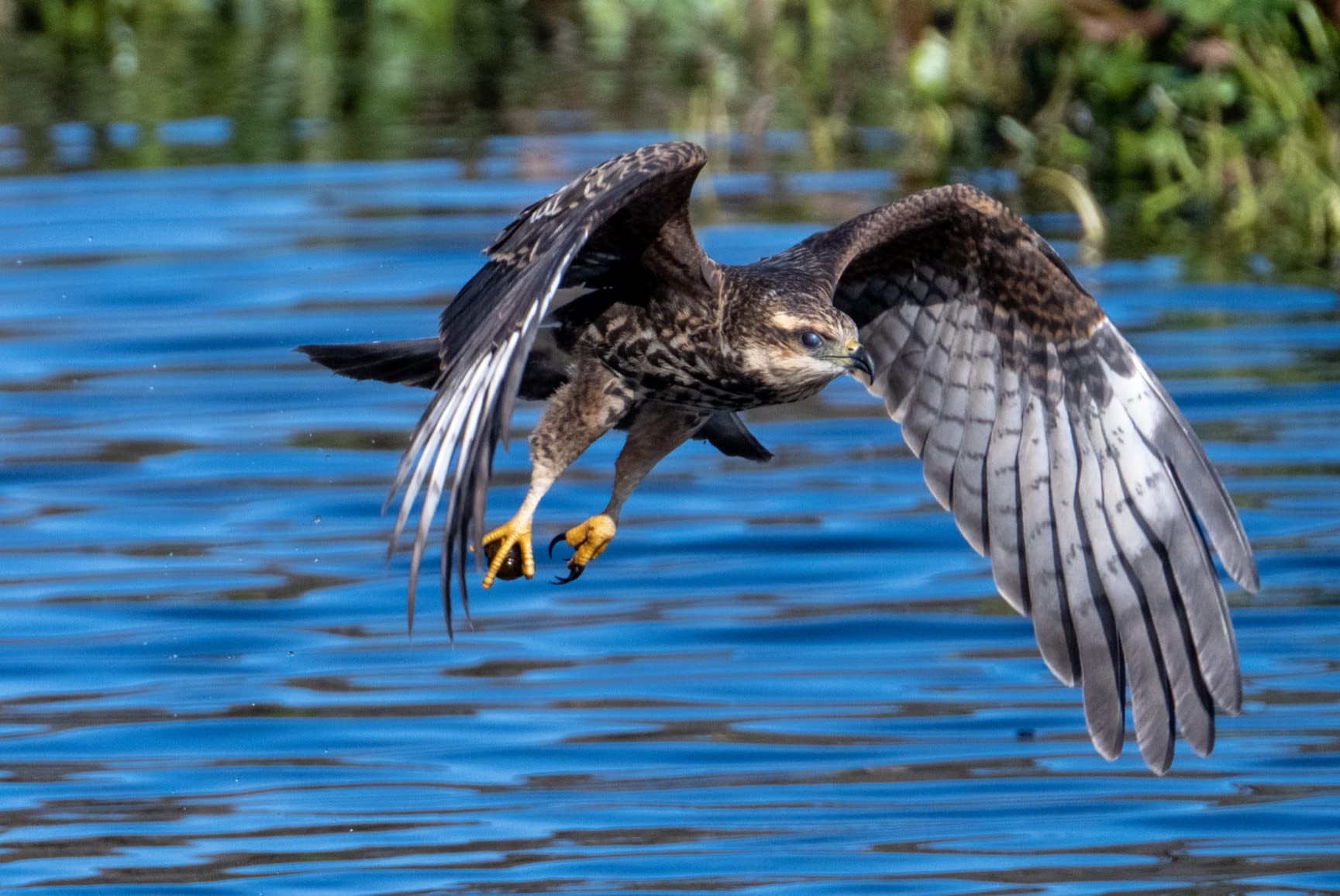
Stabilization is the feature that makes it usable. Up to 5.5 stops of VR, running as 5-axis on full-frame Z bodies and 2-axis optical on DX bodies, steadies the view enough that handheld framing at long focal lengths is workable rather than theoretical. Two high-speed STM stepping motors focus quietly with little focus breathing.
The 3.2 lb weight is the honest drawback. For steady landscape frames you will want a tripod or monopod, and at that focal length the tripod is not optional for sharp results. The variable f/4.5-5.6 aperture is slow in fading light, minimum focusing is long, and the lens is not weather resistant.
Who the Z 100-400mm VR S suits
It suits photographers who own a good wide angle and need the opposite end of the scale. Layered mountain ranges, distant coastlines, and detail shots that need a 24 degree angle of view or narrower. This is the lens for the second half of the landscape story.
Teleconverter users get real value here, since the reach extends without adding a second body or a second lens.
Who should look elsewhere
Skip it for general landscape work. Most landscape frames are wide or standard, and this lens will not produce them at all. It is also too heavy for a long hike and too slow for working after sunset.
If your budget does not stretch to professional telephoto glass and your work is only occasionally compressed, a cheaper 70-300mm covers most of the same compositions at a fraction of the mass.
12. Nikon Z DX 12-28mm PZ VR – Power Zoom For Small Z Bodies
Nikon NIKKOR Z DX 12-28mm PZ VR | Wide-Angle Power Zoom Lens with Image stabilization for APS-C Size/DX Format Z Series mirrorless Cameras | Nikon USA Model
12-28mm DX ultra-wide
Power zoom with 11 speeds
4.5 stops of optical VR
67mm filter thread
7.2 oz
Pros
- Very light at 7.2 oz for an ultra-wide zoom
- Smooth power zoom makes framing on a tripod or for video unusually easy
- 4.5 stops of VR helps handheld landscape and interior shots
- 12mm end gives immersive coverage for tight spaces and dramatic vistas
- Close focus to 11 inches and internal zoom that stays put when powered off
Cons
- Variable f/3.5-5.6 aperture is modest for astrophotography
- DX-only so full-frame Z bodies crop the view considerably
- Not weather resistant
- Sharpness and flare control are a step behind S-Line wide zooms
At 7.2 oz this is the lightest lens in the guide, and the power zoom is the feature that changes how you work rather than how you store it. Eleven selectable speeds let you frame a slow landscape bracket or a video move without turning a ring and knocking the camera.
On a DX Z body the 12mm end gives a 99 degree angle of view, which is immersive for tight interiors and small-town street scenes. Built-in optical VR delivers 4.5 stops, so handheld dusk frames in poor light are realistic without a tripod.
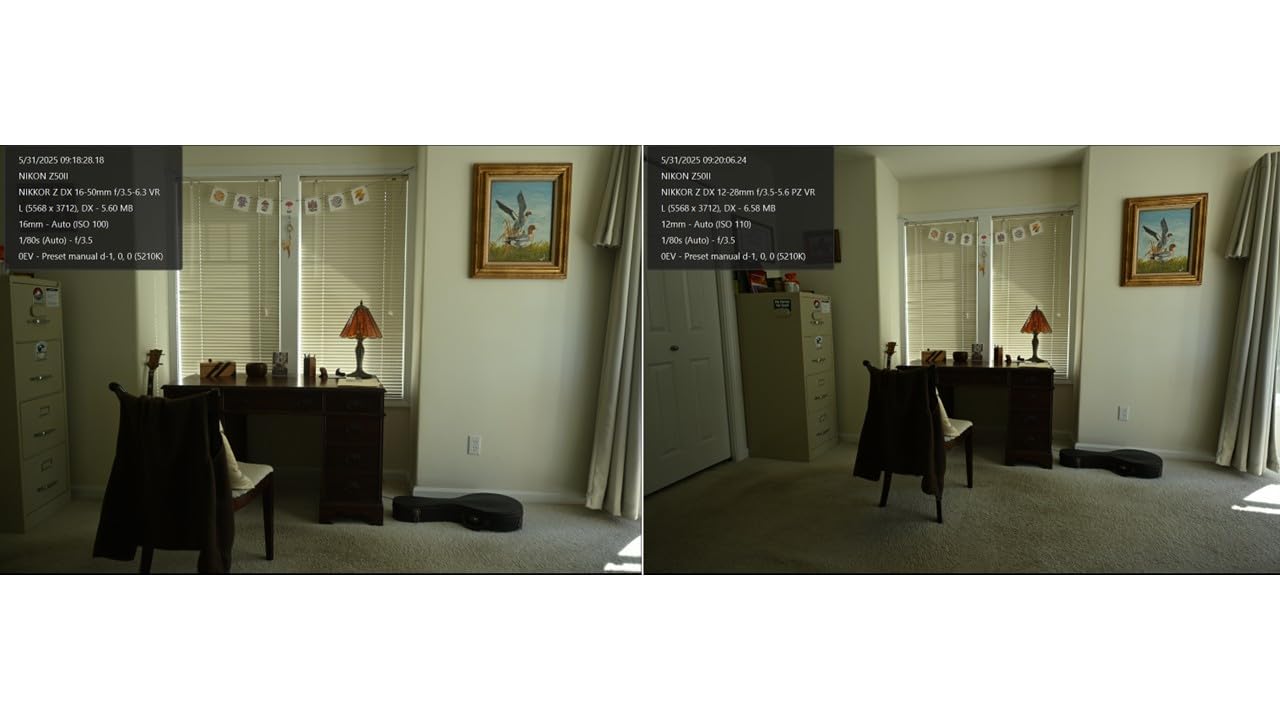
The zoom can be driven from the lens ring, the camera magnification buttons, the ML-L7 Bluetooth remote, the SnapBridge app, NX Tether or the MC-N10 remote grip. Close focus reaches 11 inches, and because the zoom is internal, the barrel stays exactly where you left it when the camera powers off, which matters on a tripod.
Owners rate image quality as good for the class rather than exceptional. The variable f/3.5-5.6 aperture is modest for astrophotography, flare control and sharpness trail the S-Line wide zooms, and the mount is DX only, so a full-frame Z body crops the view considerably. The 67mm filter thread keeps filters affordable.
Who the DX 12-28mm PZ VR suits
It suits APS-C mirrorless shooters on small bodies who want a wide zoom that weighs almost nothing. Travel, vlogging-heavy shooting, interiors, and any time you would rather not carry a heavy lens up a hill.
It also suits tripod shooters and video users, because the powered zoom gives you framing control without touching the camera. With our lens filter roundup you can pair a 67mm polarizer with it at low cost.
Who should look elsewhere
Astro shooters should pass. A variable f/3.5-5.6 aperture is not enough light for most night-sky work, and there is no weather resistance for open landscapes in poor conditions.
Anyone who wants maximum corner sharpness and flare resistance at full aperture should look at the professional wide zooms instead. This one trades optical class for weight and control.
How To Choose A Nikon Landscape Lens
The right answer depends less on specifications than on three things: what body you own, how far you walk, and how late you shoot. Work through those in order and the twelve lenses above sort themselves into a shortlist almost immediately.
Start with the mount and sensor size
Z-mount lenses are full-frame only unless they say DX in the name, and F-mount lenses come in both flavours. A DX lens on a full-frame body gives you the angle of view of a longer lens, not a wider one, which is the single most common expensive mistake in this category.
If you are moving from an F-mount DSLR to a Z body, more than 360 F-mount NIKKOR lenses work through the FTZ adapter. The 16-35mm f/4G and the 20mm f/1.8G both adapt, and both keep their 77mm thread, so your filter kit carries over unchanged. Just expect a little extra bulk at the mount and slightly slower autofocus with older lenses.
Decide how wide wide enough is
On full frame, 24mm covers a standard landscape, 16-20mm covers dramatic foregrounds, and 14mm is where dramatic starts to become a stylistic choice. On DX everything is 1.5x tighter in angle of view, so a 10mm DX lens gives you roughly the field of view a 15mm lens gives on full frame.
A common piece of advice is that 35mm and 50mm are not landscape lenses. That is right for epic vistas and wrong for detail work. A 50mm isolates a single rock in fog in a way a wide angle cannot, and plenty of published landscape work uses longer focal lengths.
Match the aperture to when you shoot
If you work between sunrise and sunset on a tripod, aperture matters less than resolution and how well the lens stops down. If you shoot night skies or star trails, aperture is the deciding spec, and anything slower than f/2.8 costs you exposure time you may not have.
Diffraction is worth understanding before you stop down aggressively. On high-resolution bodies, the usable limit often arrives around f/11, and pushing to f/16 flattens fine detail across the frame. Shooting wide open, or at f/8, then focusing to gain depth of field, usually produces a better file than stopping down for theoretical depth of field.
Check the filter thread before anything else
Five of these twelve lenses take 77mm filters, which is the most common size and the easiest to build a kit around. The 112mm thread on the 14-24mm f/2.8 S is the outlier, and wide screw-in filters at that size are expensive and prone to vignetting. Our polarizer filter guide covers matching sizes to lens types.
A 72mm thread on a bulbous front element can also vignette with a screw-in filter, so check whether the manufacturer recommends a holder system instead.
Weigh it against the walk
Every gram compounds over a full day in the hills. The 20mm f/1.8G at 355g and the DX zooms in this guide are the options for photographers who cover distance on foot, while the 14-24mm f/2.8 S at 650g is a car-side and short-walk lens. A monopod or a good strap solves more weight problems than an expensive tripod does.
Weather sealing is a real field decision
Several lenses here are marked water resistant and several are not. Coastal work, waterfalls and mountain weather punish unsealed barrels, and a plastic barrel with a thin hood is the first thing to fail. If your landscapes are outdoors, treat sealing as a requirement rather than a bonus. Our Nikon Z prime roundup marks which primes carry sealing.
Frequently Asked Questions
What lens do most landscape photographers prefer?
Most working landscape photographers reach for a wide-angle zoom rather than a prime, usually something in the 14-30mm range on full frame. A zoom lets you reframe at the overlook instead of swapping glass in the wind, and a constant aperture keeps exposure steady while you zoom. If you shoot night skies, add a fast wide prime in the 20mm range, because that is where the light gathering matters most.
What is the best landscape lens for the Nikon D850?
The Nikon 16-35mm f/4G ED VR is the strongest match for a D850. It covers 16-35mm with a constant f/4, holds sharpness well when stopped down, and its 77mm filter thread takes ordinary polarizers and graduated filters. For night work, add the 20mm f/1.8G ED, which shares that same 77mm thread.
Is 35mm or 50mm better for landscape photography?
Neither is better in general, and both suit detail work rather than sweeping vistas. A 35mm gives a slightly wider frame with more context, while a 50mm isolates a single subject more tightly and compresses distance. If your landscapes are epic wide scenes, you want 14-24mm instead. If they are single rocks, trees or peaks within a larger landscape, 35mm to 50mm is the right range.
What is the holy grail of Nikon lenses?
For landscape work, the most commonly cited holy grail is a fast ultra-wide zoom, and on Z mount that means the 14-24mm f/2.8 S at 14mm with a constant f/2.8. It is sharp corner to corner, it gathers light for night work, and it zooms. The catch is the 112mm filter thread and the 650g weight, which is why many photographers choose the 20mm f/1.8 S instead.
Can I use an F-mount Nikon lens on a Z-mount body for landscape work?
Yes, through the FTZ adapter, which supports more than 360 F-mount NIKKOR lenses. Landscape favourites such as the 16-35mm f/4G ED VR and the 20mm f/1.8G ED both adapt and keep their 77mm filter threads, so your filters still fit. Expect extra bulk at the mount and slightly slower autofocus than native Z glass, particularly with older AF-S lenses.
Final Verdict For Nikon Landscape Shooters
For most people reading this, the answer is the Nikon Z 24-120mm f/4 S. It has the widest useful range, a constant aperture, quiet autofocus and a 77mm filter thread, and after months of carrying it nothing in this list replaced it. If you need more width than 24mm gives, the Z 14-24mm f/2.8 S is the only one here that goes wider. If you shoot at night, the 20mm f/1.8 primes are the reason your exposures get short enough.
DSLR shooters are not left out. The 16-35mm f/4G ED VR covers full-frame daylight work, the 10-24mm f/3.5-4.5G DX handles architecture and interiors, and the 70-300mm adds the compression that wide lenses cannot. Whichever you pick, check the filter thread before anything else, and carry the glass that fits the walk rather than the glass that looks best at home.