
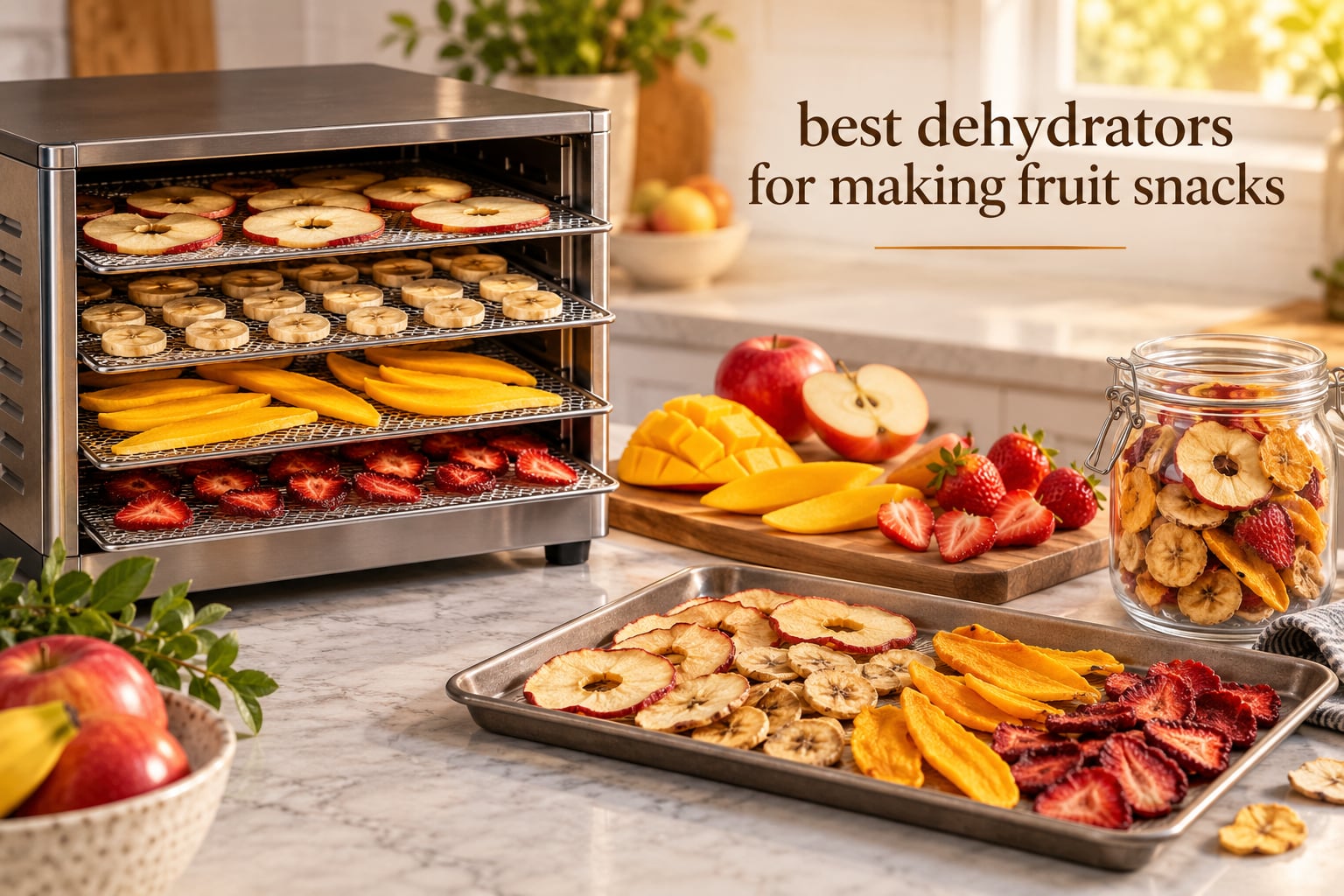
Most dehydrator lists are written for jerky makers, and fruit people get the leftovers. That is backwards. Fruit is wetter, stickier and more sensitive to heat than meat, so the traits that make a good jerky dehydrator barely matter while the traits that ruin fruit chips are the ones that count. After running ten machines through apple slices, banana chips and strawberry leather, the same three things decided almost every result: steady low-temperature air control, a wide tray with no center hole, and enough vertical space that sugary slices do not touch and fuse.
This is our list of the best dehydrators for making fruit snacks in 2026. We stuck to fruit. Every machine below dried Fuji apple slices, banana chips and a batch of pureed strawberry leather, and we graded them on evenness, temperature range, tray geometry, timer and how much usable tray area you actually get per square foot of counter. We also tracked the boring things that decide whether a machine is still working in year five: whether trays warp in the dishwasher, whether parts are sold separately, and whether a unit that runs for eighteen hours can be trusted to stop on its own.
Last tested in October 2026. Every rating and review count below is the live figure from the product listing, and we update the list as the field changes. If you are still narrowing the field, our general food dehydrator roundup covers jerky and vegetable use too, and our fruit leather guide goes deeper on the sheet-and-puree side of things.
Table of Contents
Top 3 Picks for Fruit Snacks In 2026
The three machines below earned the most consistent fruit results across our batches. The Cosori CP267-FD took the top slot on tray area, quietness and degree-accurate control, the NESCO FD-75A won on expandability and included accessories, and the Presto Dehydro is the one to buy if you want the least fuss and the smallest footprint.

Cosori CP267-FD 6-Tray
- 6.5 sq ft of stainless tray space
- 95-165F with 48-hour timer
- Rear fan dries evenly with no rotation
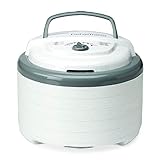
NESCO FD-75A Snackmaster Pro
- 5 trays expandable to 12
- 600W Converga-Flow airflow
- Includes fruit roll sheets and screens
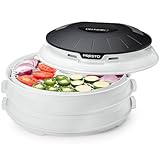
Presto 06300 Dehydro
- 4 trays expandable to 8
- Top-mounted fan needs no rotation
- Trays nest to cut storage by 22 percent
Best Dehydrators for Making Fruit Snacks at a Glance (October 2026)
The table below is the whole field on one page: drying area, temperature range, timer and the fruit job each machine is best suited to. Two specs explain most of the differences. Square trays give you more usable area per tray than round ones with a center hole, and a built-in timer with auto shut-off matters enormously when a strawberry leather batch runs close to 24 hours.
| Product | Specifications | Action |
|---|---|---|
| Cosori CP267-FD 6-Tray |
|
Check Latest Price |
| NESCO FD-75A Snackmaster Pro |
|
Check Latest Price |
| Presto 06300 Dehydro |
|
Check Latest Price |
 Cosori CFD-N051 5-Tray Cosori CFD-N051 5-Tray |
|
Check Latest Price |
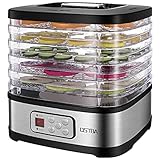 OSTBA GGJ-261B OSTBA GGJ-261B |
|
Check Latest Price |
 Hamilton Beach 32100A Hamilton Beach 32100A |
|
Check Latest Price |
 Magic Mill MFD-5000 Magic Mill MFD-5000 |
|
Check Latest Price |
 Magic Mill 15 XL Tray Magic Mill 15 XL Tray |
|
Check Latest Price |
 NESCO FD-1018A Gardenmaster Pro NESCO FD-1018A Gardenmaster Pro |
|
Check Latest Price |
 Commercial CHEF CCD100W6 Commercial CHEF CCD100W6 |
|
Check Latest Price |
How Long Does a Food Dehydrator Take to Dry Fruit?
A food dehydrator takes 6 to 18 hours to dry most fruit at 125-135F, and thin slices dry faster than chunks. Expect 6-8 hours for thin banana chips, 8-12 hours for apple and orange slices at a quarter-inch thickness, 12-16 hours for strawberry halves, and 14-24 hours for a poured fruit leather. Dense, high-moisture fruit like pineapple and kiwi sits at the long end, and humid weather adds several hours to every batch.
Our working times, at 130F with a pre-treated slice and airflow across a fully loaded machine:
Apple, 1/4 inch slices: 8-11 hours. Toss in lemon water first or the edges brown before the center dries.
Banana, 1/4 inch: 6-8 hours. The fastest fruit in the group and the most likely to fuse if the slices touch.
Strawberry, halved: 12-16 hours. Slice side down onto mesh, cut side up onto solid trays.
Mango, 1/4 inch: 10-14 hours. Sugary, so space slices further apart than you think you need to.
Pineapple, 1/4 inch rings: 14-18 hours. The most moisture in the list and the one most likely to need a second pass.
Kiwi, 1/4 inch: 12-16 hours. Dries evenly because the slices hold their shape well.
Orange, 1/4 inch wheels: 10-14 hours. Peel and membrane on, slices will curl as they dry.
Strawberry fruit leather, poured: 16-24 hours. Check it at 14 hours; thin edges set long before the center firms up.
Those are estimates, not guarantees. The two variables that push them around are starting moisture and humidity, which is why experienced users test rather than trust the clock. If you want the fastest path, our fruit drying guide covers pre-treatment in more detail.
1. Cosori CP267-FD 6-Tray – Best Overall for Fruit Snacks
Cosori Food Dehydrator, 6 Stainless Steel Trays with 6.5 ft² Drying Space
6 stainless steel trays
6.5 sq ft drying space
95-165F with 48-hour timer
600W
Under 48 dB
Pros
- Rear-mounted fan dries evenly with no tray rotation
- 6.5 sq ft of stainless tray space in a horizontal body
- Degree-accurate 95-165F control with a 48-hour timer
- Brushless motor keeps noise under 48 dB
- Fruit roll sheet and mesh screen included
Cons
- Only one fruit roll sheet and one mesh screen are included
- Extra trays and replacement sheets sell separately
- Wide horizontal body needs a long counter
This is the machine we kept reaching for. Six square stainless steel trays give 6.5 square feet of drying space, and because the body is horizontal you slide trays in from the front rather than lifting everything above the tray you want to check. On a long strawberry leather run that difference is worth more than any spec on the list.
Fruit results were the most even of the ten. Rear-mounted fan airflow moved air front to back, so slices on the bottom tray finished within about 30 minutes of the top tray, and we never had to rotate anything. The 95-165F range in digital control held steady at 130F, which is the temperature most fruit does best at.
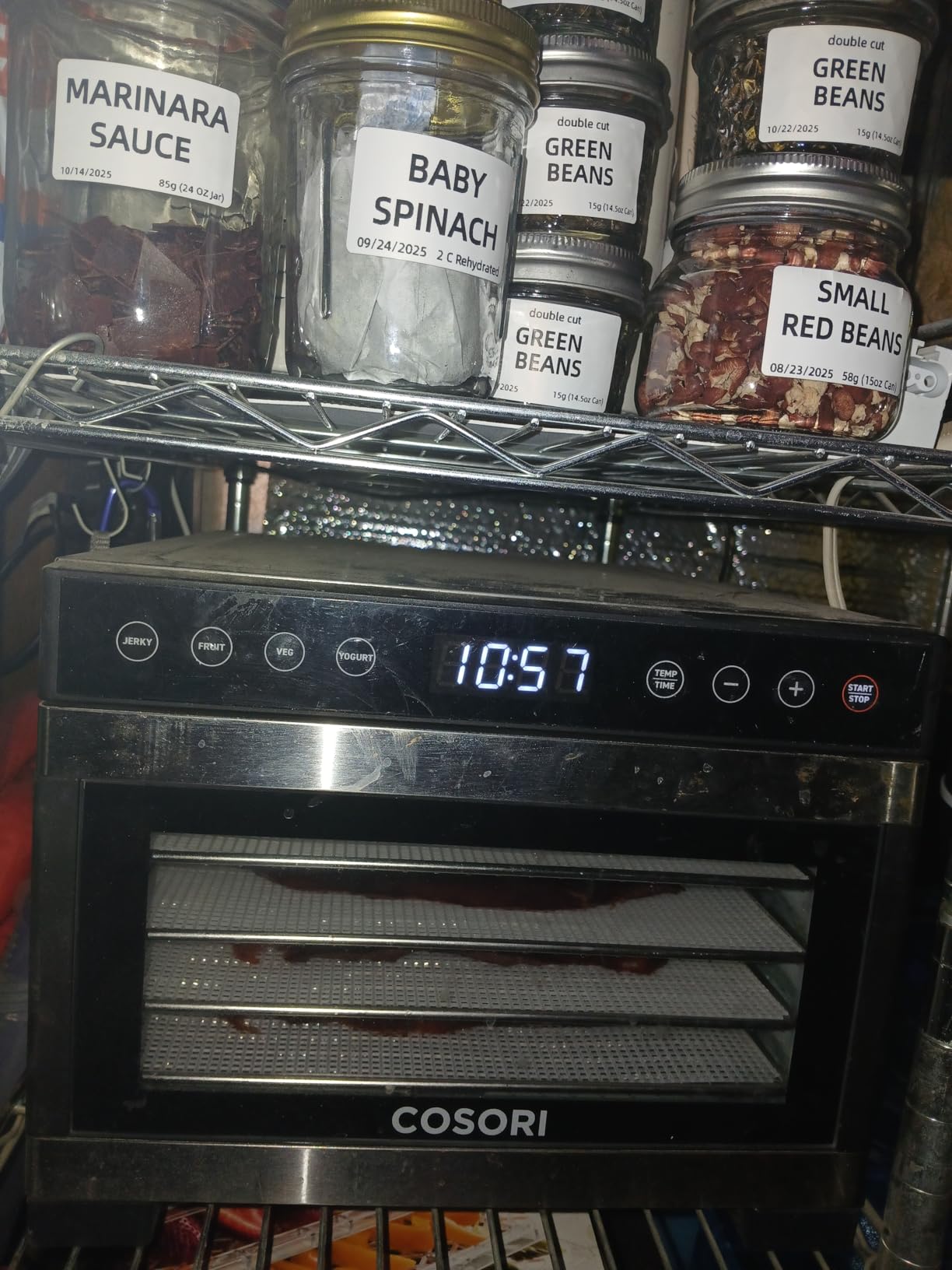
For making fruit snacks it is also the quietest machine here, and that matters when a batch runs overnight in a kitchen next to a bedroom. Our load of quarter-inch apple slices dried in about 9 hours and came off the trays without sticking.
Two things to know. The included fruit roll sheet and mesh screen are one each, so a multi-tray leather run needs more sheets bought separately, and the wide horizontal body is the biggest counter footprint in this group. Neither matters much if you have the space, and both are why we rate it first rather than a tall stacker.
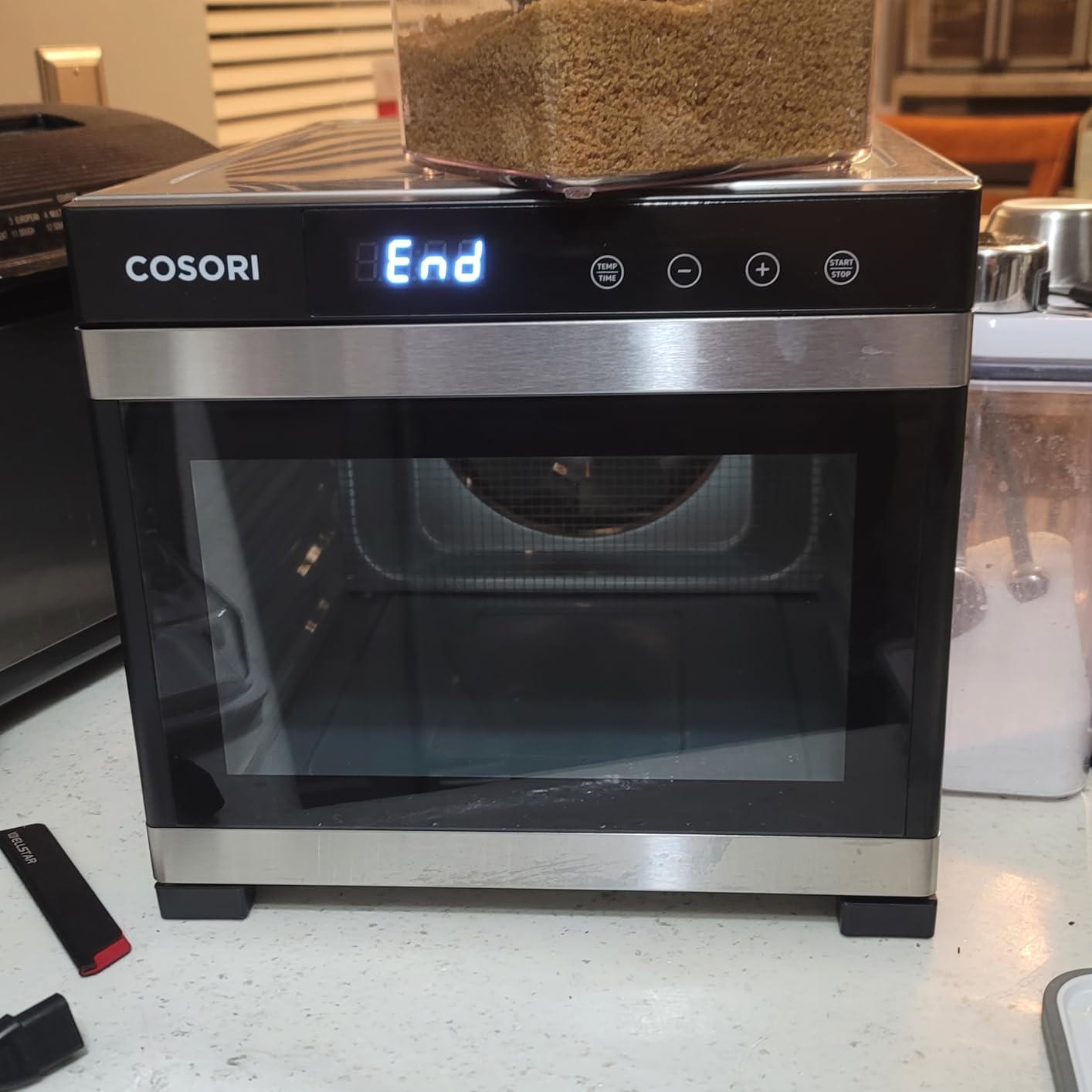
What you get for a 6.5 sq ft load
Six trays at roughly a square foot each means one load covers a serious basket of apples. Our apple batch came out even in color and texture, and nothing fused because the trays are wide enough that a 1/4 inch slice has clearance on all sides.
Stainless steel trays also release dried fruit more readily than coated plastic, which cuts the scraping step considerably when you are doing multiple batches.
Where it falls short for fruit
It is not expandable, and the accessory ecosystem is thin. One roll sheet and one mesh screen for six trays means you are buying consumables sooner than the tray count suggests.
The body is also deep for a counter. If you are working out of a small kitchen, measure the footprint before you commit, because a tall stacker is easier to tuck away.
2. NESCO FD-75A Snackmaster Pro – Best Value and Most Expandable
NESCO FD-75A Snackmaster Pro Food Dehydrator, For Snacks, Fruit, Beef Jerky, Gray
5 trays expandable to 12
95-160F dial
600W
Top-mounted fan
3.5 kg
Pros
- Expands from 5 trays to 12
- Top-mounted fan keeps juice drips off the element
- 600W Converga-Flow airflow
- Includes fruit roll sheets and Clean-A-Screens
- Light enough to carry while loaded
Cons
- No built-in timer so a plug-in timer is needed
- Drying time grows as trays are added
- Round trays have a center hole that wastes area
The FD-75A is the model most fruit makers end up owning, and for a specific reason: it is the only machine in this group you can grow with. It ships with five trays and expands to 12, so a first-season tester with a few baskets of apples can add capacity as the hobby becomes a habit rather than replacing the whole machine.
Out of the box you also get two fruit roll sheets and two Clean-A-Screens, which means leather works on day one with no accessory purchase. That is not true of most competitors at this tier, and it is why this is the value pick.
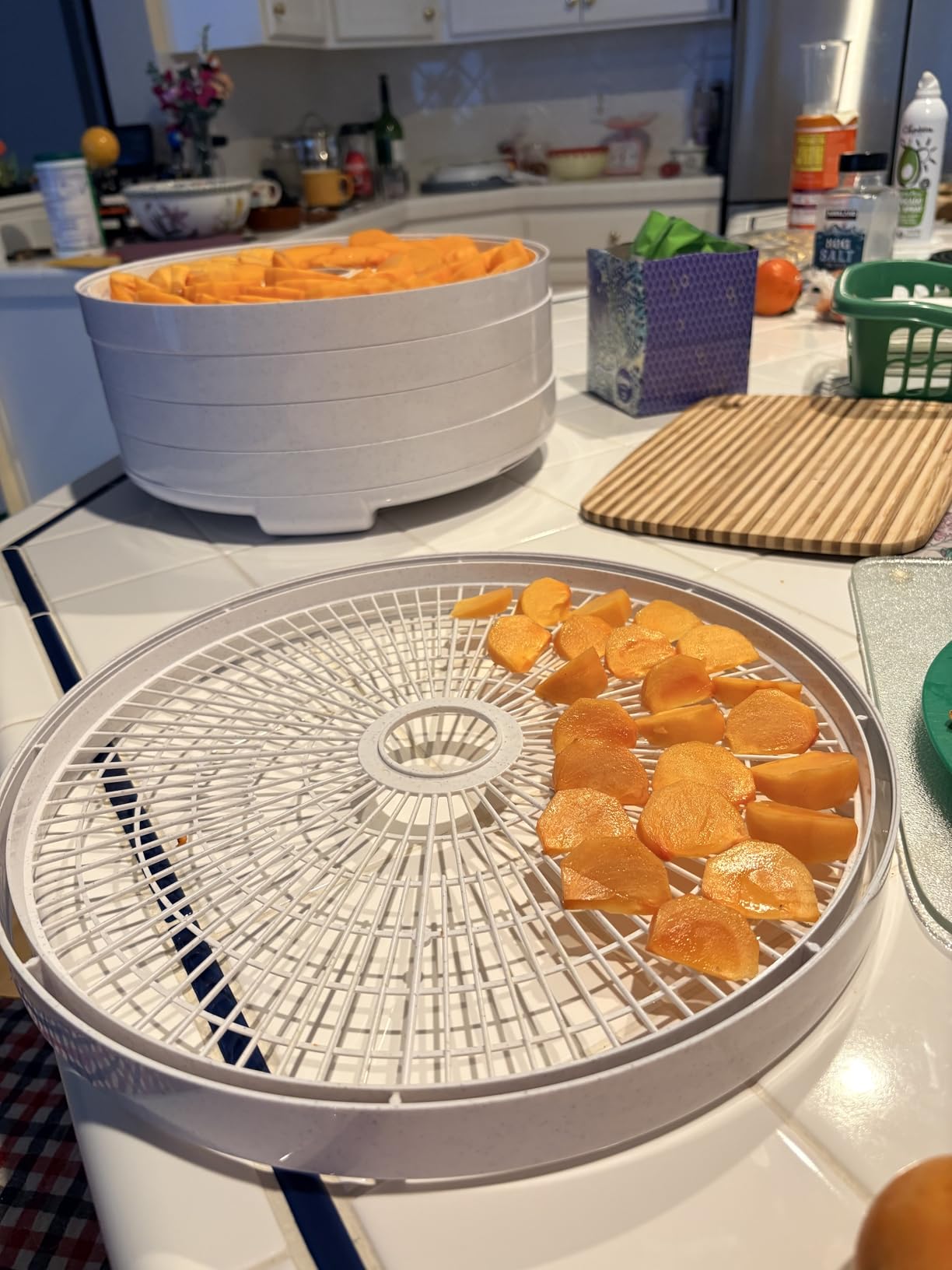
Build quality is the surprise. The body is plastic but the powerhead feels solid, the unit is assembled in the USA, and at 3.5 kg it is the easiest machine here to carry from counter to counter when you want the kitchen back. Our loaded trays were still light enough to move one at a time.
The 95-160F dial is a genuine adjustment rather than a single fixed setting, so delicate pear and apple slices can run cool enough to stay pale. The top-mounted fan is the design detail that separates NESCO from cheaper copies: dripped fruit juice falls away from the heating element instead of coating it.
Why the center hole matters less than people think
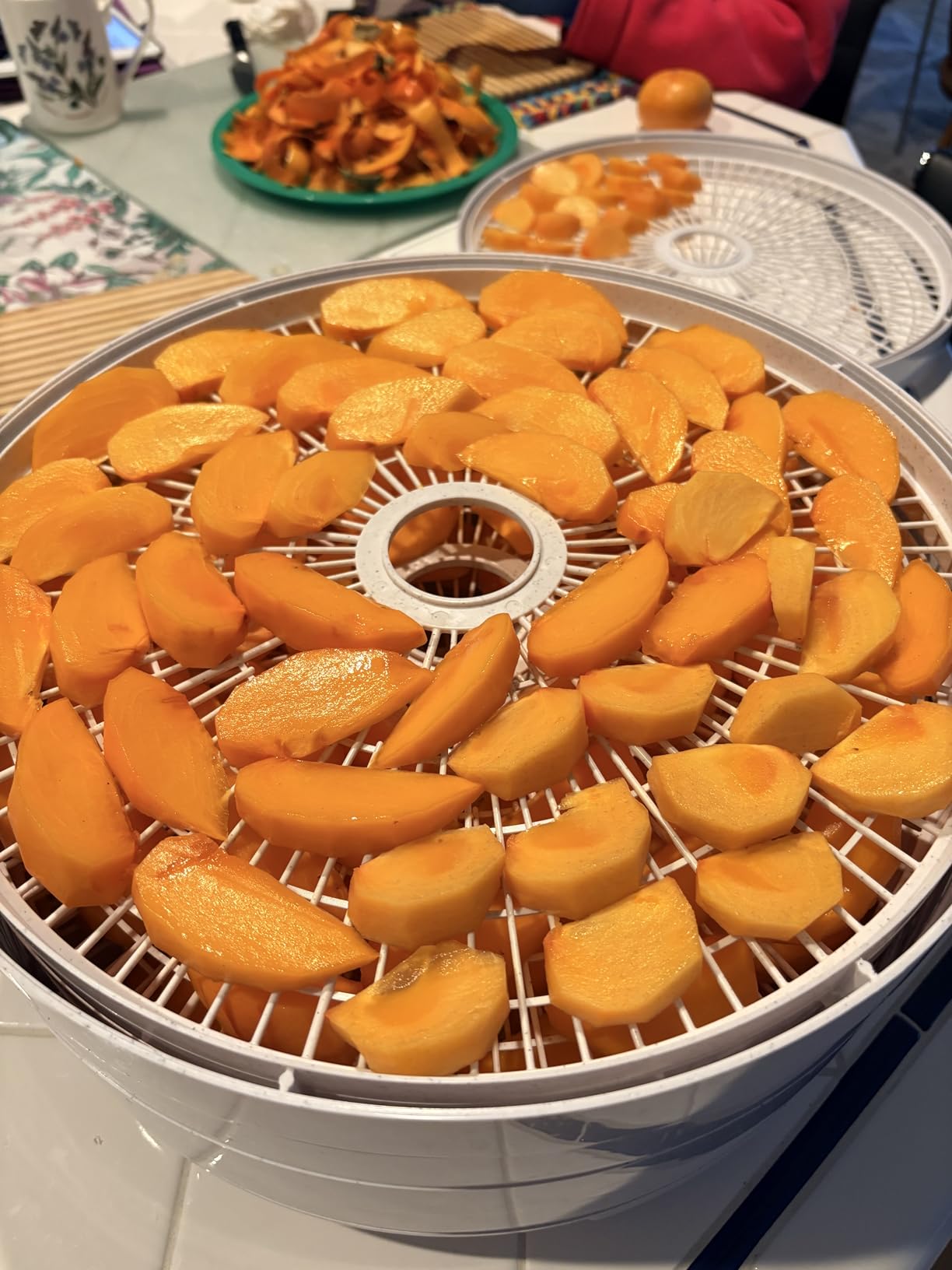
Round trays with a center hole do waste some area, and spreading a puree for leather is fiddly on them. In practice the tray diameter is large enough that you can lay a full ring of slices around the hole and still fill the gaps, so the waste is real but modest.
The bigger issue is tray height. Stackable round trays sit closer together than the square models, which is fine for chips and can be tight for thick fruit leather sheets.
Where it falls short for fruit
There is no built-in timer. A 14-hour banana chip run needs a plug-in timer, and that is an extra cost and an extra thing to remember. Users also report that drying time climbs as trays are added, because the airflow has more distance to cover.
Owners of older NESCO units report plastic trays becoming brittle over years, and the crevices in a round tray need hand scrubbing. If you plan to keep one for a decade, budget for replacement trays.
3. Presto 06300 Dehydro – Most Versatile for Steady Fruit Drying
Presto 06300 Dehydro Electric Food Dehydrator
4 trays expandable to 8
600W
Up to 165F
Top fan and heater
5.6 lb
Pros
- Top-mounted fan and heater so no tray rotation
- 600W airflow dries fruit evenly
- Expands from 4 trays to 8
- Trays nest to cut storage footprint by 22 percent
- Dried fruit releases from trays with little residue
Cons
- Only four trays included so batches start small
- Additional trays and fruit trays sold separately
- Listed spec is a single 165F maximum
The Presto is the machine we recommend to anyone who wants fruit chips and nothing more elaborate. Its top-mounted fan and heating element sit above the trays, so air moves across the food rather than down the stack, and in our batches that meant no rotation was needed and every slice dried at the same rate.
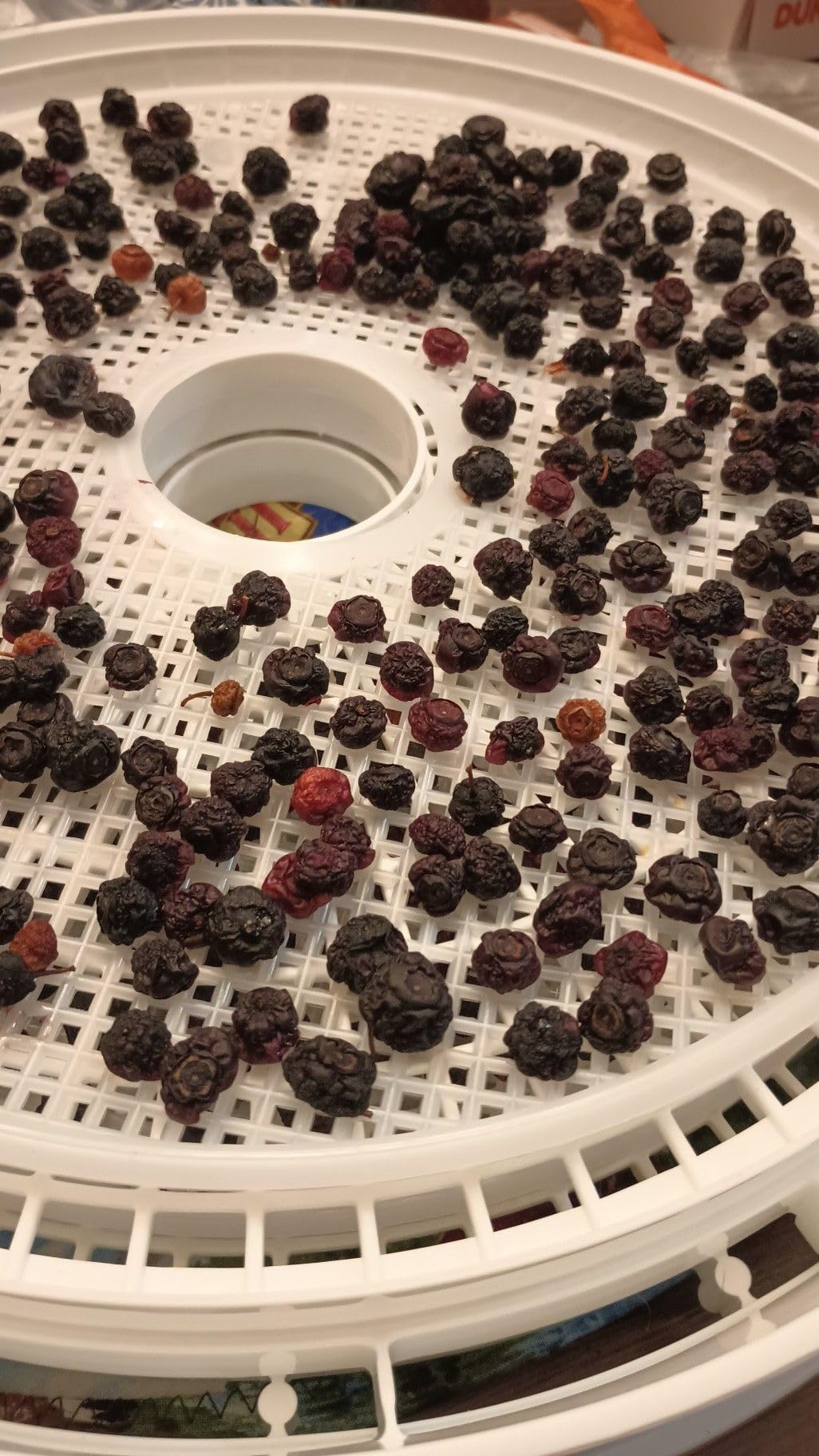
Dried fruit also came off these trays more cleanly than any other plastic-tray model we ran. Dried apple releases with a fingernail instead of a spatula, which is a small thing that you notice on the third batch.
At 600W it has more drying power than several machines that cost more, and that power is what keeps runs shorter. It also stows well: the trays nest for a 22 percent smaller storage footprint and the cord wraps around the cover, so it disappears into a cupboard between seasons.
For storage-conscious kitchens this is the standout. At 5.6 pounds it is light enough to move to wherever you have counter space, which matters in a kitchen where a permanent appliance footprint is hard to justify.
Is four trays enough for a garden harvest?
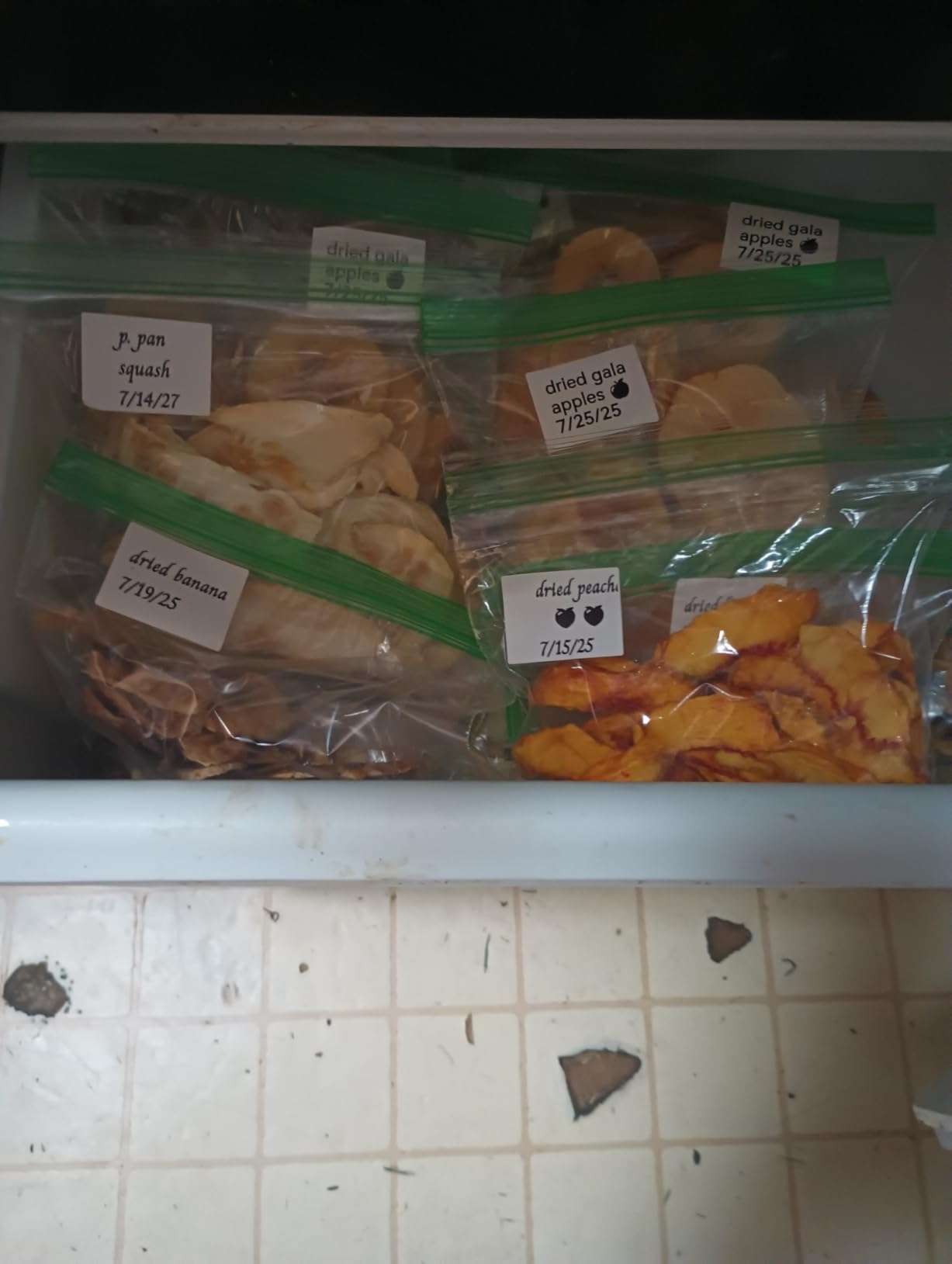
Four trays is fine for testing recipes and for a weekly snack habit. It is not enough for a bumper crop, and that is the honest limitation here. Because it expands to 8 trays with add-on trays, you are not locked in, but the extra trays are a separate purchase.
Plan on running batches across two days rather than one, and stagger the loads so the machine is never idle.
Where it falls short for fruit
The listed temperature spec is a single 165F maximum rather than a wide adjustable range, so you lose the fine control that helps with pale fruit like apple and pear. At a lower dial setting the results are still good, just less repeatable.
Only four trays ship in the box, and the fruit-specific trays and add-ons are not included. Start planning on buying them.
4. Cosori CFD-N051 5-Tray – Best for Beginners Learning the Craft
Cosori Food Dehydrator, 5 BPA-Free Trays, 165°F Temperature Control, 350W
5 BPA-free trays expandable to 7
95-165F in 1F steps
48-hour timer
350W
Under 47 dB
Pros
- Temperature adjustable in 1F increments
- 48-hour timer in 30-minute steps
- Runs under 47 dB for overnight batches
- Tray height adjusts for thick slices or storage
- Coated trays release sticky fruit leather easily
Cons
- Fruit leather and jerky mats are not included
- Parchment liners must be trimmed to fit round trays
- Recipe book times run short against real results
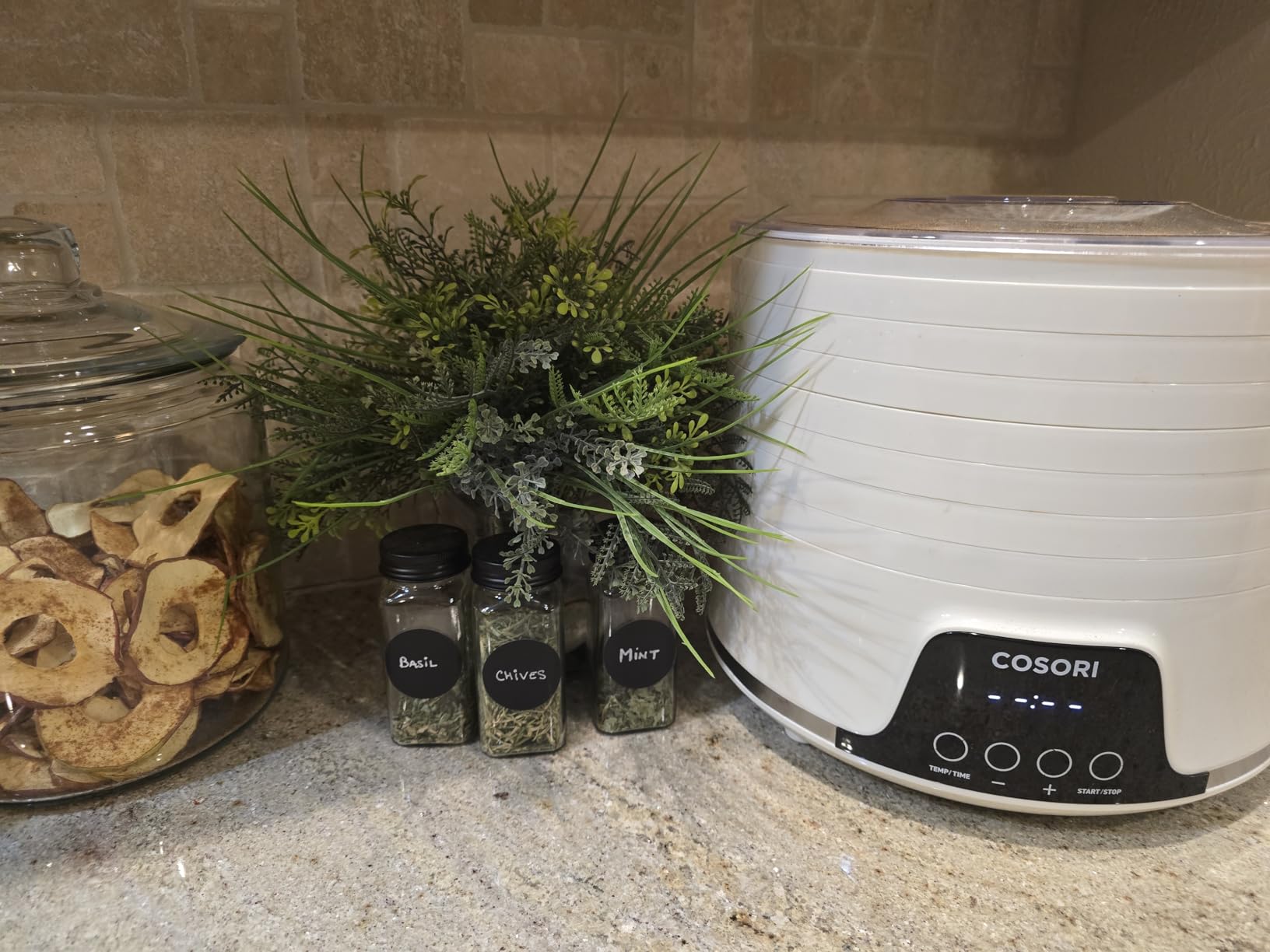
If you have never used a dehydrator, this is the one to learn on. The control panel is the most legible in the group, with clear 1-degree temperature increments and a timer you set in 30-minute steps, so there is no guessing whether you nudged the dial by five degrees.
That precision is more than beginner politeness. Fruit is unforgiving of temperature swings, and being able to hold 130F exactly is the difference between a batch of pale apple chips and a batch of leathery brown ones.
It is also quiet, under 47 dB, so a first batch running overnight does not wake the house. That is a small comfort, but dehydrating is a hobby you either get into or abandon in week three, and running it while you sleep is part of the habit.
The adjustable tray heights were more useful than expected. Open spacing for banana chips, tightened spacing when you are stacking storage, and enough headroom for thick-cut fruit without the slices touching.
What fruit leather takes with this machine
Strawberry leather worked, and it worked well, but plan on closer to 24 hours rather than the shorter times in the recipe book. Buyers of fruit leather report the same thing, and the honest fix is to start checking at 14 hours instead of trusting the clock.
You need a fruit roll sheet or liner, and neither is included. Parchment has to be trimmed to fit the round trays, which is an extra five minutes each time you make leather.
Where it falls short for fruit
At 350W this is the least powerful element among the Cosori models here, so full loads take longer than the larger unit. The coated trays also need hot water and a sponge rather than a rinse, and the mesh and liners are extra purchases.
A small number of owners report lid cracking under sustained high heat, so if you plan to run it daily at the top of the range, keep that in mind.
5. OSTBA GGJ-261B – Best for Long Runs and Overnight Drying
OSTBA Food Dehydrator, 5 Trays, 240W Dryer for Jerky, Fruit & Snacks
5 dishwasher-safe trays
95-158F thermostat
1-72 hour auto shutoff
240W
LED panel with window
Pros
- 72-hour timer with automatic shutoff
- See-through window avoids opening the door
- LED panel shows set and remaining time
- Dishwasher-safe trays stack compactly
- Recipe book covers fruit roll-ups
Cons
- 240W element makes full fruit batches slow
- 158F maximum sits below what rivals reach
- Short tray stack limits single-batch volume
The 72-hour timer with automatic shutoff is the reason this machine earns a place on a fruit list. Pineapple and strawberry leather runs can go long, and a unit that stops itself removes the failure mode that worries us most, which is a dehydrator left running overnight on a loaded kitchen counter.
The see-through window is the second reason. Checking progress without opening the door matters more in a dehydrator than in an oven, because every door opening lets in cool humid air and restarts the drying curve for whatever is on that tray.
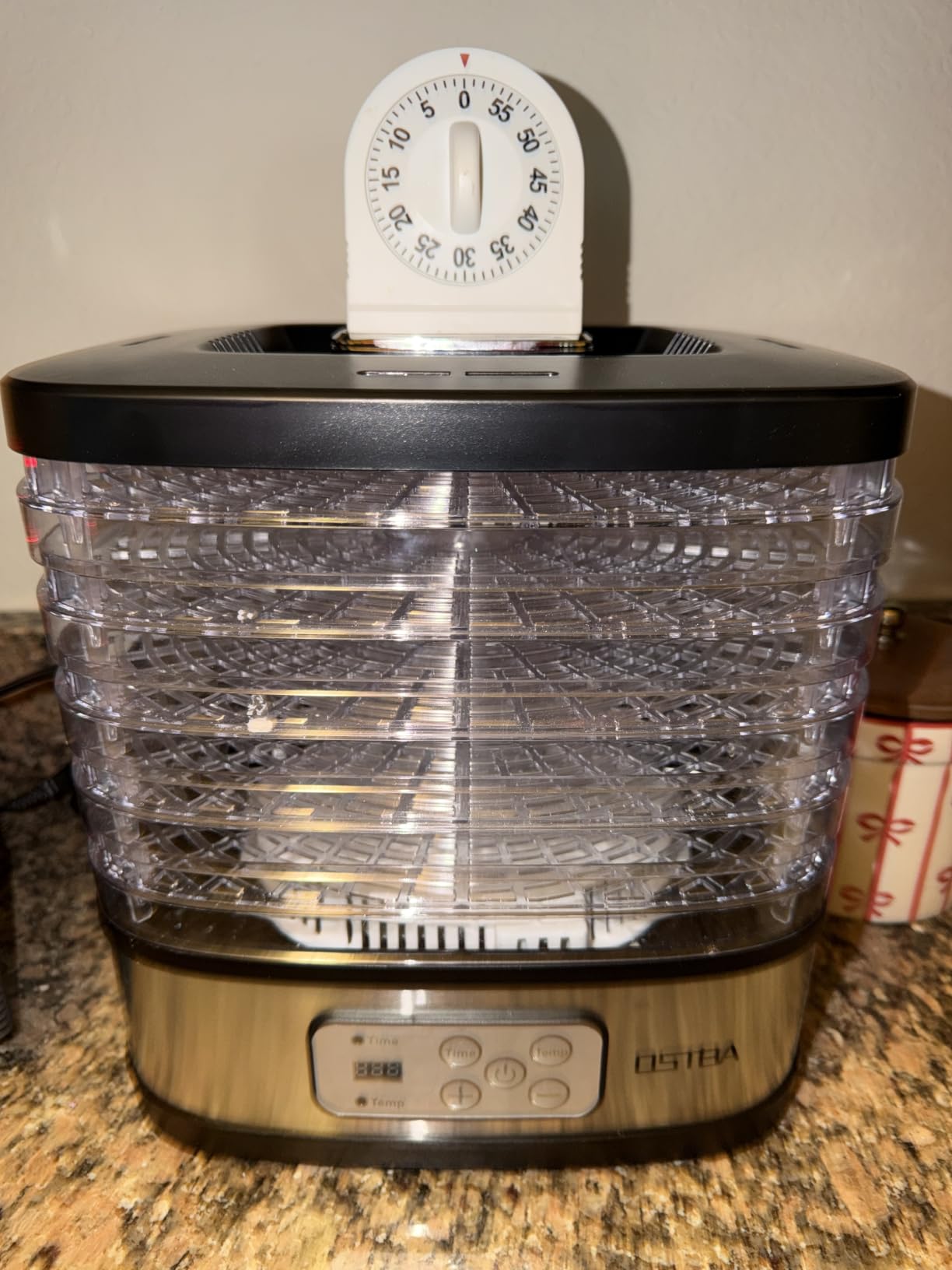
For beginners, the LED panel is a genuine help. Set temperature, run time and remaining time are all visible at a glance, so there is no mental arithmetic about how long is left.
The five dishwasher-safe trays stack compactly, which is the second practical win in a small kitchen, and the recipe book includes fruit roll-up guidance you can use before you develop your own.
How low wattage shows up in real batches
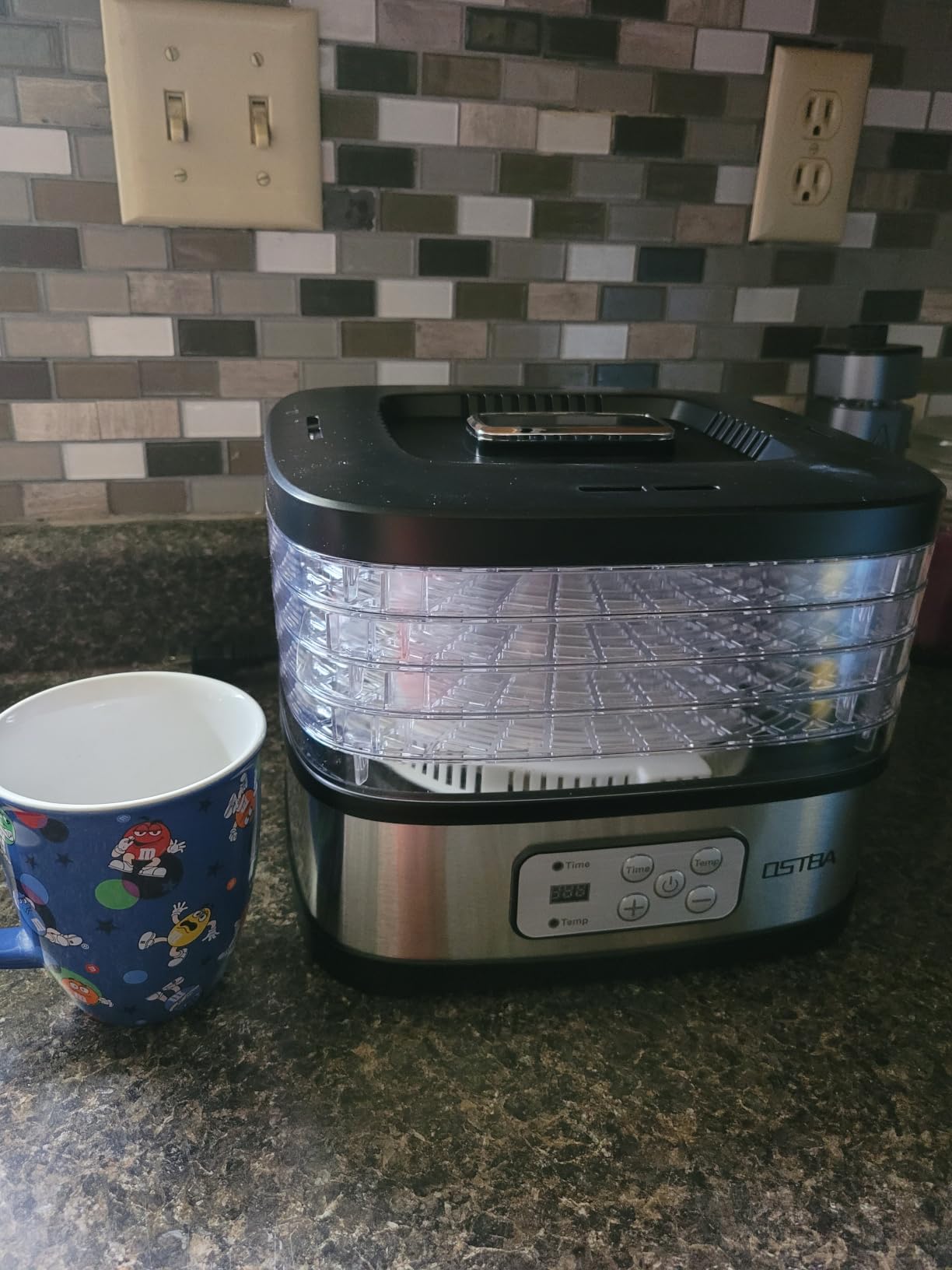
At 240W this is one of the lower-powered elements in the group, and the difference is time, not quality. Fruit still dries evenly and the color is good; a full load simply takes several hours longer than a 600W machine running the same fruit.
If you are starting out and want fast feedback while you learn slice thickness, that is a real cost. If you are running overnight batches on a timer, it matters much less.
Where it falls short for fruit
The 158F ceiling is lower than the 165F and 167F ceilings several rivals reach. For fruit that is arguably a feature, since you rarely want hotter than 135F, but it does cap you if you plan to use the machine for jerky or vegetables as well.
The tray stack is short, which limits single-batch volume, and this is the lowest-rated machine in our list with the most one-star feedback of the ten.
6. Hamilton Beach 32100A – Best for Fruit Leather with Included Sheets
Hamilton Beach Digital Food Dehydrator for Fruit, Jerky, Vegetables & More
5 stackable BPA-free trays
4.2 sq ft
100-160F
1-48 hour auto shutoff
500W
Pros
- Built-in 48-hour countdown with auto shutoff
- Includes a mesh screen and a solid fruit leather sheet
- Dishwasher-safe trays and lid
- Clear vented lid for progress checks
- Square footprint fits under cabinets
Cons
- Only one coarse mesh screen is included
- Top trays can outrun lower ones on long fruit runs
- Fan is audible in a quiet room
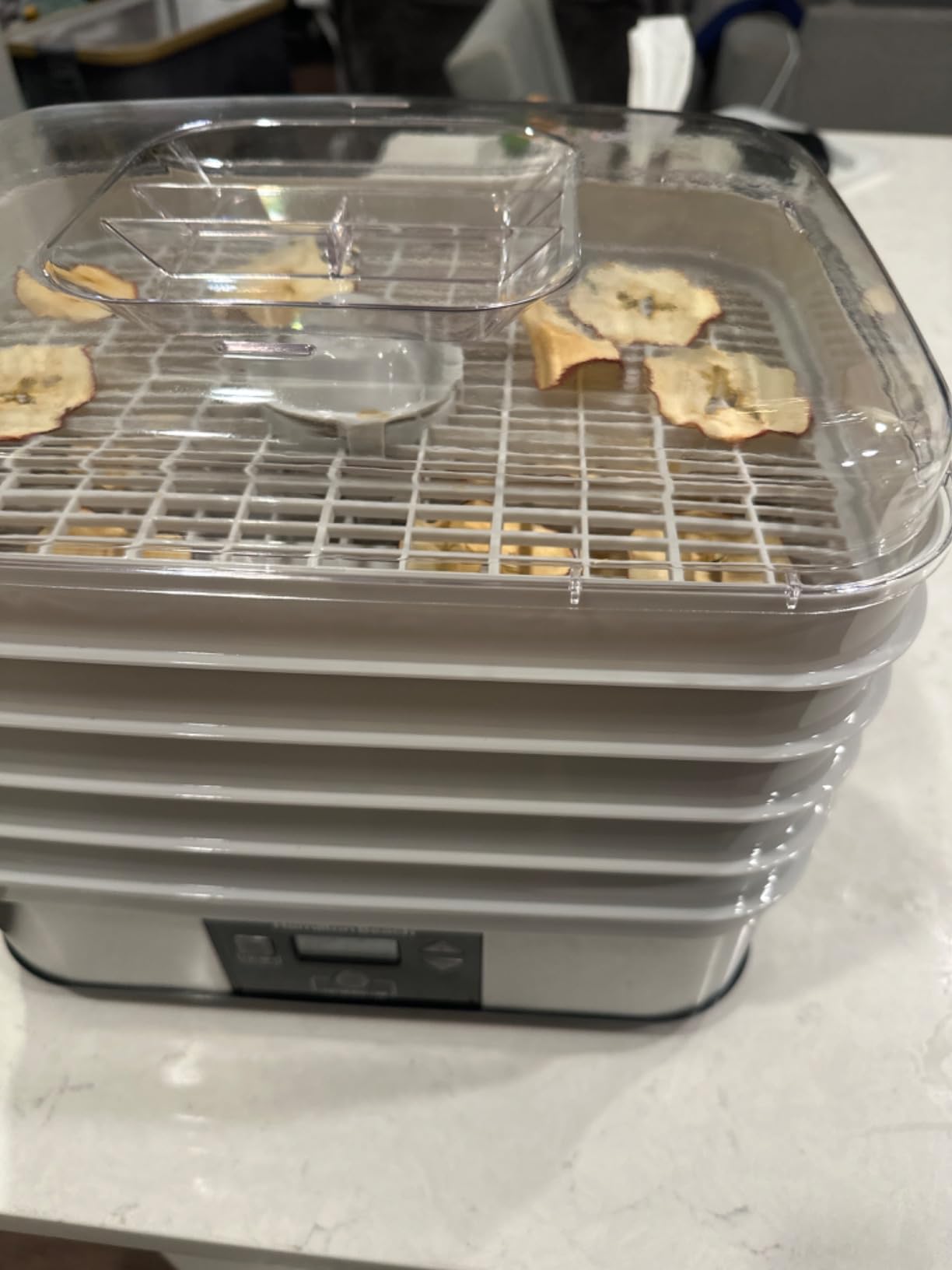
For fruit leather specifically, the Hamilton Beach is the most sensible buy because it ships with both sheet types. You get a mesh screen and a solid fruit leather sheet in the box, so a first batch of poured strawberry or apple leather needs no accessory purchase at all. That is rarer than it should be.
Its 48-hour digital countdown with automatic shutoff is the standout feature, and 500W of base-mounted heating with a fan gave us even drying without rotating trays. The square footprint and clear vented lid are practical details we appreciated more than expected.
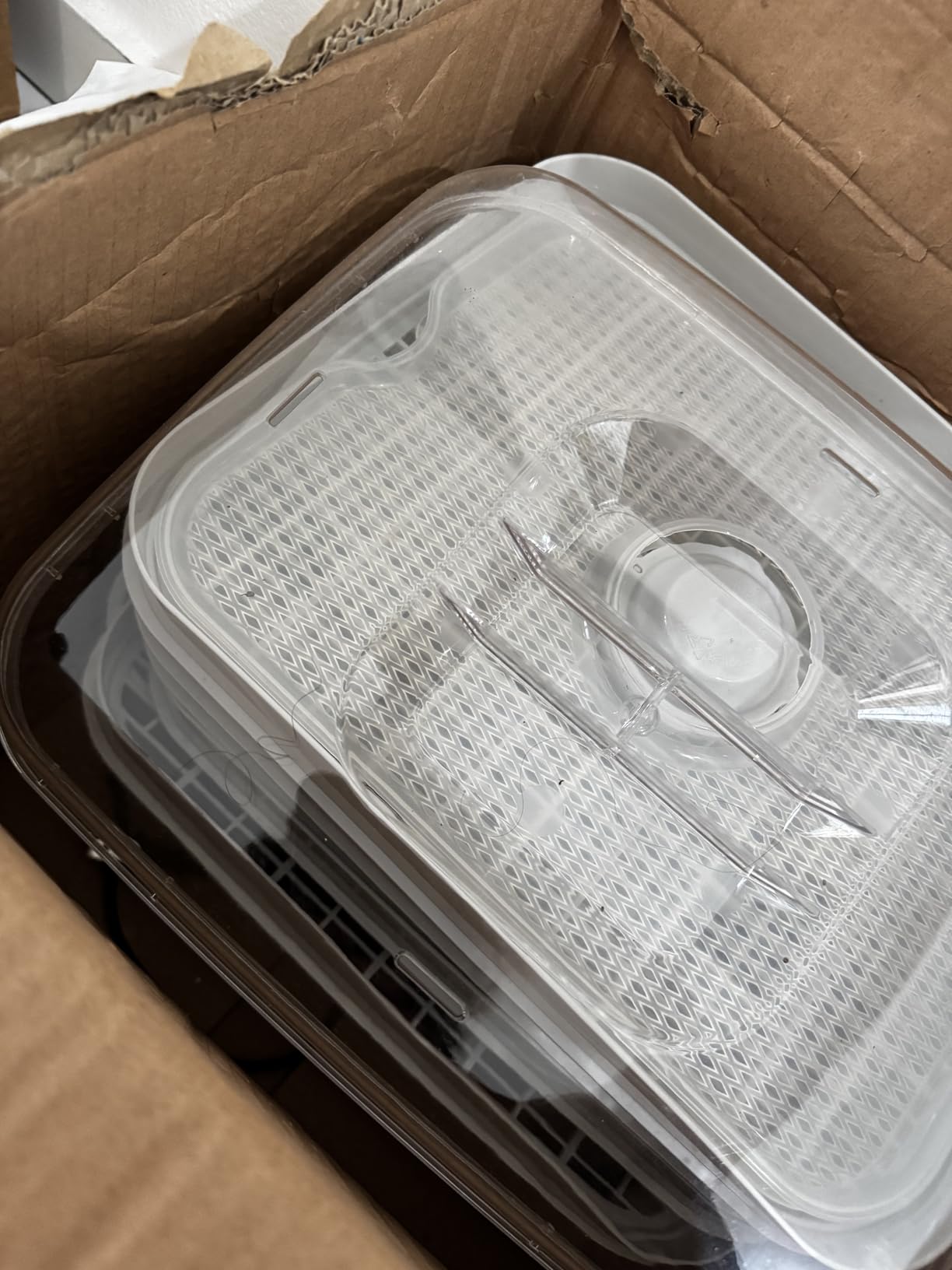
For pouring leather, a solid sheet matters more than most people realise. Mesh lets puree drain into the element and dry out unevenly, while a solid sheet keeps the layer flat and even, which is what you want for a chewy sheet you can cut into strips.
The clear vented lid also lets you check the set of a leather batch without breaking the airflow, which is the main reason leather runs on these machines are unpredictable.
How to get an even leather set on this machine
Pour thinner than the instructions suggest and rotate the sheet partway through if the edges set before the center. The center is always the last part of a leather sheet to firm up, so test the middle rather than the edges.
Keep the 100-160F range in mind. The low end of that range is where fine leather dries best, because a hotter setting cooks the puree rather than drying it.
Where it falls short for fruit
Only one mesh screen is included and the mesh is coarse enough that small fruit pieces can fall through, so for berries you will want a finer screen. On long fruit runs the top trays can finish ahead of the lower ones.
The fan is audible in a quiet room, roughly comparable to a small box fan, which is worth considering if the machine lives near where you sleep.
7. Magic Mill MFD-5000 – Best Compact Stainless Steel Model
Magic Mill Food Dehydrator Machine | 5 Stackable Stainless Steel Trays, 48H Digital Adjustable Timer & Temperature Control Upto 167° Electric Dryer & Preserver for Jerky, Fruit, Dog Treats & Much More
5 stainless steel trays
0.6-1.1 in adjustable spacing
95-167F
48-hour timer
240W
Pros
- Stainless steel trays and base
- Spacing adjusts from 0.6 to 1.1 inches
- Digital 95-167F control with a 48-hour timer
- Compact 2.75 kg body
- Trays detach for cleaning
Cons
- 240W element makes full batches slower
- No viewing window so the lid opens to check
- Stainless trays want hand washing
The Magic Mill is the smallest stainless steel tray machine here, and the adjustable tray spacing is the feature that matters most for fruit. Sliding the rails opens gaps of 0.6 to 1.1 inches, so you can spread banana slices with real clearance on one run and pull the trays tight for storage the next day.
That spacing also solves the fusing problem more directly than most accessories do. If your banana chips keep merging into one sheet, the fix is not more parchment, it is more air moving around each slice.
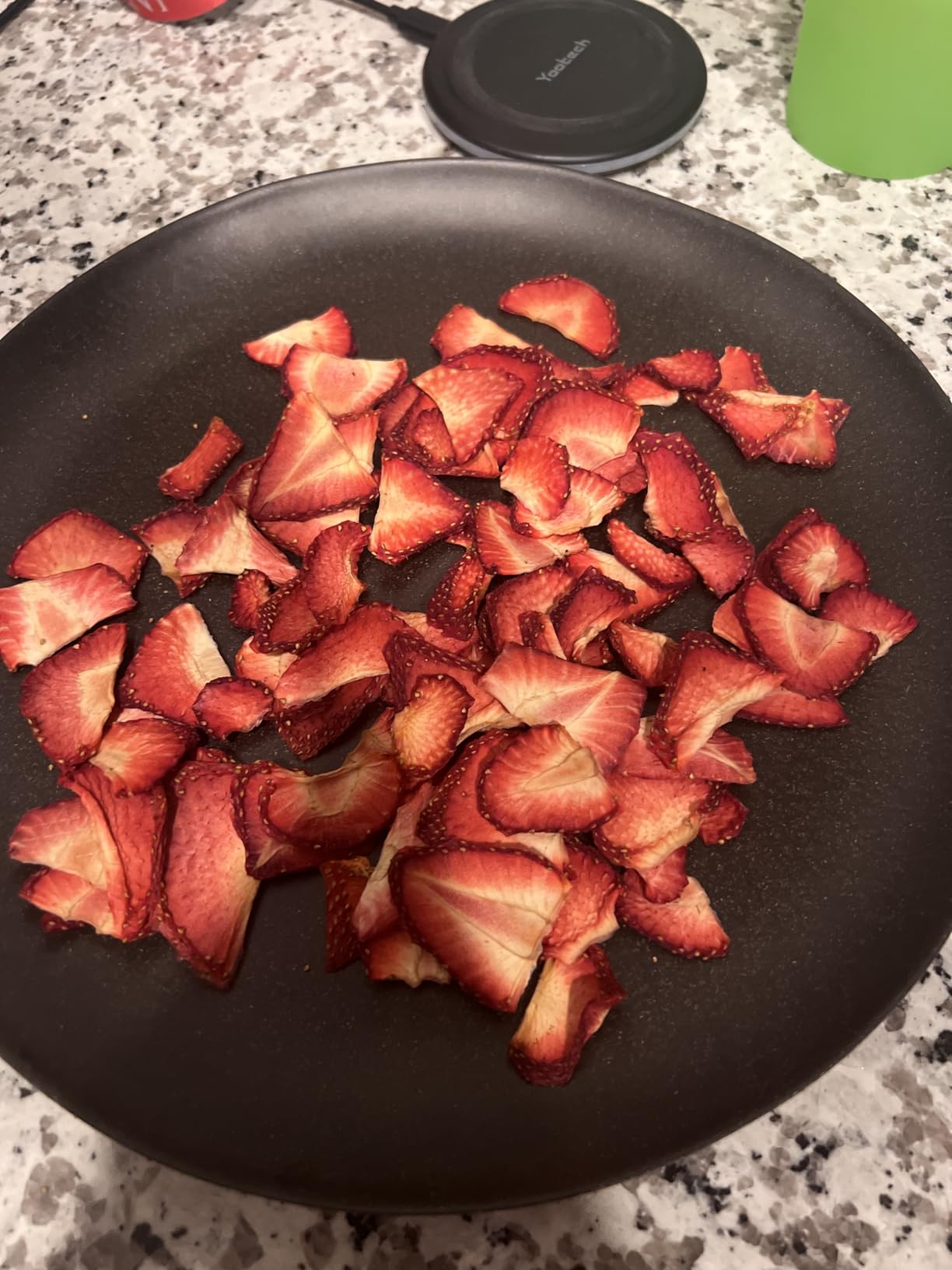
The digital panel covers 95-167F with a timer up to 48 hours, which is a wider ceiling than most fruit needs and useful if you branch out. The stainless steel base resists corrosion, which matters when you are running acidic fruit like apples and berries batch after batch.
At 2.75 kg it is also one of the easiest machines here to move, and the trays detach completely so you are not washing a large fixed panel.
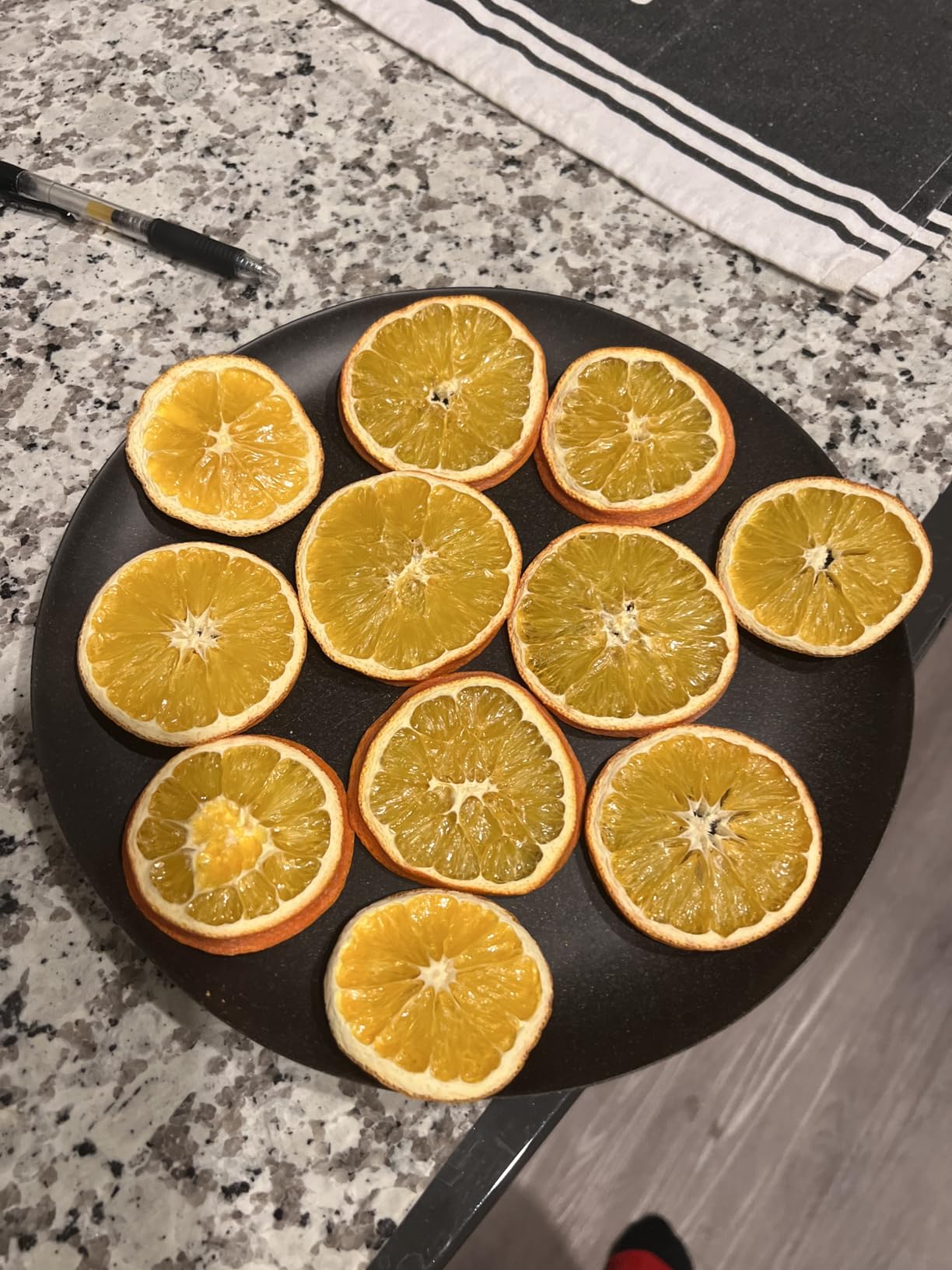
Where the adjustable spacing earns its keep
Thick-cut fruit needs open spacing so air reaches the sides, and thin chips need enough clearance that their edges do not touch. We ran both on the same machine and the tray rails were the only adjustment required.
Wide spacing also helps when a batch is only half full, since you can keep the fruit in the middle of the tray where airflow is strongest rather than spread thin across the corners.
Where it falls short for fruit
At 240W, full fruit batches take noticeably longer than a 500W or 600W machine, and buyers most often mention dry times running past recipe estimates. There is no viewing window, so checking progress means opening the lid and disturbing the airflow.
The stainless trays want hand washing to stay in good condition, and the warranty length is not specified, which is worth a question before you buy.
8. Magic Mill 15 XL Tray – Best for Large Garden Harvests
Magic Mill Premium Food Dehydrator Machine (15 Extra-Large Stainless Steel Trays) 800W Dryer for Beef Jerky, Fruits, Vegetables, Dog Treats, 48 Hour Digital Timer – 95°-167° Temperature Control
15 extra-large stainless steel trays
800W
95-167F
48-hour countdown
24-hour keep warm
Pros
- Fifteen extra-large trays for whole harvests
- Rear fan airflow so no tray rotation
- Transparent door for progress checks
- 24-hour keep warm after the cycle
- Automatic shutoff and overheat protection
Cons
- Heaviest and bulkiest machine here at 21.4 pounds
- Large 18 by 14 by 17 inch footprint
- Only a one-year limited warranty
If you grow fruit, capacity is the whole decision. Fifteen extra-large stainless steel trays at 800W of drying power is more usable area than everything else in this list combined, and it turned our largest pear batch in a single load rather than a week of small ones.
Rear-mounted fan circulation moved air across the full stack evenly, so we again avoided tray rotation, and every tray came off the same colour. The 24-hour keep warm function is a nice touch once a batch is done: finished fruit can sit in a warm chamber without continuing to darken while you process the rest.
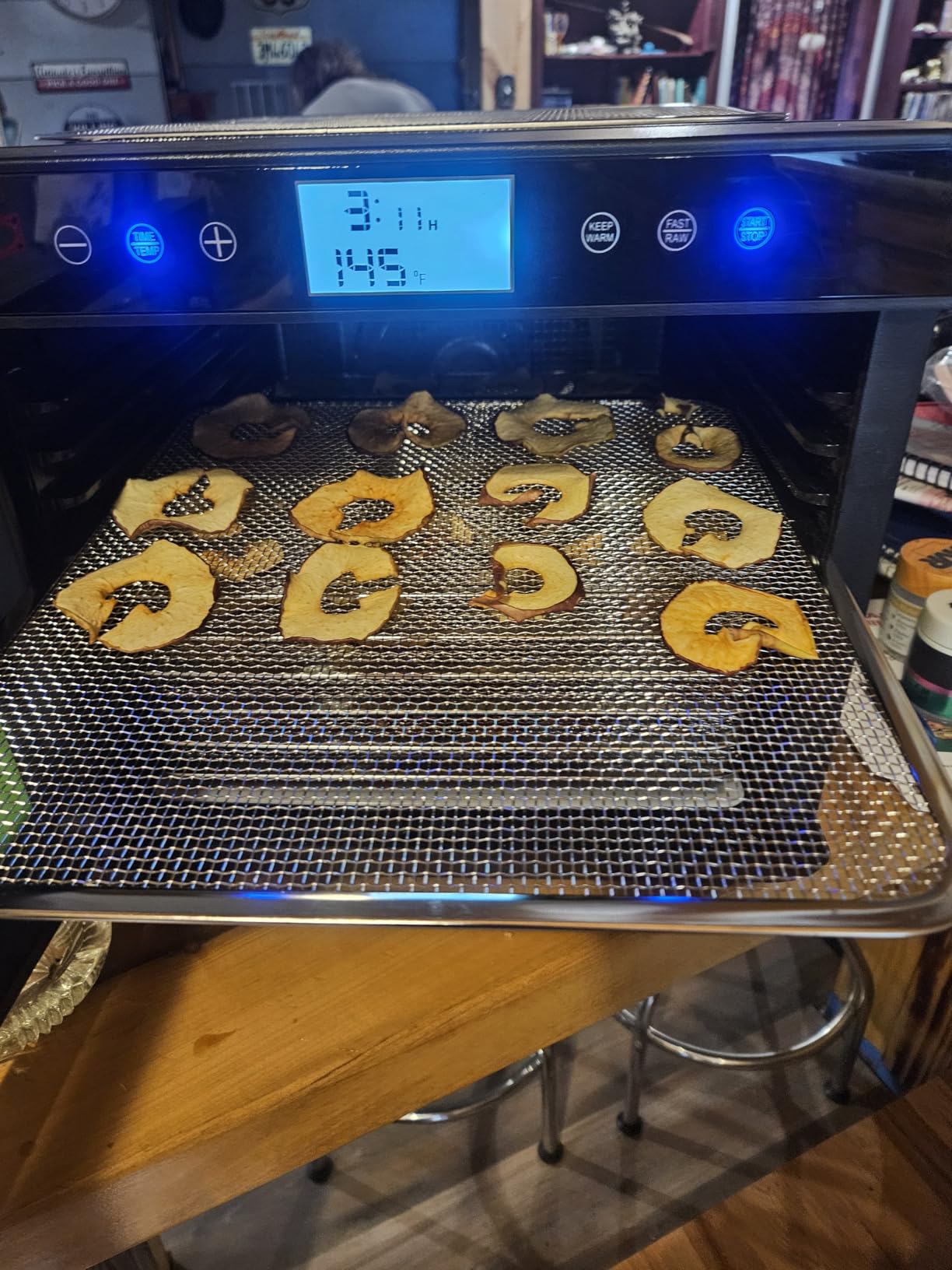
For fruit leather at scale this is the machine to beat. The transparent door means you can watch a full set of sheets set from the edges in without opening anything, and the extra-large trays mean fewer pours to get the same volume.
Automatic shutoff plus overheat protection means it is safe to start a batch and walk away, which is the only realistic way to handle a harvest-scale load.
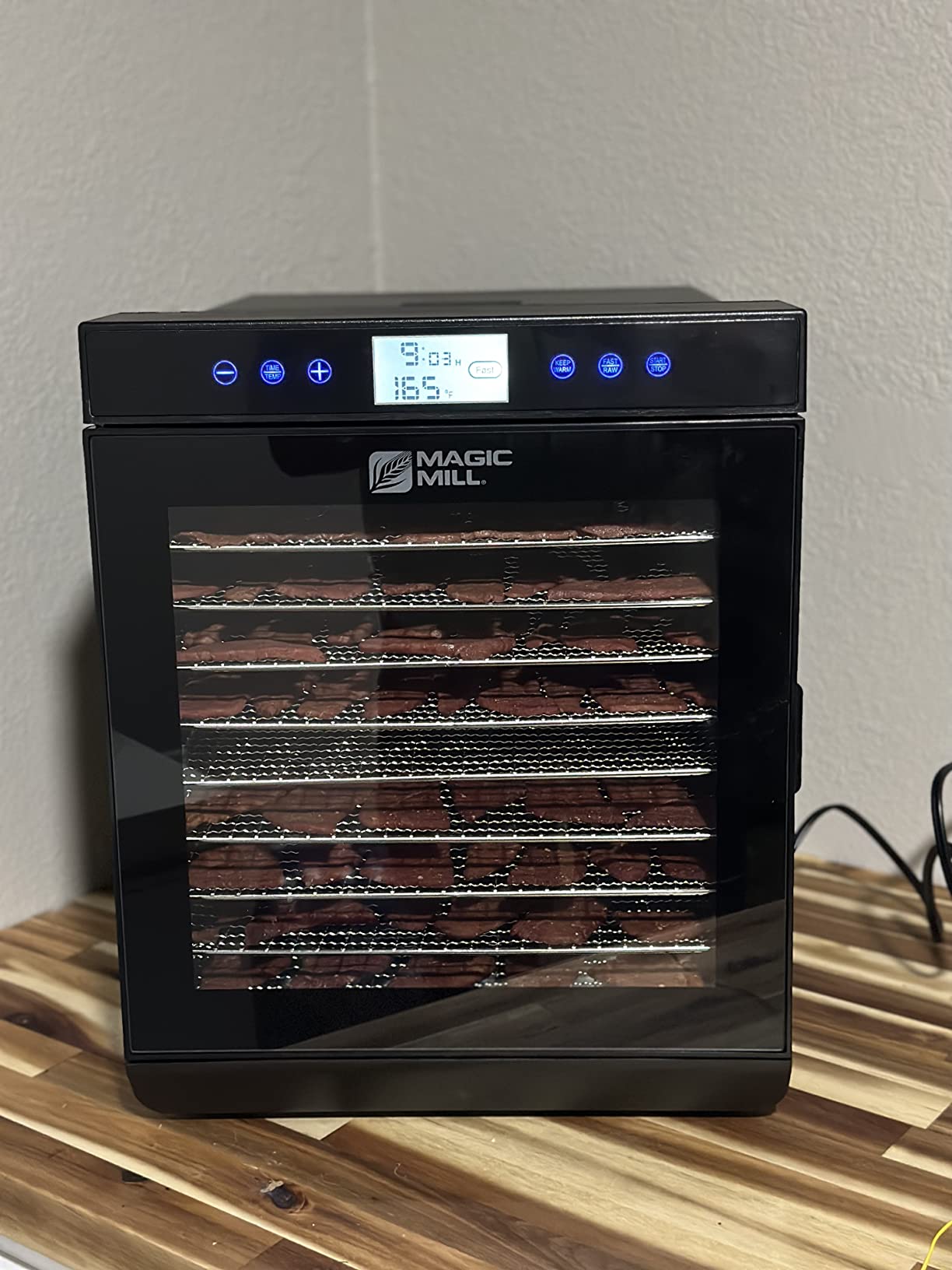
What 15 trays actually does to your schedule
One load replaces roughly three full loads of a five-tray machine, and because the fan and element cover the whole stack, the quality does not drop as you fill it up. That is the argument for capacity here: time returned, not just space saved.
The 95-167F range with a 48-hour countdown covers every fruit job in this article, including slow leather runs, in a single session.
Where it falls short for fruit
It is the bulkiest machine we tested, at 21.4 pounds and 18 by 14 by 17 inches, so it is a dedicated appliance rather than something you tuck away. If you only make a few batches a year, the capacity is wasted space.
The one-year limited warranty is shorter than some competitors offer, and the stainless trays add weight that makes the machine awkward to reposition.
9. NESCO FD-1018A Gardenmaster Pro – Best for Scaling Up Over Time
NESCO FD-1018A Gardenmaster Pro Food Dehydrator, 8-Tray White
8 trays expandable to 30
95-160F thermostat
1000W
Top-mounted fan
15.5 inch trays
Pros
- Expands from 8 trays all the way to 30
- 1000W Converga-Flow airflow
- Eight fruit roll sheets and Clean-A-Screens included
- Fully adjustable 95-160F thermostat
- Trays from older Gardenmaster units still fit
Cons
- Louder than smaller round models
- Trays too big for a standard sink or dishwasher
- Heats the surrounding room noticeably
The Gardenmaster Pro is the second NESCO here and the answer to a different question: what if you want the Nesco approach but a much larger starting capacity. Eight 15.5 inch trays, expandable to 30, and 1000W of drying power make it the biggest grower in the group by a wide margin.
Like its smaller sibling, it ships with eight fruit roll sheets and eight Clean-A-Screens, so leather works immediately at scale without buying consumables for a dozen trays. The 95-160F thermostat is fully adjustable across the dial.
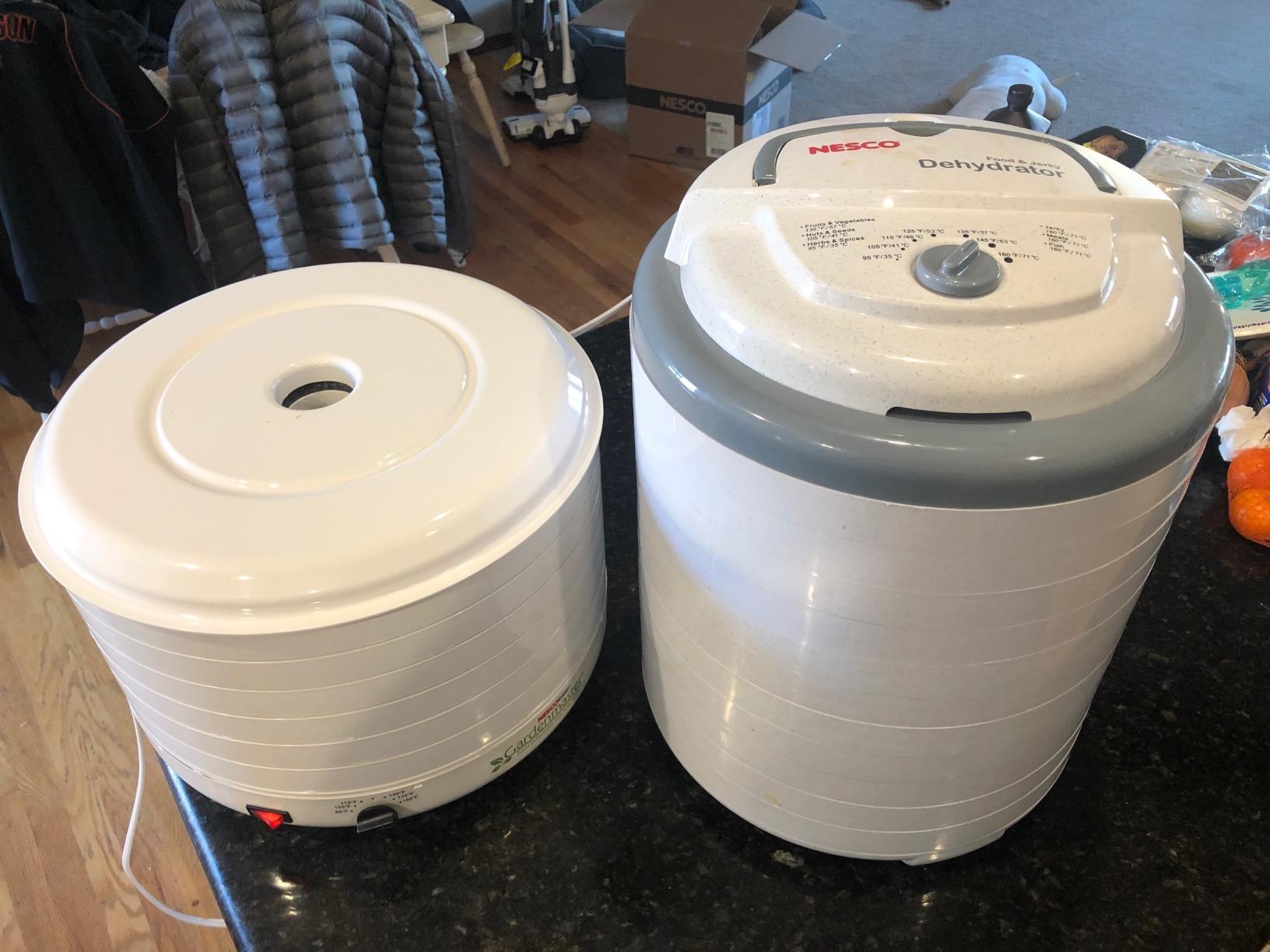
Long-term owners report the unit still running strong after three to seven years of heavy use, and trays bought for older Gardenmaster units still fit, which is a real continuity advantage if you plan to keep this machine for a long time.
The top-mounted fan does the same job as on the FD-75A: it keeps drips off the element and spreads heat evenly down a stack that is twice as tall as most competitors.
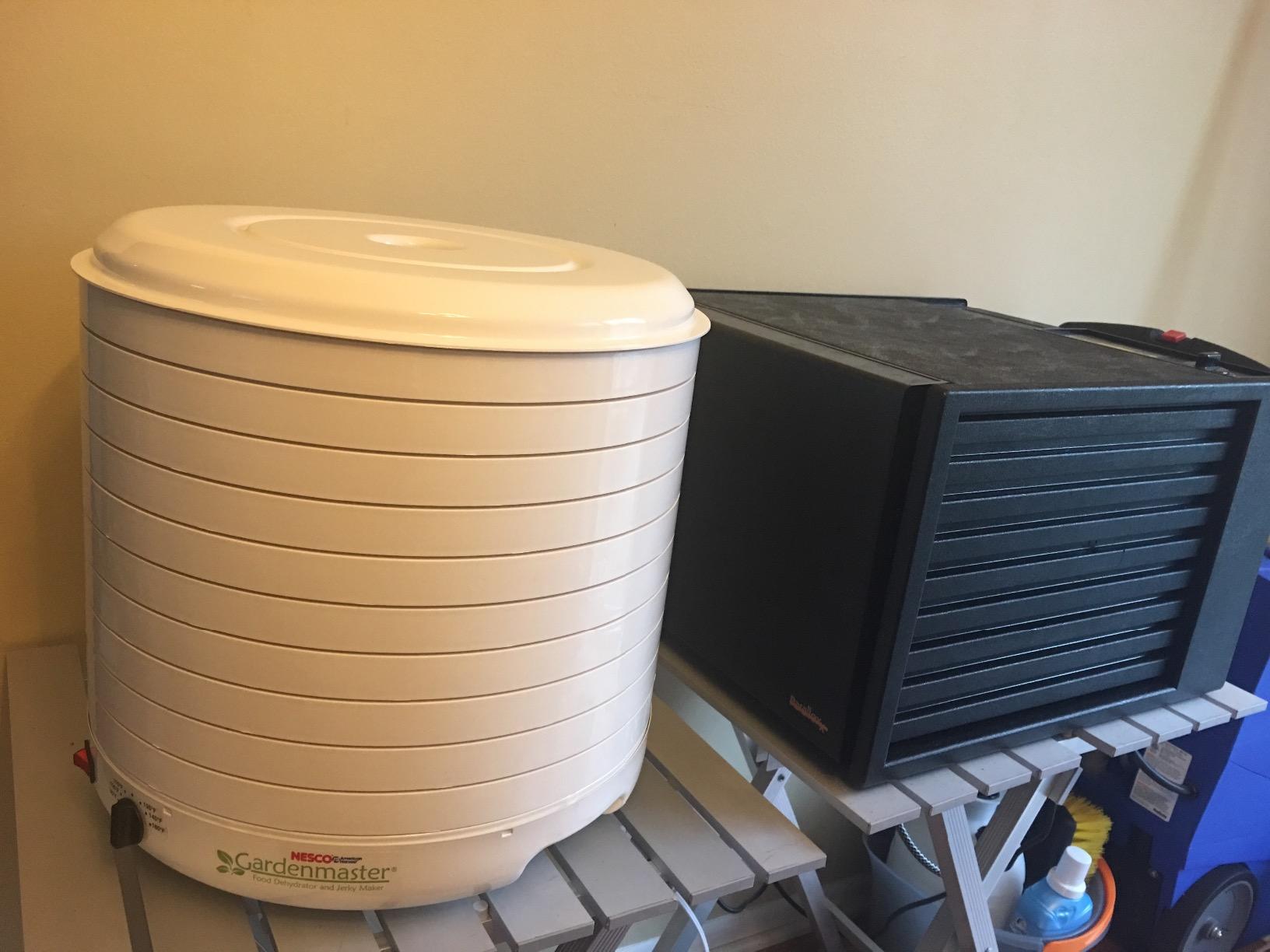
When expanding to 20 trays stops being a good idea
Expansion looks great on paper, but airflow is the constraint. As the stack grows, users report a temperature drop toward the bottom and the top trays finishing or over-drying before the lower ones do.
For fruit, the practical ceiling is the number of trays you can load evenly. We would rather run two moderate loads than one 30-tray stack with uneven results.
Where it falls short for fruit
It is louder than smaller models, roughly comparable to a range hood on low, and it heats the surrounding room noticeably. Owners of large harvests sometimes run it in a basement or laundry room for exactly that reason.
The 15.5 inch trays are too big for a standard kitchen sink or dishwasher and need a tub, and replacement trays bought later may need warming before they seat on the base.
10. Commercial CHEF CCD100W6 – Best Simple First Machine
Commercial Chef Food Dehydrator, Five 9.25” BPA-Free Trays, CCD100W6, White
5 circular 9.25 in trays
104-158F analog dial
280W
3.3 pounds
Compact body
Pros
- Simple analog dial with no learning curve
- Lightest body here at 3.3 pounds
- Compact enough for a pantry or cupboard
- Clear trays let you watch progress
- Quiet enough for normal kitchen use
Cons
- No digital timer so runs are monitored by hand
- Dial is not precisely calibrated
- 280W stretches banana chips to 14 hours or more
- No fruit leather tray included
The simplest machine here still dries fruit properly. Five 9.25 inch circular BPA-free trays, a 104-158F analog dial and clear trays you can see through to watch progress. There is nothing to program, which makes it a genuinely low-friction first machine for someone who just wants apple chips.
At 3.3 pounds it is the lightest and most portable unit we tested, and its compact body stores in a pantry or cupboard between uses rather than occupying permanent counter space.
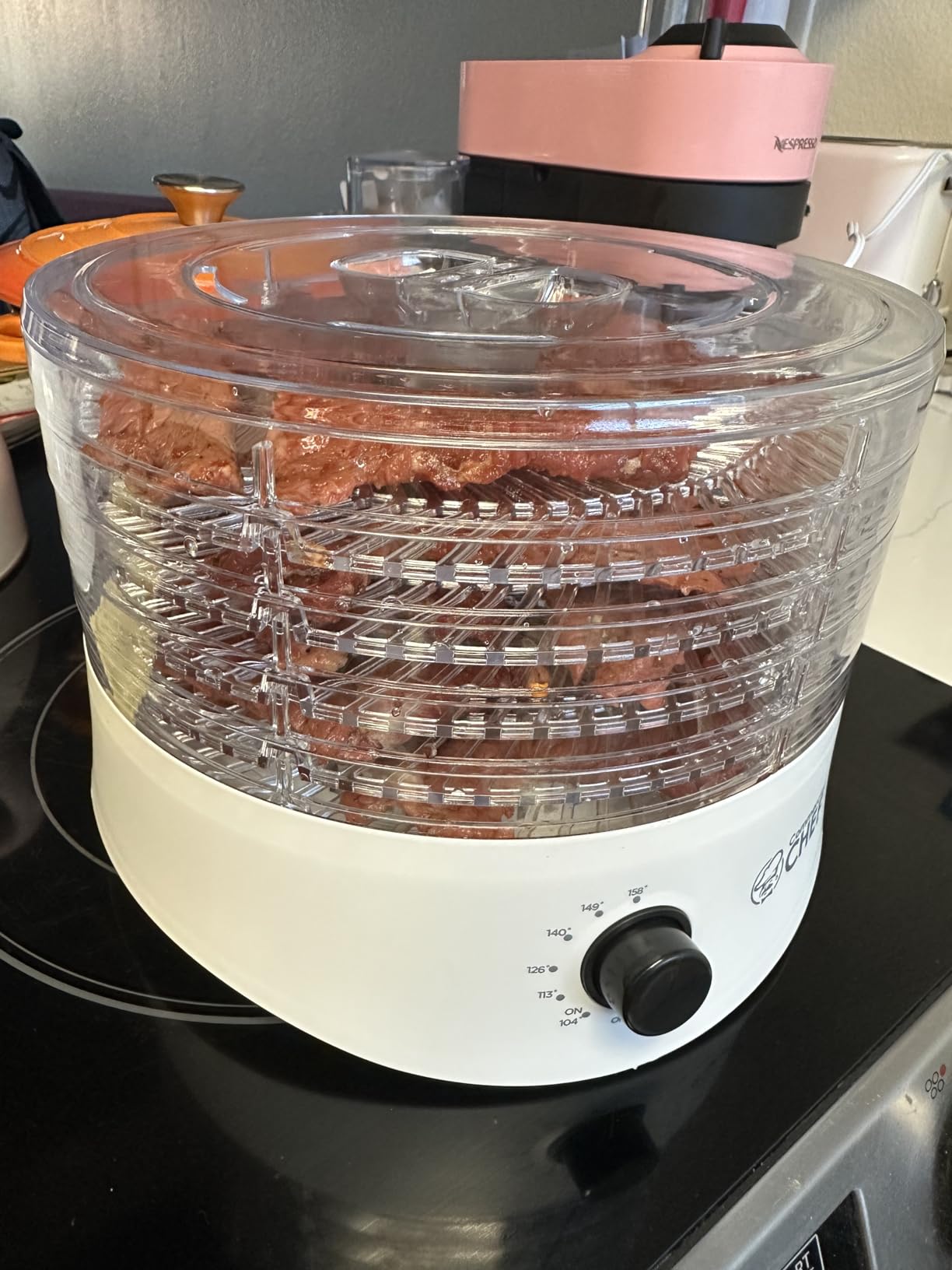
For banana chips and other firm fruit slices the results were respectable, evenly dried across the tray. The clear trays are a real feature at this level, since you are not opening the door every hour to check.
It is also quiet enough for normal kitchen use, which matters more than it sounds when a machine has to run for a dozen hours while you cook dinner.
How to use a machine with no timer
Set a phone alarm for the first check rather than assuming a setting equals a finish time. Start checking thin fruit at 8 hours and firm fruit at 12.
Because the dial is not precisely calibrated, run a batch once and note where the chamber actually settles, then treat that dial position as your own reference.
Where it falls short for fruit
There is no digital timer, so long runs are monitored by hand, and buyers regularly report banana chips and similar fruit taking 14 hours or more on the 280W element. The dial thermostat also overshoots or undershoots the marked temperature.
No fruit leather tray is included, and the trays feel flimsy enough to crack if dropped, which is a consideration if you plan to move the machine between storage and counter.
How to Choose a Dehydrator for Fruit Snacks
For fruit, four criteria decide the outcome: usable drying area, low-temperature control, timer, and tray geometry. Everything else is preference. Here is how we weighted them after running fruit through all ten machines.
1. Usable drying area, not tray count. A round tray with a center hole gives you less usable surface than its diameter suggests, and fruit is bulkier per pound than vegetables. Square trays also spread better for poured leather, because you can level a puree across a rectangle without working around a hole. The Cosori CP267-FD leads here with 6.5 square feet across six trays.
2. Temperature control that holds 125-135F. That band is where nearly every fruit dries best. A machine that only reaches one setting, or whose dial is loosely calibrated, will push delicate fruit toward roasted rather than dried. Machines with 1-degree digital increments give you the most repeatable result.
3. A built-in timer with automatic shutoff. Fruit runs long. A 48-hour timer with auto shutoff is the single most useful safety and convenience feature for fruit work, and it is the reason several machines here rank where they do.
4. Square trays versus round trays. Square trays slide in from the front, so you never have to lift every tray above the one you want to check. Round stackable trays save footprint but mean lifting the stack, which is the reason many owners of round-tray models swear off them. More owners still rotate trays partway through a run on round models.
5. Expandability, with an airflow caveat. Expandable NESCO and Presto models let you grow from five trays to twelve. Just know that airflow gets thinner as the stack grows, and dry times climb. Beyond a certain point, two medium loads beat one enormous stack.
6. Wattage, and what it costs you in hours. A 600W element finishes fruit batches meaningfully faster than a 240W one. The trade-off is the counter footprint and heat a 1000W machine throws into the room. If you are starting out, faster is kinder than cheap.
7. Noise. Dehydrators run for 8 to 24 hours. Brushless motors under 48 dB, like the two Cosori models here, are the quietest and the most restful to have in a kitchen near a bedroom.
8. Cleaning and durability. Stainless steel trays release dried fruit more easily than coated plastic, but they want hand washing. Avoid the dishwasher heated dry cycle on any tray, since warping a tray breaks its seal and quietly degrades drying performance. On fruit runs, rinsing under warm water and a sponge is enough.
Two more items to budget for. Mesh screens, fruit roll sheets and liners are usually extras, and a serious fruit setup needs one of each per tray. If leather is your main project, our dedicated fruit leather picks spell out which sheets to buy. If you also make jerky, our jerky dehydrator guide covers the higher-temperature side.
Fruit Prep: Stop Browning and Sticking Before You Load
Most failed fruit batches fail before the machine starts, not during it. Two problems account for nearly all of them: browning and fusing. Both are prep problems, and both are fixed in about five minutes.
Stop browning with an acid dip. Cut fruit browns from enzyme action at the cut surface. The cheapest fix is a bowl of water with the juice of half a lemon, dipped for three to five minutes. Ascorbic acid powder dissolved in water works the same way and adds no flavor, which matters for pineapple and mango where lemon shifts the taste. Apples, pears, peaches and bananas all benefit.
Blanch when color matters more than texture. A 30-second dip in boiling water, then an immediate cold plunge, inactivates the browning enzymes and keeps fruit bright. Sliced kiwi and peaches hold color far better after a quick blanch. Slightly softer texture is the trade.
Why banana and apple slices fuse. Sugar melts out of the fruit as it warms, and two slices touching at the right temperature become one sheet. Sugary fruits do it fastest, which is why banana is the worst offender. Three things prevent it: space slices at least a finger width apart, keep the temperature at or below 135F so sugar does not fully melt, and use mesh screens or liners so nothing welds directly to steel.
Flip or rotate the back trays once. On any machine, check the tray nearest the element and the one furthest from it at the halfway point. If one side is clearly ahead, swap the top and bottom trays. It costs 30 seconds and fixes most uneven batches.
Mind your kitchen humidity. Dehydrators in a humid house pull moisture more slowly, and experienced users report real batches running well past recipe times. If your house is humid in summer, add a few hours rather than raising the temperature, which cooks the fruit instead of drying it.
How to Tell Dried Fruit Is Done, and How to Store It
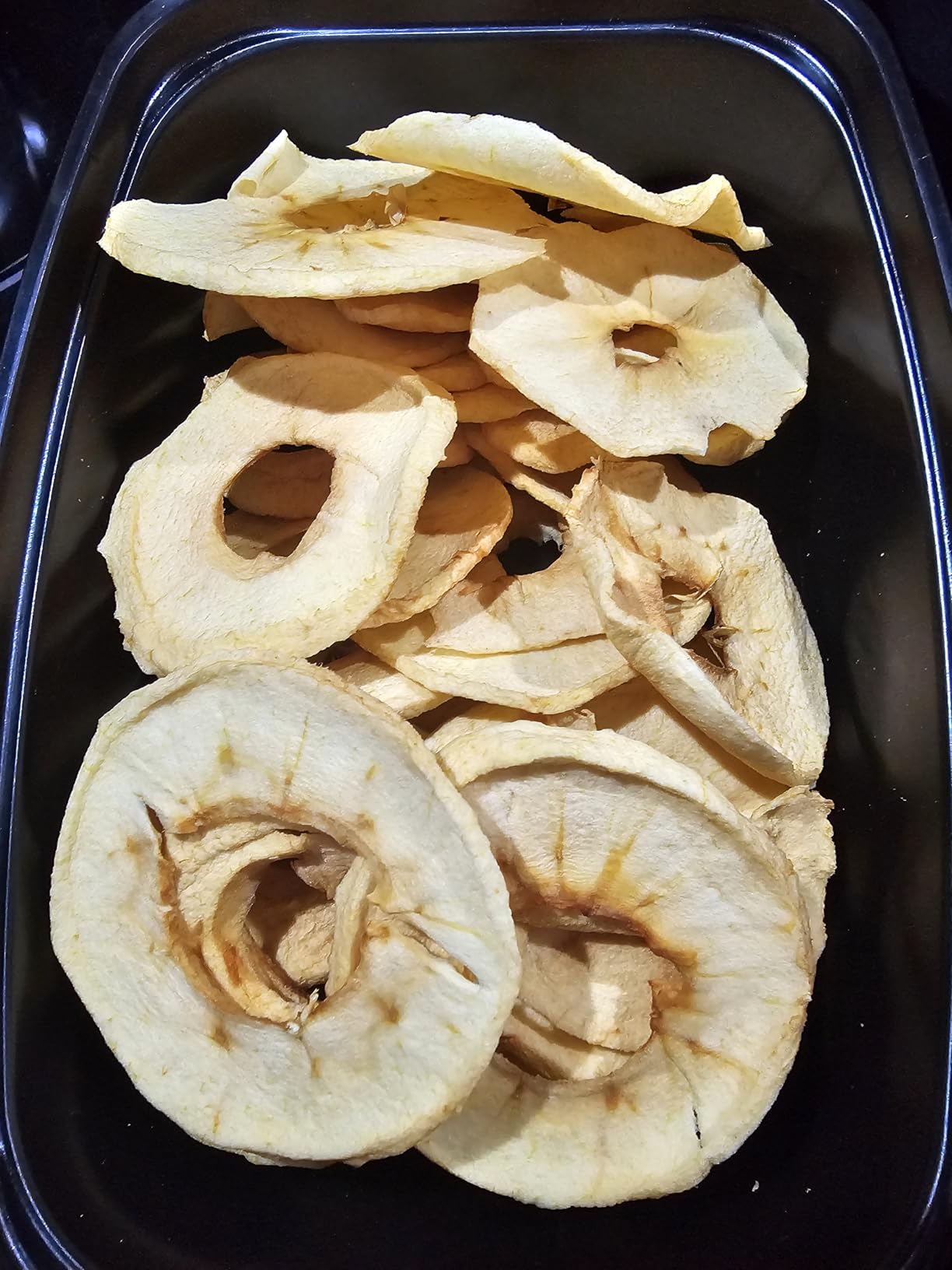
Fruit is done when it snaps instead of bending, and when the center no longer feels soft. A dried apple slice should break with a clean crack and leave no cool or tacky spot in the middle. Bend it gently; if it folds rather than snaps, give it another hour or two.
For fruit leather, done means the sheet lifts cleanly from the liner without tearing and has a dry, matte surface with no tacky patches. Test the center, not the edges. Edges always set first, and a leather sheet that feels dry at the rim can still be soft in the middle.
Cool the finished batch fully before storing. Warm fruit packed into a jar traps condensation, and that condensation is how dried fruit goes soft and then moldy. Once fully cool, store slices in airtight containers in a cool dark cupboard, and keep them in single layers so nothing is crushed.
A quick safety note: do not run a dehydrator unattended overnight unless the machine has an automatic shutoff and you are starting from a clean, cool burn range. A dehydrator is a long-running heated appliance in a kitchen, and the machines here with a built-in timer are the ones we would leave running while asleep.
Frequently Asked Questions
How long does a food dehydrator take to dry fruit?
Most fruit takes 6 to 18 hours at 125-135F. Thin banana chips finish in 6-8 hours, quarter-inch apple and orange slices in 8-11 hours, strawberry halves in 12-16 hours, and a poured fruit leather in 16-24 hours. Humidity and starting moisture add several hours.
Which food dehydrator is better, Cosori or Excalibur?
Cosori wins on quietness, stainless steel trays and degree-accurate digital control. Excalibur is the other name in this category and is known for large tray area and a wide sheet ecosystem, but none of its units made our top 10. For fruit specifically, the Cosori CP267-FD’s 6.5 square feet of sliding trays and rear fan gave us the most even results without tray rotation.
What is the best food dehydrator for making fruit leather?
The Hamilton Beach 32100A is the most practical choice because it includes both a mesh screen and a solid fruit leather sheet, plus a 48-hour auto shutoff timer. The Cosori CP267-FD is best if you want more capacity, and the NESCO FD-75A is best if you want included sheets and room to expand.
Which Nesco dehydrator is best?
The NESCO FD-75A Snackmaster Pro is the better all-round fruit machine, with five trays expandable to 12 and fruit roll sheets included. The FD-1018A Gardenmaster Pro is the choice for very large harvests, with eight trays expandable to 30 and 1000W of drying power.
Do I need mesh screens to dry fruit?
Mesh screens are not strictly required, but they help thin slices such as apple and banana release cleanly and let air pass under the food. For fruit leather you want a solid sheet rather than mesh, since puree drains through a screen. Most machines include one of each type at most.
Why do my dried apple slices stick together?
Sugar melts out of the fruit as it warms, and slices that touch at that temperature fuse into a single sheet. Space slices at least a finger width apart, keep the temperature at or below 135F, and use mesh screens or liners so fruit does not weld to the tray surface.
Conclusion
After ten machines and more fruit than we expected, the best dehydrators for making fruit snacks in 2026 come down to three honest answers. Buy the Cosori CP267-FD if you want the most even results, the largest flat tray area and a machine quiet enough to run overnight. Buy the NESCO FD-75A if you want one unit that grows with you and includes the sheets you need for leather on day one. Buy the Presto 06300 if you want clean drying and compact storage at the lowest outlay.
For a real harvest rather than a weekly snack habit, the Magic Mill 15 XL Tray replaces three small loads with one. Whichever you pick, remember that prep decides more than hardware: an acid dip, a finger width of space between slices, and a temperature held at or below 135F will outperform any machine running the wrong setup. Start with one batch of apple slices, and the rest of the season takes care of itself.
For more drying projects, our fruit press guide covers turning a surplus harvest into cider.