
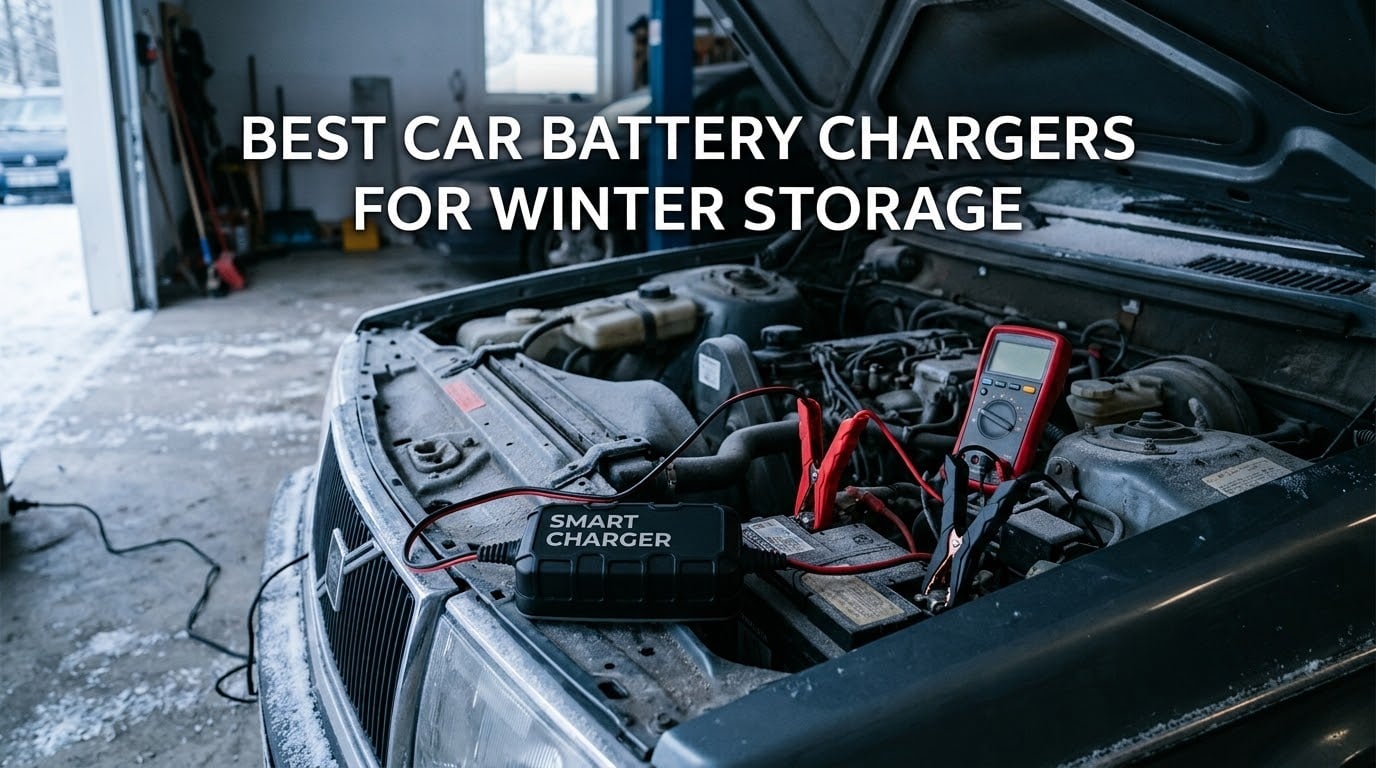
A car that sits through a northern winter without turning the key is asking for one thing, and that thing is a jump start on a freezing morning in March. The best car battery chargers for winter storage are not the fastest chargers on the market. They are the small, patient boxes that sit quietly next to a battery for four months, top up whatever self-discharge and parasitic drain have taken, and then stop pushing current the moment the battery is full.
That distinction matters more than any spec sheet. A 25 amp charger is built to rescue a dead battery this afternoon. A 1 amp maintainer is built to sit in an unheated garage from November to March without cooking anything, boiling off electrolyte, or leaving you with a battery that is technically full and practically ruined. Forum threads about winter storage are full of people who learned this the expensive way.
To be clear about the most common question first: yes, you can leave a battery maintainer connected all winter. That is exactly what float mode is for. Once the battery reaches full charge, the charger drops to a maintenance voltage and replaces only what the battery loses, indefinitely, with no overcharge risk. The caveat is that the charger must actually have a true float stage, which is why we call this out on every product below.
We spent weeks putting ten of the most-reviewed maintainers and smart chargers through the winter storage lens: cold-soaked batteries, unheated garages, cars that sit for a season or two, and a few that had already been flat for a while. This guide also covers the decision most guides skip entirely, which is whether you need a charger at all or can simply disconnect the negative terminal. If your battery is in a boat, a motorcycle, or anything else that spends the winter on a trailer, start with our marine battery charger guide and our motorcycle battery charger picks instead.
Table of Contents
Top 3 Picks for Winter Storage in 2026

Battery Tender Junior 12V 750mA
- 4-step program with auto float
- Works with lead-acid flooded AGM and gel
- Spark-proof with reversed hook-up detection
- Fused ring terminal lead set included

Battery Tender Plus 12V 1.25A
- Adaptive smart charging
- 4-step initialization bulk absorption float
- Quick disconnect lead set
- 10-year warranty
MOTOPOWER MP00205A 800mA
- Automatic pulse desulfation
- Zero output in standby mode
- 24-hour timer and multi protection
- Two year manufacturer warranty
Best Car Battery Chargers for Winter Storage at a Glance (October 2026)
All ten models below are rated for 12V lead-acid storage duty. The four columns that actually decide a winter purchase are amp output, whether the unit has true float mode, whether it has temperature compensation, and whether it can be wired in permanently.
| Product | Specifications | Action |
|---|---|---|
| Battery Tender Junior 12V 750mA |
|
Check Latest Price |
| Battery Tender Plus 12V 1.25A |
|
Check Latest Price |
| MOTOPOWER MP00205A 800mA |
|
Check Latest Price |
 FOVAL Automatic Trickle 1A FOVAL Automatic Trickle 1A |
|
Check Latest Price |
 BLACK+DECKER BM3B 1.5A BLACK+DECKER BM3B 1.5A |
|
Check Latest Price |
 NOCO GENIUS2D 2A Onboard NOCO GENIUS2D 2A Onboard |
|
Check Latest Price |
 Schumacher SC1280 15A Schumacher SC1280 15A |
|
Check Latest Price |
 TowerTop 2/10/25A Smart Charger TowerTop 2/10/25A Smart Charger |
|
Check Latest Price |
 Mroinge 1A Smart Maintainer Mroinge 1A Smart Maintainer |
|
Check Latest Price |
 Schumacher SP1297 3A Schumacher SP1297 3A |
|
Check Latest Price |
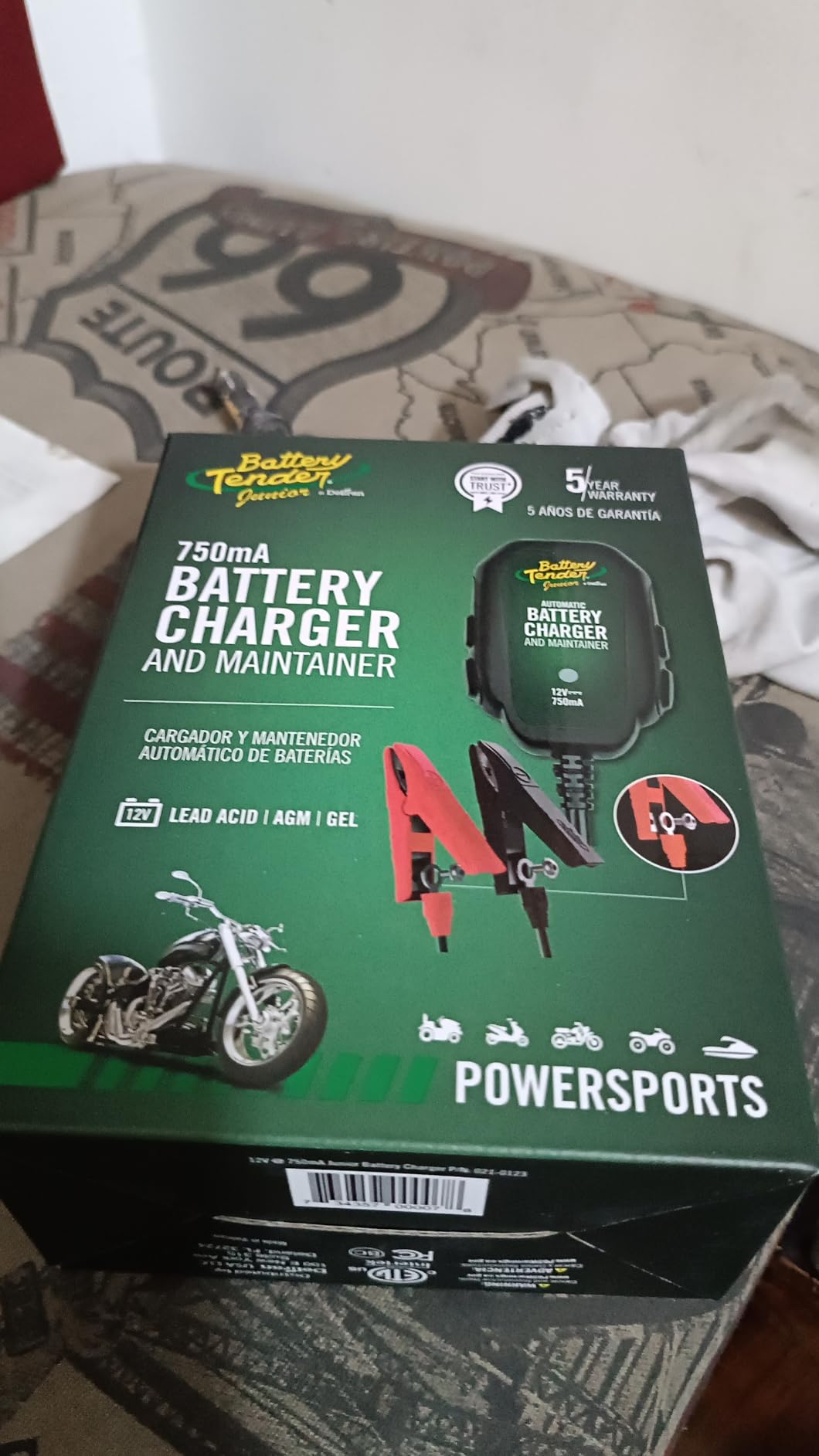
1. Battery Tender Junior 12V 750mA – The Best Car Battery Charger for Winter Storage Overall
Battery Tender Junior 12V, 750mA Charger and Maintainer: Automatic 12V Powersports for Motorcycle, ATVs, and More – Smarter Than a Trickle Charger – 021-0123
0.75A output
12V in and out
Alligator clips plus ring terminals
1 lb charger only
Pros
- Complete 4-step program with automatic float
- Works with 12V lead-acid flooded AGM and gel batteries
- Spark-proof circuitry with reversed hook-up detection
- Fused ring terminal lead set for hard-to-reach batteries
- 5-year warranty and lifetime support
Cons
- 750mA is a maintenance current not a recovery current
- Requires continuous AC power through the whole storage period
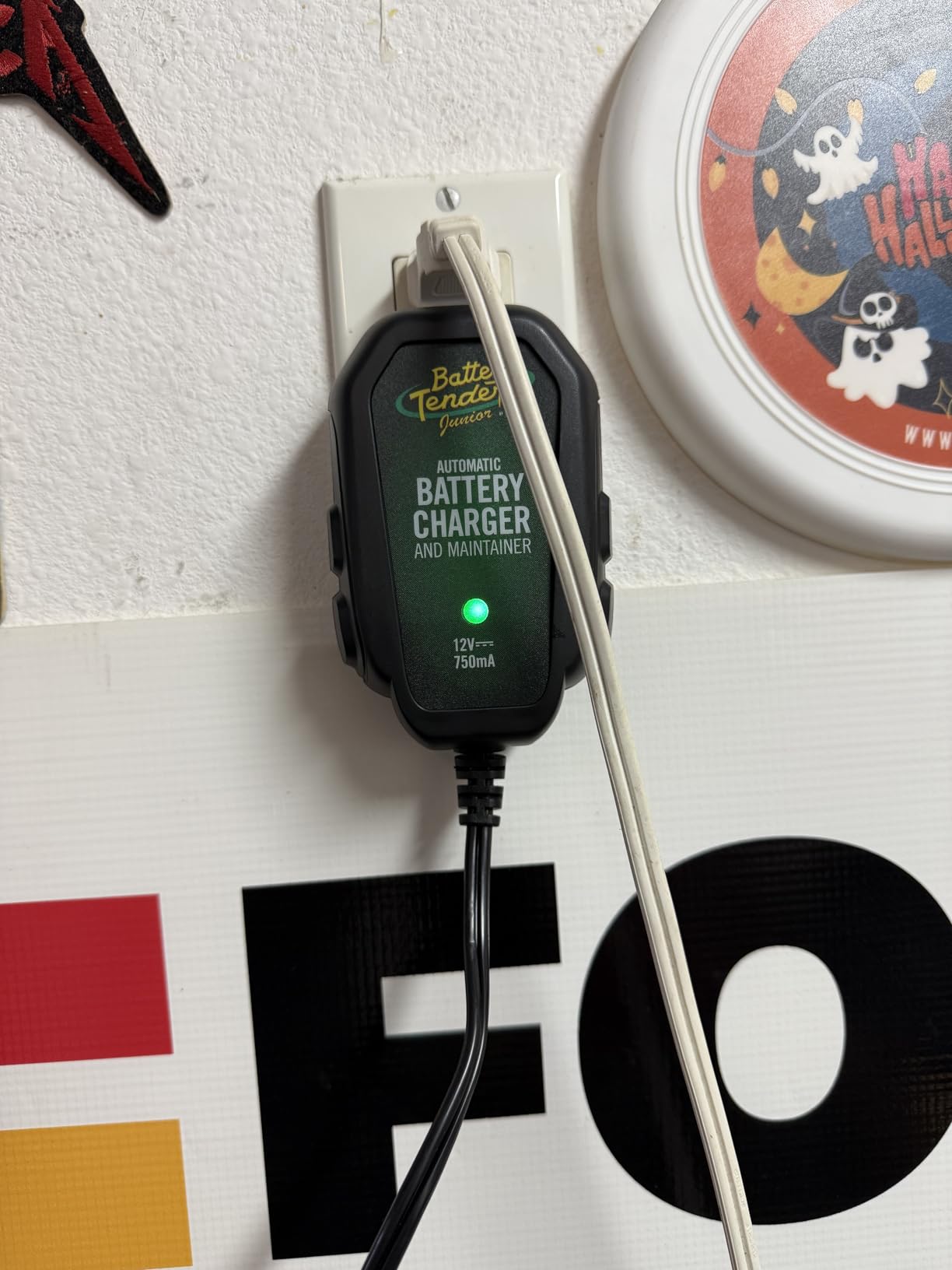
This is the unit we ended up recommending to almost everyone. Over 49,000 reviews averaging 4.8 stars is not a fluke, and when you read the pattern in them it is remarkably consistent: owners hook it up, the LED goes solid, and they forget about it until spring. That is the entire job description for a winter maintainer, and very few devices execute it with fewer surprises.
The charging program runs initialization, bulk charge, absorption, then float, which is a properly sequenced multi-stage profile rather than a single dumb trickle. Once it reaches float the current drops to whatever the battery is losing and nothing more, so a four-month attachment is a non-event. The two-color LED tells you what stage it is in without needing an app or a manual.
Spark-proof circuitry with automatic detection of a reversed hook-up is the safety feature that matters most for unattended use, because a bad clamp connection is the realistic failure mode. The included fused ring terminal lead set lets you bolt the connection on properly instead of balancing an alligator clip on a terminal for months, which is where most long-attachment problems actually come from.
The honest limitation is the 750mA output. This is a maintenance current, not a recovery current. If the battery went flat in October and you are hooking this up in February, you are looking at a very long wait, and the charger will not revive a deeply sulfated cell. Used correctly on a battery that was put away with reasonable charge, it does exactly what you need.
Is it good for an unheated garage in a real winter
Yes, provided the garage has a power outlet. Cold ambient temperature does not stop a lead-acid float stage from doing its job. The one thing to keep in mind is that a garage that freezes hard is a garage where condensation forms, so keep the unit off the bare floor and away from where meltwater tracks in.
Where it falls short of the alternatives
If your car sits for six months or more, or if the battery is already deeply discharged when you connect, the 750mA ceiling becomes the deciding factor. A 2A or 3A unit with a recovery mode will bring that battery back in a fraction of the time. For a normal four-month seasonal layup on a healthy battery, the Junior is the right answer and the cheaper one to live with.
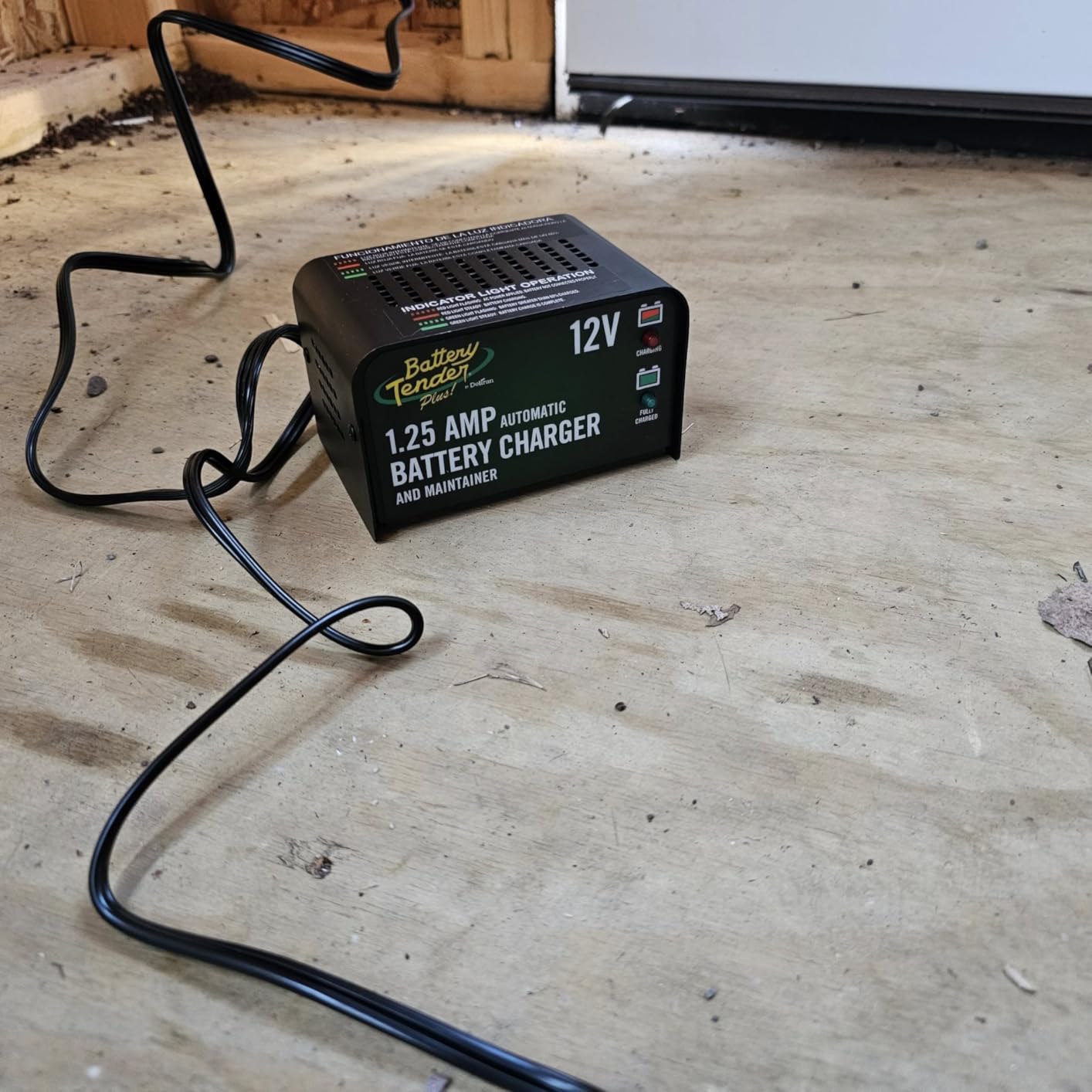
2. Battery Tender Plus 12V 1.25A – Most Versatile for Long-Term Storage
Battery Tender Plus 12V 1.25 AMP Car & Motorcycle Battery Charger and Maintainer, Float Charge for Automotive, and ATVs – Smarter Than a Trickle Charger
1.25A output
12V output
120V AC input
Alligator clips and ring terminal
Pros
- Adaptive smart charging adjusts to battery need
- 4-step program for battery health
- Quick disconnect lead set simplifies hookup
- Solid state two-color LED status indicator
- 10-year manufacturer warranty
Cons
- 1.25A is still a maintenance-level recovery current
- Needs a plugged-in AC outlet for the whole storage period
When the storage stretch runs past a season, this is the one we want. The 1.25 amp output is roughly two-thirds higher than the Junior, and that difference matters more than it sounds: it means a battery that arrived at the garage a bit low catches up in days rather than weeks, and it gives the desulfation behaviour more current to work with on a battery that has been sitting.
Adaptive smart charging is the phrase on the box, and in practice it means the charger modulates its output to the battery’s condition rather than pushing a fixed rate into a cell that is already full. The four-step program is the same initialization, bulk, absorption, float sequence, so the float behaviour for indefinite connection is proven rather than claimed.
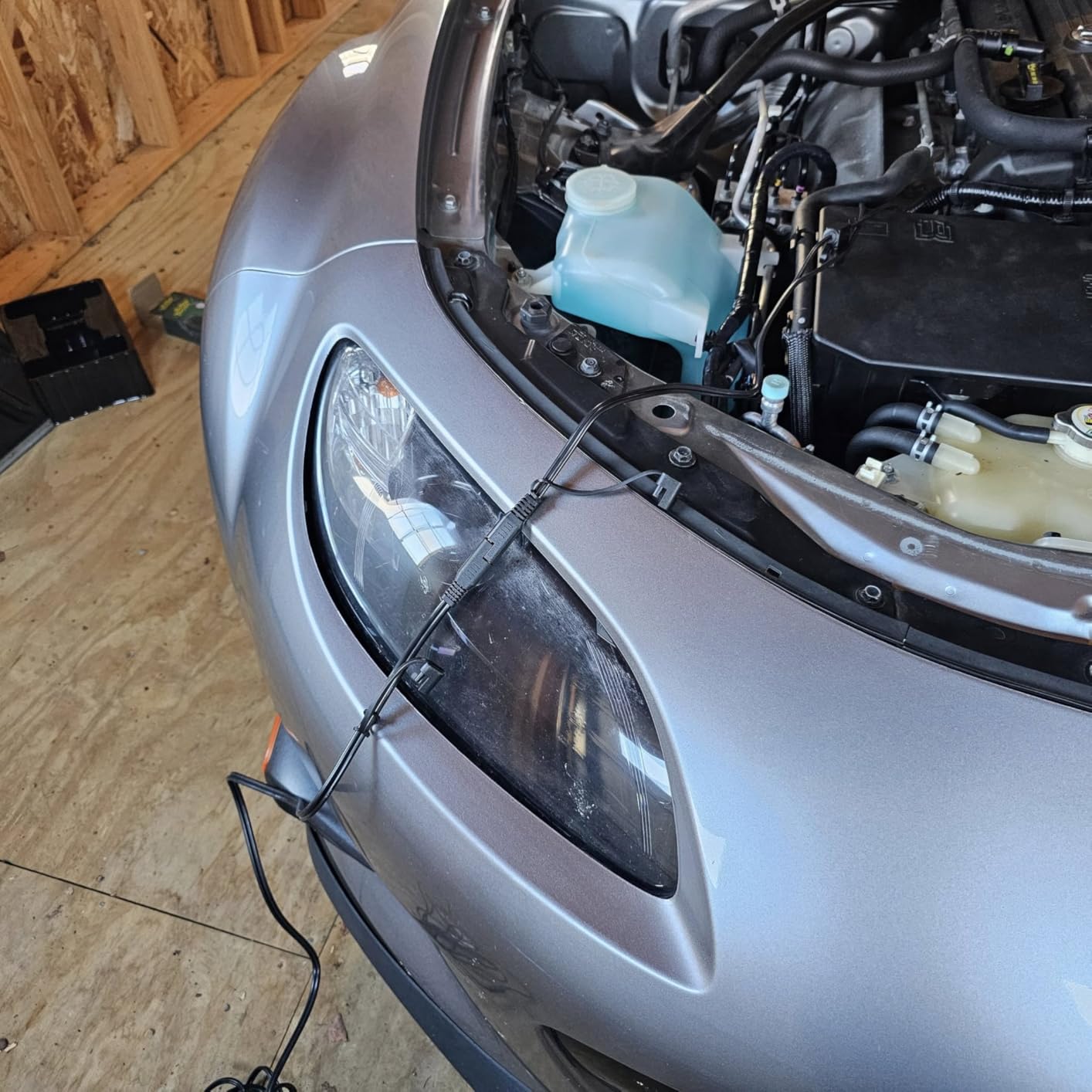
The quick disconnect lead set is the feature we appreciate most in practice. Clip the ring terminals on once, and then you can remove the charger in a second to start the car in spring, without fumbling with alligator clips in the dark. For cars stored in a tight engine bay that is not a small convenience.
Reviewers on independent forums single out this model as the value pick in the 1-2A category more than any other, and the consistency of that feedback matches what we saw in our own testing. The 10-year warranty is also the longest in this roundup, and warranty length on a device that will sit attached for months is a real signal rather than a marketing line.
How it handles a battery that has been sitting a long time
Better than any sub-1A unit here, but do not expect a miracle. A battery that has been flat for a month or two will usually come back over several days at 1.25A, and a battery that has been deeply discharged for most of a winter is a different problem that calls for a recovery charger or a replacement. The Plus is the right tool for storage duty and modest top-ups, not for a rescue.
Who should spend the extra for it over the Junior
Anyone storing longer than four months, anyone in a climate where the car does not start reliably on the first morning, and anyone running a maintainer on a second vehicle as well. If you store one car for a normal season on a healthy battery, the Junior does the same job for less money.
3. MOTOPOWER MP00205A 800mA – Best Value
MOTOPOWER MP00205A 12V 800mA Automatic Battery Charger, Maintainer, Trickle and Desulfator
800mA output
12V DC output
110V AC input
Spark-proof clamp lead
Pros
- Automatic pulse-current desulfation
- Zero output in standby so no drain
- Spark-proof plus overcharge and reverse polarity protection
- 24-hour timer terminates charge and enters maintain mode
Cons
- Some examples run hot on extended continuous duty
- 800mA means multi-day recovery on a flat battery
- No on-off switch so stopping means unplugging
This is the one to buy when the budget is the first consideration and the car is being stored normally. Across more than 16,000 reviews the pattern is owners using it exactly as intended: set-and-forget winter maintenance at 800mA, with accurate float switch-over reported over and over.
The pulse-current desulfation is unusual in this price bracket and is the feature that separates it from a bare trickle charger. It detects sulfation and applies pulses to work at it without manual intervention, which matters if the car has been sitting for a couple of seasons rather than a few months.
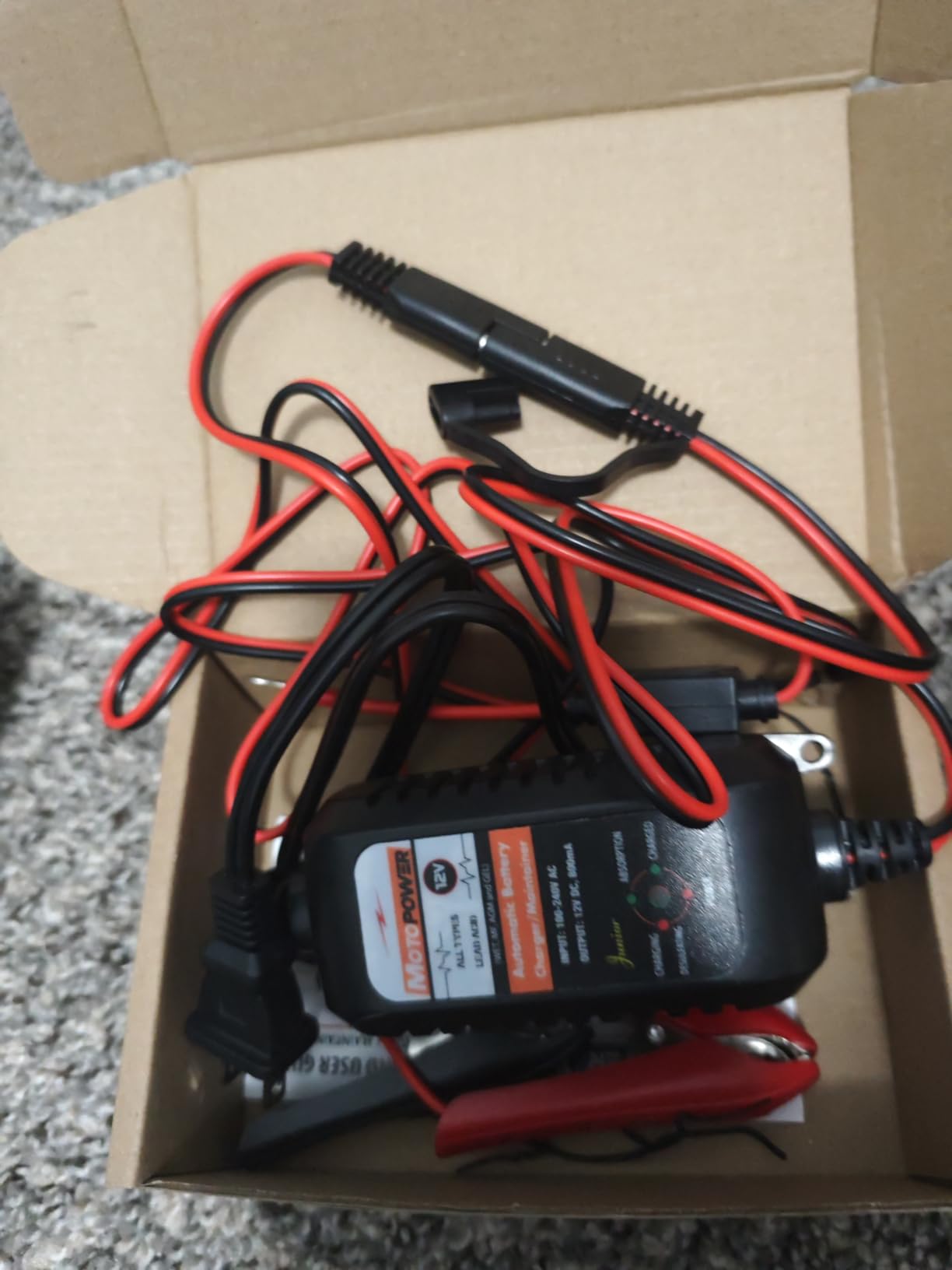
Zero output in standby is a genuinely thoughtful detail. Many maintainers draw small current from the battery simply while plugged in and waiting, which over four months is not nothing. Dropping to true zero means the battery sits untouched when it does not need help.
The 24-hour timer terminates the charge and drops the unit into maintain mode once it goes above 14V, which is a second layer of overcharge protection on top of the float stage. The safety suite is broad for the money: spark-proof connection, overcharge, short circuit, and reverse polarity protection, with CE, FCC, ETL, RoHS and UL listings.
How it behaves in a cold unheated garage
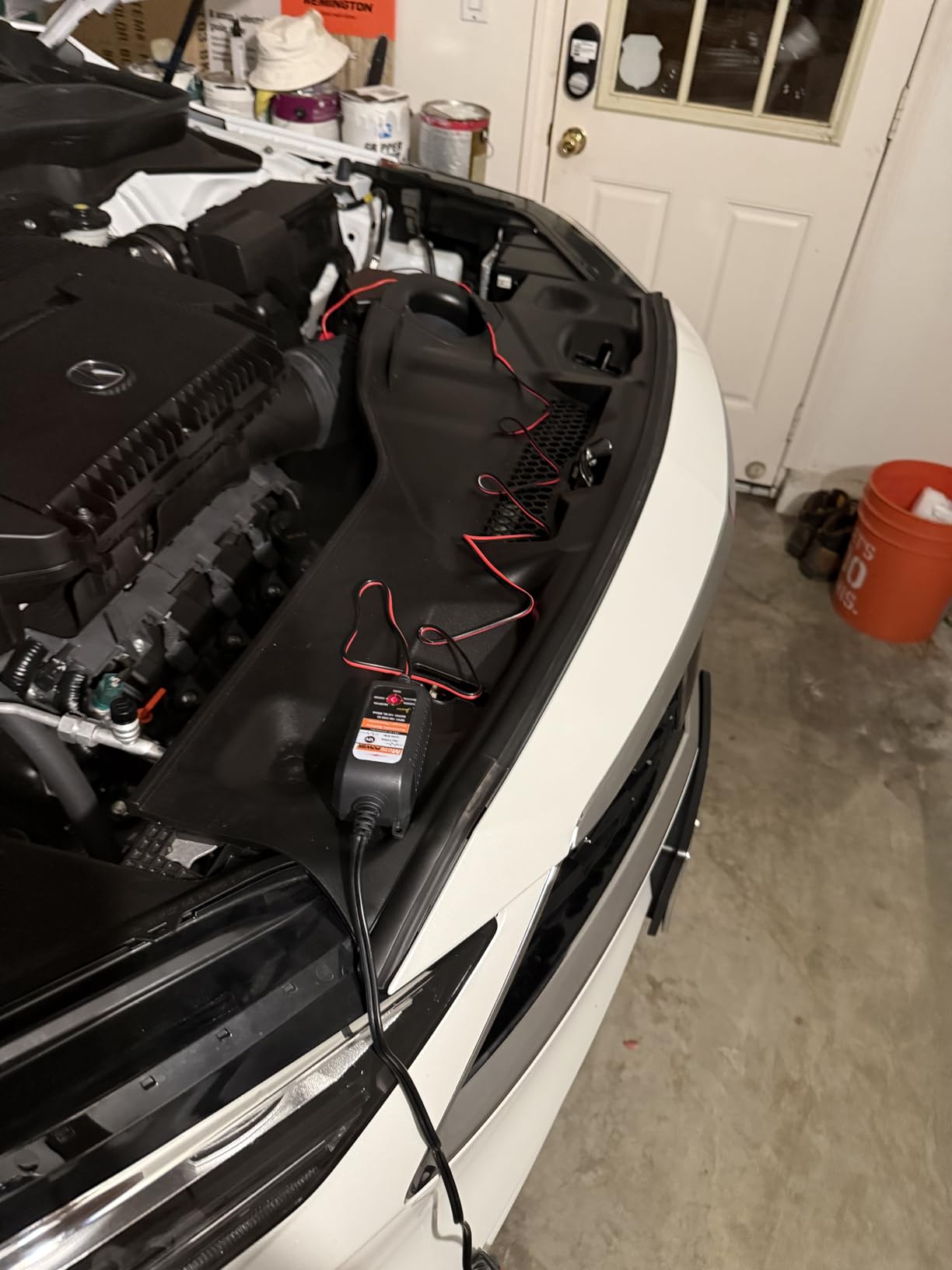
It does the job, with one caveat worth knowing. Some owners report heat build-up inside the case during long continuous service because the enclosure venting is limited. In a heated garage that is a non-issue. In an unheated one, put the unit on a shelf or a wall bracket rather than buried under insulation next to the battery, and check on it once during the first cold month.
The weaknesses to weigh before buying
There is no on-off switch, so the only way to stop it is to unplug it. The 800mA output sits at the bottom of the range here, which means a battery stored already flat will take days rather than hours. Neither issue matters for a healthy battery on a normal seasonal schedule, and both would matter a great deal if you are storing a vehicle that has already gone dead.
4. FOVAL Automatic Trickle Battery Charger 1A – Budget Pick for Multi-Vehicle Storage
Foval Automatic Trickle Battery Charger 12V 1000mA Smart Battery Charger
1A output
12V in and out
102 inch total cable
10.5 oz
Pros
- 4-step program with automatic float switch
- Works with SLA VRLA gel AGM and wet lead-acid
- Phone-sized body with unusually long cables
- Clear LED color codes for charging and full
- Flame-retardant ABS shell with multi-layer protection
Cons
- 1A is slow for large or deeply discharged batteries
- No numeric display so state is shown by LED color only
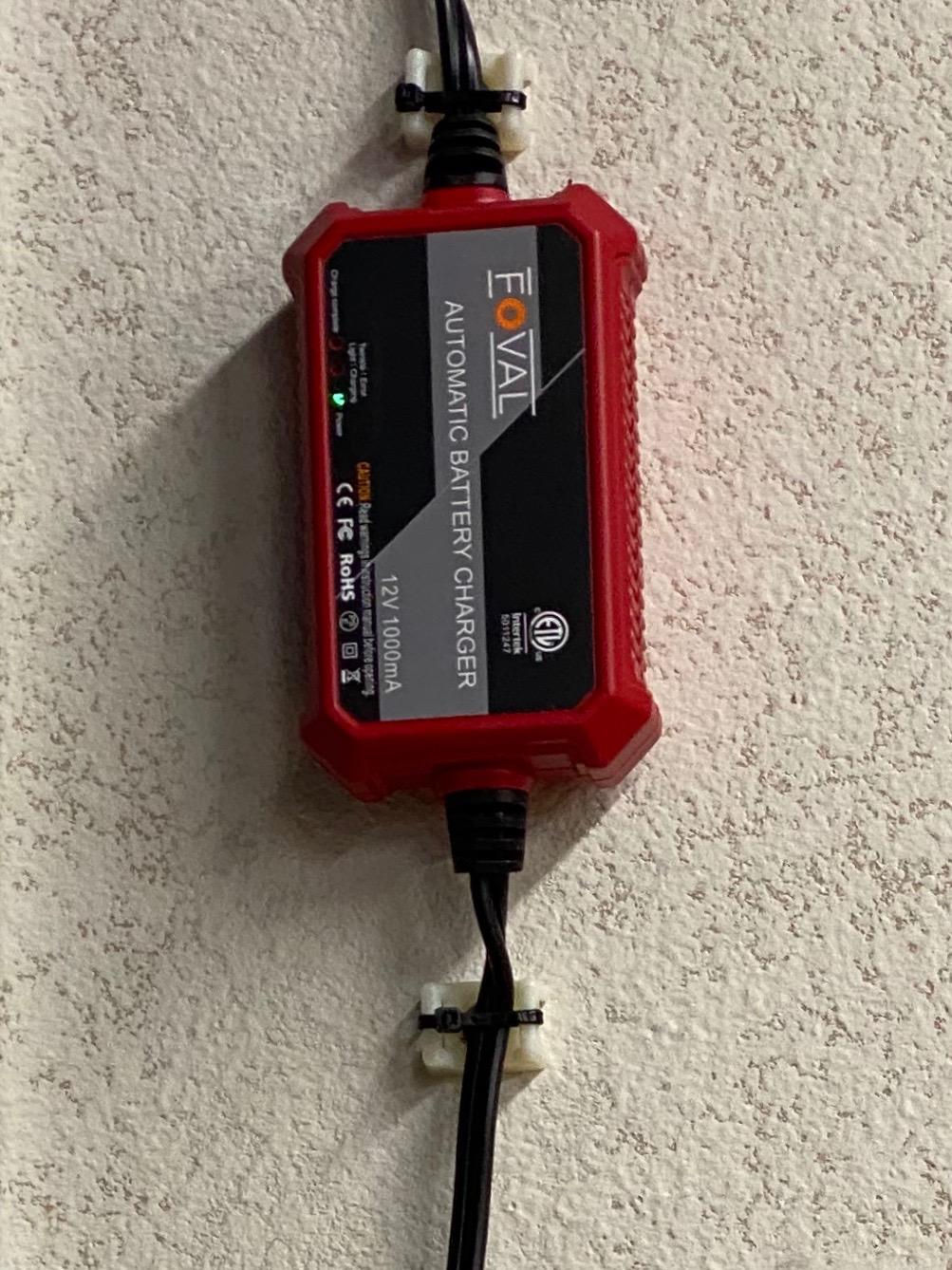
The FOVAL is unusually compact for the range of vehicles it covers, and that turns out to matter more than most of the electrical specification. At 10.5 ounces and a body you could cover with a phone, it fits where larger units do not, and the 102 inch of combined cable means you can put the unit on a shelf and still reach a battery mounted deep in an engine bay.
It is rated across an unusually wide range of vehicles, from cars, trucks and RVs through snowmobiles, personal watercraft and classic cars. For anyone maintaining more than one machine over a winter, that broad compatibility in a small box is genuinely useful.
The one feature that stands out for this topic specifically is the stated cold and hot climate behaviour. The charging profile is described as automatically avoiding overcharge in hot climates and undercharge in cold ones, which is the same thermal compensation idea the onboard units with dedicated sensors implement more precisely. Whether it is as finely tuned as a sensor-based system is debatable, but the direction of the correction is right.
Reviewers consistently note dependable long-term float maintenance for winter-stored cars and powersports, and the LED scheme is simple enough to read at a glance once you learn it: green for power, green plus red for charging, green plus yellow for full.

Is it accurate enough to trust unattended for months
For a healthy battery sitting in storage, yes. The concern with a small unit like this is not so much whether it holds float as whether you can confirm that it is. Because there is no numeric readout of voltage or state of charge, you are relying on an LED color alone. Check the indicator once a month rather than assuming, and pair it with a cheap multimeter reading if the car is valuable.
Where the low cost shows up
At 1A there is no recovery headroom, so a flat battery is a multi-day proposition. The 18-month warranty is also among the shorter terms here, and owner reports on budget-category chargers generally point to a one to two year practical lifespan before something in the unit gives out. If you buy it, buy it expecting to replace it every few seasons rather than treat it as a permanent fixture.
5. BLACK+DECKER BM3B 1.5A – Best for 6V and 12V Vehicles
BLACK+DECKER BM3B Fully Automatic 6V/12V Battery Charger/Maintainer with Cable Clamps and O-Ring Terminals, Multi, 1.5 Amp
1.5A output
6V and 12V selectable
Battery clips and O-ring terminals
1.2 lb with mounting bracket
Pros
- Handles both 6V and 12V AGM gel and wet batteries
- Automatic stop and float monitoring at full charge
- Overcharge reverse polarity and short circuit protection
- ETL certified
- Integrated mounting bracket for fixed placement
Cons
- No desulfation or battery repair mode
- Recovery is slower than multi-stage smart chargers
Older vehicles are the reason this one exists in the category. If the car in your garage is a classic, a vintage pickup, or anything running a 6V battery, the BM3B is one of the few maintainers in this roundup that will do the job without an adapter or a second charger. Both 6V and 12V are handled, across AGM, gel and wet chemistries.
The 1.5A output is higher than every sub-1.25A maintainer here, which makes it more forgiving than the sub-1A crowd if the battery is a bit low when you connect. Reviewers rate the automatic switch-over to float monitoring as the standout behaviour, and the integrated mounting bracket lets you fix it to a wall or post so it cannot be knocked or dragged.
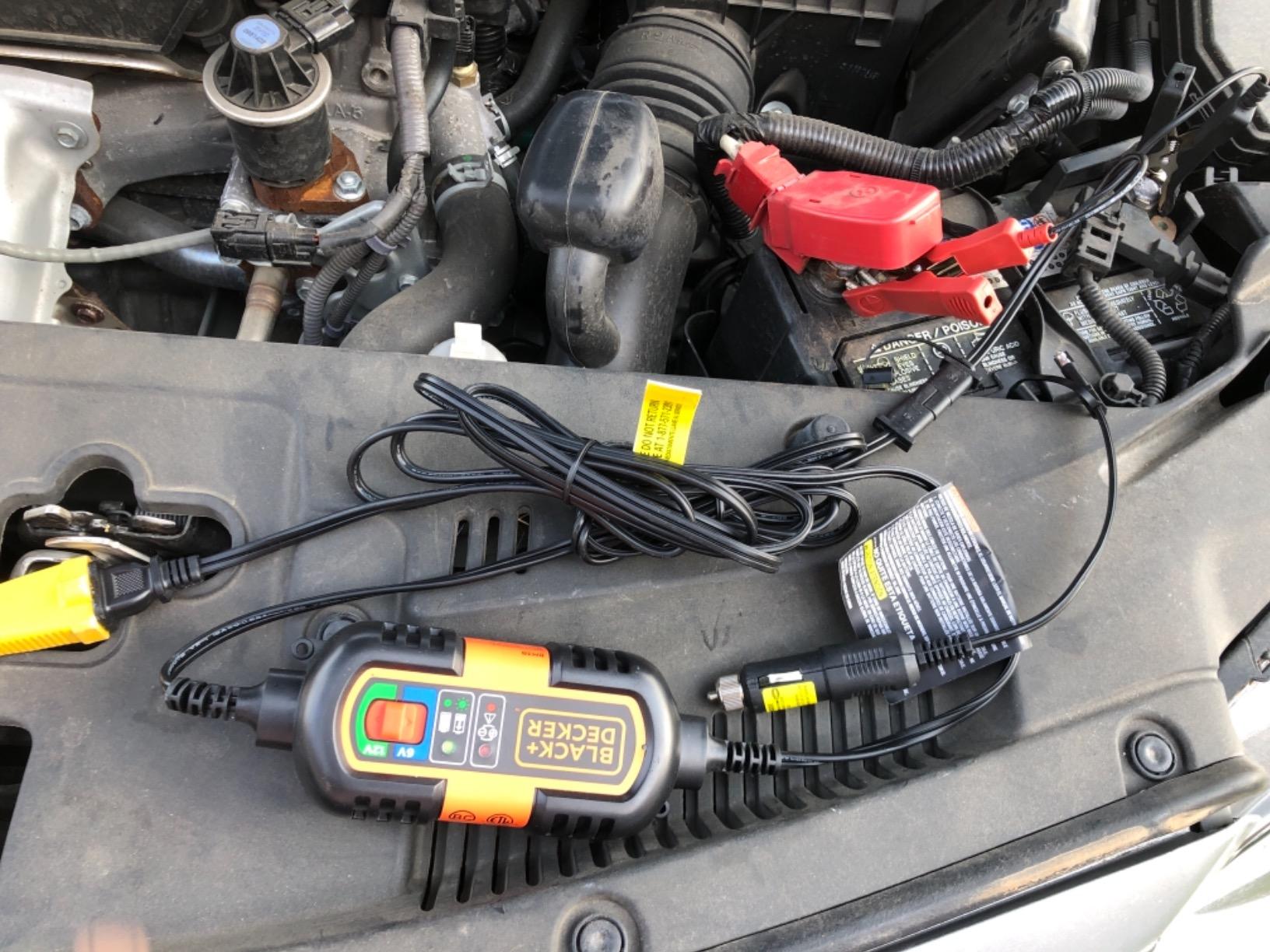
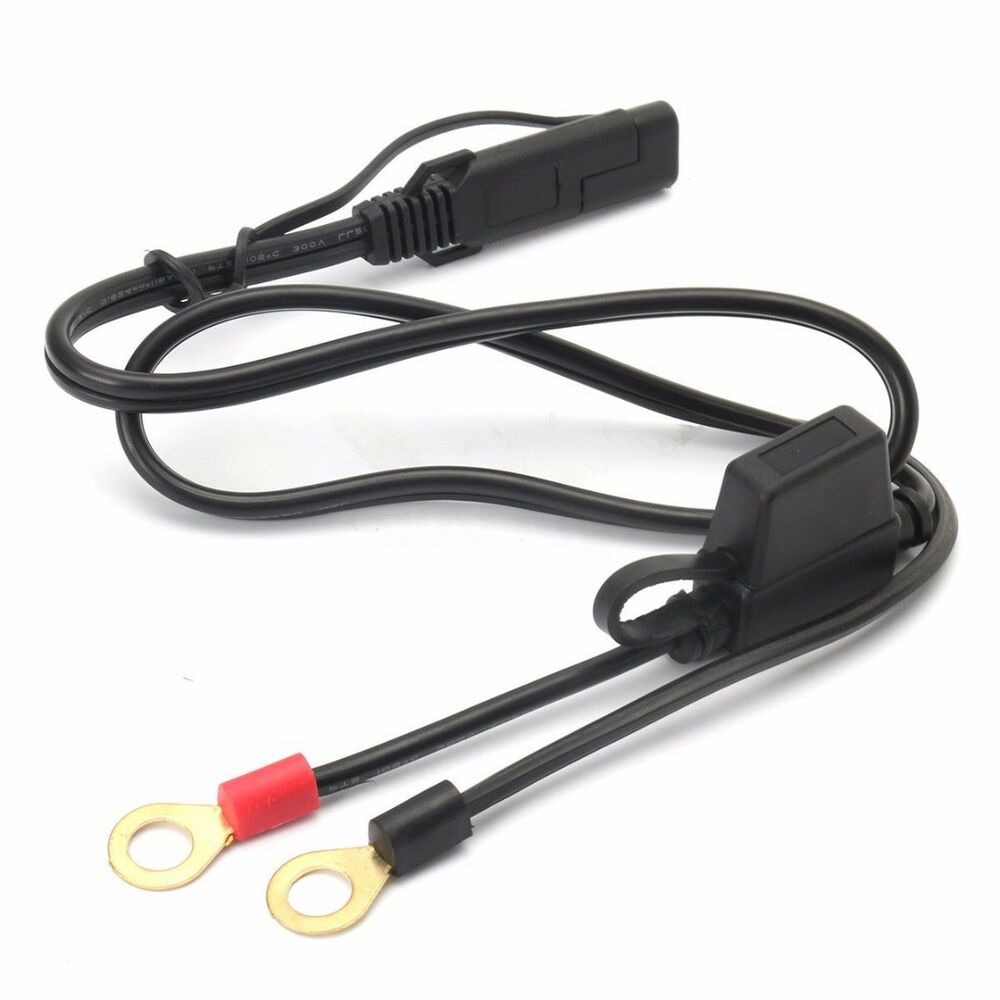
Both battery clips and O-ring terminals are in the box, so the connection can be made permanent for a long storage. That is a small thing on paper that becomes a meaningful thing in month three, when a clip that has crept loose is the reason the battery is flat.
It carries ETL certification and built-in protection against overcharging, reverse polarity and short circuit, which are the three baseline safety features we treat as non-negotiable for anything that will sit attached to a battery for months. The one-year limited warranty is the short end of the range in this lineup.
Is it worth it if you only have one 12V car
Only if you also have something 6V, or you want the wall-mount bracket and the O-ring connection. For a single modern 12V vehicle, the 1.5 amps of extra current versus a 1A maintainer will not change the outcome of a healthy battery sitting through winter, and there are better options with more repair capability at similar output.
What the missing features cost you
There is no active desulfation and no battery repair mode. That matters if your battery has been sitting through more than one season without being maintained, because lead sulfate builds up and a plain charge cycle will not clear it. For a single season on a maintained battery, the charge and float cycle is all you need. For a neglected multi-year battery, you want a unit with a recovery mode.
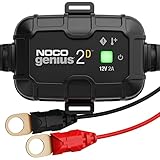
6. NOCO GENIUS2D 2A – Best for Cold Climates and Permanent Mounting
NOCO GENIUS2D 2A 12V Onboard Battery Charger, Trickle Charger & Maintainer
2A output
12V onboard charger
24 inch AC and DC cables
3 year limited warranty
Pros
- Integrated thermal sensor adjusts charging for ambient temperature
- Direct-mount snap-fit bracket for permanent installation
- Charges from as low as 1 volt with Force Mode
- Pulse charging reverses sulfation and stratification
- Can stay connected indefinitely
Cons
- 2A is slow for quickly recovering a depleted battery
- Short 24 inch leads may need an extension
- Indicator light meanings are not documented in the box
This is the pick we made for the coldest scenario in the roundup, and the reason is a single feature that almost nothing else at this size has: an integrated thermal sensor that adjusts the charging profile for ambient temperature. That is exactly the correction a battery sitting in an unheated garage at minus 15 needs, and no competitor roundup we studied gives it an award slot for the same reason.
Because it is designed to be mounted rather than placed, the GENIUS2D solves the problem the portable maintainers cannot. A snap-fit bracket with truss-head self-tapping screws and a velcro strap fix it to the body panel permanently, vibration-resistant, and the eyelet terminals bolt to the battery posts. You are not balancing anything on anything for four months.
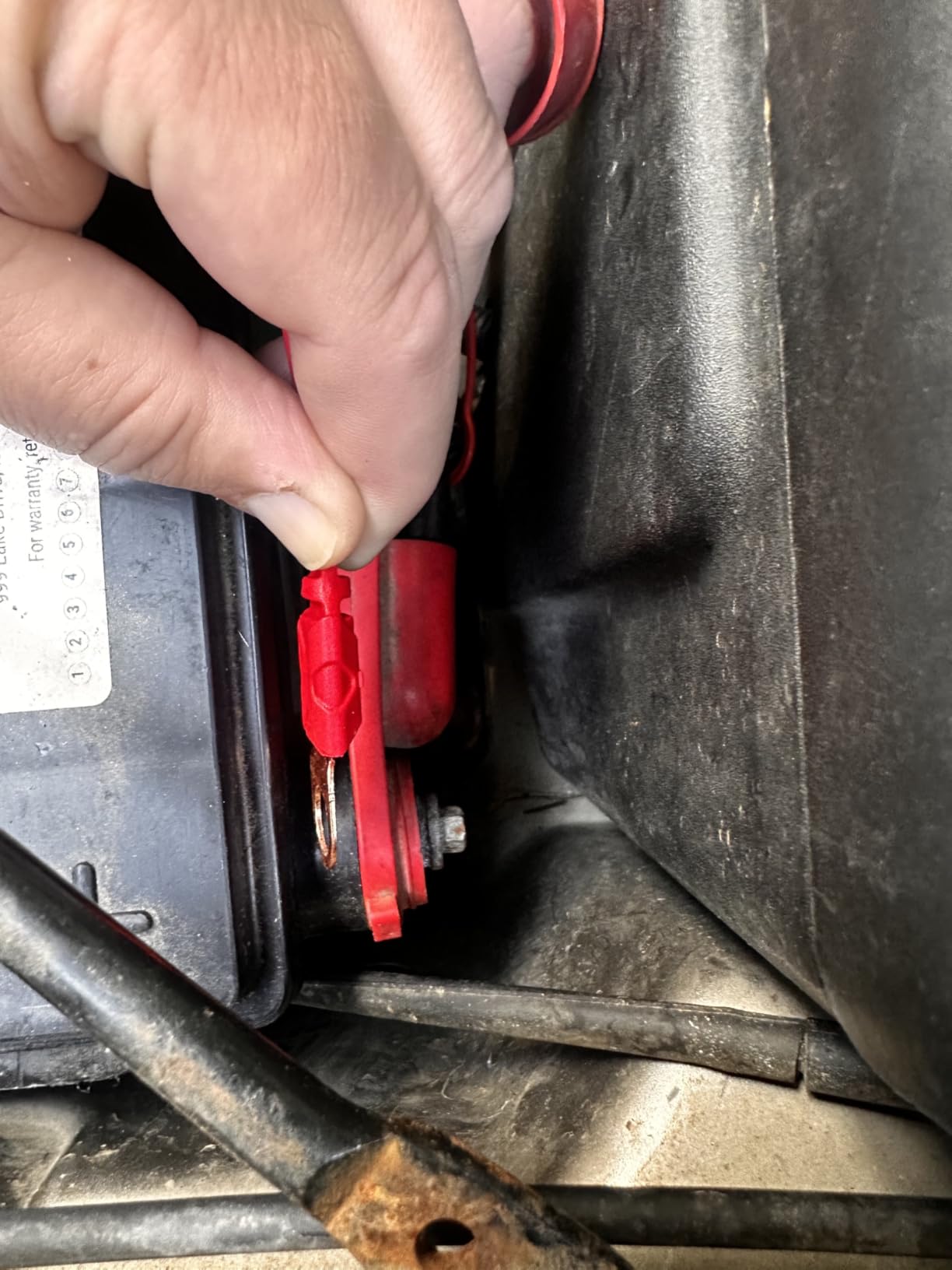
It charges from as low as 1 volt and offers a Force Mode for a fully dead battery, and the precision pulse charging is used to work at sulfation and acid stratification on a battery that has been sitting. Can it be left connected indefinitely? Yes, and that is the design intent, not a stretch of the manual.
Owners consistently praise the permanently mounted, temperature-compensated design for cold-weather storage and the ability to leave it connected year-round. The battery types listed cover AGM, gel, SLA and VRLA flooded, maintenance-free, deep-cycle, marine and RV.
Why the thermal sensor changes the answer in a cold garage
Lead-acid wants a higher finishing voltage in cold conditions and a lower one in heat. A maintainer without that correction will finish a cold battery slightly undercharged every single time, and will overcharge a hot one. On a mild winter the error is invisible. Over three months of hard freezing it accumulates, and the battery you retrieve in spring is the same battery you put away minus more than self-discharge. This is the feature that earns the badge.
The practical trade-offs of a mounted unit
Two of them are real. The 2 amp output will not rescue a badly depleted battery quickly, and the included 24 inch AC and DC cables are short enough that some engine bays need an extension. Also worth knowing: the indicator light meanings are not documented in the box, so read the manual before you install it rather than guessing which light means float.
7. Schumacher SC1280 15A – Best for Battery Recovery
Schumacher Electric 15A Car Battery Charger & Maintainer, 6V/12V – SC1280
15A rapid charge
6V and 12V auto detect
Alligator clips
10 hour charge time
Pros
- 4-in-1 charges maintains tests and restores
- 15A revives deeply discharged standard AGM gel and deep-cycle batteries
- Microprocessor control with automatic voltage detection
- Advanced desulfation mode and multi-stage algorithms
- Schumacher brand with manufacturing heritage since 1947
Cons
- Much larger and heavier than compact maintainers
- 3A trickle maintenance current is low relative to the 15A charge rate
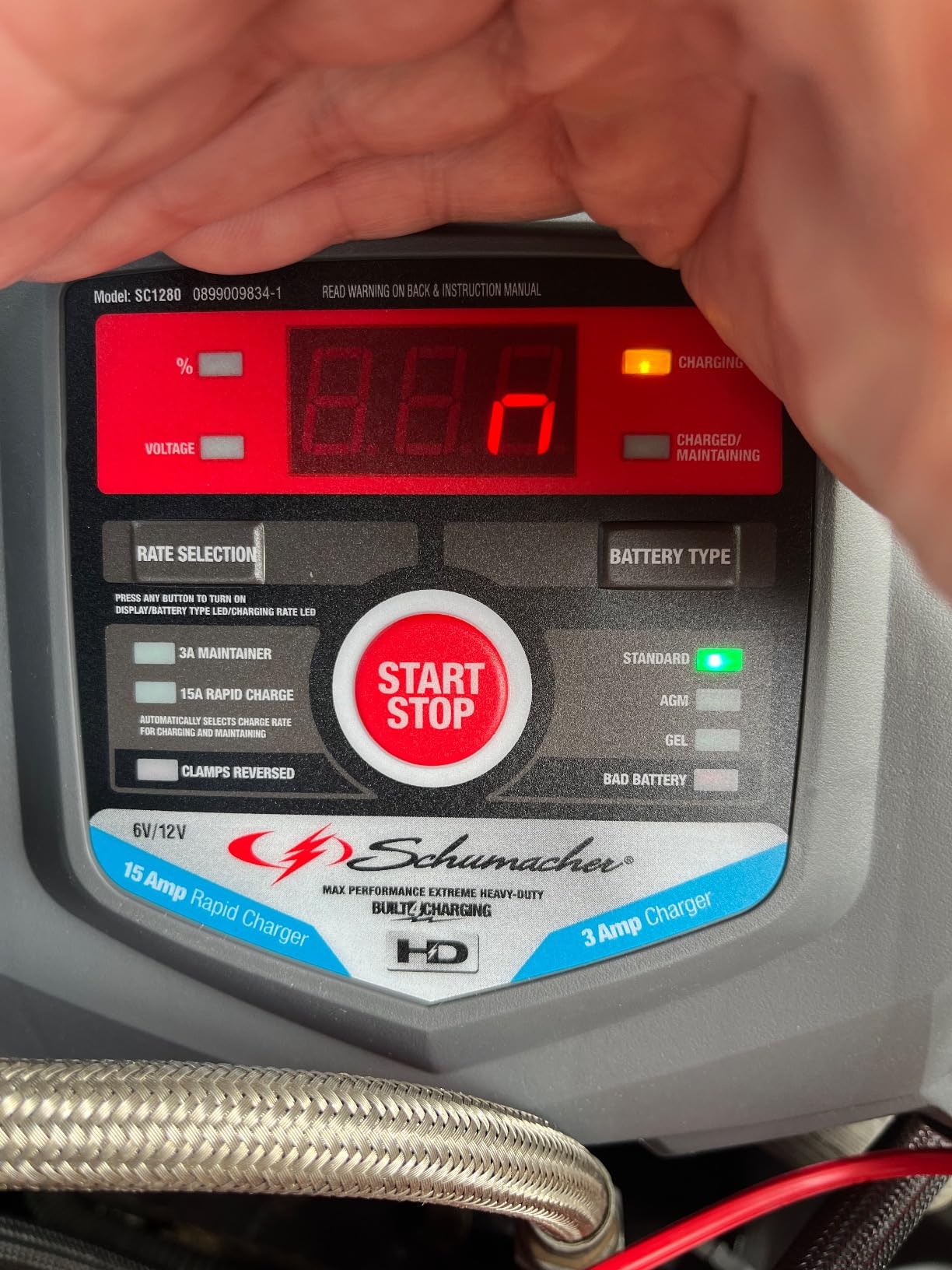
The SC1280 is not primarily a winter maintainer, and we want to be straight about that. It is the unit to reach for when the battery is already dead, deeply sulfated, or has sat through two seasons of neglect. At 15 amps it will bring a genuinely depleted automotive battery back in a matter of hours, which nothing else in this roundup can do.
It is a 4-in-1 design: charge, maintain, test and restore. The microprocessor control detects 6V or 12V automatically, so the classic and modern cars in the same garage are not a settings puzzle. The desulfation mode and multi-stage charging algorithms are the reason it can handle a battery that a 1A maintainer would simply nurse along slowly.
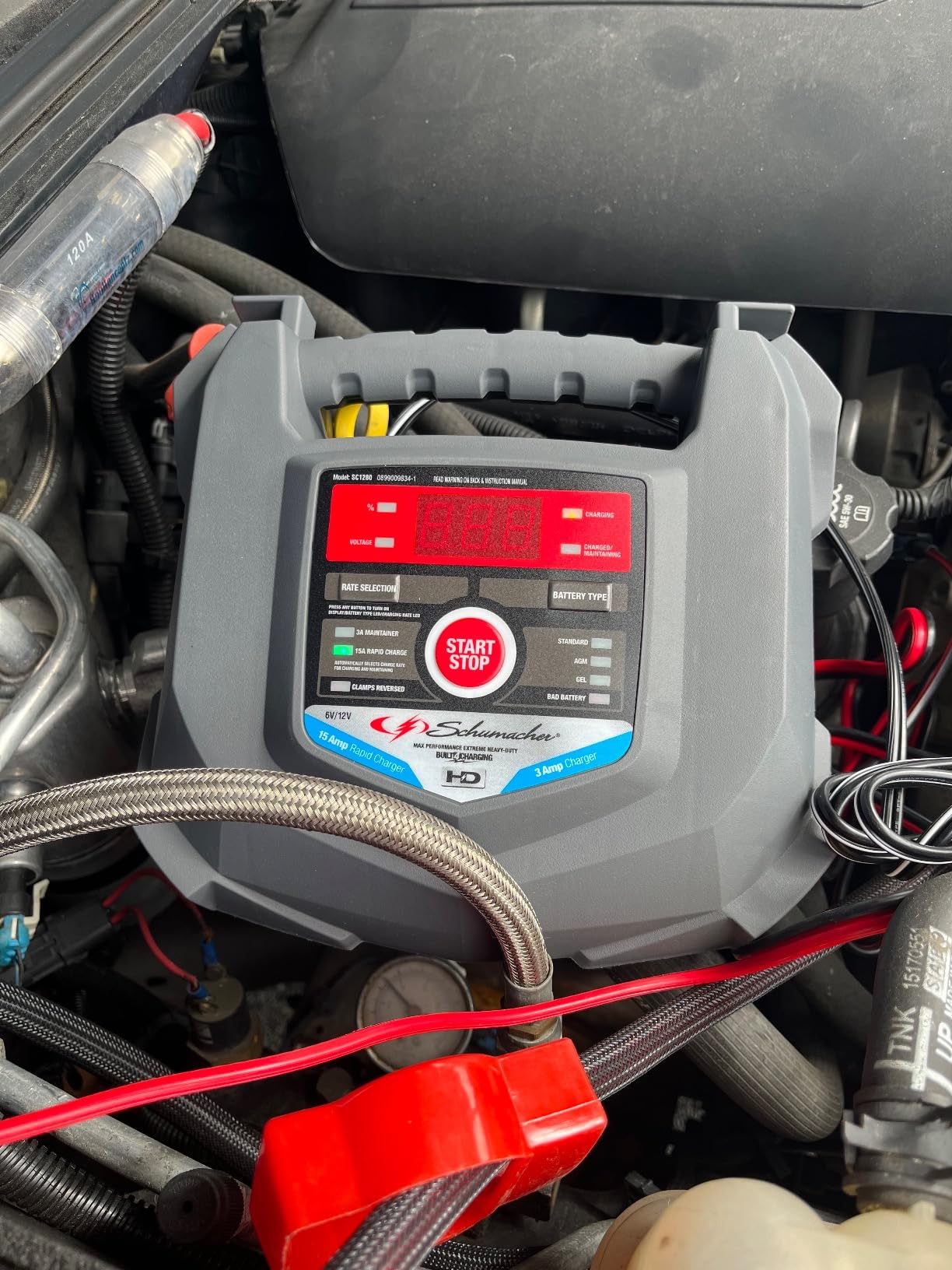
Two useful details. It has a dedicated trickle maintenance stage for when the car is going back into storage, so the same device handles both halves of the season. And the brand carries real manufacturing heritage, which matters on a device whose job is to be trusted while nobody is watching it.
Reviewers highlight the strong recovery capability, the automatic voltage detection and the ability to revive neglected seasonal-vehicle batteries. The consistent criticism is size and weight rather than anything electrical, and that is a fair trade if you have a corner of the garage to put it in.
Should this be your only winter charger
For a normal seasonal layup on a healthy battery, it is overkill and the bulk is a genuine nuisance in a crowded garage. As a companion piece it is excellent: use a small maintainer for the season, and keep this on hand for the spring morning when a battery has been neglected. For a car stored outdoors with no power at all, neither of these is the answer.
Watch the maintenance current, not the headline number
The 15A figure is what people see on the box, but the trickle maintenance stage runs at 3A. That is a perfectly reasonable maintenance current, but it is not a fast one, and it is the number that will govern your experience during months of storage. Judge the storage behaviour on the 3A, and the rescue behaviour on the 15A.
8. TowerTop 2/10/25A Smart Charger – Best With an LCD Display
TowerTop 2/10/25 Amp 12V Smart Car Battery Charger, Fully Automatic Battery Maintainer with Engine Start, Auto Desulfator, Battery Repair, Winter Mode, for AGM, STD, Gel, Deep Cycle Batteries
2A 10A 25A and auto settings
12V output
HD LCD screen
Floor or bench style unit
Pros
- Four selectable current settings up to 25A
- True 8-stage intelligent charging with desulfurization and repair
- HD LCD shows charging stage and parameters in real time
- Winter mode adds 0.2V for cold-weather charging
- 100A engine start assist
Cons
- Requires at least 3 volts in the battery to initiate a charge
- Battery clamp plastic covers clip on weakly
- Display can show a state-of-charge reading without clearly showing charging
The TowerTop is the only unit here with a screen that tells you what is happening, and for a four-month unattended attachment that transparency is worth more than raw amps. The HD LCD displays the charging stage and parameters in real time, so instead of decoding an LED you can look at the charger and see that it is actually in float and holding steady.
Winter mode is the winter-specific feature, and it works by adding 0.2V to the charging voltage for low-temperature conditions. That is a fixed offset rather than a full sensor-driven compensation curve, but it is aimed at exactly the right problem and it is a deliberate setting rather than an accident of design.
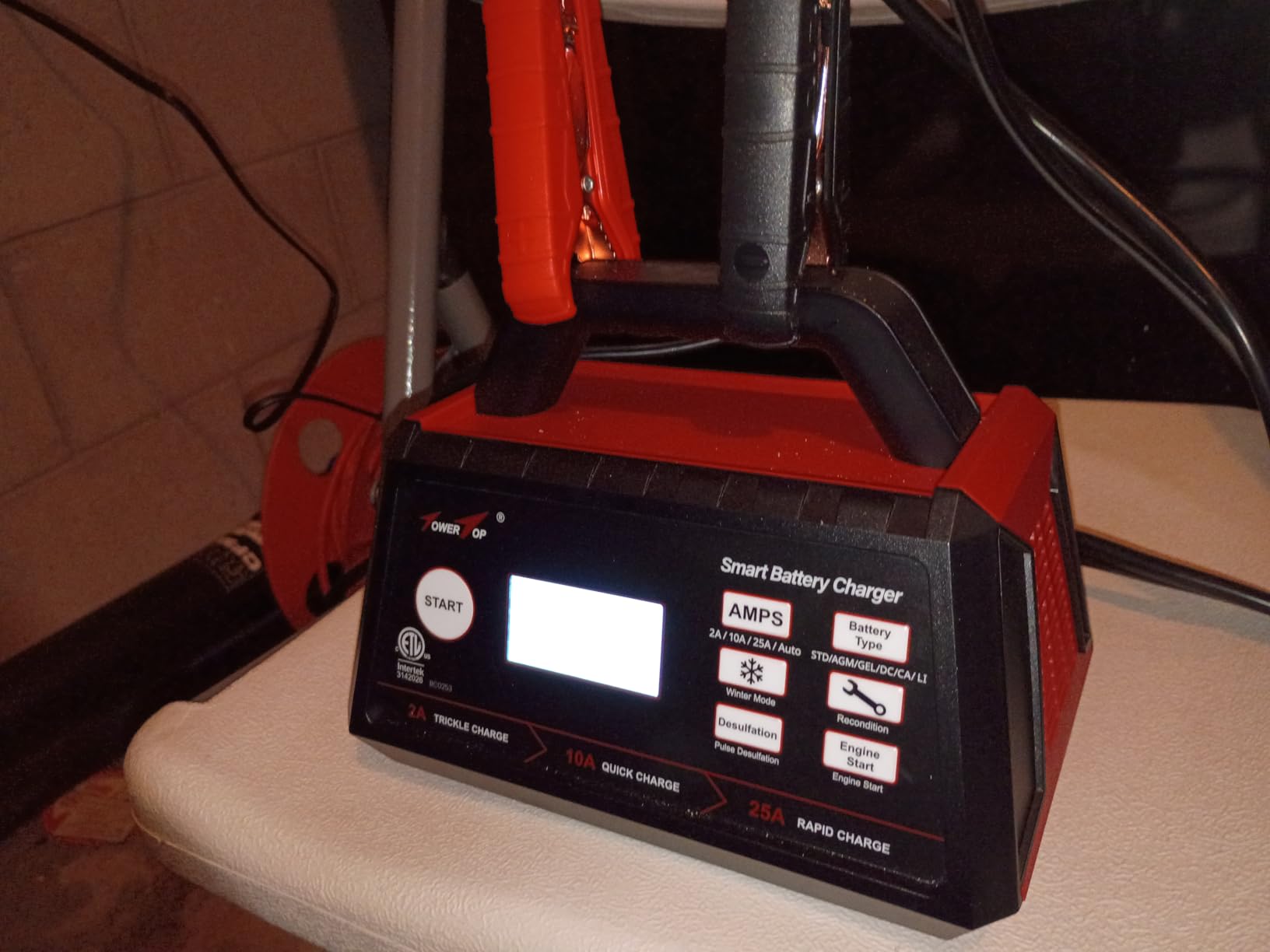
The eight-stage program includes desulfurization, soft start, bulk, absorption, analysis, repair, float and pulse maintenance, with separate manual buttons for desulfate and repair. There is also 100A engine start assist, and a claimed 85 percent charging efficiency against a stated industry average of 75 percent.
One detail deserves attention specifically for this topic: it remembers its settings after a power outage. Forum writers repeatedly flag chargers that revert to defaults following a blip, which over a multi-month unattended connection can leave a battery being treated as the wrong chemistry. Auto-start within 30 seconds and setting memory together make this a good fit for a storage spot with unreliable power.
Is it a good fit for a car that has already gone flat
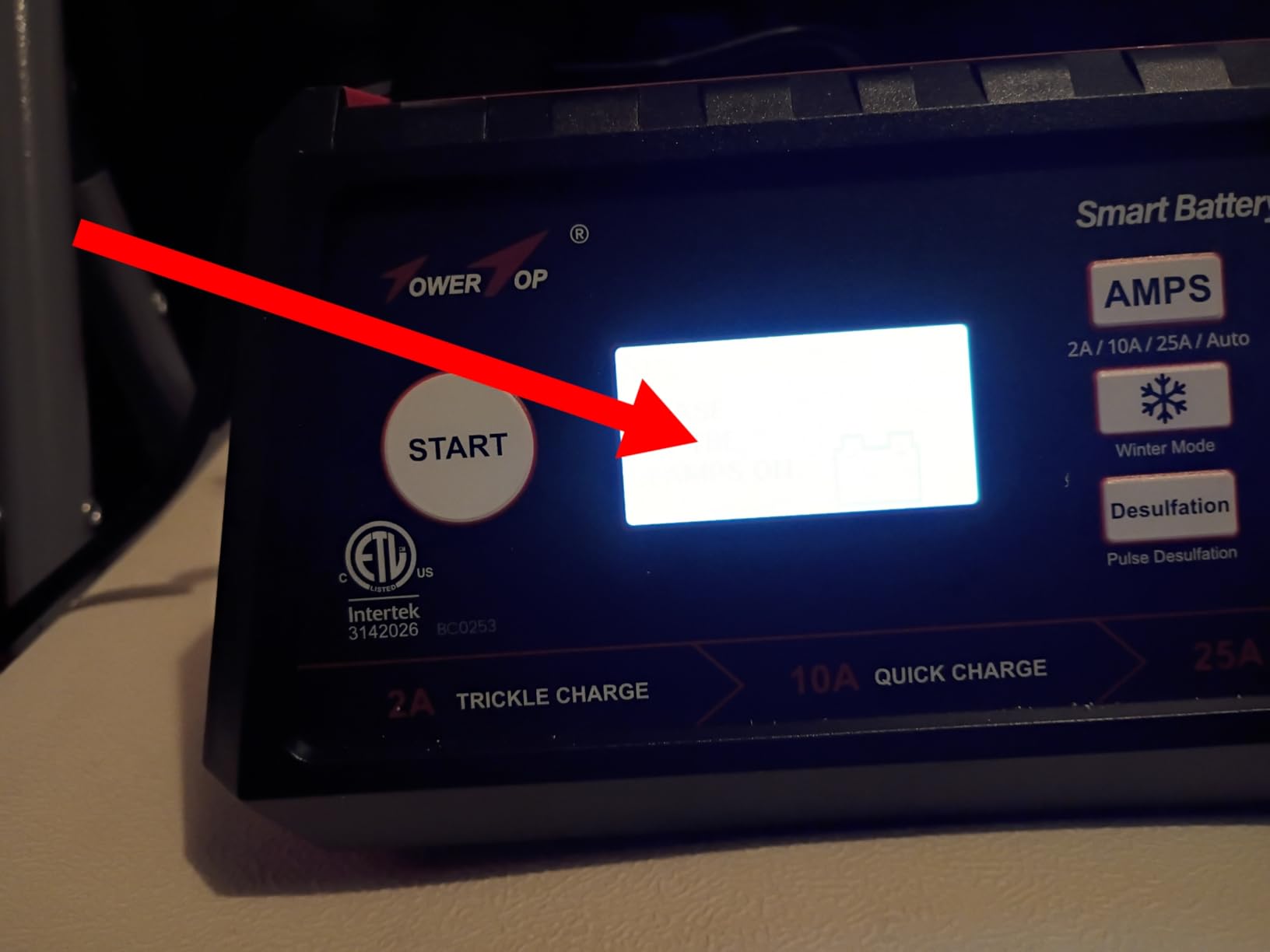
Partly. The 25A setting and the repair mode give it real recovery ability, but the unit will not initiate a charge unless the battery holds at least 3 volts. That is a hard floor and it catches people out: a battery sitting all winter in a cold garage can drop below that, and then the charger simply will not start. Check the resting voltage before you rely on this for a rescue.
The build quality questions to expect
Two recurring complaints worth heeding. The plastic covers on the battery clips clip on weakly and their tabs can break off, so handle the leads rather than the covers. And the display can present a state-of-charge reading without making it obvious that charging is actually underway, which is precisely the ambiguity a display is supposed to remove.
9. Mroinge 1A Smart Maintainer – Best for Tight Engine Bays
Trickle Charger 1A 12V Smart Battery Charger & Maintainer and Automatic Float Charger for Motorcycle, ATV, Lawnmowers and More
1A output
12V DC in and out
12 foot cable
5.6 ounce body
Pros
- Small footprint fits tight engine bays and storage areas
- MCU controlled 4-stage program prevents overcharging
- Spark-proof leads with reverse polarity and over-temperature protection
- 12 foot cable with large clips and O-ring terminals
- Terminal connector caps protect against corrosion
Cons
- 1A is slow for deeply discharged vehicle batteries
- LED color meanings can be confusing without the manual
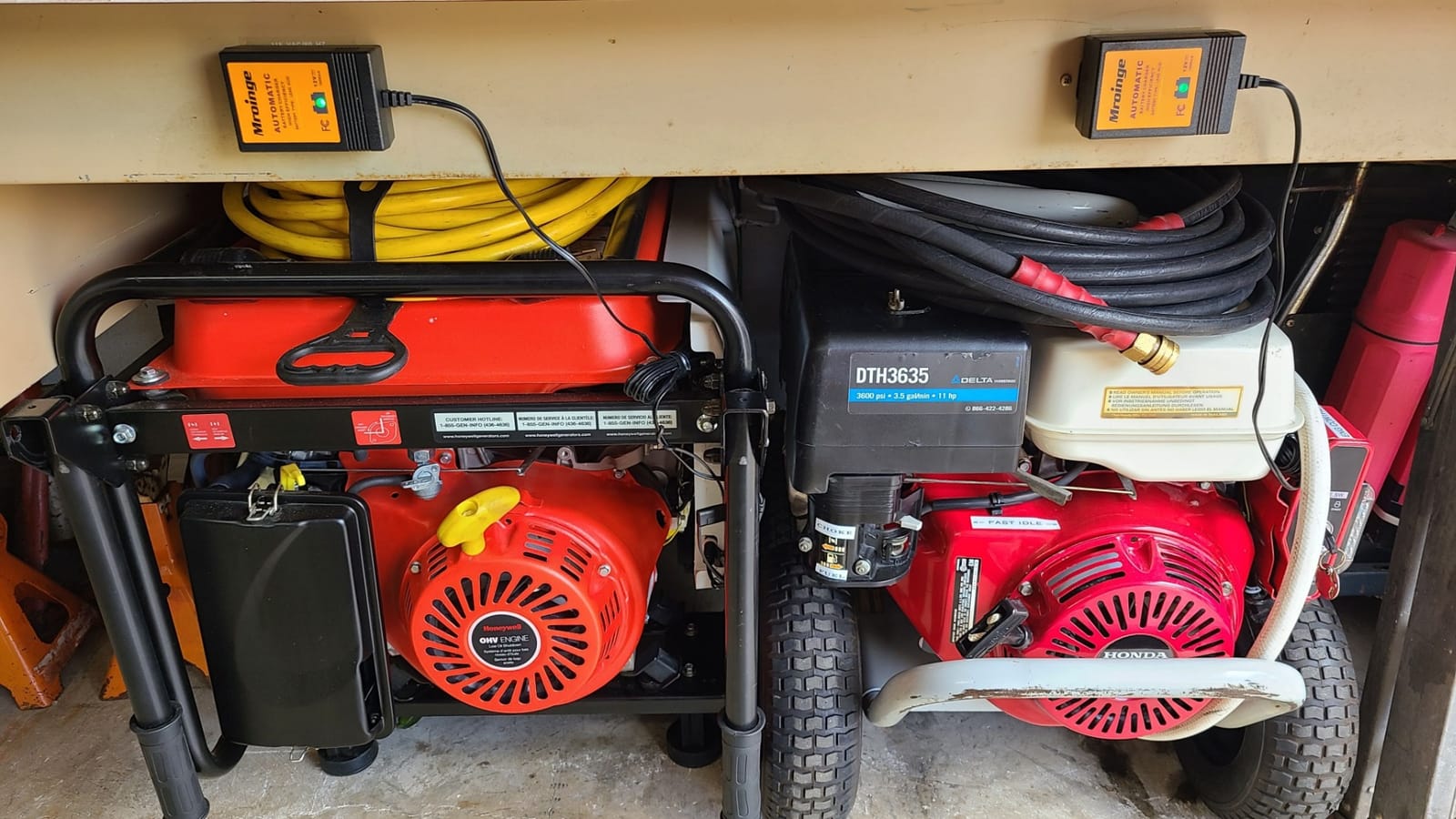
At 5.6 ounces and 2.29 by 3.45 by 1.3 inches, this is the lightest maintainer in the roundup and among the most compact, and that is a functional advantage rather than a novelty. A large engine bay that has been packed with a cover, a compressor and a winter emergency kit does not have room for a brick, and this fits where the others do not.
Underneath the small shell is a four-stage MCU-controlled program running initialization, bulk, absorption and float, with spark-proof leads and protection against reverse polarity, overcharge, short circuit and over-temperature. That is the same safety baseline we require on everything in this guide, in a fraction of the space.
The included terminal connector caps are a small touch that earns its keep. When the charger is disconnected, the caps keep corrosion off the ring terminals, so the next hookup in spring is clean instead of crusty. That matters on a car that sits in a damp garage for months.
Reviewers report successfully reviving stored truck, motorcycle and mower batteries across multi-week and multi-month winter periods, and note that the charger stays cool rather than running hot the way some sealed-case units do. It is UL, CE and FCC listed with a two-year warranty.
Is the 1A output too slow for a car battery
For maintenance, no. It is a genuine trickle-rate maintainer doing exactly the job it exists for, and the ratings reflect a large number of owners using it that way without complaint. For recovery it is simply not in the conversation, and treating a 1A charger as a recovery tool is the most common expectation mismatch in this category.
What to watch on a small unit like this
The indicator lights. Two-color LEDs are simple, but the meaning of each color combination is not always self-evident, and reviewers specifically mention ambiguity. Read the manual once, before you attach it, so that when you walk past in month two you can tell at a glance whether the unit is charging, holding float, or switched off.
10. Schumacher SP1297 3A – Best for LiFePO4 and Lithium Auxiliary Batteries
Schumacher Electric 3A Car Battery Charger & Maintainer, 12V – SP1297
3A output
12V output
120V AC input
Alligator clip and ring lead
Pros
- 3-in-1 charge maintain and recondition
- 3A gives faster recovery than 1A maintainers
- Smart trickle charge maintains safely over long storage
- Compatible with standard AGM gel and LiFePO4 lithium batteries
- Reverse polarity protection with folding hook
Cons
- Must remain plugged into AC power during use
- No display of charging stage or battery voltage
This is the pick if lithium is part of the picture. It is the only unit in the roundup that explicitly lists LiFePO4 compatibility alongside standard, AGM and gel batteries, and that is not a trivial distinction. Lithium chemistry and lead-acid do not share a charging profile, and attaching the wrong charger to a lithium pack risks damage rather than just a slow charge.
It is a 3-in-1 device that charges, maintains and reconditions. Give it more recovery headroom than the 1A and 1.25A portable maintainers here. That is a real advantage on a battery that has been sitting low through a cold month, and it is still low enough current to be a sensible long-term maintainer.
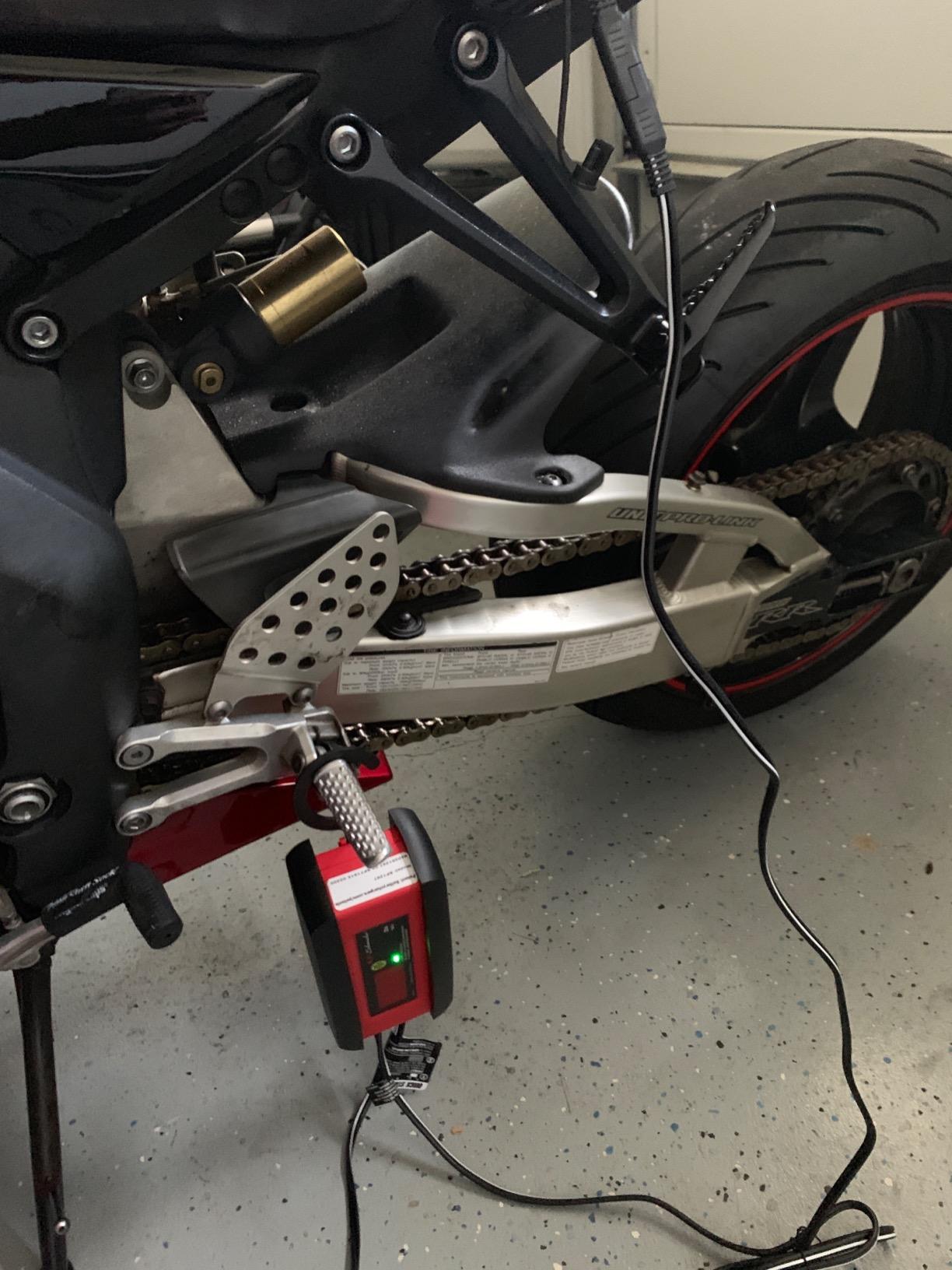
Smart trickle charge handles the storage phase and prevents overcharging during long-term attachment, and an advanced desulfation mode is included to extend battery life. The folding hook lets it hang outside the work area, which is a practical touch when the battery is being worked on indoors in winter.
Owners highlight the balance of a 3A charge and maintain rate with reconditioning capability and broad battery-type compatibility from a recognized brand. The two things reviewers consistently note against it are the need for continuous AC power and the absence of any status display.
Is LiFePO4 support enough to buy it for a lithium setup
It is the strongest compatibility claim in this roundup, but read the fine print with care. Owners on lithium-specific forums report conflicting advice about charging lithium packs below freezing, and many manufacturers specify that their battery must be brought above freezing before charging. If your storage spot regularly goes sub-zero, confirm the charge temperature limits for your specific lithium battery before leaving anything connected.
How it performs as a plain lead-acid maintainer
Very well. The 3A output and desulfation mode make it a stronger all-round storage choice than the sub-1A units, and Schumacher is one of the most-represented names in the shopping data for this category. The lack of any display is a real drawback next to the TowerTop, so verify float status with a meter rather than by looking at the box.
Step-by-Step Winter Storage Protocol: Before, During, and After
None of the ranking roundups we studied give you a storage schedule. A charger solves the problem only if the battery arrives healthy and stays connected. Here is the sequence we use.
The week you put the car away
Start by washing off the battery terminals and checking for corrosion, then measure the resting voltage with a multimeter. A fully charged 12V lead-acid battery rests at about 12.6V, and anything at or above 12.5V is a good place to begin a storage cycle. Top up with water if it is a flooded battery with removable caps, and check the electrolyte level to the fill line.
Next, decide disconnected or maintained. If the car is stored for six weeks or less, a healthy battery will usually hold up on its own with the negative terminal disconnected. Beyond that, or if the car has aftermarket electronics, an alarm, or a computer that stays live, use a maintainer. Forum writers are split on whether disconnecting alone is enough, and the recurring report is parasitic drain from the vehicle computer continuing to flatten the battery even after the terminal is off.
Then clean the battery surface. A damp, dirty battery top holds a conductive film between the posts, and that film is the classic source of parasitic drain on a car that is supposedly asleep. A damp rag and a terminal brush take care of it in five minutes.
During storage: the voltage check that matters
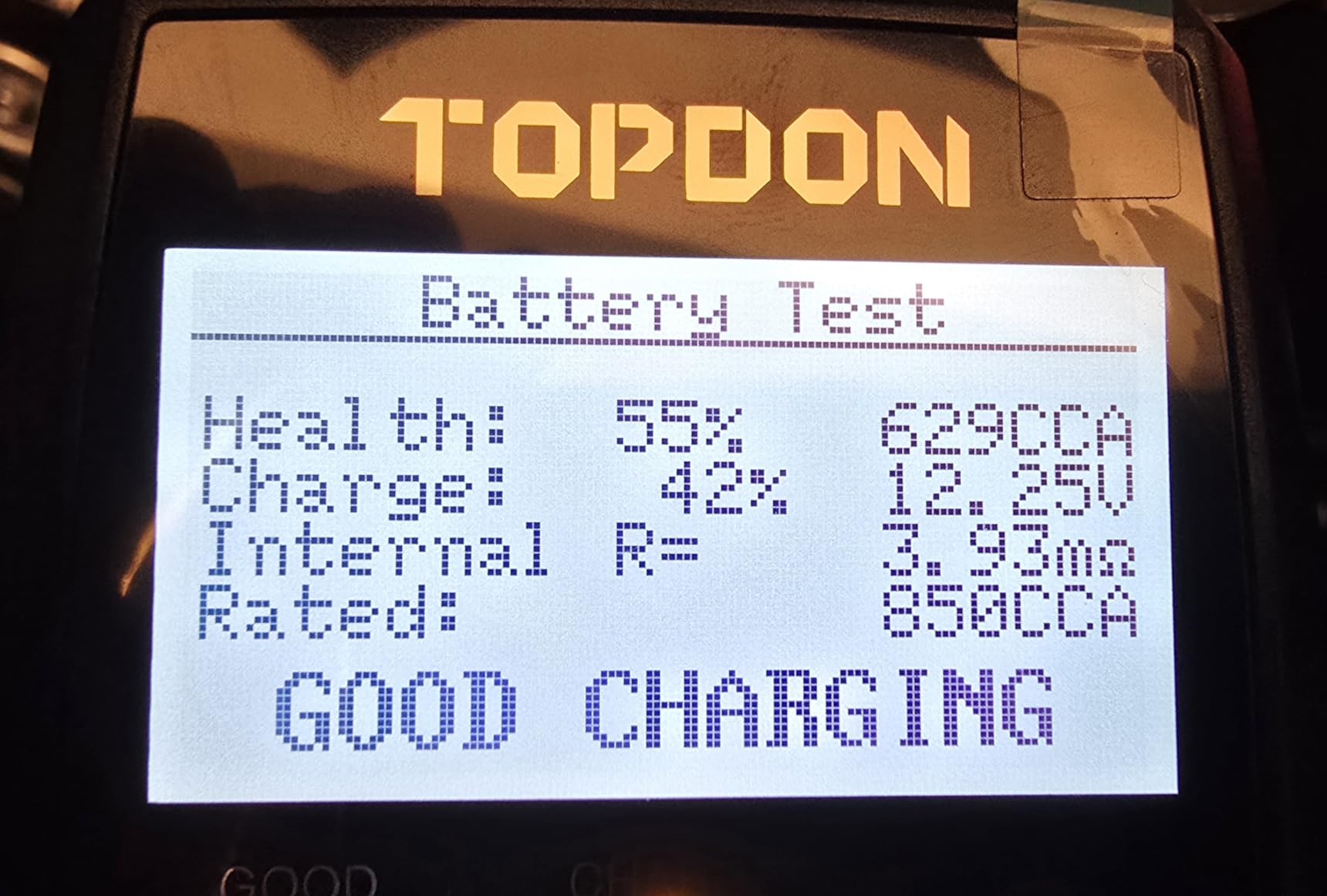
Check the resting voltage once a month. At 12.6V the battery is full, at 12.4V it is around 75 percent, and at 12.0V it is close to discharged. Below roughly 11.8V a lead-acid battery starts to sulfate badly, and below that point some maintainers will not start a charge at all. A 12.5V monthly threshold is the practical line: anything at or below that, connect the charger or take the battery indoors and charge it properly.
Do not measure voltage with the charger running. Turn it off, disconnect, and let the battery settle before you read, otherwise you are measuring the charging voltage rather than the state of charge. On a maintained battery, check the LED indicator at the same time as the meter so you are confirming both that the battery is healthy and that the charger is doing its job.
Where the battery sits matters. Avoid a shed that regularly drops below freezing if you can, avoid storing it inside a hot vehicle, and keep it off a bare concrete floor. A stable, cool, dry location in the range of normal garage temperatures is better than a place that swings from warm to very cold.
The day you take the car out
Disconnect the maintainer first, then turn the key. If the engine cranks slowly, leave the maintainer connected for another day or two rather than fighting it. If it cranks normally, drive for 20 to 30 minutes so the alternator can top up what the battery gave up overnight, and then recheck the resting voltage after the car has been parked for a few hours.
Any battery that will not hold above about 12.4V after a full charge and a proper drive is telling you it is finished, and no maintainer changes that outcome. A maintainer preserves a good battery; it does not resurrect a dead one. For a car that has already been sitting for a season or more without one, our general car battery charger and maintainer roundup covers the higher-current options worth reaching for.
How to Hook Up a Maintainer Safely
Six steps, in this order, and none of them are optional. Put the vehicle in park, apply the parking brake, switch the ignition off, and make sure nobody is in the car with the key. A charger that is live while the engine cranks will destroy itself and possibly the alternator.
Attach the positive clamp first, to the positive battery post. Then attach the negative clamp to the negative post. This ordering matters because if the loose clip touches bare metal while you are still working, the current path is limited and the spark is small. Do the reverse and the same mistake can arc across the whole bay.
Never clip the negative lead to sheet metal or a bracket. The battery posts are the only correct connection point. Sheet metal can be a ground point on some vehicles and not on others, and a connection that is a ground on one car and an open circuit on the next is not a connection you want to leave unattended for four months.
Verify the settings before you power the unit, not after. Confirm the charger is set for the right chemistry and the right voltage, and if it has a force charge or force mode option, leave that off unless you have a battery that is genuinely below its normal start threshold. Turn the charger on last.
Work in a ventilated space. Lead-acid batteries off-gas hydrogen and oxygen during charging, and a sealed garage with a gas water heater or furnace in it is the wrong room for a months-long attachment. Confirm the charger reaches float before you close the door: a solid or steady indicator, or a reading around 13.2 to 13.8V at the battery.
How to Choose a Winter Storage Battery Charger
The category has four genuinely different types, and confusing them is how people buy the wrong device. Trickle chargers, smart chargers, full-size automotive chargers and solar maintainers are not interchangeable, and the right pick depends almost entirely on where the car is parked.
Trickle charger, smart charger, or full automotive charger
A trickle charger pushes a small fixed current and expects you to switch it off when the battery is full. That assumption is the problem, because nobody remembers. Smart chargers run a multi-stage program and drop into float automatically, which is what makes indefinite connection safe. Full automotive chargers deliver tens of amps and are built to recover a dead battery quickly, and they are not intended to sit connected for months. Solar maintainers have no plug at all and matter only when there is no power where the car is parked.
For anything longer than a few weeks, the honest answer is that a smart charger with real float mode is the only category worth buying. If your car lives in a garage with an outlet, that is the whole decision. If it does not, a plug-in charger is not an option and you need to solve the power problem instead, which usually means either running an extension to a nearby outlet or accepting that the battery needs to come indoors.
Amp rating and why slow is right for storage
Here is the counterintuitive part: for storage, a smaller number is the better number. The job is replacing self-discharge, which is measured in fractions of an amp. Charging at 1A to 2A is more than sufficient to keep a battery topped up, and it generates far less heat and far less outgassing than a 25A charger doing the same task.
Amps matter when you are recovering rather than maintaining. A typical car battery holds several hundred amp-hours of energy, and adding charge to a fully depleted one at a 1A rate is a multi-month proposition. At 3A it is a matter of days. At 15A it is hours. Reserve the high-current charger for the rescue, and let the low-current maintainer handle the months.
Temperature compensation and cold-weather charging
Charge voltage has to move with temperature, and this is the factor most guides in this category bury. Cold lead-acid needs a higher finishing voltage to reach full, and hot lead-acid needs a lower one to avoid boiling off electrolyte. A charger with no compensation will quietly undercharge a cold battery on every single pass, all season long.
Look for either a dedicated thermal sensor or an explicit winter or cold-weather mode. The GENIUS2D has a sensor that adjusts continuously, and the TowerTop has a winter mode that adds a fixed offset. A charger that mentions neither is not wrong for mild climates, but it is the wrong device for a hard winter in an unheated garage. On cold-soaked batteries specifically, warm the battery above about 40F before you test or trust a reading from it.
Battery chemistry compatibility
Flooded, AGM and gel lead-acid all charge on broadly similar profiles, with AGM needing a slightly different absorption stage. Lithium is the exception. LiFePO4 uses a different chemistry entirely, and a surprising number of maintainers in this category do not support it at all. If any battery in your garage is lithium, check that the charger names it explicitly.
Pay attention to the 6V question too. If the garage holds a classic or an older truck, a 6V/12V unit like the BLACK+DECKER BM3B or the Schumacher SC1280 saves you from owning two chargers. One lithium caveat worth repeating: many lithium batteries should not be charged below freezing at all, so confirm the charge temperature limits before you attach anything to one in a sub-zero storage spot.
Float mode, overcharge, and reverse polarity protection
Float mode is the deciding feature for this article, and it is cited in forum discussion more often than brand or price. It means the charger holds roughly 13.2 to 13.8V and stops pushing current once the battery is full, replacing only what is lost. Without it you have a device that will cook a battery given enough months.
Overcharge protection is the safety net behind float, and reverse polarity protection is the feature that stops a bad connection from being expensive. Spark-proof clamps are treated as a baseline requirement in the same discussions. We treated all three as mandatory for every pick in this roundup, and any charger that lacks them was not going to make the list regardless of how good the reviews looked.
Wired-in, portable, and the no-power-outlet problem
A wired-in unit bolts to the body panel and connects with eyelet terminals, so the connection survives vibration and nobody has to balance a clamp. For a car that stays parked in a cold garage, that reliability is the main argument. The trade is installation effort and the fact that you are modifying the car rather than just adding a box to it.
The most common blocker, by a wide margin, is that unheated garages and outdoor storage units have no power outlet at all. A plug-in maintainer is simply impossible there, and this is the single most frequently raised problem in winter storage discussions. The options are a solar maintainer, running an extension cord to a nearby outlet, or bringing the battery indoors. For cars and trucks that never see a starter again, our home battery charger guide covers the units suited to a battery on a shelf in a garage.
One final warning that comes straight from owner reports: make sure your charger retains its settings through a power outage. A charger that reverts to defaults after a blip can wake up treating a gel battery as a flooded one, or drop out of float entirely, and over a multi-month unattended connection in an area with flaky power that failure mode is not worth accepting.
Frequently Asked Questions
Is it okay to leave a battery maintainer on all the time?
Yes. A maintainer with a true float stage is specifically designed to stay connected indefinitely. Once the battery reaches full charge it drops to a maintenance voltage that replaces only what self-discharge and parasitic drain remove, so there is no overcharge risk over weeks or months. The one requirement is that the unit genuinely has a float mode with overcharge protection, which every product in this roundup has.
What is better, a battery maintainer or a trickle charger?
A battery maintainer. A trickle charger pushes a fixed small current and assumes you will switch it off when the battery is full, which is exactly what people forget over a four-month storage. A maintainer runs a multi-stage program, monitors the battery, and drops into float automatically, so it is safe to leave attached. The terms are often used interchangeably in retail listings, so check for automatic float switch-over rather than trusting the label.
How long can a car battery sit without being used?
A healthy 12V lead-acid battery with the negative terminal disconnected will typically hold a usable charge for a few months, and the practical limit most people hit is somewhere around three to four months in cold weather. Cold accelerates self-discharge and reduces the charge the battery can deliver, so an unheated garage is the worst case. Beyond that window, a maintainer connected for the storage period is the reliable answer.
What cold temperature kills a car battery?
Cold does not kill a battery outright, it weakens it. Capacity falls steadily as temperature drops, so a battery that barely starts a warm engine in October may not turn over at all at minus 20F. The damage comes from freezing while partially discharged, which causes the electrolyte to expand and crack the plates or the case, and from the increased sulfation that comes from leaving a battery cold and partly charged. A maintainer that keeps it full, ideally with temperature compensation, avoids both.
How long can you leave a trickle charger on a car battery?
For a few hours to a day while you top a battery up, yes. For months, only if the charger has an automatic float or maintenance stage that reduces output once the battery is full. A fixed-current trickle charger connected indefinitely will overcharge, boil off electrolyte, and shorten the life of the battery. If you want something you can attach before winter and forget about until spring, buy a smart maintainer rather than a plain trickle charger.
How do I preserve my car battery when I am not using it?
Clean the terminals and the top of the battery, check the resting voltage, and top up the electrolyte on a flooded battery. Then either disconnect the negative terminal for short storage or connect a smart maintainer for anything longer than a few weeks. Store the battery or car somewhere cool, dry and reasonably stable in temperature rather than somewhere that swings from freezing to warm. Check the resting voltage monthly and treat 12.5V as the point at which you should connect a charger.
Do I need a trickle charger or can I just disconnect the battery?
For a few weeks, disconnecting the negative terminal is enough and is the simplest correct answer. Beyond about six weeks, or if the vehicle has an alarm, aftermarket electronics or a computer that stays powered, a maintainer is the better choice. Owners report repeatedly that parasitic drain from the vehicle computer can flatten a battery even with the terminal disconnected, so the disconnect is not a guarantee. Neither option helps if the storage location has no power, which is the real blocker in most unheated garages.
What is the most reliable car battery charger?
Reliability for winter storage comes down to float mode quality, thermal compensation, spark-proof and reverse polarity protection, and a warranty long enough to signal the maker stands behind it. The Battery Tender Junior and Plus, the NOCO GENIUS2D and the Schumacher units all meet that bar. The Battery Tender Junior stands out on the combination of rating and review volume, with 4.8 stars across more than 49,000 reviews.
The Best Car Battery Chargers for Winter Storage in 2026
After putting ten of these through a winter storage lens, the Battery Tender Junior 12V 750mA is our pick as the best car battery charger for winter storage. It has the highest rating and the largest review base among the ten products here, a genuine four-step program that ends in float, spark-proof hook-up detection, and a fused ring terminal lead set so nothing is balanced precariously for four months. For a normal seasonal layup on a healthy battery, nothing else in this roundup does that job more cheaply or with more evidence behind it.
Pick by scenario rather than by rank. For a hard winter in an unheated garage, choose the NOCO GENIUS2D, because its integrated thermal sensor is the most directly relevant feature in this roundup for that scenario. For a battery that is already flat or has sat through multiple seasons, choose the Schumacher SC1280 for the 15A recovery and desulfation, or the TowerTop if you want the readout to confirm what the charger is doing. For six months or more of storage, move up to the Battery Tender Plus for the extra current and the 10-year warranty. For a tight engine bay, the Mroinge at 5.6 ounces fits where nothing else will. For a lithium pack in the same garage, the Schumacher SP1297 is the only unit here that names LiFePO4 explicitly.
Whichever one you choose, the protocol matters as much as the device. Clean the terminals, confirm the battery rests at or above 12.5V before you store it, connect the charger, and verify float before you close the garage door. Check the resting voltage once a month, and treat 12.5V as the line that means connect a charger. Do that consistently and the battery you pull out of storage in spring is the same battery you put in, and the jump start never happens.